

Note: This article contains affiliate links. If you click on these links and make a purchase, I may earn a small commission at no extra cost to you. This helps support my research and content. Read my full affiliate disclosure here.
Keeping St. Augustine grass thick and healthy depends on timely, turf-safe weed control. The wrong product or timing can scorch the lawn, leave bare patches, or fail to eliminate persistent invaders. This guide covers seven top picks chosen for performance on St. Augustine turf and for common homeowner needs such as broadleaf control, selective grassy-weed treatment, and safety for nearby beds. You will find shortlisted options that suit small lawns, larger yard patches, and spot treatments. We evaluated each pick on turf safety, weed-spectrum effectiveness, and ease of use to help you match a product to how you manage your lawn.
Top Picks at a Glance
| Best Overall The best all-around choice for most situations | Celsius WG Herbicide Easy Mix Packet (0.226 oz) |  |
| Best Quality Built to a higher standard if you want something more solid | Bug And Blade Celsius WG Granule Two-Pack Weed Control |  |
| Best Value The sweet spot between price and what you get | Spectracide Large Plot Weed Stop for Lawns Concentrate, 1 Gallon |  |
| Best Budget The cheapest option that still gets the job done reliably | Hi-Yield Atrazine Selective Weed Killer, 32 oz |  |
| Highest Rated A top-rated pick with lots of positive feedback | Syngenta Recognition Herbicide 0.45 oz Water-Dispersible Granules |  |
| Most Popular A crowd favorite that many people choose with confidence | Southern Ag Atrazine St. Augustine Weed Killer, 32 oz |  |
| Best Seller A high-volume bestseller chosen again and again | Southern Ag Amine 2,4-D Weed Killer, 32 oz |  |
Celsius WG Herbicide Easy Mix Packet (0.226 oz)

| Item Form | Granule |
|---|---|
| Coverage | 0.23 Fl Oz |
| Liquid Volume | 0.23 fluid ounces |
| Active Ingredients | Dicamba 57.4%, Iodosulfuron-methyl-sodium 1.9%, Thiencarbazone-methyl 8.7% |
Celsius WG comes as a single easy-mix packet of wettable granules meant to be diluted with water and applied with a sprayer to actively growing weeds in warm-season lawns. It contains three active ingredients that target more than 120 annual and perennial broadleaf weeds and some grasses, and is labeled for use on St. Augustinegrass, Bermudagrass, Centipedegrass, and Zoysiagrass. The packet format simplifies measuring and mixing for small jobs or spot treatments and the product works fastest when temperatures are above 60°F; treated weeds typically show symptoms within days and die in one to four weeks. Important practical points are that you must follow safety directions when mixing and applying, avoid contact with desirable plants, and expect best results on actively growing, not stressed, weeds. The product is intended for use with a sprayer and on turf sites such as lawns, golf courses, and sports fields, so it is most convenient for homeowners and groundskeepers who want a professional-strength spot or small-area treatment without buying large containers.
Best for: Homeowners or turf managers with St. Augustine or other warm-season lawns who want a concentrated, professional-strength spot treatment that is quick to mix and effective against many broadleaf weeds.
Less Ideal for: People needing to treat large areas frequently who prefer ready-to-use bottles or broadcast products, or those who want an all-season preventative rather than a postemergent solution.
- Easy-mix single packet removes measuring and simplifies small-area mixing
- Broad spectrum control labeled for over 120 broadleaf weeds and some grasses
- Formulation approved for common warm-season turfs including St. Augustinegrass
- Works relatively quickly with visible weed decline within days under warm conditions
- Small packet size is meant for spot or limited-area use rather than large lawns
- Requires careful handling and spraying equipment to avoid off-target damage
Verdict: A compact, easy-mix postemergent packet that gives homeowners professional-strength control of broadleaf weeds on St. Augustine and other warm-season grasses.
Bug And Blade Celsius WG Granule Two-Pack Weed Control

| Item Form | Granule |
|---|---|
| Covers | Up to 4,000 sq ft per two-pack |
| Target Turf | Warm-season grasses (St. Augustine, Bermuda, Centipede, Zoysia) |
Celsius WG is a granular, two-application weed control system designed specifically for warm-season turf such as St. Augustine, bermuda, centipede, and zoysia. Each order supplies two packets intended for a spring application and a season-ending late summer or fall follow-up, together covering up to 4,000 sq ft. The formula combines three active modes of action to tackle over 120 broadleaf and grassy weeds, which helps reduce the chance of resistance and speeds visible decline within 1 to 4 weeks. Practical benefits include clear timing guidance, laminated weed ID cards to confirm target species, and a dry surface that is safe for pets and family after the granules have settled. Limitations to plan for are that it is formulated only for warm-season turf so it must not be used on cool-season lawns, and stubborn perennials may require the recommended repeat application; weather and correct application rate affect speed and completeness of control. For a homeowner wanting a performance-focused, season-long program for St. Augustine grass, this supplies a convenient two-step regimen.
Best for: Homeowners with St. Augustine or other warm-season turf who prioritize a results-driven, season-long weed control plan and want a straightforward two-application program.
Less Ideal for: Owners of cool-season lawns such as tall fescue or Kentucky bluegrass or gardeners who need an all-season, multi-turf solution across different grass types.
- Two pre-measured packets provide a planned spring and fall treatment cycle for up to 4,000 sq ft
- Triple-mode-of-action formula reduces likelihood of resistant weeds and treats both grassy and broadleaf species
- Laminated weed ID cards help you identify common warm-season lawn weeds before treatment
- Safe for family and pets after the treated area is dry when label directions are followed
- Intended only for warm-season grasses and must not be used on cool-season lawns
- Some stubborn perennial weeds may need a second application or extra time for full control
Verdict: A performance-focused two-packet granular program engineered to deliver season-long, effective weed control for St. Augustine and other warm-season lawns.
Spectracide Large Plot Weed Stop for Lawns Concentrate, 1 Gallon

| Unit Count | 128 Fluid Ounces |
|---|---|
| Item Form | Liquid |
| Coverage | 32000 square feet |
Spectracide Large Plot Weed Stop is a one-gallon concentrate formulated to kill over 200 listed broadleaf weeds down to the root while leaving established turf intact when applied correctly. You mix the concentrate with water and apply it with a tank or hose-end sprayer to lawns; the label recommends treating when daytime temperatures are between 60 and 85 degrees F and avoiding application above 85 degrees. It is rainproof within hours and is intended for both northern and southern grasses, with coverage claims up to tens of thousands of square feet depending on grass type. Practical benefits include fast visible results, broad weed control across common targets like dandelion and clover, and a concentrate format that reduces the number of refill bottles for large properties. Limitations to consider are the need for careful mixing and nozzle selection, temperature restrictions that limit when you can apply, and standard safety precautions for concentrated herbicides such as keeping people and pets off treated areas until dry.
Best for: Homeowners who want a practical, cost-effective way to treat large lawns for broadleaf weeds and prioritize coverage efficiency and visible results without replacing turf.
Less Ideal for: People with small lawns who prefer ready-to-use bottles or anyone unwilling to follow label mixing and temperature rules should consider simpler, lower-volume options.
- Concentrated formula treats large areas from a single bottle reducing trips to refill
- Kills over 200 listed broadleaf weeds and targets roots for longer control
- Rainproof in hours so treatments are less likely to wash off after light rain
- Suitable for many southern grasses including Bermuda, Zoysia and St. Augustine when used as directed
- Must not be applied when air temperatures exceed 85 degrees F which restricts use in hot climates
- Requires correct mixing and sprayer setup to avoid overapplication or turf damage
Verdict: Choose this concentrate if you need a single, economical product to treat large St. Augustine lawns for broadleaf weeds while preserving desirable turf when applied per label instructions.
Hi-Yield Atrazine Selective Weed Killer, 32 oz

| Unit Count | 32 Ounce |
|---|---|
| Item Form | Liquid |
| Active Ingredients | atrazine |
| Coverage | Full |
Hi-Yield Atrazine is a 32 oz liquid concentrate designed for Southern lawn grasses, primarily St. Augustine and centipedegrass. It is mixed with water and applied with a sprayer or watering can to target common broadleaf and grassy weeds such as henbit, clover, and chickweed. The label states one bottle can treat up to about 3,720 sq ft when diluted as directed, which makes it a cost-effective choice for larger yards. Practical benefits include season-round use in dormant or growing seasons and straightforward application steps like shaking, diluting, and avoiding mowing around treatment. Important limitations are that it is grass-specific and labeled for a limited set of turf types so using it on other grasses or ornamental beds risks damage, and it contains atrazine so users should follow safety precautions to protect children, pets, and nearby plants. Buyers should also be prepared to mix accurately and use appropriate protective gear when handling the concentrated liquid.
Best for: Budget-minded homeowners with St. Augustine or centipede lawns who want an affordable concentrate that covers several thousand square feet and is applied with a simple sprayer.
Less Ideal for: Gardeners with different turf types, mixed ornamental beds, or those who prefer non-chemical or organic weed control methods should look elsewhere.
- Selective formula labeled for St. Augustine and centipedegrass controls a range of common lawn weeds
- 32 oz concentrate treats up to roughly 3,720 sq ft when mixed per label, stretching value for larger lawns
- Can be applied during dormant or growing seasons for flexible timing
- Simple application instructions compatible with a basic pump sprayer or watering can
- Contains atrazine which requires careful handling and adherence to safety directions
- Not recommended for many other grass types or use near sensitive ornamentals
Verdict: A cost-effective liquid concentrate for Southern lawns that gives broadleaf and grass weed control on St. Augustine and centipedegrass while covering several thousand square feet per bottle.
Syngenta Recognition Herbicide 0.45 oz Water-Dispersible Granules

| Item Form | Granule |
|---|---|
| Coverage | Selective weed coverage (sedges, grasses, broadleaf weeds) |
| Liquid Volume | 0.45 fluid ounces |
Syngenta Recognition is a water-dispersible granular herbicide designed for post-emergent weed control on warm-season turf such as St. Augustinegrass, zoysiagrass, kikuyugrass and buffalograss. It is applied at low rates per acre and can be tank-mixed with other turf herbicides like Turflon Ester Ultra to broaden activity against difficult broadleaf weeds. The product highlights a proprietary safener that improves turf safety, which is particularly useful when treating sensitive St. Augustine lawns or when mixing with Fusilade II to remove bermudagrass selectively. In practice, Recognition delivers targeted control of sedges including nutsedge, kyllinga, and common broadleaf invaders when used according to label directions. Practical benefits include reliable selectivity and compatibility with common turf tank mixes, reducing the need for repeated spot treatments. Limitations are that it is a professional-strength concentrate requiring careful measurement and adherence to application rates and restrictions, and it addresses a specific weed spectrum so additional products may be needed for complete seasonal control of all lawn weeds.
Best for: Buyers who prioritize consistent, professional-grade control on St. Augustine and other warm-season grasses and who are comfortable following label rates and tank-mix practices.
Less Ideal for: Homeowners seeking a ready-to-use, one-product solution or those uncomfortable mixing concentrated professional herbicides should consider simpler consumer products or hire a licensed applicator.
- Formulated for strong selective control of sedges, grasses, and broadleaf weeds in warm-season turf
- Includes a safener for improved turf safety on sensitive species like St. Augustinegrass
- Low application rate per acre makes it economical for larger lawns or professional use
- Compatible with common turf herbicides for tank-mix flexibility and broader weed control
- Requires precise measuring and following label directions due to concentrated formulation
- Not a one-step solution for every lawn weed species and may need complementary products
Verdict: Choose Recognition when you need a reliable, turf-safe post-emergent herbicide for targeted control of sedges and common broadleaf weeds in St. Augustine and other warm-season lawns.
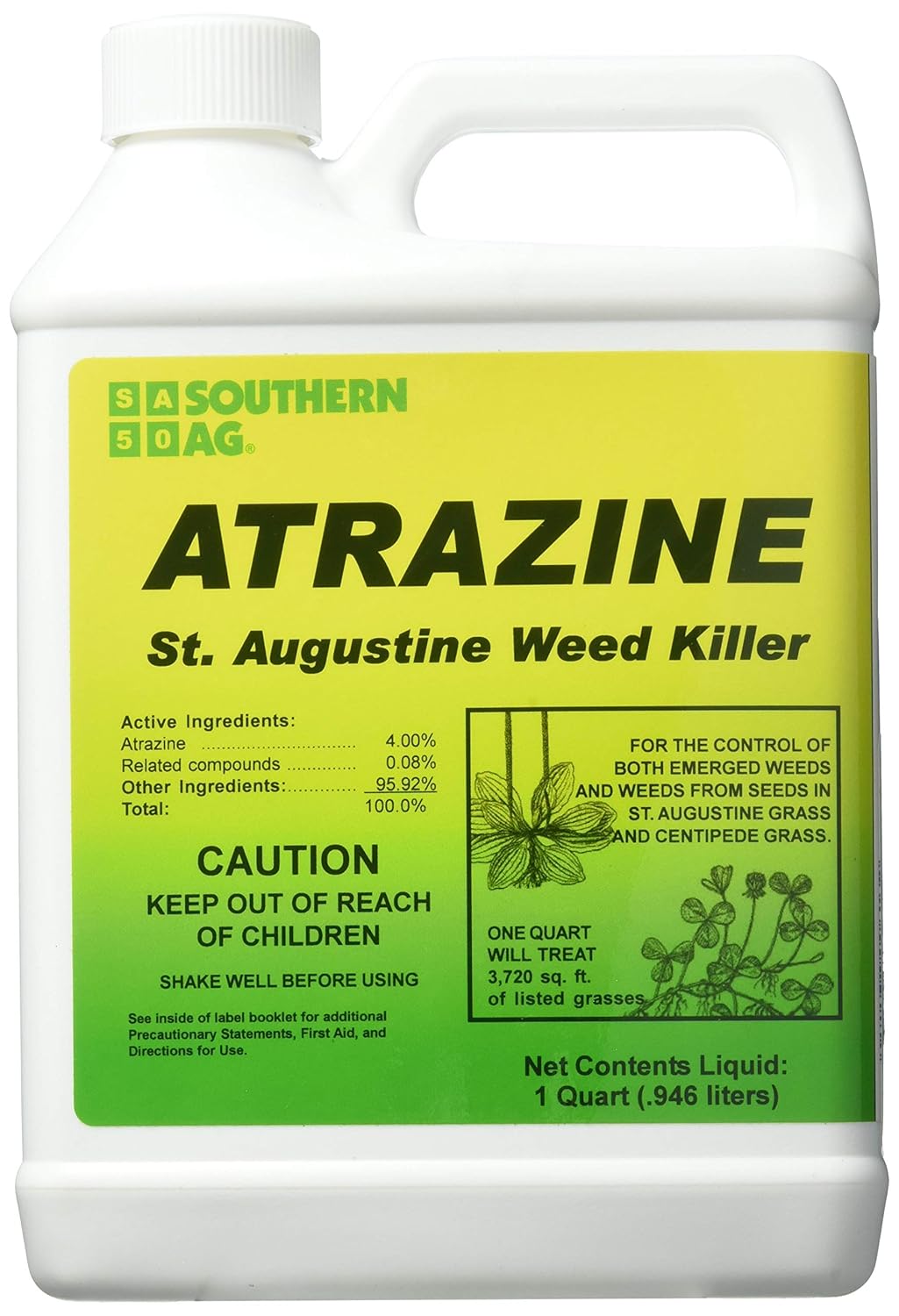
Southern Ag Atrazine St. Augustine Weed Killer, 32 oz
| Unit Count | 32 Fluid Ounces |
|---|---|
| Item Form | Spray |
| Coverage | 3,720 square_feet |
| Liquid Volume | 1 quarts |
This 32 oz atrazine concentrate from Southern Ag is made specifically for St. Augustine and centipede grasses and is used by mixing with water and applying as a spray. It kills many common broadleaf and grassy weeds and provides some suppression of crabgrass when applied at the label rate (about 4.33 oz per 500 sq ft). The product is intended for professional- or homeowner-mix application rather than hose-end sprayers, and the instructions emphasize measured mixing and even coverage for best results, typically applied in cooler, early spring for strongest control. Practical benefits include a large treated area per bottle and targeted activity on turf types that are sensitive to other herbicides. Important limitations are that atrazine is a strong herbicide requiring careful handling, protective gear, and strict adherence to label directions, and it is labeled for use only on St. Augustine and centipede lawns so it is not suitable for all turf types or near sensitive plants.
Best for: Buyers who prioritize proven turf-specific control and rely on product performance and peer feedback when treating St. Augustine or centipede lawns; good for homeowners comfortable following label mixing and safety directions.
Less Ideal for: Gardeners with mixed-species lawns, organic gardeners, or anyone unwilling to use a chemical herbicide or to follow strict safety and mixing instructions.
- Formulated for St. Augustine and centipede lawns so it targets weeds without treating all turf types the same
- Covers approximately 3,720 sq ft per quart, reducing how often you need to buy product
- Concentrated liquid allows adjustable mixing for precise application rates
- Effective against a broad spectrum of grassy and broadleaf weeds when applied per label
- Contains atrazine which requires careful handling and personal protective equipment
- Not recommended for hose-end sprayers and needs measured mixing for accurate coverage
Verdict: Choose this atrazine concentrate if you want a turf-specific weed killer that reliably controls broadleaf and grassy weeds in St. Augustine and centipede lawns.
Southern Ag Amine 2,4-D Weed Killer, 32 oz

| Item Form | Liquid |
|---|---|
| Coverage | 5000 Square Feet |
| Unit Count | 32 Ounce |
| Active Ingredients | Dimethylamine salt of 2,4-D |
Southern Ag Amine 2,4-D is a concentrated liquid herbicide designed to target broadleaf weeds and some woody plants in lawns, pastures, ditch banks, and other noncrop areas. You dilute the concentrate with water and apply as a coarse low-pressure spray; the manufacturer recommends roughly 2 to 3 tablespoons per 3 to 5 gallons of water for 1,000 sq. ft., with coverage listed up to about 5,000 sq. ft. Notable features include a low economical use rate and a low-volatility amine formulation to reduce vapor drift compared with more volatile esters. In practice it performs well on common broadleaf invaders in warm-season turf when applied carefully and with a fan nozzle. Important limitations are that it is selective for broadleaf species and will not control grassy weeds, and care is required to avoid spray drift onto susceptible ornamentals or young turf. Users should follow label safety instructions and application rates to protect desirable plants and meet local regulations.
Best for: Homeowners managing broadleaf weed problems in warm-season lawns who prioritize predictable, label-driven control and want a concentrated, economical herbicide.
Less Ideal for: Gardeners who need a single product to kill grassy weeds or those who plan to apply without following strict label precautions should consider alternative solutions.
- Concentrated formula covers a large area at recommended dilution rates
- Low-volatility amine form reduces vapor drift risk compared with some formulations
- Effective on a wide range of broadleaf weeds and woody plants
- Suitable for use on many turf and noncrop sites listed on the label
- Does not control grassy weeds so a separate product is needed for those
- Requires careful mixing and coarse low-pressure spray application to avoid damage to desirable plants
Verdict: A concentrated, low-volatility 2,4-D amine that delivers economical, reliable control of broadleaf weeds in turf when used according to label directions.
Choosing the Right Weed Killer for St. Augustine Grass: Key Factors to Consider
Turf Safety and Label Instructions
St. Augustine grass can be sensitive to certain herbicides and to timing of application. Always check the product label for explicit directions and any listed turf restrictions before applying. Turf-safe formulations are labeled for use on St. Augustine and specify maximum rates and necessary waiting periods after seeding or sod installation.
Beyond the label, consider environmental conditions at application time. Heat stress or drought can increase the risk of turf injury, so many products recommend treating during active growth and moderate temperatures. Following label rates and irrigation guidance reduces the chance of scorch, discoloration, or long-term thinning of the stand.
Target Weed Spectrum
Different products are formulated to control either broadleaf weeds, grassy weeds, or both. Broadleaf-specific herbicides will not reliably control crabgrass or foxtail, and some grassy-weed killers can harm desirable turf if the herbicide is nonselective. Identify the primary weed problems in your St. Augustine lawn before choosing a product.
For mixed infestations you may need a selective broad-spectrum option or a combination of approaches: preemergent for annual grassy weeds plus a postemergent selective for broadleaf targets. Understanding which weeds are annual versus perennial changes how often and when you need to treat.
Timing and Seasonal Use
Timing significantly affects efficacy and turf recovery. Spring and early summer are critical windows for warm-season turf: some postemergent products work best when weeds are small and actively growing, while preemergent herbicides must be applied before weed seeds germinate. Dormant-season applications may be limited by the product label or by increased turf susceptibility.
Plan treatments around mowing, irrigation, and extreme weather. Some labels advise not to mow for a certain period before or after application to allow translocation into the weed. Seasonal calendars and local extension guidance help prioritize which treatment to apply and when.
Application Method and Equipment
Products come as ready-to-use sprays, concentrates for dilution, or granular formulas. Ready-to-use sprayers are convenient for small patches, but concentrates are more economical for larger areas if you have an appropriate sprayer. Granulars may be easier for large lawns and reduce drift risk, while liquid sprays give faster contact and systemic uptake for certain weeds.
Match the formulation to the equipment you have and the size of the problem area. Proper calibration of spreaders and sprayers ensures even coverage and reduces the risk of overapplication that can harm turf.
Environmental Considerations and Proximity
Consider proximity to garden beds, water features, and pollinator plants. Some herbicides can damage nearby ornamentals by spray drift or runoff. If irrigation is expected, follow label guidance on irrigation timing after application to avoid washing product into unintended areas.
Also factor in pollinator activity; many labels include guidance to avoid spraying when flowers are actively visited. Choosing formulations and application techniques that minimize drift and runoff reduces environmental impact and keeps adjacent plants safe.
Persistence and Follow-Up Care
Residual activity varies by active ingredient. Short-residual products require follow-up treatments for persistent weeds, while longer-residual options can suppress weeds for weeks or months. Consider how persistent activity affects overseeding, landscape renovation, or planting near vegetable beds.
Follow-up care also includes irrigation practices, mowing height adjustments, and spot-treating misses. Integrated approaches that combine cultural methods, such as proper fertilization and mowing height, with targeted herbicide use provide the best long-term control without excessive chemical reliance.
Identifying Weeds in St. Augustine Lawns
Correct identification guides product selection and treatment timing. Common broadleaf weeds such as clovers, dandelions, and henbit respond to selective postemergent herbicides, while grassy invaders like crabgrass and barnyardgrass are managed with preemergents or grassy-weed selective products.
Inspect weed size and growth stage. Younger weeds are usually easier to control and require lower effective rates. Take samples or photos if you need local extension input before selecting a treatment approach.
- Broadleaf weeds: pick selective broadleaf postemergents or spot-treat individually
- Annual grassy weeds: plan preemergent timing in spring
- Perennial grasses: may need repeat treatments and cultural control
Preparing Your Lawn Before Application
Prep reduces risk of turf injury and improves herbicide uptake. Mow at the recommended height a few days before treatment so weeds are not stressed and herbicide contacts foliage. Water according to label directions-some products require dry foliage, others need soil moisture.
Clear debris and avoid applying before heavy rain is forecast. Calibrate your sprayer or spreader and mix exactly to label concentration to avoid hot spots or underdosing.
- Mow a few days before treatment unless the label advises otherwise
- Check weather and avoid windy or rainy conditions
- Calibrate equipment for even coverage
Spot Treatment Versus Whole-Lawn Applications
Spot treatments limit chemical use and reduce risk to non-target areas when weeds are isolated. Use a targeted applicator or a foam marker to avoid drift. For widespread infestations, a whole-lawn approach may be more efficient but requires precise application and irrigation timing.
Decide based on infestation scale, turf sensitivity, and your comfort with handling concentrated products. Often a combination works: spot-treat visible patches now and schedule a broadcast application if weeds expand.
- Spot treat to reduce chemical exposure and costs
- Reserve broadcast treatments for heavy or widespread infestations
- Monitor treated areas and retreat small escapes quickly
Safety and Personal Protective Equipment
Follow label PPE requirements for mixing and application. Basic protections often include long sleeves, gloves rated for chemical use, and eye protection. Avoid inhalation by using a pump sprayer with a fan nozzle when recommended.
Store concentrates securely and out of reach of children and pets. Dispose of unused mixes and empty containers per local regulations and label instructions to protect water and wildlife.
- Wear chemical-resistant gloves and protective eyewear
- Mix outdoors or in well-ventilated areas
- Follow disposal and storage guidance on the label
Cultural Practices That Reduce Herbicide Dependence
Healthy turf outcompetes many weeds. Maintaining correct mowing height for St. Augustine grass, proper fertility, and adequate irrigation reduces invasion pressure. Thick, vigorous stands shade weed seedlings and limit germination.
Overseeding is not typical with St. Augustine, so focus on preventing thin areas. Repair bare spots with sod or plugs rather than relying on herbicide treatments to mask poor turf management.
- Mow to recommended height and avoid scalping
- Fertilize based on soil test recommendations
- Address drainage or compaction that create thin turf patches
How We Chose the Best Weed Killer for St. Augustine Grass
We prioritized products that balance effective weed control with documented safety on St. Augustine turf. Key evaluation dimensions included turf safety under typical spring-through-fall use, the spectrum of weeds controlled (broadleaf and grassy targets), and labeled application methods that match common homeowner practices such as spot treatment, broadcast spraying, and granular use. We also considered speed of visible control and residual activity, which affect how quickly lawns recover and how long weeds stay suppressed. Practical handling matters in home landscapes, so we assessed ease of mixing and applying, clarity of label directions, and compatibility with common spreaders or handheld sprayers. Finally, we checked packaging and mixing concentrations to gauge how suitable a product is for small yards versus large properties. We excluded products with labels that specifically list St. Augustine grass as a restriction, formulations meant only for non-turf uses, and any weed control approaches that require commercial licensing. The result is a shortlist of options that are appropriate, usable, and relevant to typical home St. Augustine lawns.
FAQ
When is the best time to apply a postemergent on St. Augustine?
Postemergent treatments usually work best when weeds are young and actively growing, often in spring and early summer. Avoid applying during heat stress or drought; moderate temperatures and good soil moisture improve uptake and reduce turf injury risk.
Can I use a nonselective weed killer on patches and not harm the rest of the lawn?
Nonselective herbicides will damage any grass they contact. Use extreme caution and only apply with precise spot-treatment tools or barriers. For most homeowners a selective product labeled for St. Augustine is safer for patch work.
How soon can I water after applying a weed control product?
Follow the product label; recommendations vary. Some products advise waiting until after a short drying period to allow foliar uptake, while others recommend light irrigation to move active ingredients into the soil. Check the label for specific timing related to irrigation.
Will a preemergent affect overseeding or sodding plans?
Preemergents can inhibit seed germination and often require a waiting period before seeding or sodding. For St. Augustine, which is usually established with sod or plugs, review timing guidance to avoid interfering with establishment and follow label intervals before planting.
How many treatments will I likely need for perennial weeds?
Perennial weeds often require repeated treatments and follow-up cultural measures. Depending on the species and severity, expect multiple applications spaced according to label directions plus mechanical or cultural removal to fully eliminate established perennials.
Are granular herbicides safer to use near flower beds?
Granular formulations can reduce spray drift but they still pose a risk if granules move with irrigation or foot traffic. Apply carefully, keep granules off adjacent beds, and follow label precautions to protect ornamentals and pollinator plants.
Final Verdict
Pick a weed-control approach that matches the weeds you actually have, the size of the infestation, and the sensitivity of St. Augustine turf. Prioritize products labeled safe for St. Augustine, follow timing guidance for preemergent and postemergent use, and choose application methods that limit drift and overexposure. Combine targeted herbicide use with sound cultural practices like proper mowing, fertilization, and irrigation to reduce future outbreaks. With measured applications and good lawn care, you can restore a thicker, healthier St. Augustine lawn while minimizing risk to desirable turf and nearby plants.
