

Note: This article contains affiliate links. If you click on these links and make a purchase, I may earn a small commission at no extra cost to you. This helps support my research and content. Read my full affiliate disclosure here.
Poa annua can appear as light-green patches, seedheads, and a patchy texture that undermines an otherwise healthy lawn. Choosing the right weed killer for Poa annua matters because treatments that kill the weed but damage desirable grass or leave long recovery times create more work later. This guide gathers seven well-regarded options that are suitable for treating Poa annua in turf settings and explains why each made our shortlist. You will find practical guidance on application timing, turf compatibility, and expected control outcomes. We also evaluate key attributes such as active ingredient suitability and safety for common lawn grasses, so you can pick a product that fits your maintenance schedule and lawn type.
Top Picks at a Glance
| Best Overall The best all-around choice for most situations | Atticus Sertay Herbicide (1.25 oz) — Sulfosulfuron Selective Weed Control |  |
| Best Quality Built to a higher standard if you want something more solid | Syngenta Tenacity Turf Herbicide, 8 oz |  |
| Best Value The sweet spot between price and what you get | Yard Mastery Prodiamine 65 WDG Pre-Emergent Herbicide, 30 Packets |  |
| Best Budget The cheapest option that still gets the job done reliably | LebanonTurf Prodiamine 0.58% Granular Pre-Emergent (covers 20,000 sq ft) |  |
| Highest Rated A top-rated pick with lots of positive feedback | Quali-Pro Prodiamine Pre-Emergent Herbicide, 5 lb Granules |  |
| Most Popular A crowd favorite that many people choose with confidence | Quali-Pro Prodiamine 65 WDG Pre-emergent Herbicide, 5 lb |  |
| Best Seller A high-volume bestseller chosen again and again | Yard Mastery 0-0-7 Granular Prodiamine Pre-Emergent Herbicide, 45 lb |  |
Atticus Sertay Herbicide (1.25 oz) — Sulfosulfuron Selective Weed Control

| Item Form | Water-Dispersible Granule |
|---|---|
| Coverage | 12,500 square feet per 1.25 oz bottle |
| Active Ingredients | sulfosulfuron |
Atticus Sertay is a concentrated water-dispersible granule herbicide designed to target Poa annua, sedges, and a range of grassy and broadleaf weeds in warm-season turf and landscape beds. It is typically mixed and applied to actively growing young weeds in spring, summer, or fall, with visible control of Poa annua in about three to four weeks under warm, moist conditions. The product’s small 1.25 ounce unit covers up to 12,500 square feet, so a little goes a long way for spot treatments or larger areas when measured correctly. Sertay is labeled for use on common southern grasses such as bermudagrass, St. Augustine, zoysia, and centipede, and can be used near woody ornamentals and perennial groundcovers when label directions are followed. Important limitations are its state restrictions and the need to follow label timing and buffer instructions because it can harm aquatic life and is not approved everywhere. It is best used by gardeners comfortable measuring and applying selective herbicides and who follow safety and reentry guidance on the label.
Best for: Gardeners and turf managers who want a targeted, professional-strength solution to suppress Poa annua and sedges in warm-season lawns and landscaped areas and who are comfortable following label directions for selective herbicide use.
Less Ideal for: Homeowners seeking an all-purpose, nontechnical weed killer or those who need a product approved for use in restricted states or near sensitive aquatic areas.
- Contains 75% sulfosulfuron, the active ingredient proven effective on Poa annua and nutsedge
- Water-dispersible granule formula that mixes for broadcast or spot applications
- High coverage rate of up to 12,500 sq ft per 1.25 oz bottle when applied at labeled rates
- Labeled for use on a wide range of warm-season turfgrasses and around woody ornamentals
- Not registered for sale or use in some jurisdictions and requires strict adherence to label restrictions
- Can be harmful to aquatic life, so buffer zones and careful application are necessary
Verdict: Choose Sertay when you need a concentrated, selective herbicide that reliably suppresses Poa annua and sedges in warm-season turf when applied according to the label.
Syngenta Tenacity Turf Herbicide, 8 oz
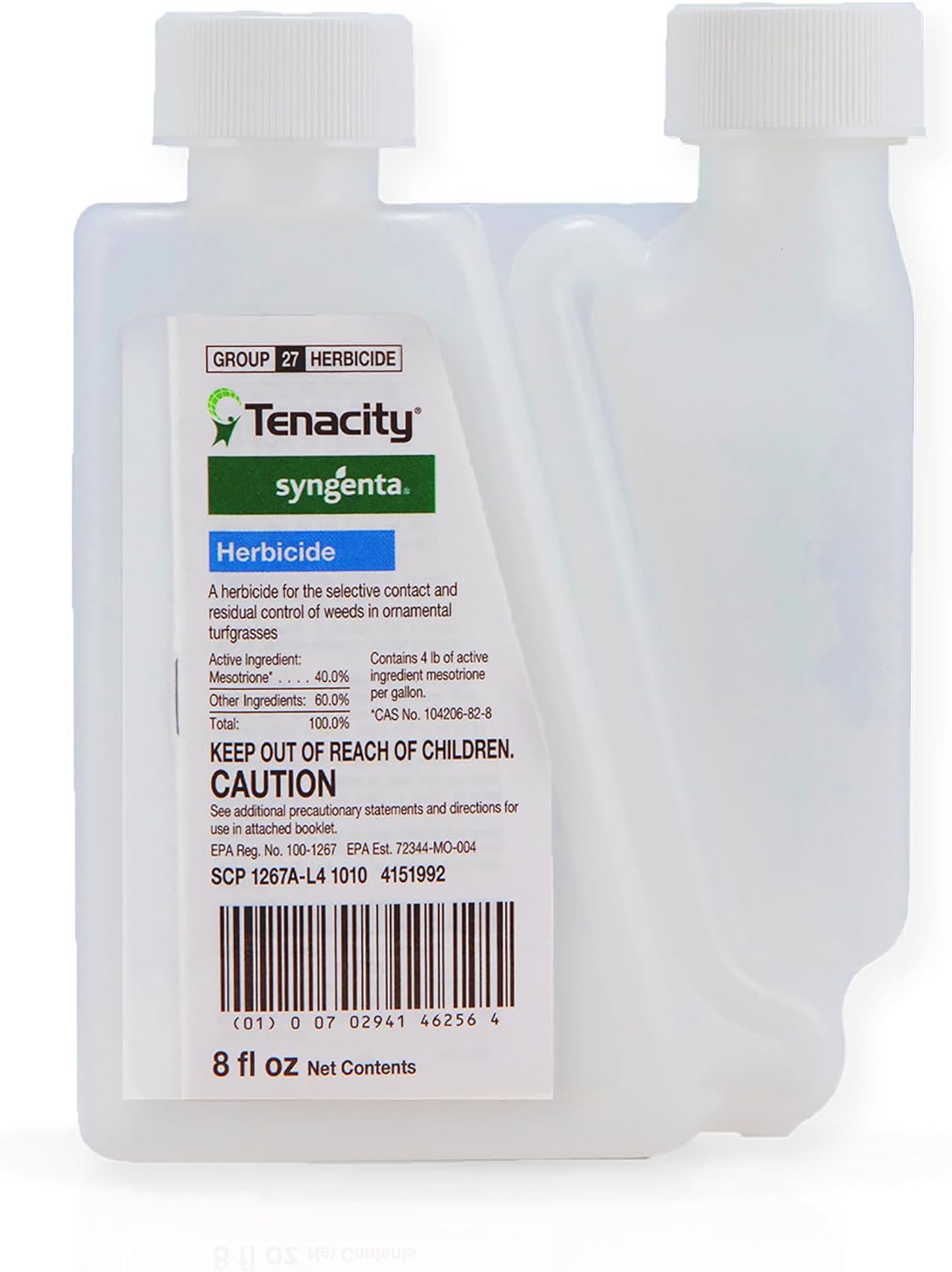
| Unit Count | 8 Fluid Ounces |
|---|---|
| Item Form | Liquid |
| Coverage | 2000 ft^2 per 1sp of product |
| Active Ingredients | Mesotrione |
Tenacity Turf Herbicide is a concentrated mesotrione-based liquid designed for both pre-emergent and post-emergent control of common lawn weeds including crabgrass, clover, chickweed and dandelions. You apply it diluted according to label rates with a handheld or hose-end sprayer to target problem areas or broadcast across the lawn; when used as a pre-emergent it is taken up as weeds emerge and when applied post-emergent it acts systemically for selective control. The product covers a large area per bottle and the active ingredient provides residual control so you can expect longer suppression than a contact-only herbicide. Important practical points are that it is turf-selective so follow the label for grass species and mixing instructions to avoid turf injury, and results can take several days to appear. Also this is a concentrated chemical intended for careful, measured application rather than spot-use by people who prefer non-chemical methods.
Best for: Gardeners focused on strong, reliable crabgrass and broadleaf weed control who are comfortable using concentrated herbicides and following label directions for turf safety.
Less Ideal for: People seeking organic, mechanical, or spot-only solutions or those unwilling to follow detailed mixing and application instructions should consider other options.
- Systemic mesotrione active ingredient controls both pre- and post-emergent weeds
- Selective to turf when used per label, allowing treatment without killing desirable grass species
- Concentrated 8 oz liquid provides wide coverage per bottle
- Provides residual suppression, reducing frequency of repeat applications
- Requires careful mixing and adherence to label for turf safety
- Not a non-chemical or organic option for weed control
Verdict: Choose Tenacity when you want a concentrated, turf-selective herbicide that delivers pre- and post-emergent control of crabgrass and other common lawn weeds.
Yard Mastery Prodiamine 65 WDG Pre-Emergent Herbicide, 30 Packets

| Included Components | 30 x 20 g pre-measured Prodiamine 65 WDG packets |
|---|---|
| Active Ingredients | Prodiamine 65.0% |
| Item Form | Granule |
| Coverage | Controls Poa annua, crabgrass and listed annual weeds from seed |
This product is a pre-emergent herbicide formulated as water-dispersible granule packets containing Prodiamine 65%. Each 20 g packet is designed to be dropped into a backpack or handheld sprayer, mixed with water, and sprayed evenly across the lawn to form a treated layer in the soil that prevents weed seedlings such as Poa annua and crabgrass from establishing. The pre-measured packets remove the need for a scale and make accurate calibration straightforward for planned preventative applications in spring and late summer or fall. Practical benefits include wide coverage per packet, clear timing guidance tied to soil temperature, and compatibility with a range of cool- and warm-season turf species when label rates are followed. Important limitations are that it will not affect weeds that have already emerged, it interferes with seeding or overseeding, and it requires proper personal protective equipment and care around water due to aquatic toxicity and label restrictions in several states. Follow the product label closely for application rates and annual limits to avoid overuse.
Best for: Homeowners who plan and schedule preventive weed control and want accurate, easy mixing without measuring tools for treated-area programs focused on stopping Poa annua before it emerges.
Less Ideal for: People needing a post-emergent solution for existing weeds, those planning to overseed soon, or users unwilling to follow label safety restrictions and state availability limits.
- Pre-measured 20 g packets simplify mixing and eliminate the need for a scale
- High active ingredient concentration (Prodiamine 65%) for reliable pre-emergent control of Poa annua and crabgrass from seed
- Large coverage per packet makes it efficient for treating whole yards or seasonal programs
- Ready-to-mix granules work with common backpack or handheld sprayers for straightforward application
- Label includes timing and activation guidance tied to soil temperature and irrigation needs
- Does not control emerged weeds so requires correct timing ahead of germination
- Not suitable for lawns being seeded or newly sodded because it prevents desirable grass seed from germinating
- Restricted for sale or use in certain states and toxic to aquatic organisms, requiring careful handling and PPE
Verdict: For planned preventive programs targeting Poa annua, the pre-measured Prodiamine packets deliver accurate, easy-to-mix applications that make timing and coverage simple.
LebanonTurf Prodiamine 0.58% Granular Pre-Emergent (covers 20,000 sq ft)

| Item Form | Granule |
|---|---|
| Coverage | 20,000 sq. ft. |
| Active Ingredients | Prodiamine |
This granular pre-emergent uses 0.58% prodiamine on a BIODAC carrier to stop crabgrass and many grassy weeds from germinating across lawns and landscaped areas. It is applied with a broadcast spreader in early spring, with a recommended follow-up in late May or early June; the manufacturer warns not to overseed for three to four months after application. The product covers a large area per unit, making it suitable for whole-yard preventive programs and for professional maintenance of turf, trees, shrubs, and flowers. Its granular form simplifies handling compared with liquids and reduces immediate runoff risk, while the prodiamine chemistry provides season-long residual control when applied correctly. Limitations include the planting restriction after application and that it prevents seed germination so it cannot be used where you plan to establish new lawn from seed shortly after treatment. Also availability is restricted in several states, so check local regulations before planning use.
Best for: Buyers who prioritize a dependable, season-long preventive approach to crabgrass control and want a product that fits routine lawn maintenance schedules used by homeowners or pros.
Less Ideal for: Gardeners planning to establish new lawns from seed shortly after treatment or those needing an option legal in excluded states should consider alternatives.
- Granular formula on BIODAC carrier for easy broadcast spreading
- Contains 0.58% prodiamine, a proven pre-emergent for crabgrass and grassy weeds
- Large coverage of 20,000 sq. ft. per unit reduces application frequency
- Suitable for use across lawns and landscaped beds to protect turf and plantings
- Prevents seed germination so you cannot overseed or plant grass seed for 3–4 months after application
- Not labeled for sale or use in a number of states, limiting availability and compliance
Verdict: Choose this granular 0.58% prodiamine product when you need a reliable, large‑area pre-emergent to prevent crabgrass and other grassy weeds.
Quali-Pro Prodiamine Pre-Emergent Herbicide, 5 lb Granules

| Item Form | Granule |
|---|---|
| Coverage | Pre-emergent grass and broadleaf weed control, season long crabgrass control |
| Active Ingredients | Prodiamine 65% |
Quali-Pro Prodiamine is a granular pre-emergent herbicide designed to prevent germination of common annual grassy and broadleaf weeds across lawns and landscape beds. You apply it before weed seeds germinate in spring or as a fall treatment to build residual control through the growing season. The product contains 65% prodiamine, which is widely used for reliable, long-lasting control of crabgrass, annual bluegrass and several broadleaf weeds, and it mixes readily when tank-mixed with fertilizers or iron. In real-world use it offers predictable, season-long suppression when applied at the labeled rate and incorporated by irrigation or rainfall. Important practical limits are that it is preventive only and will not kill established weeds, and proper timing and rate are essential to avoid reduced effectiveness. For larger areas the 5 lb package covers moderate lawn acreage but may require multiple bags for extensive turf.
Best for: Homeowners and lawn care professionals who prioritize a dependable, season-long preventive solution to keep crabgrass and annual weeds from establishing in turf.
Less Ideal for: Gardeners needing a post-emergent solution for existing weeds or those who prefer liquid ready-to-use products for spot treatments.
- High active ingredient concentration (Prodiamine 65%) for long residual control
- Granular form allows easy broadcast application and tank mixing with fertilizers
- Effective season-long crabgrass and annual weed suppression when applied correctly
- Suitable for spring or fall applications to build preventive control
- Pre-emergent only and will not control established weeds
- 5 lb bag may be insufficient for large lawns without purchasing additional quantity
Verdict: Choose this prodiamine granule when you want a proven, season-long preventive herbicide to reliably stop crabgrass and other annual weeds before they start.
Quali-Pro Prodiamine 65 WDG Pre-emergent Herbicide, 5 lb

| Item Form | Granule |
|---|---|
| Unit Count | 80 Ounce |
| Coverage | 0.5-2.30 lbs per acre or 0.185-0.55 oz per gallon, 1,000 sq.ft. |
| Active Ingredients | Prodiamine, Iron, Herbicide |
Quali-Pro Prodiamine 65 WDG is a pre-emergent herbicide sold as granules that prevent many common grassy and broadleaf weeds when incorporated into soil or applied as a spray solution. It is typically mixed at label rates and applied with a pump sprayer or battery hand can to flower beds and landscape areas in spring and fall for season-long control of weeds like crabgrass, chickweed, foxtail and spurge. The product’s broad-spectrum activity and flexible coverage rates make it cost effective for treating multiple beds or larger areas, and the dry formulation stores and measures easily. Important practical considerations include strict adherence to label directions for application rate and safety equipment and timing, and the fact that it is a preventive product so it will not control weeds that are already established. Also follow specific flower bed planting intervals, since pre-emergents can inhibit seed germination of desirable annuals and some perennials. When used correctly it is a reliable way to reduce weed pressure before seedlings emerge.
Best for: Gardeners who prioritize efficient, preventive weed control in established flower beds and want a cost-conscious, season-long solution to reduce weed emergence without frequent spot treatments.
Less Ideal for: People who need to remove existing mature weeds, or who plan to seed annual flowers immediately after treatment; those wanting an all-in-one post-emergent solution should look elsewhere.
- Broad-spectrum control of many grassy and broadleaf weeds
- Granule form that mixes for spray application and is simple to store and measure
- Effective for both spring and fall applications for season-long prevention
- Flexible coverage rates allow treating small beds to larger landscape areas
- Pre-emergent only and will not kill weeds already growing
- Can prevent germination of desirable seeds so timing relative to planting is critical
Verdict: Use this prodiamine granular pre-emergent when you want a practical, cost-effective way to prevent common weeds in established flower beds before they emerge.
Yard Mastery 0-0-7 Granular Prodiamine Pre-Emergent Herbicide, 45 lb

| Item Form | Granule |
|---|---|
| Coverage | 15,000 square feet |
| Active Ingredients | .37% Prodiamine |
| Unit Count | 720 Ounce |
This granular pre-emergent from Yard Mastery is designed to create a seasonal barrier that prevents crabgrass, poa annua, and several common lawn weeds from emerging. You apply it with a broadcast spreader at the recommended rate (commonly 3 lbs per 1,000 sq ft), water it in to activate the ingredient, and it provides roughly three months of protection when applied with soil temperatures between 55F and 70F. Notable features are the professional-strength active ingredient prodiamine at 0.37% and the large 45 lb bag that covers up to 15,000 sq ft at typical rates, which reduces the need for multiple purchases for mid-to-large yards. Practical benefits include straightforward granular application, broad weed-spectrum prevention, and compatibility with many common warm- and cool-season turfgrasses when used as directed. Limitations to consider are the need for accurate spreading and post-application watering to work effectively, adherence to annual maximum application rates, and the usual safety precautions required for concentrated herbicides around people and pets.
Best for: Homeowners who want a cost-effective, professional-strength pre-emergent to protect medium to large lawns and who prefer a granular product they can apply with a spreader.
Less Ideal for: Gardeners with very small lawns or ornamental beds that need spot treatment should consider smaller containers or targeted solutions instead.
- Professional-strength active ingredient (0.37% prodiamine) for effective pre-emergent control
- Large 45 lb bag covers up to 15,000 sq ft at recommended rates, suitable for mid-to-large lawns
- Granular formulation is easy to apply with a spreader and does not require mixing
- Provides about three months of pre-emergence protection when applied at recommended soil temperatures
- Requires precise spreading and watering to activate, otherwise efficacy can be reduced
- Contains a concentrated herbicide that requires protective gear and careful handling
Verdict: A large, pro-grade granular pre-emergent that gives homeowners an easy way to protect a medium to large lawn from crabgrass and other annual weeds.
Choosing the Right Weed Killer for Poa Annua: Key Factors to Consider
Active Ingredient and Mode of Action
Different active ingredients target Poa annua in different ways. Some herbicides are selective for grassy weeds while others are broad-spectrum. Knowing the mode of action helps predict how quickly Poa annua will die back and whether repeat applications are likely required.
Active ingredient also influences resistance risk. Rotating products with different modes of action over seasons reduces the chance that Poa annua populations develop tolerance. Read label statements about susceptible species and confirmed activity against annual bluegrass to match chemistry to your problem.
Turfgrass Compatibility
Not all weed killers are safe on every lawn grass. Cool-season species and warm-season species respond differently to particular herbicides, and some treatments can cause temporary or permanent damage to desirable turf if applied at the wrong growth stage or temperature.
Check label directions for specific turf species and any temperature or growth-stage restrictions. Lawn stressors such as drought or recent fertilization increase the risk of injury, so plan applications during recommended conditions to reduce turf damage.
Timing and Application Window
Effective control of Poa annua depends heavily on timing. Pre-emergent products stop seed germination and are applied before seed flushes, while post-emergent products work on established plants and seedheads. Knowing when Poa annua is active in your region determines whether you need pre-emergent, post-emergent, or a combination approach.
Application timing also ties into daily temperatures and turf growth. Many post-emergent herbicides work best when weeds are actively growing and soil temperatures are within a specific range. Late-season or off-timing applications often reduce efficacy and can increase stress on the lawn.
Formulation and Ease of Use
Herbicides come as concentrates, ready-to-use sprays, or granular formulations. Concentrates require correct mixing and calibration of sprayers, which gives flexibility for coverage but adds a risk of user error. Ready-to-use products are simpler but may be more costly per treated area.
Granular options can be easier to spread uniformly with a broadcast spreader but may require irrigation to activate. Think about the tools you have, how large the affected area is, and your comfort with mixing and applying chemicals safely.
Residual Activity and Re-treatment Needs
Residual control describes how long a product prevents new Poa annua seedlings from establishing after application. Longer residuals can reduce the frequency of follow-up treatments but might restrict overseeding or planting for longer periods.
Short-residual products give more flexibility for reseeding but may require multiple treatments across the germination window. Match the residual profile to your lawn calendar and whether you plan to overseed or renovate soon after treatment.
Safety and Environmental Considerations
Label instructions address re-entry times, pet and child safety, runoff risk, and buffer zones near desirable plants and water. Some chemistries pose higher runoff potential or require special handling to minimize environmental impact.
Use personal protective equipment as directed, avoid application before heavy rain, and follow irrigation restrictions to reduce off-target movement. Consider non-chemical cultural controls alongside herbicide use to lower long-term reliance on chemicals.
When To Use Pre-emergent Versus Post-emergent Treatments
Pre-emergent herbicides act on seed germination and are best applied before Poa annua seeds sprout. Use regional soil temperature cues or local extension guidance to time pre-emergent applications so they are active during the typical seed flush.
Post-emergent products control established plants and visible seedlings. They are useful for spot treatments of mature patches or when pre-emergent timing was missed. Often the most effective program combines both: a pre-emergent to reduce the main flush and targeted post-emergent spot work for surviving plants.
- Pre-emergent: prevents new seedlings, limited effect on established plants
- Post-emergent: treats visible plants, timing depends on active growth
- Combined approach reduces overall seedbank pressure over seasons
Spot Treatment Strategies for Small Patches
For isolated Poa annua clusters, spot treatments minimize chemical use and reduce turf exposure. Apply a post-emergent product directly to plants on calm, mild days and avoid overlapping sprays onto desirable grass.
Hand removal can be effective when patches are small and soil moisture softens the root mass. Follow spot herbicide applications with monitoring and retreatment only where new seedlings appear.
- Use a pump sprayer with a low-pressure nozzle for precise application
- Mask surrounding turf with cardboard or a shield when spraying windy conditions
- Record treated areas and dates to avoid over-application
Cultural Practices That Reduce Poa Annua Pressure
Cultural measures complement chemical control and lower future Poa annua outbreaks. Practices that strengthen the desired turf give it a competitive edge and reduce open spaces where annual bluegrass seeds establish.
Maintain appropriate mowing height for your grass type, water deeply and infrequently to favor deep-rooted turf, and correct soil compaction and fertility imbalances. Thick, vigorous turf crowds out seedlings and reduces the need for repeated herbicide treatments.
- Mow at recommended heights to favor turf species over Poa annua
- Core aerate compacted areas to improve rooting and reduce bare patches
- Fertilize based on soil tests to avoid excessive growth that favors annual weeds
Overseeding and Renovation After Treatment
If you plan to overseed or renovate, check label intervals for when it is safe to sow new grass after herbicide application. Some residuals block seed germination for weeks to months, which affects scheduling for repairs.
When renovation is imminent, prefer shorter-residual options or delay herbicide use until after overseeding establishment windows. Timing your renovation around the weed control calendar prevents wasted seed and uneven establishment.
- Wait the label-specified interval between application and seeding
- Consider spot-seeding untreated pockets to maintain turf density
- Use starter fertilizers and irrigation regimes appropriate for new seedlings
Safe Practices for Application and Storage
Follow label PPE and mixing instructions. Use a dedicated measuring container and mix in well-ventilated outdoor areas. Avoid applying before heavy rain or to frozen ground to prevent runoff.
Store concentrates in original containers in a locked, dry location away from children and pets. Dispose of empty containers and rinse water according to local regulations to minimize environmental harm.
- Calibrate sprayers before treating the lawn
- Keep pets and children off treated areas for the recommended interval
- Clean equipment after use and follow local disposal rules
How We Chose the Best Weed Killer for Poa Annua
We shortlisted products based on concrete, garden-focused criteria that reflect real-world Poa annua control needs. We prioritized documented efficacy against Poa annua or similar annual cool-season grassy weeds and considered the speed and consistency of visible control. Turf safety was a major filter, with preference for products that have labeled compatibility with common lawn species and a lower risk of scorch or thinning when applied at recommended rates. We assessed ease of use, including ready-to-use versus concentrated formulations and clear application instructions for timing and water volumes. Residual activity and re-treatment windows were considered to help gardeners understand how long treated areas remain less prone to reinfestation. Label restrictions for overseeding, irrigation intervals, and re-entry or pet safety also influenced selections. We excluded products with unclear label guidance for turf, limited information about activity on Poa annua, or high documented risk of damaging popular lawn grasses when used as directed. The resulting picks are those that offer a balance of control, safety, and practical application for home and small-property lawn care.
FAQ
Can I treat Poa annua without harming my lawn?
Often you can, but it depends on the product, turf species, and timing. Choose a product labeled for your type of grass and apply during recommended growth conditions to reduce turf injury.
What is the best time of year to treat Poa annua?
Timing depends on whether you use pre-emergent or post-emergent control. Pre-emergents are applied before germination flushes, while post-emergents work when plants are actively growing. Local soil temperature cues are useful for scheduling.
How many treatments will I need to control Poa annua?
Control often requires multiple approaches across a season. A combination of pre-emergent protection and targeted post-emergent spot treatments during the germination window usually yields better long-term results than a single application.
Will a herbicide prevent Poa annua from coming back next year?
Residual herbicides can reduce the number of new seedlings but rarely eliminate the seedbank entirely. Ongoing cultural practices and timed applications over multiple seasons are typically needed to lower long-term pressure.
Can I overseed soon after applying a weed killer?
It depends on the product residual. Some herbicides prevent seed germination for weeks or months. Always follow label waiting periods before overseeding to avoid poor establishment.
Final Verdict
Choose products that match your lawn type and the timing you can manage. Prioritize turf-safe chemistries when treating mixed lawns, and plan applications around soil temperature and turf growth to improve outcomes. Combine targeted herbicide use with cultural practices like proper mowing, irrigation, and aeration to reduce reliance on chemicals and improve long-term control. The right approach depends on whether you need pre-emergent protection, post-emergent spot control, or both. Focus on matching product residual and label restrictions to your renovation plans so you can treat effectively without compromising future overseeding or turf health.
