

Note: This article contains affiliate links. If you click on these links and make a purchase, I may earn a small commission at no extra cost to you. This helps support my research and content. Read my full affiliate disclosure here.
Felling trees puts unique demands on a chainsaw: sustained cutting power, reliable chain control, and safety systems that protect you during tough cuts. If you plan to take down medium to large trunks or clear mature trees from your property, the wrong saw can make the job slower, more dangerous, and harder on your body. This guide covers six top shortlisted chainsaws for felling trees, selected for power delivery, bar length suitability, and operator safety. We evaluate each pick on cutting performance, user controls, and durability so you can match a saw to the size of trees you expect to fell. Read on to get practical guidance before you choose a saw for tree-felling work.
Top Picks at a Glance
| Best Overall The best all-around choice for most situations | Husqvarna 455 Rancher Gas Chainsaw, 20-inch, 3.5 HP |  |
| Best Quality Built to a higher standard if you want something more solid | Husqvarna 460 Rancher 24-Inch Gas Chainsaw |  |
| Best Value The sweet spot between price and what you get | COOCHEER 62cc Gas-Powered Chainsaw, 3.5 HP, 20-Inch Bar |  |
| Best Budget The cheapest option that still gets the job done reliably | GARWINNER 62cc Gas-Powered Chainsaw with 20-Inch Bar |  |
| Highest Rated A top-rated pick with lots of positive feedback | STIHL MS 201 TC-M Chainsaw, 35 cm Cutting Length |  |
| Most Popular A crowd favorite that many people choose with confidence | Greenworks 40V 16" Brushless Cordless Chainsaw with 4.0Ah Battery and Charger |  |
Husqvarna 455 Rancher Gas Chainsaw, 20-inch, 3.5 HP

| Power Source | Gas Powered |
|---|---|
| Horsepower | 3.5 hp |
| Chain Length | 20 inches |
The Husqvarna 455 Rancher is a robust gas chainsaw aimed at homeowners and landowners who need a dependable workhorse for tasks like storm cleanup, cutting firewood, and routine tree trimming. It uses a 3.5-HP X-Torq two-stroke engine and a 20-inch bar to deliver strong cutting power while Smart Start and an inertia-activated chain brake simplify starting and improve safety. Practical features such as Air Injection to reduce debris reaching the filter, side-mounted chain tensioning for on-the-fly adjustments, LowVib vibration dampening, and an ergonomic offset front handle make longer jobs less tiring. Maintenance is straightforward thanks to the automatic oiler and accessible tensioning, but being a gas model it requires fuel mixing and periodic engine upkeep that electric alternatives avoid. Its weight and fuel noise are typical for this class, so expect more vibration and emissions than battery or corded saws. For someone who needs reliable, professional-level cutting performance in an all-around package, this model balances power and user-friendly features well.
Best for: Buyers who want a capable, versatile saw for frequent property maintenance and heavier cutting tasks and who prioritize cutting performance and durability over quieter electric operation.
Less Ideal for: Casual users with small yards or those who prefer low-noise, low-maintenance electric or battery saws should consider lighter alternatives.
- Powerful 3.5-HP X-Torq engine suitable for heavy cutting and firewood
- Smart Start and inertia chain brake for easier starting and improved safety
- Air Injection centrifugal system reduces debris reaching the air filter to extend engine life
- Side-mounted chain tensioning and automatic oiler simplify adjustments and routine maintenance
- Requires gas and oil mixing and regular engine maintenance unlike battery models
- Heavier and louder than electric chainsaws, which can increase fatigue and noise on long jobs
Verdict: Choose the 455 Rancher when you need a durable, pro-capable gas chainsaw that balances strong cutting power with user-focused features for regular property work.
Husqvarna 460 Rancher 24-Inch Gas Chainsaw

| Power Source | Gas Powered |
|---|---|
| Horsepower | 3.6 |
| Chain Length | 24 inches |
The Husqvarna 460 Rancher is a workhorse 24-inch gas chainsaw designed for heavy cutting jobs like felling medium to large trees and preparing firewood on acreage. It uses a 60.3-cc, 3.6-HP X-Torq two-stroke engine with Smart Start for easier ignition and an Air Injection centrifugal system that helps keep the air filter cleaner for longer service intervals. Ergonomic touches such as LowVib anti-vibration, a 7-degree offset front handle, side-mounted chain tensioning and an inertia-activated chain brake make long sessions more manageable and adjustments quicker in the field. Practical benefits include strong cutting power at low RPM, replaceable bar and chain, and an adjustable oil pump for proper lubrication during heavy use. Expect typical gas-saw care needs such as fuel mixing, periodic filter and spark plug maintenance, and the added noise and emissions of a gas engine. This is a substantial saw that performs well for owners who need sustained power and durability rather than a lightweight occasional-use option.
Best for: Landowners, small farm operators, and homeowners with extensive woodcutting needs who want a durable, high‑power saw for sustained felling and firewood preparation.
Less Ideal for: Casual users with light pruning or occasional cutting needs and those who prefer low-noise, low-maintenance electric or battery options.
- High power 60.3-cc X-Torq engine delivers strong cutting performance for large logs
- Smart Start and combined choke/stop control make starting quicker and reduce flooding
- Air Injection centrifugal system helps extend air filter life under dusty conditions
- Ergonomic design with LowVib technology and offset front handle reduces user fatigue
- Gas engine requires fuel mixing and regular maintenance compared with battery models
- Large 24-inch bar makes the saw heavier and less maneuverable for tight or overhead work
Verdict: Choose the 460 Rancher if you need a powerful, durable gas chainsaw built to handle large logs and sustained heavy-duty cutting.
COOCHEER 62cc Gas-Powered Chainsaw, 3.5 HP, 20-Inch Bar

| Power Source | Gas Powered |
|---|---|
| Horsepower | 3.5 |
The COOCHEER 62cc gas chainsaw is built for demanding yard tasks like cutting firewood and felling small to medium trees. Its 3.5 HP 2-stroke engine reaches up to 12,000 rpm and drives a 20-inch guide bar fitted with a 76-link wear-resistant chain, which together provide the cutting reach and power you need for larger limbs and trunks. The saw includes anti-vibration and low-kickback design elements and a non-slip handle to reduce operator fatigue during longer sessions. Practical touches such as a spring-assisted pull cord, a three-layer gasoline filtration system, and a carrying bag and tool kit make startup, basic maintenance, and transport easier. Expect the usual gas-saw trade-offs: you get stronger continuous power than battery models but must mix fuel, perform routine tuning, and manage noise and exhaust. The package includes replacement chain links, a spark plug, a mixing bottle, and a guide plate cover so you can start using it right away, but proper PPE and basic chainsaw servicing skills are recommended for safe, long-lasting performance.
Best for: Buyers who prioritize strong, continuous cutting power for felling trees and logging and who are comfortable with routine gas-engine maintenance and safe chainsaw operation.
Less Ideal for: Casual gardeners or users who prefer low-noise, low-maintenance battery tools or who will only perform occasional light pruning.
- Powerful 62cc, 3.5 HP 2-stroke engine suitable for felling and heavy cutting
- 20-inch guide bar with a 76-link wear-resistant chain for extended cutting reach
- Anti-vibration handle and low-kickback chain design to reduce fatigue and enhance control
- Includes useful accessories such as a carrying bag, tool kit, spare spark plug, and fuel mixing bottle
- Requires fuel mixing and regular engine tuning and maintenance
- Gas engine produces noise and exhaust compared with battery alternatives
Verdict: A robust gas chainsaw that delivers the power and bar length needed for efficient tree felling and heavy-cutting jobs.
GARWINNER 62cc Gas-Powered Chainsaw with 20-Inch Bar

| Power Source | Gas Powered |
|---|---|
| Horsepower | 3.26 |
This GARWINNER gas chainsaw is a budget-oriented 62cc, two-stroke saw built for felling trees and cutting larger logs. It delivers strong power and a 20-inch bar that makes it suitable for medium to large tree work, while features like automatic chain oiling and a professional-style chain help keep cutting efficient and reduce wear. Safety-minded touches include dual throttle switches and a brake baffle to reduce accidental starts and allow quick stops. Typical use will be periodic heavy-duty cutting on a property, firewood processing, and storm cleanup rather than continuous commercial logging. Practical benefits are straightforward: ample horsepower for its class, self-lubrication to lower maintenance, and a comfortable handle for extended use. Important limitations are that it is a basic consumer-grade saw so expect more vibration and the need for routine tuning compared with premium pro models, and gasoline two-stroke engines require fuel mixing and more hands-on maintenance. For buyers focused on value, it provides capable felling performance at a lower price with the usual upkeep of a gas saw.
Best for: Buyers who need a capable, lower-cost chainsaw for occasional to regular tree felling and firewood work and who are comfortable performing basic engine maintenance.
Less Ideal for: Professional arborists or users who need a low-vibration, low-maintenance saw for continuous daily commercial use should consider higher-end or professional models.
- High 62cc two-stroke engine provides strong cutting power suitable for medium to large trees
- Automatic chain oiling reduces manual lubrication and helps extend chain life
- Safety features include dual throttle switches and a brake baffle for accidental-start protection
- 20-inch bar gives reach for felling and cross-cutting larger logs
- Consumer-grade build likely produces more vibration and requires frequent tuning compared with pro models
- Two-stroke gasoline engine requires fuel mixing and routine maintenance
Verdict: A powerful, value-focused gas chainsaw that gives solid felling capability for homeowners and property owners who want heavy-cutting performance on a budget.
STIHL MS 201 TC-M Chainsaw, 35 cm Cutting Length

| Power Source | Gas Powered |
|---|---|
| Horsepower | 2.4 hp |
| Chain Length | 35 centimeters |
| Manufacturer Warranty Description | 1 year |
The STIHL MS 201 TC-M is a gas-powered chainsaw built for dependable performance in demanding yard and light professional work. It pairs a 2.4 hp engine with a 35 cm cutting bar so it can handle limb work, pruning, and small to medium firewood cutting with steady power. Key features include a proven STIHL drivetrain and a compact chassis that makes the saw easier to maneuver in tight spaces and overhead jobs. Practical benefits are long spare-part availability and a one-year manufacturer warranty that support long-term ownership, while the gas power gives consistent cutting speed without dependence on batteries. Limitations are inherent to a compact gas saw: it requires fuel and routine maintenance like chain sharpening and tuning, and it is heavier and louder than comparable battery models. For buyers who prioritize reliable, serviceable power and parts support, this model delivers consistent, workshop-serviceable performance.
Best for: Buyers who need a dependable, serviceable gas chainsaw for regular yard work or light professional tasks and who value long-term parts support and predictable power delivery.
Less Ideal for: Casual users who prefer lower-noise, low-maintenance battery tools or those who need the lightest possible tool for occasional use.
- Gas-powered 2.4 hp engine provides consistent cutting power for demanding tasks
- Compact 35 cm bar improves maneuverability for pruning and overhead work
- Long spare-part availability (25 years) supports long-term serviceability
- Manufacturer warranty and established brand reputation for reliability
- Requires regular fuel, maintenance, and tuning compared with electric alternatives
- Heavier and louder than cordless battery chainsaws, which affects comfort for extended use
Verdict: Choose this STIHL if you want a compact, gas-powered chainsaw built for reliable, serviceable performance and long-term parts support.
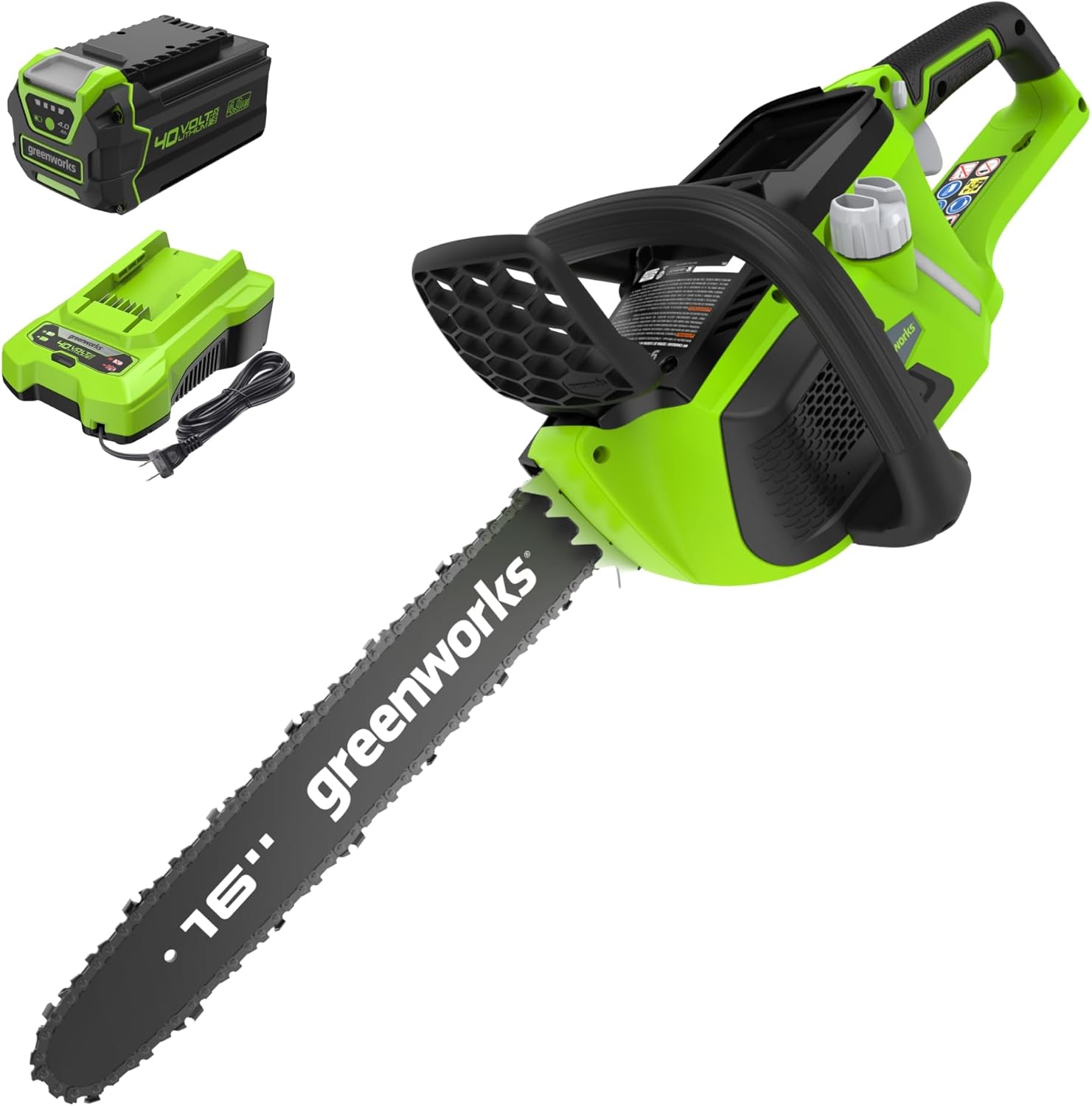
Greenworks 40V 16" Brushless Cordless Chainsaw with 4.0Ah Battery and Charger
| Power Source | Battery Powered |
|---|---|
| Horsepower | 160 |
| Chain Length | 16 inches |
| Included Components | Chainsaw, Battery, Charger, Manual |
The Greenworks 40V 16" brushless chainsaw is a battery-powered alternative to small gas saws designed for homeowners who need to fell trees, cut firewood, and handle storm cleanup. Its brushless motor produces higher torque and lower vibration than older brushed designs, and the included 4.0Ah battery and charger give reasonable run time for multiple cuts without gas, fumes, or pull-start hassles. Key usability features are tool-free chain tensioning, an automatic oiler with a visible reservoir, metal bucking spikes for control while cutting, and a safety chain brake. In practice it is quieter and cleaner than a gas saw and easier for less-experienced users to start and maintain. Important limitations are that full-power runtime and continuous cutting of very large trunks will be constrained by battery capacity, and some users report mixed experiences with the auto-oiler. For homeowners who prioritize low maintenance, reduced noise, and adequate power for most residential tree-felling tasks, this model is a strong, user-friendly choice; those needing prolonged heavy commercial use should plan additional batteries or a gas machine.
Best for: Homeowners who want a low-maintenance, quieter chainsaw capable of felling medium trees and cutting firewood without dealing with gas, and who value ease of use and safety features.
Less Ideal for: Professional arborists or contractors who need sustained full-power runtime for continuous large-diameter tree work should consider a commercial gas chainsaw instead.
- Brushless 40V motor provides strong torque with lower vibration and improved durability
- Includes 4.0Ah battery and charger for immediate use and decent run time for residential jobs
- Tool-free chain tensioning and visible auto-oiler simplify maintenance in the field
- Safety features such as chain brake and low-kickback chain improve user protection
- Battery runtime may limit long continuous cuts on very large trunks compared with gas saws
- Some users report inconsistent performance from the automatic oiler
Verdict: Choose this Greenworks 40V brushless 16" chainsaw if you want a gas-free, low-noise option that handles residential tree felling and firewood cutting with easy maintenance and built-in safety.
Choosing the Right Chainsaw for Felling Trees: Key Factors to Consider
Cutting Power and Engine Type
A chainsaw's cutting power determines how easily it slices through large-diameter trunks. Gas engines typically deliver higher peak torque for sustained cuts, while high-power electric or battery systems can be competitive for moderate tree sizes. Match power to the maximum trunk diameter you expect to fell to avoid bogging down the saw during a cut.
Engine or motor type also affects noise, emissions, and weight. Gas units offer refueling convenience for long jobs but require regular tuning and fuel management. Battery systems eliminate mixing fuel and reduce emissions but require enough battery capacity or spare packs to complete a felling session without losing power mid-cut.
Appropriate Bar Length and Reach
Bar length determines the maximum single-pass cut and influences how many cuts or repositioning moves you must make when felling large trees. Longer bars let you tackle wider trunks without step-cutting, but they add weight and change balance, which affects control during precise notch and back cuts.
Consider the diameter of trees on your property and choose a bar length that lets you make safe notch and hinge cuts without overstretching. If you often work alone or climb, a slightly shorter, more manageable bar may be safer and easier to control despite requiring extra cuts on very large trunks.
Chain Safety Systems and Stopping Reliability
A chainsaw used for felling requires reliable chain-stopping mechanisms. Inertia-activated chain brakes, quick-acting manual brakes, and robust chain catchers reduce the risk of injury if the saw kicks back or the chain derails. Effective safety systems let you stop a moving chain quickly between cuts and limit the chance of severe accidents during complex felling maneuvers.
Inspect how easy the controls are to reach with gloved hands, whether the brake engages consistently under load, and how the saw behaves if the chain binds during a back cut. These features matter more when working on larger trees where cutting forces are higher and misfeeds are more likely.
Ergonomics, Weight, and Anti-Vibration
Comfort and control matter when making multiple notches, back cuts, and limb removals. A saw that balances well and has low vibration reduces wrist and arm fatigue, improving cut precision and safety. Anti-vibration mounts, rubberized handles, and balanced center of gravity let you hold the saw steady for longer periods.
Weight becomes critical when you are lifting the saw to notch heights or working from a ladder or sawbuck. Heavier saws may cut faster but will tire you and make extended felling sessions more difficult. Consider how often you will lift the saw and the typical working positions you use.
Chain Quality, Tensioning, and Sharpening Ease
A sharp, well-tensioned chain cuts cleaner and requires less force, reducing stress on the engine or motor during felling. Look for models that allow straightforward chain tension adjustments without tools and chains built from durable steel that hold a sharp edge longer. Easy access to the bar and simple removal procedures speed maintenance between cuts.
Sharpening frequency depends on wood type and branch content. Saws that accept common file sizes and have clear depth gauge indicators will save time and keep cutting consistent throughout a felling job.
Durability and Serviceability
Felling trees is demanding work that stresses the drive sprocket, clutch, bar nose, and chain. Durable construction in these areas reduces downtime and the need for frequent part replacements. Consider how easy it is to access consumables, whether replacement parts are standard sizes, and the availability of straightforward repair procedures.
Also evaluate the ease of routine checks, such as air filter access and spark plug or battery compartment service. A saw that is easier to service in the field will keep your work moving and lower long-term ownership effort.
Matching Saw Size to Tree Diameter
Estimate the largest trunk diameter you will fell and plan for a bar length that comfortably exceeds that width. This minimizes the need for multiple overlapping cuts, which can be risky and time consuming. For occasional felling of small to medium trees, a mid-length bar may be the best compromise between reach and manageability.
When working with very large trunks, use a longer-bar saw or plan a team approach with a sawbuck and wedge system to control the fall. Remember that longer bars change handling and require stronger chain retention and braking systems to stay safe.
- Shorter bars: easier control, lighter weight
- Longer bars: fewer cuts, more weight and leverage
- Factor in branches and internal rot when estimating required reach
Felling Technique and Saw Setup
Correct setup and technique reduce the strain on the saw and improve safety. Use a proper notch and hinge technique sized to the tree and avoid overcutting the back cut. Set chain tension and check the chain brake before every felling session.
Wedges, felling levers, and a clear escape path are as important as the saw. Properly sharpened cutters and a clean air intake will keep the engine or battery delivering consistent power through a long cut.
- Mark and clear the escape route before making the final back cut
- Use wedges to prevent bind and help direct the fall
- Re-tension chain after the chain warms from cutting
Working Alone Versus Team Felling
If you regularly fell trees alone, prioritize lighter, easier-to-handle saws with strong anti-vibration systems and reliable starting behavior. Battery options with a spare pack can reduce the need for carrying fuel but confirm battery runtime for multiple large cuts.
For team felling or professional work, heavier saws with longer bars and higher torque output will speed the job. Coordinate roles so one operator handles the primary cut while others manage wedges, limb removal, and safety monitoring.
- Solo operators: lighter saws, reliable starting, accessible controls
- Teams: higher-power saws, longer bars, role coordination
Transport, Storage, and Field Maintenance
How you move and store the saw affects longevity and readiness. Secure the bar with a scabbard during transport, keep chains protected from moisture, and store fuel or batteries according to manufacturer recommendations. Regularly clean saws after dusty or resinous cuts to prevent buildup that impairs cooling and chain movement.
Field maintenance kits with spare chains, files, a wrench, and a small sharpening guide make it faster to respond to dull cutters and avoid long delays during a felling job.
- Carry basic sharpening and tension tools in the field
- Protect the bar and chain during transport
- Clean cooling fins and air intakes after heavy cutting
Personal Protective Equipment and Risk Management
Chainsaw PPE is essential when felling trees. Use cut-resistant chaps or trousers, a helmet with face shield and ear protection, gloves with good grip, and sturdy boots. PPE reduces injury severity and helps you maintain better control of the saw during felling operations.
Risk management also means planning the felling direction, checking for dead limbs that could fall unexpectedly, and avoiding cutting in unstable weather. Regularly inspect the saw for loose fasteners, chain condition, and brake function before each session.
- Wear cut-resistant lower-body protection and helmet with face shield
- Check surrounding trees for lean or deadwood
- Confirm the chain brake engages before final back cuts
How We Chose the Best Chainsaw for Felling Trees
We focused on attributes that matter when felling standing trees and removing large limbs. Key evaluation criteria included cutting power and torque for sustained cuts through thick wood, bar length compatibility with common trunk diameters, engine or motor reliability under heavy load, chain retention and braking systems for immediate stopping, and user ergonomics to reduce fatigue during extended cutting. We also considered durability of drive components, ease of routine maintenance such as chain tensioning and sharpening, and available safety features like inertia chain brakes and anti-vibration mounts. Noise and emissions were secondary filters for gardeners working in noise-sensitive areas or those preferring cleaner-running options. Excluded items included small consumer trimming saws with underpowered outputs, multi-tool attachments not designed for sustained felling, and products lacking basic safety features. The resulting shortlist balances real-world cutting ability with operator control and serviceability for typical property and farm tree-felling tasks.
FAQ
What bar length is best for felling medium to large trees?
Bar length depends on the maximum trunk diameter you expect. Choose a bar that exceeds that diameter to reduce overlapping cuts. For medium trees, a mid-length bar balances reach and control; for large trunks, longer bars let you cut in fewer passes but add weight.
Can battery-powered chainsaws handle felling tasks?
Battery chainsaws can handle felling for small to medium trees if they provide sufficient torque and battery capacity. For large or continuous felling, gas or high-capacity electric systems usually offer more sustained power.
How often should I sharpen the chain when felling trees?
Sharpen frequency varies with wood type and debris. Expect to sharpen more often when cutting dirty, frozen, or knotty wood. Check cutting performance frequently and file or replace the chain when cuts become slow or produce fine sawdust rather than large chips.
What safety systems are essential for felling chainsaw work?
Inertia or manual chain brakes, a chain catcher, anti-kickback chain geometry, and accessible stop controls are essential. These systems limit injury if kickback or derailment occurs and are particularly important under the higher forces involved in felling large trees.
How should I manage saw maintenance in the field during a felling job?
Carry a field kit with spare chains, sharpening tools, a tensioning wrench, and basic cleaning supplies. Stop periodically to clear debris from the bar and chain, re-tension the chain when it warms, and inspect air intakes to maintain cooling and performance.
Is it better to use a longer bar or make multiple cuts on large trunks?
A longer bar reduces the number of cuts but increases weight and handling difficulty. Multiple controlled cuts with a manageable bar can be safer for a solo operator. Choose based on your strength, experience, and whether you have assistance for heavy lifting and repositioning.
Final Verdict
Choosing the right chainsaw for felling trees is a balance between cutting capacity and operator control. Prioritize enough cutting power and an appropriate bar length for the largest trunks you will work on, while also weighing ergonomics, anti-vibration features, and reliable chain safety systems. Accept the tradeoff that longer, more powerful saws speed large cuts but demand more strength and maintenance. Focus on a saw that matches your typical tree sizes, fits your working style whether solo or with a team, and offers straightforward maintenance so it remains reliable through repeated felling tasks.
