

Note: This article contains affiliate links. If you click on these links and make a purchase, I may earn a small commission at no extra cost to you. This helps support my research and content. Read my full affiliate disclosure here.
Choosing the right house plant grow light matters because indoor light conditions vary widely and plants respond differently to spectrum, intensity, and runtime. The right fixture can revive a leggy plant, encourage compact branching, or trigger blooms where natural light falls short. This guide presents the top shortlisted options for house plants, with clear notes on how each meets common indoor growing needs. We evaluated products across factors that matter in real homes: spectrum accuracy, usable coverage, energy draw and heat, ease of installation, and durability. Read on for practical buying guidance and deeper explanations of the features that actually affect daily care and plant health.
Top Picks at a Glance
| Best Overall The best all-around choice for most situations | GLOWRIUM G2 Full-Spectrum Dual-Head Floor Grow Light with Adjustable Height |  |
| Best Quality Built to a higher standard if you want something more solid | Barrina 4ft T8 Full Spectrum LED Grow Light, 6-Pack |  |
| Best Value The sweet spot between price and what you get | Kullsinss Halo Full-Spectrum LED Grow Light (80 LEDs, Adjustable Height) |  |
| Best Budget The cheapest option that still gets the job done reliably | Juhefa 6000K Full Spectrum Gooseneck Plant Grow Light (40 White + 8 Red LEDs) |  |
| Highest Rated A top-rated pick with lots of positive feedback | GLOWRIUM Dual-Head 48W Full-Spectrum Tall Grow Light (Freestanding) |  |
| Most Popular A crowd favorite that many people choose with confidence | GooingTop HY-021 6000K Full-Spectrum Clip Grow Light |  |
| Best Seller A high-volume bestseller chosen again and again | Aokrean Halo Full-Spectrum LED Grow Light with Base (2-Pack) |  |
GLOWRIUM G2 Full-Spectrum Dual-Head Floor Grow Light with Adjustable Height

| Light Source Type | LED |
|---|---|
| Wattage | 36 watts |
| Number of Light Sources | 120 |
| Additional Features | Adjustable Brightness, Adjustable Height, Full Spectrum, Plant Growth Modes, Timer |
| Power Source | Corded Electric |
The GLOWRIUM G2 is a freestanding LED grow lamp designed to support plants from seedling to flowering. It has two adjustable lamp heads that rotate 360 degrees and a three-section pole that sets up at multiple heights so you can position light evenly over seedlings, potted herbs, or larger houseplants. The fixture delivers true full-spectrum light across 380–780 nm and offers three growth modes plus six dimming levels, so you can match intensity and spectrum to germination, vegetative growth, or flowering. A built-in timer with 3, 9, and 12 hour options simplifies daily scheduling. Construction is aluminum with a heavy non-slip base for stability and improved heat dissipation. In practice this makes the G2 a convenient all-round choice for living rooms, offices, or indoor gardens where a single freestanding lamp must serve mixed plant types. Limitations include no waterproofing and reliance on a corded power source, so it is not suited for wet environments or truly mobile setups, and it lacks app control found on some competing models.
Best for: Buyers who want a versatile, plug-and-play grow light that can handle seedlings through flowering and cover mixed houseplants in a single freestanding unit.
Less Ideal for: People who need outdoor, waterproof lighting or those who prefer app-based smart controls and fully wireless setups.
- True full-spectrum output (380–780 nm) with selectable growth modes for different plant stages
- Adjustable height and 360-degree rotating dual heads allow even coverage over multiple pots
- Six dimming levels plus built-in 3/9/12 hour timer for easy automated scheduling
- Aluminum lamp head and heavy non-slip base improve heat dissipation and stability
- Not water resistant so unsuitable for humid or wet locations
- No smart app or wireless control options for remote scheduling
Verdict: A flexible, full‑spectrum floor grow light that balances performance and convenience for mixed indoor houseplants.
Barrina 4ft T8 Full Spectrum LED Grow Light, 6-Pack

| Wattage | 42 watts |
|---|---|
| Brightness | 2100 lumen |
| Color Temperature | 5000 Kelvin |
| Number of Light Sources | 6 |
| Mounting Type | Ceiling Mount |
The Barrina 4ft T8 full‑spectrum LED set is a plug‑and‑play solution for indoor seedling and vegetative stages. Each 42W fixture delivers about 2100 lumens at 5000K, and the included V‑shaped reflector plus aluminum shell improve light throw and heat dissipation for steady performance. Installation is straightforward with mounting clips, tape and connecting cables and you can link multiple fixtures in series to cover a long seedling bench or a small grow tent. Practical benefits for tomato seedlings include even white-spectrum light that encourages compact, balanced early growth and the ability to run an array without complex wiring. Limits to consider are that these are ceiling/indoor fixtures only and not water resistant, and the units use a fixed push‑button on/off control rather than dimming or spectrum adjustment, so you will need a separate timer or controller for precise photoperiods and intensity tuning.
Best for: Growers who prioritize steady, high‑output lighting arrays for fast, uniform seedling growth and want a straightforward, scalable installation for benches or small grow tents.
Less Ideal for: Home gardeners wanting adjustable spectrum or integrated dimming control, or setups where fixtures may be exposed to moisture or occasional splashing.
- Full spectrum 5000K output suited to seedling and vegetative growth
- Linkable design lets you daisy‑chain multiple fixtures to cover benches or tents
- V‑shaped reflector and aluminum body improve light distribution and heat dissipation
- No built‑in dimming or spectrum control so intensity and photoperiod need external timers or controllers
- Not water resistant, so it must be kept away from humidity and overhead watering
Verdict: A reliable, linkable full‑spectrum T8 array that delivers consistent light intensity for vigorous tomato seedlings when you need scalable, performance‑focused coverage.
Kullsinss Halo Full-Spectrum LED Grow Light (80 LEDs, Adjustable Height)

| Light Source Type | LED |
|---|---|
| Number of Light Sources | 80 |
| Additional Features | Adjustable Height, Dimmable, Full Spectrum, Timer |
| Power Source | Corded Electric |
The Kullsinss Halo is a floor-style full-spectrum LED grow light built for indoor plants that need variable coverage and height. It uses 80 LEDs to deliver wavelengths from roughly 380–760 nm and offers three spectrum modes plus five dim levels and selectable timers (6/12/16 hours), so you can tailor light intensity and daily runtime for seedlings through flowering. The fixture mounts on a pole and the lamp height extends from about 10 to 65 inches, which makes it useful for tall houseplants or a group of potted plants on a stand. Practical touches include a push-button controller, corded power and a faux woodgrain finish that blends with living-room decor. Expect solid heat management because the design emphasizes indoor safety for plant foliage. Limitations are that it comes without a weighted base included and it is corded rather than battery-powered, so plan for stable mounting and nearby outlets when positioning the lamp.
Best for: Buyers who want a flexible, living-room-friendly grow lamp that can be tuned for different plant stages and moved up or down to fit changing plant height and light needs.
Less Ideal for: People who need a compact light for very small desks or those who require a battery-powered or fully portable solution.
- Full-spectrum output with 80 LEDs covers all growth stages from germination to flowering
- Adjustable height (approximately 10–65 inches) for tall plants or multi-shelf setups
- Five dim levels, three spectrum modes and a 6/12/16 hour timer for flexible scheduling
- Push-button control and discreet faux woodgrain styling that fits living spaces
- No weighted base included so it requires a compatible stand or secure soil insertion
- Corded electric power limits placement unless an outlet is nearby
Verdict: A versatile full-spectrum floor grow light that gives practical, adjustable control for indoor plants that need varying height and intensity.
Juhefa 6000K Full Spectrum Gooseneck Plant Grow Light (40 White + 8 Red LEDs)

| Light Source Type | LED |
|---|---|
| Wattage | 5 watts |
| Light Source Special Features | dimmable |
| Mounting Type | Table Mount |
This Juhefa gooseneck grow light is designed for small-scale indoor growing and seed starting. It combines 40 white 6000K LEDs with 8 red 660nm LEDs to provide a broad spectrum useful across growth stages, and the flexible gooseneck lets you aim light precisely at seedlings or small pots. Setup is simple: plug in the USB power, position the lamp, and choose one of three auto timers (4, 8, or 12 hours) so plants get consistent daily cycles without manual switching. Five dimmable levels let you lower intensity for fragile seedlings or raise it for vegetative growth. The lamp is lightweight and clips or stands near plants on a desk, shelf, or plant stand. Practical benefits include low power draw, a high CRI for true color rendering, and built-in timing that helps when you are away. Limitations are its modest overall output for larger trays or deeper canopies and a single light bar that requires close placement for even coverage, so you may need multiple units for bigger seedling flats.
Best for: Buyers starting seeds or growing a few small indoor plants who want an inexpensive, easy-to-use lamp that provides timed, adjustable light without a complex setup.
Less Ideal for: Growers who need to light large trays, multiple shelves, or high-light greenhouse crops should choose higher-output fixtures or larger panels instead.
- Full-spectrum LED array with dedicated 660nm red diodes to support flowering and fruiting
- Built-in 4/8/12 hour auto timer keeps a consistent daily light cycle without manual intervention
- Five dimmable brightness levels allow tuning for seedlings through vegetative stages
- Flexible 360° gooseneck and long USB cable for precise positioning over small pots and trays
- Low wattage draw suitable for continuous use without high electricity cost
- Single light bar provides limited coverage so multiple units are needed for larger seedling flats
- Not powerful enough for deep canopies or high-light fruiting crops when used alone
Verdict: A budget-friendly, plug-and-play gooseneck grow light that gives seedlings reliable timed and dimmable full-spectrum illumination for small indoor setups.
GLOWRIUM Dual-Head 48W Full-Spectrum Tall Grow Light (Freestanding)

| Wattage | 48 watts |
|---|---|
| Light Source Type | LED |
| Number of Light Sources | 268 |
| Additional Features | Adjustable Arm, Adjustable Height, Dimmable, Full Spectrum, Timer |
| Power Source | Corded Electric |
The GLOWRIUM tall dual-head grow light is a freestanding LED lamp built to provide reliable, year-round supplemental light for indoor plants. It offers three preset spectrum modes for seedling, vegetative, and flowering stages and 268 LEDs driven by 48 watts for broad, efficient coverage. The pole extends to roughly 71 inches and each head has a 360° flexible gooseneck so you can direct light to multiple plants or taller specimens. The inline controller gives six preset brightness levels plus press-and-hold stepless dimming and selectable timers (3, 9, 12, 16 hours) so you can automate daily light cycles during the short days of winter. Practical advantages include a heavy iron base and metal pole for stability, a high light-transmitting cover over the LEDs, and claimed long life and energy efficiency. Important limits are that it is corded only and not water resistant, so it belongs indoors, and setup requires a small footprint for the base. For someone needing dependable, adjustable indoor lighting through winter, this model covers the essentials without complicated smart features.
Best for: Buyers who want a dependable, no-frills supplemental light that runs predictable timers and delivers adjustable coverage for winter plant care without needing app setup or complicated controls.
Less Ideal for: Growers who need outdoor-safe fixtures, integrated smart-home control, or a compact clip-on lamp for very small spaces should look elsewhere.
- Full-spectrum output with dedicated seedling, vegetative and flowering modes
- Adjustable height and dual 360° gooseneck heads for targeted coverage
- Built-in timers and multiple dimming options for automated daily schedules
- Sturdy metal pole and iron base improve stability for taller plants
- High LED count (268) and energy-efficient 48W power draw for sustained use
- Corded freestanding design is not water resistant so unsuitable for humid outdoor areas
- No smart app control for remote scheduling or grouping with other lights
Verdict: A sturdy, easy-to-use full-spectrum floor grow light that automates reliable winter lighting for indoor plants without extra smart features.
GooingTop HY-021 6000K Full-Spectrum Clip Grow Light
| Power Source | Corded Electric |
|---|---|
| Color Temperature | 6000 Kelvin |
| Light Output Maximum | 2500 lumens |
| Light Source Special Features | Dimmable |
| Number of Light Sources | 84 |
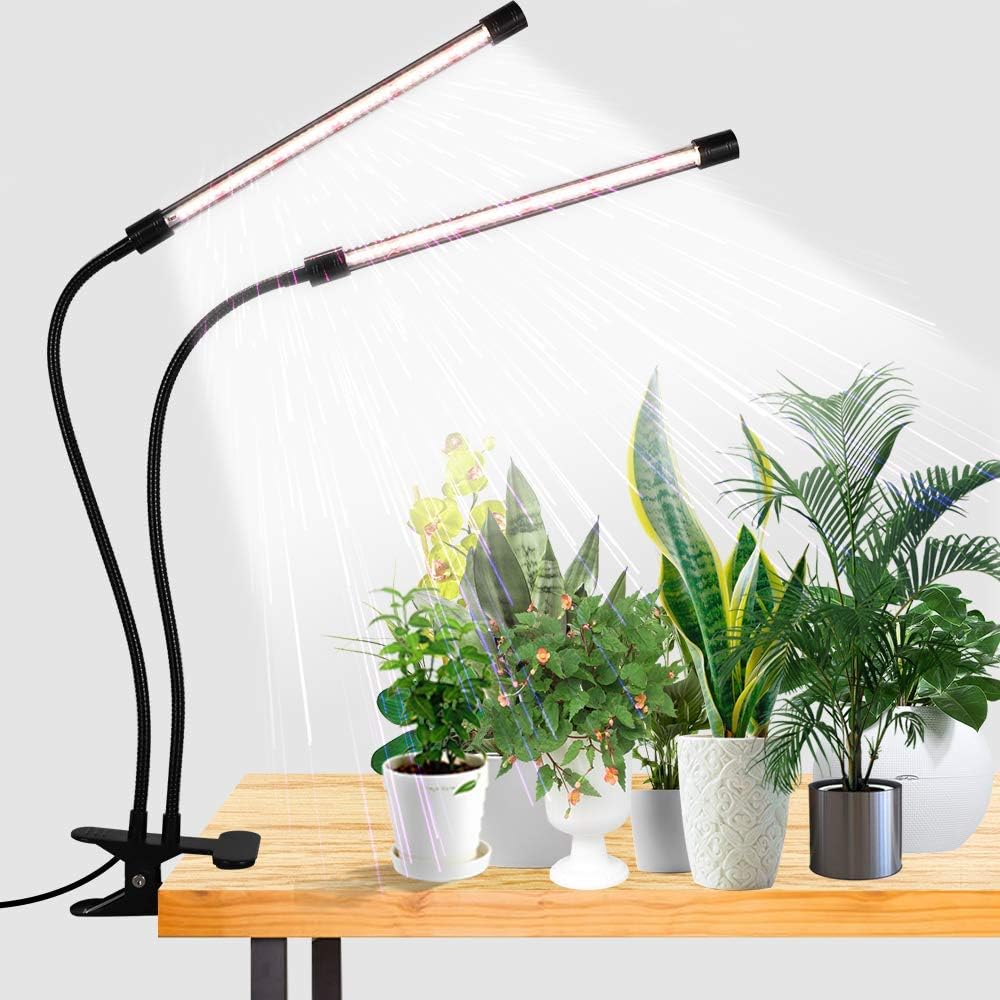
This GooingTop HY-021 is a compact clip-on grow light built for small houseplants, seedlings and shelf gardens. It uses 84 LEDs (white plus deep red) to deliver a 6000K full-spectrum output intended to mimic midday sun, with a high color-rendering output that also makes it pleasant as a reading lamp. Two flexible gooseneck heads and a strong clamp let you aim light precisely over pots and seed trays, while the attached remote provides 50%/100% dim levels and repeating timers at 4, 8 or 12 hours for hands-off scheduling. Practical benefits include low power draw (listed as roughly 10 W LED draw), a claimed 1 to 2 square meter coverage for seedlings, and an included timer that simplifies day/night cycles. Limitations are its design for small setups rather than large grow racks and the clip mounting limits placement compared with freestanding fixtures. The unit also relies on the corded remote instead of a smartphone app and the lifespan claim is typical of LEDs but not independently verifiable from the listing.
Best for: Buyers who want a simple, low-power, plug-and-play grow light to boost seedlings and a few houseplants on a desk or shelf and who value an easy-to-use timer and adjustable brightness.
Less Ideal for: Growers planning multi-shelf installations, larger vegetable grows, or who need networked or app-based control should consider larger bar lights or fixtures designed for commercial racks.
- Full-spectrum 6000K output with added 660 nm red LEDs to support vegetative growth and flowering
- Attached remote with dimming (50%/100%) and repeat timer settings (4/8/12 hours) for easy scheduling
- Flexible dual goosenecks and strong clamp enable precise positioning over small pots and seed trays
- High reported color rendering for comfortable viewing and accurate plant color assessment
- Low electrical draw around 10 W while covering small growing areas
- Clip-mount design and stated 1–2 m² coverage make it better suited to individual plants or small trays rather than large multi-shelf setups
- No smart app or wireless control option; remote is cord-attached which limits placement flexibility
Verdict: A compact, easy-to-use clip grow light that delivers full-spectrum light and convenient timer/dim controls for small indoor plant setups.
Aokrean Halo Full-Spectrum LED Grow Light with Base (2-Pack)

| Bulb Base | E26 |
|---|---|
| Number of Light Sources | 48 |
| Wattage | 10 watts |
| Power Source | Corded Electric |
| Timer | 3/9/12H |
The Aokrean Halo grow light is a compact LED lamp designed for indoor plant growth and decorative display. It ships as a two-pack and can be used either by inserting the stake into potting soil or by placing the pot on the supplied ABS base for a freestanding lamp. The unit uses 48 LEDs per light and offers three spectrum modes (white, warm white plus red, and mixed) plus ten brightness levels controlled by a touch/push button and a built-in timer with 3/9/12 hour cycling. The telescoping pole extends to cover taller small-to-medium pots and the 5V USB power and low 10W draw make it energy efficient and safe for continuous use. Practical benefits include flexible placement, multiple spectrum settings for seedlings through vegetative growth, and a small footprint that doubles as home decor. Limitations are its non-waterproof construction and modest light output suited to single pots or small clusters rather than a full grow shelf, and the base relies on pot weight for stability.
Best for: Buyers who want a simple, low-risk grow light for a few houseplants or seedlings and prefer plug-and-play controls, automatic timers, and a neat decorative look that fits on a windowsill or tabletop.
Less Ideal for: Gardeners who need high-intensity lighting for multiple larger plants, full shelves, or humid greenhouse conditions should choose a more powerful, waterproof fixture.
- Dual installation: stake into soil or place on included base for freestanding use
- Full-spectrum LEDs with three spectrum modes and 10 brightness levels for different growth stages
- Built-in timer with 3/9/12 hour cycles for automated daily light scheduling
- Low power draw (10 watts) and USB/5V power for efficient, low-heat operation
- Not water resistant so it must be kept away from wet environments
- Light output is modest and best for single small-to-medium pots rather than larger setups
Verdict: Aokrean Halo is a compact, easy-to-use full-spectrum grow light best suited to low-risk buyers who want a plug-and-play solution for a few indoor pots or seedlings.
Choosing the Right House Plant Grow Light: Key Factors to Consider
Light Spectrum and Tunability
House plants use different wavelengths for leaf growth and flowering. A fixture that delivers a balanced spectrum close to natural sunlight supports overall health, while tunable options let you emphasize blue light for compact vegetative growth or red light to encourage blooms. Accurate spectral data helps you match settings to plant families and life stages.
Without spectrum information, you may unknowingly favor foliage at the expense of flowering, or produce stretched, weak growth. Tunability and preset modes make it easier to adapt a single fixture to succulents, foliage plants, and bloomers without changing bulbs.
Coverage Area and Light Intensity
Coverage describes how much horizontal space a fixture will illuminate at a given hanging height, and intensity determines whether light reaches the lower leaves. Measure your setup and compare the specified coverage at realistic mounting heights rather than advertised maximums. For a single shelf of small pots, a narrow, higher-intensity beam may work; for a cluster of medium pots, wider coverage at lower intensity is usually better.
Consider the layout of your plants. Taller plants and those with dense canopies need higher overall light output to penetrate foliage, while low-light tolerant species require far less. A mismatch between coverage and plant arrangement leads to uneven growth and constant repositioning.
Energy Use and Practical Runtime
Grow lights often run many hours daily, so their watt draw and efficiency matter for ongoing operating cost and heat generation. Look for fixtures with high photon output per watt so you deliver usable light with lower electricity use. Energy-efficient designs also tend to run cooler, reducing stress on plants and the need for additional ventilation.
Think about the photoperiods your species need. If you plan long daily runtimes or extended winter use, efficiency becomes a primary cost and comfort consideration rather than an afterthought.
Heat Output and Safety
Excess heat can scorch leaves, dry potting mix, and force you to increase ventilation. Fixtures that manage heat through passive cooling or quiet fans help maintain safe canopy temperatures and stable humidity. Check how close a light must be to plants; some high-output fixtures require greater clearance to avoid heat damage, which affects perceived coverage and intensity.
Built-in thermal protection and moisture-resistant housings reduce risk in humid rooms like bathrooms or kitchens. Poor heat management shortens component life and increases maintenance.
Mounting, Controls, and Usability
How a light mounts and how easy it is to change height or angle has a big effect on day-to-day use. Adjustable hangers, rails or integrated hooks let you fine-tune intensity and uniformity as plants grow. Built-in timers, dimmers, and app controls simplify photoperiod management and let you create schedules for different species without manual intervention.
Ease of cleaning, cable routing, and straightforward instructions matter for hobbyists who prefer low-fuss setups. Complex controls are useful, but only if they are reliable and easy to program.
Durability and Environmental Resistance
Indoor growing often exposes fixtures to steam, mist from watering, and occasional knocks. Materials and assembly that resist corrosion, protect LEDs from humidity, and use sealed connectors extend service life. Consider IP ratings or explicit moisture-resistance statements for lights you plan to use in humid rooms.
A durable fixture reduces long-term replacement and provides consistent light output over seasons. Fragile construction may show early failure in everyday household environments.
Matching Light to Common House Plant Types
Different plant groups have different light preferences. Foliage plants such as philodendrons and pothos usually thrive under moderate intensity and warmer spectral balance, while succulents and cacti need higher intensity and a fuller spectrum to maintain compact growth.
Use lower-intensity, broader-coverage fixtures for shade-tolerant species placed on shelves or corners. For compact, high-light plants kept on windowsill trays or grow benches, choose fixtures with higher photon flux and the option to lower intensity as plants adapt.
- Foliage plants: moderate intensity, balanced spectrum
- Flowering houseplants: higher red content during bloom cycles
- Succulents: high intensity, full spectrum, shorter distances
Placement and Mounting Best Practices
Measure available vertical space before choosing a light. Hanging height is one of the easiest ways to tune intensity and coverage without changing equipment.
Mount fixtures so air can circulate above and below the unit to aid cooling. Use adjustable hangers or chains to lower lights as plants grow rather than moving pots repeatedly.
- Keep high-output lights further away to prevent scorching
- Use reflectors or white backdrops to increase effective coverage
- Group plants with similar light needs together for consistent results
Managing Schedules and Photoperiods
Many house plants prefer a consistent daily light span that mimics seasonal day length. Built-in timers or simple plug timers let you establish reliable photoperiods without manual switching.
Adjust the length and intensity of exposure as plants move between growth stages. Shorten nights during active vegetative growth and increase darkness when resting or inducing flowering, according to the species' needs.
- Use 12 to 16 hours for most active growth phases
- Reduce intensity or hours for rest periods
- Mimic natural seasonal shifts gradually over several weeks
Integrating Grow Lights with Natural Sunlight
Use supplemental fixtures to fill gaps in natural light rather than replace it. Morning or late-afternoon supplemental light extends usable hours and supports consistent daily totals of photons.
Watch how shadows and window direction affect distribution. South-facing windows give strong direct light that may only need short supplemental periods, while north-facing rooms typically rely on continuous supplemental illumination.
- Combine natural and artificial light to reduce runtime
- Position fixtures to avoid direct glare into living spaces
- Balance color temperature with room aesthetics by choosing warmer or cooler outputs
Maintenance and Longevity Tips
Clean lenses and reflectors periodically to prevent dust from reducing output. Small reductions in light can compound into noticeable growth changes over months.
Inspect mounting hardware and cables for wear, and keep fixtures away from prolonged water spray. Replace components like external drivers or hanging hardware at the first sign of corrosion to prevent failures.
- Wipe surfaces monthly in standard household environments
- Check fan vents and passive cooling channels for blockages
- Store spare connectors and hanging hardware to simplify repairs
How We Chose the Best House Plant Grow Light
We shortlisted lights based on measurable, gardener-relevant dimensions rather than broad claims. Primary evaluation criteria included spectrum accuracy and tunability to match vegetative and flowering needs; usable light coverage at realistic hanging heights; power efficiency and heat management so fixtures can run for long photoperiods without damaging plants; and build quality plus mounting and control options that affect everyday setup. We also considered control features such as timers and dimming because accurate photoperiods and intensity adjustments matter for different species and seasons. Durability and moisture resistance were assessed to ensure safe operation in kitchen, bathroom, or greenhouse-adjacent environments. Items were excluded if they lacked published spectral data, had unclear mounting instructions, or used poorly managed high heat that risks foliage damage. These filters focused the list on versatile, safe, and efficient fixtures that perform reliably across common indoor growing scenarios.
FAQ
How far should a grow light be from my house plants?
Distance depends on output and plant type. Low-light plants can be 12 to 24 inches away from moderate fixtures, while succulents and high-light plants often need 6 to 12 inches from a high-output light. Always start higher and lower the fixture if plants show signs of needing more intensity.
Can I use a single fixture for plants with different needs?
Often you can with zoning and adjustable controls. Group plants with similar needs and use dimming or height adjustments to tune intensity. For very different requirements, consider separate fixtures or movable setups to avoid compromises that slow growth.
Does light spectrum really affect flowering?
Yes. Red and far-red wavelengths influence flowering signals in many species, while blue light promotes compact vegetative growth. Spectrum matters most when you are trying to induce blooms or control plant shape over several weeks.
How long should grow lights run each day for house plants?
Most house plants do well with 12 to 16 hours of light during active growth. Some species need shorter or longer periods, so check species-specific recommendations. Use timers to maintain consistent daily schedules.
Will grow lights raise room temperature noticeably?
Modern LED fixtures are energy efficient and produce less heat than older technologies, but high-output units can still raise canopy temperatures. Good heat management and proper spacing keep temperatures within safe ranges for most indoor plants.
Are moisture-resistant fixtures necessary for indoor growing?
Moisture resistance is helpful if you keep plants in bathrooms, kitchens, or humid microclimates near misters. For typical living-room installations, standard indoor-rated fixtures are usually adequate, but sealed connectors and corrosion-resistant finishes add durability.
Final Verdict
Prioritize spectrum accuracy, usable coverage, and efficient heat management when choosing a house plant grow light. Decide whether tunability and advanced controls matter for the species you grow, then match fixture coverage to your available space and plant layout. Focus on the tradeoffs between intensity, energy use, and convenience. With those priorities in mind, you can confidently pick a fixture that supports healthy growth, reduces maintenance, and fits your indoor setup.
