

Note: This article contains affiliate links. If you click on these links and make a purchase, I may earn a small commission at no extra cost to you. This helps support my research and content. Read my full affiliate disclosure here.
A 100-foot soaker hose can simplify watering long garden rows, flower borders, and narrow lawns while saving water compared with overhead sprinkling. The right hose gives steady seepage rather than jets, so roots get consistent moisture and you avoid runoff or soggy patches. This guide covers our shortlisted top picks across common garden situations and highlights which features matter most for durability, flow control, and ease of installation. Read on for practical buying guidance and clear criteria we used to evaluate each option.
Top Picks at a Glance
| Best Overall The best all-around choice for most situations | Hlinker Flat Soaker Hose 100 ft (linkable) |  |
| Best Quality Built to a higher standard if you want something more solid | Aurssa 1/2" 100 ft Rubber Soaker Hose (with connector kit) |  |
| Best Value The sweet spot between price and what you get | AIODE Flat Soaker Hose 100 ft |  |
| Best Budget The cheapest option that still gets the job done reliably | Winisok 50 ft Soaker Hose (50 ft x 2 Pack) |  |
| Highest Rated A top-rated pick with lots of positive feedback | MHMHM 5/8" Soaker Hose with Solid Brass Fittings, 100 ft |  |
| Most Popular A crowd favorite that many people choose with confidence | Secbulk Flat Soaker Hose, 100 ft Linkable Drip Irrigation Hose |  |
| Best Seller A high-volume bestseller chosen again and again | Hourleey Flat Soaker Hose 100 ft – Linkable Dual-Layer Drip Hose |  |
Hlinker Flat Soaker Hose 100 ft (linkable)

| Material Type | Vinyl |
|---|---|
| Maximum Pressure | 100 psi |
| Item Length | 100 feet |
| Nominal Wall Thickness | 0.5 inch |
This Hlinker flat soaker hose is a 100 foot, linkable drip-style hose made from recycled vinyl with a fabric cover to provide slow, consistent seepage along its length. It is intended to lie flat along flower beds or be buried under a shallow layer of mulch so water reaches plant roots rather than wetting foliage. The hose connects end-to-end with rust-resistant caps so you can build a custom run and it is compatible with standard garden hose threads and irrigation timers. The double-layer construction and fabric covering improve resistance to sun damage and help reduce kinks while the flat profile makes it easy to snake between plants and roll up for storage. Recommended working pressure is in the 40 to 90 psi range for the most even output, and it has been tested to withstand higher pressures briefly but sustained high pressure will shorten its life. For gardeners who want targeted, water-efficient irrigation for flower beds this hose is a practical, easy-to-install option, though it requires a suitable pressure source and occasional checks for wear where fittings connect.
Best for: Gardeners who want a simple, water-efficient way to irrigate flower beds and narrow planting rows and who prefer a low-maintenance, install-and-forget drip solution.
Less Ideal for: People who need high-pressure spray irrigation, very long runs without connectors, or a permanently buried irrigation system designed for professional landscape installation.
- Flat, kink-resistant design lies close to soil for uniform root watering
- Linkable ends and standard threads let you build custom lengths and attach timers
- Fabric-covered double layer resists sun damage and extends service life
- Made from recycled vinyl and CA65-compliant materials suitable for vegetables and herbs
- Requires adequate water pressure (recommended 40–90 psi) for even seepage
- Connections and end caps can wear over time and need periodic inspection
Verdict: Choose this hose when you want an easy-to-configure, flat soaker hose that delivers steady root-level watering for flower beds.
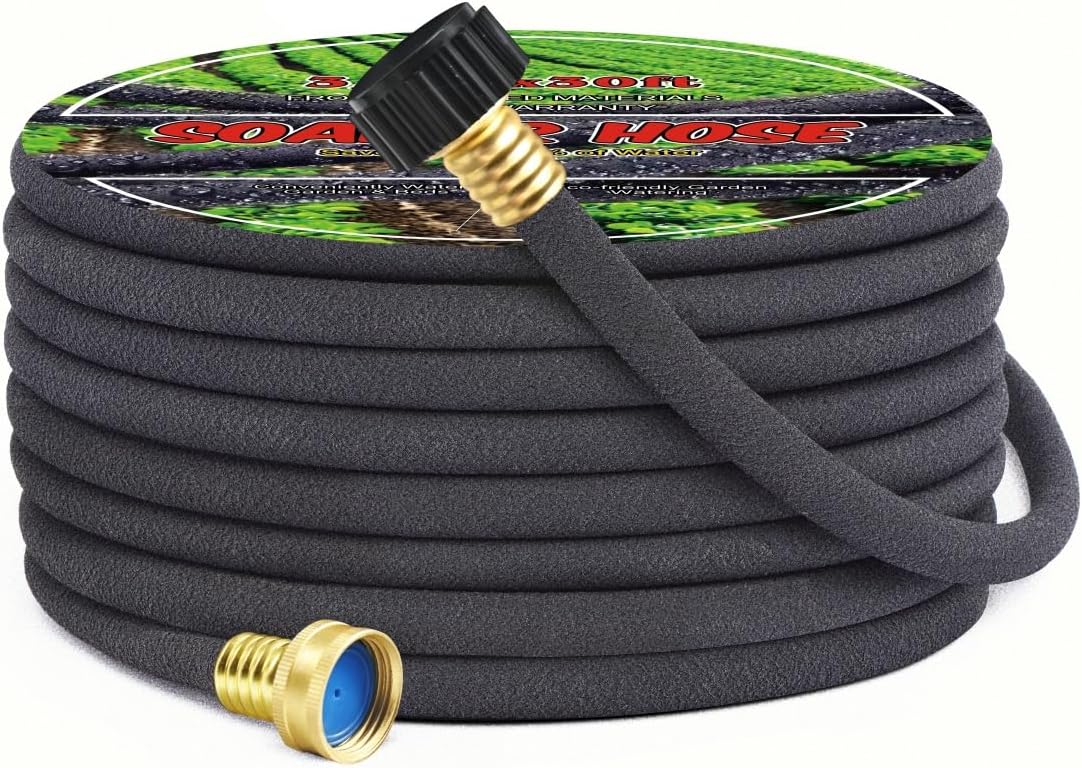
Aurssa 1/2" 100 ft Rubber Soaker Hose (with connector kit)
| Material Type | Rubber |
|---|---|
| Outside Diameter | 0.5 inches |
| Item Length | 120 inches |
| Maximum Pressure | 60 psi |
| Thread Size | 3/4" GHT |
This Aurssa 100 ft rubber soaker hose is built for steady, water-efficient garden irrigation across long beds and vegetable rows. It connects to a standard 3/4" GHT threaded faucet or hose and distributes water through tiny pores along its length, delivering a reported soak rate of 5 to 8 liters and operating up to 60 psi. The rubber construction makes the line flexible enough to weave through plants and durable enough to resist kinking and abrasion compared with thin vinyl alternatives. It ships ready to use and can be trimmed and joined with the included fittings to match bed layouts. Because it wets soil at the root zone it reduces foliage wetting and can lower overall water use and disease risk. Expect the hose to require occasional adjustments to maintain even seepage along long runs and to be slower to dry or store than lighter materials. It also needs a regulator or timer if you want precise flow control across variable terrain or mixed plantings.
Best for: Gardeners focused on performance and water efficiency who need a continuous long run for flower beds or vegetable rows and want a durable, flexible hose they can trim and join to suit a layout.
Less Ideal for: Those who need an ultra-lightweight, temporary solution for occasional use or who require automatic pressure regulation built into the hose should consider alternative systems.
- Long 100 ft length covers extended beds without many joins
- Rubber construction improves flexibility and resistance to kinks and abrasion
- Compatible 3/4" GHT thread and included connectors let you trim and join runs for custom layouts
- Delivers slow, ground-level watering that reduces foliage wetting and conserves water
- Soak rate and distribution can vary with water pressure and slope, requiring layout tweaks for even coverage
- Heavier rubber is bulkier to store and slower to dry than lightweight soaker hoses
Verdict: Choose this durable 100 ft rubber soaker hose when you want reliable, long-run root-zone watering that conserves water and stands up to regular garden use.
AIODE Flat Soaker Hose 100 ft

| Material Type | Pvc And Nylon |
|---|---|
| Item Length | 100 feet |
| Maximum Pressure | 90 psi |
| Nominal Wall Thickness | 0.6 inches |
The AIODE 100 ft flat soaker hose is built to provide low-flow, root-focused irrigation across long garden beds. Its double-layer PVC and nylon construction is intended to give consistent seepage along the length while resisting kinks and abrasion. Typical use is to run the hose along planting rows or weave it through raised beds, attach to a standard spigot or inline timer, and bury or mulch over it for discreet, water-efficient delivery. Notable features include a claimed 40–90 psi working range and a flat profile that is easy to coil and store. In practice the hose is lightweight and simple for one person to lay out, and it can reduce surface runoff and evaporation compared with sprinklers. Limitations are that pressure requirements mean very low-pressure water sources or very long runs with many branches may need a regulator or splitter to maintain even seepage, and the flat design is less robust against punctures than thick rubber garden hoses. Overall it is a practical, space-saving option for gardeners focused on steady, root-level watering rather than high-pressure tasks.
Best for: Gardeners who want a practical, water-efficient way to irrigate long beds or multiple plants with an easy-to-install, low-profile hose.
Less Ideal for: People who need high-pressure watering, frequent dragging over rough terrain, or a hose used as a general-purpose utility line should consider a conventional rubber hose or a pressure-rated drip system instead.
- Double-layer PVC and nylon construction for more consistent seepage and durability
- Flat, lightweight profile that is easy to unroll, arrange, and store
- Suitable for direct root watering of beds, vegetables, shrubs and trees which reduces evaporation
- Requires moderate inlet pressure to maintain even seepage across long runs
- Flat tubing is more prone to puncture from sharp objects compared with thicker rubber hoses
Verdict: Choose this 100 ft flat soaker hose if you want a lightweight, space-saving solution that delivers steady root-level watering across long garden beds.
Winisok 50 ft Soaker Hose (50 ft x 2 Pack)

| Item Length | 50 feet |
|---|---|
| Nominal Wall Thickness | 0.125 inches |
| Outside Diameter | 0.75 inches |
| Maximum Pressure | 60 psi |
| Item Weight | 2 kg |
This Winisok soaker hose is a simple drip-irrigation solution for watering garden beds, lawns, and raised planters. It is constructed with a PVC inner tube reinforced by fabric and a cloth cover so it resists leaks and can lie buried or run along the soil surface. The hose connects with standard 3/4" threaded fittings so you can attach it to an outdoor faucet or link several lengths to cover larger beds. It is meant to operate under moderate pressure and the manufacturer warns to keep pressure below 60 psi; in practice you start with low pressure and increase slowly to prevent kinks and ensure even seepage. The hose is lightweight and flexible, making it easy to position and store, and its uniform water seepage can reduce surface evaporation and cut watering time. Expect typical limitations of economical PVC soakers: it will be less puncture resistant than heavy rubber hoses and may require occasional repositioning or protection from sharp objects to avoid damage.
Best for: Buyers who want an affordable, easy-to-deploy drip option to save water and automate watering for garden beds and small lawns. Good for gardeners prioritizing cost and simplicity over heavy-duty durability.
Less Ideal for: People needing a rugged, long-term underground irrigation backbone or frequent commercial use should choose heavier-duty tubing or professional drip lines instead.
- Delivers slow, uniform seepage to hydrate roots and reduce surface evaporation
- Cloth-covered PVC construction improves leak resistance compared with simple porous tubing
- Standard 3/4" threaded fittings allow easy connection to faucets and to chain multiple lengths
- Flexible and lightweight for easy placement, burial, and storage
- Not rated for high-pressure use and can kink if water pressure is raised too quickly
- PVC construction is less durable against punctures and abrasion than heavier rubber options
Verdict: An inexpensive, easy-to-use soaker hose that cuts watering time and water loss, making it a smart budget choice for home garden beds and small lawns.
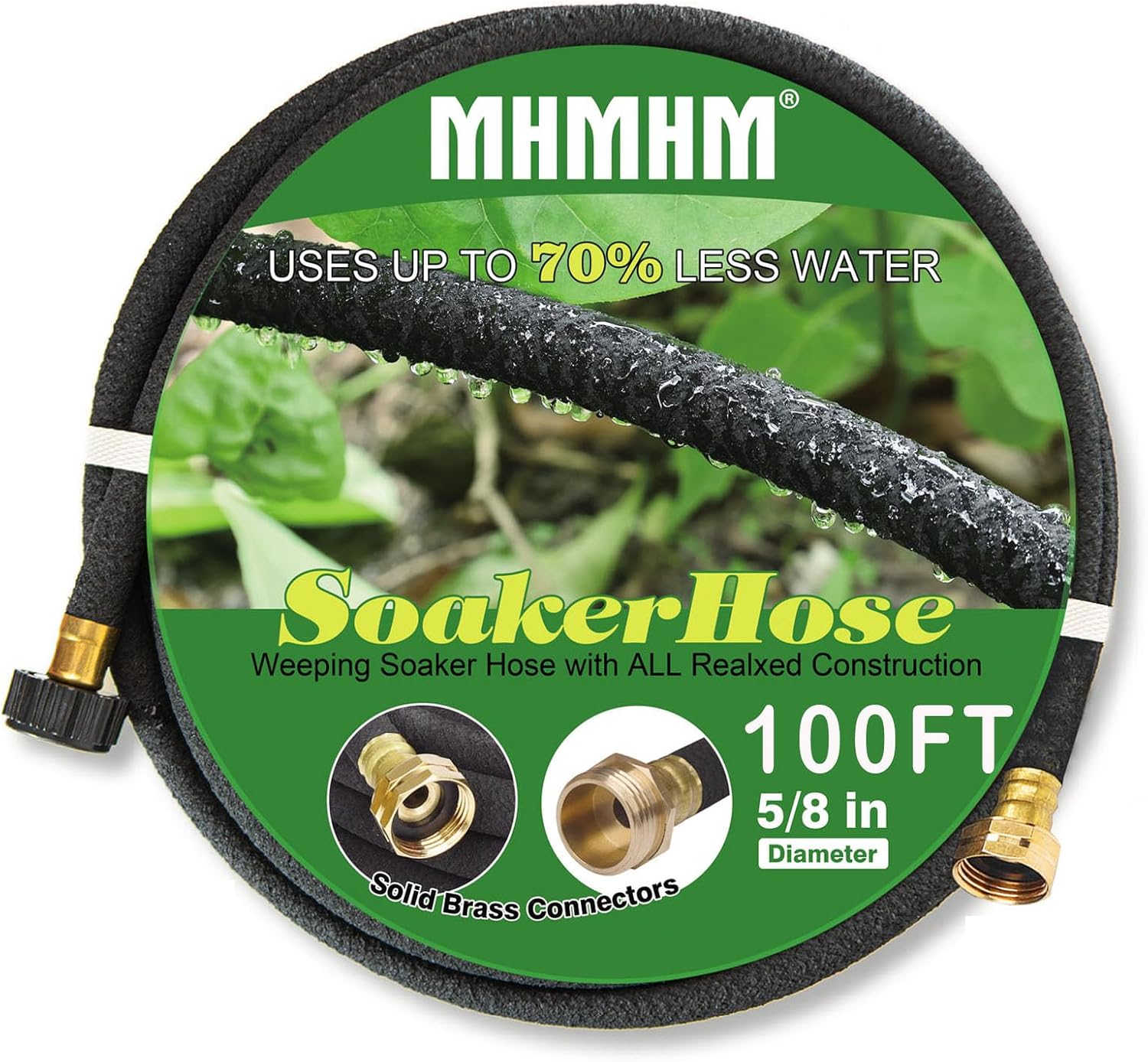
MHMHM 5/8" Soaker Hose with Solid Brass Fittings, 100 ft
| Material Type | Rubber |
|---|---|
| Nominal Wall Thickness | 0.3125 inches |
| Outside Diameter | 0.63 inches |
| Item Length | 100 feet |
| Included Components | soaker hose |
This MHMHM 5/8" soaker hose is built for steady, low-pressure watering of flower beds, vegetable rows, and around shrubs. Made from recycled rubber with 5/8-inch outside diameter and solid brass fittings, it lays flat along planting beds and seeps water directly into the root zone to cut runoff and evaporation. The hose’s round, flexible construction makes it easy to arrange in straight runs or loop around plants without frequent kinking, and the brass connector adds durability at connection points. The manufacturer rates the material to withstand extreme temperatures from -40°F to 140°F, which helps it survive seasonal outdoor use. Expect consistent slow seepage that saves water compared with overhead watering, but you will need a faucet pressure regulator or timer for best results and regular checks for clogs in heavy-mineral water areas. This hose is straightforward to cut to length and join with couplers for longer runs but does not include additional connectors or stakes in the package.
Best for: Gardeners who prioritize a dependable, long-lasting irrigation solution for beds and small orchards and who want consistent, low-pressure root watering rather than overhead sprinkling.
Less Ideal for: People who need a complete plug-and-play kit with fittings and stakes included or those who prefer high-pressure drip systems for potted plants and hanging baskets.
- Solid brass fittings improve connection durability and reduce leaks at joints
- Recycled rubber construction rated for -40°F to 140°F for year-round resilience
- Round 5/8" profile resists kinking and can be routed in loops or straight runs
- Delivers slow, root-level watering that reduces evaporation and runoff
- No additional connectors, stakes, or pressure regulator included
- May require periodic flushing or replacement in areas with hard water or heavy sediment
Verdict: Choose this hose when you want a robust, all-season 100-foot soaker hose with durable brass fittings for reliable root-level irrigation.
Secbulk Flat Soaker Hose, 100 ft Linkable Drip Irrigation Hose

| Material Type | Vinyl |
|---|---|
| Maximum Pressure | 100 psi |
| Included Components | hose |
| Unit Count | 1 Count |
This Secbulk flat soaker hose is a linkable, fabric-covered vinyl hose intended to deliver slow, even seepage along its length for garden beds, raised beds, and narrow planting rows. It connects end to end with standard garden hose threads and includes rust-resistant end caps so you can build a longer irrigation run or attach a timer. The double-layer vinyl with a fabric cover resists sun damage better than simple rubber weeping hoses and the flat profile makes it easy to snake under plants and roll up for seasonal storage. It is rated for up to 100 psi and the manufacturer recommends 40 to 90 psi for best soaking performance. Because it is made from recycled vinyl and passes CA65, it is positioned as safe for use around vegetables and herbs. Limitations to expect are the need to manage inlet pressure for consistent flow and the usual soaker-hose tendency for surface wetting if left exposed rather than buried under mulch. For gardeners who want a modular, low-maintenance slow-watering solution, this hose delivers predictable, water-saving coverage across a long run.
Best for: Gardeners who want a long, modular soaker hose to set up low-effort, water-efficient irrigation for beds and rows and who value product durability and safety for edibles.
Less Ideal for: People who need precise, adjustable emitters for container plants or flow-control on individual plants should consider drip tubing or micro-sprayers instead.
- Linkable ends and rust-resistant caps let you extend runs and add a timer or standard fittings
- Flat, kink-resistant profile is easy to lay out, tuck under plants, and roll up for storage
- Fabric-covered double-layer vinyl offers improved UV resistance compared with simple rubber weeping hoses
- Made from recycled vinyl and tested to CA65, presented as safe for use around edible plants
- Performs best within a recommended pressure range so you may need a pressure regulator for inconsistent water supplies
- Surface exposure can cause uneven watering unless buried under mulch or placed carefully
Verdict: A long, durable flat soaker hose that links together for low-effort, water-saving irrigation across large garden beds.
Hourleey Flat Soaker Hose 100 ft – Linkable Dual-Layer Drip Hose

| Material Type | Nylon |
|---|---|
| Item Length | 100 feet |
| Maximum Pressure | 150 psi |
| Included Components | Soaker Hose, Stake |
The Hourleey Flat Soaker Hose is a 100 foot, linkable drip hose intended for garden beds and landscaped rows where steady, low-volume watering is needed. It delivers water through evenly spaced holes along a dual-layer PVC and nylon construction so moisture soaks into the root zone instead of spraying the surface. Typical use is laying the hose along beds, staking it in place, connecting multiple lengths end-to-end, and running at the recommended working pressure for even output. Notable features include a kink-resistant flat profile that tucks under mulch, a fabric cover to resist clogging, and stakes for straightforward placement. Practical benefits are clear water savings when compared with open hoses and less hand-watering for seedlings and vegetables. Important limitations are that it is meant for cold water only and performs best within the suggested 60–80 PSI range; pressure outside that range can affect drip consistency. Also the flat profile may be harder to repair than standard round soaker hoses if punctured.
Best for: Gardeners who prioritize efficient, low-maintenance irrigation for beds or vegetable rows and want a product that can be extended and tucked under mulch for consistent root watering.
Less Ideal for: People who need a hose for frequent high-pressure or hot-water tasks or who prefer a round, easily repairable soaker hose for heavy-duty rough use.
- Delivers water directly to roots for efficient irrigation and reduced evaporation
- Linkable end-to-end design makes it easy to extend coverage across beds
- Dual-layer PVC and nylon construction offers kink resistance and durability
- Fabric-covered design helps reduce clogging and allows under-mulch placement
- Requires appropriate water pressure to maintain even drip performance
- Not rated for use with hot water
Verdict: Choose this hose if you want a water-saving, linkable soaker system that delivers steady root-zone irrigation across long garden beds.
Choosing the Right 100-Foot Soaker Hose: Key Factors to Consider
Water Distribution Along 100 Feet
Even seepage along the whole 100-foot run is essential. If pore density or patterning is uneven, plants near the faucet can get overwatered while the far end remains dry. Consider hoses that advertise balanced pore spacing or include built-in pressure compensation features. In practice, plan to run the hose with slightly reduced household pressure or use a pressure regulator to improve uniformity.
Also think about layout. Long straight runs behave differently than coiled layouts. If you snake the hose around beds, some sections will receive slightly more flow. Placing the hose where gravity and level changes are minimal helps maintain even distribution.
Material and UV Resistance
A 100-foot hose spends a lot of time exposed to sun and soil abrasion. Materials with thicker walls, reinforced fibers, or UV-stabilized polymers resist cracking and hardening. Hoses made from simple thin plastic will develop leaks faster, especially at connection points or where they rub against rough edging.
Inspect for reinforced seams or multi-layer construction when durability is a priority. If you plan to bury the hose under a thin layer of mulch, choose materials rated for occasional soil contact and that will not degrade quickly in moist conditions.
Compatibility and Connection Options
Long runs often require linking multiple hoses or attaching an end cap and a valve. Check that fittings are compatible with standard garden hose threads, have sturdy barbed ends for snug clamps, or include quick-connect adapters. Built-in end caps or repair kits make field fixes easier and reduce downtime during the growing season.
Also verify whether the product works with common timers and pressure regulators. A hose that requires proprietary adapters can complicate a simple drip setup and increase effort when expanding or repairing the line.
Kink Resistance and Flexibility
Flexibility matters when you weave a hose through beds or around plants. A hose that kinks will restrict flow and create uneven watering spots. Look for hoses designed with pliable but resilient walls that bend smoothly without flattening.
If you frequently move the hose or store it coiled, select one that retains flexibility in cooler weather. Some thicker hoses resist kinking but can be stiff to position, so balance flexibility with the need for a stable lay.
Flow Control and Pressure Tolerance
Household water pressure varies and affects seepage rate on long hoses. Hoses that tolerate a range of pressures or that include flow adjustment fittings help you fine-tune moisture delivery. Without flow control, higher pressure can force water out through larger pores near the faucet and leave the far end underwatered.
Consider adding a pressure regulator or inline valve if your household pressure is above typical drip levels. Also account for seasonal pressure changes and frost closure; choose hose materials and connectors that handle typical pressure fluctuations without leaking.
Planning a Layout for a 100-Foot Run
Measure the area before buying so you avoid excess coil and pressure loss. For narrow beds, a single straight line down the center is often sufficient. For wider beds, consider two parallel runs or weaving the hose in a gentle S-shape so all root zones receive moisture.
Account for elevation changes. A hose that climbs or drops significantly can change local pressure and seep rates. Keep high and low sections as level as possible, or use additional valves to balance flow in sections separated by grade.
- Run the hose along the soil surface and cover lightly with mulch to reduce evaporation.
- Avoid running under heavy foot traffic or where garden tools may abrade the tubing.
- Label connection points so you can troubleshoot blockages or leaks easily.
Installation Tips and Common Repairs
Install using gentle curves and avoid sharp bends that create flat spots. When attaching to a spigot use a short, reinforced lead-in section to reduce stress at the faucet. Test the entire length at a lower pressure before leaving it for long periods so you can spot uneven wetting or leaks.
Repair kits and clamps are valuable for long hoses. Small splits or worn sections can be cut out and reconnected with barbed couplings or compression fittings, which restores function quickly without replacing the whole run.
- Flush the hose before first use to clear debris.
- Seal connections with clamps or correct-size fittings rather than relying on friction alone.
- Store coiled off the ground in winter or drain and roll up if freezing conditions are expected.
Integrating Timers and Pressure Regulators
Timers make consistent watering simple, but long soaker runs need appropriate run times to avoid oversaturation near the source. Start with short cycles and check soil moisture at the far end to dial in timing. Where pressure is high, add a regulator to prevent excessive seepage near the faucet.
Some gardeners use multiple short cycles spaced throughout the day rather than one long soak. This reduces runoff and encourages deeper root penetration while matching the slow seep rate of a soaker hose.
- Use a timer with manual override for quick adjustments during hot spells.
- Choose a regulator rated for low-flow drip applications.
- If pressure varies widely, consider zoning the line with separate valves.
Seasonal Care and Winterizing
A 100-foot soaker hose left full of water can be damaged by freezing. At season end, disconnect the hose, drain completely, and store coiled in a protected spot. If the hose remains installed, drain and cap low points to avoid freeze expansion.
During the season, inspect hoses periodically for hardening or UV cracking. Repositioning slightly each year can extend life by distributing wear across a different surface area against edging or mulch.
- Avoid prolonged direct sun exposure when possible by covering with a thin layer of mulch.
- Keep repair supplies on hand to patch small leaks quickly.
- Replace worn fittings rather than forcing aged connectors that leak.
Water-Saving Strategies With Soaker Hoses
Soaker hoses are efficient when matched to plant water needs. Group plants with similar moisture requirements on the same run to avoid over- or under-watering. Use mulch to trap moisture and reduce watering frequency.
Monitor soil moisture rather than following a rigid schedule. Because seep rates can vary, occasional spot checks at the far end and midpoints of the run help prevent chronic under-watering.
- Consider shorter runs or multiple zones for mixed plantings.
- Combine soaker hose irrigation with hand-watering for new transplants.
- Reduce run times during cool or rainy periods to avoid saturation.
How We Chose the Best 100-Foot Soaker Hose
We focused on attributes that matter for long-run, in-ground or surface-level drip irrigation when using a 100-foot soaker hose. Key evaluation criteria included uniform water distribution along a long length, material durability against abrasion and UV, connection and repair options for linking or ending a long run, flow control and compatibility with common hose valves and timers, and ease of installation including kink resistance and flexibility when snaking around beds. We tested these dimensions by comparing manufacturer specifications for pore density and patterning, material composition and wall thickness, fitting types and included adapters, and user-reported longevity in garden settings. We excluded hoses meant only for short-term seasonal use, decorative porous tubing with very low flow, and proprietary systems that require special fittings not commonly found in home gardens. The result is a list that favors long-run reliability, consistent seepage over the entire 100-foot length, and straightforward integration with typical backyard irrigation setups.
FAQ
Can a 100-foot soaker hose be connected to a regular faucet and timer?
Yes, most hoses will attach to a standard faucet using common threads. For timed schedules, use a low-flow compatible timer and consider adding a pressure regulator to keep seepage even along the full length.
Will a single 100-foot run water a wide garden bed evenly?
Often it will not cover very wide beds evenly. For wider areas, run the hose in a serpentine pattern or use multiple parallel runs so roots across the bed receive similar moisture.
How do I prevent the end of the hose from staying dry?
Reduce inlet pressure, use a pressure regulator, or create a layout that minimizes elevation change. Testing run times and checking moisture at the far end during setup helps you find the right balance.
Can soaker hoses be buried under mulch or soil?
Yes, light covering with mulch helps conserve moisture and protects the hose from UV. Avoid deep burial under heavy soil that may compress the hose and restrict seepage or make repairs difficult.
How do I repair small leaks in a long soaker hose?
Cut out the damaged section and reconnect with a barbed coupling and hose clamps or use a repair sleeve designed for porous hoses. Keep repair kits on hand so fixes are quick and inexpensive.
How long should I run a 100-foot soaker hose each session?
Run time depends on soil type and plant needs. Start with short cycles of 20 to 40 minutes and check moisture depth. Sandy soils drain faster and may need more frequent cycles; clay holds water longer and needs shorter intervals.
Final Verdict
When choosing a 100-foot soaker hose, prioritize even water distribution and material durability for a long, low-maintenance season. Pay attention to connection options and flow control so you can tune seepage for your soil and plant spacing. Expect tradeoffs between flexibility and wall thickness; the best choice balances long-run reliability with the ability to route the hose where you need it. With the right layout, pressure control, and seasonal care, a 100-foot soaker hose is a simple, water-efficient solution for long beds and narrow lawns.
