

Note: This article contains affiliate links. If you click on these links and make a purchase, I may earn a small commission at no extra cost to you. This helps support my research and content. Read my full affiliate disclosure here.
If you mow uneven terrain, steep slopes, or damp yards, a 4X4 lawn mower can make the job safer and faster. These machines transfer power to all wheels, improving traction on hills, in mud, and when pulling attachments. Choosing the right unit affects how easy the mower is to handle, how it treats your turf, and how much routine service it needs. This guide shortlists the top 5 4X4 lawn mowers for Best 4X4 Lawn Mower and walks through the real-world features gardeners care about, including traction systems, engine durability, and turf protection. The picks that follow were evaluated on concrete performance and maintenance criteria to help you match a machine to your yard and tasks.
Top Picks at a Glance
| Best Quality Built to a higher standard if you want something more solid | Mammotion LUBA 2 AWD 5000HX Robot Lawn Mower (All-Wheel Drive, 2.2"–4.0" Cutting Height) |  |
| Best Value The sweet spot between price and what you get | WORX Landroid Vision Cloud 4WD Robot Lawn Mower (WR344) |  |
| Best Budget The cheapest option that still gets the job done reliably | Segway Navimow i210 AWD Robot Lawnmower |  |
| Highest Rated A top-rated pick with lots of positive feedback | YARBO Y40P Core Robot Lawn Mower Pro (20" Deck, Wire-Free, NetRTK Navigation) |  |
| Most Popular A crowd favorite that many people choose with confidence | DREAME A3 AWD Pro 3500 LiDAR Robot Lawn Mower, 4WD, 15.8" Dual-Disc Cutting |  |
Mammotion LUBA 2 AWD 5000HX Robot Lawn Mower (All-Wheel Drive, 2.2"–4.0" Cutting Height)

| Cutting width | 15.7 inches |
|---|---|
| Cutting height range | 2.2–4.0 inches |
| Battery capacity | 12 Ah |
| Connectivity | Bluetooth, Wi‑Fi, 4G |
| Max. mowing area | 1.25 acres |
The Mammotion LUBA 2 AWD 5000HX is a feature-rich robotic mower built for larger home lawns and challenging terrain. It uses an all-wheel-drive system and 165 W motors to tackle steep slopes up to 80 percent and rough ground that would stop many yard robots. UltraSense AI vision plus RTK positioning lets it map the lawn, manage up to 50 zones, and perform precise edge and zero-distance cutting without relying solely on satellite signals. Dual cutting discs with a roughly 15.7 inch cutting width give relatively wide coverage, and a 12 Ah battery provides multiple runs per charge with automatic return-to-charge and resume. Connectivity via 4G, Wi-Fi, and Bluetooth lets you monitor and change schedules from the app, and built-in GPS and anti-theft features add protection. Important practical limits are its weight and complexity: it is a substantial unit that benefits from careful initial setup and occasional tuning, and mowing area per charge is listed below a full acre so very large properties will need more frequent charging cycles.
Best for: Homeowners with roughly one-acre lawns or smaller who want a capable autonomous mower that handles steep or uneven terrain and who value connected features and anti-theft protection.
Less Ideal for: People wanting a very lightweight, low-maintenance unit for small flat yards or buyers who need continuous uninterrupted mowing on significantly larger properties without frequent recharge breaks.
- All-wheel-drive and 165 W motors provide strong traction for slopes up to 80% and rough terrain
- UltraSense AI vision plus RTK navigation enables precise edge cutting and reliable mapping without sole reliance on GPS
- Manages up to 50 separate mowing zones and resumes after charging for hands-off lawn coverage
- 4G, Wi-Fi, and Bluetooth connectivity with app control and GPS anti-theft tracking
- Mowing area per charge is under a full acre so larger 1+ acre properties may see frequent charging cycles
- Relatively heavy and complex, requiring careful initial setup and occasional maintenance
Verdict: Choose the LUBA 2 AWD 5000HX if you need a connected, AWD robotic mower that reliably handles steep, uneven lawns up to about an acre with advanced mapping and anti-theft features.
WORX Landroid Vision Cloud 4WD Robot Lawn Mower (WR344)
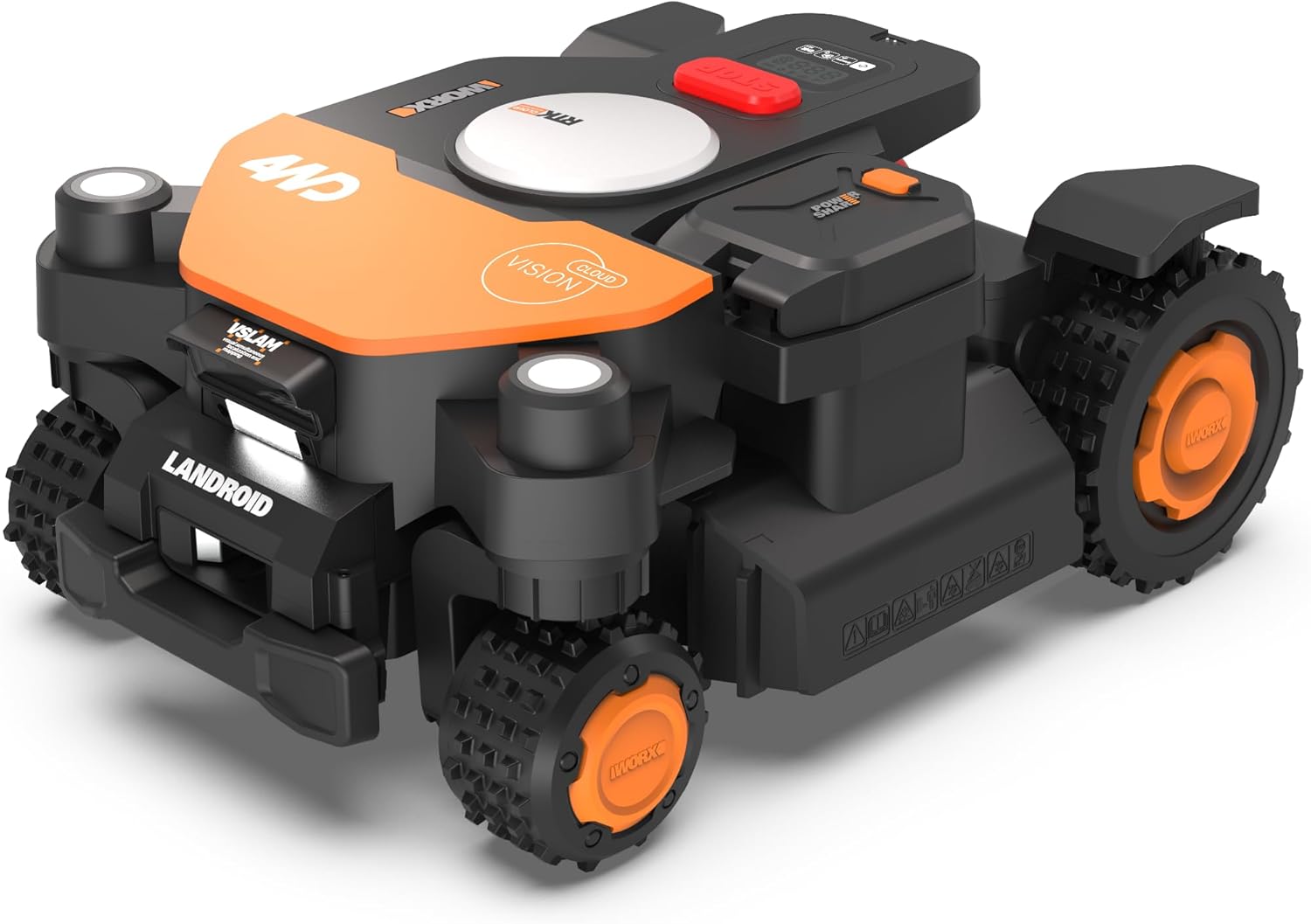
| Power Source | Battery Powered |
|---|---|
| Operation Mode | Automatic |
| Cutting width | 8.7 inches |
| Maximum Adjustable Cutting Height | 3.54 inches |
| Minimum Adjustable Cutting Height | 1.57 inches |
The WORX Landroid Vision Cloud 4WD (WR344) is a fully automatic robot mower built to handle steep, uneven, and complex lawns up to about one acre. It uses Vision AI plus RTK cloud positioning so the mower maps your yard, detects and avoids obstacles, and follows precise paths without perimeter wire. Notable features include four-wheel drive and a terrain-adaptive chassis for traction on slopes up to 84%, auto mapping and multi-zone management via the app, cut-to-zero edge trimming to reduce manual edging, and night-capable FiatLux lights. In practical use this means minimal setup for defined lawns, reliable operation in shade or varied terrain, and cleaner edges than many robot mowers. The main trade-offs are cost and system complexity: commercial-grade RTK, cellular/Wi-Fi connectivity, and advanced sensors add purchase and potential maintenance overhead compared with simpler wire-based models. Buyers should also plan for occasional firmware updates and app configuration to get the most consistent mapping and zone behavior.
Best for: Buyers who want a hands-off, precise solution for a challenging or large yard and prioritize consistent, turf-friendly results over minimal initial spend.
Less Ideal for: People with very small, simple lawns who prefer a lower-cost, no-frills mower or those who want to avoid managing connected devices and software updates.
- RTK cloud navigation with centimeter-level positioning for precise, repeatable mowing patterns
- Vision AI obstacle avoidance and auto mapping reduce manual boundary setup
- 4WD and terrain-adaptive chassis handle steep slopes and uneven ground up to 84% grade
- Cut-to-zero border cutting minimizes the need for manual edging
- App control with multi-zone management and remote monitoring
- Higher upfront cost and greater system complexity compared with basic wire-based robot mowers
- Advanced features depend on connectivity and occasional firmware/app maintenance
Verdict: Choose the WR344 if you need a connected, 4WD robot mower that delivers centimeter-level navigation and reliable performance on steep or complex lawns.
Segway Navimow i210 AWD Robot Lawnmower

| Power Source | Battery Powered |
|---|---|
| Operation Mode | Automatic |
| Cutting width | 7.1 inches |
| Adjustable Cutting Height | 2–3.6 inches |
The Segway Navimow i210 AWD is an automated robot mower built to handle uneven ground and steep lawns thanks to its all-wheel-drive system and electronic stability control. It runs on a 5.1Ah battery and is intended for hands-off mowing of small properties, using Network RTK+Vision auto mapping to set virtual boundaries without perimeter wire. Typical use is set-and-forget: place the mower at the lawn edge, let the app create a map, assign up to 20 zones and let the unit mow on its schedule, returning to charge as needed. Notable features include AWD for up to 45% slopes, zero-turn steering to avoid lawn scraping, a 7.1-inch cutting width with adjustable heights from 2 to 3.6 inches, and quiet operation around 59 dB(A). Practical benefits are precise navigation, minimal manual setup, and good hill-climbing performance for small, complex yards. Important limitations are a relatively narrow cutting width that increases total runtime on larger lawns, blades ship separately which adds maintenance steps, and the unit is focused on small areas rather than larger properties so it may need frequent runs to keep bigger lawns tidy.
Best for: Buyers who want a mostly hands-off mower for a small, hilly or complex yard and value easy setup and precise navigation over maximum cutting speed.
Less Ideal for: Those with larger lawns who prioritize wide swaths and faster coverage or buyers seeking the lowest-cost entry-level robot mower.
- All-wheel drive with electronic stability control for confident slope performance up to 45%
- Perimeter wire-free setup with Network RTK+Vision auto mapping for fast, hands-free installation
- Zero-turn steering design reduces turf scuffing and improves maneuverability around obstacles
- Quiet mowing around 59 dB(A) for less neighborhood disturbance
- 7.1-inch cutting width is narrow, increasing time needed on larger lawns
- Replacement blades are sold separately, adding to maintenance cost and initial setup
Verdict: Choose the i210 AWD if you need a compact, easy-to-set-up robot mower that reliably handles steep, complex small lawns with hands-off navigation.
YARBO Y40P Core Robot Lawn Mower Pro (20" Deck, Wire-Free, NetRTK Navigation)

| Power Source | Battery Powered |
|---|---|
| Cutting width | 20 inches |
| Maximum Adjustable Cutting Height | 4 inches |
| Operation Mode | Automatic |
| Towing capacity | 500 lbs |
The YARBO Y40P Core Robot Lawn Mower Pro is a high-capacity, modular robotic mower built to handle big yards with minimal intervention. It runs on battery power with dual hub motors driving a 20-inch deck and is meant to operate wire-free using NetRTK plus RTK, binocular vision, and inertial sensing to map, avoid obstacles, and stay on course across large or rural lots. Typical use is automated zone mowing on properties up to several acres where the unit docks to recharge and resumes the job; it can also tow loads and accept modular attachments for leaf blowing or snow clearing. Notable features include strong traction and climb capability on 35-degree slopes, IPX6 protection for wet conditions, app control over Wi-Fi or 4G, and rapid wireless charging to 80 percent in about 90 minutes. Practical benefits are reduced labor and the ability to replace multiple machines with one modular platform. Important limitations are the machine size and weight, which require two people for setup and may be more than needed for small lawns, and some advanced navigation features rely on network positioning that is most useful on larger properties.
Best for: Property owners or facility managers who need a robust, low-maintenance mower for large, complex lawns and who prioritize automation, precise wire-free navigation, and multi-season capability.
Less Ideal for: Small-homeowners or those with only a small urban yard who want a compact, low-cost mower should consider simpler robotic or push mower options instead.
- Wire-free NetRTK + RTK + vision navigation avoids burying boundary wire and keeps accurate positioning across large lots
- Dual hub motors and 20" deck provide strong cutting power and the ability to tow up to 500 lbs
- IPX6 water protection and rain detection let it cut in wet conditions while staying quiet under 60 dB
- Auto-docking with 630W wireless charging that charges to 80% in roughly 90 minutes for quick turnaround
- Modular platform supports attachments for leaf blowing and snow clearing to replace multiple machines
- Large, heavy unit that needs two people to unload and assemble and may be overkill for small yards
- Advanced positioning features depend on network RTK availability to reach full accuracy on very large or rural lots
Verdict: Choose the YARBO Y40P if you need a commercial-grade, wire-free robotic mower that covers large properties reliably and replaces multiple yard machines with one modular platform.
DREAME A3 AWD Pro 3500 LiDAR Robot Lawn Mower, 4WD, 15.8" Dual-Disc Cutting

| Power Source | Battery Powered |
|---|---|
| Operation Mode | Automatic |
| Maximum Adjustable Cutting Height | 4 inches |
| Battery Average Life | 1 days |
The DREAME A3 AWD Pro 3500 is a high-capacity robotic mower built to handle complex, uneven yards without boundary wires. It uses 360-degree LiDAR plus binocular AI vision to map yards, avoid more than 300 obstacles, and navigate reliably around trees and tight corners while the Dreamehome app manages schedules, zones, and no-go areas. True 4WD hub motors and heavy-duty off-road wheels let it climb slopes up to 38.7 degrees and drive over small curbs and roots, while dual floating cutting discs deliver a 15.8-inch cutting width for faster coverage. Practical benefits include quiet day-or-night operation, one-tap height adjustment for different grasses, built-in GPS/4G tracking and theft alerts, and IPX6-level cleaning convenience. Important limitations are its weight and size compared with consumer push mowers, and reliance on the app and cellular tracking for advanced features. For large acreage use expect professional-level setup of zones and an understanding that maintenance of blades, battery health, and occasional firmware or connectivity checks are part of ownership.
Best for: Homeowners with larger, irregularly shaped or hilly lawns who want hands-off, high-precision mowing and are comfortable managing app-based mapping and zone setup.
Less Ideal for: People with very small, simple lawns or buyers who prefer minimal tech and plug-and-play devices without app or cellular dependence.
- LiDAR plus binocular AI vision for stable, wire-free mapping and obstacle avoidance
- True 4WD hub motors and off-road wheels that handle slopes up to 38.7 degrees
- Wide 15.8-inch dual-disc cutting for faster coverage and consistent edge trimming
- App control with multi-zone mapping, scheduling, and GPS/4G anti-theft tracking
- Large and relatively heavy unit that may be more complex to service than simpler mowers
- Advanced features depend on app connectivity and cellular services
Verdict: Choose this model if you need a wire-free, LiDAR-guided 4WD mower that can reliably handle steep, complex acreage with minimal daily attention.
Choosing the Right 4X4 Lawn Mower: Key Factors to Consider
Traction System and Driveline
How power is distributed to all four wheels determines real-world climbing and pull-through performance. Look for selectable differential locks, progressive four-wheel traction that engages smoothly, and robust gears or belts sized for slope work. A poorly designed driveline can chatter, slip, or overheat when stressed on wet inclines.
Consider whether traction features are automatic or manual, since automatic systems reduce driver input but can mask drivetrain stress. Heavier drivetrain components add weight that improves grip but can also compact turf if the mower is used on soft ground frequently.
Engine Power and Cooling
Engines need both torque for hill climbs and cooling capacity to handle long workloads. Higher torque at low RPM helps when cutting thick grass on slopes, while a well-routed cooling system prevents heat soak during steep climbs or slow operating speeds. Consider engines with accessible oil and air filters to simplify routine service.
Think about fuel capacity and run time if you have a large property. Engines tuned for durability and easier starting in varied weather are preferable for year-round use.
Cutting Deck Design and Turf Protection
Deck width and blade layout influence cut consistency and the number of passes required. Deck materials, reinforcement, and anti-scalp features determine how the mower treats uneven ground. A floating deck or adjustable anti-scalp rollers helps preserve turf on undulating lawns.
Also assess how clippings are managed. Side discharge, mulching, or collection options affect finish and clean-up. On wet or thick growth, deck airflow and blade tip speed matter for a clean cut rather than tearing grass.
Operator Comfort and Control
Comfortable controls reduce fatigue and improve precision on slopes. Look for ergonomic steering, easy-to-reach traction controls, and seats with good vibration isolation. Visibility over the deck and to the cutting edge matters when navigating obstacles.
Brake and parking systems should be straightforward and secure on inclines. Intuitive control layouts let you focus on terrain rather than hunting for switches, which is important when working in variable conditions.
Maneuverability and Stability
A mower that turns tightly but remains stable on grades is easier to use around trees, beds, and fences. Wheelbase, center of gravity, and weight distribution affect whether the mower tips or slips on side slopes. Wider tires with appropriate tread patterns help traction without excessive turf compaction.
Consider whether the machine will be used with attachments. Added implements change balance and braking distance, so choose a platform designed for the tasks you plan.
Serviceability and Parts Access
Easier access to routine service points cuts maintenance time and keeps the machine working reliably. Look for conveniently placed oil drains, clearly labeled filters, and panels that open without tools. Readiness of replacement belts, blades, and driveline components matters when you rely on the mower through a season.
Also factor in the clarity of the service schedule and whether common procedures can be done safely in the driveway. Machines that require specialized shop work for minor items increase downtime.
When a 4X4 Mower Is Worth It
A four-wheel-drive mower becomes worth the investment when your yard includes slopes, frequently wet patches, or rough terrain that stalls two-wheel units. If traction loss causes repeated stuck wheels, excessive slip, or scuffing, a 4X4 platform will reduce those issues and save time over the season.
For flat, well-draining lawns the traction benefits are less critical and the added weight and complexity may be unnecessary. Evaluate the steepest grades you routinely mow and consider whether you need the extra capability for pulling attachments or working after rain.
- Improves climb capability on steep lawns
- Reduces wheel spin and turf tearing in wet conditions
- Adds weight and mechanical complexity compared with two-wheel models
Tires and Ground Pressure
Tire type and pressure influence traction and turf impact. Wider tires with lower inflation spread load more evenly, reducing ruts and compaction. Aggressive tread patterns help bite on slopes but can leave deeper impressions on soft lawns.
Inflation recommendations change with load and conditions. Running near the lower end of the recommended pressure increases footprint but may cause faster wear if the tire sidewalls flex excessively. Carry a compact pressure gauge to tune tires for changing conditions.
- Choose wider tires for soft ground
- Use tread patterns matched to mud versus firm turf
- Adjust pressures based on load and slope
Attachment Use and Versatility
If you plan to use front or rear attachments such as collection systems, dethatchers, or sprayers, check how adding weight affects handling and braking on grades. Some platforms are designed to accept a range of implements without compromising stability, while others become nose-heavy or harder to control.
Look for reinforced hitch points and integrated PTO or hydraulic options when versatility is a priority. Simple attachment hookups save time and let you switch tasks without specialist help.
- Verify rated hitch and PTO capacities
- Consider how attachments change center of gravity
- Confirm electrical or hydraulic compatibility if needed
Seasonal Care and Storage
Year-round owners should plan winterizing tasks and off-season storage. Proper cleaning of the deck, draining or stabilizing fuel, and battery care extend component life. A covered, ventilated storage spot prevents corrosion and reduces the likelihood of small-animal damage.
Routine inspections after heavy-duty use on slopes will catch driveline wear early. Keep a log of services and component replacements to track patterns like belt slippage or premature tire wear.
- Clean under the deck after wet or sticky clippings
- Stabilize fuel and remove battery if stored long term
- Inspect driveline and brakes after steep-season work
Safety Practices on Slopes
Operating any powered ride-on on slopes requires conservative technique. Reduce speed, mow across grade where appropriate, and avoid sudden steering inputs that can shift weight. If a slope exceeds recommended angles for the machine, walk-mow those areas or consider turf improvements first.
Use wheel chocks and a solid parking brake when leaving the machine unattended on a slope. Regularly inspect brakes and steering linkages for wear, since component degradation reduces safety margins.
- Mow across slope where deck and terrain allow
- Always engage parking brake and chocks before dismounting
- Replace worn tires and brake components promptly
How We Chose the Best 4X4 Lawn Mower
We focused on features that affect everyday mowing on slopes, wet ground, and rough turf. Key evaluation criteria included traction system design and driveline durability, because gearing and differential lock options determine how well a mower climbs and pulls through soft spots. Engine power and cooling mattered for sustained performance during long runs and steep climbs. Cutting deck design and turf protection were assessed to judge cut quality and surface disturbance. Operator comfort and control were reviewed for safety and fatigue resistance on longer jobs. Finally, maintenance accessibility and service intervals were considered since easier upkeep reduces downtime and long-term costs. We excluded machines that lack true four-wheel-drive drivetrains or that are clearly intended only for flat, ornamental lawns. We also filtered out models with poor parts availability or unclear maintenance documentation. The remaining selections balance hill-capable traction, durable drivetrains, effective cutting decks, and usable operator ergonomics.
FAQ
Do I need a 4X4 lawn mower for a slightly sloped yard?
It depends on how often you mow and the slip you experience. For occasional light slopes a good two-wheel-drive mower with the right tires may suffice. If you frequently encounter wheel spin, mud, or steep pitches, a 4X4 unit offers noticeable control and safety benefits.
How does four-wheel drive affect turf compaction?
Four-wheel drive typically adds weight, which can increase compaction. However, traction reduces wheel spinning and rutting. Choosing wider tires, lowering pressure appropriately, and using anti-compaction practices can offset added weight.
Are 4X4 mowers harder to maintain?
They can be slightly more complex due to additional driveline components and differentials. Routine checks of gearboxes, belts, and universal joints are important, but many service tasks remain the same as for two-wheel-drive models.
Can I use attachments with a 4X4 mower?
Yes. Many four-wheel-drive platforms accept the same attachments as conventional mowers, but you should verify hitch capacity, PTO compatibility, and how added weight affects handling on slopes.
Is engine power more important than traction?
Both matter. Traction prevents wheel spin while engine torque provides the power to climb and cut heavy grass. For steep or dense conditions, prioritize a combination of strong low-end torque and a capable traction system.
Final Verdict
Pick a 4X4 lawn mower when your property regularly challenges traction or requires hauling and towing on grades. Prioritize driveline durability, torque-focused engines, and a deck design that preserves turf for the best long-term results. Balance these needs against weight and maintenance requirements so you get a machine that handles your terrain confidently without creating new turf problems. If stability and control on slopes are primary concerns, select a unit with proven traction features and easy service access. If you rarely need extra grip, a simpler platform may meet your needs while reducing complexity.
