

Note: This article contains affiliate links. If you click on these links and make a purchase, I may earn a small commission at no extra cost to you. This helps support my research and content. Read my full affiliate disclosure here.
If you work with large trees, storm cleanup, or frequent milling tasks, a 60CC pro chainsaw delivers the power and durability you need. Picking the right heavy-duty saw matters because underpowered or poorly balanced models make cuts slower, increase fatigue, and raise safety risks. This guide highlights seven shortlisted 60CC Pro chainsaws chosen for serious yard and property work. We evaluate each on engine and cutting performance, build durability, handling, and maintenance demands so you can match a saw to your workload and skill level. Read on to see which features matter most for large-scale cutting and how the finalists score on those priorities.
Top Picks at a Glance
| Best Overall The best all-around choice for most situations | Qgnaewnoyj 60cc Gas-Powered 22" Chainsaw |  |
| Best Quality Built to a higher standard if you want something more solid | JPNTECH 60cc Gas Chainsaw with 20" Bar |  |
| Best Value The sweet spot between price and what you get | Ynomdusa 60cc Gas-Powered 2-Stroke Chainsaw with 22" Guide Bar |  |
| Best Budget The cheapest option that still gets the job done reliably | HuidTews 60cc Gas-Powered Chainsaw, 22" Guide Bar, 2.8KW |  |
| Highest Rated A top-rated pick with lots of positive feedback | QeuSulio 22" 60cc Gas Chainsaw (2-Stroke) |  |
| Most Popular A crowd favorite that many people choose with confidence | VEVOR 62cc Gas-Powered Chainsaw, 20-inch Guide Bar |  |
| Best Seller A high-volume bestseller chosen again and again | SUPMIXTOOLS 62cc 20-inch Gas Chainsaw (Model S6251) |  |
Qgnaewnoyj 60cc Gas-Powered 22" Chainsaw

| Power Source | Gas Powered |
|---|---|
| Horsepower | 3.8 hp |
| Chain Length | 22 inches |
| Engine Type | Single Cylinder, Air-cooled, 2-Stroke |
| Fuel Tank Capacity | 550ml/18.6Oz |
This Qgnaewnoyj 60cc gas chainsaw is built for demanding outdoor work such as felling, land clearing, and cutting large firewood. It pairs a 2-stroke, single-cylinder engine that claims 3.8 hp and 10,000 rpm with a 22-inch guide bar to handle thick limbs and medium trees. The saw includes practical safety and convenience features: an inertia-activated chain brake, double safety switches, an automatic oiling system, and a translucent fuel tank for quick visual checks. The kit comes with basic PPE and assembly tools, and the manual explains chain installation, tensioning, and starting procedures. Expect significant vibration, noise, and routine maintenance typical of 2-stroke gas saws, including carburetor cleaning and frequent air filter checks. It also requires mixing fuel at the specified 25:1 ratio and some mechanical familiarity to set up and maintain for reliable long-term use. For someone who needs raw cutting power and cordless mobility on larger properties, it delivers capability in a complete package; buyers wanting low noise, minimal upkeep, or lightweight handling should consider other options.
Best for: Best for homeowners and landowners who need a powerful, portable saw for heavy pruning, firewood cutting, and occasional logging and who are comfortable performing basic engine maintenance.
Less Ideal for: Not a good fit for users who prioritize low noise, minimal maintenance, or frequent light-duty trimming where a smaller electric or battery saw would be easier to handle.
- High claimed power output (3.8 hp) with a 22-inch chain for cutting larger logs and trees
- Inertia chain brake and double safety switches improve operator safety during use
- Automatic oiling and translucent fuel tank make lubrication and fuel checks easier
- Includes basic protective gear and assembly tools so you can start using it soon after setup
- As a 2-stroke gas saw it requires fuel/oil mixing and regular engine maintenance
- Loud operation and substantial vibration typical of high-displacement gas chainsaws
- Assembly and tuning require mechanical familiarity to ensure safe, reliable performance
Verdict: Choose this 60cc chainsaw if you need cordless gas power and a full 22-inch cutting bar for heavy-duty yard and land clearing tasks.
JPNTECH 60cc Gas Chainsaw with 20" Bar

| Power Source | Gas Powered |
|---|---|
| Horsepower | 3.5 hp |
| Chain Speed | 8500 Rpm/Min |
| Chain Length | 20 inches |
The JPNTECH 60cc gas chainsaw is built for high-output cutting tasks like felling medium trees, bucking firewood, and clearing large limbs. Its 3.5 horsepower engine and 20-inch low-kickback bar deliver strong chain speed (listed at 8,500 rpm) so the saw chews through hardwood and dense sections without frequent bogging. The package includes a spare spark plug, tool kit, fuel mixing bottle and an oil hopper to get the saw running and maintained on day one. Practical features that help in the field are the spring-assisted pull start, an automatic lubricating system to reduce bar and chain wear, and an anti-vibration handle for longer sessions. Expect typical gasoline-saw maintenance such as mixing two-stroke fuel, regular chain sharpening and routine filter checks; the saw’s weight and fuel/oil management make it less convenient for light pruning or long overhead work. For a user prioritizing raw cutting performance, this model balances power, useful accessories, and serviceability, while requiring the normal care and safe handling of a high-displacement gas saw.
Best for: Buyers who need a high-performance, gas-powered saw for felling, bucking, and clearing heavy wood and who are comfortable with regular maintenance and fuel mixing.
Less Ideal for: Casual gardeners, light pruning tasks, or users who want a low-maintenance electric or battery saw for occasional yard work.
- High power output from a 3.5 HP 60cc engine suitable for heavy cutting
- Includes 20-inch bar and chain ready for felling and bucking
- Automatic lubricating system to reduce bar and chain wear during extended use
- Package includes useful startup and maintenance items like tool kit, fuel mixing bottle, and spare spark plug
- Anti-vibration handle and spring-assisted start for easier operation in the field
- Requires two-stroke fuel mixing and regular maintenance typical of gas chainsaws
- Heavier and bulkier than light-duty saws, making extended overhead work more tiring
Verdict: If you need raw, professional-level cutting power in a 60cc package, this JPNTECH chainsaw delivers robust performance and field-ready accessories.
Ynomdusa 60cc Gas-Powered 2-Stroke Chainsaw with 22" Guide Bar

| Engine Type | Single Cylinder, Air-cooled, 2-Stroke |
|---|---|
| Displacement | 60cc |
| Power | 2.8kw |
| Speed | 10000rpm |
| Fuel Mix Ratio | 25:1 (gasoline:oil) |
This Ynomdusa 60cc chainsaw is a gas-powered, 2-stroke machine aimed at homeowners and small-ranch users who need serious cutting power. It delivers a claimed 2.8 kW at up to 10,000 rpm and comes with a 22-inch guide bar and automatic lubrication to keep the chain fed during long cuts. The saw includes practical safety and comfort touches such as an inertia-activated chain brake, a widened brake baffle, double start switches, an ergonomic anti-slip handle, and supplied PPE like goggles and gloves. The translucent fuel and oil tanks make monitoring levels straightforward, and the tool bag and guide bar cover help with storage. Important limitations are typical for large 2-stroke saws: it requires mixing fuel at the specified 25:1 ratio, periodic carburetor and air filter maintenance, and it produces high noise levels and vibration despite damping features. For buyers wanting a reliable, high-displacement petrol saw for logging, pruning large trees, or cutting firewood, this model offers strong cutting capacity but demands proper fuel handling and routine upkeep.
Best for: Buyers who need a dependable, high-displacement petrol chainsaw for heavy-duty tasks like logging, firewood cutting, and large tree pruning and who are willing to perform routine maintenance.
Less Ideal for: Casual users who prefer low-maintenance electric or battery saws or anyone who cannot accommodate the noise and fuel-mixing requirements of a large 2-stroke engine.
- High claimed power output (2.8 kW) and 10,000 rpm for fast cutting with a 22 inch bar
- Built-in safety features including inertia chain brake and widened brake baffle
- Automatic lubricating oil system and translucent tanks for easier monitoring
- Ergonomic non-slip handle and vibration-damping design for more comfortable operation
- Includes accessories and personal protective equipment for immediate use
- Requires 2-stroke fuel mixing (25:1) and regular carburetor and filter maintenance
- Loud operation (listed 116 dB) typical of high-displacement petrol engines
Verdict: If you want a robust, reliability-minded petrol chainsaw for heavy cutting, this 60cc model delivers strong power and practical safety features for demanding outdoor work.
HuidTews 60cc Gas-Powered Chainsaw, 22" Guide Bar, 2.8KW

| Power Source | Gas Powered |
|---|---|
| Horsepower | 2.8 KW |
| Chain Speed | 10000rpm |
| Chain Length | 22 inches |
| Fuel Tank Capacity | 550ml/18.6Oz |
This HuidTews 60cc gas chainsaw is built for demanding yard and small-forest work where you need raw cutting power. It uses a 2-stroke 60cc engine rated at 2.8 kW and spins the chain up to 10,000 rpm on a 22-inch guide bar, which the manufacturer says handles logs up to about 22 inches in diameter. The saw includes practical user-focused items such as an inertia-activated chain brake, dual safety switches, tool bag, gloves, goggles, ear protection, and an automatic oiling system that reduces chain wear and oil use. It has a spring-loaded pull start, tool-free chain tensioning, and vibration-damping features to make longer jobs more manageable. Important limitations to note are typical for budget gas saws: it requires correct 2-stroke fuel mixing and routine carburetor and air-filter maintenance, it is relatively heavy, and assembly and tuning at first use demand some mechanical comfort. If you need a high-power saw on a tighter budget and are willing to do basic maintenance, this model gives substantial cutting ability for the price.
Best for: Buyers who need professional-level cutting power on a budget and are comfortable doing routine tuning and maintenance to keep a gas saw running reliably.
Less Ideal for: Those who want a lightweight, low-maintenance option for occasional trimming or who prefer electric battery operation should consider smaller electric or battery chainsaws instead.
- High cutting power from a 60cc, 2.8 kW engine suited for large-diameter logs
- 22-inch guide bar for faster work on thick limbs and timber
- Built-in safety features including inertia chain brake and dual safety switches
- Automatic lubrication system to reduce chain wear and oil consumption
- Comes with basic protective gear and a tool bag for on-site use
- Requires regular carburetor and air-filter maintenance and correct 2-stroke fuel mixing
- Relatively heavy which can increase fatigue during extended use
Verdict: If you want 60cc-class cutting power without paying pro-brand premiums, this chainsaw delivers strong performance and useful safety features for budget-conscious buyers.
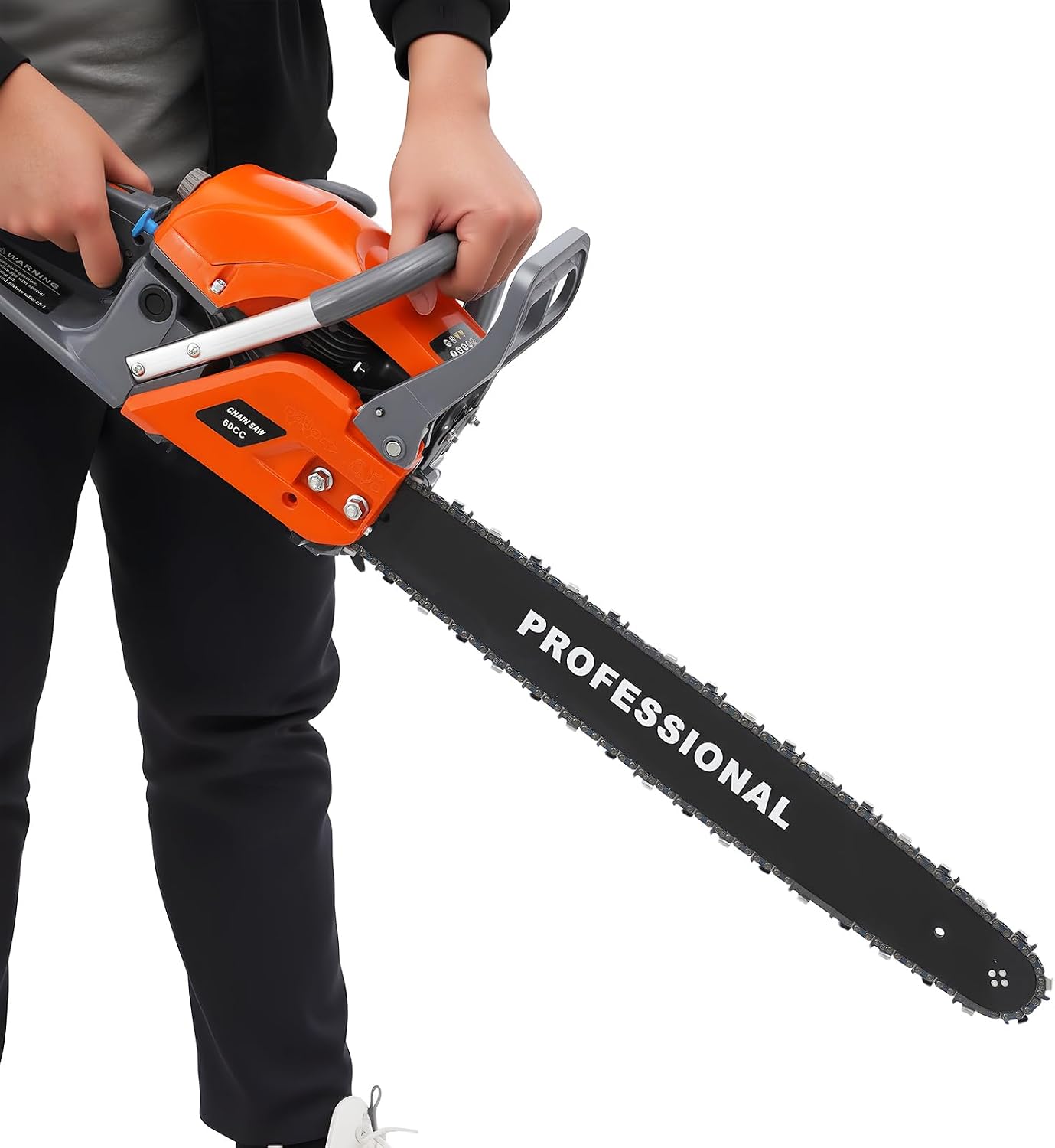
QeuSulio 22" 60cc Gas Chainsaw (2-Stroke)
| Power Source | Gas Powered |
|---|---|
| Horsepower | 3.75 hp |
| Chain Speed | 10000rpm |
| Chain Length | 22 inches |
| Fuel Tank Capacity | 550ml/18.6Oz |
This QeuSulio 22" 60cc gas chainsaw is built as a straightforward, powerful tool for cutting firewood, pruning large trees, and small-scale logging. It uses a 60cc single-cylinder two-stroke engine with a pull-start ignition and an automatic oiling system to keep the chain lubricated during extended cuts. The saw ships with a 22" guide bar and basic safety accessories including gloves, goggles, and ear protection, plus an inertia-activated chain brake and dual safety switches that reduce accidental starts. Practical design touches include a translucent 18.6 oz fuel tank and an ergonomic, vibration-damping handle for longer sessions. Expect solid cutting power and a 10,000 rpm chain speed, but be prepared for the typical maintenance of a two-stroke gas saw: mixing fuel at the specified ratio, routine air filter and carburetor cleaning, and regular chain tension checks. Noise and vibration levels are noted in the specs, so plan hearing protection and follow the included startup and break-in guidance to get reliable performance over time.
Best for: A buyer who needs a robust, gas-powered saw for heavy garden work, firewood cutting, or occasional logging and who is comfortable with routine engine maintenance and safe operation.
Less Ideal for: Not the best choice for casual users who want a low-maintenance electric or battery saw or for those who prefer quieter, emission-free tools for urban settings.
- High power for the class with a 60cc engine and quoted 2.8 kW output for demanding cuts
- 22" guide bar suitable for large-diameter logs and heavy pruning
- Inertia-activated chain brake and dual safety switches for safer operation
- Includes basic PPE and a tool bag so you can start working right away
- Automatic chain lubrication and easily visible fuel tank simplify longer jobs
- Requires regular two-stroke maintenance including fuel/oil mixing and periodic carburetor and filter servicing
- Manufacturer and model have limited track record and few customer reviews to verify long-term reliability
Verdict: If you want strong, pro-level cutting power in a 60cc gas saw and can commit to routine two-stroke maintenance, this 22" QeuSulio model delivers usable power and safety features for demanding yard and light-forestry tasks.
VEVOR 62cc Gas-Powered Chainsaw, 20-inch Guide Bar

| Engine displacement | 62CC |
|---|---|
| Horsepower | 3.8 hp |
| Chain pitch | 0.325 in |
| Chain links | 76 links |
| Fuel tank capacity | 550 ml |
The VEVOR 62cc gas-powered chainsaw is built to tackle medium to large jobs like felling small trees, cutting firewood, and heavy pruning. Its 3.8 hp two-stroke engine and 20-inch guide bar can cut logs up to about 18 inches in diameter, and a high-revving 12,000 rpm top speed helps it chew through dense wood. The saw includes practical touches such as a longer pull rope and cold/hot start settings to help with starting in varied temperatures, an emergency stop lever, and a corrosion-resistant 45# steel guide bar with a 0.325-inch pitch chain (76 links). The PA6 composite body and separate fuel and chain-oil tanks aim to reduce leaks and withstand outdoor conditions. Expect a substantial tool weight and the usual maintenance demands of a gas saw: you will need proper fuel mixing, routine chain tensioning, sharpening, and periodic engine tuneups. Also plan for noise, vibration, and protective gear when operating. For buyers who prioritize power and cut capacity, this VEVOR delivers straightforward performance, but it requires the typical hands-on upkeep of a 2-stroke gas machine.
Best for: Buyers who need brute cutting power for frequent medium-to-large tree work and accept hands-on maintenance and safety protocols to keep a gas saw performing reliably.
Less Ideal for: Casual gardeners, those who prefer low-maintenance tools, or users who need a quiet, vibration-minimized option should consider electric or battery alternatives instead.
- High cutting capacity with a 20-inch guide bar suitable for logs up to about 18 inches in diameter
- Strong 62cc two-stroke engine rated at 3.8 hp for demanding yard and light-logging tasks
- Cold and hot start options plus an extended pull rope to improve starting reliability in different conditions
- Separate chain oil tank and chain adjuster for on-the-job lubrication and easy tensioning
- Emergency stop and guard design to help limit flying debris and improve operator safety
- Requires regular gas/oil mixing, carburetor adjustments, chain sharpening, and general 2-stroke maintenance
- Relatively heavy and produces typical gas-saw noise and vibration which mandate PPE during use
Verdict: If you want a powerful 20-inch gas chainsaw that handles large-diameter cuts and you are prepared for routine 2-stroke upkeep, this VEVOR is a work-oriented choice.
SUPMIXTOOLS 62cc 20-inch Gas Chainsaw (Model S6251)

| Power Source | Gas Powered |
|---|---|
| Horsepower | 4.2 hp |
| Chain Speed | 8500 Rpm/Min |
| Chain Length | 20 inches |
The SUPMIXTOOLS S6251 is a 62cc, 20-inch gas chainsaw built for demanding cutting jobs around large properties and light logging. It pairs a 4.2 hp two-stroke engine with a 20-inch guide bar and a chain rated for 0.325" pitch, 0.058" gauge and 76 links to cut through large limbs and small trunks quickly. Notable features include an inertia-activated chain brake, low-kickback design, anti-vibration handle and an adjustable automatic oiler to reduce chain wear. The tool uses a spring-assisted recoil starter and includes a fuel mixing bottle, basic toolkit and spare spark plug, which helps get the saw running and maintained in the field. Expect strong cutting performance and good runtime for remote jobs where electric power is not available, but plan for routine engine maintenance, correct fuel mixing and noise and vibration typical of a 62cc gas engine. Assembly and the recommended starting sequence require following the manual and a short learning curve for reliable starts.
Best for: Buyers who need a rugged, petrol-powered saw for frequent heavy-duty cutting and who prioritize consistent cutting power and field serviceability over low noise and minimal upkeep.
Less Ideal for: Casual gardeners, apartment owners, or anyone who needs a lightweight, quiet saw for occasional small pruning should consider battery or smaller gas models instead.
- Powerful 62cc engine with 4.2 hp for heavy cutting tasks
- 20-inch bar and chain suitable for large limbs and firewood
- Automatic oiler to extend chain and bar life
- Inertia chain brake and low-kickback design for improved operator safety
- Includes starter toolkit, fuel mixing bottle, and spare spark plug for field maintenance
- Requires regular two-stroke engine maintenance and correct fuel mixing
- Heavier and louder than battery models which affects prolonged use comfort
Verdict: Choose this 62cc 20-inch SUPMIXTOOLS saw when you need reliable, high-power cutting for large trees and heavy yard work where gas performance matters.
Choosing the Right 60CC Pro Chainsaw: Key Factors to Consider
Engine Power and Torque
A 60cc-class engine must deliver sustained torque at the chain for clean cuts through large-diameter wood. Peak horsepower tells part of the story, but torque at working RPM determines how well the saw pulls through green hardwood or knotty timber. Higher torque reduces the need to force the saw, which lowers the chance of kickback and operator fatigue.
Fuel delivery tuning, carburetor adjustability, and low-end torque response all affect how the engine behaves under load. For heavy use, look for engines with proven cooling passages and thicker crankcases; these help maintain consistent power during long cuts and reduce wear. Consider how torque curves match the bar length you plan to use so the saw can keep chain speed under heavy load.
Bar Length and Chain Compatibility
Bar length sets the maximum cut capacity and influences balance and maneuverability. Longer bars let you cut bigger logs in fewer passes but require more power and can make the saw harder to handle for precise work. Matching chain pitch and gauge to the bar and sprocket is essential for smooth operation and reduced wear.
Also consider availability of replacement bars and chains in standard sizes and whether the saw accepts common guide-bar mounting patterns. For heavy-duty tasks, pick bars with reinforced nose sections and chains designed for high-feed cutting to reduce stretch and extend service intervals.
Cooling and Vibration Management
Heavy cutting generates heat and vibration that accelerate wear and sap operator stamina. Effective cooling systems, including well-directed airflow and finned components, help keep cylinder head temperatures down during repeated heavy cuts. Overheated engines lose power and can suffer premature ring and piston wear.
Vibration isolation between the engine and handles reduces hand fatigue and numbness, allowing longer safe work periods. Look for anti-vibration mounts, balanced crank assemblies, and handle geometry that reduces transmitted shock while still allowing precise control.
Ergonomics, Weight, and Balance
Ergonomics determine how long you can use the saw without excessive fatigue. Weight matters, but balance between the front and rear is just as important. A heavier saw with good balance can feel easier to control than a lighter saw with a forward-heavy layout.
Handle shape, trigger placement, and clearance for gloved hands affect control in wet or dirty conditions. Foregrip design that facilitates secure two-handed work and a comfortable rear handle with throttle lock and easy-access chain brake improve safety and reduce strain during repetitive cuts.
Maintenance and Serviceability
Heavy users need saws that are easy to service in the field. Tool-free chain tensioning, accessible air filters, and clear access to spark plug and carburetor make routine maintenance faster and reduce downtime. Replaceable wear parts like clutch drums, sprockets, and guide bars should be widely available.
Consider whether the saw uses common fastener types and whether routine adjustments can be performed without specialized tools. Simpler maintenance reduces total operating cost and keeps the saw reliably ready for long jobs.
Starting Reliability and Cold-Weather Performance
Reliable starting saves time and frustration on cold mornings or after long idle periods. Well-designed choke and primer systems, decompression valves, and predictable cold-start behavior are important for professional use. Carburetor settings and fuel system design influence choke dependence and warm-up time.
Cold-climate users should favor designs with easy-access primer bulbs and choke controls and consider how aftermarket cold-start aids or different spark plugs can improve reliability. The saw should also tolerate intermittent idle without flooding or hard starting after short breaks.
Matching Saw Specs to Job Types
Different yard and property tasks demand different saw setups. For limbing and pruning, a shorter bar and a saw tuned for quick throttle response are easier to control. For felling and milling, a longer bar and a saw with strong midrange torque let you finish larger cuts with fewer passes.
Think about how often you will handle heavy logs versus lighter trimming. If you split time between tasks, prioritize features like vibration control and quick-tension chain systems that improve everyday usability across jobs.
- Short bars for precise cutting and limbing
- Long bars for felling and large logs
- Midrange torque for consistent under-load performance
Field Maintenance Tips for Heavy Use
Keep a small service kit in your work vehicle with spare chains, a chainsaw file or grinder, extra fuel, and basic hand tools. Regularly inspect chain sharpness and bar condition before heavy jobs to avoid accelerated wear and dangerous cutting behavior.
Clean or replace air filters frequently when working in dusty conditions. Check chain tension when the engine is cool and after prolonged cutting sessions, since heat changes can cause the chain to expand and loosen.
- Carry spare chains and a raker/filing tool
- Check and clean air filters daily in dusty work
- Retorque bar nuts and check sprocket wear at regular intervals
Safety Practices for Powerful Chainsaws
Using a high-displacement saw increases the stakes for safe operation. Always use proper protective gear including cut-resistant chaps, eye and ear protection, gloves, and a hard hat when working near falling limbs. Maintain a firm, two-handed grip and keep bystanders well clear of the work zone.
Understand and respect the saw's kickback behavior. Use chains with reduced kickback profiles if your work includes frequent limbing, and practice working positions that minimize bind and sudden bar contact with obstructions.
- Wear appropriate PPE and maintain clear work zones
- Use chain brakes and reduced-kickback chain designs when needed
- Plan escape routes before felling trees
Transport and Storage Considerations
Secure the saw in a well-ventilated case or rack during transport and always drain or stabilize fuel for longer storage periods. Avoid leaving fuel in the tank during months of inactivity to prevent carburetor gumming and starting problems.
Store the saw in a dry place off the floor and protect the bar and chain with a cover. Periodically rotate the chain and check for rust on the bar nose and rivets if stored in humid conditions.
- Stabilize or drain fuel for extended storage
- Protect bar and chain with a sheath
- Store in a dry, ventilated area off the ground
Upgrades and Aftermarket Parts to Consider
For professional workloads, consider hardened or low-stretch chains, heavy-duty bars, and upgraded air filtering systems. Aftermarket mufflers and tuned ignition systems can improve torque delivery and throttle response, but check compatibility and service implications.
Replaceable clutch drums, sealed bearings, and reinforced mounting plates extend the working life of the saw under repetitive heavy use. Choose commonly available parts so service and repairs remain practical.
- Consider hardened chains and reinforced bars
- Upgrade filters for dusty environments
- Prefer widely available replacement parts
How We Chose the Best 60CC Pro Chainsaw
We focused editorial selection on attributes that determine real-world usefulness and longevity for heavy-duty 60CC Pro chainsaws. Key evaluation criteria included measured engine power and torque relative to bar length, build quality of the powerhead and chassis, chain and bar durability, user ergonomics and balance for extended use, starting and warm-up reliability, and ease of routine maintenance. We prioritized saws with robust cooling and vibration management because those features reduce operator fatigue and extend component life under heavy loads. Fuel efficiency and emissions were considered where data was available, since fuel consumption affects operating cost in prolonged jobs. We excluded lightweight homeowner saws and models with unclear serviceability or limited parts availability. Finalists were those that balanced strong cutting performance with durable construction and practical maintenance features that matter to professional and serious amateur users.
FAQ
Is a 60CC Pro Chainsaw too powerful for home yard work?
A 60cc-class saw can be overkill for light trimming and small-diameter limbs. It is best suited for large properties, felling medium to large trees, and frequent heavy-duty tasks. If you rarely need big cuts, a smaller saw is usually easier to handle.
What bar length should I pair with a 60cc Pro saw?
Bar length depends on the largest log diameter you expect to cut. Many 60cc-class saws run well with bars in the 18 to 24-inch range for general heavy work. Longer bars increase cutting capacity but need more engine torque and add weight.
How often should I sharpen the chain when using a 60cc saw?
Sharpen frequency depends on cutting conditions. For continuous heavy cutting, inspect and touch up the chain multiple times per day. For intermittent work, expect to sharpen after several hours of cutting or whenever you notice the saw producing fine sawdust instead of coarse chips.
Can I use a 60CC Pro Chainsaw in cold weather?
Yes, but cold starts can be harder. Models with easy-access primer bulbs, decompression valves, and predictable choke behavior are preferable. Use fresh fuel and consider a choke technique or cold-weather spark plug to improve starting reliability.
What maintenance tasks reduce long-term operating costs?
Regular air-filter cleaning, correct chain tension, prompt replacement of worn sprockets and bars, and using proper fuel mix and fresh oil extend component life. Routine inspections and quick field repairs reduce the need for major service down the line.
Final Verdict
For heavy-duty cutting and property maintenance, prioritize engine torque, bar and chain durability, and vibration management when choosing a 60CC Pro Chainsaw. Balance and serviceability matter almost as much as peak power because they determine how long you can work comfortably and how quickly you can get the saw back into service after maintenance. Focus on the tradeoff between bar length and maneuverability for your typical tasks, and choose a saw with straightforward maintenance features to keep downtime low.
