

Note: This article contains affiliate links. If you click on these links and make a purchase, I may earn a small commission at no extra cost to you. This helps support my research and content. Read my full affiliate disclosure here.
A long soaker hose can change how you irrigate flower beds, vegetable rows, and foundation plantings. Choosing the right 75 foot soaker hose matters because length affects water pressure, run time, and how evenly moisture reaches roots across the whole run. In this guide we shortlist five top options suitable for long beds and narrow lawns, and we walk through the practical tradeoffs you will face in a real garden. The picks below were evaluated on how consistently they wet soil, their build durability, ease of setup, and how well they handle varied household water pressure. Read on to see which features matter most for your layout and watering schedule.
Top Picks at a Glance
| Best Overall The best all-around choice for most situations | KOBAZ 75 ft Sprinkler Soaker Hose (PVC) with Stakes and Removable End Cap |  |
| Best Value The sweet spot between price and what you get | Secbulk 75 ft Flat Soaker Hose with Stakes (Linkable, Dual-layer Leak-resistant) |  |
| Best Budget The cheapest option that still gets the job done reliably | Rocky Mountain Goods 75 ft Flat Weeper Soaker Hose |  |
| Highest Rated A top-rated pick with lots of positive feedback | Winisok 75 ft Flat Sprinkler Soaker Hose with Stakes |  |
| Most Popular A crowd favorite that many people choose with confidence | Gilmour 75' Flat Weeper Soaker Hose |  |
KOBAZ 75 ft Sprinkler Soaker Hose (PVC) with Stakes and Removable End Cap

| Material Type | Polyvinyl Chloride (PVC) |
|---|---|
| Item Weight | 3.7 pounds |
| Item Length | 75 inches |
| Maximum Pressure | 60 psi |
| Included Components | Landscape staples, Leak-proof Gaskets, Removable End Cap, Sprinkler Hose |
The KOBAZ 75 ft sprinkler soaker hose doubles as a misting sprinkler and a root-level soaker, letting you switch between gentle overhead spray and slow seep irrigation by how you position and cap the hose. Its three-tube construction with closely spaced micro-holes produces an even, mist-like output that reduces runoff and helps new grass, vegetable beds, and shrubs get consistent moisture. Made from PVC, the hose is intended for everyday household pressures up to 60 psi and resists kinking and surface abrasion. Practical details include a removable end cap for flushing or linking an extension and a pack of metal landscape staples to pin the hose in place. Expect compact storage since the flat design rolls up easily. Limitations are typical of PVC soaker hoses: it is not optimized for very high pressures or heavy commercial use, and micro-holes can clog over time in hard water without occasional flushing.
Best for: Home gardeners who want a versatile 75 ft solution to water lawns, raised beds, and narrow planting strips with minimal fuss and easy storage.
Less Ideal for: Large-scale or commercial irrigation needs where higher pressure, industrial materials, or long-term continuous operation are required.
- Dual-function design works as both a misting sprinkler and a soaker hose for flexible watering
- Three-tube, micro-hole pattern promotes even distribution and reduces runoff
- Includes removable end cap for easy flushing or extending length
- Comes with metal stakes to secure the hose and reduce shifting
- Flat PVC construction rolls up compactly for storage and resists kinks
- PVC construction is intended for household use and may not hold up to heavy commercial pressure
- Micro-holes can clog over time if not periodically flushed in areas with mineral-rich water
Verdict: Choose this 75 ft KOBAZ hose if you want a single, easy-to-store watering solution that can act as both a misting sprinkler and a soaker for home gardens.
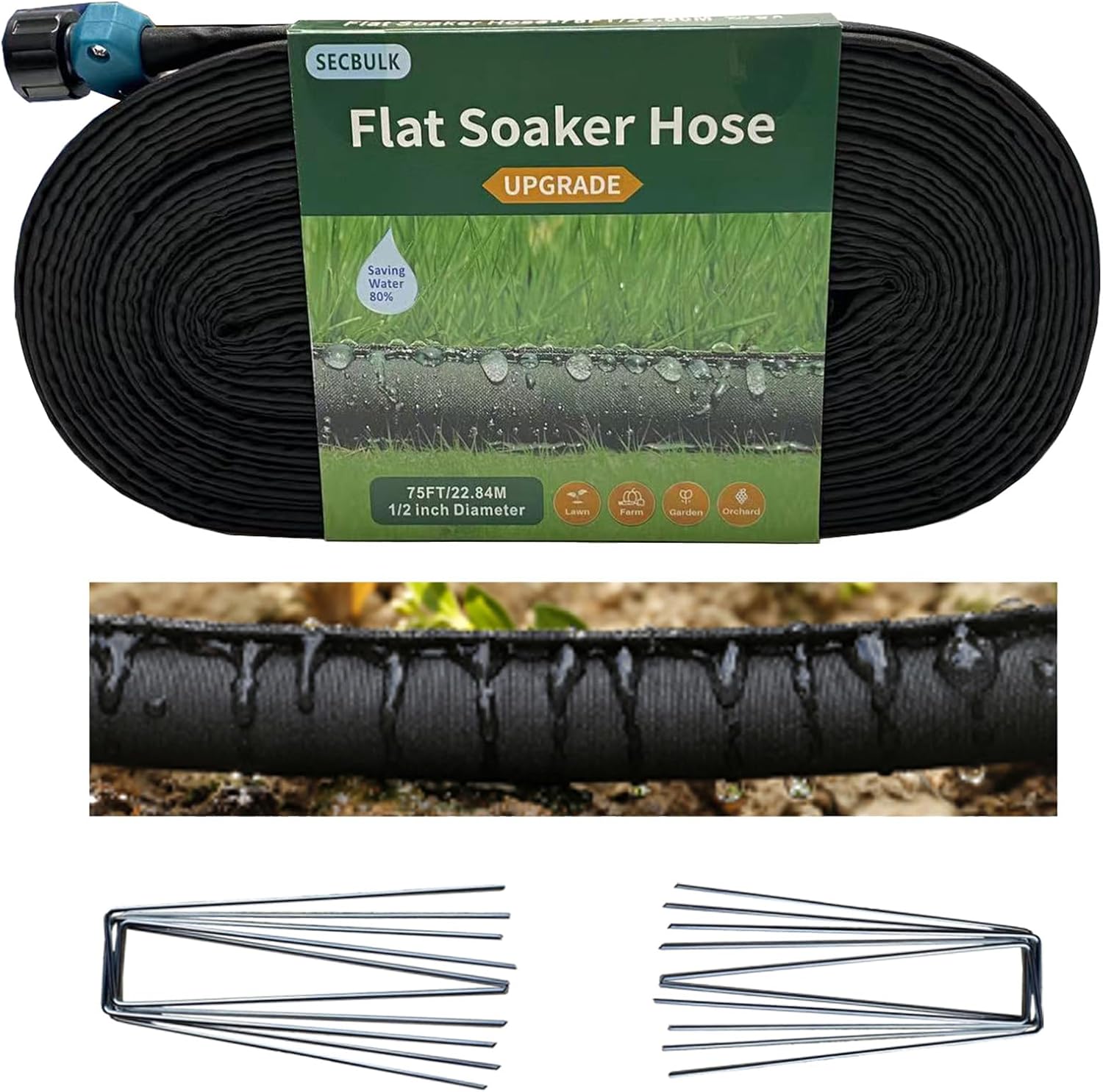
Secbulk 75 ft Flat Soaker Hose with Stakes (Linkable, Dual-layer Leak-resistant)
| Item Length | 75 feet |
|---|---|
| Material Type | Vinyl |
| Maximum Pressure | 85 psi |
This 75-foot Secbulk flat soaker hose is built to deliver slow, even watering along its entire length for garden beds, vegetable rows, and shrub borders. It uses a fabric-covered recycled vinyl body with multiple seep holes so water soaks into the soil instead of spraying foliage, which reduces waste and leaf wetting. The flat, kink-resistant profile makes it easy to snake through planting and roll up for seasonal storage, and rust-resistant end caps and garden-hose-compatible threads let you connect multiple lengths or attach a timer. Its rated maximum pressure is 85 psi and the maker recommends operating between about 40 and 90 psi for best performance. The dual-layer construction and fabric cover aim to resist sun damage and extend service life, and the material is described as safe for edible plants. Important limitations: it is a passive soaker hose so pressure and flow control matter for even output, it cannot handle hot water, and buried installation should be shallow as instructed to avoid clogging. For routine drip-style watering of beds and mixed plantings this hose is practical and easy to use, but expect performance to depend on proper pressure and layout planning.
Best for: Buyers who want an efficient, low-maintenance way to water garden beds and edibles without installing a complex irrigation system and who prioritize water savings and easy seasonal storage.
Less Ideal for: People needing pressurized targeted emitters, long-term buried drip mainlines, or systems that must handle hot water should look at other irrigation options.
- Even, slow seep watering along the entire 75 ft length reduces runoff and wet foliage
- Flat, kink-resistant design is easy to route through beds and store
- Linkable ends and standard hose-thread connectors work with timers and additional lengths
- Fabric-covered dual-layer vinyl resists sun damage and is described as safe for edible plants
- Performance depends on correct water pressure and layout since it is a passive soaker system
- Not rated for hot water use
Verdict: A practical 75 ft soaker hose that delivers even, water-saving soak irrigation for beds and vegetable rows while staying easy to connect and store.
Rocky Mountain Goods 75 ft Flat Weeper Soaker Hose

| Material Type | Polyvinyl Chloride (PVC), Vinyl |
|---|---|
| Unit Count | 75 Feet |
| Maximum Pressure | 30 psi |
| Included Components | Hose |
This Rocky Mountain Goods 75 ft soaker hose delivers slow, consistent watering by leaking water along its length to feed roots directly. It is meant to lie in garden beds or along rows of vegetables and uses a double-layer PVC liner covered in fabric to resist wear while conserving water compared with overhead watering. The hose is intended to run at about 25 to 30 psi and includes three pressure-reducing discs so you can dial back pressure if you see spraying. Practical benefits include straightforward installation, uniform moisture for long beds, and lower evaporation loss that can reduce watering frequency. Limitations are that it is not a replacement for a regular hose for filling containers or running sprinklers and performance depends on correct pressure and layout; higher pressure will cause spraying until reduced. For a cautious buyer who wants reliable, simple drip-style irrigation for beds or borders, this is an easy-to-use option that focuses on steady root watering rather than versatility for other tasks.
Best for: Home gardeners who want a low-maintenance, water-saving solution for vegetable beds, borders, or long planting rows and prefer reliable, predictable watering over multiuse hoses.
Less Ideal for: People who need a multipurpose garden hose for watering, washing, or running sprinklers or who require very high-pressure performance.
- Delivers consistent low-flow watering along the entire length for even root moisture
- Double-layer PVC and fabric cover improve durability for garden use
- Included pressure-reducing discs let you adjust flow to prevent spraying
- Conserves water by targeting roots and reducing evaporation
- Not suitable as a regular hose for filling containers or attaching sprinklers
- Requires proper pressure (25–30 psi) and layout to avoid uneven output or spraying
Verdict: A straightforward, water-saving soaker hose that provides steady root-level irrigation for beds and vegetable rows with minimal setup.
Winisok 75 ft Flat Sprinkler Soaker Hose with Stakes

| Item Length | 75 feet |
|---|---|
| Material Type | Polyvinyl Chloride (PVC) |
| Maximum Pressure | 60 psi |
| Nominal Wall Thickness | 1.25 millimeters |
This Winisok 75 ft flat sprinkler soaker hose combines a shallow sprinkler spray and deep-soak option in one flexible PVC hose built for routine garden irrigation. Lay it striped-side up for a wide spray or flip it for low-pressure soaking; the three-hole design aims to distribute water evenly so beds and borders receive steady moisture without washing soil away. It runs at 20–60 PSI and includes a removable end cap so multiple lengths can be linked to cover larger lawns. The package also supplies 40 landscape stakes to pin the hose in place and reduce shifting under pressure. Construction is PVC with UV-resistant, triple-layer reinforcement intended to resist kinks, punctures, and everyday outdoor wear. Limitations to note are that PVC can stiffen in cold weather and the flat design needs careful placement to avoid uneven watering on very uneven ground. For long, continuous runs you should monitor pressure and connections to prevent leaks at joints.
Best for: Gardeners who prioritize a dependable, long-running irrigation solution for large beds or lawns and want a low-maintenance hose that stays anchored and links easily to cover more area.
Less Ideal for: People needing a compact, highly flexible expandable hose for frequent storage or growers working only in very small container setups.
- Two-in-one flat design for upward sprinkler spray or low-profile soaker soaking
- Three-hole layout for more even water distribution that reduces runoff
- Includes 40 landscape stakes to hold hose position and maintain consistent coverage
- Removable end cap allows secure series connections to expand coverage
- UV-resistant triple-layer PVC construction designed to resist kinks and punctures
- Made from PVC which may become less flexible in cold conditions
- Requires careful placement on very uneven terrain to avoid dry spots
Verdict: Choose this 75 ft Winisok flat soaker hose when you need a durable, anchored irrigation line that delivers consistent, linkable watering across large garden beds.
Gilmour 75' Flat Weeper Soaker Hose

| Material Type | Vinyl |
|---|---|
| Item Length | 75 inches |
| Item Weight | 2 pounds |
| Included Components | Pack of 1 Gilmour 870751-1001 Hose Flat Soaker, 75' |
The Gilmour 75' flat weeper soaker hose is a lightweight, flexible soaker that distributes water through a fabric-covered jacket so moisture seeps into the soil rather than spraying the surface. It is typically laid along foundation beds, under mulch, or at the base of shrubs and vegetables and can be left in place for seasonal irrigation. The flat profile makes it easy to position in tight beds and to roll up for compact storage. Its vinyl construction and fabric cover are described as clog resistant and durable for repeated seasonal use, and multiple lengths can be linked to extend coverage for longer foundation runs. Expect slow, steady water delivery that can save water compared with overhead watering and reduce runoff near foundations. Limitations include the need to monitor pressure and run time to avoid overwatering in clay soils and the lack of built-in emitters for precise, measured flow per foot, so spacing and layout require some trial and adjustment for uniform moisture.
Best for: Buyers who want a simple, low-maintenance method to water foundation plantings and garden beds efficiently and who prefer a solution that is easy to install and store seasonally.
Less Ideal for: Those seeking a precision drip system with rated emitters per foot or homeowners who need a heavy-duty hose to withstand frequent foot traffic or burial without protective sleeving.
- Delivers water directly to root zone for efficient, low-evaporation watering
- Flat, flexible design is easy to lay in narrow foundation beds and rolls up compactly for storage
- Clog-resistant fabric cover helps maintain consistent seepage
- Can be linked to additional hoses to extend coverage for longer runs
- No integrated flow regulation or per-foot emitter specification for exact uniformity
- Made of vinyl which can wear faster than reinforced rubber in high-traffic areas
Verdict: A straightforward, easy-to-install soaker hose that efficiently waters foundation beds with minimal fuss and compact storage.
Choosing the Right 75 Foot Soaker Hose: Key Factors to Consider
Length and Layout Impact
A 75 foot run can span several beds or a long border, but length changes how water pressure behaves across the line. Longer runs often lose pressure toward the far end, so consider whether you will run the hose in a single straight line, loop it back, or divide it into shorter segments. How you route the hose affects wetting uniformity and may require pressure adjustments or a parallel second line for even coverage.
Think about access points for filling planting areas. If you need to water discrete patches, plan where the hose will lie so pores face the soil and are not buried under mulch that could block flow.
Pore Density and Watering Rate
Pore spacing and size determine how fast soil receives water. A dense pore pattern gives gentler, slower soaking that is better for seed beds and shallow-rooted plants, while wider-spaced pores deliver faster soaking suited to established shrubs. Consider your plant mix and soil type; heavier clay holds water longer and benefits from slower soaking, while sandy soils need more frequent, higher-volume delivery.
Also factor in watering time. A hose with smaller pores will require longer run times to saturate the same area, which can affect your scheduling if you use a manual timer or a limited daily water allotment.
Material and UV Resistance
Hoses left on the surface are exposed to sun and weather, so material choice influences lifespan. Look for construction described as UV-resistant or reinforced to resist cracking and brittleness over seasons. Thicker walls and reinforcement layers help prevent punctures when the hose crosses paths or is dragged over rough edges.
Durability also matters for storage. Some materials limp or become stiff after winter; others tolerate coiling and uncoiling without damage. If you plan to keep the hose in place year-round, pick materials designed for continuous outdoor exposure.
Kink Resistance and Flexibility
A hose that kinks will bottleneck flow and create dry spots. Kink resistance depends on wall stiffness and reinforcement. Softer hoses lay flat and conform to curves but may be more prone to tangles; stiffer hoses resist kinks but can be harder to position close to plants.
Flexible hoses are useful around raised beds and irregular borders. Evaluate how easily a hose lies flat along edges and whether it returns to shape after being folded for storage. Good balance between suppleness and body prevents blockages and makes handling faster.
Fittings Compatibility and Repairability
Standard fittings make installation with timers, pressure regulators, and splitters straightforward. Check whether ends accept common hose clamps or quick-connect adapters. The ability to cut and rejoin sections with simple connectors is valuable if you need to shorten or repair a 75 foot run without replacing the entire hose.
Repair-friendly designs reduce long-term waste and let you adapt layouts as beds change. Consider how easily replacement connectors and splice kits can be used in the garden.
Pressure and Flow Handling
Household water pressure varies, and a 75 foot run amplifies those effects. Some hoses deliver consistent output at typical domestic pressures, while others require a pressure regulator to avoid blowouts or weak far-end flow. If your source pressure is high, ensure the hose construction tolerates that pressure or use a regulator.
Flow handling also affects irrigation timing. Hoses designed for pressure compensation will maintain more uniform wetting across long runs. If your layout is uneven in elevation, factor in head pressure changes as well.
Best Uses for a 75 Foot Soaker Hose
A 75 foot soaker hose is ideal for long, narrow planting areas such as vegetable rows, perennial borders, and shrub lines along foundations. Its length lets you water a continuous stretch without frequent re-positioning, cutting down on manual labor with routine irrigation.
Use this length when beds are aligned near a single faucet point or when you can run the hose along the base of plants. For wide beds, consider running the hose in parallel lines or turning it in a U shape to reach more root zones.
- Vegetable rows and narrow raised beds
- Foundation plantings and long borders
- Temporary watering for newly planted seedlings along a run
Installation Tips for Long Runs
Lay the hose with minimal twists and keep pore-facing sides in contact with the soil surface. If you need to cross walkways, protect the hose from abrasion with short pieces of flat stone or a channel to avoid punctures.
Start at the faucet end with a pressure regulator or timer if you use automated schedules. Test-run for 20 to 30 minutes first to check wetting patterns and adjust placement before letting the hose run on a regular schedule.
- Use a pressure regulator when household pressure is high
- Anchor hose with landscape pins to hold curves in place
- Overlap sections slightly when joining to avoid leaks
Seasonal Care and Storage
If you live in a freezing climate, drain and coil the hose for winter storage to prevent cracking. Some gardeners bury soaker hoses under a thin layer of mulch for winter but still remove connectors and drain lines to avoid freeze damage.
For year-round surface use, clean debris from pores and inspect fittings each season. Proper storage and occasional flushing extend service life and maintain consistent flow.
- Drain and store indoors before first freeze
- Flush line after heavy debris or sediment buildup
- Inspect for UV damage each spring
Adapting a Long Hose to Variable Water Pressure
When far-end wetting is weaker, try reducing overall flow or splitting the run into two shorter parallel lines. A pressure regulator at the supply can protect the hose and smooth out delivery, while splitters let you feed separate zones with better uniformity.
For sites with steep elevation changes, run shorter segments on different zones or place the hose lower in the bed where root systems prefer moisture.
- Use splitters to divide long runs
- Pressure regulators stabilize output
- Adjust run time rather than increasing pressure to avoid erosion
Siting Soaker Hoses with Different Plant Types
Match pore density and placement to plant water needs. Place hoses closer to shallow-rooted vegetables and farther from deep-rooted shrubs, or run two parallel lines spaced to cover wider root zones. For mixed beds, stagger the hose so each plant gets access without oversaturating the soil.
Mulch over the hose to conserve water and reduce surface evaporation, but avoid burying connectors that may need seasonal inspection.
- Stagger hoses for mixed beds
- Keep hoses visible at connectors for inspection
- Use mulch to retain moisture but maintain pore access
How We Chose the Best 75 Foot Soaker Hose
We evaluated candidate 75 foot soaker hoses using concrete, garden-focused criteria that matter for long-run irrigation. Key evaluation points included water delivery consistency, which looks at how evenly the hose wets soil across its entire 75 foot length and how dependent that pattern is on household water pressure. Durability and material construction assessed resistance to abrasion, UV degradation, and failure from repeated folding or winter storage. Kink and tangle resistance reviewed how easily the hose lies flat and whether it holds its pore pattern without bunching when laid out in beds. We also scored ease of installation and fittings, including compatibility with standard garden spigots, ability to use pressure regulators or timers, and whether the hose can be cut and joined without losing flow. Flow efficiency and pressure handling examined how much run time is required and whether pressure compensating features are needed for long runs. We excluded hoses shorter than the stated 75 foot length and products whose construction details were unclear or that lacked basic gardener-use information. The final list prioritizes steady wetting, long-term durability, practical installation, and real-garden handling.
FAQ
Will a 75 foot soaker hose provide even watering from end to end?
Often but not always. Evenness depends on household water pressure, pore design, and how the hose is routed. To improve uniformity, run a test and use a pressure regulator or split the run into shorter segments if the far end is under-watered.
Can I leave a soaker hose in place year-round?
It depends on climate and material. In mild climates many gardeners leave hoses in place and cover them with mulch. In freezing regions it is best to drain and store hoses for winter to prevent damage.
How do I connect a 75 foot soaker hose to a timer or regulator?
Most soaker hoses accept standard garden fittings and can be attached to timers or regulators with common adapters. Ensure connections are tight and test the assembly for leaks before regular use.
Can I cut a soaker hose to shorten it or repair a leak?
Usually yes. Many hoses can be cut and rejoined with compression couplers or barb fittings. Make a clean cut, use the appropriate connector, and test the repaired section under pressure.
Is it better to bury a soaker hose or lay it on top of the soil?
Both methods work. Laying on top under a thin layer of mulch makes inspection and repairs easier while still reducing evaporation. Burying slightly can improve contact with roots but may complicate winter removal and inspection.
Final Verdict
For long beds and linear plantings a 75 foot soaker hose offers a low-effort way to deliver gentle, targeted water. Prioritize hoses that demonstrate even water delivery, durable construction, and easy-to-use fittings. Balance flexibility and kink resistance based on how often you reposition the line. Decide first on layout and expected run times, then choose a hose that matches your pressure conditions and maintenance preferences. That approach will get consistent wetting with minimal fiddling, helping plants establish and thrive without unnecessary waste.
