

Note: This article contains affiliate links. If you click on these links and make a purchase, I may earn a small commission at no extra cost to you. This helps support my research and content. Read my full affiliate disclosure here.
Picking the right all-round compost makes a practical difference in how quickly your beds and containers establish and how healthy plants grow through the season. Good compost improves soil texture, water retention, and nutrient availability while working for a wide range of vegetables, ornamentals, and container plants. This guide presents six shortlisted all-round composts chosen for common garden uses and explains the criteria we used to evaluate them. Read on for clear guidance about texture, nutrient balance, and ideal uses so you can match a compost to your garden needs.
Top Picks at a Glance
| Best Overall The best all-around choice for most situations | Blue Ribbon Organics OMRI-Certified Organic Compost (Bag) |  |
| Best Quality Built to a higher standard if you want something more solid | Espoma Organic Land and Sea Gourmet Compost with Lobster & Crab Meal, 1 cu ft |  |
| Best Value The sweet spot between price and what you get | Wiggle Worm Pure Worm Castings Organic Fertilizer, 15 lb |  |
| Best Budget The cheapest option that still gets the job done reliably | Life Cycle Organics Organic Compost, 1 Gallon |  |
| Highest Rated A top-rated pick with lots of positive feedback | Wiggle Worm Pure Worm Castings Organic Fertilizer, 30 lb |  |
| Most Popular A crowd favorite that many people choose with confidence | Brut Organic Worm Castings, 5 lb |  |
Blue Ribbon Organics OMRI-Certified Organic Compost (Bag)

| Brand | Blue Ribbon Organics |
|---|---|
| Included Components | Compost |
| Item Type Name | Organic Compost |
| Volume | 7.48 gallons |
Blue Ribbon Organics OMRI-Certified Compost is a bagged, fully processed organic compost designed to be worked into beds, used as a topdressing on lawns, or applied as a mulch around trees and shrubs. It is made from recycled food and yard residuals, monitored for maturity and contaminants, and certified for organic use so you can add it directly to vegetable, flower, and landscape plantings. Typical applications include incorporating 3–4 inches into new beds, adding a light 1/4–1 inch replenishment to established beds, or topdressing lawns at 1/4–1/2 inch in fall. The product claims improved aeration, increased water retention, pH buffering, and a boost of key nutrients such as nitrogen, phosphorus, and potassium. Because it is a natural material, moisture variation can affect bag weight and handling, and a single bag covers a modest area, so larger projects will require multiple bags or bulk compost. For gardeners focused on measurable soil improvement and organic certification, this compost delivers an easy, safe way to rebuild soil health without synthetic inputs.
Best for: Gardeners who prioritize measurable soil improvement and organic certification and want a ready-made compost to reliably boost planting beds, lawns, and established landscapes.
Less Ideal for: Large-scale landscapers or gardeners needing to amend many beds quickly should consider bulk compost options rather than repeated bag purchases.
- OMRI certified and meets US Composting Council standards so it is suitable for organic vegetable and flower gardens
- Processed and tested for maturity, pathogens, and weed seed to reduce risk of introducing problems
- Versatile use: can be tilled into new beds, used as a topdressing for lawns, or applied as mulch around trees and shrubs
- Contains a balanced mix of organic nutrients and improves soil aeration and water retention
- Bag size/volume is modest so several bags are needed for large beds or multiple trees
- Moisture variation in a natural product can make individual bag weights inconsistent
Verdict: Choose this bagged OMRI-certified compost when you want a tested, organic-ready product that reliably improves soil structure and supports performance-oriented gardening.
Espoma Organic Land and Sea Gourmet Compost with Lobster & Crab Meal, 1 cu ft

| Item Form | Granules |
|---|---|
| Specific Uses For Product | Soil Conditioning, Plant Growth, Seed Development, Root Development |
| Included Components | Lobster and crab meal |
| Ingredients | Aged forest products, sphagnum peat moss, humus, limestone, lobster meal & crab meal |
Espoma Organic Land and Sea is a premium, ready-to-use compost intended for amending garden beds, planters, and transplant holes. The mix combines aged forest products, sphagnum peat moss, humus, limestone for pH adjustment, and lobster and crab meal to deliver organic nutrients and slow-release nitrogen. It also includes a mycorrhizae blend to help root establishment and nutrient uptake. In practice this product is mixed into native soil when planting or used to refresh container mixes, and it noticeably improves moisture retention and soil texture while adding a food source for vegetables, flowers, trees, and shrubs. Because it is a finished compost you do not need to wait for further decomposition before planting. Limitations are typical of peat-containing mixes: it is somewhat bulky to handle and not a concentrated fertilizer for rapid greening, so heavy feeders may still need supplemental feedings during the season. Overall it is a convenient, performance-focused soil amendment for gardeners who want an organic, biologically active boost at planting time.
Best for: Gardeners who prioritize reliable, organic soil improvement at planting time and want a biologically active amendment that supports root development and steady plant performance.
Less Ideal for: Buyers seeking an instant, high-nitrogen fertilizer or those who strictly avoid peat-based products should consider alternatives.
- Finished, ready-to-use compost suitable for immediate planting
- Contains lobster and crab meal for slow-release organic nutrients
- Includes endo and ecto mycorrhizae to support root growth and nutrient uptake
- Improves soil texture and moisture retention for containers and beds
- Contains peat moss which some gardeners avoid for sustainability reasons
- Not formulated as a high-concentration fertilizer for rapid greening
Verdict: A ready-to-use organic compost that boosts soil biology and root performance at planting for gardeners focused on steady, long-term results.
Wiggle Worm Pure Worm Castings Organic Fertilizer, 15 lb

| Item Form | Granules |
|---|---|
| Specific Uses For Product | Soil Conditioning |
| Coverage | vegetable gardens, lawns and turf grasses, houseplants and indoor gardens |
| Unit Count | 240 Ounce |
| Contains Fertilizer | Yes |
Wiggle Worm Pure Worm Castings is a ready-to-use organic soil amendment made from 100% worm castings that you can sprinkle into planting holes, top-dress containers, or mix into potting mixes. Typical uses include lining seed furrows, mixing with soil when transplanting, top-dressing established plants, and brewing diluted casting tea for quick nutrient uptake. Notable features are its OMRI listing for organic use, fine granular form that improves soil aeration and water retention, and a manufacturing process that removes contaminants and worm eggs. Practical benefits for mint and other herbs include steady, non-burning nutrition, improved root health, and increased microbial activity that supports vigorous, aromatic foliage. Limitations are that it is a slow-release amendment rather than a quick high-N fertilizer for an instant green-up and you will need to apply modest amounts periodically rather than a single heavy dose; it is also sold in a 15 lb bag which may be more than needed for a few small pots. For gardeners focused on long-term soil health, it integrates easily into raised beds and container mixes.
Best for: Gardeners who prioritize steady, organic soil building for herbs and containers and who prefer low-risk, long-term nutrition to support healthy root systems and aromatic mint growth.
Less Ideal for: Buyers who need a rapid, high-nitrogen feed for quick leafy growth or those who only want a tiny sample-sized product for a single pot.
- OMRI listed organic pure worm castings safe for organic gardens
- Fine granules that improve soil aeration and water retention
- Plant-ready, non-burning nutrients that can be used as top-dress or mixed into potting mix
- Versatile applications including casting tea, transplanting, and compost layering
- Not a high-salt quick-release fertilizer so it does not deliver an immediate strong nitrogen boost
- Sold in a single 15 lb bag which may exceed needs for small indoor herb collections
Verdict: Use this OMRI-listed pure worm castings bag when you want a safe, low-risk organic amendment that builds soil health and keeps mint thriving over the long term.
Life Cycle Organics Organic Compost, 1 Gallon

| Item Form | Granules |
|---|---|
| Specific Uses For Product | Soil Conditioning |
| Coverage | Organic |
| Target Species | All plants |
| Liquid Volume | 1 gallons |
Life Cycle Organics Organic Compost is a ready-to-use soil amendment sold in a 1-gallon container and formulated from 100% natural plant and wood materials. Gardeners typically mix it into raised beds at 20–30 percent by volume, spread 1–2 inches into vegetable beds before planting, or blend a portion with potting mix for containers. The product is OMRI-listed and presented in a granular form that supplies microbial life and organic matter to improve soil structure and fertility without synthetic additives. Practical benefits include easy incorporation into existing soil, versatility across beds, containers, and lawns, and clear usage suggestions on the label. Because it comes in a small 1-gallon unit, it is convenient for targeted applications, sample trials, or container gardeners who do not need bulk compost. Limitations are its small volume for larger beds and the need to buy multiple units for whole-yard topdressing; also users should handle it carefully to avoid skin or eye irritation and follow mixing directions.
Best for: Gardeners on a tight budget who need a compact, certified organic compost for targeted improvements in raised beds, containers, or small vegetable plots.
Less Ideal for: Those planning to amend large garden areas or topdress an entire lawn should consider bulk compost or larger-volume products to avoid repeated purchases.
- 100% natural organic ingredients that support microbial soil life
- Clear usage guidance for raised beds, vegetable gardens, containers, and lawns
- Granular form that mixes easily into soil and potting mixes
- OMRI-listed formulation suitable for organic gardening
- Small 1-gallon volume makes it impractical as the sole source of compost for large garden beds or full-lawn applications
- Label warns of possible skin and eye irritation requiring careful handling
Verdict: Buy this if you want a small, OMRI-listed organic compost to trial or improve containers and small beds without synthetic additives.
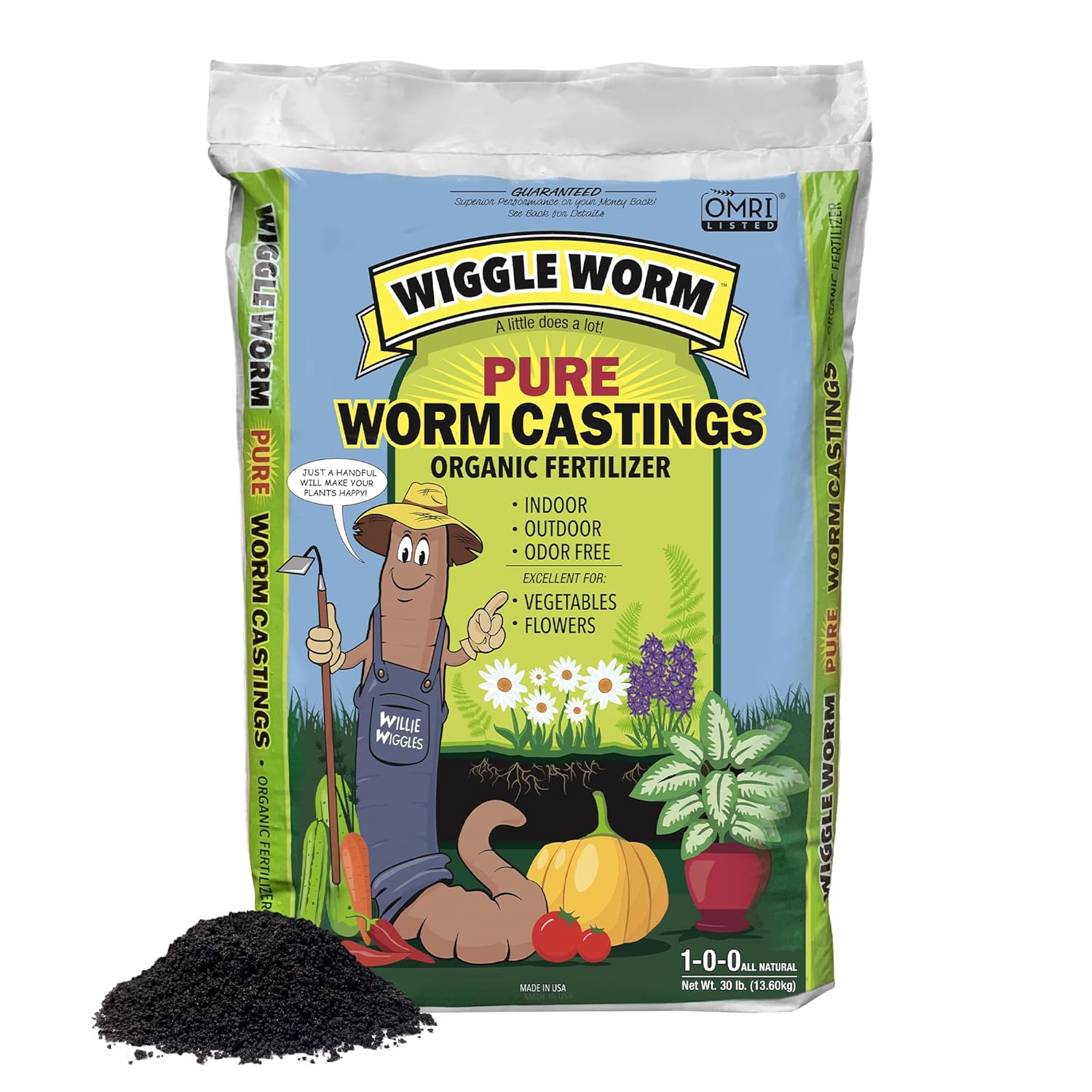
Wiggle Worm Pure Worm Castings Organic Fertilizer, 30 lb
| Item Form | Granules |
|---|---|
| Specific Uses For Product | Soil Conditioning |
| Application Method | Apply to soil |
| Unit Count | 480 Ounce |
Wiggle Worm Pure Worm Castings are a ready-to-use organic soil amendment made from concentrated earthworm castings. Gardeners typically mix a portion into potting mixes, top-dress established plants, work it into transplant holes, or brew it as a nutrient tea; the product page includes specific dosing for vegetables, containers, lawns, and roses. The castings are odorless, non-burning, and OMRI listed for organic use, so they supply water-soluble nutrients plus microbes that improve aeration, water retention, and root development without synthetic chemicals. Practical benefits include easy application, safe use on seedlings and mature plants, and versatility across raised beds, container gardens, and lawns. The main limitation is that this is a concentrated soil builder rather than an all-in-one fertilizer with NPK labels, so users seeking precise, fast-acting nutrient ratios may need to supplement for specific deficiencies; also a 30 lb bag is bulky to handle for small-space gardeners. For gardeners focused on long-term soil health and organic production, it functions as a low-risk, effective amendment.
Best for: Gardeners who prioritize building long-term soil health and want a safe, organic amendment for vegetables, ornamentals, and containers; buyers who value proven, low-risk inputs backed by strong user feedback.
Less Ideal for: Gardeners who need targeted, rapid nutrient correction based on precise NPK values or those who only want a lightweight product for very small balconies or indoor micro-gardens.
- OMRI listed organic and made from 100% worm castings
- Provides beneficial microbes that improve soil structure and water retention
- Odorless and non-burning so safe for seedlings and established plants
- Versatile dosing for containers, raised beds, lawns, and making worm casting tea
- No standard NPK nutrient label so not a precise standalone fertilizer for targeted feeding
- Large 30 lb bag can be heavy and awkward for gardeners with limited storage or mobility
Verdict: Choose this product when you want a proven, OMRI-listed worm casting that builds soil biology and improves plant health across beds and containers.
Brut Organic Worm Castings, 5 lb

| Item Form | Granules |
|---|---|
| Specific Uses For Product | Gardening,Organic |
| Target Species | All plants |
| Mixing Ratio | 1:5 |
Brut Organic Worm Castings function as a concentrated, natural soil amendment you mix into potting mixes or top-dress garden beds and raised beds. Typical use is mixing at the recommended 1:5 ratio for new indoor plants, sprinkling a cup around established houseplants, or working into outdoor planting holes and beds according to the brand directions. The product is OMRI/CDFA listed and produced in controlled conditions, which supports consistent nutrient content and beneficial microbial life that help roots establish, improve soil structure, and increase moisture retention without burning plants. Practical benefits for raised garden beds include improved aeration, slow-release nutrients, and a boost in microbial activity that supports long-term fertility. Limitations are that it is not a complete NPK fertilizer for immediate heavy feeding needs and larger beds require significant quantities to hit the suggested per-square-foot rates, so frequent applications or bulk purchases may be needed for big projects.
Best for: Gardeners who prioritize dependable, organic soil improvement for raised beds and container gardens and prefer predictable, low-risk amendments that support long-term soil health.
Less Ideal for: Those needing immediate, high-NPK feeding for heavy-feeding crops or gardeners who want to amend very large beds without buying supplemental bulk material.
- Certified organic and produced indoors for consistent purity
- Rich in beneficial microbes that improve soil structure and plant vigor
- Easy-to-use granular form suitable for mixing or top-dressing
- Not a standalone high-NPK fertilizer for rapid nutrient correction
- Five-pound bag may be small for large raised beds and repeated seasonal use
Verdict: Use this OMRI/CDFA-listed worm castings product to reliably build long-term fertility and microbial health in raised beds and containers.
Choosing the Right All Round Compost: Key Factors to Consider
Texture and Particle Size
Texture determines how compost behaves when you sow seed, transplant seedlings, or mix it into existing soil. A well-screened, fine-to-medium texture gives good seed-to-soil contact, reduces air pockets, and promotes even moisture distribution. Coarse fractions improve drainage but can make seedbeds uneven and dry out containers quickly.
Consider where you will use the compost most often. For seed starting and small pots, choose a finer screened mix. For incorporating into large beds or improving drainage in heavy soils, a slightly coarser texture with larger humified particles can be beneficial.
Nutrient Balance and Release
Compost varies in immediate nutrient availability. Some are richer in plant-available nitrogen, phosphorus, and potassium and will support quick establishment, while others act mainly as slow-release organic matter that feeds soil life over months. The balance affects how much additional fertilizer you might need, especially for heavy-feeding crops.
Think about the plants you grow. Vegetables and fast-growing annuals do better with composts that supply moderate immediate nutrients. For long-term soil building and low-maintenance ornamentals, a compost emphasizing slow-release nutrient contribution is often preferable.
Moisture Retention and Drainage
Compost influences both how long soil stays moist and how well excess water drains. High organic matter increases water-holding capacity, which benefits containers and sandy soils. However, overly fine or extremely compacted compost can reduce drainage and encourage waterlogging in heavy soils.
Match the compost to your site conditions. For dry, sandy beds or small containers, favor mixes that hold water. For clay soils or areas that stay wet, choose composts with better structure and larger particles to improve porosity.
Weed Content and Weed-Seed Free Assurance
Compost quality depends on how feedstocks were managed and the processing temperatures achieved during composting. Products free of weed seeds and viable root fragments reduce future weeding and risk of spreading invasive species. Finished, thermally treated composts typically have fewer viable seeds.
If you are top-dressing beds or using compost in seed rows, prioritize mixes labeled or described as screened and weed-seed free to avoid introducing new weeds into managed planting areas.
Organic Matter and Soil Biology Support
Beyond nutrients, compost is primarily a soil biology and structure amendment. Higher organic matter supports earthworms, beneficial microbes, and long-term aggregate stability, which improves root access to air and nutrients. The degree of humification influences how quickly compost supplies carbon to soil organisms.
For gardeners focused on long-term soil health and resilience, choosing composts with higher stable organic matter and evidence of good humification will give better returns over seasons compared with fresher, minimally decomposed materials.
Suitability for Containers and Seedlings
Containers and seedlings have different demands than in-ground beds. Compost intended for container use should be light, well-draining yet moisture-retentive, and free of large woody pieces that impede root development. For seedlings, a finer, cleaner texture and predictable nutrient content are important to avoid transplant shock and uneven growth.
If you mix compost with potting media, evaluate how it affects weight and water scheduling. Lightweight but water-holding composts reduce the frequency of watering while still providing a hospitable root environment for young plants.
When to Use All Round Compost in the Garden
All round compost is the go-to amendment for general improvements across beds, borders, and containers. Use it to top-dress established planting areas, as a component of potting mixes, or to mix into the top 10 to 20 centimeters of soil when preparing new beds.
It is especially useful at planting time for vegetables, annuals, and perennials that benefit from modest, balanced nutrient input and improved soil structure. Avoid relying solely on it for correcting extreme pH or severe drainage problems; those issues need targeted amendments.
- Top-dressing flower beds in spring or autumn
- Mixing into potting mixes for containers and hanging baskets
- Improving structure of tired or compacted beds
- Incorporating into raised beds before planting
How to Apply All Round Compost Effectively
For established beds, spread a 2 to 5 centimeter layer of compost over the soil surface and fork it lightly into the topsoil. This refreshes organic matter without disturbing root systems. For new beds, mix compost into the upper 15 to 20 centimeters to provide a fertile planting zone.
When using compost in containers, mix it at 20 to 30 percent by volume with a quality potting medium to balance drainage and moisture retention. For seedlings, use a finer, screened fraction and avoid heavy applications that can hold too much water and cause damping-off.
- Top-dress with thin layers for maintenance
- Incorporate deeper when rebuilding beds
- Blend with potting mix for containers
- Use screened compost for seed starting and small pots
Common Mistakes to Avoid
Applying too much compost at once can temporarily tie up nitrogen or create overly rich conditions that encourage leafy growth at the expense of flowers and fruit. Use moderate quantities and supplement with targeted fertilizers when growing heavy feeders.
Using untested or fresh green waste compost without confirmation of weed-free status can introduce viable seeds or phytotoxic compounds. Always choose finished, screened compost for sensitive uses like seed beds and small pots.
- Avoid thick layers that smother soil life
- Don't use coarse, unfinished compost for seed starting
- Check compost maturity before applying to newly planted transplants
Storage and Handling Tips
Store compost in a dry, covered area to preserve moisture and avoid nutrient leaching. Keep bags sealed until use to prevent drying and contamination. For bulk compost, place on pallets or a clean hard surface rather than bare soil to limit contamination.
When moving compost, use garden tools that minimize compaction and break up any clumps. If compost smells strongly of ammonia, it may be incompletely composted and should be allowed to mature further before use.
- Keep bags sealed and store off the ground
- Use a tarp or bin for bulk storage
- Let suspicious-smelling compost aerate before use
Environmental and Sourcing Considerations
Know the feedstocks when possible. Composts made from mixed green waste, garden prunings, and well-rotted manure supply different benefits than those made primarily from leaf mold or woody residues. Local, responsibly produced compost reduces transport emissions and supports circular garden practices.
Look for information about screening, thermal processing, and testing for contaminants when available. Responsible producers will provide guidance about intended uses and any restrictions.
- Prefer locally produced, well-processed composts
- Ask about feedstocks and screening where possible
- Avoid composts with large unprocessed woody chunks for fine gardening uses
How We Chose the Best All Round Compost
We prioritized composts that suit a wide range of garden uses rather than niche mixes for a single crop. Selection focused on physical texture, nutrient profile, source materials and consistency, microbiological activity, and ease of use in beds and containers. We looked for balanced nutrient analyses and predictable release patterns suitable for planting and top-dressing. Particle size and moisture retention were key because they directly affect seed sowing, transplanting, and root growth. We excluded specialized products formulated only for acid-loving plants, heavy clay remediation only, or mixes with unprocessed green waste that can rob nitrogen during establishment. We also excluded finished composts with unusually coarse woody fractions that are unsuitable for seedbed and container use. Our filters emphasized ready-to-use, weed-seed-free, and consistently screened textures that perform reliably in typical backyard and balcony gardens.
FAQ
Can I use all round compost for seed starting?
Often you can, but choose a finely screened fraction and mix it with a lighter potting medium. Pure garden compost may be too heavy or variable for direct seed sowing without blending.
How much compost should I add to vegetable beds each year?
A thin annual top-dress of 2 to 5 centimeters is usually sufficient to maintain organic matter. For rebuilding low-organic soils, incorporate compost more deeply at planting or during a renovation.
Will compost change my soil pH?
Compost typically has a mild buffering effect and may slightly nudge pH toward neutral, but it is not a reliable method for major pH correction. For significant pH adjustments, use targeted lime or sulfur treatments after testing soil.
Is homemade garden compost as good as bagged all round compost?
It depends on how it was made and finished. Well-aged, screened homemade compost can match commercial products, but immature or weed-seed-rich batches can cause problems. Finished, thermally treated composts are more predictable for sensitive uses.
Can I use all round compost in hanging baskets and containers?
Yes, when blended appropriately. Use compost at around 20 to 30 percent of the potting mix to improve structure and nutrients while maintaining good drainage and lightness for containers.
Final Verdict
Choose an all-round compost that matches your main uses first. Prioritize texture and screening for seedbeds and containers, and prioritize moisture retention and organic matter for dry or sandy sites. Balance immediate nutrient needs with long-term soil biology goals so you do not over-apply nutrients or create drainage issues. By focusing on particle size, nutrient release, and weed-free processing, you can confidently pick an all-round compost that suits beds, borders, and containers and improves garden performance season after season.
