

Note: This article contains affiliate links. If you click on these links and make a purchase, I may earn a small commission at no extra cost to you. This helps support my research and content. Read my full affiliate disclosure here.
If wildlife is nibbling seedlings, trampling beds, or leaving messes in planters, the right animal repeller can restore order without harming animals. You want a solution that works in real outdoor conditions, matches the typical pests on your property, and lasts through sun, rain, and cold. This guide examines seven shortlisted animal repellers chosen for consistent detection, effective deterrence methods, and long-term weather resistance. We evaluate each option on factors gardeners care about like detection range, active deterrent type, and build quality. Read on to find which style fits your yard, raised bed, or patio planting area.
Top Picks at a Glance
| Best Overall The best all-around choice for most situations | JahyElec Sonic Fortress Pro 2-Pack Solar Ultrasonic Animal Repellers |  |
| Best Quality Built to a higher standard if you want something more solid | Orbit Yard Enforcer Motion-Activated Sprinkler |  |
| Best Value The sweet spot between price and what you get | CKCOEO Solar Ultrasonic Animal Repellent with Motion Sensor and Strobe Light |  |
| Best Budget The cheapest option that still gets the job done reliably | SHKI Solar Ultrasonic Animal Repellent (Outdoor, PIR Sensor) |  |
| Highest Rated A top-rated pick with lots of positive feedback | Peepst Solar Motion-Activated Ultrasonic Animal Repeller (2-Pack) |  |
| Most Popular A crowd favorite that many people choose with confidence | Bonide Repels-All Animal Repellent Granules, 3 lb |  |
| Best Seller A high-volume bestseller chosen again and again | Jqely Ultrasonic Indoor Pest Repeller — 3-Mode Plug‑In (10‑Pack) |  |
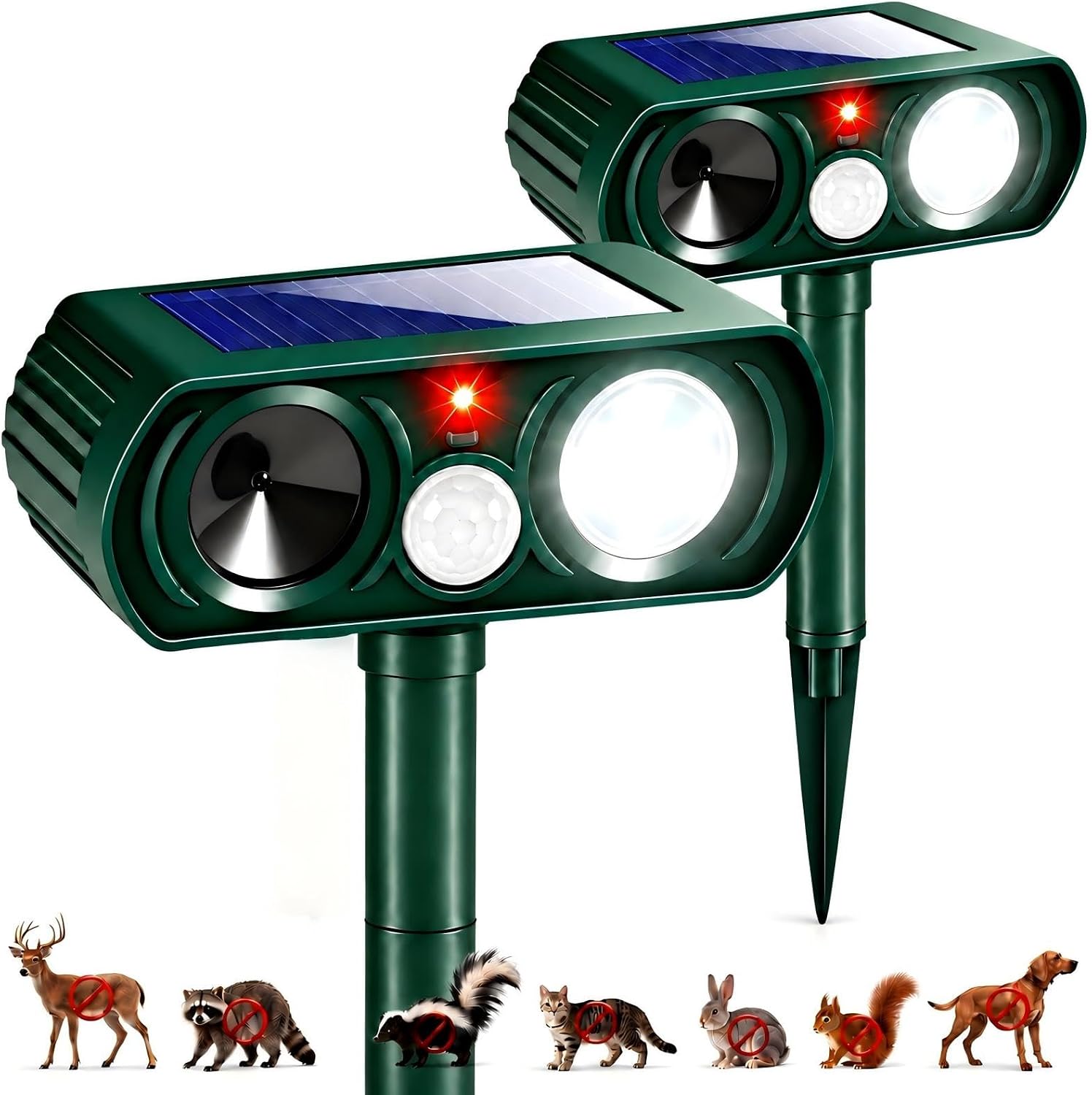
JahyElec Sonic Fortress Pro 2-Pack Solar Ultrasonic Animal Repellers
| Number of Items | 2 |
|---|---|
| Unit Count | 2 Count |
| Sensor Angle | 110° |
| Detection Range | Up to 33 feet |
| Ingress Protection | IP65 |
The JahyElec Sonic Fortress Pro 2-pack is a set-and-forget outdoor deterrent that combines PIR motion sensing, ultrasonic pulses, and flashing LEDs to discourage animals from gardens, flowerbeds, and trash areas. Each unit is solar powered and rated IP65, so you can stake it in a sunny spot or hang it on a fence and expect it to withstand rain and light snow without daily maintenance. The PIR sensor covers a wide 110° angle and activates up to about 33 feet, which makes these suitable for protecting planting beds, compost areas, or perimeter zones where animals typically enter. Practical benefits include trap-free, chemical-free protection and easy one-person installation with a ground stake or rear mounting slot. Limitations to consider are the usual variability of ultrasonic devices with different species and environmental factors such as dense vegetation or very uneven terrain that can reduce effective range, and the need to place units in full sun for reliable solar charging. For many homeowners this kit offers a low-effort supplement to physical barriers and habitat modification.
Best for: Gardeners and homeowners who want a low-effort, nonlethal way to reduce visits from common yard animals and prefer maintenance-free electronic deterrents over traps or chemicals.
Less Ideal for: People needing guaranteed removal of persistent pests or those who cannot position units in sunny locations; also not the best sole solution for large properties where multiple barriers are required.
- Solar-powered with built-in charging for maintenance-free daily use in sunny locations
- PIR motion sensor with a 110° detection angle and up to 33 feet activation range
- IP65 waterproof housing suitable for outdoor placement in variable weather
- Dual deterrent action using ultrasonic sound plus flashing LED light to increase effectiveness
- Easy installation using a ground stake or rear mounting slot for fence or wall placement
- Effectiveness can vary by species and environmental conditions so results are not guaranteed for all pests
- Performance depends on sufficient sun exposure for solar charging which may limit placement options
Verdict: A low-maintenance, weatherproof solar ultrasonic repeller kit that adds practical, nonlethal protection to small to medium garden areas.
Orbit Yard Enforcer Motion-Activated Sprinkler

| Maximum Pressure | 100 psi |
|---|---|
| Maximum Flow Rate | 0.5 gpm |
| Material Type | Plastic, Zinc |
| Manufacturer Warranty Description | 3 year |
The Orbit Yard Enforcer is a motion-activated sprinkler designed to discourage animals from entering lawns and garden beds by delivering short bursts of water when it senses heat and movement. Installation is straightforward using the included metal step spike and the unit is weather-resistant for outdoor use. You can adjust detection range up to 40 feet, set a 120-degree field of view, and choose Day, Night, or Always-On modes to match when animals are most active. Spray duration is adjustable for 3 to 10 seconds and there is a separate 30-minute manual watering cycle for quick spot watering. Practical benefits include humane animal deterrence without chemicals, flexible coverage for different yard layouts, and a simple manual watering option. Limitations to consider are that detection can vary with animal size, placement, and weather conditions and the device relies on a hose connection and water pressure for effectiveness, so it is less suitable in very low-pressure systems or for covering extremely large areas continuously.
Best for: Homeowners who want a humane, low-maintenance way to deter cats and other small animals from flower beds and lawns while retaining the option for occasional spot watering.
Less Ideal for: People who need continuous coverage of very large properties or who lack reliable water pressure should consider other solutions.
- Adjustable detection range up to 40 ft and 120° field of view for targeted coverage
- Multiple operation modes (Day, Night, Always-On) to match animal activity patterns
- Adjustable spray duration and 30-minute manual watering cycle for spot watering
- Includes metal step spike and weather-resistant construction for easy outdoor installation
- Detection performance varies with animal size, placement, and environmental conditions
- Depends on hose connection and sufficient water pressure to be effective
Verdict: Choose the Yard Enforcer if you want a humane, adjustable motion-activated sprinkler that deters cats and other small animals while also offering convenient spot-watering.
CKCOEO Solar Ultrasonic Animal Repellent with Motion Sensor and Strobe Light

| Power source | Solar |
|---|---|
| Detection angle | 150 degrees |
| Detection range | 25-30 ft |
| Waterproof rating | IP65 |
This solar ultrasonic repellent combines a PIR motion sensor, high-frequency sound pulses, and a flashing strobe to keep small mammals out of gardens and yards. Install it on a stake about 9 to 10 inches above the ground or hang it on a fence facing animal paths; when the sensor detects movement within about 25 to 30 feet and 150 degrees, the unit emits ultrasonic bursts and a bright LED flash for immediate deterrence and then returns to standby. The built-in solar panel charges the internal battery so the device runs after dark without wiring, and the IP65 ABS housing tolerates rain and sprinklers for year-round outdoor use. Practical benefits include easy, tool-free setup, chemical-free operation, and coverage that targets a wide range of species. Limitations to note are the need for good sun exposure to maintain charge, an advertised adjustment period of a few weeks for persistent animals, and the typical line-of-sight requirement of ultrasonic devices which reduces effectiveness around dense vegetation or obstructed approaches.
Best for: Gardeners and yard owners who want a low-maintenance, chemical-free deterrent that can be set-and-forgotten to reduce small mammal damage around beds and lawns.
Less Ideal for: People with shaded sites that get little direct sun or those who need immediate, guaranteed removal of persistent animals in heavily obstructed areas.
- Solar-powered with on-board charging so it runs at night without external power
- PIR motion sensor covers up to about 150 degrees and 25–30 feet for triggered activation
- IP65-rated ABS housing protects electronics from rain and outdoor conditions
- Dual-action deterrent using ultrasonic pulses plus flashing LED to startle animals
- Performance depends on direct sunlight for reliable charging and runtime
- Ultrasonic effectiveness is reduced by obstacles and may take weeks for animals to adapt or leave
Verdict: A hands-off, solar-powered ultrasonic repeller that gives practical, weatherproof protection against squirrels and other small pests for sun-exposed gardens.
SHKI Solar Ultrasonic Animal Repellent (Outdoor, PIR Sensor)

| Power options | Solar and USB charging |
|---|---|
| PIR detection angle | 110° |
| Detection range | Up to 26 feet |
| Waterproof rating | IP65 |
This small solar ultrasonic repellent is designed to protect yards and gardens by combining a motion-activated ultrasonic emitter with flashing LEDs and simulated flame lights. It is typically mounted on a fence, wall, or staked into the ground about 9–10 inches above soil level and uses a high-sensitivity PIR sensor to detect movement across a roughly 110° angle up to about 26 feet. Two operating modes let you run ultrasonic output alone or alternate sound with light effects. The unit charges by solar panel and can be topped up via the included USB cable for cloudy periods. Built from ABS with an IP65 rating, it is weather resistant for outdoor use. Practical benefits include hands-off operation, no poisons or traps, and easy multi-location installation. Limitations are typical for ultrasonic devices: effectiveness varies by species and environment, detection is directional so placement matters, and some users may need multiple units to cover larger areas consistently.
Best for: Buyers who want a low-cost, low-maintenance, nonlethal way to discourage common yard animals and prefer a simple installation they can set and forget.
Less Ideal for: People needing guaranteed removal of persistent or burrowing pests or those who require broad continuous coverage for large properties should consider more robust or multiple solutions.
- Solar plus USB charging keeps it running in low sun
- PIR motion sensor activates deterrents only when needed, saving power
- IP65 weather resistance and ABS construction for outdoor durability
- Multiple deterrent modes (ultrasonic, flashing and flame-simulating lights) increase likelihood of deterring different animals
- Ultrasonic effectiveness varies by species and can be limited by obstacles and ambient noise
- Coverage is directional and limited so larger yards may require several units
- No proven range guarantee for every target species; placement trial and error may be required
Verdict: A budget-friendly, weatherproof solar repellent that offers motion-activated ultrasonic and light deterrents for simple, chemical-free yard protection.
Peepst Solar Motion-Activated Ultrasonic Animal Repeller (2-Pack)

| Power Source | Solar Powered |
|---|---|
| Frequency Range | 18–45 kHz |
| Detection Angle | 110° PIR sensor |
| Sensing Range | Up to 26 ft |
| Ingress Protection | IP44 |
The Peepst solar animal repeller is a weatherproof, motion-activated device that uses adjustable ultrasonic frequencies and a flashing light or audible siren to discourage deer, rabbits, raccoons and similar pests from gardens and lawns. Typical use is stake-mounting units around the perimeter of a planting area and setting one of six frequency bands plus one of three operating modes to match local pest activity and neighbor concerns. Notable features include a PIR sensor with a 110° detection angle and roughly 26 ft range, three top-dial modes for daytime siren, reduced-night disturbance, or off, and a solar panel with USB-C backup charging for continuous operation. Practically, the frequency options and motion activation let you concentrate deterrence where animals enter, reducing constant noise, while the IP44 housing keeps the unit running through rain and light snow. Important limitations are that ultrasonic repellents need time and tuning to be effective and PIR sensors can trigger from vegetation or heat sources, so placement and occasional sensitivity adjustment are necessary for reliable results.
Best for: Gardeners who prioritize a low-maintenance, weatherproof deterrent and want to install long-term perimeter protection that can be tuned to local wildlife behavior.
Less Ideal for: People who need an immediate, guaranteed solution for heavy or entrenched wildlife problems or who require visual barriers or lethal control methods.
- Solar power with USB-C backup allows continuous outdoor operation without wiring
- Adjustable 18–45 kHz frequencies let you tune the device to different nuisance species
- Motion-activated PIR sensor (110° angle, ~26 ft range) concentrates deterrence where animals appear
- Three operating modes (day siren, auto with reduced nighttime sound, off) reduce disturbance to neighbors
- Ultrasonic approach requires 1–2 weeks and frequency rotation for best results
- PIR sensor can produce false triggers from moving vegetation or nearby heat sources
Verdict: A dependable, tuneable solar ultrasonic repeller that provides hands-off perimeter protection for gardens when you need a low-maintenance, weatherproof deterrent.
Bonide Repels-All Animal Repellent Granules, 3 lb

| Net weight | 3 lb |
|---|---|
| Form | Granules |
| Claims | Biodegradable; People & pet safe when used as directed |
| Coverage duration | Up to 60 days (under normal conditions) |
Bonide Repels-All is a ready-to-use granular repellent formulated to keep deer, rabbits, squirrels, raccoons and many other pests away from planting areas. You spread the granules around beds, borders or other vulnerable spots and lightly water them in if no rain is expected; the manufacturer says the effect can last up to two months under normal conditions. The formula relies on scented and taste-irritant ingredients derived from fish meal, oils and minerals to trigger avoidance behavior rather than kill wildlife, and the product is described as biodegradable and safe for lawns and ornamentals when used as directed. For gardeners focused on protecting perennials, shrubs and newly planted areas it provides a low-effort barrier and can be re-applied more frequently after heavy rain or during rapid plant growth. Limitations are that effectiveness varies by species and local pressure of animals, and the granules require reapplication on a schedule for consistent protection and must not be applied directly to edible crops intended for human consumption.
Best for: Gardeners who want a low-effort, nonlethal way to protect ornamental plants from deer and small mammals and who prefer products that are described as safe for people and pets when used as directed.
Less Ideal for: Growers who need a guaranteed solution for heavy deer browsing or those wanting a repellent they can apply directly to fruits and vegetables should consider other targeted methods.
- Ready-to-use granular form is simple to apply around beds and borders
- Repels a broad list of animals including deer and rabbits using scent and taste deterrents
- Manufacturer states granules are biodegradable and safe for lawns and ornamental plants when used as directed
- Long-lasting effect up to 60 days under normal conditions with light watering after application
- Effectiveness varies with local animal pressure and weather and may require frequent reapplication after heavy rain
- Not labeled for direct use on edible crops intended for human consumption
Verdict: Choose these granules if you want a simple, nonlethal barrier that reduces deer and small-mammal damage to ornamental beds with infrequent reapplication.
Jqely Ultrasonic Indoor Pest Repeller — 3-Mode Plug‑In (10‑Pack)

| Unit Count | 10 Count |
|---|---|
| Coverage | Up to 1600 sq ft (open space) per unit |
| Power Consumption | 3-5W |
| Frequency Range | 10kHz-65kHz |
This Jqely ultrasonic repeller is a plug-in device that uses adjustable ultrasonic frequencies to discourage flies, mosquitoes, ants, roaches, and small rodents without chemicals or traps. It offers three modes: a low-noise mode for overnight or pet-friendly situations, a moderate mode for general flying and crawling insects, and a higher-frequency mode intended for heavier infestations or rodents that should be run only when people and pets are absent. Setup is simple — plug one unit into an outlet and select the desired mode — and the units run continuously at low power (3–5W), which makes them inexpensive to operate. The practical benefits are no mess, no bait, and continuous background protection where coverage is unobstructed; they are well suited for kitchens, living rooms, garages, and basements. Important limitations are that ultrasonic waves do not pass through walls or large furniture well, so multiple units are needed for whole-house coverage, and the highest-power mode can produce audible noise that may be uncomfortable if used around people or pets.
Best for: Best for buyers who want a low-effort, chemical-free way to reduce flies and other indoor pests in individual rooms and prefer a conservative, noninvasive solution.
Less Ideal for: Not a good fit for someone needing instant elimination across multiple rooms, or for households that cannot run the device in higher modes when unoccupied.
- Three selectable ultrasonic modes to target different pests and infestation levels
- Low continuous power draw for 24/7 operation without batteries
- No chemicals or sticky traps required, so no mess or residue
- Advertised wide indoor coverage up to 1600 sq ft in open space per unit
- Simple one-button plug-and-play operation
- Ultrasonic waves are blocked by walls and large furniture so one unit rarely protects multiple rooms effectively
- The highest-intensity mode can produce audible noise and is not suitable when people or pets are present
Verdict: A simple, low-power, chemical-free plug-in that provides continuous room-by-room fly and pest deterrence when used as part of a multi-unit setup.
Choosing the Right Animal Repeller: Key Factors to Consider
Detection Range and Sensor Type
How far a unit senses motion determines how much area it protects. A longer detection range reduces the number of devices needed to cover a vegetable patch or border, while a narrower beam can help focus protection on a single bed. Sensor type matters: passive infrared (PIR) works well for warm-bodied animals, ultrasonic sensors detect movement in a different way and can be tuned, and combined systems improve accuracy. Reliable sensing reduces false activations from plants moving in the wind or from small non-target animals.
For gardens, adjustable sensitivity is valuable because it lets you ignore small backyard traffic while catching larger pests. Consider the sensor field of view too: some units have wide-angle coverage for lawns while others use a directed beam ideal for protecting entry points to a greenhouse or compost area.
Deterrent Method and Humaneness
Different repellers use sound, flashing lights, water spray, or physical motion to discourage animals, and the method you choose affects both effectiveness and neighborhood acceptance. Ultrasonic or audible sound can be effective on certain species but may behave differently in open air than near structures. Motion-activated sprinklers are immediately obvious and work well on many mammals that dislike sudden wetting. Visual deterrents like flashing LEDs can work at night but are less effective for persistent animals.
Pick a deterrent that matches the target species and your tolerance for audible disturbances. Humaneness matters for many gardeners, so prefer nonlethal options that discourage return visits without harming wildlife. Look for adjustable intensity or mode settings so you can fine-tune the response for specific pests.
Weather Resistance and Build Quality
Outdoor devices must withstand sun, rain, and temperature swings. A unit with proper sealing, UV-stable plastics, and corrosion-resistant mounts will need less maintenance and last through seasons. Poor build quality leads to water ingress around sensors or speakers, which reduces effectiveness and creates failure points.
Check for rated ingress protection or manufacturer guidance on outdoor use when evaluating options. Durable housings and replaceable mounting stakes or brackets extend service life, and rugged wiring or connectors are especially important where irrigation or mowing equipment is nearby.
Power Options and Installation Flexibility
How a repeller is powered affects where it can be placed. Hardwired or plug-in units are suitable near an outlet but limit placement. Battery-powered devices offer flexible positioning but require periodic replacement or recharging. Solar-powered units provide long-term low-maintenance operation but need enough sunlight to stay charged. Consider how often you want to check or recharge units and whether wiring will be exposed to pets or tools.
Installation method is also crucial: stake-mounted units are easy to move seasonally, while bracket-mounted devices are better for permanent placement. Look for models with multiple mounting options so you can try different locations to find the most effective coverage.
Coverage Area and Unit Spacing
A repeller's stated coverage area gives a starting point for planning placement, but real-world layout matters. Obstacles like fences, shrub rows, and structures can block sensors or sound waves, so overlapping coverage is often necessary in complex gardens. For linear areas like vegetable beds, a small number of well-positioned units with directional sensors can be more effective than many omnidirectional devices.
Map your site and estimate where animals enter to decide how many units and what spacing will be needed. Remember that deterrent strength drops with distance, so spacing guidelines should account for the target species and the chosen deterrent method.
Maintenance and Long-Term Costs
Ongoing upkeep influences whether a repeller remains useful season after season. Battery replacement, solar panel cleaning, and occasional sensor adjustment are normal tasks. Units that need frequent consumables or complicated calibration become a burden for busy gardeners. Consider how easy it is to access a unit for maintenance and whether replacement parts like stakes or mounting brackets are commonly available.
Also think about the life expectancy of key components such as speakers or solenoids in sprinkler units. A slightly higher initial investment in a durable unit can reduce long-term replacement costs and downtime in a planted area.
Matching Deterrent Style to Target Wildlife
Different animals respond to different stimuli. Small rodents are often unimpressed by visual flashes but sensitive to sudden water or physical barriers. Rabbits and deer might be deterred by motion-activated sprinklers or sudden loud noises, while raccoons respond to unpredictable activation patterns rather than a constant stimulus. Observe the signs in your garden to determine activity times and likely species before choosing a deterrent style.
If you are unsure which species are active, choose a flexible device with multiple modes or try a low-commitment option like a portable stake unit to test effectiveness in your specific layout.
- Use audio or ultrasonic for nocturnal mammals that rely on hearing.
- Use water spray for animals that avoid getting wet.
- Use directional sensors for garden beds and wide-angle units for lawns.
Placement Tips for Maximum Effect
Position units where animals enter or travel through rather than in the center of an area. Mount sensors at the height of the target animal to improve detection accuracy. For example, low mounts catch rabbits and ground squirrels better, while higher mounts suit deer or raccoons.
Avoid placing units directly behind vegetation that moves in the wind and can trigger false activations. Test placement for a few days and adjust sensitivity or angle as needed to reduce nuisance triggers while keeping coverage effective.
- Aim sensors along common pathways, fence lines, or near compost piles.
- Overlap coverage slightly when protecting irregularly shaped beds.
- Face sprinklers slightly off-axis from watering lines to prevent corrosion from irrigation.
Combining Physical and Electronic Methods
Electronic repellers work best when they are part of a layered strategy. Physical barriers like low fencing, garden netting, or raised beds provide a reliable first line of defense. Pairing these with electronic deterrents fills gaps where barriers are impractical or visually intrusive.
Layering also reduces habituation. If an animal encounters both a fence and intermittent electronic deterrence, it is less likely to become accustomed to a single stimulus. Rotate deterrent modes or move portable units periodically to maintain effectiveness.
- Use barriers for daytime grazers and electronic devices for nighttime intruders.
- Rotate modes between audible, light, and sprinkle where possible.
- Inspect physical barriers regularly to prevent weak points that negate electronic efforts.
Powering Remote Garden Areas
For beds or greenhouses away from outlets, solar and battery-powered units provide the most practical solutions. Solar panels need a clear line of sunlight to stay charged, so place them where morning or midday sun is reliable. Battery-only options have predictable runtime but require replacement or recharging at intervals depending on activation frequency.
If you have multiple remote units, consider rechargeable battery packs with a single charging station to simplify maintenance. For permanent installations near structures, run protected low-voltage wiring if feasible to avoid frequent battery changes.
- Choose solar units for sunny spots to reduce maintenance.
- Opt for replaceable batteries where shade or heavy activation drains power.
- Consider conduit or protected wiring for semi-permanent electrical runs.
Minimizing Unwanted Triggers and Nuisance
False activations from moving branches, passing neighbors, or small pets can shorten battery life and lead to neighborhood complaints. Use sensitivity controls and aim sensors away from high-traffic zones to reduce nuisance triggers. Some devices offer pet immunity settings or directional sensors that ignore motion below a certain height.
Regularly trim vegetation around the sensor field of view and test settings at different times of day. If nuisance activations persist, change the mode or relocate the unit rather than increasing output, which can disturb non-targets.
- Enable pet immunity features when available.
- Trim plants that intersect the detection field.
- Schedule activity windows if the unit supports timed operation.
How We Chose the Best Animal Repeller
Our selection focused on practical performance in garden settings and durability under real outdoor conditions. We prioritized devices with proven coverage area so a single unit will protect the intended planting zone. Detection accuracy and adjustable sensitivity were important to reduce false triggers from wind or non-target movement. We favored deterrent methods that are effective yet nonlethal, such as sound, motion-activated sprinkling, or light, giving gardeners humane options for different situations. Weather resistance and robust housings were required so units remain functional through wet seasons and sun exposure. Power options and installation flexibility were assessed to fit different yard setups, from plug-in coverage near a shed to battery- or solar-powered units for isolated beds. We excluded items that rely on short-lived consumables or require frequent calibration that gardeners told us is impractical for routine use. The final list balances detection, deterrent effectiveness, longevity, ease of setup, and energy options to reflect real-world garden needs.
FAQ
Will an animal repeller harm pets or wildlife?
Most repellers use nonlethal stimuli like sound, light, or water and are not intended to harm animals. Small pets may react to certain audible or ultrasonic modes, so choose units with adjustable settings or pet-immunity options when domestic animals are present.
How many units do I need to protect a vegetable garden?
The number depends on unit coverage and garden layout. Estimate coverage per device, map likely entry points, and allow some overlap around obstacles. Directional units can protect linear beds with fewer devices, while open lawns may need several omnidirectional units for complete coverage.
Do solar animal repellers work in cloudy climates?
Solar units function best with regular sun exposure. In cloudy or heavily shaded locations they can still work but may need supplemental charging or more frequent battery support. Consider battery-backed solar models for inconsistent sun.
How often do these devices need maintenance?
Maintenance frequency varies by model and environment. Expect to check batteries or solar panels periodically, clear debris from sensors, and inspect mounts after storms. A durable, well-sealed unit typically needs only seasonal checks.
Can animals become used to a repeller?
Habituation can occur with consistent, predictable stimuli. Rotating modes, moving portable units occasionally, and combining electronic deterrents with physical barriers reduce the chance that animals will ignore the device over time.
Final Verdict
Choosing the right animal repeller means balancing coverage needs, the target species, and how much maintenance you can manage. Prioritize reliable detection at the animal's height, a deterrent method suited to local wildlife, and weatherproof construction for longer life. Consider power options and placement flexibility to match your garden layout and routine maintenance habits. With these priorities in mind, you can pick a humane, effective setup that protects plantings while minimizing nuisance activations.
