

Note: This article contains affiliate links. If you click on these links and make a purchase, I may earn a small commission at no extra cost to you. This helps support my research and content. Read my full affiliate disclosure here.
If big black ants have moved into your yard, garden beds, or patio, you need targeted control that stops colonies without creating extra work or hazards. Choosing the right ant killer for big black ants matters because these larger species behave differently, build deep nests, and can be less affected by treatments designed for smaller house ants. This guide shortlists the top options that work well in outdoor and perimeter settings and explains why each approach can succeed in real garden situations. We evaluate products on how quickly they reduce visible ants, how effectively they reach nests, and how safe they are to apply around plants and pets. Below are the top picks for this specific problem plus practical guidance to help you match product type and application method to the infestation and setting.
Top Picks at a Glance
| Best Overall The best all-around choice for most situations | Amdro Ant Killer for Outdoor Home Perimeter, 24 oz |  |
| Best Quality Built to a higher standard if you want something more solid | Syngenta Advion Ant Gel (4 Tubes, 30 g each) |  |
| Best Value The sweet spot between price and what you get | Terro Outdoor Liquid Ant Bait Stakes, 12-Pack |  |
| Best Budget The cheapest option that still gets the job done reliably | Raid Ant Killer Baits, 8 Count (Child-Resistant) |  |
| Highest Rated A top-rated pick with lots of positive feedback | NCSIFDD Ant Away Ant Repellent Gel, 6-Pack |  |
| Most Popular A crowd favorite that many people choose with confidence | TERRO Liquid Ant Killer Bait Stations, 12-Pack (T300B) |  |
Amdro Ant Killer for Outdoor Home Perimeter, 24 oz

| Item Form | Granules |
|---|---|
| Target Species | Insects |
| Special Features | Ant Killer for Outdoor Home Perimeter |
| Active Ingredients | Hydramethylnon |
This granular ant bait is formulated for outdoor perimeter control around foundations, lawns, and landscaped areas. You apply a 12-inch band around the house or sprinkle directly on visible trails and mounds; worker ants take the granules back to the colony so the active ingredient, hydramethylnon, can reach the queen and reduce the nest. The label claims protection up to three months and treatment coverage measured in linear feet, which makes it suitable for ongoing seasonal control rather than spot fixes. It works best when applied in cool morning or evening hours on dry ground and should not be used before rain or when temperatures are below 50°F. Practical benefits include simple shake-on application, broad efficacy against many common ant species, and residual activity that lowers repeat treatments. Important limitations are that it is a chemical bait requiring careful handling and adherence to safety directions and that results depend on ant foraging behavior so very large or established colonies may need follow-up treatments or combined tactics.
Best for: Buyers who prioritize strong, season-long perimeter control and want a targeted bait solution for lawns and landscaped areas rather than temporary surface sprays.
Less Ideal for: Those seeking non-chemical or immediate-kill surface treatments, or people who need a one-time indoor solution should consider other products or integrated approaches.
- Designed for outdoor perimeter use with instructions for 12-inch band application around the home
- Granular bait formulation is carried by foragers to the colony to target the queen
- Label lists effectiveness against a wide range of common ant species
- Offers residual control claimed up to three months reducing application frequency
- Contains hydramethylnon and requires careful handling and adherence to safety directions
- Performance depends on ants discovering and collecting the bait so results can vary by species and activity levels
Verdict: Choose this product if you want a proven granular perimeter bait that targets colonies to deliver longer-lasting outdoor ant control.
Syngenta Advion Ant Gel (4 Tubes, 30 g each)

| Unit Count | 4.23 Ounce |
|---|---|
| Included Components | 4 Tubes x 30-Grams, 1 Plunger and 2 Tips |
| Item Form | Gel |
| Active Ingredients | 0.05% indoxacarb |
| Target Species | Insects |
Advion Ant Gel is a user-friendly gel bait intended to control common household and structural ant species by exploiting worker foraging behavior. You apply small spots or short lines of the odorless gel along active trails, in cracks and crevices, and near entry points; foraging workers consume the bait and carry it back to the nest where it is shared, helping to eliminate the queen and other nestmates. The kit ships with four 30 g tubes plus an applicator plunger and tips for precise placement, which makes targeting tight spaces straightforward. Its non-repellent formula with 0.05% indoxacarb is formulated to be attractive to a range of species including Argentine and carpenter ants, and it is labeled for both indoor and outdoor use. Limitations to note are that it is a chemical bait so safety precautions are needed around children and pets and efficacy depends on ants accepting the bait matrix versus other available food sources.
Best for: Homeowners and renters who want a targeted, easy-to-apply solution to eliminate established ant infestations and prefer a bait that works via worker-mediated transfer to treat whole colonies.
Less Ideal for: People seeking non-chemical or immediate-contact kill methods or those who need a one-time spray rather than ongoing baiting strategies should consider other options.
- Non-repellent gel formulation designed for worker ants to feed and transfer bait to the colony
- Includes four 30 g tubes plus a plunger and application tips for precise placement
- Labelled for both indoor and outdoor use, suitable for common pest species
- Odorless formula that is easy to place along trails, cracks, and crevices
- Contains a chemical active ingredient so it must be kept away from children and pets
- Effectiveness depends on ants preferring the bait over other available food sources
Verdict: Choose Advion Ant Gel when you want a precise, bait-based solution that encourages workers to carry poison back to the nest for colony-level control.
Terro Outdoor Liquid Ant Bait Stakes, 12-Pack

| Unit Count | 12 Count |
|---|---|
| Material Type | Plastic |
| Target Species | Ant |
| Power Source | manual |
These Terro Outdoor Liquid Ant Bait Stakes are simple, low-effort bait stations designed to intercept ant colonies outdoors before they reach the house. Each stake contains a sweet liquid bait with borax that worker ants feed on and carry back to the nest, which can eliminate the queen and much of the colony over a 2 to 4 week period. They are weather-resistant, see-through so you can monitor bait consumption, and install by cutting a tab and pushing the stake into soil or mulch near ant trails. For homeowners dealing with small common species such as little black, odorous house, pavement, and ghost ants, the stakes provide targeted perimeter protection without sprays or direct contact. Limitations are that baiting takes days to weeks to fully work and you may see increased ant activity at first as foragers discover the bait. Also they must be placed where children and pets cannot access them and replaced periodically to maintain protection.
Best for: Homeowners who want a low-effort, evidence-based way to stop small common outdoor ants at the source and prefer baiting over sprays, using visual confirmation of activity before replacing units.
Less Ideal for: People needing an immediate knockdown or single-visit solution for heavy indoor infestations or those who cannot place bait stations out of reach of children and pets.
- Colony-level control via borax bait that foraging ants share with the nest
- Ready-to-use stakes are easy to deploy by cutting the tab and inserting in soil
- See-through design lets you monitor bait consumption and know when to replace
- Weather-resistant stations suitable for yards, patios, and garden perimeters
- Works gradually and can take 2–4 weeks for complete colony control
- Not child- or pet-proof if placed in accessible areas and requires careful placement
Verdict: A practical, easy-to-use baiting solution that stops small outdoor ant colonies by getting worker ants to carry borax bait back to the nest.
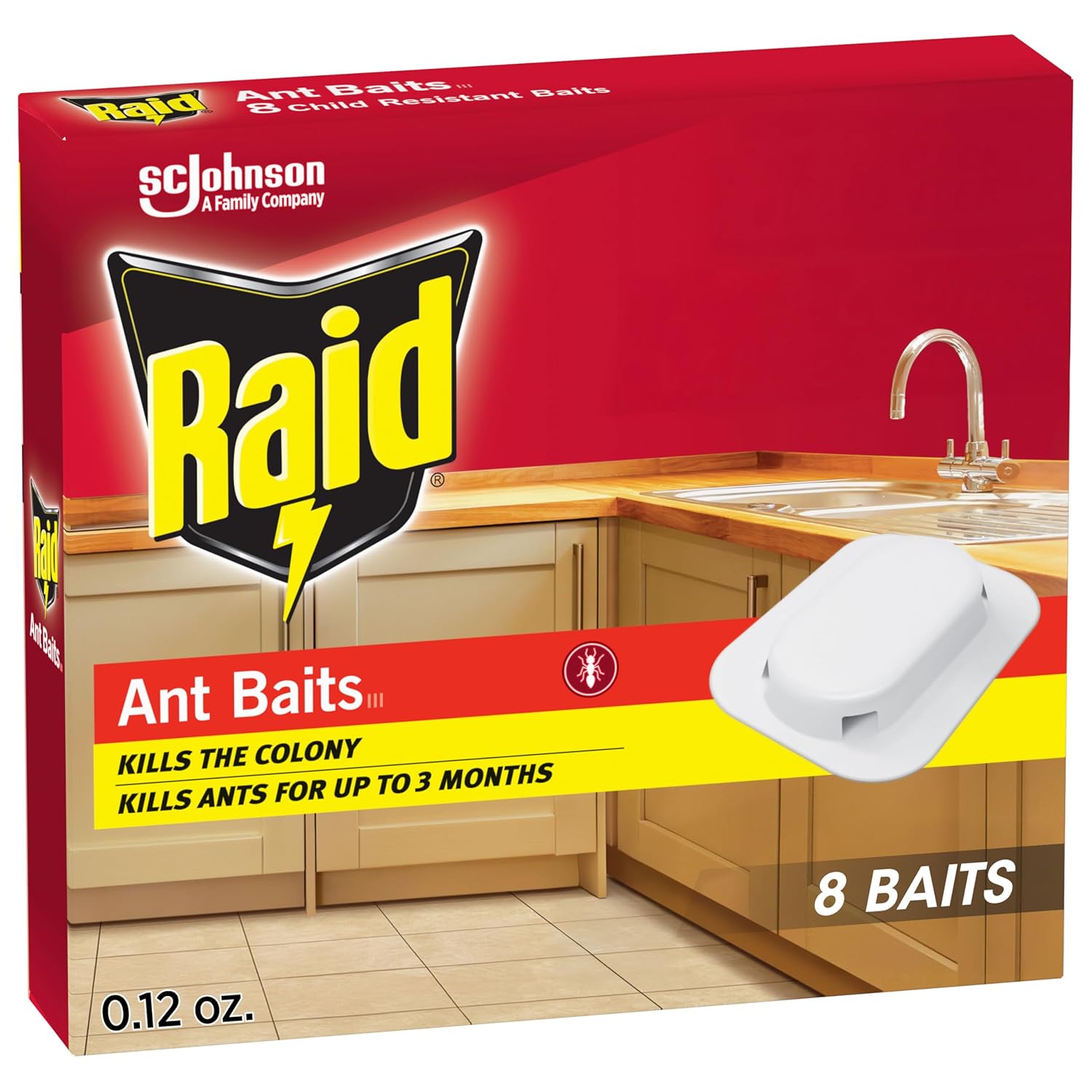
Raid Ant Killer Baits, 8 Count (Child-Resistant)
| Package quantity | 8 Count |
|---|---|
| Child safety | Child-resistant |
| Intended use | Indoor |
| Effect duration | Up to 3 months |
These Raid Ant Killer Baits are small, ready-to-use indoor stations that dispense an attractive liquid bait ants carry back to the colony, which can eliminate the nest over time. You place the bait along walls, in corners, and near entry points where small ants forage; after ants feed, the active ingredient is shared with other colony members, including the queen, and protection can last for weeks. The child-resistant design reduces accidental access in homes with children while the compact stations are low-profile and easy to position. Because they are prefilled and disposable, there is no mixing or measuring, which makes them convenient for quick treatment in kitchens, pantries, and baseboards. Limitations are that the product is for indoor use only and may be less effective if competing food sources are left available or if multiple heavy infestations require broader perimeter treatment. For someone looking for a simple, no-fuss bait to try first, these are a practical option.
Best for: Budget-minded homeowners or renters who want an easy, low-effort indoor solution to control small ant trails and try baiting before calling for broader treatments.
Less Ideal for: People needing immediate knockdown for very large or outdoor ant colonies or those who prefer non-chemical mechanical control methods.
- Ready-to-use prefilled bait stations that require no setup
- Child-resistant design reduces accidental access
- Bait formula is transferred through the colony to target the queen
- Compact, low-profile stations are easy to place along walls and entry points
- Intended for indoor use only, not suited for outdoor colony control
- May be less effective if other food sources are available or in very large infestations
Verdict: A low-cost, no-fuss indoor bait station that effectively targets small ant colonies by having foragers carry bait back to the nest.
NCSIFDD Ant Away Ant Repellent Gel, 6-Pack

| Unit Count | 12 Count |
|---|---|
| Number of Pieces | 1 |
This ant repellent gel is a concentrated applicator product intended for targeted spot treatments around entry points, baseboards, window frames, and known ant trails. You remove the cap, attach the precision tip, and apply pea‑sized drops into crevices or along trails; the manufacturer notes it can take 3–5 days to work through a colony and helps keep ants away for up to 60 days in treated areas. Practical benefits include the narrow applicator for neat placement in tight gaps, suitability for both indoor and outdoor problem spots, and a formulation presented as family and pet safe when used as directed. Important limitations are that results are not instantaneous and multiple applications or placements may be needed to control larger or multiple colonies, and effectiveness depends on correctly locating trails and nest access points. For someone who wants a low‑mess, targeted solution rather than broad broadcast treatments, this gel is a convenient option.
Best for: Buyers who prioritize dependable, low‑mess spot treatment for recurring ant sightings and prefer a product they can place precisely where ants travel.
Less Ideal for: People needing rapid elimination of very large or widespread infestations or those who prefer broadcast sprays or professional colony eradication services.
- Precision applicator allows neat, pea‑sized placements in tight crevices and along ant trails
- Labeled for both indoor and outdoor use so the same product can treat kitchens, baseboards, and patios
- Formulation described as family and pet safe when used according to directions
- Single placements can provide protection in treated areas for up to 60 days
- Not an immediate knockdown—can take 3–5 days to affect a colony
- May require several placements and correct trail identification to fully control larger infestations
Verdict: Use this precision gel when you want a neat, family‑safe spot treatment that targets ant trails and entry points rather than a broad spray solution.
TERRO Liquid Ant Killer Bait Stations, 12-Pack (T300B)

| Unit Count | 12 Count |
|---|---|
| Item Form | Liquid |
| Target Species | Insects |
| Active Ingredients | Sodium Tetraborate Decahydrate (Borax), 5.40% |
Terro Liquid Ant Killer bait stations are prefilled, single-use traps designed for indoor control of common sugar-loving ants. You place the small stations along baseboards, in corners, under appliances, or on countertops where you see ant activity. Worker ants are drawn to the sweet liquid, feed on it, and take it back to the nest so the borax-based active ingredient can eliminate the colony over days to weeks. The product is easy to use with no mixing or setup and the 12-pack gives coverage for several rooms. Because the bait is contained inside a low-profile plastic station, it reduces incidental contact risk compared with loose sprays or powders and lasts for weeks while ants continue to visit. Limitations are that the formula targets sugar-preferring species so very protein- or grease-attracted ants may ignore it, and control can take 2 to 4 weeks for larger infestations. Also stations should be placed away from pets and children despite the contained design since the bait contains borax.
Best for: Homeowners who prioritize an easy, low-hassle indoor solution and want a bait that works at the colony level with minimal hands-on pest handling.
Less Ideal for: People who need immediate knockdown of ants or who have pets or children that frequently access treated areas and cannot reliably keep them away from placed stations.
- Ready-to-use stations require no mixing or setup
- Designed to be carried back to the nest for colony-level control
- Low-profile enclosed bait reduces messy exposure compared with loose liquids or sprays
- 12 stations provide coverage for multiple rooms or hotspots
- Formulation is sugar-based so less effective on ants that prefer protein or grease
- Control can take 2–4 weeks for large or established colonies
Verdict: A simple, low-contact indoor bait system that reliably reduces sugar-loving ant infestations by getting worker ants to carry borax back to the colony.
Choosing the Right Ant Killer for Big Black Ants: Key Factors to Consider
Target Species Behavior
Big black ants often forage farther from nests and build deeper galleries than smaller household ants. Knowing whether the ants you see are food-foraging workers or scout foragers changes what treatment works best. Treatments that rely on worker-bait transfer need to match the species' food preferences and feeding habits. If the species tends to avoid sugary baits or prefers protein, bait choice and placement must reflect that.
Understanding colony structure also matters. Some larger ants form multiple satellite nests that require perimeter or baiting strategies rather than relying on a single mound treatment. Observing where trails begin and where ants congregate during peak activity times guides effective placement of baits or liquid treatments.
Formulation Type and Mode of Action
Ant control options include baits, contact insecticides, granular formulations, and non-chemical approaches. Baits are useful when workers will feed and carry toxicant back to the nest, but they depend on correct bait matrix and delayed-acting active ingredients for transfer. Contact sprays can kill visible ants on contact but may not reach the nest and often offer limited residual control.
Granules and soil-applied residuals can penetrate foraging pathways and provide longer protection but may need watering-in or placement in dry galleries. Knowing how an active ingredient moves through the colony and whether it targets worker behavior or nest mortality affects which formulation you choose.
Application Precision and Delivery
How you apply an ant killer determines both effectiveness and non-target risk. Spot-treating mounds, placing bait stations along trails, or applying a narrow perimeter band reduces product spread and exposure to plants or beneficial insects. Hose-end or broadcast applications are faster for large areas but can overspray and impact nearby beds. Equipment compatibility matters too: products designed for drenching nests, using injector nozzles, or fitting bait stations provide more controlled outcomes.
Timing matters as well. Apply treatments during peak foraging periods when workers are most active, and avoid watering or heavy rain windows that can wash away treatments before they act.
Residual Activity and Environmental Persistence
Residual longevity determines how often you need to reapply and how well the treatment protects treated areas. Some treatments provide hours of protection, others last weeks in soil or on hard surfaces. Longer residuals reduce repeat work but can increase exposure risk to non-target organisms and nearby plants. Evaluate label guidance on persistence and any instructions for avoiding runoff.
Also consider local weather and soil type. Sandy soils and heavy rainfall can reduce persistence, while shaded, dry galleries may hold residuals longer. Choose products and timing that align with environmental conditions in your yard.
Safety Around Plants, Children, and Pets
Gardeners need to balance control with safety. Read and follow product directions about re-entry intervals, edible crop restrictions, and safe placement of baits or granules near play areas. Some formulations require covering treated mounds or removing pets from the area during application. Products with lower toxicity profiles and targeted delivery methods help minimize risk to beneficial insects, pollinators, and household animals.
Consider physical barriers and habitat modification as complementary measures to reduce reliance on chemical control. Maintaining clean outdoor eating areas, sealing food waste, and trimming vegetation away from foundation lines can reduce reinfestation pressure and limit the need for repeated treatments.
Practical Maintenance and Follow-Up
Ant control is often a process rather than a single event. Expect to monitor treated areas, reapply where labels allow, and combine treatment types for stubborn infestations. Record where you apply products and note ant activity over days to ensure treatments reach nests. Non-chemical follow-up such as removing mulch from contact points, redirecting irrigation, or repairing structural entry points reduces the likelihood of reinfestation.
Also consider seasonal behavior. Many large ant species are more active and easier to treat in warmer months. Planning control efforts during peak activity improves bait uptake and reduces the need for multiple large-scale treatments.
Understanding Big Black Ants in the Yard
Big black ants are a diverse group and often behave differently from tiny sugar ants. They can tunnel deep, create visible mounds, or nest under pavement and garden features. Identifying activity patterns helps you decide between baiting, mound treatment, or perimeter residuals.
Start by observing trails and peak foraging times. Large workers moving in lines toward a food source indicate a centralized nest and make trail baiting effective. If workers appear dispersed with multiple entry points, perimeter or soil-applied treatments may be more reliable.
- Watch trails during morning and late afternoon when ants are most active.
- Look for soil mounds, displaced gravel, or openings under pavers that indicate nest entrances.
- Note what food sources attract the ants to guide bait matrix choice.
Nonchemical and Cultural Controls That Help
Mechanical and habitat changes reduce ant pressure and can be used alongside treatments. Removing food attractants, securing trash, and wiping down outdoor surfaces cut off foraging incentives. Trimming vegetation away from foundations and reducing excessive mulch depth lowers nest habitat near structures.
Physical methods such as applying boiling water into visible nest openings can disrupt colonies in small infestations, but this approach is limited by depth of galleries and can harm nearby plants. Combining cultural controls with targeted products reduces dependence on frequent chemical applications.
- Seal food sources and store pet food indoors when possible.
- Move woodpiles and debris away from foundations where ants nest.
- Reduce irrigation that keeps soil overly moist and attractive to some ant species.
When to Use Baits Versus Contact Treatments
Baits are best when workers are actively feeding and will transport toxicants back to the nest. Choose a delayed-action bait matrix that matches the ants' food preferences. Place baits along trails and near nest entrances, not scattered across the yard.
Contact sprays and dusts work for visible ants and quick knockdown but may not control deep nests or satellite colonies. Use contact treatments for immediate reduction and follow with baits or residual applications to reduce reinfestation risk.
- Use bait stations to protect bait from rain and non-target access.
- Apply contact treatments selectively to trails and nest openings rather than blanket spraying.
Safe Placement and Timing Strategies
Timing applications for peak foraging increases effectiveness. Early morning or late afternoon applications often catch the most workers. Avoid treating during heavy rain forecasts to prevent wash-off.
Place products where children and pets are least likely to contact them. Perimeter bands, trench treatments, or secured bait stations reduce exposure compared with broadcast granular applications across play areas.
- Check local weather and apply when no rain is expected for 24 to 48 hours.
- Keep treated areas clearly marked until products have settled or been watered in as directed.
Monitoring Outcomes and Knowing When to Reapply
After treatment, monitor trails and nest activity for several days to weeks depending on the formulation. Bait response may take multiple days as workers transport material back to the nest. Residual products often show quicker visible reductions but watch for reappearance of foragers from satellite nests.
Document where you treated and revisit those spots at different times of day. Reapply only according to label directions and consider rotating approaches if activity persists despite labeled use.
- Use sticky tape or chalk to mark trail origins and check for new activity paths.
- Keep a log of application dates and observed changes for better future planning.
How We Chose the Best Ant Killer for Big Black Ants
We focused on products and approaches that address the biology and behavior of larger outdoor ants. Key evaluation criteria included how reliably a treatment removes foragers and reduces the nest population, persistence of residual activity in soil or on surfaces, safety for use near vegetation and common garden animals, and ease of targeted application that limits drift and non-target exposure. We also prioritized options that allow spot treatment of mounds and perimeters and those compatible with typical garden maintenance routines. Excluded items were general household sprays and baits formulated primarily for small indoor ants, and non-specific repellents that only deter activity without reducing colony size. We considered only formulations and delivery methods that can realistically reach nest galleries, provide measurable residual control, and be used responsibly in yards, planters, or around foundation plantings. Editorial filters emphasized real-world practicality, documented modes of action appropriate for larger ant species, and clarity of application instructions.
FAQ
How can I tell if the ants in my yard are big black ants or another species?
Big black ants are generally larger, often 1/4 inch or more, and move in more deliberate lines between food and nest sites. Observe worker size, nest type, and foraging behavior. If unsure, note whether they build prominent soil mounds or nest under stones, which helps identify likely treatment approaches.
Are baits effective for controlling large outdoor ant colonies?
Baits can be effective if the workers accept the bait and carry it into the nest. Success depends on matching the bait matrix to the ants' feeding preferences and placing baits along active trails. Baits need time and worker transfer to reach the colony, so expect several days before seeing full results.
Is it safe to treat near vegetable beds and pollinator plants?
Safety depends on the product formulation and label instructions. Use targeted placement, secured bait stations, and avoid broadcast sprays over flowering plants. When treating near edibles, follow label re-entry and harvest intervals and use methods that minimize contact with beneficial insects.
Will treating a single mound eliminate the entire infestation?
Treating a visible mound can reduce a localized nest, but many large ant species have satellite nests or multiple entrances. Comprehensive control often requires treating trails, perimeters, and known satellite sites in addition to any obvious mounds.
How long after treatment should I expect to see ant activity decline?
Decline can be immediate for contact treatments and may take several days to weeks for baits that require colony transfer. Residual soil treatments often produce visible reductions within a few days but monitor for returning activity to know if follow-up is needed.
Can landscape changes reduce reinfestation?
Yes. Reducing moisture, removing wood and debris, trimming plants away from foundations, and managing food sources reduces habitat and foraging cues. Combining habitat modification with targeted treatments gives the best long-term results.
Final Verdict
For big black ants, prioritize treatments that reach nests and match the ants' feeding behavior. Choose bait strategies when workers are actively foraging and will transport toxicants, and use targeted residuals or mound-specific applications when you need faster visible knockdown. Balance effectiveness with safety by using precise application methods and following label instructions. Ultimately, control is a mix of correct product choice, careful placement, and ongoing monitoring. Focus on minimizing non-target exposure and adapting your approach if activity persists to achieve reliable, long-term reduction of big black ant populations.
