

Note: This article contains affiliate links. If you click on these links and make a purchase, I may earn a small commission at no extra cost to you. This helps support my research and content. Read my full affiliate disclosure here.
Ticks are persistent in yards, patios, and along garden edges, and the right anti tick spray for home can make outdoor spaces safer for people and pets. You want a product that actually reduces tick numbers where you spend time while fitting your tolerance for chemicals, plant safety, and application frequency. This guide shortlists the top options and explains how each product was evaluated on real garden concerns like repellency duration and safe application. Read on for practical details that will help you choose the spray that matches your yard size, landscape type, and household priorities.
Top Picks at a Glance
| Best Overall The best all-around choice for most situations | Raid Flea Killer Plus Carpet & Room Spray, 16 oz |  |
| Best Quality Built to a higher standard if you want something more solid | Virbac Knockout E.S. Area Treatment Carpet Spray, 16 oz |  |
| Best Value The sweet spot between price and what you get | Black Flag Flea & Tick Spray Plus Growth Regulator, 1 Gallon |  |
| Best Budget The cheapest option that still gets the job done reliably | Hot Shot Flea, Tick & Lice Killer Aerosol with Odor Neutralizer, 14 oz |  |
| Highest Rated A top-rated pick with lots of positive feedback | Migdracy Plant-Based Flea & Tick Spray for Home and Fabrics, 16 oz |  |
| Most Popular A crowd favorite that many people choose with confidence | ADAMS Flea & Tick Home Spray, 24 oz |  |
| Best Seller A high-volume bestseller chosen again and again | Vet's Best Flea & Tick Home Spray for Dogs, Plant-Based, 14 oz |  |
Raid Flea Killer Plus Carpet & Room Spray, 16 oz

| Net volume | 16 oz |
|---|---|
| Indoor use | Residential only |
| Active ingredients | Pyrethrins, Tetramethrin, (S)-Methoprene, Piperonyl Butoxide |
| Residual control | Up to 4 months on carpets and upholstery |
This Raid Flea Killer Plus Carpet & Room Spray is an indoor aerosol designed to treat carpets, upholstery, pet bedding, and cracks where fleas and ticks hide. It sprays as a surface treatment and can be used upright or upside down to reach seams, tufts, baseboards, and furniture undersides. The formula kills adults on contact and contains an insect growth regulator to reduce hatching eggs for an extended period on treated fabrics. Practical benefits include a wide-angle spray for faster coverage, clear directions for spot and whole-room application, and instructions for pet areas so you can treat bedding without laundering. Important limitations are safety and ventilation requirements since the product is flammable, contains pesticides, and requires people and pets to leave the area until surfaces dry. It is for indoor residential use only and not for application to people or pets directly. For heavier infestations this spray works best as part of a combined approach that includes vacuuming, treating pets separately, and following repeat treatments as directed.
Best for: Homeowners or renters who want a ready-to-use indoor spray to knock down visible fleas and reduce egg hatch on carpets and upholstery as part of a multi-step home treatment.
Less Ideal for: People seeking an all-in-one solution for pets themselves or those who need a pet-safe topical product should choose treatments labeled for animals or consult a veterinarian.
- Kills adult fleas and ticks on contact and treats hatching eggs for ongoing control
- Wide-angle aerosol and ability to spray upside down make it easier to reach seams and under furniture
- Clear, detailed label directions for carpets, upholstery, pet areas, and spot treatments
- Non-staining formula when tested first on delicate fabrics
- Contains flammable, pressurized contents and pesticide ingredients that require ventilation and emptying the room
- Not safe for direct use on people or pets and must be used alongside separate pet treatments
Verdict: A fast, easy-to-use indoor spray that kills fleas and ticks on contact and helps prevent egg hatching for months, making it a strong choice for routine household flea control.
Virbac Knockout E.S. Area Treatment Carpet Spray, 16 oz
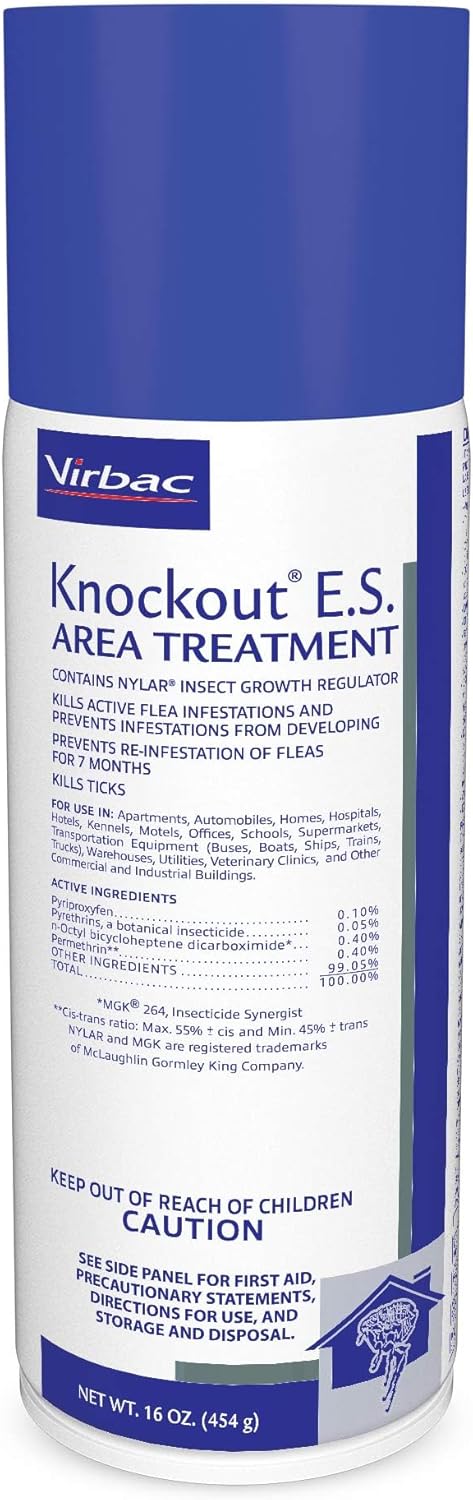
| Active ingredients | Pyriproxyfen 0.100%, Pyrethrins 0.050%, Permethrin 0.400% |
|---|---|
| Coverage | Approximately 2,100 sq. ft. per 16 oz can |
| Form | Aerosol spray (inverted) |
| Primary use | Indoor area treatment for fleas and ticks |
Virbac Knockout E.S. is an aerosol area treatment designed for indoor use on carpets, rugs, upholstery and pet bedding to eliminate adult fleas and ticks and disrupt future infestations. The formula combines fast-acting pyrethrins and permethrin with pyriproxyfen, an insect growth regulator, so you get immediate knockdown plus residual control of eggs and larvae. One 16 oz can claims coverage of about 2,100 sq. ft., so a single can is useful for treating medium to large rooms; the inverted spray helps reach baseboards and cracks where insects hide. It is straightforward to apply and dries without a noticeable sticky residue or strong lingering odor when used per label instructions. Important limitations are the usual safety precautions for households with infants, fish, or pyrethroid-sensitive pets and the need to follow ventilation and reentry times on the label. For heavy or widespread infestations repeated or professional treatment may still be required.
Best for: Buyers who prioritize proven performance and residual control when treating carpets and indoor areas for fleas and ticks and who follow product label directions closely.
Less Ideal for: Households with aquatic pets, very young infants, or people wanting an all-natural, nonpyrethroid solution should consider alternatives or consult a professional.
- Kills adult fleas and ticks while the IGR (pyriproxyfen) prevents development of eggs and larvae
- Inverted aerosol spray reaches baseboards, cracks, upholstery and other hidden areas
- Covers up to about 2,100 sq. ft. from a single 16 oz can for broad room treatment
- Dries without leaving a sticky residue or strong lingering odor when used as directed
- Contains pyrethrins and permethrin which require following label safety precautions around children, fish, and sensitive pets
- May be insufficient alone for very heavy or structural infestations that need repeat or professional treatments
Verdict: Choose this aerosol spray when you need a strong, room‑wide carpet treatment that delivers immediate knockdown plus months of residual flea control.
Black Flag Flea & Tick Spray Plus Growth Regulator, 1 Gallon

| Unit Count | 128 Fluid Ounces |
|---|---|
| Item Form | Spray |
| Target Species | Insects |
| Active Ingredients | Lambda-Cyhalothrim, Pyriproxyfen |
This one-gallon Black Flag spray is a ready-to-use home treatment formulated for carpet and upholstery use to knock down fleas, flea eggs and larvae plus ticks. It combines a fast-acting insecticide with Nylar growth regulator, which helps break the flea life cycle and extend protection without separate products. Typical use is spot- or whole-room application: treat baseboards, carpets, rugs and furniture and follow the label rate for full-room coverage. The product is practical for treating infestations because it targets multiple life stages and claims up to seven months disruption of flea development when used properly. It is also versatile against carpet beetles and dust mites. Important limitations are that follow-up treatments and coordinated yard and pet care are still recommended for full control, and the formula contains standard active ingredients that require careful handling around children and pets during application. The large gallon size makes it efficient for treating multiple rooms but may be more than needed for very small spaces.
Best for: Homeowners who want a practical, single-product solution for indoor flea outbreaks and prefer a ready-to-use spray they can apply to carpets and upholstery themselves.
Less Ideal for: People seeking an odorless or non-chemical alternative or those who only need a very small spot treatment should consider other options.
- Kills fleas, flea eggs, flea larvae and ticks for multi-stage control
- Contains Nylar insect growth regulator to prevent fleas maturing into adults
- Ready-to-use spray suitable for carpets, upholstery, rugs and baseboards
- Large 1 gallon volume covers wide areas for whole-room treatments
- Requires follow-up treatments and coordinated pet/yard care for complete control
- Contains standard insecticides that need careful handling around people and pets
Verdict: A large ready-to-use carpet and upholstery spray that combines fast-kill insecticide with a growth regulator to simplify indoor flea control.
Hot Shot Flea, Tick & Lice Killer Aerosol with Odor Neutralizer, 14 oz

| Unit Count | 14 Ounce |
|---|---|
| Item Form | Spray |
| Target Species | Dog |
| Age Range Description | 12 Weeks or Older |
This Hot Shot aerosol is a straightforward carpet and upholstery spot treatment for controlling fleas, ticks, and lice in indoor areas and on dogs older than 12 weeks. You use it to treat pet resting areas, carpets, floor coverings, cracks and crevices, and to spray dogs by thoroughly covering the coat and fluffing hair so the spray reaches the skin. Notable features include a permethrin-based formula for both adult and larval pests and an odor neutralizer to reduce spray smell. The practical benefits are fast local control of infestations and the convenience of a ready-to-use aerosol that can be applied to bedding and upholstery without mixing. Important limitations are that it is for indoor spot treatment only, is not safe for cats, and requires repeat application every two weeks if pests persist; users must also follow label safety instructions and keep it away from heat or open flame. For budget-conscious shoppers looking for a simple, multipurpose flea spray, this is an efficient option.
Best for: Buyers who want an inexpensive, ready-to-use spray to treat carpets, furniture, and dog bedding for fleas and ticks without mixing concentrates.
Less Ideal for: Households with cats or owners seeking a full-home fumigation or long-term veterinarian-recommended systemic prevention.
- Ready-to-use aerosol convenient for spot treating carpets, upholstery, and pet bedding
- Permethrin-based formula targets fleas, ticks (adults and larvae), and lice
- Includes odor neutralizer to reduce spray smell during application
- Can be applied directly to dogs over 12 weeks for targeted protection
- Not safe for use on cats
- Requires repeat treatment every two weeks if infestation persists
- Intended for indoor spot treatment only and flammable so must be stored carefully
Verdict: A budget-friendly, ready-to-use aerosol for quick spot treatment of carpets, upholstery, and dog bedding to control fleas, ticks, and lice.
Migdracy Plant-Based Flea & Tick Spray for Home and Fabrics, 16 oz

| Unit Count | 16 Fluid Ounces |
|---|---|
| Item Form | Spray |
| Scent Name | Peppermint |
| Active Ingredients | Cedarwood Oil, Peppermint Oil, Geraniol |
This 16-ounce Migdracy spray uses cedarwood, peppermint and geraniol to repel fleas and ticks on pet bedding, carpets, rugs and upholstery without strong chemical odors. It dispenses as a fine mist for even coverage and dries clean on most fabrics, making it suitable for routine treatments in rooms and on furniture where pets spend time. Practical features include a peppermint scent that freshens treated areas and a ready-to-use bottle that requires no mixing. For carpet use it is best for preventative or maintenance applications rather than rapid knockdown of heavy infestations, and repeated treatments may be needed in high-traffic or heavily infested areas. The botanical formulation is gentler smelling than many insecticides but may be less potent against established infestations compared with professional-strength or chemical-based products. If you want a pleasant-smelling, easy-to-apply spray for regular protection of carpets and pet areas, this offers a convenient plant-based option.
Best for: Buyers who prioritize routine, low-odor protection for carpets and pet areas and prefer botanical ingredients for regular home use.
Less Ideal for: Those facing a severe or established flea or tick infestation who need immediate, high‑strength chemical control should choose a professional or veterinary-recommended treatment instead.
- Plant-based active ingredients (cedarwood, peppermint, geraniol) for routine indoor use around pets
- Fine mist spray that applies evenly to carpets and upholstery without leaving sticky residue
- Pleasant peppermint botanical scent that eliminates harsh chemical odor
- Ready-to-use 16 fl oz bottle convenient for repeated spot and area treatments
- Not formulated as a fast-acting insecticide for heavy infestations
- May require multiple applications to maintain protection in high-traffic or heavily infested areas
Verdict: A convenient, plant-based spray that keeps carpets and pet areas smelling fresh while providing regular preventative protection against fleas and ticks.
ADAMS Flea & Tick Home Spray, 24 oz

| Unit Count | 24 Fluid Ounces |
|---|---|
| Item Form | Liquid |
| Scent Name | Fragrance Free |
| Target Species | Dog |
| Active Ingredients | Piperonyl Butoxide; Etofenprox; (S)-Methoprene 0.01% |
This 24-ounce ADAMS Home Spray is a trigger-spray insecticide formulated for indoor use on carpets, rugs, upholstery and pet bedding. It delivers fast knockdown of fleas and other listed pests and contains an insect growth regulator to interrupt the flea life cycle so treated areas can remain protected for months. Typical use is a light, uniform mist across carpeted rooms and furniture surfaces, then vacating the area for the recommended time. Notable features include a fragrance-free, non-staining formula and coverage sufficient for several rooms from one bottle. Practical benefits are that it treats both adults and immature stages to reduce repeat infestations and that it is versatile enough for multiple surfaces. Important limitations are that it must not be applied to people or pets, requires following label safety and reentry instructions, and some situations may need repeat applications or broader integrated pest control if infestations are heavy.
Best for: Buyers who prioritize proven indoor pest control and want a product with documented long‑term flea prevention for home and furniture areas.
Less Ideal for: People looking for a pet-applied solution or an immediate single-application cure for heavy, widespread infestations should consider treatments that are applied to animals or professional services instead.
- Kills a broad list of indoor pests including fleas, ticks and bed bugs
- Contains insect growth regulator to prevent flea reinfestation for up to 7 months
- Fragrance-free, non-staining formula suitable for carpets and upholstery
- Ready-to-use trigger bottle for straightforward application
- Not for use directly on pets or people and requires vacating treated areas per label
- May require repeat treatments or additional products for severe infestations
Verdict: Choose this spray if you want a ready-to-use indoor treatment that kills listed pests and helps prevent flea reinfestation for months.
Vet's Best Flea & Tick Home Spray for Dogs, Plant-Based, 14 oz

| Unit Count | 14 Fluid Ounces |
|---|---|
| Item Form | Spray |
| Scent Name | Peppermint |
| Target Species | Dog |
| Active Ingredients | eugenol, peppermint oil |
Vet's Best Flea & Tick Home Spray is a plant-based topical and environmental spray designed to kill fleas, ticks, flea eggs, and mosquitoes on contact and to help deter reinfestation. You can use it directly on dogs 12 weeks and older as well as on bedding, carpets, upholstery, patios and other pet areas, making it useful for treating both animals and their living spaces. The formula highlights certified natural oils such as peppermint and eugenol and is described as non-staining with a light peppermint scent. Practical benefits include an easy aerosol-style application for spot treatments, a family-friendly profile that avoids harsh synthetic pesticides, and versatility when you need quick control of visible pests or to freshen pet areas. Limitations are that plant-based sprays tend to act on contact and may need repeated applications to address eggs or heavy infestations, and the product is not labeled for species other than dogs or for animals under 12 weeks without veterinary guidance.
Best for: Pet owners who want a safer, more natural flea and tick option that can be applied both to dogs and to their living spaces and who prioritize reducing chemical exposure while treating occasional pests.
Less Ideal for: Households facing severe, entrenched infestations that need long-lasting residual control or veterinary-prescribed systemic treatments should consider stronger or professional options.
- Plant-based active ingredients (peppermint oil and eugenol) that avoid harsh synthetic pesticides
- Safe for use on dogs 12 weeks and older and on household surfaces like bedding and upholstery
- Non-staining, lightly scented formula suitable for indoor and outdoor use
- Works on contact against adult fleas, ticks and mosquitoes for quick visible control
- Likely requires repeat applications to manage eggs, larvae, or heavy infestations
- Not validated for species other than those listed on the label and not for animals under 12 weeks
Verdict: Choose this plant-based spray if you want a versatile, family-friendly product to treat dogs and pet areas with quick contact kill and natural ingredients.
Choosing the Right Anti Tick Spray for Home: Key Factors to Consider
Repellency Duration and Residual Control
How long a spray remains effective after application is one of the most important practical factors. Longer residual activity reduces how often you need to treat lawn edges, brushy borders, and leaf litter where ticks hide. Short-duration products may be useful for short events or spot treatments but require more frequent reapplication to maintain protection.
Consider the labeled hours or days of repellency and whether the manufacturer reports residual knockdown against nymphs as well as adults. In real garden use, duration can be reduced by heavy rain, irrigation, or frequent foot traffic through treated zones, so account for local weather patterns when planning an application schedule.
Application Safety Around People and Pets
Safety labeling and active ingredient profiles matter when you are treating spaces that children and pets use. Look for clear instructions about reentry intervals, pet-safe drying times, and whether treated areas can be accessed after application. Some formulations are designed to have low mammalian toxicity but still require that pets not be allowed on wet surfaces until dry.
Also assess whether the product requires personal protective equipment (PPE) for the applicator. Sprays that need minimal PPE and have clear, simple directions are more suitable for typical homeowners who will be applying treatments themselves.
Coverage Rate and Spray Method
Coverage determines how efficiently you can treat yard margins, foundation plantings, and wooded edges. Products that specify square-foot coverage per container or nozzle settings help you estimate how much product you need for your property size. Hose-end and pump sprayers offer different output rates and convenience; hose-end adapters speed up coverage of large lawns while pump sprayers are better for targeted borders.
Think about nozzle quality and whether the spray produces a fine mist or coarser droplets. A very fine mist may drift and waste active ingredient, while coarse droplets may fail to reach dense leaf litter. The right spray method reduces waste and improves consistent tick control across treatment zones.
Plant Sensitivity and Landscape Compatibility
Many anti tick sprays include insecticidal or repellent actives that can stress sensitive ornamentals, vegetables, or newly planted lawns. Check label directions for use near edible gardens or on specific plant families. Some formulations are labeled safe for use on ornamental beds and around foundation plants, while others advise avoiding direct contact with foliage.
When treating near vegetable plots, fruit trees, or pollinator-attractive blooms, consider buffer strips or spot-treating perimeters rather than broadcasting product over the entire yard. Timing applications outside pollinator activity periods and following label guidance minimizes unintended effects on beneficial insects.
Rainfastness and Environmental Persistence
How a product behaves after rainfall affects real-world performance. Rainfastness describes whether the active ingredient binds to treated surfaces or washes off quickly. A spray that loses potency immediately after rain will require retreatment and may leave gaps in protection.
Conversely, some products are designed to bind and persist, offering multi-week control but potentially increasing environmental persistence. Balance the need for durable control with concerns about runoff into storm drains or nearby water features and choose products whose wash-off profiles suit your yard's drainage and rainfall patterns.
Ease of Use and Storage
Homeowners are more likely to use a product consistently if it is easy to measure, mix, apply, and store. Look for ready-to-use options if you only need occasional spot treatment, or concentrated formulas with clear dilution instructions if you will treat large areas. Clear labeling and child-resistant caps are practical bonuses.
Consider storage stability and shelf life if you buy larger containers. Products with stable, long shelf life reduce waste and make it easier to maintain a seasonal treatment program without frequent repurchasing.
Where Ticks Hide in Residential Landscapes
Ticks favor cool, humid microhabitats near lawn edges, under shrubs, and in unmowed grassy corridors. Understanding these hotspots helps you apply anti tick spray for home more strategically rather than broadcasting product blindly across the yard.
- Perimeter vegetation and foundation plantings where people and pets enter the yard
- Leaf litter, woodpiles, and shaded borders with dense ground cover
- Brushy edges between lawn and woods, especially along walking trails or fence lines
Timing Applications for Best Results
Apply sprays when ticks are active in your region and when weather allows treated surfaces to dry before rain. For many areas, spring and early summer coincide with peak nymph activity, while some species have late-summer or fall peaks. Check local extension guidance for seasonal timing.
Avoid spraying during hottest midday temperatures to reduce plant stress and avoid peak pollinator activity. If rain is forecast within 24 hours, postpone treatment unless the product specifically states it is rainfast shortly after application.
- Treat before expected peak activity periods in your area
- Reapply according to label interval, especially after heavy rain
- Target shady, humid microhabitats rather than open sunny turf
Integrating Sprays with Other Yard Practices
Anti tick sprays work best as one component of an integrated approach. Combining perimeter treatments with habitat modification reduces long-term tick pressure. Simple changes like trimming low branches, removing brush and leaf litter, and creating a dry barrier between lawn and woods lower suitable tick habitat.
Use sprays to treat specific high-risk zones while practicing landscape maintenance to make the environment less hospitable to ticks. Pet parasite control and yard fencing also reduce the chances of ticks being carried into treated areas.
- Maintain a 3-foot-wide sunlit buffer between lawn and wooded areas
- Store firewood away from the house and off the ground
- Keep children's play areas and pet zones on well-mown, sunny turf
Safe Use Around Edible Gardens and Pollinators
When treating near edible plants or flowering perennials, choose application patterns that avoid direct contact with blooms and harvestable foliage. Many labels advise against spraying flowering plants or recommend application when pollinators are least active, such as early morning or late evening.
Consider spot treating borders and perimeter zones rather than applying product in raised beds or vegetable plots. When in doubt, create a buffer area between treated zones and any space where you harvest food.
- Avoid spraying directly on flowers and vegetable foliage
- Apply during low pollinator activity times to minimize non-target impacts
- Use physical barriers or alternative methods for immediate protection in edible areas
Application Equipment and Techniques
Selecting the right applicator affects evenness of coverage and user comfort. Hose-end sprayers speed coverage for large lawns but can be less precise than pump sprayers, which are better for borders and undergrowth. Wear appropriate gloves and avoid inhaling spray mist during application.
Test a small area first if you are concerned about plant sensitivity and follow label instructions for dilution and nozzle settings to ensure correct droplet size and distribution.
- Calibrate sprayers so you know square-foot coverage per tank
- Use a coarse nozzle for dense ground cover to reduce drift
- Rinse equipment after use and follow local guidelines for disposal of leftover product
How We Chose the Best Anti Tick Spray for Home
Our selection process focused on practical, garden-focused performance measures that matter when treating residential outdoor spaces. We prioritized products with clear statements about active ingredients and expected protection time, because repellency duration determines how often you need to reapply in a home landscape. Application safety was another major filter, including label guidance for people, pets, and nearby plants. Coverage rate and spray method were evaluated since a product that is hard to apply or that treats only a narrow swath is less useful on larger properties. We also considered residue behavior and rainfastness, because products that wash off quickly deliver inconsistent control. We excluded treatments intended only for clothing or indoor surfaces and products labeled solely for agricultural, veterinary, or industrial use. We avoided anything lacking clear directions for residential outdoor application. The final shortlist balances repellency duration, low-toxicity options, ease of application, and stated plant- and pet-safety guidance to help gardeners pick an appropriate home-use anti tick spray.
FAQ
How often do I need to reapply anti-tick spray in a home yard?
Reapplication frequency depends on the product's labeled residual activity and local weather. Many sprays require reapplication every few weeks during peak tick season, while some longer-lasting formulations can extend protection. Heavy rain or irrigation usually shortens the effective interval.
Can I use anti-tick spray near vegetable gardens?
You can, but exercise caution. Avoid spraying directly on edible foliage and follow label instructions. Consider treating perimeter zones and maintaining a buffer rather than broadcasting product over vegetable beds.
Are low-toxicity or natural formulations effective around homes?
Low-toxicity and botanical options may reduce exposure concerns but sometimes offer shorter duration or different efficacy against specific tick life stages. They can be useful for spot treatments or areas with children and pets, but you may need to reapply more often.
Is it safe for pets to be in treated areas?
Safety depends on the specific product label. Many sprays allow reentry after treated surfaces are dry, but pets should be kept off wet areas until the product dries and until label-specified reentry intervals have passed.
Will spraying reduce tick numbers in wooded edges and leaf litter?
Targeted perimeter treatments and spot applications to leaf litter and brushy edges can lower local tick numbers, but complete elimination is unlikely without broader habitat management. Combining sprays with landscape cleanup gives more durable results.
Final Verdict
Choose an anti tick spray for home by matching repellency duration, application safety, and coverage method to your yard size and household needs. Prioritize products with clear label instructions for people, pets, and nearby plants, and plan applications around weather and tick seasonality. Remember that sprays are most effective when used with habitat modifications like removing leaf litter and maintaining dry buffers. Make tradeoffs between persistence and environmental sensitivity, and pick the option that you will apply consistently for reliable seasonal protection.
