

Note: This article contains affiliate links. If you click on these links and make a purchase, I may earn a small commission at no extra cost to you. This helps support my research and content. Read my full affiliate disclosure here.
Picking the right autumn weed-and-feed for lawns matters because fall is when lawns store energy for winter and fight a last surge of broadleaf weeds. The wrong product can underdeliver on root development or fail to suppress the weeds that make spring recovery harder. This guide shortlists the top autumn formulations suited for cool-season lawn care and similar turf situations. We evaluated options for how they support root growth, control common fall weeds, and fit into realistic lawn care schedules. Below are the top picks and the practical criteria we used to assess them.
Top Picks at a Glance
| Best Overall The best all-around choice for most situations | Scotts Turf Builder Weed & Feed (42.87 lb) |  |
| Best Quality Built to a higher standard if you want something more solid | Scotts Turf Builder Weed & Feed 3, Granular Lawn Fertilizer and Weed Killer, 14.29 lb |  |
| Best Value The sweet spot between price and what you get | GreenView Weed & Feed Lawn Fertilizer, 13 lb Bag |  |
| Best Budget The cheapest option that still gets the job done reliably | Spectracide Weed & Feed 20-0-0 Ready-to-Spray, 32 oz |  |
| Best Seller A high-volume bestseller chosen again and again | Scotts Turf Builder WinterGuard Fall Weed & Feed, 11.43 lb |  |
Scotts Turf Builder Weed & Feed (42.87 lb)
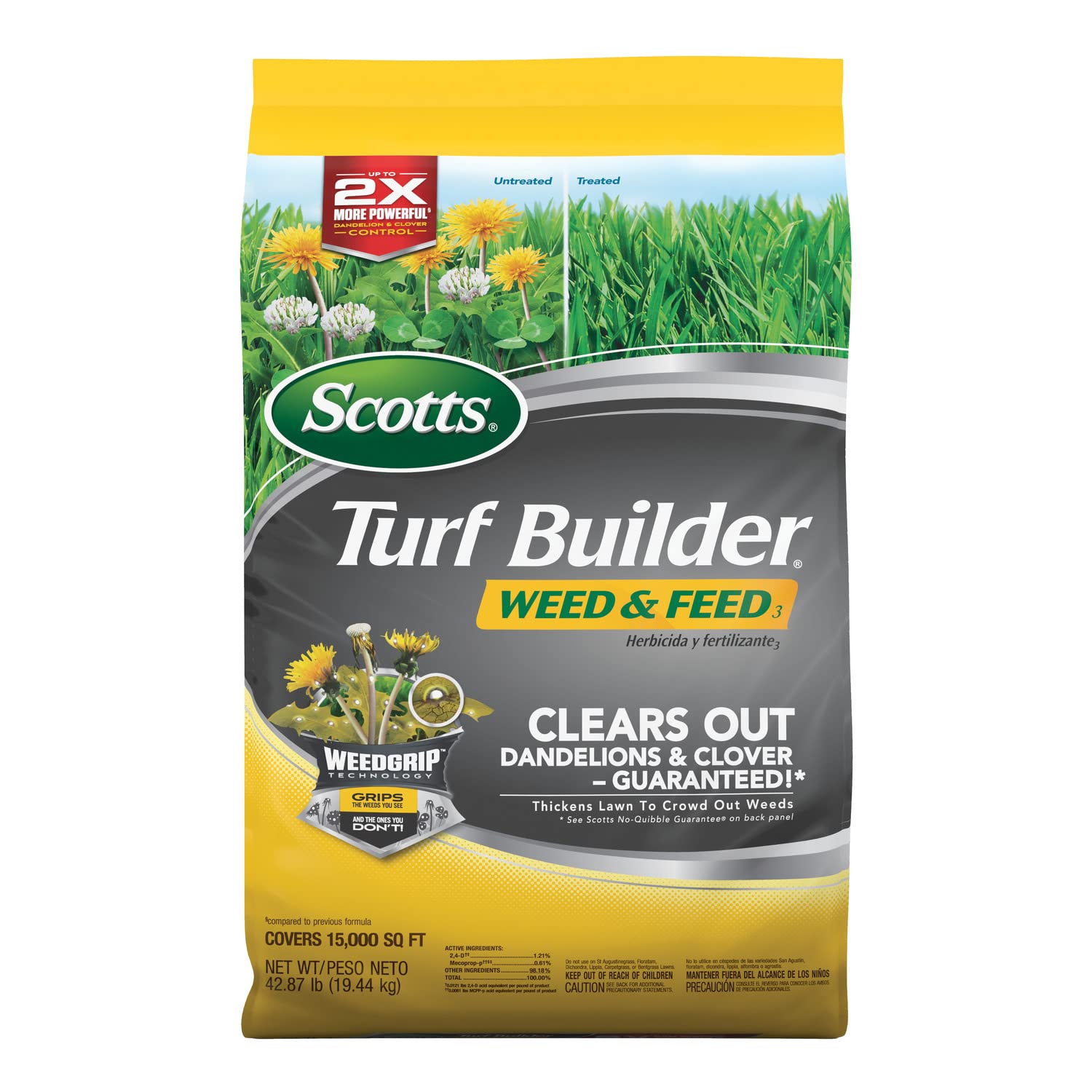
| Item Form | Granule |
|---|---|
| Coverage | 15000 square_feet |
| Active Ingredients | 24-D Mecoprop-p |
Scotts Turf Builder Weed & Feed is a granular lawn treatment that kills broadleaf weeds while feeding grass to encourage thicker turf. It is applied with a spreader when weeds are actively growing and temperatures are between 60°F and 90°F; the label recommends applying to a wet lawn so granules stick to weed leaves and waiting 24 hours before watering. The formula uses WeedGrip technology and lists active ingredients including 2,4-D and Mecoprop-p, and the 42.87 lb bag covers about 15,000 square feet. In practice this product is straightforward to broadcast across medium to large lawns and gives visible reduction of common weeds like dandelions and clover while supplying nutrients to help crowd out future weeds. Important limitations are application timing and grass restrictions: do not use on St. Augustinegrass, bentgrass, carpetgrass, dichondra, or lippia, and do not apply if rain is expected within 24 hours. Also keep people and pets off treated turf until dust settles. For homeowners who follow label directions, it is an efficient one-step option for late spring weed control and feeding.
Best for: Homeowners who want a single product to both reduce common broadleaf weeds and feed a cool- or warm-season lawn and who prefer a proven brand with clear label instructions and wide user adoption.
Less Ideal for: People with lawns made of excluded grass types or those needing immediate spot treatment for individual weeds should consider alternatives designed for those specific situations.
- Combines selective broadleaf weed control and fertilizer in one application
- Large bag covers up to 15,000 sq. ft., suitable for medium to large lawns
- WeedGrip technology helps granules adhere to weed leaves for better control
- Granular form is compatible with common broadcast or drop spreaders
- Not safe for several grass types including St. Augustine and bentgrass
- Requires specific temperature and moisture conditions for best results
Verdict: A convenient, proven one-step weed-and-feed for homeowners who want broadleaf weed control plus lawn feeding across large yards.
Scotts Turf Builder Weed & Feed 3, Granular Lawn Fertilizer and Weed Killer, 14.29 lb

| Item Form | Granule |
|---|---|
| Coverage | 5000 square_feet |
| Active Ingredients | 2,4-D 1.220%, Mecoprop 0.081% |
Scotts Turf Builder Weed & Feed3 is a granular lawn product that combines a fertilizer with broadleaf weed control for routine lawn maintenance. It is applied with a broadcast or drop spreader to a wet lawn when daytime temperatures are between 60 and 90°F, and it uses WeedGrip technology to help granules stick to weed leaves for better uptake. In practice it kills common weeds such as dandelion and clover while delivering nutrients to thicken grass, so treated areas often green up and look fuller over a few weeks. The package covers about 5,000 sq. ft. and manufacturer instructions recommend avoiding certain grass types and keeping people and pets off the lawn until dust settles. Important limitations are that it is not safe for some turf species and must not be watered for 24 hours after application; timing and correct spreader settings affect results. For homeowners wanting a combined feed-and-weed treatment for standard lawns, it simplifies two tasks into one application, but it requires following the label closely for safe and effective use.
Best for: Homeowners seeking a straightforward, combined fertilizer and weed-control treatment to maintain and thicken common cool- and warm-season turf in a typical yard.
Less Ideal for: Specialist turf managers, owners of sensitive turf varieties (listed on the label), or those who need spot treatment only rather than whole-lawn applications.
- Combines fertilizer and broadleaf weed control in one granular product
- WeedGrip formulation helps granules adhere to weed leaves for improved herbicide contact
- Covers approximately 5,000 sq. ft. per 14.29 lb bag, suitable for many small to medium lawns
- Clear application guidance for use with common spreaders and specific temperature/wetting windows
- Contains active herbicide ingredients not appropriate for all turf types and must be avoided on listed grasses
- Requires strict timing and no watering for 24 hours after application to be effective and safe
Verdict: A practical one-step weed-and-feed for typical lawns that feeds turf while targeting common broadleaf weeds across a 5,000 sq. ft. area.
GreenView Weed & Feed Lawn Fertilizer, 13 lb Bag

| NPK | 27-0-4 |
|---|---|
| Form | Granule |
| Coverage | 5000 square_feet |
| Active ingredient | Nitrogen |
GreenView Weed & Feed is a combined granular fertilizer and selective herbicide designed to feed established turf while controlling broadleaf weeds. You apply it to a dry, established lawn when weeds are actively growing, then water to activate the product and avoid mowing for two days. It uses a controlled-release nitrogen formulation to deliver steady feeding for up to eight weeks, which helps green-up without pushing surge growth and supports deeper roots for better drought tolerance. The herbicide component targets more than 250 common lawn weeds such as dandelion, clover, and plantain, so one application handles both nutrition and weed pressure across many cool- and warm-season grasses. Practical benefits include long feeding duration, wide weed control, and coverage suitable for medium to large yards. Important limitations are that it is for established turf only, it can damage certain grasses like St. Augustine (in Florida), dichondra, and carpetgrass, and timing matters because weeds must be actively growing for best control.
Best for: Homeowners who want a single, budget-friendly product to both feed and reduce broadleaf weeds on established lawns and prefer less frequent applications over the season.
Less Ideal for: Gardeners establishing new turf, owners of sensitive or excluded grass types, or those seeking an organic or granular fertilizer without herbicide.
- Controlled-release nitrogen feeds lawns for up to eight weeks, reducing the need for frequent applications
- Provides selective control of over 250 broadleaf weeds alongside fertilization
- Covers approximately 5,000 square feet from a single 13 lb bag, suitable for medium to large yards
- Zero phosphate formulation to reduce risk of waterway runoff
- Not safe for certain turf types such as St. Augustine in Florida, dichondra, and carpetgrass
- Requires correct timing and watering after application for effective weed control
- Intended only for established lawns and can harm seedlings or sensitive grasses
Verdict: A cost-effective all-in-one weed-and-feed that delivers eight weeks of controlled-release nitrogen while knocking back a wide range of common broadleaf weeds.
Spectracide Weed & Feed 20-0-0 Ready-to-Spray, 32 oz

| Unit Count | 32 Fluid Ounces |
|---|---|
| Item Form | Spray |
| Coverage | 7500 square_feet |
| Active Ingredients | Nitrogen |
Spectracide Weed & Feed 20-0-0 is a hose-end spray that combines a broadleaf weedkiller with a high-nitrogen feed to treat lawns without mixing. You attach the QuickFlip sprayer to a garden hose, spray when weeds are actively growing, and the formula targets dandelion, chickweed, clover, plantain and similar weeds while delivering nitrogen to green up turf. The ready-to-spray design makes application fast for mid-season spot or whole-lawn treatments, and the stated coverage (up to 7,500 sq ft) suits small to medium yards. Important practical points: use on actively growing lawns, water 1–2 days before applying, and avoid application in extreme heat or before rain. Safety precautions are needed because the product can irritate skin and eyes and must be kept away from children and pets. This product is best for straightforward seasonal weed control and fertilization in established lawns rather than for new seedings or sensitive sites where reseeding is planned soon.
Best for: Buyers who want a quick, no-mix solution to reduce visible broadleaf weeds while boosting lawn greenness on an established lawn and who prefer an easy hose-end application.
Less Ideal for: Gardeners planning to seed or sod soon, or those with small specialty lawns that require low-nitrogen or organic treatments should consider other options.
- Ready-to-spray hose-end applicator simplifies application with no measuring or mixing
- High nitrogen formulation feeds lawn while treating broadleaf weeds
- Wide stated coverage that can treat up to 7,500 sq ft
- Targets common broadleaf weeds like dandelion, clover, chickweed and plantain
- Contains ingredients that can irritate skin and eyes so protective gear is required
- Not suitable for newly seeded, sodded, or reseeded areas for at least six months
Verdict: A fast, no-mix hose-end weed-and-feed that kills common broadleaf weeds while giving a strong nitrogen boost to established lawns.
Scotts Turf Builder WinterGuard Fall Weed & Feed, 11.43 lb

| Item Form | Granule |
|---|---|
| Coverage | 4000 square feet |
Scotts Turf Builder WinterGuard is a fall granular weed-and-feed formulated to kill common broadleaf weeds such as clover and dandelion while feeding cool- and warm-season grasses. It is applied with a broadcast or drop spreader to a moist lawn on a calm day when temperatures are between 60°F and 90°F. Notable features include WeedGrip Technology to improve granule adhesion to weed leaves, instructions tuned for Scotts spreaders, and coverage sized for about 4,000 square feet per 11.43 lb bag. In practice it simplifies a seasonal task by combining weed control and fertilization in one application, which helps build root strength and recover summer stress heading into winter. Important limitations are that it is labeled for specific grass types only and must not be used on St. Augustinegrass, bentgrass, or several groundcover species, and you must avoid watering for 24 hours after application for best effect. For homeowners who want a dependable, single-step fall treatment for typical lawn weeds, this performs as advertised; those with unsupported grass types or very large lawns will need a different product or multiple bags.
Best for: Homeowners who prioritize a reliable, low-effort fall solution to eliminate clover and other broadleaf weeds while feeding their lawn for winter hardiness.
Less Ideal for: Properties planted with unsupported turf species or buyers who need coverage for very large lawns without buying multiple bags.
- Kills over 50 listed lawn weeds including clover and dandelion
- Combined fertilizer and weed control saves an extra application
- WeedGrip Technology helps granules stick to moist weed leaves for better uptake
- Clear application guidance for use with Scotts spreaders and recommended timing
- Labeled for specific grass types only and should not be used on St. Augustinegrass, bentgrass, or certain groundcovers
Verdict: Choose this product if you want a dependable one-step fall treatment that both kills clover and feeds your lawn to build stronger roots for spring.
Choosing the Right Autumn Weed and Feed for Lawns: Key Factors to Consider
Nutrient Timing and Release
Autumn products should deliver nitrogen in a way that supports late-season growth without encouraging tender turf that cannot harden for winter. Slow-release nitrogen helps strengthen blades and build carbohydrate reserves while reducing the risk of lush, vulnerable growth right before cold weather. Look for clear labels stating the percentage of slow- versus quick-release nitrogen.
Potassium content is equally important because it helps root system hardiness. A product with balanced nitrogen and higher potassium supports root growth and winter stress tolerance. Avoid formulations that emphasize quick green-up alone if your goal is winter survival and spring vigor.
Weed Control Spectrum and Timing
Effective autumn weed-and-feed should target the broadleaf weeds that emerge or remain active in fall, such as dandelion, clover, and plantain. The active ingredients and labeled spectrum determine whether the product will suppress the weeds that compete with turf as it stores energy.
Timing matters: applying herbicides when weeds are actively translocating carbohydrates to roots increases control. Products with clear timing windows for autumn application make it easier to plan treatments that coincide with weed physiology for better long-term control.
Turf Compatibility and Safety
Different grass species tolerate herbicides and fertilizer timing differently. A safe autumn weed-and-feed will list compatible turf types and include temperature or dormancy warnings. Using an incompatible formulation can cause leaf burn, stunted growth, or damage that reduces winter hardiness.
Also consider re-entry and pet-safety instructions. Users should be able to follow label directions without complex precautions that make routine lawn care impractical. Clear safety guidance helps avoid accidental turf injury or exposure risks.
Coverage Rate and Application Practicality
Coverage information affects how much product you need and whether a formulation is cost-effective for your lawn size. Look at the labeled coverage per bag or container and whether the spreader settings are provided. A product that requires multiple passes or difficult calibration increases the chance of uneven feeding or missed weeds.
Consider physical form too. Granular products designed for broadcast spreaders are often easier for homeowners, while liquids may require more accurate mixing. Packaging that supports accurate measurement reduces waste and ensures consistent results across the entire lawn.
Instruction Clarity and Weather Guidance
Autumn weather can vary, and successful application depends on timing relative to rainfall and temperature. Products that offer clear guidance on how soon to expect rain after application, or whether watering-in is recommended, make scheduling easier. Instructions should also specify ideal temperature ranges for herbicide activity and any restrictions near newly seeded areas.
Good labels explain follow-up care, such as mowing timing and when to avoid further fertilizer applications, so the homeowner knows how the autumn treatment fits into the broader seasonal lawn program.
When to Apply in Autumn
Apply weed-and-feed when daytime temperatures are consistently moderate and cool-season grasses are still actively growing but not under heat stress. A common practical window is after the last summer heat spike and before turf starts regular dormancy signals, such as slowed growth and color change.
Avoid applying immediately before an expected hard freeze. Also avoid treatments during drought stress when the turf is not actively taking up nutrients or herbicides, as this reduces effectiveness and can increase turf injury risk.
- Choose a dry day with at least 24 hours without heavy rain predicted.
- Aim for soil temperatures that indicate active root uptake rather than dormancy.
- If overseeding, check label restrictions-some products advise waiting several weeks after seeding.
Preparing Your Lawn Before Application
Mow to a recommended height and remove heavy clippings so the product contacts leaf tissue or soil as intended. Uneven thatch layers and excessive clippings can reduce herbicide contact and nutrient absorption.
Watering practices before application matter. A lightly moist lawn helps uptake but avoid applying to a saturated lawn where runoff or dilution could occur.
- Repair bare spots and control pests that might confound results before treatment.
- Mark sprinkler heads or landscape beds to avoid accidental overspray or granule build-up.
Tools and Spreaders for Even Coverage
A calibrated broadcast spreader gives the most even distribution for granular autumn weed-and-feed. Check the manufacturer settings for the product coverage rate and make overlapping passes for uniform application. Handheld spreaders can work for small areas but are less consistent on uneven terrain.
Clean spreader components after use to prevent cross-contamination with other lawn products. For liquid formulations, ensure the sprayer is free of residues and properly rinsed.
- Do a small practice pass to confirm spread pattern and rate.
- Follow pattern recommendations such as perpendicular passes to avoid streaks.
Post-Application Care and Expectations
After applying, expect gradual effects on weeds over 1 to several weeks depending on weed type and weather. Nutrient benefits for the lawn also appear over time, with slow-release formulations offering longer-lasting support into winter.
Avoid aggressive mowing or heavy foot traffic immediately after application if label guidance suggests a settling period. Plan routine winter prep tasks around the product's stated re-entry and mowing windows.
- Track treated areas and note timing so follow-up spring treatments are scheduled appropriately.
- If heavy rain occurs shortly after application, monitor for reduced effectiveness and consider remediation steps indicated on the label.
Environmental Considerations and Responsible Use
Be mindful of runoff risk when applying near slopes, water features, or storm drains. Use buffer zones and avoid applying before heavy rain to reduce nutrient and herbicide movement off-site.
Select products with clear stewardship instructions and follow recommended application rates. Over-application not only wastes product but increases the risk of environmental harm and turf damage.
- Store unused product securely and dispose of empty containers according to local regulations.
- Consider integrated practices such as targeted spot treatment for isolated weed patches to reduce overall chemical load.
How We Chose the Best Autumn Weed and Feed for Lawns
We assembled candidate autumn weed-and-feed formulations that are designed specifically for fall lawn care and then filtered them by practical garden-use criteria. We prioritized products with clear nutrient profiles emphasizing slow-release nitrogen and adequate potassium for root hardening, along with proven active ingredients for controlling broadleaf weeds that emerge in autumn. Coverage rate and application ease were assessed to ensure homeowners can treat typical lawn sizes without excessive passes or complicated mixing. We also considered safety guidance and turf friendliness, favoring formulations with instructions compatible with common cool-season grasses and clear timing windows to avoid lawn stress. Products lacking transparent nutrient labeling, vague weed-control claims, or instructions that risk turf damage in cooler weather were excluded. The final selections balance turf nutrition, weed control spectrum, application practicality, and user guidance for autumn conditions.
FAQ
Can I apply autumn weed-and-feed right after overseeding?
It usually depends on the product label. Many autumn weed-and-feed formulations advise waiting several weeks after seeding to avoid harming young grass. Check the specific instructions for recommended wait times before applying near newly germinated turf.
Will autumn treatments prevent spring weeds?
Autumn herbicide applications can reduce populations of perennial and established broadleaf weeds that otherwise compete in spring, but they do not eliminate all spring annuals. Good turf nutrition and follow-up spring programs help maintain control into the next season.
Is a slow-release nitrogen important for fall applications?
Often yes. Slow-release nitrogen supplies steady nutrition that strengthens roots and builds carbohydrate reserves without promoting tender topgrowth that is vulnerable to cold. Quick-release nitrogen can cause a flush of growth you may not want late in the season.
How soon after rain can I apply granular weed-and-feed?
You should apply when the lawn surface is dry and no heavy rain is expected for at least 24 hours unless the product specifically permits watering-in sooner. Heavy rain soon after application can wash granules away and reduce both nutrient and herbicide effectiveness.
Can I use the same autumn product on all grass types?
No. Compatibility varies by active ingredients and turf species. Check the product label for listed grass types and temperature restrictions to avoid injury to warm-season grasses or sensitive cool-season varieties.
Final Verdict
Choose an autumn weed-and-feed that balances a slow-release nutrient profile with an herbicide spectrum suited to the broadleaf weeds active in fall. Prioritize products that list turf compatibility, clear coverage rates, and straightforward timing guidance. Tradeoffs include immediate green-up versus long-term root hardening, so pick the formulation that matches whether you want winter survival and spring vigor or short-term cosmetic color. Follow label instructions closely, apply in the proper seasonal window, and coordinate with other lawn tasks like overseeding and irrigation to get the best results.
