

Note: This article contains affiliate links. If you click on these links and make a purchase, I may earn a small commission at no extra cost to you. This helps support my research and content. Read my full affiliate disclosure here.
A reliable Broadcast Spreader makes fast work of seeding, fertilizing, and applying granular treatments across lawns, large yards, and property edges. Choosing the right unit affects how evenly materials distribute, how much time you spend, and how often you need to refill or maintain the tool. This guide covers six shortlisted Broadcast Spreaders that suit common garden needs, from small residential lawns to larger acreage tasks. We evaluated practical factors gardeners care about, including build durability, hopper capacity, spread pattern, and calibration controls. Read on for the criteria we used and guidance to help you pick the best spreader for your situation.
Top Picks at a Glance
| Best Overall The best all-around choice for most situations | Scotts Turf Builder EdgeGuard DLX Broadcast Spreader |  |
| Best Quality Built to a higher standard if you want something more solid | CHAPIN 8400C 100-Pound Professional SureSpread Turf Spreader |  |
| Best Value The sweet spot between price and what you get | Agri-Fab 130-lb Walk-Behind Broadcast Spreader (Model 45-0462) |  |
| Highest Rated A top-rated pick with lots of positive feedback | John Deere 130 lb Push Broadcast Spreader |  |
| Most Popular A crowd favorite that many people choose with confidence | Scotts Turf Builder EdgeGuard Mini Broadcast Spreader |  |
| Best Seller A high-volume bestseller chosen again and again | Scotts Whirl Hand-Powered Spreader |  |
Scotts Turf Builder EdgeGuard DLX Broadcast Spreader

| Capacity coverage | Holds up to 15,000 sq. ft. |
|---|---|
| Additional features | EdgeGuard Technology, Pre-calibrated |
| Included components | Scotts – 76232 |
The Scotts Turf Builder EdgeGuard DLX is a user-friendly broadcast spreader for homeowners who need reliable, uniform application of granular lawn products. It comes pre-calibrated so you can set the rate dial to the suggested setting for Scotts products, pour material into the curved hopper, and walk the lawn with consistent coverage thanks to a dual-bladed agitator. The EdgeGuard side shield lets you block the right-side of the pattern to avoid driveways and flower beds, which is handy when working close to hardscapes. With a capacity rated up to 15,000 sq. ft., the unit suits seasonal tasks from fertilizing and overseeding to distributing ice melt on walkways. Practical limits include its focus on Scotts calibration rather than adjustable precision for every brand and the manual push design that requires some effort over very large or hilly properties. Assembly is not required, so it is ready to use right away for common yard sizes and chores.
Best for: A practical homeowner who wants a dependable, no-fuss spreader for seasonal lawn care tasks and occasional ice melt use across a typical residential yard.
Less Ideal for: Large properties, commercial users, or those who need highly precise, brand-agnostic calibration should consider tow-behind or professional spreaders instead.
- Pre-calibrated settings for easy setup with Scotts granular products
- EdgeGuard side shield prevents material from landing on sidewalks and beds
- Curved hopper and dual-bladed agitator improve flow and reduce clogging
- Large coverage capacity suitable for typical residential lawns
- Calibration is optimized for Scotts products and may not match other brands exactly
- Manual push design can be tiring on very large or steep lawns
Verdict: Choose this spreader if you want a ready-to-use, homeowner-friendly broadcast spreader that prevents overspray onto hardscapes while covering most residential lawns.
CHAPIN 8400C 100-Pound Professional SureSpread Turf Spreader

| Load Capacity | 100 pounds |
|---|---|
| Wheel Type | Rubber |
| Number of Wheels | 2 |
| Material Type | Polyethylene, Stainless Steel |
The CHAPIN 8400C is a professional-grade broadcast spreader designed for larger lawns and contractor use. It moves material from a 100-pound one-piece poly hopper through an adjustable rotary gate and cast zinc-plated agitator to reduce clogs, while the steel linkage and enclosed gearbox protect moving parts from weather. Typical use is pushing it across turf where the 14-inch pneumatic tires and T-handle with rubber grips keep the unit steady and comfortable on uneven ground and slopes. Practical benefits include a large capacity that reduces refill trips, directional spread pattern control for targeted application, and included rain cover and hopper grate for wetter conditions. Construction mixes polyethylene with a stainless steel frame for durability and easier cleaning. Important limitations are that it is bulky and requires assembly, and it is not suited for corrosive salts, sand, pelletized lime, or very fine powders, so product compatibility is narrower than with some multi-use spreaders.
Best for: Buyers who prioritize performance and durability for treating larger lawns or professional properties and want precise, consistent broadcast spreading without frequent refills.
Less Ideal for: Casual gardeners with very small yards or those who need to spread sand, salt, pelletized lime, or very fine powders should consider lighter or specialized alternatives.
- Large 100-pound hopper reduces the number of refills for big lawns
- Adjustable rotary gate and cast agitator minimize clogging and allow varied spread patterns
- Stainless steel frame and enclosed gearbox improve durability and protect moving parts
- 14-inch pneumatic tires provide stability on uneven terrain and slopes
- Not recommended for salt, sand, pelletized lime, or very fine powders
- Relatively heavy and bulky which can make storage and transport more demanding
Verdict: Choose the CHAPIN 8400C when you need a durable, high-capacity spreader that delivers consistent, professional broadcast coverage across large or uneven turf areas.
Agri-Fab 130-lb Walk-Behind Broadcast Spreader (Model 45-0462)
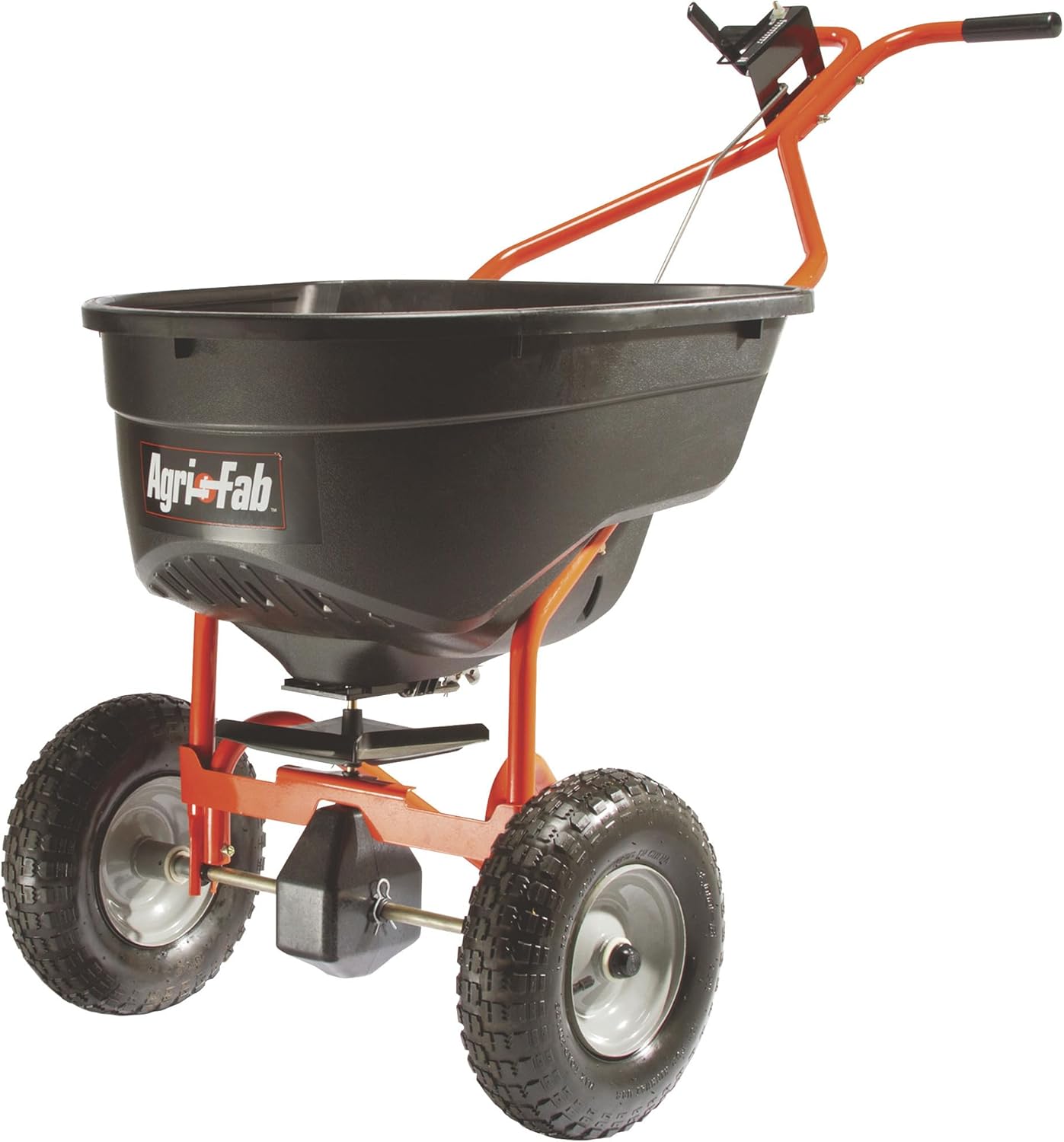
| Weight Capacity Maximum | 130 pounds |
|---|---|
| Number of Wheels | 2 |
| Tire Type | Tubeless |
| Material Type | Poly and steel |
The Agri-Fab 130-lb walk-behind broadcast spreader is a straightforward, high-capacity tool for spreading fertilizer, grass seed, or ice melt over lawns up to about half an acre. It uses a large polyethylene hopper and pneumatic tires to move smoothly over uneven turf, while a direct rod control makes adjusting and engaging the spread pattern simple during use. The wide broadcast pattern covers more ground per pass, reducing time spent spreading compared with lawn-size handheld options. Construction mixes poly and steel for a balance of durability and lighter weight, and the ergonomic handle improves comfort during longer passes. Expect reliable performance for routine residential lawn care, though assembly is required and the unit is a push-style spreader so it is physically demanding on larger sites. Controls are basic rather than precision-calibrated, so granular control for very small application rates may require extra care. For seasonal tasks from spring seeding to winter deicing, this model delivers consistent, no-frills coverage for homeowners focused on efficiency and capacity.
Best for: Homeowners who want a no-nonsense, high-capacity spreader to finish lawn tasks faster and who prioritize durability and ease of use over precision metering.
Less Ideal for: Owners of very large properties who prefer tow-behind or tractor-mounted spreaders and users who need highly precise, small-rate fertilizer application.
- Large 130 lb hopper reduces refills and speeds work on medium lawns
- Pneumatic tires and simple frame roll well over uneven yards
- Direct rod control is easy to use and intuitive while walking
- Polyethylene hopper and steel components provide a durable yet reasonably light build
- Push operation can be tiring on larger properties
- Controls are basic and may require testing to dial in precise spread rates
Verdict: A rugged, high-capacity push spreader that saves time on medium residential lawns by covering large areas with one hopper load.
John Deere 130 lb Push Broadcast Spreader

| Capacity | 130 lbs. |
|---|---|
| Approximate coverage | 25,000 sq ft |
| Spread width | 10 – 12 ft |
| Wheels | 13" x 4" pneumatic tires |
| Control | Direct rod control with adjustable flow stop |
The John Deere 130 lb Push Broadcast Spreader is built for routine, reliable lawn and property maintenance across seasons. It is used by filling the large rust-proof poly hopper and pushing the unit across turf while adjusting the direct rod control and flow stop to set application rate and gate opening. Notable features include a 130 lb capacity that covers roughly 25,000 sq ft per fill, a wide broadcast pattern up to 12 ft for faster coverage, heat-treated steel gears enclosed in a protective housing to resist corrosive materials, and large turf-tread pneumatic tires for easier maneuvering over uneven lawns. In practice this means fewer refills on mid-size lawns, consistent spread if you maintain a steady walking speed, and durable drivetrain components that are less exposed to grit and moisture. Expect some assembly and that spread width varies with material and pace, so initial calibration passes are helpful to avoid over- or under-application. The unit favors dependable, low-maintenance performance rather than lightweight portability.
Best for: Buyers who prioritize a durable, low-maintenance spreader for regular lawn care and seasonal tasks and want to cover up to about half an acre per fill without frequent stops.
Less Ideal for: People who need a lightweight or compact spreader for very small yards, tight garden beds, or frequent transport in small vehicles should consider smaller handheld or tow-behind options.
- Large 130 lb rust-proof poly hopper reduces refill interruptions for mid-size lawns
- Wide broadcast pattern up to 12 ft speeds up coverage on open turf
- Heat-treated steel gears enclosed in protective housing resist corrosion from fertilizer and ice melt
- Turf-tread pneumatic tires improve traction and maneuverability on uneven ground
- Spread width and application rate depend on walking speed and material, requiring calibration passes
- Requires some assembly before first use
Verdict: Choose this spreader if you want a heavy-duty, low-maintenance broadcast unit that covers large lawns with consistent, durable performance.
Scotts Turf Builder EdgeGuard Mini Broadcast Spreader
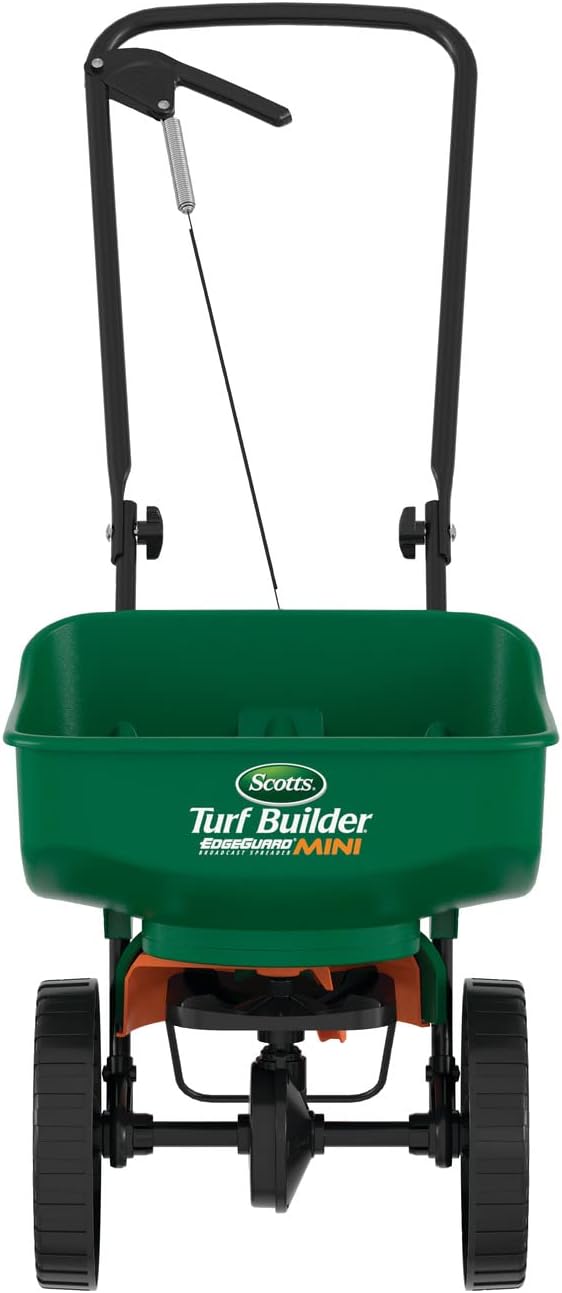
| Capacity | Up to 5,000 sq. ft. |
|---|---|
| Usage | Fertilizer, seed, granular weed control, salt, ice melt |
| Features | EdgeGuard technology; curved hopper; dual-bladed agitator |
| Storage | Fold-down handle; ready-to-use (no assembly) |
The Scotts Turf Builder EdgeGuard Mini is a compact, ready-to-use broadcast spreader aimed at homeowners with small yards. It holds enough product to cover up to 5,000 sq. ft., arrives pre-calibrated, and features a curved hopper with a dual-bladed agitator for steady flow and more even distribution of granules. The standout is Scotts EdgeGuard technology, which blocks the right-side spread pattern so you can keep fertilizer and ice melt off driveways and sidewalks. The fold-down handle and durable open-spoke wheels make it easy to store and roll over typical lawn terrain. Because it is designed for smaller areas, you get a nimble tool for targeted feeding, seeding, or winter salt application without overkill. The trade-offs are that it is not built for large properties and lacks the heavier-duty capacity and finer control settings of larger models, so you may need multiple passes or a larger spreader for big lawns or commercial use.
Best for: Homeowners who need a simple, reliable spreader for small to medium yards and prioritize avoiding accidental application onto hardscapes.
Less Ideal for: Landscapers or owners of large properties who need higher capacity, finer control, or heavy-duty commercial equipment.
- Pre-calibrated and ready to use for quick setup
- EdgeGuard feature prevents product from reaching driveways and sidewalks
- Curved hopper and dual-bladed agitator for smoother, more consistent flow
- Compact with fold-down handle for easy storage
- Intended capacity suited to smaller lawns, not efficient for large properties
- Fewer precision settings than larger, professional spreaders
Verdict: Choose this spreader if you want a compact, no-fuss tool that delivers even coverage and keeps product off driveways and sidewalks.
Scotts Whirl Hand-Powered Spreader

| Material Type | Metal, Plastic |
|---|---|
| Handle Material | Rubber |
| Capacity Coverage | Up to 1,500 sq. ft. |
| Assembly | Ready to use |
| Usage | Seed, fertilizer, salt, ice melt |
The Scotts Whirl is a simple, hand-powered broadcast spreader built for small yards and spot jobs. It holds enough product to cover up to about 1,500 sq. ft. and arrives ready to use with no assembly required. The unit uses a small hopper and a manual agitator to deliver smooth, even coverage of granular fertilizer, grass seed, or ice melt while an adjustable arm support improves comfort during use. Because it is hand-held and lightweight, it is easy to maneuver around garden beds, sidewalks, and driveways where a wheeled broadcast spreader would be awkward. The compact design means you will refill more often and it is not intended for large lawns, but that same size keeps storage and cleanup simple. Construction mixes metal and plastic with a rubber handle for grip; the mechanism is straightforward so maintenance is minimal. For someone who wants a reliable, low-tech way to treat small areas, this does the job without complexity, though users with large properties will find the capacity and manual operation limiting.
Best for: Homeowners with small lawns or frequent spot tasks who prefer a simple, low-maintenance tool that gives predictable coverage without mechanical complexity.
Less Ideal for: Owners of medium to large yards or those who need fast coverage across many square feet should choose a larger wheeled spreader instead.
- Hand-powered design is easy to maneuver for small areas and spot treatments
- Engineered for smooth, even coverage to reduce missed spots
- Adjustable arm support improves comfort during use
- Ready to use out of the box with minimal maintenance
- Small hopper capacity requires frequent refills for anything larger than 1,500 sq. ft.
- Manual operation is slower than wheeled spreaders for larger lawns
Verdict: If you need a dependable, no‑frills spreader for small lawns and spot treatments, the Scotts Whirl delivers even coverage with minimal fuss.
Choosing the Right Broadcast Spreader: Key Factors to Consider
Spread Consistency and Pattern
How uniformly a spreader throws seed or granular fertilizer determines how your lawn germinates and how evenly nutrients get distributed. Inconsistent spread patterns produce strips of heavy and light coverage, leading to patchy grass and wasted materials. Look for spreaders with adjustable deflectors or simple fins that shape the broadcast arc so you can compensate for wind and walking speed.
Spread consistency matters more when working near edges or around beds because double application can burn plants or waste product. For overseeding or applying small-seed mixes, a narrower and more controlled pattern reduces scatter onto driveways and sidewalks.
Hopper Capacity and Refill Frequency
Hopper size affects how often you stop to refill. Larger hoppers let you cover bigger lawns without interruption, but they add weight and bulk when full. Consider how much area you typically treat at once and whether you want to cart heavy loads across uneven turf. A mid-size hopper is often the best compromise for most homeowners doing routine lawn care.
Design details like wide openings, easy-to-remove lids, and clear volume markings speed refills and cut spill risk. Also note how the hopper sits on the frame; a reinforced pan prevents sagging when heavy granules are loaded repeatedly over seasons.
Flow Control and Calibration
Different products flow at different rates depending on granule size and shape. A spreader with straightforward, reliable flow control and clear calibration markings lets you set the correct rate for seed, fertilizer, lime, or ice melt. Calibration that is easy to test and adjust reduces the chance of over- or under-applying materials.
A good control mechanism resists clogging and offers increments small enough to match common application charts. If you plan to switch frequently between product types, pick a unit with fast, repeatable adjustments so you can maintain consistent application across jobs.
Build Durability and Weather Resistance
Spreaders live outdoors and see knocks, UV exposure, and contact with corrosive materials. Choose construction that handles those conditions: UV-stabilized plastic hoppers, rust-resistant metal frames or powder-coated steel, and sealed or protected hardware. Robust axles and bearings help the wheels turn smoothly year after year, especially when carrying heavy loads.
Durability also affects repair options. Simple, modular designs let you replace a wheel or gear without specialized tools. Avoid spreaders with thin, folding mechanisms or low-quality fasteners that loosen after a season of use.
Maneuverability and Handling
How a spreader rolls and steers determines how comfortable it is to use across lawns, slopes, and around obstacles. Larger pneumatic or semi-pneumatic wheels roll over bumps and wet turf more easily, while small hard wheels may bind on uneven ground. Balance matters too; a well-positioned hopper keeps weight centered so the spreader tracks straight and does not tip when turning.
Consider handle height and control placement for comfortable walking posture. If you need to cover irregular terrain, look for wider tires and a stable stance that prevents tipping when crossing ruts or seams in the lawn.
Maintenance and Cleanability
Residual fertilizer and seed left in a spreader can corrode metal parts and clog outlets. Models that disassemble easily and expose the metering mechanism make rinsing and drying straightforward. Smooth interior hopper surfaces and removable spreader plates speed cleanup.
Also check how accessible replacement parts are and whether the mechanism can be lubricated without full disassembly. Regular maintenance keeps calibration accurate and extends the spreader's service life.
Best Spreaders by Lawn Size and Task
Match hopper capacity and wheel size to the area and the job. For small urban lawns or patch repairs, a compact broadcast spreader with fine flow control reduces waste and makes short jobs easy. Mid-size hoppers work well for typical suburban lawns and balance fewer refills with manageable weight. For large properties, prioritize higher-capacity hoppers and robust wheels so you can cover more ground per fill.
Tasks shape the choice as well. Use finer settings and narrower patterns for seeding or overseeding to avoid scattering seed into flower beds. Broader settings and wider arcs are appropriate for applying bulk lawn fertilizer or ice melt across driveways and paths.
- Small lawns: lighter frame, accurate low-flow settings
- Medium lawns: mid-capacity hopper, balanced wheels
- Large areas: large hopper, durable wheels, and robust frame
Calibration Best Practices
Always test a spreader on a flat, non-porous surface before treating your lawn. Mark a measured strip, operate the spreader at your planned walking speed, and collect applied material to confirm the rate. Adjust the flow and repeat until output matches the product application chart.
Calibration should be checked when switching products, after cleaning, and periodically through the season. Wind and walking speed materially affect distribution, so aim for calm conditions and a steady pace when possible.
- Use a measured pass to test output
- Adjust flow in small increments
- Re-check calibration after cleaning or long storage
Using Spreaders Near Edges and Landscaping
Edges and beds require controlled application to avoid waste and potential plant damage. Slow your walk and reduce the spread width when passing borders. Many broadcast spreaders include deflectors or simple shields to keep granules off sidewalks and into the lawn.
If you must treat narrow strips, consider overlapping thin passes rather than increasing the flow setting. That approach reduces the risk of creating concentrated bands of product.
- Install deflectors for bordering work
- Reduce speed and width near beds
- Overlap thinner passes instead of increasing flow
Storage and Off-Season Care
Clean spreaders thoroughly before storing to remove corrosive fertilizer residues. Dry all components and park units in a dry, sheltered spot away from direct sunlight when possible. If you store a spreader outdoors, elevate it to keep the hopper off wet ground and consider a breathable cover to limit UV damage.
Lubricate pivot points and check hardware for tightness before the next season. Keeping the appliance well-maintained avoids surprise failures during peak lawn-care windows.
- Rinse and dry hopper and metering parts
- Lubricate moving parts and inspect fasteners
- Store in a dry, shaded area or under a breathable cover
Safety Tips for Applying Lawn Products
Wear gloves and eye protection when filling and calibrating to avoid contact with corrosive or irritant materials. Avoid applying granular products in windy conditions to prevent drift onto neighboring properties or into garden beds.
Follow label directions for each product, especially regarding re-entry times, watering after application, and safe zones around edible gardens. Keep children and pets off treated areas until the product settles or the label indicates it is safe.
- Use personal protective equipment when handling materials
- Avoid windy days and protect adjacent beds
- Follow product label instructions for safety and timing
How We Chose the Best Broadcast Spreader
We started by focusing on models built for typical lawn and garden uses and excluded specialty drop spreaders or handheld-only push tools that do not provide broadcast patterns. Selection criteria prioritized durability of the hopper and frame to resist UV and impact in outdoor storage; the accuracy and adjustability of the broadcast pattern to minimize overlap and waste; hopper capacity and ease of refilling so a gardener can finish common lawn sizes with fewer trips; spreader calibration and flow-control mechanisms to match different granule sizes and application rates; and overall handling, including wheel size and steering for uneven turf. We also considered maintenance factors such as ease of cleaning and how readily the controls are accessed without tools. Models that lacked basic calibration ability, had fragile frames, or were clearly designed only for occasional light use were excluded. The final shortlist reflects spreaders that balance robust construction with practical flow control and predictable coverage for real outdoor work.
FAQ
What is the difference between broadcast and drop spreaders?
Broadcast spreaders fling granules in a wide arc for faster coverage, while drop spreaders place material directly beneath the spreader for a narrow, precise strip. Broadcast models are better for large lawns; drop units are useful for precise work near beds and borders.
How often should I calibrate my spreader?
Calibrate whenever you change product types, after cleaning, and at the start of each season. Also test if you notice uneven growth patterns after an application. Small adjustments can make a significant difference in application rate.
Can I use a broadcast spreader for seed and fertilizer with the same settings?
Usually not. Seed and fertilizer have different granule sizes and flow characteristics, so you should calibrate separately for each product to achieve the correct application rate and spread pattern.
How do I prevent clogging in a broadcast spreader?
Keep the hopper dry and clean before storage, use a product that is within the recommended granule size for your spreader, and flush or brush the flow mechanism after use. Avoid mixing wet material and do not store fertilizer in the hopper long term.
Are larger wheels necessary for uneven lawns?
Larger or pneumatic wheels improve roll over rough turf and reduce the chance of wheels catching in ruts. For uneven or soft ground, prioritize wider, more robust wheels for smoother operation.
Final Verdict
When choosing a Broadcast Spreader, prioritize spread consistency, flow control, and a hopper size that matches the areas you treat most often. Durable construction and simple maintenance features reduce downtime and extend service life, while the right wheel and handle setup improves comfort and accuracy in everyday use. Balance the tradeoffs between capacity and maneuverability. If you treat small plots, choose finer control and lighter weight. For larger lawns, favor larger hoppers and sturdier wheels. Use calibration and good technique to get predictable results every season.
