

Note: This article contains affiliate links. If you click on these links and make a purchase, I may earn a small commission at no extra cost to you. This helps support my research and content. Read my full affiliate disclosure here.
Outdoor insect pressure can ruin time on the patio, upset plants, and spread disease to people and pets. Choosing the right bug fogger for outdoors matters because these devices behave differently depending on wind, coverage area, and the type of spray or thermal output they produce. This guide covers six shortlisted options that work well in yards, decks, and larger outdoor entertaining spaces. We evaluate real gardener concerns like spray reach and run time alongside ease of setup and safety features so you can pick a unit that fits the size and conditions of your outdoor space. Read on for a practical overview of what to expect and how each kind performs in typical garden situations.
Top Picks at a Glance
| Best Overall The best all-around choice for most situations | Raid Yard Guard Mosquito Fogger Aerosol Spray, 16 oz (Pack of 12) |  |
| Best Quality Built to a higher standard if you want something more solid | Burgess 1443 Propane Insect Fogger |  |
| Best Value The sweet spot between price and what you get | Bengal Yard & Patio Mosquito Fogger, 17 oz (2 Pack) |  |
| Best Budget The cheapest option that still gets the job done reliably | Repel Outdoor Fogger Camp Fogger 16 oz |  |
| Highest Rated A top-rated pick with lots of positive feedback | Rodiuiu 43cc Backpack Cold Fogger with 20L Tank |  |
| Most Popular A crowd favorite that many people choose with confidence | Cutter Backyard Bug Control Outdoor Fogger 16 oz (3-pack) |  |
Raid Yard Guard Mosquito Fogger Aerosol Spray, 16 oz (Pack of 12)

| Unit Count | 12 Count |
|---|---|
| Item Form | Spray |
| Target Species | Insects |
| Item Weight | 1.76 ounces |
Raid Yard Guard Mosquito Fogger is an easy-to-use aerosol that produces a fine outdoor fog to knock down mosquitoes and other flying insects across patios, yards, and decks. You use it by spraying around the perimeter or into vegetation where insects congregate, and the mist disperses to treat shrubs, grass, and open spaces. The product is sold as a 12-count pack, so it keeps a steady supply on hand for season-long use or repeated treatments on larger properties. Notable features include a formula targeted at common outdoor pests and an advertised residual effect lasting up to six hours, which helps extend protection after application. Because it is an aerosol fogger, it quickly treats areas without the need for power equipment or complicated setup. Important limitations are that it is for outdoor use only and requires following safety directions to keep children and pets away during and after treatment. The spray covers up to about a 30-by-30-foot area per use, so very large properties will need multiple cans or repeated applications.
Best for: Buyers who prioritize dependable, straightforward mosquito control for regular outdoor use and want a product that is simple to apply and keep stocked through the season.
Less Ideal for: Those looking for a long-term landscape treatment plan or integrated pest control for large acreage should consider professional services or larger-capacity systems instead.
- Ready-to-use aerosol for fast application with no equipment required
- Pack of 12 provides a steady supply for repeat treatments
- Works on a range of common outdoor flying pests including mosquitoes and flies
- Advertised effect that can last up to six hours to extend protection
- Intended for outdoor perimeter and vegetation treatment only, not for enclosed spaces
- Covers a limited area per can so multiple cans are needed for large yards
Verdict: If you want a reliable, no-fuss aerosol fogger to quickly reduce mosquitoes and other flying pests around patios and yards, this multi-can Raid pack delivers consistent, easy coverage.
Burgess 1443 Propane Insect Fogger

| Target Species | Fly, Mosquito |
|---|---|
| Power Source | Propane |
| Material Type | Plastic |
| Unit Count | 1 Count |
The Burgess 1443 is a propane-powered yard fogger engineered to produce a very fine, fast-dissipating insecticidal fog for outdoor mosquito control. It is designed for short treatments of larger lawns and landscaped areas, dispersing an odorless 10-foot cone of fog that can treat about 5,000 square feet in roughly 10 minutes. Typical use is simple: mount a tall 14.1 oz propane cylinder, fill the 40 oz reservoir with approved fogging insecticide, aim into vegetation, and activate the trigger; a lock prevents accidental dispensing. The unit’s fine particles penetrate foliage where mosquitoes hide and claim up to six hours of knockdown and repellent effect, with the visible fog gone in about five minutes so the area can be reoccupied. Practical benefits are portability, rapid coverage, and the professional-style fog quality. Limitations include the need to buy compatible branded fog insecticides, a separate propane cylinder, and that it is intended only for outdoor residential use rather than enclosed or sensitive environments.
Best for: Buyers who prioritize fast, professional-style mosquito control for backyard events or large yards and want a portable, high-coverage solution they can deploy on demand.
Less Ideal for: People looking for continuous, low-chemical prevention for small patios or enclosed spaces should consider other mosquito control methods.
- Produces very fine fog particles that penetrate foliage for effective mosquito knockdown
- Portable propane power lets you treat larger yards without cords
- Treats an average 5,000 sq ft in about 10 minutes for fast coverage
- Fog dissipates in roughly five minutes so spaces can be reused quickly
- Requires separate purchase of compatible branded fogging insecticide
- Needs a tall 14.1 oz propane cylinder which is not included
Verdict: Choose the Burgess 1443 when you need a portable, fast-acting fogger that delivers professional-style mosquito knockdown across a large yard.
Bengal Yard & Patio Mosquito Fogger, 17 oz (2 Pack)

| Unit Count | 17 Ounce |
|---|---|
| Item Form | Aerosol |
| Liquid Volume | 34 fluid ounces |
The Bengal Yard & Patio Mosquito Fogger is a 17-ounce aerosol fogger sold as a two-pack that quickly knocks down mosquitoes and other outdoor pests and leaves treated surfaces that continue to kill insects for up to 24 hours. It is applied around yards, patios and other outdoor gathering areas to clear flying insects and discourage spiders from building webs. The formula targets mosquitoes, flies, gnats, ants, spiders, scorpions and moths, so one product covers multiple nuisance pests rather than needing several specialty sprays. Because it is a ready-to-use aerosol, setup is simple and no mixing or equipment is required, but expect limited run time per can and the need to follow label directions for safety and reentry times. The fogger works best for spot treatments and perimeter use rather than whole-property, long-term suppression, so homeowners who want occasional, reliable knockdown will appreciate the convenience while those needing continuous, wide-area treatment should consider complementary methods.
Best for: Buyers who want an easy, no-fuss way to clear patios and yards of mosquitoes and other common outdoor pests for occasional use and outdoor gatherings.
Less Ideal for: People seeking continuous, whole-yard pest management or commercial-scale treatment should look at timed foggers or professional services instead.
- Quick knockdown of mosquitoes and flying insects
- Continues killing on treated surfaces for up to 24 hours
- Targets a broad range of outdoor pests with one product
- Ready-to-use aerosol requires no mixing or special equipment
- Designed for spot and perimeter applications rather than whole-property long-term control
- Limited volume per can requires multiple cans for larger areas
Verdict: A convenient, ready-to-use fogger that delivers fast knockdown and short-term (24-hour) outdoor control for patios and small yards.
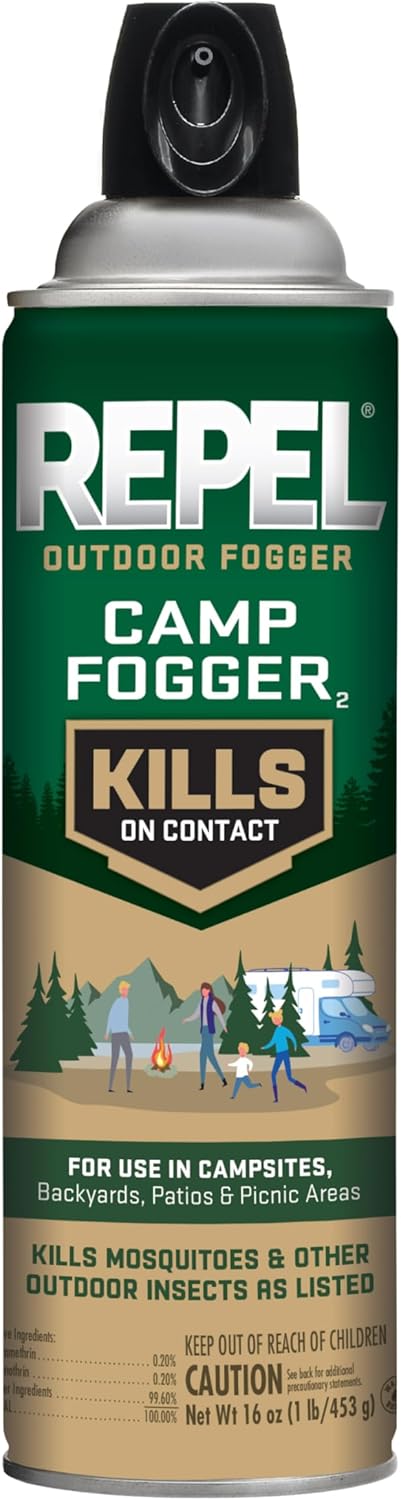
Repel Outdoor Fogger Camp Fogger 16 oz
| Item Volume | 16 fluid ounces |
|---|---|
| Item Form | Aerosol |
| Indoor Outdoor Usage | Outdoor |
| Target Species | Mosquito |
The Repel Outdoor Fogger is a 16-ounce aerosol designed to quickly knock down mosquitoes and a range of other flying and crawling insects around campsites, patios and picnic areas. You use it by spraying when the air is calm or with the wind if there is a breeze, holding the can slightly downward and allowing a few minutes for the spray to take effect. The formula lists active ingredients tetramethrin and phenothrin and is intended for outdoor spot treatments where fast control is needed. Practical benefits include rapid results, compact portable packaging that is easy to throw in a camping kit, and a broad target list that covers gnats, flies, wasps and some ants. Important limitations are that it is for outdoor use only, treatments should not exceed once per day, and the product contains chemicals that carry a California health warning for reproductive harm and cancer, so users should follow label precautions and avoid repeated exposure. This works best as an occasional quick-response solution rather than a long-term landscape treatment.
Best for: Buyers who want an inexpensive, portable spray to get rapid temporary relief from mosquitoes and flies during outdoor activities like camping, picnics or backyard gatherings.
Less Ideal for: People seeking continuous, long-term yard protection or those who prefer non-chemical or low-toxicity pest control methods should consider alternate approaches.
- Fast knockdown of mosquitoes and many common outdoor insects
- Portable 16-ounce aerosol is easy to carry for camping and outings
- Simple application instructions suitable for quick spot treatments
- Broad target list includes flying and crawling pests commonly found at outdoor gatherings
- Contains chemicals with a state health warning which requires careful use and avoidance of repeated exposure
- Not intended for daily or long-term landscape pest control
Verdict: A low-cost, portable aerosol fogger that delivers quick on-contact control of mosquitoes and common outdoor flies for short-term outdoor use.
Rodiuiu 43cc Backpack Cold Fogger with 20L Tank

| Tank Volume | 20 liters |
|---|---|
| Power Source | gas_powered |
| Engine Power | 2.13kw |
| Spray Range | 12M+ |
This backpack cold fogger is built for treating large outdoor areas quickly. It uses a 43cc gas engine that runs at high RPM to produce a cold fog from either liquid or powder formulations, and the 20 liter tank means fewer refills when covering orchards, fields, or large yards. The unit is worn on the back with widened pressure-reducing straps and cushion pads to reduce fatigue during longer jobs, and a simple pull-start plus a closed-throttle parking makes operation straightforward. Notable features include a spray reach listed at about 12 meters, capability to handle both liquids and powders, and a 30:1 fuel mix recommendation to protect the engine. Practical benefits are fast coverage of broad areas, versatility in treatment types, and a design aimed at operator comfort. Important limitations are that it is gas powered so it produces exhaust and needs fuel mixing and basic maintenance, and its weight when filled still requires some physical strength to carry for extended periods.
Best for: Buyers who need a durable, high-capacity fogger for frequent or large-area outdoor pest control and who prioritize reliable, sustained power over electric simplicity.
Less Ideal for: Casual users with small yards or those who prefer low-maintenance, emission-free electric units should consider smaller electric or battery foggers instead.
- Large 20L tank reduces refill frequency for large-area jobs
- Gas engine provides sustained high-power output for long-range spray
- Accepts both liquid and powder formulations for flexible use
- Ergonomic backpack straps and cushions improve comfort during extended use
- Requires fuel mixing, routine engine maintenance, and produces exhaust emissions
Verdict: Choose this backpack fogger when you need a reliable, high-capacity gas-powered unit that covers large outdoor areas with minimal refills.
Cutter Backyard Bug Control Outdoor Fogger 16 oz (3-pack)

| Unit Count | 16 Ounce |
|---|---|
| Included Components | 16oz Fogger (3-Pack) |
| Liquid Volume | 48 fluid ounces |
| Specification Met | EPA |
| Active Ingredients | Phenothrin (0.20%), Tetramethrin (0.20%) |
The Cutter Backyard Bug Control Outdoor Fogger is a simple aerosol fogger designed for quick, local control of mosquitoes and other flying insects around yards, patios, decks, and picnic areas. Each 16 oz can sprays a fine mist intended to kill mosquitoes, gnats, flies, wasps and flying moths on contact; the package includes three cans so you can treat multiple areas or reapply over several days. It is used by pointing the nozzle away from people and pets, spraying the target zone when the air is calm, and allowing a few minutes for the spray to take effect. Notable features are its EPA specification and an active ingredient blend of tetramethrin and phenothrin that delivers fast knockdown. Practical benefits include easy one‑step application and the convenience of a three‑pack for repeat spot treatments or covering multiple locations. Important limitations are short‑range, temporary protection—each can treats about 1,200 cubic feet and should not be used more than once a day—and it is not intended for enclosed spaces or completely replacing long‑term yard management strategies like source reduction or barrier treatments.
Best for: Buyers who want an inexpensive, easy-to-use solution for occasional mosquito problems and quick treatments around outdoor living spaces.
Less Ideal for: Homeowners seeking long‑term, property‑wide mosquito control or hands‑off seasonal solutions should consider professional or residual barrier options instead.
- Ready‑to‑spray aerosol for fast, on‑contact knockdown of flying insects
- Three‑pack provides coverage for multiple areas or repeated treatments
- EPA‑specified formula with active ingredients known for quick effectiveness
- Short duration of protection suitable for spot treatments rather than season‑long control
- Not safe for use in enclosed porches and requires keeping people and pets away until dry
Verdict: A low‑complexity, budget‑friendly three‑pack for fast spot treatments that quickly knocks down mosquitoes and other flying pests around outdoor seating areas.
Choosing the Right Bug Fogger for Outdoors: Key Factors to Consider
Spray Reach and Droplet Size
How far the fogger projects and the size of its droplets determines real-world coverage. Larger droplets fall faster and are better for treating foliage and nearby surfaces, while smaller droplets stay airborne longer and drift farther. Outdoors you need a balance: droplets fine enough to treat flying insects across a yard but coarse enough to land on vegetation where biting pests hide.
Wind and open spaces also change how droplets behave. A unit with adjustable nozzle settings or multiple flow modes helps you adapt droplet size and spray pattern to calm or breezy conditions so treatments are effective rather than wasted.
Run Time and Fuel or Liquid Capacity
Run time affects how much area you can cover before refilling or switching locations. Units with larger tanks or efficient fuel consumption let you treat bigger yards without frequent stops. For propane or thermal foggers, fuel efficiency determines treatment duration and how many re-fills you will need during a season.
Consider whether the fogger supports variable flow rates. Lower flow extends run time for light treatments, while high flow clears dense insect populations faster but uses more product. If you plan recurring treatments, choose capacity and efficiency that match your yard size and schedule.
Power Source and Portability
Outdoor foggers come in electric, battery, and fuel-powered formats. Electric models are quiet and suitable near an outlet but limit placement. Battery units offer cordless convenience for lawns and remote landscaping. Propane or fuel-fired thermal foggers generate dense fog and extended range but require fuel handling and produce more noise and heat.
Portability is tied to weight, handle design, and whether the unit has a wheeled cart. If you must move the fogger across uneven ground or carry it from vehicle to treatment zone, look for ergonomic handles and compact footprints.
Safety Features and Containment
Safety matters more outdoors than you might expect. Thermal and propane units produce heat and must have secure mounting, heat shields, and reliable shutoff valves to prevent accidents. Tanks and hoses should be durable and leak-resistant when using chemical formulations.
Consider features like timed cycles, remote switches, and automatic shutoffs. Also plan for containment and signage: even outdoors you should avoid treating near open water, edible gardens, or areas where children and pets congregate until the area is safe again.
Adjustability and Spray Control
Being able to dial in spray intensity, pattern, and timing increases the usefulness of a fogger across different outdoor tasks. Spot-treating a patio requires a different setting than broadcasting over a lawn or treating dense shrubs. Adjustable nozzles, variable speed fans, and timers let you fine-tune output so you do not overapply product or miss target zones.
Good control reduces product use and lessens environmental impact while improving effectiveness against the specific insects you are targeting.
Durability and Weather Resistance
Outdoor equipment faces sun, moisture, and rough handling. Materials that resist rust, UV degradation, and brittle plastic failure will last longer. Look for units with sealed electrical components if you expect damp conditions or early morning treatments when dew is present.
Serviceability also matters. Foggers built from common parts and simple fittings are easier to maintain and repair between seasons. Replaceable nozzles and standard fuel connectors extend the lifespan of a unit.
When to Use a Fogger Versus Other Control Methods
Foggers are best for fast, broad applications where flying or surface-resting insects are widespread. They are useful for evening treatments aimed at reducing mosquito activity before outdoor events and for creating a protective zone around patios or seating areas.
Fogging is not always the right choice for targeted pests hiding deep in dense foliage or for treating soil-dwelling insects. In those cases, spot treatments, traps, or cultural controls like removing standing water and pruning may be more effective.
- Use foggers for quick reduction of biting flies, mosquitoes, and gnats across open spaces.
- Combine fogging with source control-remove standing water and dense debris to reduce reinfestation.
- Avoid fogging during high winds or when rain is imminent, as treatments will be ineffective.
Preparing Your Yard and Neighbors
Before fogging, remove or cover food, pet dishes, and water features. Close windows and doors on adjacent buildings and notify neighbors if the treatment could drift onto shared spaces.
Trim back dense vegetation to expose harborage sites so droplets land on target surfaces rather than being trapped in foliage. Mark off the treated area with temporary signage if children or pets are likely to enter during or immediately after application.
- Cover or remove exposed food and pet items.
- Trim vegetation and clear debris from the treatment perimeter.
- Consider wind direction and schedule treatments during calm periods, typically dusk or early morning.
Environmental and Nonchemical Options
Fogging with chemical formulations is one tool among many. For lower-impact approaches, consider botanical aerosols designed for outdoor use or mechanical controls like traps and bat or bird habitat to increase natural predation.
Habitat changes, such as removing standing water, improving drainage, and planting insect-repellent species, reduce overall pressure and make fogger treatments less frequent and more effective when used.
- Use traps and larvicides in water-holding containers to cut mosquito reproduction.
- Promote predators and avoid creating shelter that benefits pest insects.
- Rotate tactics seasonally to limit resistance and reduce chemical reliance.
Maintenance and Winter Storage
After each season, flush tanks and lines with the manufacturer-recommended cleaner or plain water where appropriate to prevent clogging. Dry tanks and store the unit in a cool, dry place away from direct sunlight to protect seals and plastic components.
Check nozzles, hoses, and gaskets for wear before the season starts. Replace any brittle hoses and lubricate moving parts so the fogger is ready when insect pressure rises again.
- Empty and clean tanks after use; dry thoroughly before storage.
- Inspect seals and replace worn parts in the off-season.
- Keep spare nozzles and common fittings on hand for quick repairs.
How We Chose the Best Bug Fogger for Outdoors
We prioritized features that matter to gardeners using foggers outdoors rather than laboratory numbers. Key evaluation criteria included spray reach and droplet distribution because these determine how much area a single treatment covers, and run-time efficiency since longer continuous operation reduces the need to reposition units in larger yards. We judged power source flexibility, looking for options that run on propane, electricity, or battery so gardeners can pick what fits their layout and noise tolerance. Safety and containment were assessed by checking for child and pet-safe shutoffs, stable stands, and heat shielding for thermal units. We also considered portability and setup time, since many outdoor treatments are done from a truck, patio, or across a lawn. Units that require excessive assembly or special nozzles scored lower for practical garden use. Exclusions: handheld aerosol sprays and indoor-only foggers were excluded because they do not provide the area coverage or power gardeners need outdoors. Our selection emphasizes units designed for open-air pest control, reliable run-times, and practical safety features.
FAQ
How often should I fog my yard for mosquitoes?
Frequency depends on infestation level and local conditions. Often a weekly or biweekly treatment is effective during peak mosquito season, with additional spot treatments after heavy rain or when activity spikes.
Is it safe to fog near edible gardens and fruit trees?
Fogging near edibles requires care. Avoid direct application to edible parts and cover or harvest produce before treatment. Choose formulations labeled for use around edible plants and wait the recommended reentry interval before handling produce.
Can I use foggers on windy days?
Fogging in wind is usually ineffective because drift reduces target coverage. Choose calm conditions, typically early morning or evening, to maximize droplet deposition on insects and resting surfaces.
Do thermal foggers leave residue on plants?
Thermal foggers can leave a fine residue on foliage depending on droplet size and formulation. That residue often dissipates over time or with watering, but you should avoid direct application to delicate ornamental foliage if residue is a concern.
What safety gear should I use when operating a fogger?
Wear eye protection, a respirator rated for aerosols, long sleeves, and gloves. For thermal or fuel-powered units, add heat-resistant gloves and keep a fire extinguisher on hand when handling propane or hot surfaces.
Are battery-powered foggers effective for large yards?
Battery foggers are convenient and quiet, but run time and tank capacity may limit coverage on large properties. They work well for spot treatments and medium-sized yards but may require multiple batteries or refills for extensive areas.
Final Verdict
Choose a fogger based on how much area you need to treat, your power access, and how often you will apply treatments. Prioritize spray reach and run time for large yards, and look for adjustable output and solid safety features if you plan to use treatments near people, pets, or edible plants. Balancing portability with fuel or tank capacity will help you pick a unit that performs reliably in your typical garden conditions. With the right tradeoffs, a dedicated outdoor bug fogger can significantly reduce biting and nuisance insects while fitting into your seasonal pest-management routine.
