

Note: This article contains affiliate links. If you click on these links and make a purchase, I may earn a small commission at no extra cost to you. This helps support my research and content. Read my full affiliate disclosure here.
Roses are vulnerable to a wide range of chewing and sucking pests that can ruin blooms and weaken canes. Choosing the right bug spray for roses matters because some treatments knock down pests quickly but can scorch foliage or disrupt beneficial insects, while gentler options may require more repeat applications. This guide shortlists seven top-rated options specifically for roses and explains how we judged effectiveness, residual control, and plant safety. Read on to find practical advice for matching a spray to your rose type, pest pressure, and garden practices before the product list.
Top Picks at a Glance
| Best Overall The best all-around choice for most situations | BioAdvanced Dual Action Rose and Flower Insect Killer, 24 oz |  |
| Best Quality Built to a higher standard if you want something more solid | BioAdvanced All‑in‑One Rose and Flower Plant Care Concentrate, 32 fl oz |  |
| Best Value The sweet spot between price and what you get | BioAdvanced 3-in-1 Insect, Disease and Plant Mite Control Spray, 24 fl oz |  |
| Best Budget The cheapest option that still gets the job done reliably | BioAdvanced Rose & Flower Insect Killer Spray, 24 oz |  |
| Highest Rated A top-rated pick with lots of positive feedback | Bonide Rose Shield Ready-to-Use Combination Insect & Fungus Spray, 32 oz (3-pack) |  |
| Most Popular A crowd favorite that many people choose with confidence | Bonide Captain Jack's Ready-to-Use Neem Oil Spray, 32 oz |  |
| Best Seller A high-volume bestseller chosen again and again | BioAdvanced 3-in-1 Insect, Disease & Mite Control Spray, 32 fl oz |  |
BioAdvanced Dual Action Rose and Flower Insect Killer, 24 oz

| Unit Count | 24 Ounce |
|---|---|
| Item Type Name | Garden Insecticide |
| Target Species | Insects |
| Liquid Volume | 24 fluid ounces |
This ready-to-spray BioAdvanced formula is designed to control common rose pests like aphids, whiteflies and Japanese beetles while also usable on houseplants. It uses a continuous mist applicator so you can spray at any angle and reach undersides of leaves and tight blooms without drips. One application is claimed to provide rainproof residual protection for up to 30 days, which reduces how often you need to reapply during an active season. Practical benefits include broad-spectrum control of more than 40 listed pests and easy outdoor or temporary indoor plant treatment if you let sprays dry before returning plants inside. Limitations are typical of chemical insecticides: it targets adult and contact pests but will not selectively preserve beneficial insects you might want to keep on roses, and safety measures are required when applying around pollinators, pets, and edible plants. Follow label directions for timing, protective gear, and reentry intervals to get the intended results and avoid harm to non-targets.
Best for: Gardeners who want a straightforward, ready-to-use spray to quickly knock back visible pests on roses and other ornamentals while minimizing reapplication time.
Less Ideal for: Organic gardeners or those seeking insecticides that spare pollinators and beneficials should look for targeted or organic alternatives.
- Continuous spray mist reaches undersides of leaves and tight flower areas for even coverage
- Broad-spectrum control listed for over 40 common garden pests including aphids and Japanese beetles
- Ready-to-use 24 fl oz bottle suitable for spot treatments and small rose beds
- Rainproof residual protection that can last up to 30 days after application
- Non-selective chemical means beneficial insects and pollinators can be harmed if applied indiscriminately
- Not formulated for edible plants so must be kept away from vegetables and fruit trees
Verdict: A practical, ready-to-use rose spray that delivers easy contact control and up to 30 days of rainproof protection for busy gardeners.
BioAdvanced All‑in‑One Rose and Flower Plant Care Concentrate, 32 fl oz

| Unit Count | 32 Fluid Ounces |
|---|---|
| Item Form | Spray |
| Target Species | Insects |
| Specification Met | EPA |
This BioAdvanced concentrate is designed as an all‑in‑one treatment for roses and ornamentals, combining insecticide, fungicide, and miticide in a single spray. You dilute the concentrate per label directions and apply it to rose bushes, shrubs, vines and other listed flowering plants to kill listed insects on contact and to control diseases such as black spot and powdery mildew. The formula contains systemic and contact actives so it provides immediate knockdown plus residual protection that is rainproof within hours and lasts up to 14 days. Practical benefits include fewer product changes during the season and reduced application time because one product addresses multiple problems. Important limitations are that it covers only the pests and diseases listed on the label and it contains standard pesticide active ingredients so you must follow pollinator and safety precautions and the label directions exactly. For gardeners seeking broad, performance‑focused protection for roses, it simplifies routine spray programs but is not a replacement for integrated pest management steps like pruning and sanitation.
Best for: Gardeners who prioritize reliable, performance‑focused protection for roses and want one product that handles insects, mites, and common fungal diseases to reduce time and product juggling.
Less Ideal for: Organic gardeners or those who avoid synthetic pesticides and people who need a solution for pests or diseases not listed on the product label.
- Combines insecticide, fungicide, and miticide in one product reducing the need for multiple sprays
- Provides both contact knockdown and residual protection that is rainproof within hours
- Covers common rose pests and diseases such as aphids, Japanese beetles, black spot and powdery mildew
- Concentrate format lets you treat more area per bottle compared with ready‑to‑use sprays
- Label lists specific target pests and diseases so effectiveness is limited to listed species
- Contains conventional pesticide active ingredients requiring careful adherence to safety and pollinator timing
Verdict: Buy this if you want one high‑coverage product that delivers knockdown plus up to two weeks of rainproof protection for common rose pests and diseases.
BioAdvanced 3-in-1 Insect, Disease and Plant Mite Control Spray, 24 fl oz

| Unit Count | 24 Fluid Ounces |
|---|---|
| Item Form | Liquid |
| Target Species | Fungus |
| Active Ingredients | Bifenthrin 0.0134%, Myclobutanil 0.0124% |
This ready-to-use BioAdvanced 3-in-1 spray is designed to tackle insects, fungal diseases, and plant mites in a single application. You use it on roses, flowering plants, ornamentals, shrubs, and trees to kill pests such as aphids, whiteflies, and adult Japanese beetles while also controlling diseases like black spot and powdery mildew. Notable features include a rainproof formula that starts working within about four hours and residual protection for up to 14 days, plus a combination of bifenthrin (insecticide) and myclobutanil (fungicide) that provides contact kill and some systemic uptake. In practice this simplifies treatment schedules by replacing separate products for insects, disease, and mites, saving time for routine garden maintenance. Important limitations: it contains synthetic active ingredients so it should not be applied when pollinators are present and is not labeled for edible food crops; some gardeners preferring insecticidal soaps or organic options will find this outside their preferred approach.
Best for: Buyers who want a single, low-effort product to manage common pests and fungal problems on ornamental plants and roses and who prioritize convenience and predictable residual control.
Less Ideal for: Gardeners focused on organic, pollinator-safe, or edible-crop treatments should choose an insecticidal soap or organic fungicide instead.
- Combines insecticide, fungicide, and miticide in one ready-to-use spray
- Rainproof within about 4 hours and provides up to 14 days of protection
- Kills a broad range of listed pests on contact including aphids and whiteflies
- Works on ornamentals, roses, shrubs, and trees so one product covers many plantings
- Contains synthetic active ingredients and must not be used when pollinators are present
- Not labeled for use on food crops so unsuitable for vegetables and fruit trees
Verdict: A convenient all-in-one ready spray that saves time by combining insect, disease, and mite control for ornamental gardens.
BioAdvanced Rose & Flower Insect Killer Spray, 24 oz

| Unit Count | 24 Fluid Ounces |
|---|---|
| Item Form | Spray |
| Target Species | Insects |
| Active Ingredients | Cyfluthrin |
| Specification Met | EPA |
This ready-to-use BioAdvanced spray is designed for quick spot treatment of roses, flowers, shrubs and vegetable gardens. The bottle delivers a fast-acting cyfluthrin formula that kills common pests such as aphids, whiteflies, Japanese beetles and caterpillars on contact, and the label claims protection for up to 14 days after application. Typical use is a direct spray to foliage until leaves are coated but not dripping, making it convenient for spot treatments or treating individual plants without mixing. The product is easy to apply and covers many common garden pests, which is helpful when you want an immediate reduction in visible damage. Important limitations are that it is a chemical insecticide with a synthetic active ingredient and is formulated for above-ground pests only, so it does not target soil-dwelling stages and should be used according to label precautions around beneficial insects and flowering pollinators. For gardeners needing occasional, effective knockdown of common pests, this is a practical ready-to-use option.
Best for: Gardeners who want an affordable, no-mix spray to quickly knock down visible pests on roses and ornamental plants and who prioritize convenience and immediate results.
Less Ideal for: People looking for organic or pollinator-safe options or those needing systemic or soil-targeted pest control should consider alternatives.
- Ready-to-use sprayer for easy spot application
- Kills a wide range of listed pests on contact
- Provides up to 14 days of residual protection as stated on the label
- Contains a synthetic pyrethroid active ingredient which can harm beneficial insects if applied to blooms
- Not intended for control of soil-dwelling pests or grubs
Verdict: A convenient, budget-friendly ready-to-use spray for rapidly reducing common above-ground garden pests on roses and flowers.
Bonide Rose Shield Ready-to-Use Combination Insect & Fungus Spray, 32 oz (3-pack)

| Item Form | Spray |
|---|---|
| Target Species | Fungus |
| Unit Count | 3 Count |
This Bonide Rose Shield RTU combination spray is designed to give routine protection for rose bushes by combining insect control with a fungicide in a single, ready-to-use bottle. You spray foliage and blooms to target common pests and to prevent or control fungal problems, which makes it convenient for regular maintenance treatments. The product comes in a three-pack, so you can cover multiple plants or schedule several applications across the season without mixing concentrates. As a ready-to-use formula it is simple to apply with minimal setup and reduces the chance of dosing errors. The trade-off is less flexibility compared with concentrates if you want to treat large areas economically, and it requires repeated applications for season-long control rather than delivering long-term residual protection from a single use. For gardeners prioritizing straightforward, dependable applications on roses, this delivers predictable, consistent performance.
Best for: Home gardeners who want a simple dependable spray to routinely protect a small collection of roses without mixing chemicals or managing concentrates.
Less Ideal for: Large-scale gardeners or landscapers treating many plants who need a concentrated product for cost-effective bulk applications.
- Combines insecticide and fungicide so one product treats both common rose pests and fungal issues
- Sold as a three-pack for coverage across multiple plants or repeated seasonal applications
- Ready-to-use formula requires no mixing and reduces chance of measurement errors
- Ready-to-use format is less cost-efficient for treating large gardens compared with concentrates
- Requires repeated applications for continued protection rather than providing long single-dose residual control
Verdict: A convenient, dependable ready-to-use combo spray that simplifies routine insect and fungus control on roses.
Bonide Captain Jack's Ready-to-Use Neem Oil Spray, 32 oz

| Item Form | Liquid |
|---|---|
| Target Species | Insects |
| Liquid Volume | 32 fluid ounces |
| Active Ingredients | Clarified Hydrophobic Extract of Neem Oil |
This ready-to-use neem oil spray is a multipurpose garden treatment that kills insects at all life stages while also serving as a miticide and preventative fungicide. Packaged in a 32-ounce trigger bottle, it is applied by shaking and thoroughly spraying plant surfaces, including leaf undersides, at the first sign of pests or disease and reapplying every 7 to 14 days as needed. The active ingredient is a clarified hydrophobic extract of neem oil, which is approved for organic gardening and labeled safe to use on vegetables up to the day of harvest. Practical benefits include broad pest coverage (aphids, whiteflies, spider mites and others), disease suppression such as powdery mildew, and convenience from a ready-to-use sprayer. Important limitations are that results are slower than synthetic contact insecticides and application timing matters to avoid leaf burn in full sun; repeated applications may be needed for heavy infestations. Follow label safety directions and keep the product away from children and pets.
Best for: Gardeners who want a single, organic-approved product to manage common vegetable garden pests and fungal problems and who prefer products with strong user feedback.
Less Ideal for: Growers needing rapid knockdown of severe infestations or commercial producers who require fast-acting, high-throughput treatments.
- Kills multiple pest stages including eggs, larvae and adults for more complete control.
- Also acts as a fungicide and miticide so one product covers pests and common fungal issues.
- Ready-to-use trigger bottle requires no mixing and is easy to apply to leaves and undersides.
- Approved for organic gardening and can be used on vegetables up to day of harvest.
- Slower-acting than many synthetic contact insecticides, so it may take several applications to see control.
- Must avoid spraying in peak sunlight to reduce risk of leaf burn.
Verdict: A convenient, organic-approved all-in-one neem spray that controls common vegetable garden pests and fungal issues with minimal fuss.
BioAdvanced 3-in-1 Insect, Disease & Mite Control Spray, 32 fl oz
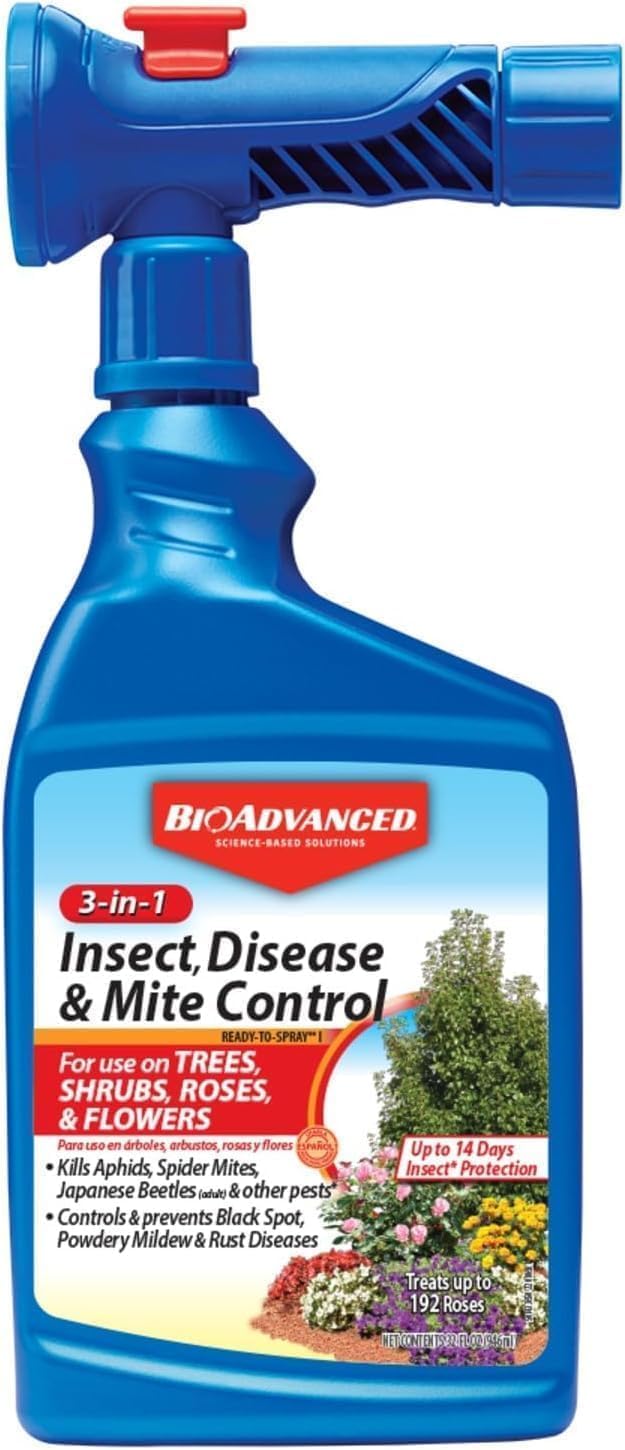
| Unit Count | 32 Fluid Ounces |
|---|---|
| Item Form | Spray |
| Target Species | Aphids, caterpillars, leafminers, whiteflies and other listed pests |
| Active Ingredients | Tau-fluvalinate 0.61%, Tebuconazole 0.65% |
This BioAdvanced 3-in-1 spray is a performance-focused ready-to-use treatment that kills common pests on contact while also preventing and curing listed fungal diseases and controlling spider mites. It attaches to a garden hose for broad, even coverage and is labeled to treat up to 192 rose bushes, making it practical for medium to large beds and multiple shrubs. Key features include systemic ingredients plus contact control, rainproof protection lasting up to 14 to 30 days depending on labeled claims, and active ingredients targeting aphids, caterpillars, whiteflies, and mites. In use you spray foliage including undersides, and the product provides both immediate knockdown of insects and longer residual control so follow-up applications are less frequent. Limitations: it is a chemical treatment so users must follow safety directions and keep children and pets away until treated areas have dried, and it is not sold for use in New York. For someone prioritizing reliable, one-step control of aphids and associated fungal problems on roses and ornamentals, this bottle delivers convenient, broad-spectrum protection.
Best for: Gardeners who want a fast, high-performance one-step solution to control aphids and related pests while also preventing common fungal diseases on roses and ornamental plants.
Less Ideal for: Organic gardeners or those seeking nonchemical options should look for botanical or soap-based aphid controls instead.
- Combines insecticide, fungicide, and miticide in one ready-to-use formula for streamlined treatment
- Attaches to a garden hose for fast coverage of many plants including up to 192 roses
- Provides knockdown on contact and residual protection between labeled reapplications
- Controls a wide list of pests including aphids, spider mites, whiteflies, and caterpillars
- Contains chemical active ingredients that require careful handling and adherence to safety directions
- Not approved for sale in all states which limits availability for some users
Verdict: For gardeners focused on performance, this ready-to-spray 3-in-1 formula delivers fast aphid knockdown plus disease prevention in one convenient application.
Choosing the Right Bug Spray for Roses: Key Factors to Consider
Target Pest Spectrum
Different bug sprays are formulated to control different groups of pests. Some products are optimized for soft-bodied insects like aphids and spider mites, while others have ingredients more active against beetles or caterpillars. Matching the spray to the pests you actually see on your roses avoids unnecessary applications and increases first‑treatment success.
Identify the most common pests in your planting area before choosing a spray. If you routinely get mixed infestations, look for products labeled for a broad spectrum rather than a single pest. For seasonal problems like Japanese beetles, timing applications to adult flight windows increases effectiveness.
Plant Safety and Timing
Roses, especially newly grafted or recently transplanted bushes, can be sensitive to certain spray chemistries and to application during hot sun. Label directions typically warn about leaf burn risk when applied at high temperatures or under full sun. Choosing a spray with an established record of low phytotoxicity on roses reduces the chance of spotting or scorch.
Timing matters too. Apply in the cooler parts of the day and avoid treating during bloom when pollinators are active unless the product is safe for flowering plants. Read and follow the label reflowering and preharvest intervals if you cut roses for bouquets.
Residual Activity and Reapplication Needs
Some sprays provide hours of control while others offer several days to weeks of residual protection. Longer residual activity can reduce the frequency of applications, which is useful when managing large beds or when repeated treatments stress the plants. However, longer residuals can also increase exposure risk to beneficial insects.
Consider how often you can realistically inspect and spray your roses. For heavy infestations or high pest pressure you may prefer stronger residuals, but for everyday maintenance shorter-acting products used precisely can minimize non-target impacts.
Impact on Beneficial Insects
Bees, predatory wasps, lacewings, and lady beetles help keep rose pests in check. Broad-spectrum insecticides can harm these allies and lead to secondary pest outbreaks. Many gardeners accept some tradeoff between control speed and impact on beneficial fauna.
If pollinators are active near your roses, select sprays with lower toxicity to beneficials, use spot treatment rather than blanket sprays, and apply in the evening when bees are less active. Always follow label guidance about pollinator protection and buffer zones.
Formulation and Application Method
Bug sprays come as ready-to-use bottles, concentrates, hose-end applicators, and systemic drenches. Ready-to-use products are convenient for small plantings or spot treatments. Concentrates can be more economical for larger beds but require careful mixing. Systemic options taken up by roots or stems can offer internal protection for new growth but may not control all pest types.
Choose a formulation that fits your comfort with mixing, the size of your rose beds, and whether you need a contact spray for immediate knockdown or a systemic for longer internal protection.
Residue Concerns and Environmental Conditions
Residues on foliage and cut flowers matter if you plan to harvest blooms. Some sprays require rinsing or a set withholding period before cutting. Rainfastness is also important; products that wash off easily will need reapplication after heavy rain.
Account for your local climate when selecting a spray. In humid regions, fungal issues can complicate spray timing because wet foliage and certain chemistries increase phytotoxicity risk. Read label instructions about rainfastness and safe re-entry intervals.
When to Treat Roses Versus Using Cultural Controls
Not every insect sighting needs a spray. Light aphid colonies can often be managed by strong water sprays, pruning out heavily infested growth, or encouraging predators. Reserve chemical or botanical sprays for infestations that threaten bud set, defoliate canes, or persist after mechanical control.
Use preventive cultural measures alongside sprays. Proper watering, balanced fertilization, and good air circulation reduce plant stress and make roses less attractive to pests. Inspect roses weekly during active growth and bloom to catch problems early.
- Use water sprays and pruning for small, localized infestations
- Address environmental stresses that attract pests
- Combine treatments with habitat for beneficial insects
Best Application Practices to Protect Roses
Apply sprays in the early morning or late evening to reduce heat-related leaf damage and to avoid peak pollinator activity. Thorough coverage of undersides of leaves and new growth is usually more important than heavy coverage of old canes.
Follow label dilution and frequency instructions closely. Overconcentration or too-frequent applications increase the risk of burn and can weaken plants. For bloom safety, check label guidance about applications during flowering and any recommended buffer periods before cutting blooms.
- Spray when temperatures are below mid-day heat
- Target new shoots and bud clusters where pests congregate
- Avoid spraying open flowers when possible
Combining Treatments With Integrated Pest Management
Integrate botanical options, contact sprays, and systemic treatments with monitoring and biological control. Rotate modes of action to prevent resistance when treating larger rose plantings or repeated seasons of pressure.
Spot treat heavily infested areas rather than blanket-spraying entire beds. Encourage beneficials by maintaining nearby nectar sources and avoiding treatments during peak pollinator activity.
- Rotate active ingredient classes seasonally
- Use spot treatments to limit non-target exposure
- Encourage predators with shelter and flowering plants
Spray Safety and Protective Measures
Always wear appropriate personal protective equipment as indicated on the product label. Gloves, eye protection, and long sleeves reduce accidental exposures when mixing and applying concentrates.
Keep spray equipment clean to avoid unintended chemical mixes. Rinse sprayers and hoses after use, and store products and tools safely out of reach of children and pets.
- Follow label PPE recommendations
- Do not reuse containers for other purposes
- Store products in a cool, dry, locked area
Managing Resistant or Persistent Pests
Some pests develop tolerance to repeated treatments with the same chemistry. If control weakens over time, change the active ingredient class rather than increasing dose or frequency. Consider combining a physical removal approach with a different mode of action.
For persistent infestations, focus on timing and coverage. Treat early in pest life cycles when larvae are more vulnerable, and ensure thorough application to hidden feeding sites under buds and leaf folds.
- Rotate ingredient classes to reduce resistance risk
- Time applications to vulnerable pest stages
- Use thorough coverage rather than repeated light sprays
How We Chose the Best Bug Spray for Roses
We prioritized products that balance fast, reliable pest control with minimal phytotoxicity on roses and acceptable risk to beneficial insects when used correctly. Selection criteria included demonstrated efficacy against common rose pests such as aphids, thrips, Japanese beetles, and rose slugs; clear directions for application rates and timing compatible with flowering roses; and labeled plant safety notes for different rose varieties and temperatures. Residual activity and reapplication interval were considered because treatments that wear off quickly are impractical for heavy infestations. We also looked for formulations and delivery methods suited to backyard and container rose care, including hose-end, ready-to-use spray, concentrates, and systemic options. Products without explicit rose-label directions, or those with high documented rates of foliar burn on roses under normal use, were excluded. Our final shortlist focuses on options that gardeners can reasonably use without specialized equipment and that align with the scoring metrics below.
FAQ
How often should I spray roses when I see aphids?
Frequency depends on the product and pest pressure. Many contact sprays require reapplication every 7 to 14 days while infestations persist. For heavy outbreaks you may need more frequent treatments early on, then reduce frequency as numbers decline.
Can I spray roses during bloom without harming pollinators?
Often it depends on the product. Many labels advise avoiding applications to open flowers and recommend spraying in the evening when bees are less active. Choose lower-toxicity options and avoid spraying plants that are attracting pollinators during peak activity.
Will systemic treatments prevent new infestations on roses?
Systemic options taken up by the plant can protect new growth from certain sap-sucking pests for several weeks, but they do not control all pest types and may not kill adult chewing insects on contact. Use systemics as part of an integrated approach.
Are botanical sprays safer for beneficial insects?
Botanical products can be less persistent and lower in toxicity to some beneficials, but they are not without impact. Because many are broad-spectrum contact agents, timing and targeted application are important to reduce harm to predators and pollinators.
What should I do after heavy rain washes off a spray?
Inspect plants for renewed activity and follow label guidance on reapplication after rain. Some products are rainfast within a few hours while others wash off and will need retreatment once foliage is dry.
Is hand-removal or pruning ever a better option than spraying?
Yes. For small infestations or isolated canes, physical removal, pruning out damaged growth, or blasting aphids with water can be effective and avoids chemical exposure. Reserve sprays for larger or persistent problems.
Final Verdict
Choosing the best bug spray for roses means balancing quick pest control with protecting foliage, blooms, and beneficial insects. Prioritize sprays that match the pest spectrum you face, have clear instructions for roses and heat-sensitive conditions, and fit your application routine. Pay attention to timing and minimize blanket applications to preserve pollinators and natural predators. With the right tradeoffs in mind you can confidently pick a spray that protects blooms while keeping your rose bed healthy.
