

Note: This article contains affiliate links. If you click on these links and make a purchase, I may earn a small commission at no extra cost to you. This helps support my research and content. Read my full affiliate disclosure here.
If you need to control insects inside your home without turning living spaces into an odor-filled zone, the right bug spray makes a big difference. Indoor sprays behave differently than outdoor formulations: they must balance fast knockdown with low lingering smell, safe surface contact, and compatibility with fabrics and food-prep areas. This guide covers seven top bug sprays shortlisted for indoor use and explains why each type earned a spot. We evaluate knockdown speed, indoor safety, and residue control so you can pick the product best suited to bedrooms, kitchens, living rooms, or garages. Read on to see which traits matter most for indoor pest control.
Top Picks at a Glance
| Best Overall The best all-around choice for most situations | Ortho Home Defense Insect Killer Refill, 1.33 gal (Indoor & Perimeter) |  |
| Best Quality Built to a higher standard if you want something more solid | Ortho Home Defense Max Ant, Roach & Spider Spray, 14 oz |  |
| Best Value The sweet spot between price and what you get | STEM Plant-Based Bug Spray for Ants, Roaches and Flies, 12 fl oz |  |
| Best Budget The cheapest option that still gets the job done reliably | Raid Ant & Roach Killer, Fragrance Free, 17.5 oz |  |
| Highest Rated A top-rated pick with lots of positive feedback | Raid Ant & Roach Killer Spray, Lemon Scent, 17.5 oz |  |
| Most Popular A crowd favorite that many people choose with confidence | Ortho Home Defense Insect Killer for Indoor & Perimeter, 1.33 gal. with Comfort Wand |  |
| Best Seller A high-volume bestseller chosen again and again | Atticus Talak 7.9% Bifenthrin Indoor/Outdoor Insecticide Concentrate, 32 oz |  |
Ortho Home Defense Insect Killer Refill, 1.33 gal (Indoor & Perimeter)

| Unit Count | 170.24 Fluid Ounces |
|---|---|
| Item Form | Spray |
| Target Species | Insects |
| Liquid Volume | 1.33 gallons |
This Ortho Home Defense refill is made for homeowners who want a high-capacity solution for indoor and perimeter pest control. The concentrate is intended to be poured into the reusable Comfort Wand applicator so you can treat entry points, baseboards, doorframes, and foundation perimeters without repeated small bottles. Its formula claims an invisible, fast-drying barrier that provides up to 12 months of residual control for ants, roaches, and spiders when applied on non-porous indoor surfaces, and it targets a broad list of common household insects. In practice the refill reduces trips to the store and lowers per-application cost compared with single-use sprayers, and the continuous-spray wand reduces user fatigue for larger jobs. Important limitations are that the long-residual claim applies mainly to certain pests and non-porous surfaces, and precise coverage requires following the spray distance and band-width directions to avoid overapplication. This product is best used as part of a preventive or follow-up treatment routine rather than a one-time knockdown for heavy infestations.
Best for: Homeowners who prioritize effective, long-lasting perimeter and indoor protection and who want a refillable, economical option for routine pest control.
Less Ideal for: People who need immediate, heavy-duty knockdown treatments or who prefer single-use ready-to-spray bottles for spot treatments.
- Large 1.33 gallon refill reduces frequency of repurchasing and is economical for whole-home or perimeter treatments
- Compatible with the Comfort Wand reusable applicator for continuous spray and less hand fatigue during larger jobs
- Invisi-Shield formula dries clear with no noticeable fumes, allowing people and pets to re-enter once dry
- Broad-spectrum label covers many common indoor and perimeter pests, including ants, roaches, spiders and mosquitoes
- Residual protection claim is specific to ants, roaches and spiders on non-porous indoor surfaces and may not apply equally to all listed insects
- Requires a compatible applicator wand or transfer container since it is a refill rather than a ready-to-use spray
Verdict: Buy this refill if you want an economical, high-capacity solution to maintain a long-lasting indoor and perimeter insect barrier using a reusable comfort-wand applicator.
Ortho Home Defense Max Ant, Roach & Spider Spray, 14 oz

| Item Form | Spray |
|---|---|
| Target Species | Insects |
| Unit Count | 14 Ounce |
| Liquid Volume | 13.4 fluid ounces |
Ortho Home Defense Max is an indoor aerosol formulated to kill ants, roaches, beetles and spiders quickly while leaving little to no residue. You use it as a spot treatment where you see activity or as a preventative perimeter on baseboards, around door frames and other nonporous surfaces; the angled spray works at any angle, including upside down, so it is easy to reach cracks and crevices. Notable features include a no-fume, quick-drying formula and a long residual claim of up to one year on nonporous surfaces, which makes it useful for both reactive treatments and seasonal prevention. Practical benefits are straightforward: fast knockdown of visible insects, simple aerosol application without mixing, and the ability to treat awkward areas thanks to the comfort sprayer. Important limitations are that the one-year residual applies only to nonporous surfaces and real-world longevity will vary with cleaning and traffic, and it is an aerosol so care is needed around pets, food prep areas and venting while spraying.
Best for: Buyers who prioritize fast, reliable knockdown and long-lasting indoor protection and who need an easy-to-apply spray for targeted cracks, baseboards and entry points.
Less Ideal for: People who need a non-aerosol, plant-safe or outdoor-only solution or who require pest control designed for porous surfaces or full-structure professional treatments.
- No-fume, quick-drying formula suitable for indoor use on visible surfaces
- Angled spray works at any angle to reach cracks, crevices and undersides
- Kills common indoor pests quickly including ants, roaches, beetles and spiders
- Provides a long-lasting residual barrier on nonporous surfaces when used as directed
- Residual protection is limited to nonporous surfaces and affected by cleaning and traffic
- Aerosol delivery requires caution around food prep areas, children and pets
Verdict: Choose this spray if you want a quick-drying, angled aerosol that knocks down common indoor pests and leaves a long-lasting barrier on nonporous surfaces.
STEM Plant-Based Bug Spray for Ants, Roaches and Flies, 12 fl oz

| Active ingredients | Geraniol 6.2%, Lemongrass Oil 0.5% |
|---|---|
| Other ingredients | White Mineral Oil, Isopropyl Myristate, (+)-Ethyl Lactate 93.9% |
| Form | Trigger spray |
| Use | Indoor and outdoor spot treatments |
This STEM bug spray is a trigger-spray insecticide formulated with plant-derived actives such as geraniol and lemongrass oil to kill ants, roaches and flies on contact. It is intended for targeted indoor and outdoor spot treatments: shake, hold about a foot from the insect and spray directly on or where insects congregate. The product’s botanical formula and absence of added dyes or strong chemical fragrances make it a reasonable choice for homes where users prefer less synthetic-smelling options. The trigger bottle gives control for spot application and repeated short bursts, and the directions note it is oil-based so spills should be cleaned promptly. Important limitations are that it is not for spraying on people, pets or plants and requires direct hits for best effect rather than long-range fogging. For persistent infestations you may need supplemental measures because this is designed for surface and contact kills rather than residual baiting or area-wide control.
Best for: Buyers who want an affordable, low-odor botanical spray for quick spot control of common household pests and who prioritize a simple, easy-to-use trigger bottle for targeted treatments.
Less Ideal for: People facing large or hidden infestations who need long-lasting residual control or bait-style solutions should consider professional products or integrated pest control approaches.
- Plant-based active ingredients (geraniol and lemongrass oil) that reduce strong chemical odor
- Trigger-spray bottle for controlled, targeted application
- Labeled for both indoor and outdoor spot treatments when used as directed
- No added dye or fragrance listed, which minimizes residue and scent
- Oil-based formula can leave slippery residue if spilled
- Requires direct spraying of insects for effectiveness and offers limited residual control
- Not safe to spray on people, pets or plants
Verdict: A budget-friendly, low-odor plant-based trigger spray that provides quick, targeted kills of ants, roaches and flies for everyday spot treatments.
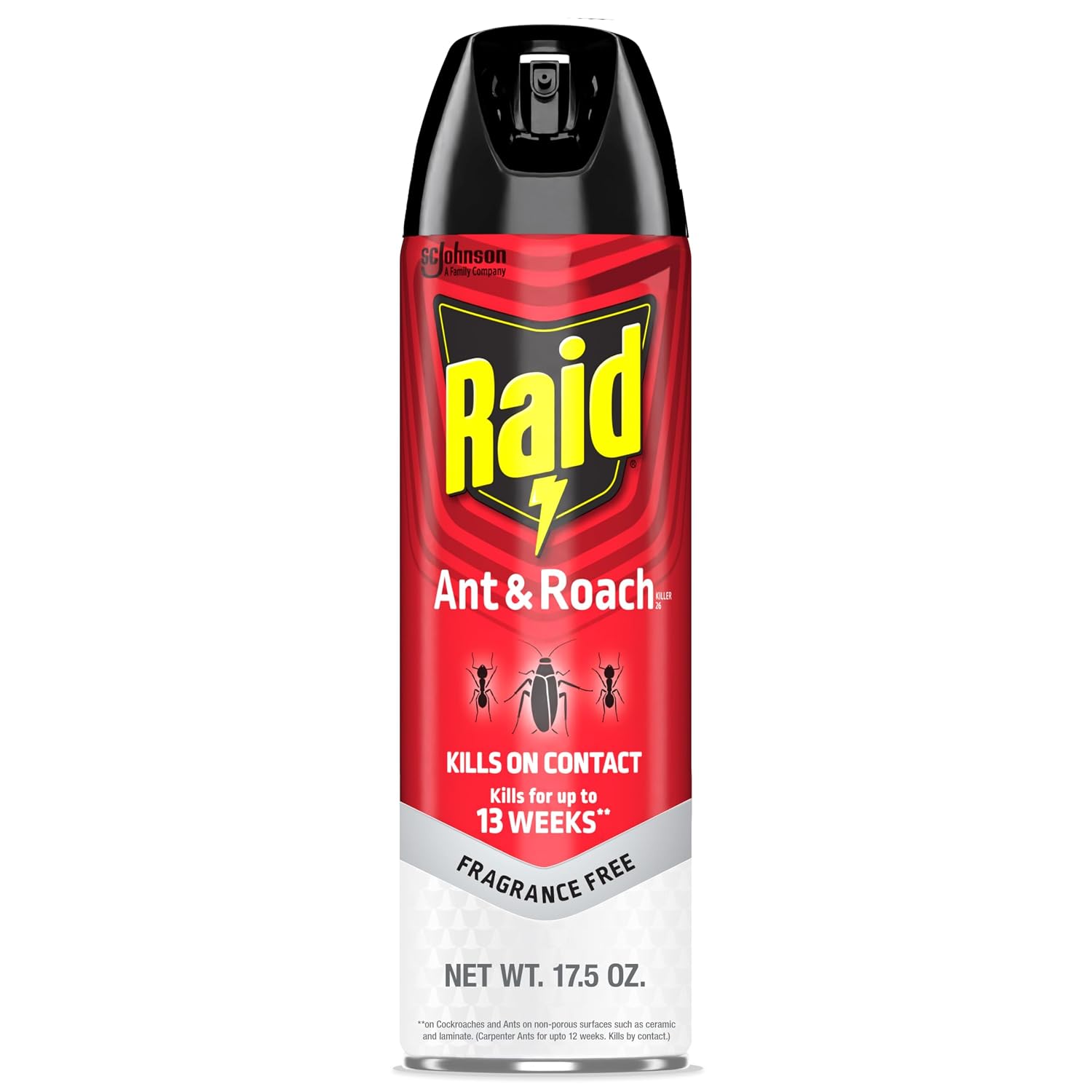
Raid Ant & Roach Killer, Fragrance Free, 17.5 oz
| Unit Count | 17.5 Ounce |
|---|---|
| Item Form | LIQUID |
| Target Species | Insects |
| Liquid Volume | 1 deciliters |
Raid Ant & Roach Killer is an easy-to-use aerosol that kills on contact and leaves a residual insecticide layer meant to keep killing crawling pests for up to 13 weeks. Typical use is spraying along floors, baseboards, garbage cans, under sinks and in basements or garages where ants and roaches travel. The formula targets a broad list of insects including roaches, ants, silverfish, crickets and some spiders, and the fragrance-free version avoids leaving a noticeable chemical smell. Practical benefits include quick knockdown of visible bugs, a clear application pattern for treating infestation sites, and a long residual window between treatments. Important limitations are that it is flammable and packaged under pressure so it must be stored and applied carefully, and aerosol application is suitable for spot and perimeter treatments but not for treating food-contact surfaces or for people seeking non-chemical or pet-safe long-term options.
Best for: Homeowners who want a straightforward, no-frills insect spray to quickly eliminate visible ants and roaches and to reduce returns between treatments.
Less Ideal for: People wanting non-chemical pest control methods or those needing treatments safe for constant use around unattended pets and infants should consider alternatives.
- Kills on contact and provides residual control for weeks after application
- Fragrance-free formula minimizes lingering odor in treated areas
- Broad-spectrum effectiveness against many common crawling insects
- Aerosol can is flammable and must be stored and used with caution
- Not intended for use on food-contact surfaces or where children and pets directly access treated areas
Verdict: If you need an affordable, fragrance-free aerosol that kills crawling insects on contact and keeps working for weeks, this is a practical choice.
Raid Ant & Roach Killer Spray, Lemon Scent, 17.5 oz

| Unit Count | 17.5 Ounce |
|---|---|
| Item Form | LIQUID |
| Active Ingredients | IMIPROTHRIN 0.060%, CYPERMETHRIN 0.100% |
| Residual Control | Up to 13 weeks (listed) |
Raid Ant & Roach Killer is an easy-to-use aerosol spray designed to kill ants, roaches and many other crawling pests on contact and leave a residual barrier on treated surfaces. You shake and spray directly onto baseboards, under sinks, garbage cans and other problem areas; the formula lists imiprothrin and cypermethrin as active ingredients and promises up to 13 weeks of residual control for roaches and carpenter ants. In practice it works well for spot treatments and quick knockdown of visible insects and is useful for keeping treated cracks and crevices hostile to re-infestation. The lemon scent reduces chemical odor compared with some alternatives, but it is still an insecticide so use with ventilation and keep away from food and pets. This product is primarily for indoor surface applications rather than outdoor broadcast use, and repeated treatments are needed over time to maintain control in heavy infestations.
Best for: Buyers looking for an affordable, no-fuss indoor spray to quickly stop visible ants and roaches and maintain treated surfaces between deeper control measures.
Less Ideal for: Homeowners facing large or persistent infestations who need professional-grade or long-term structural solutions should consider integrated pest control options instead.
- Kills a wide range of crawling insects on contact including ants and roaches
- Residual action up to 13 weeks helps reduce follow-up treatments on treated surfaces
- Simple aerosol application for spot treatments and hard-to-reach baseboards
- Lemon scent mutes strong chemical smell compared with unscented sprays
- Contains synthetic insecticides so requires ventilation and pet/child precautions
- Not intended for broad outdoor perimeter use or as a long-term structural treatment
Verdict: A straightforward, budget-friendly indoor spray that quickly kills crawling pests and provides weeks of residual control for routine home spot treatments.
Ortho Home Defense Insect Killer for Indoor & Perimeter, 1.33 gal. with Comfort Wand

| Item Form | Spray |
|---|---|
| Target Species | Insects |
| Liquid Volume | 1.33 gallons |
| Active Ingredients | Bifenthrin 0.05%, Zeta-Cypermethrin 0.0125% |
This 1.33 gallon Ortho Home Defense spray is designed to treat both indoor problem spots and the outdoor perimeter of a home to reduce ants, roaches, spiders and many other crawling and flying insects. It comes with a battery-powered Comfort Wand that delivers a continuous spray so you can apply a uniform band around foundations, patios and entry points without bending or pumping. The formula with bifenthrin and zeta-cypermethrin is intended to kill on contact and establish a barrier that the manufacturer says lasts up to 12 months for ants, roaches and spiders on non-porous indoor surfaces. In real-world use that means fewer repeat treatments in busy yard perimeters and around doors and windows. The spray dries clear with minimal fumes which helps for indoor use near kitchens and living areas. Limitations are that this is a chemical insecticide so users should follow safety directions around children, pets and plants and it is not a specific solution for pests not listed on the label. For homeowners focused on strong, perimeter-level protection this product simplifies application and covers a large area per container.
Best for: Homeowners who want a performance-focused perimeter treatment to reduce recurring yard and entry-point insect problems and prefer a ready-to-use product that is easy to apply.
Less Ideal for: People seeking organic or non-chemical control methods or those who need a targeted solution for pests not listed on the label should consider alternative products.
- Includes battery-powered Comfort Wand for continuous, fatigue-free application
- Ready-to-use 1.33 gallon container covers large perimeters without mixing
- Formula creates a barrier claimed to provide up to 12 months protection against ants, roaches and spiders on non-porous indoor surfaces
- Dries clear and gives off minimal fumes, making indoor use more practical
- Contains synthetic insecticides so precautions are required around children, pets and ornamentals
- Protection claims are specific to certain species and surfaces so results vary by pest and conditions
Verdict: A powerful, ready-to-use perimeter and indoor spray for homeowners who want long-lasting, performance-oriented protection against common yard and household insects.
Atticus Talak 7.9% Bifenthrin Indoor/Outdoor Insecticide Concentrate, 32 oz

| Active Ingredient | Bifenthrin |
|---|---|
| Formulation | Suspension Concentrate |
| Liquid Volume | 32 fluid ounces |
| Length of Control | Up to three months |
| Target Species | Insects |
Talak 7.9% is a liquid concentrate for treating lawns, landscaping, outdoor living areas and indoor perimeter spots like baseboards and cabinets. You dilute the concentrate with water to create a spray for barrier treatments, spot applications or lawn mixes; label rates explain how much to mix per gallon depending on the use. The product uses bifenthrin, a proven broad-spectrum active ingredient, and the manufacturer states it controls over 75 species and can give residual control for as long as three months. Its water-based formula dries clear, leaves no odor or visible residue, and is not phytotoxic on plants when used per label. Practical benefits include flexible indoor and outdoor use, clear drying, and a bottle designed for easier pouring. Important limitations are that solutions should be mixed only for same-day use, it is not registered for sale in a few states, and it is not approved for fogger application, so professional-style misting methods are not appropriate.
Best for: Buyers who want a single, reliable product to protect yards, patios and building perimeters from a wide range of common pests and prefer conservative, label-driven application practices.
Less Ideal for: People seeking ready-to-use sprays or fogger-compatible products or those in states where this formulation is not registered should look at alternatives.
- Broad-spectrum control listed for 75+ indoor and outdoor pest species
- Water-based formula that dries clear and leaves no odor or residue
- Flexible label directions for lawns, landscapes, hardscapes and indoor perimeter treatments
- Long residual activity up to three months when applied at recommended rates
- Mixed spray solutions cannot be stored and must be used the same day
- Not approved for fogger application and not available for sale in some states
Verdict: A versatile, water-based bifenthrin concentrate that delivers long-lasting, broad-spectrum outdoor (and perimeter indoor) control when used according to the label.
Choosing the Right Bug Spray for Inside House: Key Factors to Consider
Target Pest Spectrum
Know which insects you need to control. Different sprays are formulated to work best on specific pests such as ants, cockroaches, flies, or spiders. A product labeled for a broad indoor pest spectrum saves time when you have multiple species, but if one pest dominates-like a roach infestation-you may prefer a formulation specifically effective against that group.
Matching the spray to target species affects how you apply it and where. For example, baits and contact sprays work differently: contact sprays provide immediate knockdown on visible insects, while baits and long-residual products help control hidden populations over time. Read label target lists to ensure the product covers the insects you see.
Indoor Safety and Re-entry Instructions
Indoor sprays must include clear label directions for occupied spaces. Look for information about ventilation, recommended re-entry intervals, and whether pets or food should be removed or covered. Some formulations require only brief airing, while others ask that rooms remain vacant longer after application.
Consider sensitivities in the household. If occupants include children, seniors, or people with respiratory issues, choose low-odor options and follow label steps for airing and surface wiping. Personal protective recommendations for the applicator matter too; simple trigger-spray cans often need less gear than concentrated pour-and-mix products.
Residue, Odor, and Staining
Residue left on countertops, upholstery, or floors can affect both aesthetics and safety. Some sprays leave visible oily films or strong scents that linger for days. Others are formulated to dry cleanly with minimal odor.
Think about where you will use the spray. Kitchens and dining surfaces require products that either avoid food-contact areas or instruct you to wipe surfaces after drying. For fabrics and carpets, avoid formulas known to stain. Clear guidance on residue and recommended cleanup steps helps prevent damage and reduces exposure risk.
Surface Compatibility and Material Concerns
Different indoor surfaces-painted drywall, sealed wood, laminate counters, fabric upholstery, and electronics-react differently to insecticides. A product safe for baseboards may not be suitable for fabric, finished wood, or food-prep counters.
Check labels for prohibitions and suggested test spots. If you plan to treat window sills, curtains, or upholstery, choose sprays explicitly labeled safe for fabrics or that advise a test on an inconspicuous area. For applications near electronics, avoid overly wet sprays and use targeted application methods to prevent damage.
Formulation and Application Method
Formulation affects how easy and precise an application will be. Pump or trigger sprays allow targeted spot treatments, foam applicators cling to vertical surfaces, and aerosols provide quick broad coverage but can overspray. Concentrates require dilution and careful measuring, which can be more economical but introduce mixing risks.
Consider the typical treatment area. For small spot issues behind appliances or inside cabinets, a precision trigger or foam is preferable. For quick surface knockdown in a large living room, a broad-spray option may be faster. Choose a method you will use correctly and consistently.
Duration of Residual Control
Some indoor sprays give only immediate knockdown and leave little residual effect, while others offer residual control that suppresses returning insects for weeks. Longer residuals reduce how often you must reapply but may increase concerns about lingering residue and exposure.
Match residual expectations to the infestation severity and location. In high-traffic areas or food-prep zones you may prefer minimal residuals and more frequent spot treatments. In infrequently used basements or attics, a longer-lasting product can be more useful.
Where to Use Indoor Bug Spray Safely
Identify sensible treatment zones before spraying. Common indoor targets include baseboards, cracks and crevices, under sinks, behind appliances, and around door and window frames. Avoid direct application to food-contact surfaces, open dishes, or children's toys. When treating near fabrics, test a small hidden area first to check for staining.
Ventilate treated areas by opening windows and running fans if the label allows. Remove or cover fish tanks, and keep pets out of the room until recommended re-entry times have passed. For spot treatments inside cabinets or along cracks, use a targeted stream rather than fogging the whole room.
- Treat cracks and crevices where insects hide rather than spraying random surfaces.
- Wipe food-prep counters after recommended re-entry times if label advises.
- Isolate or cover aquarium filters and food bowls before treatment.
Application Techniques for Better Results
Apply sprays in short bursts and follow label distances to avoid overwetting surfaces. For persistent insects, focus on entry points, baseboards, and behind appliances where eggs and nymphs hide. Use foam or gel applicators in voids and cracks to leave a controlled, clinging deposit.
Rotate application methods if one strategy does not control the problem: combine spot sprays for visible insects with residual treatments in hiding spots. Keep notes on where you applied product so you do not overapply in the same place.
- Use crevice tools or foam for gaps and behind appliances.
- Avoid spraying electronics; use dusters or vacuuming for those areas instead.
Protecting People, Pets, and Items During Treatment
Before spraying, remove food, utensils, and open containers from the area. Cover or move houseplants and bedding if treatment occurs nearby. If pets cannot be removed from the room, confine them to untreated areas until surfaces are dry and re-entry intervals have elapsed.
After treatment, air out the room as the label suggests and wipe surfaces that contact food or children if recommended. If someone in the household has sensitivities, choose a low-odor or ready-to-use formula and consider non-chemical controls first.
- Follow label re-entry and ventilation instructions strictly.
- Store leftover product out of reach and in original containers with labels intact.
Non-Chemical Alternatives and Integrated Approaches
Combine sprays with non-chemical steps for longer-term control. Seal cracks and gaps, fix leaks, and remove food sources like crumbs or open pet food. Sticky traps, caulking, and improved sanitation reduce pest pressures and make sprays more effective when used sparingly.
Use monitoring traps to identify hotspots before treating, which reduces unnecessary chemical use. In many household scenarios, mechanical exclusion and sanitation are the most sustainable long-term strategies.
- Inspect and seal entry points to reduce re-infestation.
- Use traps and sanitation to lower the frequency of spray applications.
How We Chose the Best Bug Spray for Inside House
We focused on products and formulations appropriate for treating insects inside occupied homes, prioritizing practical safety and performance attributes gardeners and homeowners notice during indoor pest control. Selection criteria included documented efficacy against common indoor pests, indoor inhalation and surface-safety properties, label guidance for use around pets and food-prep areas, and the ease of applying without staining fabrics or leaving strong odors. We excluded outdoor-only insecticides, foggers designed for unoccupied structures, and aerosol formulas meant only for outdoor use. We also filtered out products lacking clear label instructions for indoor surfaces or without data on target species. The shortlist emphasizes fast knockdown against ants, cockroaches, flies, and small spiders, low residual staining, straightforward application methods, and labels that support spot treatment rather than full-structure fumigation. Where available, formulation type, active ingredient class, and recommended re-entry intervals were used to assess suitability. Overall, our picks reflect a balance of indoor effectiveness, practical safety guidance, and everyday usability for occupied homes.
FAQ
Can I spray indoors while children are sleeping?
You should avoid spraying while children are sleeping. Most indoor labels recommend ventilating and waiting until treated areas are dry and odor has dissipated. Plan applications when all occupants can leave the room and re-enter according to label times.
Are all indoor bug sprays safe around pets?
Not all formulas are pet-friendly. Labels vary in their guidance for pet exposure and re-entry times. Remove or confine pets during application and follow label instructions closely for when it is safe to return them to treated areas.
Will indoor bug spray stain my furniture or carpets?
Some sprays can leave oily residues or cause staining on fabrics. Test a small hidden area first, and follow label warnings about staining. Choose water-based, low-residue formulas for treatment near upholstery or rugs when possible.
How long does it take for an indoor spray to kill insects?
Knockdown time depends on the active ingredient and target pest. Many contact sprays immobilize insects within minutes, while others may take longer or require direct contact. Residual control timelines are noted on the label and can range from days to weeks.
Can I spray near food-prep surfaces?
Avoid direct application to food-prep areas. If treatment is necessary nearby, remove food items and utensils, ventilate as directed, and wipe surfaces that contact food after the recommended re-entry time if the label advises doing so.
When should I call a professional instead of using an over-the-counter spray?
Consider professional help for large or persistent infestations, signs of structural infestation, or if you cannot safely reach hiding spots. Professionals can access tools and treatments designed for severe indoor problems.
Final Verdict
Pick an indoor bug spray that matches the pests you see, the surfaces you will treat, and the sensitivities of household occupants. Prioritize clear re-entry guidance, low residue and odor, and application methods suited to the spaces you must treat. Balancing immediate knockdown with safe, minimal residual impact will help you control pests without disrupting daily life. Use sprays as one part of a broader indoor pest management plan that includes sanitation, exclusion, and targeted monitoring for the best long-term results.
