

Note: This article contains affiliate links. If you click on these links and make a purchase, I may earn a small commission at no extra cost to you. This helps support my research and content. Read my full affiliate disclosure here.
Picking the right chainsaw around the $300 price point matters because this is where many casual and serious gardeners get useful power without overspending. A well-chosen chainsaw will make pruning, storm cleanup, and small to medium firewood cutting faster and safer, while a poor match creates wasted effort and unnecessary risk. This guide shortlists the top options for chainsaws for $300 and explains the practical differences you will notice in a yard or small woodland. We evaluated each option for cutting performance, build durability, user safety, and ongoing maintenance needs. Read on to understand which features matter for your landscape tasks and why these six made our list.
Top Picks at a Glance
| Best Overall The best all-around choice for most situations | Husqvarna 120 Mark III Gas Chainsaw, 16-Inch Bar |  |
| Best Quality Built to a higher standard if you want something more solid | EGO POWER+ CS1611 16" Cordless Chainsaw with 56V 2.5Ah Battery and Charger |  |
| Best Value The sweet spot between price and what you get | DEWALT 20V MAX 12" Brushless Cordless Chainsaw Kit (DCCS621P1) |  |
| Best Budget The cheapest option that still gets the job done reliably | WEN CP1518 18-Inch Corded Electric Chainsaw, 15-Amp |  |
| Highest Rated A top-rated pick with lots of positive feedback | Milwaukee M18 FUEL 16 in. Cordless Chainsaw (Tool Only) |  |
| Best Seller A high-volume bestseller chosen again and again | SEESII 12-Inch Cordless Brushless Chainsaw |  |
Husqvarna 120 Mark III Gas Chainsaw, 16-Inch Bar

| Power Source | Gas Powered |
|---|---|
| Horsepower | 1.88 hp |
| Chain Length | 16 inches |
The Husqvarna 120 Mark III is a compact gas chainsaw built for routine yard work: limb pruning, light felling and cutting firewood. It pairs a 38-cc X-Torq two-stroke engine with a 16-inch bar and an automatic oiler so you can keep cutting without frequent lubrication fiddling. Features aimed at ease of use include an air purge to simplify starting, a combined choke/stop control to reduce flooding, a simple chain tensioner for quick adjustments, and LowVib dampening to lower operator fatigue. Safety is addressed with an inertia-activated chain brake. The Air Injection centrifugal system helps keep the air filter cleaner for longer, which is useful if you run the saw regularly in dusty conditions. Expect a capable, user-friendly tool for homeowners who want dependable gas power in the sub-$300 range, but professional users needing long daily runtimes or larger cutting capacity should consider heavier commercial models.
Best for: Homeowners and weekend landscapers who want a reliable, easy-to-use gas chainsaw for pruning, small felling and firewood without the complexity of professional equipment.
Less Ideal for: Commercial loggers or users who need a high-hour production saw or larger cutting capacity for big timber should choose a heavier-duty model instead.
- Easy starting with air purge and combined choke/stop control
- LowVib technology reduces vibration and operator fatigue
- Air Injection centrifugal system extends time between air filter cleanings
- Simple chain tensioning and automatic oiler for low-maintenance use
- 16-inch bar and 38-cc engine are best for light to medium tasks, not heavy professional felling
Verdict: A user-friendly, gas-powered 16-inch chainsaw that balances easy starting, low vibration, and low maintenance for homeowners seeking dependable cutting power under $300.
EGO POWER+ CS1611 16" Cordless Chainsaw with 56V 2.5Ah Battery and Charger
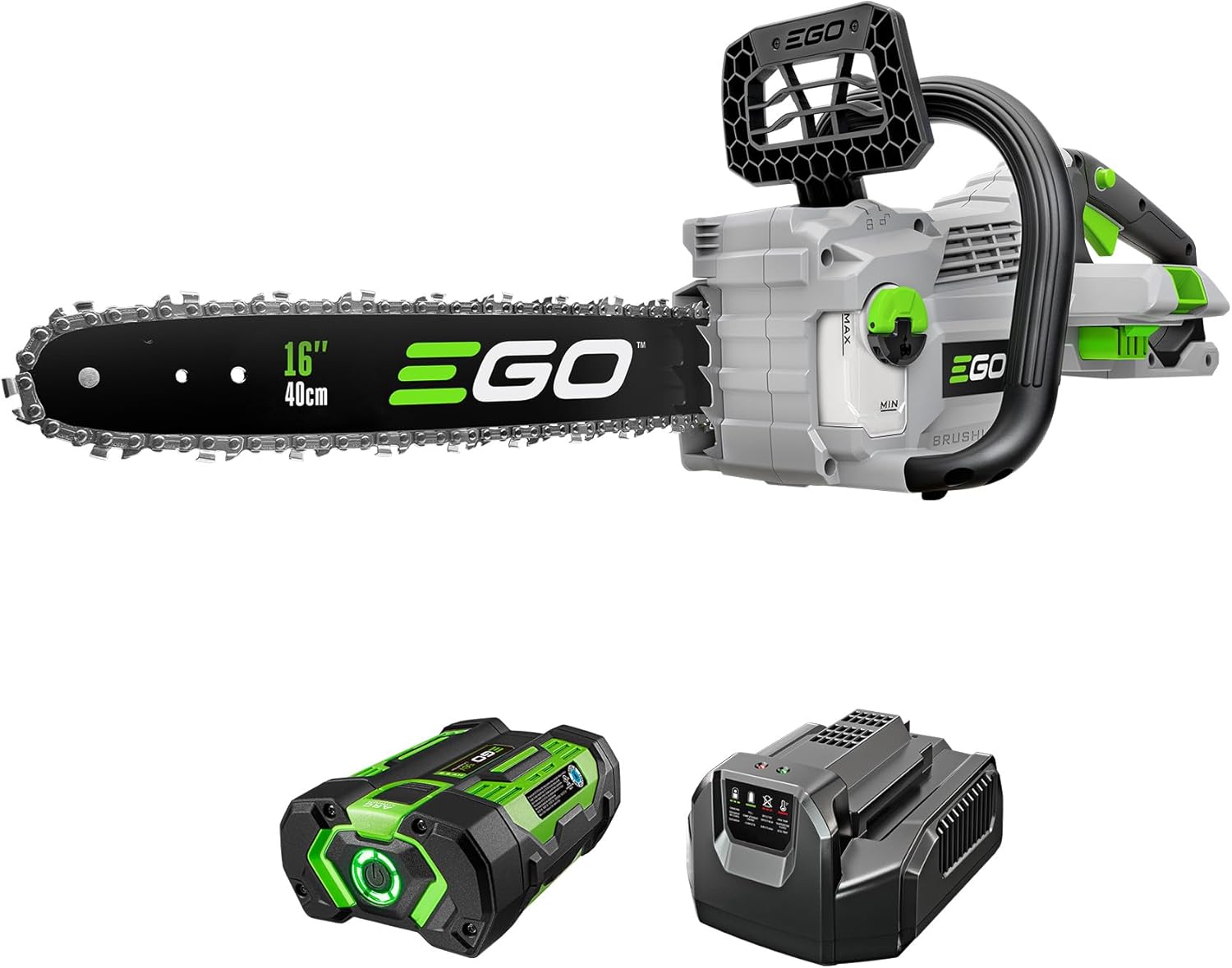
| Power Source | Battery Powered |
|---|---|
| Horsepower | 2.3 |
| Chain Length | 16 inches |
| Included Components | 2.5Ah Battery and Standard Charger |
| Chain Speed | 20 m/s |
The EGO POWER+ CS1611 is a battery-powered 16-inch chainsaw built to give prosumer-level cutting performance without gas. It uses a high-efficiency brushless motor rated as a 40CC equivalent and runs on the included 56V 2.5Ah ARC Lithium battery, which the manufacturer says delivers up to about 130 cuts through a 4×4 on a single charge. Notable features include a 20 m/s chain speed for efficient cuts, a tool-free chain-tensioning dial for quick on-the-job adjustments, automatic oiling with a spill-free reservoir, metal bucking spikes for secure cutting, and an IPX4 weather resistance rating. In real use this means quieter, low-maintenance operation compared with gas saws, fast setup between cuts, and enough runtime for routine property work like limb removal, small tree felling, and firewood prep. Limitations are battery runtime for very heavy or continuous commercial use and the saw’s 16-inch bar, which restricts maximum cut diameter compared with larger pro gas models.
Best for: Buyers wanting a low-maintenance, gas-free alternative that still delivers near-gas power for regular property maintenance, pruning, and medium-duty cutting tasks.
Less Ideal for: Users who need long uninterrupted runtime for commercial logging or must cut very large-diameter timber should consider larger gas or higher-capacity battery systems.
- Brushless motor with 40CC gas-equivalent power for strong cutting performance
- Includes 56V 2.5Ah battery and charger so it is ready to use out of the box
- Tool-free chain tensioning lets you adjust the chain quickly on site
- Automatic oiling with a spill-free reservoir keeps the chain lubricated during work
- IPX4 weather resistance and metal bucking spikes add durability and control in outdoor conditions
- 16-inch bar limits maximum cut diameter compared with larger pro chainsaws
- Runtime depends on battery capacity and may be insufficient for long, continuous heavy-duty jobs
Verdict: A ready-to-use cordless chainsaw that gives near-gas power and easy on-the-job adjustments, ideal for homeowners and pros doing regular medium-duty cutting.
DEWALT 20V MAX 12" Brushless Cordless Chainsaw Kit (DCCS621P1)

| Power Source | Battery Powered |
|---|---|
| Horsepower | 0.7 hp |
| Chain Length | 12 inches |
| Included Components | (1) DCCS621 | (1) Sheath | (1) DCB205 Battery and Charger |
The DEWALT 20V MAX 12" cordless chainsaw kit is a compact, battery-powered saw intended for cutting tree limbs, small logs, and light construction tasks. It uses a brushless motor for improved efficiency and claims up to 100 cuts per charge with the included 20V battery and charger, which makes it useful for weekend yard work or jobsite trimming without the fuss of gas maintenance. The low-kickback 12" bar and chain improve safety and make controlled cuts easier for less experienced users, while the lightweight design helps reduce fatigue during extended use. Being battery powered eliminates fumes, cold starts, and carburetor upkeep common to gas saws, but it is not aimed at heavy felling or large-diameter logs where longer runtime and more power are required. For buyers who want a tidy, lower-maintenance alternative to small gas saws, this kit balances portability, runtime, and practical cutting power in a familiar DEWALT platform.
Best for: Buyers who want a low-maintenance, portable chainsaw for routine yard work, limb trimming, and light construction cutting and who prioritize convenience and predictable runtime over maximum power.
Less Ideal for: Users who regularly need to fell large trees or process thick firewood should consider higher-power gas or larger battery saws designed for heavy-duty cutting.
- Brushless motor for better efficiency and longer runtime
- Includes battery and charger so it is ready to use out of the box
- Low-kickback 12" bar and chain for safer, more controlled cutting
- Compact, lightweight design reduces user fatigue and improves maneuverability
- 0.7 hp and a 12" chain limit suitability for heavy felling or very large logs
- Runtime depends on included battery capacity so extended work may require spare batteries
Verdict: A convenient, low-maintenance cordless option that delivers solid performance for routine yard and light construction cutting tasks.
WEN CP1518 18-Inch Corded Electric Chainsaw, 15-Amp

| Power Source | Corded Electric |
|---|
The WEN CP1518 is a straightforward corded electric chainsaw built for routine yard work like pruning, cutting storm-downed limbs, and bucking small trees. Its 15-amp motor spins the included 18-inch chain up to 41 feet per second, giving enough power for medium-duty work without gasoline or engine maintenance. Practical features make it easy to use: an auto-oiling system keeps the bar and chain lubricated during cutting, tool-free chain tensioning speeds up adjustments, and a kickback brake improves safety. The corded design removes runtime worry but does require access to a grounded outlet and a heavy-duty extension cord for remote areas. The saw’s lightweight layout reduces operator fatigue during longer sessions, though it will not match the portability or raw power of gas models for very large trees. For homeowners who want a low-maintenance, emission-free option for regular trimming and firewood prep, this saw balances performance and convenience effectively.
Best for: Homeowners who prioritize a low-maintenance, emission-free saw for regular pruning, limb removal, and small firewood cutting and who prefer the convenience of plug-in power over gas engines.
Less Ideal for: Landscapers or users who need portable, high-power performance for very large trees or remote job sites where cord access is impractical.
- Adequate 15-amp motor and 18-inch chain speed suitable for typical yard and small tree work
- Auto-oiling system reduces chain wear and maintenance needs
- Tool-free chain tensioning for quick adjustments without tools
- Kickback brake for improved user safety
- Lightweight design lowers operator fatigue during extended use
- Corded power requires a nearby outlet or long heavy-duty extension cord limiting remote use
- Not intended for heavy commercial logging or very large diameter trees
Verdict: A practical, low-maintenance corded chainsaw that delivers reliable medium-duty cutting power for routine homeowner yard work.
Milwaukee M18 FUEL 16 in. Cordless Chainsaw (Tool Only)

| Power Source | Battery Powered |
|---|---|
| Horsepower | 5.3 hp |
| Chain Length | 16 inches |
The Milwaukee M18 FUEL 16 in. cordless chainsaw is a tool-focused model that brings high power and convenient cordless operation to homeowner cutting tasks. It uses the M18 battery platform (battery and charger sold separately) and is built around a 16-inch Oregon bar and chain with an automatic oiler and variable speed trigger so you can control cut speed for different wood types. In practice this saw handles hardwood and mid-size logs quickly and is reported to deliver many cuts per charge with higher-capacity M18 packs. Notable features include the brushless FUEL motor for stronger acceleration and reduced maintenance compared with brushed motors, and a compact build that makes limbing and pruning easier in tight spaces. Important limitations are that the battery and charger are not included so you must already own or purchase compatible M18 batteries to realize the reliability benefits, and run time depends heavily on battery capacity. For homeowners who want near-professional cutting performance without gas fuss, this is a dependable cordless option when paired with a robust M18 battery.
Best for: Homeowners who prioritize a reliable, high-performance cordless saw and either already own M18 batteries or are prepared to invest in them for consistent, gas-free cutting around the yard.
Less Ideal for: Casual users who want an all-in-one package with battery and charger included or people needing very long continuous cutting sessions without spare batteries.
- Powerful brushless motor claims faster cuts than gas models for efficient work
- Automatic oiler maintains chain lubrication for consistent cutting performance
- Variable speed trigger gives precise control for pruning or larger cuts
- Compatible with the M18 battery ecosystem so higher-capacity packs boost runtime
- Battery and charger are not included so additional purchase is required
- Run time and cutting output depend on which M18 battery you use
Verdict: Choose this Milwaukee M18 FUEL 16 in. cordless chainsaw if you want near-professional cordless cutting performance and already use or plan to buy M18 batteries for dependable, gas-free operation.
SEESII 12-Inch Cordless Brushless Chainsaw

| Power Source | Battery Powered |
|---|---|
| Horsepower | 1200 watts |
| Chain Length | 12 inches |
| Included Components | chainsaw |
The SEESII 12-inch cordless chainsaw is designed for homeowners and pros who need portable, high-power cutting without a generator. It pairs a 1200W brushless motor with two 4.0Ah batteries to deliver sustained cutting power for pruning, cutting storm debris, and working on small to medium logs. The tool-free chain tension system and automatic lubrication reduce downtime and routine maintenance, and the 60 mL oil tank helps keep the chain running smoothly during longer sessions. Because it is cordless and relatively lightweight for its class, it is easy to move around the yard or use at remote sites where cords are impractical. Important limits to note are the 12-inch bar, which constrains maximum log diameter compared with full-size saws, and battery reliance for very long jobs where alternating charged packs or a backup power source is needed. For straightforward woodcutting tasks this model balances cutting performance, convenience, and low maintenance.
Best for: Buyers who prioritize efficient, portable wood cutting for yard cleanup, pruning, and medium DIY projects and want a low-maintenance cordless saw they can move around the property easily.
Less Ideal for: Contractors or users who regularly need to fell large trees or process large-diameter logs should choose a full-size gas or professional electric chainsaw instead.
- 1200W brushless motor provides strong, efficient cutting power for hardwood and storm debris
- Two 4.0Ah batteries extend runtime for longer jobs and include a built-in charge indicator
- Automatic oiling with a 60 mL tank reduces frequent stops for lubrication
- Tool-free chain tensioning simplifies on-the-job adjustments
- Cordless, relatively lightweight design improves portability and use at remote sites
- 12-inch bar limits the maximum log diameter compared with larger professional chainsaws
- Runtime depends on battery swapping for extended heavy-duty cutting sessions
Verdict: A powerful, low-maintenance cordless 12-inch saw that maximizes portable cutting performance for homeowners and weekend woodworkers.
Choosing the Right Chainsaw for $300: Key Factors to Consider
Cutting Power and Bar Length
Cutting power determines what the saw will handle without bogging down. For $300 saws you will usually see enough torque for medium limbs, pruning, and small log cutting. Bar length affects reach and cutting diameter; a longer bar cuts larger logs but adds weight and torque demand.
Match motor or engine horsepower to the tasks you expect. If you plan on regular firewood or clearing fallen trees, prioritize higher torque and a longer bar. For mostly pruning and small limbs, a shorter bar and lighter saw reduce fatigue and improve control.
Power Type and Runtime
Gas, corded electric, and battery saws behave differently in the yard. Gas models provide continuous runtime and higher peak torque but require fuel mixing and more maintenance. Corded electric saws offer consistent power with minimal upkeep but require access to an outlet and a heavy extension cord. Battery saws are quieter and easier to start and maintain, but runtime depends on battery capacity and battery replacement cost.
Consider how long typical jobs last. If you often cut for an hour or more away from power, gas or high-capacity battery options are preferable. For short pruning sessions around the house, battery or corded saws can be more convenient.
Safety Features and Controls
Safety features directly influence how confidently you can use a chainsaw. Look for chain brakes, low-kickback bars and chains, inertia-activated stops, and reliably placed throttles and hand guards. Anti-vibration systems and good grip surfaces reduce user fatigue and help maintain control during extended cuts.
Also evaluate ease of starting and kill-switch accessibility. A saw that is safer to manipulate will reduce the chance of accidents during routine garden tasks, especially when working on ladders or uneven ground.
Maintenance Needs and Parts Availability
Routine maintenance keeps a chainsaw running safely and efficiently. At the $300 level, factor in how easy it is to access the chain tensioner, air filter, spark plug or battery contacts, and whether common wear parts like the chain and bar are readily available. Tools with tool-less tensioning and accessible air filters speed routine upkeep.
Consider local service options and how easy it is to replace consumables. A machine that is cheaper to maintain over time often offers better long-term value than one with a lower purchase price but scarce parts.
Weight, Balance, and Ergonomics
Weight and balance determine how long you can use a saw without excessive fatigue. A well-balanced saw distributes weight between the front and rear handles, making directional cuts and limbing easier. Heavy saws can be fine for stationary cuts but become tiring for overhead or extended work.
Grip shape, handle vibration isolation, and control layout affect wrist comfort and cutting precision. Try to match saw weight to the typical job: lighter saws for pruning and elevated work, heavier units when the focus is on ground-level bucking.
Best Uses at the $300 Price Point
A chainsaw for $300 usually sits between homeowner convenience and semi-pro capability. In practice, these saws handle small to medium-diameter logs, routine pruning, storm cleanup, and splitting smaller rounds for firewood. Expect reliable cuts on 6 to 14 inch diameter wood depending on bar length and power type.
Choose a saw in this price range when you need more cutting capability than a casual trimmer but do not require full-time professional durability. The right pick here gives you a versatile tool that works across seasons without excessive upkeep.
- Pruning and limb removal
- Storm and storm-limb cleanup
- Cutting firewood from small to medium logs
- Property maintenance and fence post removal
Battery Vs Gas: Practical Tradeoffs
Battery saws are cleaner, quieter, and simple to maintain. They start instantly and are excellent for residential areas and short jobs. However, battery runtime limits continuous cutting and peak torque compared with gas models.
Gas saws deliver consistent high torque and long runtime for remote work but need fuel, mixing in two-stroke engines, and more frequent maintenance. Noise and emissions are higher, which matters on shared properties or in urban settings.
- Battery: low maintenance, quiet, limited continuous runtime
- Gas: high torque, long runtime, more upkeep and noise
Routine Maintenance Checklist
Maintaining a saw keeps it safe and extends service life. Basic tasks include keeping the chain sharp, checking and adjusting chain tension, cleaning or replacing the air filter, and confirming that safety systems operate correctly. For gas saws, check spark plugs and fuel lines regularly. For battery saws, inspect battery contacts and follow manufacturer storage guidance.
Adopt a pre-job inspection habit: check chain tension and lubrication, verify the chain brake, and ensure handles and guards are tight before each use. Simple upkeep reduces breakdowns and keeps cutting performance steady.
- Sharpen chain and check tension before extended use
- Keep bar and chain well-lubricated
- Clean air filter and replace spark plug as needed
- Store batteries at recommended charge levels in cool, dry places
Handling Tough Cuts and Kickback Prevention
Tough cuts and sudden pinching can cause kickback, a leading cause of chainsaw accidents. To avoid it, use correct cutting techniques: avoid the tip of the bar for pulling cuts, support the log to prevent pinching, and make relief cuts when necessary. A saw equipped with low-kickback chain and a reliable chain brake reduces risk during unexpected shifts.
Practice steady work posture and avoid overreaching. When working on unstable or elevated surfaces, consider using tools or helpers to stabilize the workpiece rather than relying solely on saw control.
- Avoid tip contact to reduce kickback risk
- Use chain brake and low-kickback chain features
- Stabilize the log before cutting to prevent pinching
Storage and Winter Care
Proper storage protects the saw during inactive seasons. Drain fuel from gas saws or run the engine until empty to prevent stale fuel issues. For battery saws, store batteries at partial charge in a cool dry place and avoid extreme temperatures. Clean the saw and coat exposed metal with a light protective oil to prevent rust during long storage.
When bringing a saw back into service after winter, recheck all safety systems, replace consumables as needed, and run a short test cut to ensure chain sharpness and lubrication.
- Empty or stabilize fuel for long-term storage
- Store batteries at recommended charge and temperature
- Clean and lightly oil exposed metal parts to prevent corrosion
How We Chose the Best Chainsaw for $300
We chose candidates that suit homeowners and property stewards looking to spend about $300 on a chainsaw. Primary filters included realistic cutting power for common tasks, long-term durability of engine or motor components, and core safety features that reduce user risk during routine yard work. We also assessed ease of maintenance and parts availability so the tool stays serviceable beyond the first season. Ergonomics and weight were measured for real-world handling during pruning and limb work. Finally, we checked fuel or battery runtime expectations depending on power type to ensure a single charge or tank could handle an average job. Excluded from consideration were heavy commercial-grade saws meant for full-time arborists and ultra-budget units that lack basic safety or durability. We prioritized models that deliver reliable performance for homeowners, small acreage owners, and gardeners who need a durable, maintainable tool at the $300 scale.
FAQ
Is a $300 chainsaw powerful enough for firewood?
Often, yes. Many chainsaws near $300 have enough torque and a suitable bar length to cut small to medium logs into firewood. Larger diameter trees or frequent heavy-duty cutting may require more powerful equipment or longer bars.
Which power type is best around $300 for homeowners?
It depends on your typical jobs. Battery saws offer low maintenance and quiet operation for short jobs, while gas saws provide longer continuous runtime and higher peak torque for remote or longer cutting sessions.
How important is bar length at this price point?
Bar length matters because it limits the maximum log diameter you can cut without additional passes. Shorter bars are lighter and better for pruning, while longer bars increase cutting capacity but add weight and torque demands.
What maintenance should I expect with a $300 chainsaw?
Expect routine sharpening, chain tension checks, lubrication, and filter or battery care. Gas models need occasional spark plug and fuel-system attention. Choosing a model with easy access to wear parts reduces upkeep time.
Can I reduce kickback risk with a midrange saw?
Yes. Look for low-kickback chains, effective chain brakes, and good anti-vibration systems. Proper cutting technique and good log support are also essential in lowering kickback risk.
Final Verdict
At the $300 level you can get a chainsaw that reliably handles most homeowner tasks without the cost and complexity of professional gear. Prioritize cutting power and durability if you plan on regular firewood or storm cleanup, or favor lighter weight and low maintenance if pruning and occasional jobs are the norm. Balance the tradeoffs between runtime, upkeep, and ergonomics when choosing. Focus on the evaluation factors covered above to pick the saw that matches the specific types of cutting you do most often.
