

Note: This article contains affiliate links. If you click on these links and make a purchase, I may earn a small commission at no extra cost to you. This helps support my research and content. Read my full affiliate disclosure here.
Picking the right chainsaw for beginner use changes how quickly you gain confidence and how safely you work around the yard. A model with approachable power, clear safety features, and ergonomic handling can turn routine pruning, storm cleanup, and small firewood cutting into straightforward tasks. This guide covers six top choices shortlisted for new users and explains the practical criteria we used to evaluate them, including safety systems, ease of handling, and maintenance demands. Read on to understand which traits matter most for a beginner and why they affect performance in real garden and yard conditions.
Top Picks at a Glance
| Best Overall The best all-around choice for most situations | DEWALT 20V MAX 12" Cordless Brushless Chainsaw Kit (with Battery and Charger) |  |
| Best Value The sweet spot between price and what you get | Supstable Mini Cordless Chainsaw with 6" and 8" Bars, 1000W Brushless, Dual Batteries |  |
| Best Budget The cheapest option that still gets the job done reliably | Bilijamy 6" Cordless Mini Chainsaw with 2.0Ah Battery |  |
| Highest Rated A top-rated pick with lots of positive feedback | LCOIEDU 6" Cordless Mini Chainsaw with Two Batteries |  |
| Most Popular A crowd favorite that many people choose with confidence | Seesii M6 Lite 6" Cordless Mini Chainsaw with Two Batteries |  |
| Best Seller A high-volume bestseller chosen again and again | SEESII 12-Inch Cordless Brushless Chainsaw (2×4.0Ah Batteries) |  |
DEWALT 20V MAX 12" Cordless Brushless Chainsaw Kit (with Battery and Charger)

| Power Source | Battery Powered |
|---|---|
| Horsepower | 0.7 hp |
| Chain Length | 12 inches |
| Included Components | Chainsaw, sheath, battery and charger |
The DEWALT 20V MAX 12" Cordless Chainsaw Kit is a compact, battery-powered saw built for homeowner and light professional tasks like pruning limbs, cutting small trees, and on-site construction cuts. It uses a high-efficiency brushless motor and the included 20V battery and charger to deliver up to about 100 cuts per charge, so you can finish routine yard work without fumes or gas maintenance. The 12-inch low-kickback bar and chain help reduce kickback risk and make controlled cuts easier for less-experienced users, while the lightweight design improves maneuverability when working overhead or in tight spots. Practical benefits include quieter operation, minimal routine maintenance compared with gas saws, and the convenience of a single-battery system that fits other 20V tools. Limitations are that the 12-inch bar and modest 0.7 hp output limit this saw to small- to medium-diameter wood and repeated heavy-duty felling will quickly drain the battery; users who need long continuous runtime or large-tree cutting should consider larger bar lengths or gas alternatives.
Best for: Someone looking for a fuss-free, easy-to-handle chainsaw for regular yard maintenance and occasional construction cuts who values low maintenance and quieter operation.
Less Ideal for: People who need a saw for large-tree felling, heavy commercial workloads, or long continuous cutting sessions should choose a larger bar or gas-powered saw instead.
- Brushless 20V motor for improved runtime and lower maintenance
- Low-kickback 12" bar and chain for more controlled, beginner-friendly cuts
- Lightweight, compact design that is easier to handle and maneuver
- Includes battery and charger so the kit is ready to use out of the box
- 12" bar and 0.7 hp rating limit it to small- and medium-diameter cutting
- Battery runtime can require recharging or swapping for extended jobs
Verdict: A lightweight, low-maintenance cordless 12" chainsaw that makes routine yard and light construction cutting safer and easier for beginners.
Supstable Mini Cordless Chainsaw with 6" and 8" Bars, 1000W Brushless, Dual Batteries
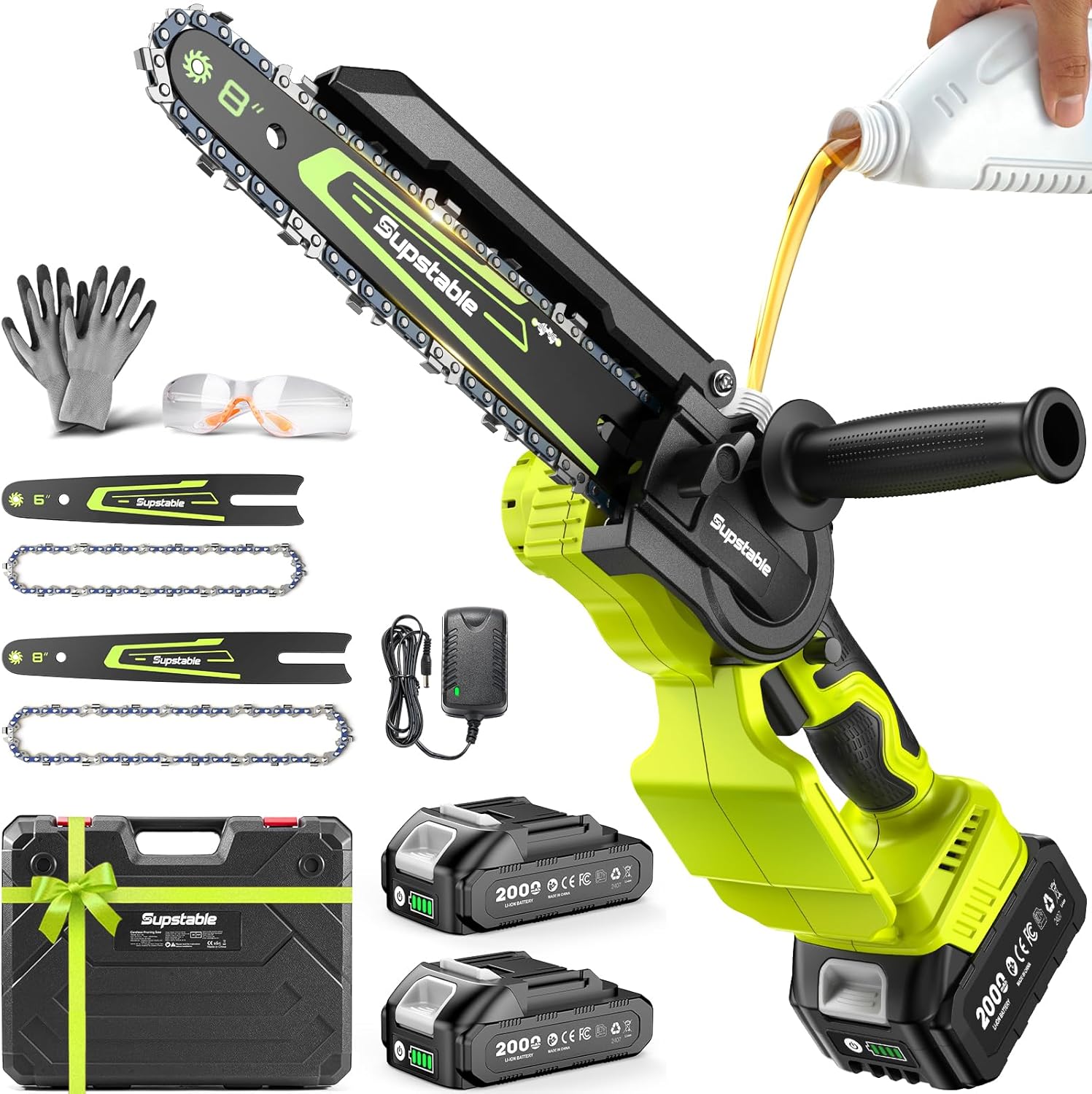
| Power Source | Battery Powered |
|---|---|
| Horsepower | 1000 watts |
| Chain Speed | 32ft/s |
| Included Components | 2 batteries and charger; 6" & 8" guide bars; gloves and goggles |
The Supstable mini cordless chainsaw is a lightweight, user-friendly kit designed for routine yard work and beginner users. It accepts interchangeable 6" and 8" guide bars so you can switch between precise pruning and larger branch or small firewood cuts. Its 1000W brushless motor delivers relatively high torque for a compact tool, and the package includes two 2.0Ah batteries to extend run time for multiple small jobs without frequent recharging. Built-in conveniences include an automatic oiling reservoir to keep the chain lubricated, a safety lock and debris baffle, plus a non-slip auxiliary handle and included gloves and goggles for safer operation. The saw ships in a plastic suitcase for organized storage. Limitations to expect are the short bar length and modest battery capacity compared with full-size saws, so it is not suitable for heavy felling or large-diameter logs and will require recharging for extended cutting sessions. For straightforward pruning, trimming, and light firewood preparation this kit balances power, portability, and basic safety features well for new users.
Best for: A homeowner or beginner gardener who prioritizes a compact, easy-to-handle tool for regular pruning, branch trimming, and light firewood tasks and values safety and portability.
Less Ideal for: Professionals, heavy-duty landscapers, or anyone needing to cut large-diameter trees or long continuous sessions should choose a full-size gas or higher-capacity battery chainsaw instead.
- Two interchangeable guide bars (6" and 8") for both precise pruning and larger branch cuts
- 1000W brushless motor for stronger, smoother cutting and longer motor life
- Includes two rechargeable batteries to extend usable runtime between charges
- Auto-oiler keeps the chain lubricated for smoother cutting and lower maintenance
- Safety features and accessories included: safety lock, gloves, goggles, debris baffle, and a storage suitcase
- Bar lengths limit the saw to pruning, limb work, and small firewood rather than large tree felling
- Battery capacity is modest so continuous heavy cutting will require spare batteries or breaks to recharge
Verdict: A compact, beginner-friendly cordless kit that gives versatile pruning and light cutting power with convenient safety and auto-oiling features.
Bilijamy 6" Cordless Mini Chainsaw with 2.0Ah Battery

| Power Source | Battery Powered |
|---|---|
| Horsepower | 440 watts |
| Included Components | Battery, Chain, Guide Bar, Charger, Protective Cover |
This Bilijamy cordless mini chainsaw is built for light yard work and beginners who need a portable tool for pruning branches, small tree work, and DIY wood cutting. The 440W motor and 6-inch bar deliver quick cuts through limbs up to about 5 inches thick, while the compact design and 1.3 kg weight make one-handed use and overhead pruning realistic for many users. It includes a 2000mAh battery that the listing claims runs 30–40 minutes per charge and a fast charger that tops the battery in about an hour, so short jobs around the yard can be completed without waiting long to recharge. Practical touches include tool-free chain tensioning, an automatic lubrication reservoir to reduce wear, and a 5-layer safety system with a lock switch, front guard, gloves, and goggles. Limitations to note: this is not a full-size chainsaw so it will struggle on large trunks or continuous heavy cutting, and actual runtime will vary with cut thickness and user technique. For basic pruning and light woodworking it is convenient and easy to handle for new users.
Best for: Buyers who want an inexpensive, easy-to-use cordless chainsaw for occasional pruning, balcony or small-yard work, and basic DIY projects without the complexity of a full-size saw.
Less Ideal for: Not a good choice for heavy logging, felling large trees, or contractors who need long continuous runtime and higher cutting capacity.
- Lightweight, portable design suitable for one-handed pruning and overhead work
- Fast-charging 2000mAh battery that claims 30–40 minutes runtime for short jobs
- Automatic chain lubrication and tool-free tensioning simplify maintenance
- Includes safety accessories (gloves and goggles) and a safety lock to reduce accidental starts
- 6-inch bar and compact motor are intended only for small branches and light-duty cutting
- Runtime and cutting claims are manufacturer estimates and will vary with material and usage
Verdict: A compact, beginner-friendly cordless chainsaw that makes quick pruning and light woodcutting easy and affordable.
LCOIEDU 6" Cordless Mini Chainsaw with Two Batteries

| Power Source | Battery Powered |
|---|---|
| Horsepower | 880 watts |
| Chain Speed | 29ft/s |
| Chain Length | 6 inches |
This 6-inch cordless mini chainsaw is aimed at homeowners who need a reliable, easy-to-use tool for pruning and small cutting jobs. It arrives ready to use and includes two lithium batteries and a charger so you can work longer without recharging between short tasks. The 880-watt motor and hardened steel chain deliver quick cuts at a published chain speed, making it suitable for trimming branches and cutting wood up to about 6 inches thick. Safety features such as a two-step start (safety lock plus trigger) and a wraparound metal bumper add protection during use. The saw is lightweight and ergonomically shaped for one-handed operation, which helps reduce fatigue during repeated small cuts. Important limitations are its small 6-inch bar, which makes it unsuitable for heavy logging or large-diameter trees, and the real-world runtime may vary with cut type and user technique. For beginners focused on straightforward pruning tasks, this model offers a convenient, safer entry point into power chainsaws.
Best for: A practical choice for beginners or homeowners who prioritize dependable, straightforward pruning and small woodcutting with safety features and included spare batteries.
Less Ideal for: Not a good fit for users who need a professional saw for frequent heavy-duty cutting, large trees, or long continuous runs without swapping batteries.
- Comes with two lithium batteries and a charger for extended runtime between charges.
- Powerful 880-watt motor and hardened steel chain for effective cutting of branches up to 6 inches.
- Two-step safety start and wraparound metal bumper improve safe handling for inexperienced users.
- Lightweight ergonomic design enables one-handed operation and reduces user fatigue.
- 6-inch bar is limited to small branches and logs and not suitable for large-diameter cutting.
- Manufacturer runtime claims may vary in real-world conditions depending on cut density and operator technique.
Verdict: A dependable, beginner-friendly cordless mini chainsaw that combines 880 watts of power with extra batteries and safety features for reliable small-tree pruning and yard maintenance.
Seesii M6 Lite 6" Cordless Mini Chainsaw with Two Batteries

| Power Source | Battery Powered |
|---|---|
| Horsepower | 900 watts |
| Chain Speed | 29ft/s |
| Chain Length | 6 inches |
The Seesii M6 Lite is a one-handed cordless mini chainsaw aimed at homeowners who need an easy-to-use tool for pruning, branch trimming, and small timber cuts. It pairs a 900 W motor with a 6-inch chain and claims chain speeds around 29 ft/s, which makes quick work of limbs and logs up to about 15 cm thick in short bursts. The package arrives ready to use with two 21V 2000 mAh batteries, a charger, spare chain, basic tools, gloves, and a chain guard for immediate jobs without extra purchases. Practical benefits include low weight for reduced fatigue, a double safety lock to prevent accidental starts, and a compact form that is beginner-friendly and suitable for one-handed operation. Important limitations are the short bar length, which restricts it to light yard work rather than felling large trees, and the reliance on small battery packs that may require recharging for longer sessions. Buyers should also follow safety guidance closely since powerful cutting in a compact tool increases the need for stable handling and protective gear.
Best for: A cautious beginner or homeowner who wants an easy, low-fatigue cordless saw for routine pruning and small cutting jobs and values a complete out-of-the-box kit.
Less Ideal for: Landscapers, heavy-duty users, or anyone who needs to cut large trees or extended logs should choose a full-size chainsaw with a longer bar and higher-capacity power system.
- Ready-to-use kit with two batteries, charger, spare chain and basic tools
- Lightweight one-handed design reduces user fatigue and helps beginners handle trimming tasks
- Powerful 900 W motor and ~29 ft/s chain speed for efficient cuts on small branches and logs
- 6-inch bar limits use to pruning and small wood rather than large tree work
- Uses small-capacity batteries that may need frequent recharging during extended jobs
Verdict: A compact, beginner-friendly cordless mini chainsaw that delivers convenient, low-fatigue pruning performance straight out of the box.
SEESII 12-Inch Cordless Brushless Chainsaw (2×4.0Ah Batteries)

| Power Source | Battery Powered |
|---|---|
| Horsepower | 1200 watts |
| Chain Length | 12 inches |
| Included Components | chainsaw |
| Item Highlight | 2 x 4.0Ah Battery, Auto Oiling |
This SEESII 12-inch cordless chainsaw is aimed at homeowners who need a safer, easier-to-use alternative to gas saws. It runs on two 4.0Ah batteries that provide extended runtime for pruning, cutting storm debris, and small logs without the hassle of fuel. The 1200W brushless motor delivers strong cutting performance while the automatic lubrication system keeps the chain running smoothly and reduces manual maintenance. Tool-free chain tensioning and a built-in battery indicator make setup and monitoring straightforward for beginners. At roughly 12 pounds it is reasonably portable for rooftop or property work and the cordless design lets you use it away from outlets. Important limitations are that the 12-inch bar is not intended for very large trees or professional logging and battery runtime will vary with heavy cuts, so you may need to swap batteries for long sessions. Safety-conscious users should still follow standard PPE and chain-saw safety practices.
Best for: Homeowners or weekend gardeners who want a cordless, easy-to-use saw for routine pruning, storm cleanup, and small lumber tasks and who prioritize straightforward setup and lower maintenance.
Less Ideal for: Arborists or users who regularly cut large trees or need a professional-grade saw with longer continuous runtime should consider larger gas or professional cordless models.
- Brushless 1200W motor for strong, efficient cutting
- Two 4.0Ah batteries provide longer runtime and a visible battery indicator
- Automatic oiling reduces maintenance and keeps the chain lubricated
- Tool-free chain tensioning simplifies setup and adjustments
- 12-inch bar is not suited for large-diameter trees or professional forestry work
Verdict: A beginner-friendly cordless chainsaw that balances strong cutting power and low-maintenance features for safe, dependable yard work.
Choosing the Right Chainsaw for Beginner: Key Factors to Consider
Safety Features and Kickback Protection
Beginner chainsaw buyers should assess built-in safety systems carefully because these directly reduce the risk of injury. Look for low-kickback bars and chains, an inertia or active chain brake, and a clearly positioned throttle interlock. These features help stop the chain quickly if the saw jerks or you lose control.
Additional safety elements such as a chain catcher, hand guards, and wraparound front handles improve handling during awkward cuts. Controls that are easy to reach while maintaining a two-handed grip encourage safer habits. Personal protective equipment is still essential even with advanced safety features.
Weight, Balance, and Ergonomics
A lighter chainsaw is easier to hold for extended periods and helps a beginner maintain proper posture and control. But overall balance matters as much as weight: a well-balanced unit reduces wrist strain and makes horizontal and overhead cuts feel more stable.
Look for comfortable, non-slip handles and vibration damping to limit hand fatigue. Consider how you will use the saw most often-pruning, limbing, or cutting small logs-and choose a size and grip orientation that suits those tasks. Good ergonomics improve accuracy and reduce the likelihood of mishandling.
Power Output Relative to Intended Tasks
Match the saw's power to the jobs you expect to do. Beginners rarely need high-displacement engines or very long guide bars. Too much power makes the tool harder to control while too little power causes the saw to bog down on thicker wood, creating frustrating or unsafe situations.
For yard tasks, shorter bars and modest engine or motor output provide steady cutting without overwhelming the operator. Consider future needs as well, but prioritize a model that delivers consistent, controllable performance at the scale of home use.
Starting System and Reliability
Difficulty starting a saw adds stress and can encourage unsafe shortcuts. For gas models, easy-start systems, primer bulbs, and simplified choke controls reduce failed starts. Battery-powered options remove pull-start issues but require attention to battery capacity and charge times.
Reliability in routine starting and stopping means fewer surprises in the field and more predictable practice sessions while learning. Check that maintenance access points are straightforward so that new owners can keep the saw working properly without complex tools.
Chain Tensioning and Routine Maintenance
Chain condition and tension directly affect cutting performance and safety. Look for models with tool-less chain tensioning or tensioning mechanisms that are simple to reach. Easy access to the air filter and spark plug helps with regular upkeep and keeps small problems from becoming safety hazards.
Maintenance intervals and parts availability matter for long-term ownership. A beginner should be able to perform basic tasks like chain sharpening, cleaning, and tension adjustment without specialized equipment or advanced mechanical skills.
Noise, Emissions, and Workspace Considerations
Noise level influences how early or late you can operate the saw in residential areas and affects hearing protection needs. Battery-electric chainsaws are typically quieter and produce no direct emissions, which is important for enclosed or sensitive environments.
If you will be working near neighbors or in a small backyard, consider the impact of engine noise and exhaust. Emissions also affect maintenance and storage choices; electric models reduce the need for fuel handling but require battery management.
Gas Vs Battery for New Users
Both fuel types are used in home chainsaws, but they behave differently in everyday garden work. Gas saws generally deliver longer run times and stronger torque at low speeds, which can help with dense or knotty wood. They require fuel mixing knowledge for two-stroke engines, regular carburetor and spark plug attention, and accept the vibration and noise that comes with combustion.
Battery-powered saws remove pull-starting and fuel handling, offering quiet operation and simplified startup. They are lighter and easier to maintain, though runtime is limited by battery capacity. For a beginner who values low maintenance and practice time without engine fiddling, electric models are often a more forgiving choice.
- Gas: more continuous power, requires fuel and more maintenance
- Battery: quieter, easier start, limited by battery life
Sizing Guide: Bar Length and Task Match
Bar length determines the maximum log diameter you can cut in a single pass and affects the saw's balance. For pruning and small limb removal, 12 to 14-inch bars are usually sufficient. For cutting small firewood or larger branches, 16 to 18-inch bars provide extra reach without becoming unwieldy for a beginner.
A longer bar increases torque demand and weight at the nose, which can make kickback more severe and control harder for a novice. Start with the shortest bar that comfortably handles your typical tasks and only step up in length if you regularly encounter larger pieces of wood.
- Short bars improve control and reduce kickback risk
- Larger bars handle bigger logs but increase weight and torque
Basic Maintenance Tasks Every Beginner Should Master
Simple maintenance keeps the saw cutting well and reduces safety risks. Learn to check and adjust chain tension before each session, sharpen or replace the chain when it dulls, clean or replace the air filter, and inspect the bar for wear. These tasks are straightforward and prevent many common cutting problems.
Also establish a routine for checking chain lubrication and verifying that safety features operate correctly. Keeping a small kit with basic files, a scrench or screwdriver, and a bar wrench will make routine upkeep faster and encourage safe practices.
- Check and adjust chain tension before use
- Keep the chain sharp and properly lubricated
- Inspect safety systems and clean air filters regularly
Start-Up and Cutting Technique Tips
Practice starting, idling, and stopping in an open area before attempting cuts near structures or people. Establish a firm two-handed grip with thumbs wrapped around the handles and stand to one side of the cutting path. Let the saw do the work: apply steady pressure and avoid forcing the bar through the wood.
When cutting limbs, use controlled notches to prevent pinching. Be aware of the nose of the bar to avoid contact that can cause kickback. Slow down and reassess if a cut binds or the saw behaves unpredictably.
- Always use a two-handed grip and maintain stable footing
- Avoid cutting with the bar nose to reduce kickback
- Make relief cuts to prevent pinching on larger branches
Protective Gear and Safe Work Practices
Safety gear is non-negotiable. Use eye protection, hearing protection, cut-resistant gloves, and leg protection such as chaps rated for chainsaw use. A well-fitted helmet with a face shield adds protection when working near falling limbs. Proper footwear with good traction prevents slips while operating the saw.
Plan each cut, keep bystanders clear, and never operate a chainsaw when tired or under the influence of substances that impair judgment. Periodic short breaks reduce fatigue and help maintain safe handling throughout a job.
- Essential PPE: eye, ear, hand, and leg protection
- Keep a clear work zone and avoid working alone on higher-risk tasks
How We Chose the Best Chainsaw for Beginner
We focused on attributes that matter most to someone learning chainsaw use rather than professional-spec features. Selection started with user-focused safety elements such as chain brakes, low-kickback bars and chains, and accessible throttle lockouts. We prioritized models with predictable, manageable power output and lighter weight to reduce fatigue and improve control during common homeowner tasks. Ease of starting and routine maintenance were key filters: reliable starting systems, simple chain tensioning, and easy air filter and spark plug access reduce the learning curve. Ergonomics and vibration control were evaluated because fatigue and poor grip increase risk. We also considered run time and fuel/ battery features that affect how long a beginner can practice without interruptions. We excluded heavy-duty professional saws, high-displacement engines, and commercial attachments that require advanced skills. Poorly documented safety features or inconsistent reliability reports were also excluded. The final list reflects tools that balance safety, manageable power, and low maintenance burden for new users.
FAQ
What size chainsaw is best for a beginner who only prunes trees and trims branches?
For pruning and general trimming, a shorter bar around 12 to 14 inches is usually best. It offers better control, lighter weight, and reduced kickback risk while covering most small- to medium-diameter branches.
Are battery chainsaws powerful enough for typical homeowner jobs?
Battery chainsaws can be powerful enough for most homeowner tasks such as pruning, limbing, and cutting small firewood. Their runtime depends on battery capacity, so choose a model with enough battery life for your expected session lengths.
How often should I sharpen the chain when learning to use a chainsaw?
Sharpen the chain whenever cutting performance drops noticeably: slowing, excessive smoke, or the need to force the saw. For regular homeowner use, sharpening every few sessions is common. Frequent sharpening preserves control and reduces strain on the saw and operator.
What basic safety checks should I perform before each use?
Before each session, check chain tension and lubrication, verify the chain brake and throttle interlock function, inspect the chain for damage, and confirm that handles and fasteners are secure. Also ensure you have proper personal protective equipment on.
Can a beginner maintain a gas chainsaw without mechanical experience?
Yes, a beginner can handle basic gas saw maintenance such as spark plug checks, air filter cleaning, chain tensioning, and routine sharpening. More complex carburetor adjustments or engine repairs may require professional assistance or a service center.
How can I reduce the risk of kickback while learning?
Use low-kickback bars and chains, avoid contacting the bar nose with wood, maintain proper stance and grip, and cut at a controlled pace. Training on basic cutting techniques and starting with shorter bars helps reduce kickback risk for new users.
Final Verdict
Prioritize safety features, manageable power, and easy maintenance when picking a chainsaw for beginner use. The right balance of weight, ergonomics, and a forgiving starting system makes learning faster and reduces injury risk. Tradeoffs are inevitable: lighter battery models simplify handling but limit runtime, while gas saws extend work time at the cost of more maintenance. Choose a saw that matches the scale of the tasks you expect to do and commit to basic maintenance and PPE. That approach lets you focus on developing safe technique and gaining confidence in the yard.
