

Note: This article contains affiliate links. If you click on these links and make a purchase, I may earn a small commission at no extra cost to you. This helps support my research and content. Read my full affiliate disclosure here.
If you cut and season your own firewood, the right chainsaw changes how much work you can do in an afternoon. A chainsaw for firewood must pair reliable cutting power with controls and safety features you can use for long sessions near the woodpile. This guide shortlists six top options suited to homeowners and woodcutters focused on felling small trees, bucking rounds, and cutting split-ready lengths. We evaluated each option on factors that matter in the yard: true cutting performance, fuel or battery runtime, ease of maintenance in the field, and rider comfort for repetitive cuts. Below are our top picks and the buying guidance to match a saw to your woodpile and workflow.
Top Picks at a Glance
| Best Overall The best all-around choice for most situations | Husqvarna 450 Rancher 20" Gas Chainsaw, 50.2 cc X-Torq Engine |  |
| Best Quality Built to a higher standard if you want something more solid | Husqvarna 460 Rancher 24-inch Gas Chainsaw |  |
| Best Value The sweet spot between price and what you get | EGO POWER+ 16" Battery Chainsaw with 2.5Ah Battery and Charger (CS1611) |  |
| Best Budget The cheapest option that still gets the job done reliably | VEVOR 62cc Gas-Powered Chainsaw, 20-inch Bar |  |
| Highest Rated A top-rated pick with lots of positive feedback | Oregon CS1500 15A Corded Electric Chainsaw with PowerSharp Self-Sharpening, 18-Inch Bar |  |
| Most Popular A crowd favorite that many people choose with confidence | SEESII 16- and 12-Inch Cordless Electric Chainsaw with Dual 5.0Ah Batteries |  |
Husqvarna 450 Rancher 20" Gas Chainsaw, 50.2 cc X-Torq Engine

| Power Source | Gas Powered |
|---|---|
| Horsepower | 3.2 hp |
| Chain Length | 20 inches |
| Included Components | Gas Chainsaw, Owners Manual |
| Manufacturer Warranty Description | 2 years |
The Husqvarna 450 Rancher is a gas-powered, all-purpose chainsaw built for cutting firewood, pruning, and yard cleanup where consistent power is needed. It uses a 50.2-cc X-Torq two-stroke engine that delivers about 3.2 horsepower and supports bar lengths up to 20 inches, so it handles full-size rounds and mid-sized logs without bogging. Practical features include Smart Start and an air purge for easier starting, Air Injection centrifugal pre-cleaning to reduce filter maintenance, LowVib vibration reduction for longer sessions, and an ergonomic rear handle for control during repetitive cuts. The saw is intended for users who want professional-style performance without stepping up to heavier pro models; it balances power, maneuverability, and serviceability. Expect routine two-stroke maintenance, fuel mixing, and slightly higher noise and vibration compared with electric alternatives. The 20-inch bar option gives good cutting reach but adds weight during extended overhead or one-handed tasks, so it is best used for planned firewood work and limb cutting rather than light trimming around the yard.
Best for: Buyers who need a capable, gas-powered saw for regular firewood cutting and heavier yard work and who prioritize cutting performance and durability over minimal maintenance. Ideal for homeowners who split and season their own firewood or small-scale landowners who want near-professional capability.
Less Ideal for: People who prefer low-maintenance or quiet electric tools or those who only need a lightweight saw for occasional small pruning tasks.
- Powerful 50.2-cc X-Torq engine suitable for cutting firewood and larger limbs
- Supports up to a 20-inch bar for longer cuts and faster work on logs
- Smart Start and air purge make cold starts and re-starts easier in the field
- Air Injection centrifugal system reduces debris reaching the air filter, lowering maintenance frequency
- LowVib technology and ergonomic handle improve comfort during extended use
- Requires regular two-stroke fuel mixing and routine maintenance typical of gas saws
- Heavier than smaller homeowner saws which can increase fatigue during long sessions
Verdict: Choose the 450 Rancher if you want a robust, gas-powered saw that reliably cuts firewood and mid-size logs while offering pro-level starting, airflow, and vibration features.
Husqvarna 460 Rancher 24-inch Gas Chainsaw

| Power Source | Gas Powered |
|---|---|
| Horsepower | 3.6 |
| Chain Speed | 24 inch |
| Manufacturer Warranty Description | 2 years |
The Husqvarna 460 Rancher is built for heavy-duty firewood cutting and property maintenance where power and durability matter. It uses a 60.3-cc, 3.6-HP X-Torq 2-stroke engine with Smart Start and Air Injection to make starting easier and reduce debris intake for longer engine life. The saw accepts bars up to 24 inches and includes a side-mounted tensioner, inertia chain brake, and LowVib vibration reduction to improve control during long sessions. Typical use will be bucking large logs, cutting standing timber, and preparing firewood on acreage; the 24-inch bar and robust engine let you tackle thick sections in fewer passes. Practical benefits include reliable torque at low RPMs for heavy cuts, accessible maintenance points, and a supplied bar, chain, and basic tools to get started. Important limitations are its weight and fuel dependence compared with lighter battery or electric models, and a 24-inch bar can be overkill for small-diameter firewood or homeowners who prefer quieter, lower-maintenance options.
Best for: Buyers who prioritize raw cutting performance and need a workhorse saw for large firewood, farm, or acreage jobs where power and long bar length are essential.
Less Ideal for: Casual users with small yards, frequent neighbors, or those who prefer low-noise, low-maintenance battery or corded electric saws should consider smaller or electric models instead.
- High-power 60.3-cc X-Torq engine delivers strong torque for large, stubborn logs
- Accepts up to a 24-inch bar suitable for big firewood and land-clearing tasks
- Air Injection centrifugal cleaning reduces debris to prolong air filter and engine life
- Smart Start and side-mounted chain tensioner simplify starting and on-the-job adjustments
- LowVib and ergonomic front handle improve comfort during extended cutting sessions
- Heavier and more physically demanding than battery or electric alternatives
- Requires regular fuel mixing and engine maintenance typical of gas two-stroke saws
Verdict: Choose the Husqvarna 460 Rancher when you need a powerful, gas-driven chainsaw that makes quick work of large firewood and heavy-duty cutting tasks.
EGO POWER+ 16" Battery Chainsaw with 2.5Ah Battery and Charger (CS1611)
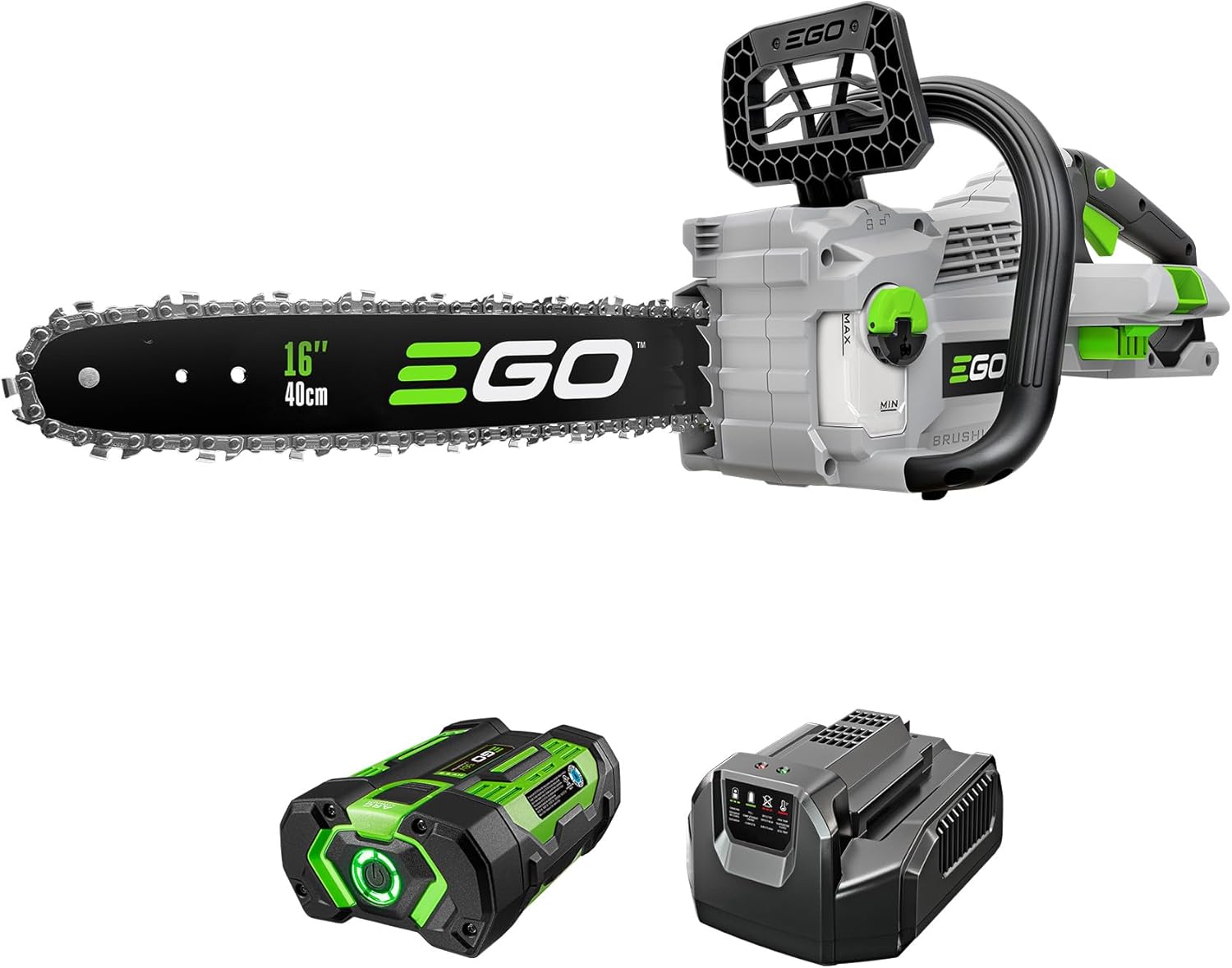
| Power Source | Battery Powered |
|---|---|
| Horsepower | 2.3 |
| Chain Length | 16 inches |
The EGO POWER+ 16" CS1611 is a battery-powered chainsaw designed to give gas-like performance without fumes or a cord. It uses a brushless motor and the included 2.5Ah 56V ARC Lithium battery to deliver the equivalent of a 40CC gas saw, with a 16-inch bar and a chain speed up to 20 m/s for efficient cuts. Typical use is cutting firewood, limbing, and occasional property maintenance; the tool-free chain tensioning and automatic oiling make set up and repeated cuts faster and less fussy. Practical features include a low-kickback chain with a visible brake indicator and metal bucking spikes for control while cutting rounds. Battery run time is adequate for short to medium sessions—EGO quotes up to about 130 cuts on a 4×4 with the included battery—so heavier firewood work benefits from carrying a larger-capacity battery. The saw is weather-resistant and quieter than gas models, but sustained heavy-duty cutting will require higher-capacity batteries or more frequent recharging compared with gas chainsaws.
Best for: Buyers who want a low-maintenance, quieter alternative to gas for cutting firewood and light to moderate yard jobs and who prefer cordless convenience over handling fuel.
Less Ideal for: Users who regularly cut very large quantities of firewood or very large diameter logs and need uninterrupted long runtime should consider heavier-duty gas saws or larger-capacity battery systems.
- Brushless motor that matches roughly a 40CC gas saw for strong cutting performance
- Includes 56V 2.5Ah battery and charger so it is ready to use out of the box
- Tool-free chain tensioning and automatic oiling speed maintenance between cuts
- Low kickback chain with visible brake indicator and metal bucking spikes for better control
- IPX4 weather resistance for use in damp conditions
- Included 2.5Ah battery limits continuous run time for long firewood sessions
- 16-inch bar is versatile but may be slow on very large diameter rounds
Verdict: A convenient, gas-equivalent cordless chainsaw ready to use out of the box that is ideal for homeowners cutting typical firewood and yard debris.
VEVOR 62cc Gas-Powered Chainsaw, 20-inch Bar

| Horsepower | 3.8 hp |
|---|---|
| Power Source | Corded Electric |
| Chain Length | 20 inches |
| Model Number | CN-62G |
The VEVOR 62cc gas chainsaw is a budget-minded, high-displacement saw built for cutting large logs and heavy pruning. With a 3.8 hp two-stroke engine and a 20-inch guide bar it can tackle trunks and large firewood rounds up to about 18 inches in diameter. Practical features include cold and hot start controls, an extended pull rope to ease starting, a visible chain adjuster for quick tensioning, and an emergency stop lever and guard to help control kickback and debris. A generous 550 ml fuel tank and 260 ml chain oil tank let you work longer between refills. The reinforced PA6 composite body is marketed as impact and heat resistant, which should hold up under regular backyard use. Expect typical gas-saw maintenance needs such as mixing fuel, tuning the carburetor, cleaning the air filter, and sharpening or replacing the chain over time. At this power level the saw is heavier and louder than small consumer models and requires protective gear and some familiarity with two-stroke engines to run safely and reliably.
Best for: Buyers who need a powerful, no-frills gas saw to produce large quantities of firewood and are comfortable with routine engine maintenance and safety gear.
Less Ideal for: Casual users who prefer low-noise, low-maintenance tools or those who need a lightweight saw for frequent one-handed pruning tasks.
- High cutting capacity with a 62cc engine and 20-inch bar suitable for large firewood rounds
- Large fuel and chain oil tanks reduce refill frequency during extended firewood sessions
- Cold and hot start options plus an extended pull rope improve starting reliability in varied conditions
- Chain tensioner and accessible controls make on-the-job adjustments straightforward
- Requires regular two-stroke maintenance and correct fuel/oil mixing which adds running complexity
- Heavier and louder than smaller consumer saws which can be tiring for long handheld use
Verdict: If you want a budget-oriented saw that cuts big firewood efficiently, this 62cc VEVOR delivers the power and runtime to get the job done.
Oregon CS1500 15A Corded Electric Chainsaw with PowerSharp Self-Sharpening, 18-Inch Bar

| Power Source | Corded Electric, Gas Powered |
|---|---|
| Chain Length | 18 inches |
The Oregon CS1500 is a corded electric chainsaw built for steady, reliable cutting around the yard and for splitting small to medium firewood. It delivers continuous 15-amp power without the fuss of fuel mixing or battery charging, and the built-in PowerSharp sharpening system refreshes the chain in 3 to 5 seconds so you spend less time stopping to sharpen. Tool-less chain tensioning and an automatic Lubri-Tec oiling system simplify routine maintenance and help the saw keep cutting efficiently. Chisel-style cutters with ramped depth gauges reduce kickback and produce smooth cuts through limbs and logs. The corded design means you must work within reach of an outlet or use a heavy-duty extension cord rated for the saw, and it is not suited to remote or heavy industrial use where a gas saw or high-capacity battery tool would be better. For homeowners who want dependable, low-maintenance performance for firewood and regular yard work, this saw makes those chores faster and easier.
Best for: Homeowners who need a reliable, low-maintenance saw for regular firewood cutting and yard jobs and who work within reach of mains power.
Less Ideal for: If you need a saw for remote locations, large-scale timber work, or extended heavy-duty cutting, a gas or high-capacity battery model would be a better choice.
- Integrated PowerSharp system sharpens the chain on the saw in 3–5 seconds, minimizing downtime
- Corded 15-amp motor provides continuous power without refueling or recharging
- Tool-less chain tensioning makes adjustments quick and easy
- Automatic Lubri-Tec oiling keeps bar and chain lubricated for longer life and smoother cutting
- Corded power restricts mobility and requires a properly rated outdoor extension cord
Verdict: Choose the Oregon CS1500 if you want a dependable, low-maintenance corded chainsaw that stays sharp with minimal downtime for firewood and routine yard work.
SEESII 16- and 12-Inch Cordless Electric Chainsaw with Dual 5.0Ah Batteries

| Power Source | Battery Powered |
|---|---|
| Horsepower | 1600 watts |
| Chain Speed | 42 ft/s |
| Included Components | 12" spare chain and guide bar, 16" chainsaw, 2×5.0Ah batteries, 2× fast chargers |
This SEESII cordless chainsaw is a versatile battery-powered saw aimed at homeowners who need a reliable tool for cutting firewood, pruning, and storm cleanup. It ships with both 12-inch and 16-inch guide bars so you can switch to the compact bar for pruning and tight spots or use the longer bar for thicker logs. The 1600W brushless motor and 42 ft/s chain speed deliver strong, smooth cuts while the dual 18V 5.0Ah batteries extend runtime and come with two fast chargers to minimize downtime. Practical features include a tool-free chain tensioning knob, an automatic oiler with a translucent 150ml tank, and several safety elements such as a chain brake, safety lock switch, and hand guard. The saw runs quieter than comparable gas models, which is helpful in neighborhood settings. Important limitations are that it requires both batteries installed to reach rated performance and battery runtime will vary with log size and cutting conditions, so expect shorter sessions on dense hardwoods compared with gas alternatives.
Best for: Homeowners and small-property owners who want an easy-to-use cordless chainsaw for regular firewood cutting, pruning, and storm cleanup and who prioritize simpler maintenance and quieter operation over maximum continuous runtime.
Less Ideal for: Users who need prolonged, heavy-duty logging or frequent cutting of large hardwoods where gas-powered saws or higher-capacity battery rigs are required.
- Includes both 12-inch and 16-inch guide bars for pruning and heavier cuts
- Dual 18V 5.0Ah batteries with two fast chargers for extended runtime and quicker recharge
- 1600W brushless motor and 42 ft/s chain speed for efficient, lower-maintenance cutting
- Tool-free chain tensioning and automatic oiling with a visible 150ml tank for easy upkeep
- Multiple built-in safety features including a chain brake, safety lock switch, and hand guard
- Designed to run with both batteries installed so it is not usable on a single battery
- Actual runtime depends heavily on wood hardness and cutting style and may be less than advertised for large logs
Verdict: A convenient dual-bar cordless chainsaw with strong brushless power and dual batteries that makes cutting firewood and routine yard cleanup easy for homeowners.
Choosing the Right Chainsaw for Firewood: Key Factors to Consider
Bar Length and Cutting Capacity
Bar length determines the maximum log diameter you can cut in a single pass. For typical home firewood, a bar in the 14 to 20 inch range balances maneuverability and capacity; shorter bars are easier to handle but require more cuts on larger rounds, while longer bars add weight and can increase kickback risk.
Consider the sizes of trees and rounds you usually process. If you frequently cut trunks wider than the saw's bar, plan to buck in stages or choose a longer bar. Remember that longer bars need more power to maintain efficient cutting, so pair bar length with adequate engine or motor capacity.
Power Source and Runtime
Gas, battery, and corded electric saws each have tradeoffs for firewood work. Gas models typically deliver the highest continuous power and quick refuelability in the field, making them suitable for extended cutting sessions. Battery saws offer quieter operation and lower maintenance but are limited by battery capacity and recharge time.
Evaluate typical session length and access to charging or fuel when choosing a power source. For occasional short jobs, a battery saw may be more convenient. For multi-hour woodcutting or when working far from power, prioritize models with longer runtime or easy field refueling.
Chain Type and Sharpening
The chain tooth geometry and gauge affect cutting speed and how often you need to sharpen. Aggressive chains cut faster but dull more quickly, especially on dirty or frozen wood. Standard full-chisel chains cut fast in clean wood but can stall on knots; semi-chisel chains stay sharper longer in mixed conditions.
Consider how comfortable you are sharpening chains or whether you will rely on a service. Easy-access tensioners and simple chain removal make in-the-field sharpening and replacement practical, reducing downtime during a long woodcutting session.
Weight Distribution and Comfort
Handling matters when you are making dozens or hundreds of cuts. A well-balanced saw reduces fatigue and improves control when bucking and cutting rounds on uneven ground. Look beyond listed weight to how the saw feels in both hands and whether the handle positions support your typical cutting stance.
Anti-vibration features, rubberized grips, and an ergonomic throttle layout all reduce hand fatigue and make prolonged cutting safer. If you plan long sessions, prioritize models designed for comfort over those that are merely the lightest on paper.
Safety Features and Controls
Effective safety features are essential for repetitive firewood cutting. A responsive chain brake, easy-to-reach throttle lock, and low-kickback chain options matter for preventing accidents during aggressive cuts. Chain catchers and hand guards reduce the severity of incidents when a chain breaks or binds.
Make sure the saw's controls remain operable with gloved hands and that the emergency stop action is intuitive. Safety training and proper PPE remain critical, but choosing a saw with thoughtful, accessible controls reduces risk during routine woodcutting.
Ease of Field Maintenance
Chainsaws used for firewood often face dust, sap, and debris that increase maintenance needs. Look for saws with tool-free chain tensioners, easy filter access, and clear labeling for routine checks. Simple carburetor adjustments on gas models or battery swap simplicity on cordless units speeds troubleshooting when you are mid-session.
Consider whether replacement parts like chains, bars, and filters are commonly available. A saw that is easy to service in the field keeps you cutting more and spending less time waiting for repairs.
Selecting the Right Bar Length for Your Woodpile
Match bar length to the typical log diameters you process. For single-family homeowners who buck small to medium hardwoods, a mid-length bar offers the best balance between control and reach. If you rarely encounter logs above 16 inches, a shorter bar saves weight and reduces snagging when working in tight spots.
When you face occasional oversized rounds, consider a saw that supports longer bars or an approach where you split the log into smaller, manageable sections before bucking. Always pair a longer bar with sufficient power to avoid binding and overheating the chain.
- Short bars improve maneuverability in dense yards.
- Longer bars reduce the number of passes on large rounds but add weight.
- Check that the saw's power matches the bar length to maintain cutting speed.
Maintaining Chains and Sharpening on the Trail
Chains will dull with regular contact with dirt, sand, or frozen wood. Carry a basic sharpening kit and a spare chain for extended sessions. Learn to file to the correct angle and depth gauge settings for your chain type to keep cutting efficiency high.
Regularly inspect the chain for damage and replace it if teeth are bent or rivets are loose. Proper lubrication and tensioning in the field extends chain life and reduces the chance of binding.
- Carry a round file and depth gauge tool.
- Bring a spare chain for long jobs.
- Check tension after every few cuts, especially when the chain warms up.
Practical Safety Habits for Firewood Cutting
Safety practices are as important as the saw you choose. Wear eye protection, chainsaw chaps or cut-resistant pants, gloves, and hearing protection. Maintain a secure stance and clear the cutting area of tripping hazards before each cut.
Use wedges to prevent pinching when a kerf closes and plan escape paths when cutting standing timber for bucking sessions. Regularly test the chain brake and keep the on/off controls accessible while wearing your gear.
- Keep bystanders well clear of the work area.
- Never cut above shoulder height.
- Inspect safety systems before starting extended work.
Fuel and Battery Management for Longer Sessions
For multi-hour woodcutting days, plan your fuel and battery strategy. Gas saws benefit from pre-mixed fuel in secure containers and a clean spare spark plug on hand. Cordless saws require spare batteries and a charging plan if you expect to run more than a single battery life.
Store batteries in a cool, dry place when not in use and rotate spare batteries so they are always ready. For remote jobs, portable charging or a small generator can keep cordless options in play but adds complexity to your setup.
- Rotate batteries between cuts to avoid mid-session downtime.
- Use fresh fuel mix and keep a small kit for tune-ups.
- Label fuel containers and batteries for quick swaps.
Transport, Storage, and Seasonal Care
How you transport and store a chainsaw affects longevity and readiness. Secure the saw in a locked, ventilated carrier or trunk to avoid fuel fumes in living spaces. Clean off sap and sawdust after each use and run the chain with a degreaser if needed before long-term storage.
For seasonal storage, drain fuel or run the engine dry to prevent varnish in the carburetor. Lubricate the chain and bar, and store spare chains in a protective sleeve. Regular off-season checks prevent frustrating surprises when the wood heating season starts again.
- Store with bar cover and low-tensioned chain.
- Perform a full maintenance check before winter cutting season.
- Keep a small tool kit and spare parts labeled and accessible.
How We Chose the Best Chainsaw for Firewood
We selected six chainsaws for firewood that meet practical, hands-on standards for home firewood work. Key evaluation criteria included cutting power and torque under load, since real firewood often includes knots and variable grain. We assessed runtime and refuel convenience to reflect long cutting sessions away from outlets. Durability and maintenance were judged by ease of chain tensioning, accessibility of the air filter and spark plug, and how straightforward chain sharpening or replacement is in the field. Ergonomics and safety were measured through vibration levels, handle layout for two-handed control, chain brake responsiveness, and whether the saw supports common safety accessories. We also looked at user serviceability and parts availability as a proxy for long-term ownership effort. Exclusions: we did not include specialty logging rigs, purely decorative models, or tools intended only for limbing or pruning rather than cutting rounds. The final list favors saws that balance power, control, and practical maintenance for homeowners cutting firewood.
FAQ
What bar length is best for home firewood cutting?
For most homeowners, a bar between 14 and 20 inches covers typical firewood diameters. Shorter bars are easier to control for small logs, while longer bars let you cut larger rounds in fewer passes but add weight and require more power.
Is a battery chainsaw powerful enough for firewood?
Battery chainsaws can be sufficient for light to moderate firewood work and offer quieter operation with less maintenance. For extended sessions or larger hardwoods, battery capacity and recharge logistics can limit productivity compared with gas-powered saws.
How often should I sharpen my chain when cutting firewood?
Sharpening frequency depends on wood type and contamination. Expect to touch up the chain several times during a long day of cutting, and more often if you hit dirt or frozen sections. Carry a basic sharpening kit to maintain cutting efficiency.
What maintenance should I do before a long woodcutting day?
Check chain tension and lubrication, inspect the air filter and clean or replace if needed, ensure the spark plug and fuel system are in good shape on gas models, and charge or bring spare batteries for cordless saws. A quick pre-flight check prevents many mid-session issues.
Are low-kickback chains worth it for firewood work?
Low-kickback chains reduce the risk of dangerous rebounds and can be a good choice for less experienced operators. They may cut slightly slower than aggressive full-chisel chains but increase safety during routine bucking and crosscutting.
Final Verdict
When choosing a chainsaw for firewood, prioritize the combination of cutting capacity, runtime, and serviceability that matches how you work. A saw with adequate power and a mid-length bar handles the majority of home firewood tasks while keeping weight and fatigue manageable. Balance safety features and ergonomic design against maintenance demands. For occasional users, convenience and low maintenance may matter more. For heavy weekend cutting, favor power and easy field serviceability. Choose the option that fits your typical session length and log sizes to get the most productive and safe experience.
