

Note: This article contains affiliate links. If you click on these links and make a purchase, I may earn a small commission at no extra cost to you. This helps support my research and content. Read my full affiliate disclosure here.
Working on oak trees demands more from a chainsaw than pruning shrubs or cutting soft hardwoods. You need a tool that can sustain long cuts, resist chain dulling, and handle heavy limbs without bogging down. This guide covers seven shortlisted options chosen for their real-garden performance around mature oaks and large hardwoods. We evaluated candidates for sustained cutting power, bar and chain durability, vibration control, and maintenance needs so you can pick a chainsaw that matches your experience and the task. Below are the top-rated choices for tough oak work and the decision factors that matter most.
Top Picks at a Glance
| Best Overall The best all-around choice for most situations | Husqvarna 450 Rancher 20" Gas Chainsaw (50.2 cc, 3.2 HP) |  |
| Best Quality Built to a higher standard if you want something more solid | Husqvarna 460 Rancher 24-Inch Gas Chainsaw |  |
| Best Value The sweet spot between price and what you get | EGO POWER+ CS1611 16" Cordless Chainsaw with 56V 2.5Ah Battery and Charger |  |
| Best Budget The cheapest option that still gets the job done reliably | SUPMIXTOOLS 62cc 20" Gas Chainsaw (2-Cycle) |  |
| Highest Rated A top-rated pick with lots of positive feedback | Milwaukee M18 FUEL 16 in. Cordless Chainsaw (Tool Only) |  |
| Most Popular A crowd favorite that many people choose with confidence | Oregon CS1500 18" Corded Electric Chainsaw with PowerSharp Self-Sharpening |  |
| Best Seller A high-volume bestseller chosen again and again | Supstable S16 Pro 16-Inch 40V Brushless Cordless Chainsaw with 4.0Ah Battery |  |
Husqvarna 450 Rancher 20" Gas Chainsaw (50.2 cc, 3.2 HP)

| Power Source | Gas Powered |
|---|---|
| Horsepower | 3.2 hp |
| Chain Length | 20 inches |
The Husqvarna 450 Rancher is a workhorse gas chainsaw aimed at users who need reliable power for pruning, yard cleanup, and firewood cutting. It pairs a 50.2-cc X-Torq two-stroke engine with a 20-inch bar to deliver strong cutting performance and steady torque under load. Practical features include Smart Start and an air purge for easier, quicker startups and an Air Injection centrifugal pre-cleaning system that reduces debris reaching the air filter to help engine longevity. LowVib technology, an ergonomic rear handle and soft inlay improve comfort during extended use, and an inertia-activated chain brake adds a safety layer against kickback. Expect robust power and professional handling, but also the usual maintenance needs of a gas saw such as fuel mixing, routine filter and spark plug service, and higher noise and emissions compared with battery models. For buyers wanting consistent heavy-duty cutting and proven engine performance, this model is a solid choice; for very light occasional jobs, it may be more saw than necessary.
Best for: Experienced homeowners and semi-pro users who prioritize sustained cutting power and durability for frequent tree work, firewood cutting, and heavy yard cleanup.
Less Ideal for: Casual users with only occasional light trimming needs or those who prefer low-noise, low-maintenance battery tools.
- Powerful 50.2-cc X-Torq engine delivers strong cutting performance for heavy tasks
- Smart Start and air purge make starting quicker and less finicky
- Air Injection centrifugal system reduces debris in the air filter for longer service intervals
- Ergonomic design with LowVib and soft inlay improves comfort during extended use
- Requires regular gas and two-stroke oil mixing and routine maintenance inherent to gas engines
- Heavier and louder than cordless electric alternatives
Verdict: Choose the Husqvarna 450 Rancher when you need a durable, high‑power gas chainsaw for frequent heavy cutting tasks.
Husqvarna 460 Rancher 24-Inch Gas Chainsaw

| Power Source | Gas Powered |
|---|---|
| Horsepower | 3.6 |
| Chain Length | 24 inches |
The Husqvarna 460 Rancher is a workhorse 24-inch gas chainsaw designed for heavy cutting jobs like felling medium to large trees and preparing firewood on acreage. It uses a 60.3-cc, 3.6-HP X-Torq two-stroke engine with Smart Start for easier ignition and an Air Injection centrifugal system that helps keep the air filter cleaner for longer service intervals. Ergonomic touches such as LowVib anti-vibration, a 7-degree offset front handle, side-mounted chain tensioning and an inertia-activated chain brake make long sessions more manageable and adjustments quicker in the field. Practical benefits include strong cutting power at low RPM, replaceable bar and chain, and an adjustable oil pump for proper lubrication during heavy use. Expect typical gas-saw care needs such as fuel mixing, periodic filter and spark plug maintenance, and the added noise and emissions of a gas engine. This is a substantial saw that performs well for owners who need sustained power and durability rather than a lightweight occasional-use option.
Best for: Landowners, small farm operators, and homeowners with extensive woodcutting needs who want a durable, high‑power saw for sustained felling and firewood preparation.
Less Ideal for: Casual users with light pruning or occasional cutting needs and those who prefer low-noise, low-maintenance electric or battery options.
- High power 60.3-cc X-Torq engine delivers strong cutting performance for large logs
- Smart Start and combined choke/stop control make starting quicker and reduce flooding
- Air Injection centrifugal system helps extend air filter life under dusty conditions
- Ergonomic design with LowVib technology and offset front handle reduces user fatigue
- Gas engine requires fuel mixing and regular maintenance compared with battery models
- Large 24-inch bar makes the saw heavier and less maneuverable for tight or overhead work
Verdict: Choose the 460 Rancher if you need a powerful, durable gas chainsaw built to handle large logs and sustained heavy-duty cutting.
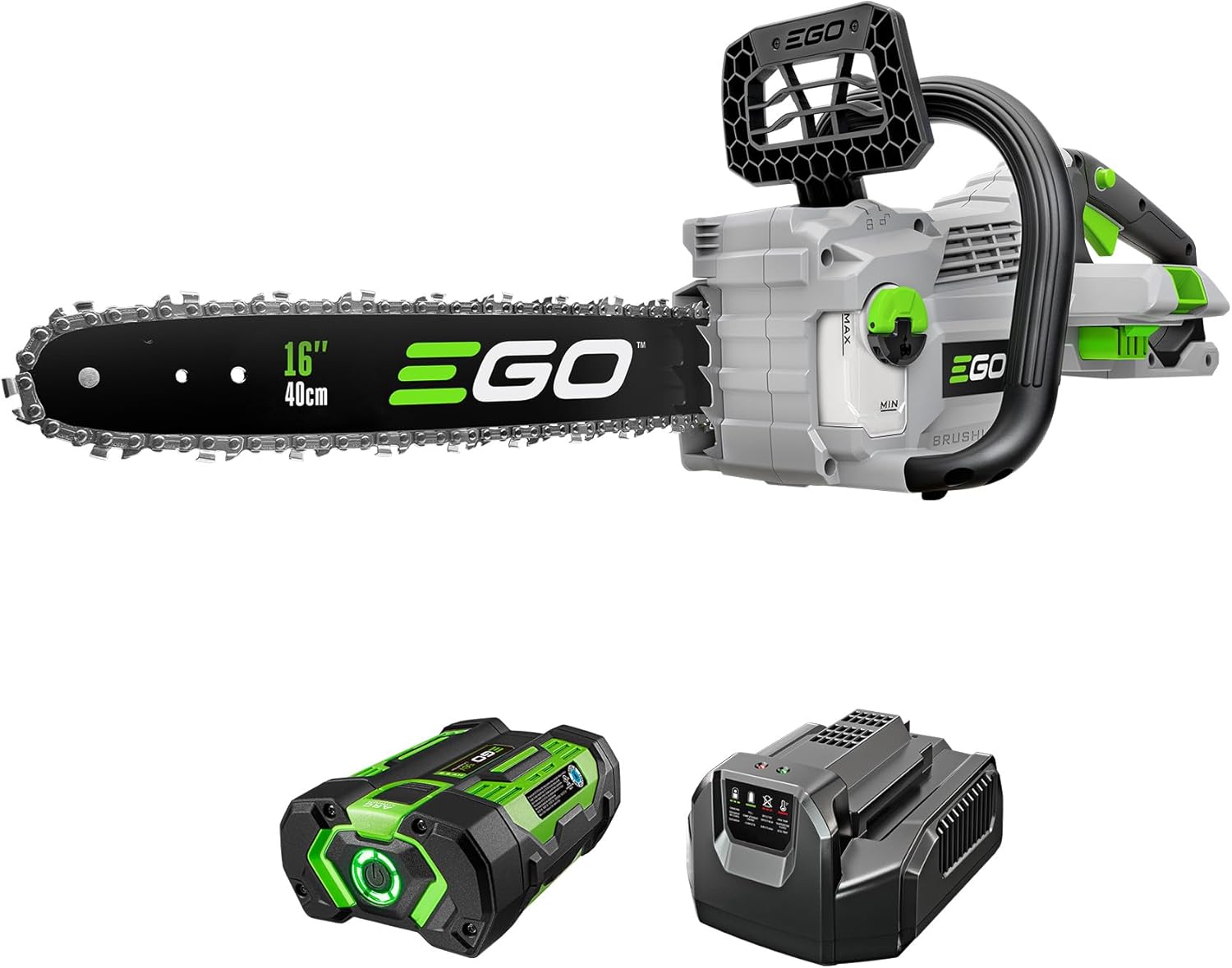
EGO POWER+ CS1611 16" Cordless Chainsaw with 56V 2.5Ah Battery and Charger
| Power Source | Battery Powered |
|---|---|
| Horsepower | 2.3 |
| Chain Length | 16 inches |
| Included Components | 2.5Ah Battery and Standard Charger |
| Chain Speed | 20 m/s |
The EGO POWER+ CS1611 is a battery-powered 16-inch chainsaw built to give prosumer-level cutting performance without gas. It uses a high-efficiency brushless motor rated as a 40CC equivalent and runs on the included 56V 2.5Ah ARC Lithium battery, which the manufacturer says delivers up to about 130 cuts through a 4×4 on a single charge. Notable features include a 20 m/s chain speed for efficient cuts, a tool-free chain-tensioning dial for quick on-the-job adjustments, automatic oiling with a spill-free reservoir, metal bucking spikes for secure cutting, and an IPX4 weather resistance rating. In real use this means quieter, low-maintenance operation compared with gas saws, fast setup between cuts, and enough runtime for routine property work like limb removal, small tree felling, and firewood prep. Limitations are battery runtime for very heavy or continuous commercial use and the saw’s 16-inch bar, which restricts maximum cut diameter compared with larger pro gas models.
Best for: Buyers wanting a low-maintenance, gas-free alternative that still delivers near-gas power for regular property maintenance, pruning, and medium-duty cutting tasks.
Less Ideal for: Users who need long uninterrupted runtime for commercial logging or must cut very large-diameter timber should consider larger gas or higher-capacity battery systems.
- Brushless motor with 40CC gas-equivalent power for strong cutting performance
- Includes 56V 2.5Ah battery and charger so it is ready to use out of the box
- Tool-free chain tensioning lets you adjust the chain quickly on site
- Automatic oiling with a spill-free reservoir keeps the chain lubricated during work
- IPX4 weather resistance and metal bucking spikes add durability and control in outdoor conditions
- 16-inch bar limits maximum cut diameter compared with larger pro chainsaws
- Runtime depends on battery capacity and may be insufficient for long, continuous heavy-duty jobs
Verdict: A ready-to-use cordless chainsaw that gives near-gas power and easy on-the-job adjustments, ideal for homeowners and pros doing regular medium-duty cutting.
SUPMIXTOOLS 62cc 20" Gas Chainsaw (2-Cycle)

| Power Source | Gas Powered |
|---|---|
| Horsepower | 4.2 hp |
| Chain Speed | 8500 Rpm/Min |
| Chain Length | 20 inches |
The SUPMIXTOOLS 62cc 20-inch gas chainsaw is a powerful 2-cycle saw built for homeowners and light pros who need strong cutting performance. It uses a 62cc 2-stroke engine that delivers high chain speed and roughly 4.2 horsepower, making it capable of cutting larger logs, limbing, and routine tree work. The saw ships with a 20-inch guide bar, low-kickback chain, basic toolkit, spare spark plug, and a fuel mixing bottle so you can get started after assembly. Practical benefits include strong cutting power for firewood and felling medium trees, an ergonomic balance that helps reduce fatigue during longer sessions, and a chain brake and safety switch for added protection. Note that it is a carbureted gas engine so you should expect routine maintenance such as mixing fuel, sharpening/adjusting the chain, and periodic tuneups; it is also heavier and louder than electric alternatives. If you need dependable, high-power cutting in areas without electricity, this model supplies the necessary performance but requires careful handling and upkeep.
Best for: Buyers who need a traditionally powered saw with strong cutting ability for firewood, tree trimming, and occasional felling and who prefer established gas-engine reliability over battery alternatives.
Less Ideal for: People who want the quietest, lowest-maintenance option or who primarily work in small yards with easy access to electricity should consider electric or battery chainsaws instead.
- Powerful 62cc 2-stroke engine suitable for demanding cutting tasks
- 20-inch guide bar and low-kickback chain for efficient cutting of larger logs
- Includes starter kit items useful for first-time setup (toolkit, spark plug, fuel bottle)
- Chain brake and safety switch for added operator protection
- Requires regular gas mixing, maintenance, and tuning typical of carbureted 2-stroke engines
- Heavier and louder than battery or electric chainsaws, which affects transport and noise
Verdict: Choose this saw if you need a robust gas-powered 20-inch chainsaw that delivers real cutting power for demanding outdoor jobs.
Milwaukee M18 FUEL 16 in. Cordless Chainsaw (Tool Only)

| Power Source | Battery Powered |
|---|---|
| Horsepower | 5.3 hp |
| Chain Length | 16 inches |
The Milwaukee M18 FUEL 16 in. cordless chainsaw is a tool-focused model that brings high power and convenient cordless operation to homeowner cutting tasks. It uses the M18 battery platform (battery and charger sold separately) and is built around a 16-inch Oregon bar and chain with an automatic oiler and variable speed trigger so you can control cut speed for different wood types. In practice this saw handles hardwood and mid-size logs quickly and is reported to deliver many cuts per charge with higher-capacity M18 packs. Notable features include the brushless FUEL motor for stronger acceleration and reduced maintenance compared with brushed motors, and a compact build that makes limbing and pruning easier in tight spaces. Important limitations are that the battery and charger are not included so you must already own or purchase compatible M18 batteries to realize the reliability benefits, and run time depends heavily on battery capacity. For homeowners who want near-professional cutting performance without gas fuss, this is a dependable cordless option when paired with a robust M18 battery.
Best for: Homeowners who prioritize a reliable, high-performance cordless saw and either already own M18 batteries or are prepared to invest in them for consistent, gas-free cutting around the yard.
Less Ideal for: Casual users who want an all-in-one package with battery and charger included or people needing very long continuous cutting sessions without spare batteries.
- Powerful brushless motor claims faster cuts than gas models for efficient work
- Automatic oiler maintains chain lubrication for consistent cutting performance
- Variable speed trigger gives precise control for pruning or larger cuts
- Compatible with the M18 battery ecosystem so higher-capacity packs boost runtime
- Battery and charger are not included so additional purchase is required
- Run time and cutting output depend on which M18 battery you use
Verdict: Choose this Milwaukee M18 FUEL 16 in. cordless chainsaw if you want near-professional cordless cutting performance and already use or plan to buy M18 batteries for dependable, gas-free operation.
Oregon CS1500 18" Corded Electric Chainsaw with PowerSharp Self-Sharpening

| Power Source | Corded Electric |
|---|---|
| Horsepower | 2400 watts |
| Chain Length | 18 inches |
| Manufacturer Warranty Description | 2 year |
The Oregon CS1500 is a homeowner-focused corded electric chainsaw designed for regular tree trimming, limb removal, and general yard cleanup. It delivers strong electric power and starts instantly so you avoid engine maintenance or gas mixing. The standout feature is the integrated PowerSharp self-sharpening system that sharpens the chain in a few seconds without removing it, which cuts downtime and keeps cuts consistent. Tool-less chain tensioning and an automatic oiler simplify upkeep, making the saw easy to maintain between uses. Safety-oriented elements such as a chain brake and a lower-noise corded motor suit suburban settings and neighbors. Limitations include dependence on a power cord, which restricts reach compared with cordless or gas saws, and a fixed 18-inch bar that is less suitable for very large trunks. For routine tree cutting on a small to medium property this model balances power, low maintenance, and safety in a package aimed at cautious, practical users.
Best for: Homeowners who want a reliable, low-maintenance chainsaw for regular pruning, limb removal, and small-to-medium tree cutting without dealing with gas engines.
Less Ideal for: Landscapers, remote jobs, or users who need cordless portability or a saw for frequent heavy-duty felling of very large trees.
- Integrated PowerSharp self-sharpening sharpens the chain in seconds without removal
- Instant corded electric start avoids gas mixing and engine maintenance
- Automatic oiler keeps bar and chain lubricated during use
- Tool-less tensioning makes chain adjustments quick and simple
- Lower noise and built-in chain brake improve safety for residential use
- Corded power limits mobility and requires access to an extension cord
- 18-inch bar is not ideal for cutting very large tree trunks
Verdict: If you want a safe, low-maintenance chainsaw for routine tree cutting around the yard, the Oregon CS1500 delivers instant corded power and a unique self-sharpening chain that keeps you cutting with minimal fuss.
Supstable S16 Pro 16-Inch 40V Brushless Cordless Chainsaw with 4.0Ah Battery

| Power Source | Battery Powered |
|---|---|
| Horsepower | 2000 watts |
| Chain Speed | 35ft/s |
| Chain Length | 16 inches |
The Supstable S16 Pro is a battery-powered 16-inch chainsaw aimed at homeowners who need gas-like cutting power without the fuss of fuel. It pairs a 2000W brushless motor with a 40V 4.0Ah battery to deliver up to 35 ft/s chain speed and work sessions the manufacturer says can run up to about 50 minutes per charge. Notable features include an automatic chain oiler, tool-free side tensioning for quick chain adjustments, a rapid-response chain brake, and included safety gloves and goggles. In practice this makes the saw well suited to cutting medium logs, pruning large branches, and storm cleanup around the yard while avoiding fumes and cold starts. The cordless design improves maneuverability but runtime is limited by a single battery and additional batteries will be needed for extended professional use. The kit is ready to run out of the box, but buyers should be aware the battery system is 40V only and accessory compatibility is restricted to the same voltage family.
Best for: Homeowners and careful DIYers who want near-gas power without fuel maintenance and who value ready-to-use safety features for routine tree trimming, firewood cutting, and storm cleanup.
Less Ideal for: Professional arborists or users who need uninterrupted all-day runtime and rely on interchangeable batteries across different voltage platforms.
- High-power 2000W brushless motor delivers strong, gas-like cutting performance
- Automatic chain lubrication reduces wear and produces smoother cuts
- Tool-free chain tensioning allows fast on-the-job adjustments
- Comes as a complete kit with battery, fast charger, safety goggles, and gloves
- Single included 4.0Ah battery limits continuous runtime for long jobs
- Battery system is 40V only so it is not compatible with 20V tools
Verdict: Buy this if you want a ready-to-run 16-inch cordless chainsaw that delivers strong, gas-like cutting performance with convenient safety and maintenance features.
Choosing the Right Chainsaw for Oak Trees: Key Factors to Consider
Engine or Motor Output
Cutting large oak requires sustained power more than short bursts of speed. For gas saws that means displacement and real-world torque ratings rather than peak RPM alone. For battery saws it means continuous wattage and tested runtime under load.
Higher sustained output reduces the chance of bogging when biting into dense grain or when making multiple successive cuts. It also affects the maximum comfortable bar length you can run for safe, efficient cutting. Consider how often you'll be making full-depth trunk cuts versus occasional limb work when deciding how much output you need.
Bar Length and Material
Longer bars let you tackle larger trunks in fewer cuts but add weight and leverage that affects balance. For oak work choose a bar length that covers the diameter you encounter most often while keeping the saw manageable. Hardened or alloyed bars and replaceable nose sprockets help resist wear from heavy use.
A bar that is too short forces extra cuts and more handling time. A bar that is too long increases fatigue and can worsen kickback dynamics if not matched with the right chain and user technique. Think practically about the largest logs you will handle and pick a bar length accordingly.
Chain Quality and Sharpening
Hardwood dulls cutters faster, so chain composition and cutter geometry matter. Chains with harder teeth or specific profiles stay sharp longer but may be harder to file. Ease of field sharpening and availability of replacement chains influence long-term ownership.
Also consider the chain pitch and gauge compatibility with common files and sharpening jigs. A chain that is easy to service in the field keeps you cutting instead of waiting for professional sharpening, which is valuable when working on remote properties or multi-day jobs.
Vibration Control and Handling
Oak cuts are often long and fatiguing. Anti-vibration systems, balanced designs, and ergonomics reduce arm strain and improve control during long sessions. Reduced vibration also helps with accuracy, which matters when making felling cuts or working near buildings.
Evaluate handle shapes, grip materials, and weight distribution. A saw that feels steady during a test cut will be easier to position for safe notch and back cuts and will reduce the risk of sloppy technique that can cause accidents.
Safety Features
Cutting dense hardwood raises the stakes for kickback, chain chatter, and accidental contact. Look for reliable chain brakes, responsive throttle interlocks, and low-kickback chain designs. A visible and easy-to-reach chain-stop mechanism can prevent minor slips from becoming serious injuries.
Also consider sightlines and control layout so you can make precise cuts. Safety is not only about hardware; it includes how the saw behaves under load and how predictable its response is when the chain binds or the blade contacts a hard knot.
Serviceability and Fuel or Battery Considerations
Frequent oak cutting demands routine maintenance. Easy access to the spark plug, air filter, chain tensioner, and sprocket makes field servicing faster. For gas saws, fuel mixing simplicity and choke design affect cold starts. For battery saws, battery swap speed, battery capacity, and charging logistics determine how long you can work before stopping.
Also account for parts availability such as replacement bars, chains, and sprockets. A saw that is simple to service in the field reduces downtime during a long job and lowers total ownership hassle.
Matching Bar Length to Typical Oak Diameters
Measure the largest trunks and limbs you plan to cut and pick a bar length that requires the fewest cuts while keeping the saw controllable. For frequent small-diameter work a shorter bar is lighter and easier to handle. For large trunks you may prefer a longer bar but accept more weight.
Also plan for handling and safety when using long bars. Two-person techniques, proper felling notches, and staged cuts reduce strain and improve safety when the bar is at the upper end of manageable lengths.
- Short bar advantage: lighter, easier to control
- Long bar advantage: fewer cuts for large trunks
- Consider getting a spare shorter bar for limbing work
Gas Versus Battery for Heavy Oak Work
Gas saws traditionally offer higher sustained power and faster refueling, which matters for extended oak cutting. They also require more on-site maintenance like fuel mixing and air filter care.
Modern battery systems can approach gas performance for many tasks and provide quieter, cleaner operation with less routine engine maintenance. For long continuous cutting, battery packs and charging logistics are the limiting factor to consider.
- Gas: better continuous power, more maintenance
- Battery: quieter, simpler upkeep, depends on battery capacity
Sharpening Strategy for Hardwood
Keep a sharpening routine based on cutting conditions. Frequent small touch-ups take less time than dealing with a badly dulled chain. Carry a compatible round file and a filing guide to maintain consistent cutter angles in the field.
For heavily knotted oak, inspect and touch up the chain more often. If you expect to do long jobs, plan for a second pre-sharpened chain so you can swap and continue working while the dull chain is reconditioned.
- Carry correct-file size and a guide
- Rotate chains to maintain cutting momentum on long jobs
- Check chain tension often; heat and load can loosen chains
Handling Big Cuts Safely
Use notch and back-cut technique for trunk felling, and plan escape paths before starting cuts. For heavy limbs, support the cut to prevent pinching the bar and chain when the limb shifts. Consider wedges and proper rigging for controlled drops.
When working alone on large cuts, take conservative approaches: smaller, staged cuts reduce risk. If a cut looks likely to bind or twist, stop and reassess rather than forcing the cut.
- Plan cuts and escape routes
- Use wedges to prevent pinching
- Employ two-person techniques for very large limbs
Maintaining Performance Over a Season
Regular maintenance keeps a chainsaw reliable during prolonged oak work. Clean the air intake, check chain oil delivery, and replace worn bars or sprockets before they compromise cutting performance. Keep spare parts and a small tool kit on hand.
Log usage and maintenance dates so you can anticipate servicing needs. Proper storage between jobs-dry, clean, and with the chain lightly oiled-reduces corrosion and preserves sharpening intervals.
- Routine air filter and spark plug checks
- Monitor chain oil flow and bar wear
- Keep spare chains and basic tools accessible
How We Chose the Best Chainsaw for Oak Trees
We limited the list to professional-grade and advanced homeowner chainsaws suited to heavy hardwood like oak. Candidates were evaluated on concrete, garden-relevant dimensions that matter when cutting large oak trunks and limbs. Key filters included rated engine or motor power and torque for sustained cuts, bar length and bar material for reach and wear resistance, chain quality and ease of sharpening for edge life, and vibration and handling for user control during long jobs. We also tested real-garden maintenance factors: how accessible the chain tensioning and sprocket are, tool-free service features, and fuel or battery runtime considerations for extended cutting. Safety features such as chain brake responsiveness and kickback reduction were included as pass/fail filters. We excluded lightweight ornamental saws and models intended only for limbing small trees, because those designs lack the durability and power for oak work. Final selections balanced raw cutting capability with serviceability and user safety.
FAQ
What bar length should I use for a mature oak trunk?
Bar length depends on trunk diameter. Choose a bar that covers the majority of the trunk diameters you encounter to minimize cuts. For very large trunks consider staged cuts or felling methods rather than relying on an overly long bar.
Can battery chainsaws handle continuous oak cutting?
Battery saws can handle many oak tasks but continuous heavy cutting depends on battery capacity and cooling. For multi-hour jobs you will need spare batteries or a charging plan, whereas gas saws can refuel quickly in the field.
How often will I need to sharpen the chain when cutting oak?
Hardwood dulls chains more quickly, so expect to sharpen more frequently than with softwood. Frequency depends on wood condition and knots, but checking and touching up every few hours of intensive cutting is common.
Is a low-kickback chain necessary for oak work?
Low-kickback chains reduce the severity of kickback events and are a practical safety choice. They may cut slightly slower than aggressive cutters, but the tradeoff in safety and predictability is often worth it for dense hardwood.
What maintenance matters most after a day cutting oak?
After a heavy day clean sawdust from the intake and clutch area, check chain tension and oil flow, and inspect the bar and chain for wear or damage. Addressing small issues immediately prevents bigger problems on the next job.
Final Verdict
When choosing a chainsaw for oak trees prioritize sustained cutting power, a bar length suited to the diameters you face, and a durable chain that is easy to sharpen in the field. Balance those needs against weight, vibration control, and how you will service the saw during long jobs. Your final choice should reflect the size of the oaks you cut and how often you work. If you need long continuous cutting choose higher output and service-friendly designs; if most tasks are limbing and smaller trunks, favor lighter handling and easier maintenance.
