

Note: This article contains affiliate links. If you click on these links and make a purchase, I may earn a small commission at no extra cost to you. This helps support my research and content. Read my full affiliate disclosure here.
When you are opening or maintaining trails, the right chainsaw makes the job safer, faster, and less tiring. A chainsaw for trail building must balance dependable cutting power with portability and field serviceability so you can work away from roads and power sources. This guide highlights the top five options suited specifically for trail work, shortlisted for their real-world handling, durability, and ease of maintenance. Below you will find concise evaluations that focus on cutting capability, weight and balance, fuel or battery logistics, and how easy each saw is to service in the field. Use the notes to match a saw to the terrain and crew size you expect to encounter.
Top Picks at a Glance
| Best Overall The best all-around choice for most situations | Husqvarna 450 Rancher 20" Gas Chainsaw (50.2 cc, 3.2 HP) |  |
| Best Quality Built to a higher standard if you want something more solid | Stihl MS 151 TC-E Chainsaw, 30 cm Bar |  |
| Best Value The sweet spot between price and what you get | EGO POWER+ CS1611 16" Cordless Chainsaw with 56V 2.5Ah Battery and Charger |  |
| Highest Rated A top-rated pick with lots of positive feedback | STIHL MS 201 TC-M Chainsaw, 35 cm Cutting Length |  |
| Most Popular A crowd favorite that many people choose with confidence | SEESII 12-Inch Cordless Brushless Chainsaw |  |
Husqvarna 450 Rancher 20" Gas Chainsaw (50.2 cc, 3.2 HP)

| Power Source | Gas Powered |
|---|---|
| Horsepower | 3.2 hp |
| Chain Length | 20 inches |
The Husqvarna 450 Rancher is a workhorse gas chainsaw aimed at users who need reliable power for pruning, yard cleanup, and firewood cutting. It pairs a 50.2-cc X-Torq two-stroke engine with a 20-inch bar to deliver strong cutting performance and steady torque under load. Practical features include Smart Start and an air purge for easier, quicker startups and an Air Injection centrifugal pre-cleaning system that reduces debris reaching the air filter to help engine longevity. LowVib technology, an ergonomic rear handle and soft inlay improve comfort during extended use, and an inertia-activated chain brake adds a safety layer against kickback. Expect robust power and professional handling, but also the usual maintenance needs of a gas saw such as fuel mixing, routine filter and spark plug service, and higher noise and emissions compared with battery models. For buyers wanting consistent heavy-duty cutting and proven engine performance, this model is a solid choice; for very light occasional jobs, it may be more saw than necessary.
Best for: Experienced homeowners and semi-pro users who prioritize sustained cutting power and durability for frequent tree work, firewood cutting, and heavy yard cleanup.
Less Ideal for: Casual users with only occasional light trimming needs or those who prefer low-noise, low-maintenance battery tools.
- Powerful 50.2-cc X-Torq engine delivers strong cutting performance for heavy tasks
- Smart Start and air purge make starting quicker and less finicky
- Air Injection centrifugal system reduces debris in the air filter for longer service intervals
- Ergonomic design with LowVib and soft inlay improves comfort during extended use
- Requires regular gas and two-stroke oil mixing and routine maintenance inherent to gas engines
- Heavier and louder than cordless electric alternatives
Verdict: Choose the Husqvarna 450 Rancher when you need a durable, high‑power gas chainsaw for frequent heavy cutting tasks.
Stihl MS 151 TC-E Chainsaw, 30 cm Bar

| Power Source | gasoline-powered |
|---|---|
| Horsepower | 1 KW |
| Chain Length | 30 centimeters |
The Stihl MS 151 TC-E is a lightweight, gasoline-powered chainsaw built for skilled users who need a nimble tool for tree care and trail clearing. It pairs a 2-MIX motor and a 30 cm chain with Stihl ErgoStart and a manual fuel pump for smoother starting in variable field conditions. Typical uses include pruning, limbing, and cutting smaller-diameter logs while moving along trails where portability matters. Notable features are the low weight for its class, a 1/4-PM3 chain for refined cuts, and ergonomics aimed at reducing start effort. In practice this means faster repositioning on steep or narrow trails and more precise cuts when clearing brush or branches. Important limitations are the short bar length and modest power output compared with larger saws, so it is not intended for felling large trees or heavy bucking tasks. Sound and vibration levels are typical for gas models and will require hearing protection and short work intervals for comfort. For trail builders who need a portable, professional-grade saw for routine clearing, this balances performance and maneuverability well.
Best for: Trail builders and land managers who prioritize a portable, easy-to-handle gas saw for pruning, limbing, and clearing small to medium brush while moving through tight or steep terrain.
Less Ideal for: Users who need a high-capacity saw for felling large trees, heavy bucking, or sustained high-volume cutting should choose a larger, more powerful model.
- Lightweight and highly portable for easy maneuvering on trails
- ErgoStart and manual fuel pump to make starting easier in the field
- 2-MIX motor with 1/4-PM3 chain provides refined, controlled cuts
- Compact 30 cm bar suitable for pruning, limbing, and small log work
- Limited bar length and modest power make it unsuitable for large-tree felling
Verdict: Choose this Stihl if you want a professional, lightweight gas chainsaw that is easy to carry and starts reliably for trail clearing and light tree-care work.
EGO POWER+ CS1611 16" Cordless Chainsaw with 56V 2.5Ah Battery and Charger
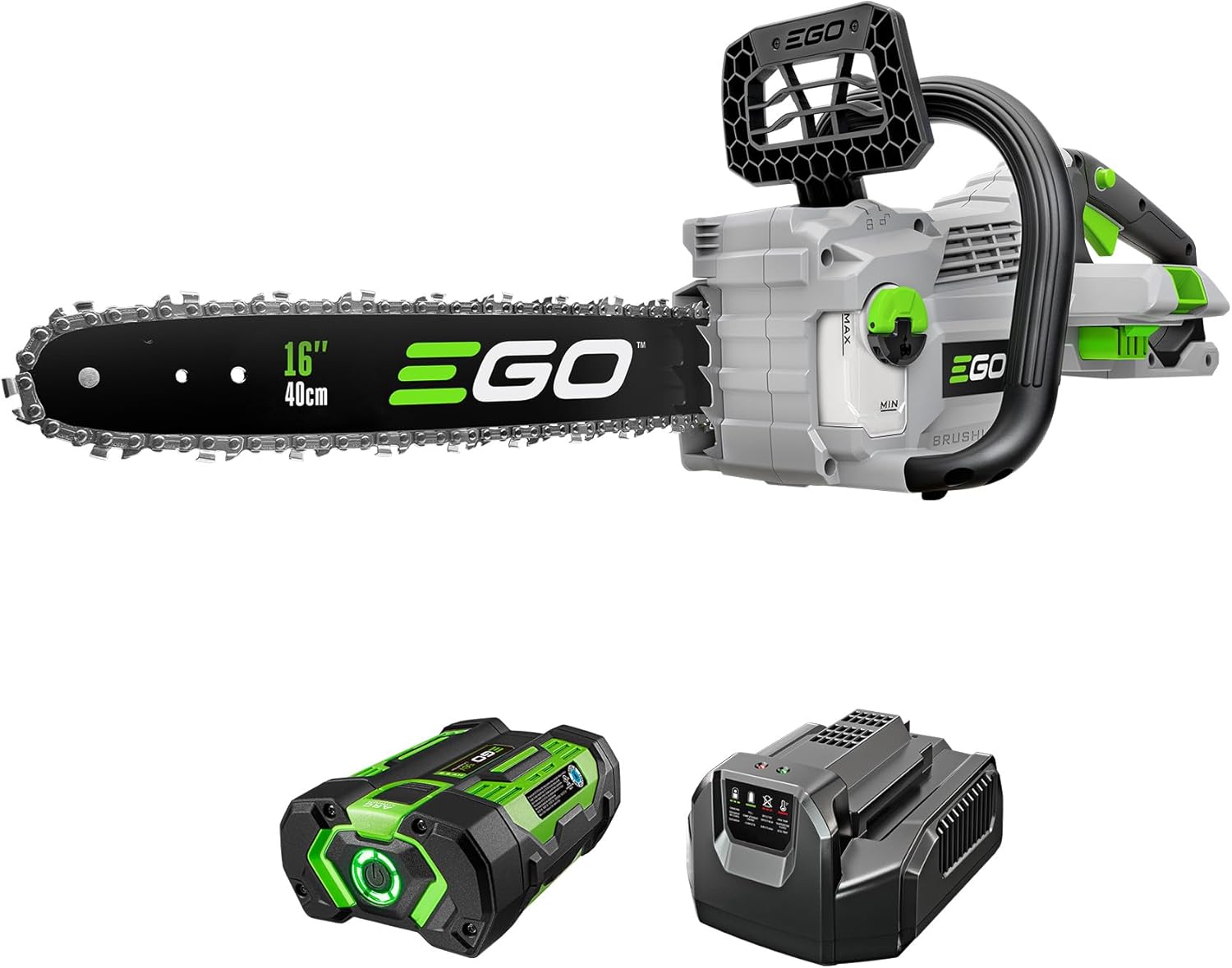
| Power Source | Battery Powered |
|---|---|
| Horsepower | 2.3 |
| Chain Length | 16 inches |
| Included Components | 2.5Ah Battery and Standard Charger |
| Chain Speed | 20 m/s |
The EGO POWER+ CS1611 is a battery-powered 16-inch chainsaw built to give prosumer-level cutting performance without gas. It uses a high-efficiency brushless motor rated as a 40CC equivalent and runs on the included 56V 2.5Ah ARC Lithium battery, which the manufacturer says delivers up to about 130 cuts through a 4×4 on a single charge. Notable features include a 20 m/s chain speed for efficient cuts, a tool-free chain-tensioning dial for quick on-the-job adjustments, automatic oiling with a spill-free reservoir, metal bucking spikes for secure cutting, and an IPX4 weather resistance rating. In real use this means quieter, low-maintenance operation compared with gas saws, fast setup between cuts, and enough runtime for routine property work like limb removal, small tree felling, and firewood prep. Limitations are battery runtime for very heavy or continuous commercial use and the saw’s 16-inch bar, which restricts maximum cut diameter compared with larger pro gas models.
Best for: Buyers wanting a low-maintenance, gas-free alternative that still delivers near-gas power for regular property maintenance, pruning, and medium-duty cutting tasks.
Less Ideal for: Users who need long uninterrupted runtime for commercial logging or must cut very large-diameter timber should consider larger gas or higher-capacity battery systems.
- Brushless motor with 40CC gas-equivalent power for strong cutting performance
- Includes 56V 2.5Ah battery and charger so it is ready to use out of the box
- Tool-free chain tensioning lets you adjust the chain quickly on site
- Automatic oiling with a spill-free reservoir keeps the chain lubricated during work
- IPX4 weather resistance and metal bucking spikes add durability and control in outdoor conditions
- 16-inch bar limits maximum cut diameter compared with larger pro chainsaws
- Runtime depends on battery capacity and may be insufficient for long, continuous heavy-duty jobs
Verdict: A ready-to-use cordless chainsaw that gives near-gas power and easy on-the-job adjustments, ideal for homeowners and pros doing regular medium-duty cutting.
STIHL MS 201 TC-M Chainsaw, 35 cm Cutting Length

| Power Source | Gas Powered |
|---|---|
| Horsepower | 2.4 hp |
| Chain Length | 35 centimeters |
| Manufacturer Warranty Description | 1 year |
The STIHL MS 201 TC-M is a gas-powered chainsaw built for dependable performance in demanding yard and light professional work. It pairs a 2.4 hp engine with a 35 cm cutting bar so it can handle limb work, pruning, and small to medium firewood cutting with steady power. Key features include a proven STIHL drivetrain and a compact chassis that makes the saw easier to maneuver in tight spaces and overhead jobs. Practical benefits are long spare-part availability and a one-year manufacturer warranty that support long-term ownership, while the gas power gives consistent cutting speed without dependence on batteries. Limitations are inherent to a compact gas saw: it requires fuel and routine maintenance like chain sharpening and tuning, and it is heavier and louder than comparable battery models. For buyers who prioritize reliable, serviceable power and parts support, this model delivers consistent, workshop-serviceable performance.
Best for: Buyers who need a dependable, serviceable gas chainsaw for regular yard work or light professional tasks and who value long-term parts support and predictable power delivery.
Less Ideal for: Casual users who prefer lower-noise, low-maintenance battery tools or those who need the lightest possible tool for occasional use.
- Gas-powered 2.4 hp engine provides consistent cutting power for demanding tasks
- Compact 35 cm bar improves maneuverability for pruning and overhead work
- Long spare-part availability (25 years) supports long-term serviceability
- Manufacturer warranty and established brand reputation for reliability
- Requires regular fuel, maintenance, and tuning compared with electric alternatives
- Heavier and louder than cordless battery chainsaws, which affects comfort for extended use
Verdict: Choose this STIHL if you want a compact, gas-powered chainsaw built for reliable, serviceable performance and long-term parts support.
SEESII 12-Inch Cordless Brushless Chainsaw

| Power Source | Battery Powered |
|---|---|
| Horsepower | 1200 watts |
| Chain Length | 12 inches |
| Included Components | chainsaw |
The SEESII 12-inch cordless chainsaw is designed for homeowners and pros who need portable, high-power cutting without a generator. It pairs a 1200W brushless motor with two 4.0Ah batteries to deliver sustained cutting power for pruning, cutting storm debris, and working on small to medium logs. The tool-free chain tension system and automatic lubrication reduce downtime and routine maintenance, and the 60 mL oil tank helps keep the chain running smoothly during longer sessions. Because it is cordless and relatively lightweight for its class, it is easy to move around the yard or use at remote sites where cords are impractical. Important limits to note are the 12-inch bar, which constrains maximum log diameter compared with full-size saws, and battery reliance for very long jobs where alternating charged packs or a backup power source is needed. For straightforward woodcutting tasks this model balances cutting performance, convenience, and low maintenance.
Best for: Buyers who prioritize efficient, portable wood cutting for yard cleanup, pruning, and medium DIY projects and want a low-maintenance cordless saw they can move around the property easily.
Less Ideal for: Contractors or users who regularly need to fell large trees or process large-diameter logs should choose a full-size gas or professional electric chainsaw instead.
- 1200W brushless motor provides strong, efficient cutting power for hardwood and storm debris
- Two 4.0Ah batteries extend runtime for longer jobs and include a built-in charge indicator
- Automatic oiling with a 60 mL tank reduces frequent stops for lubrication
- Tool-free chain tensioning simplifies on-the-job adjustments
- Cordless, relatively lightweight design improves portability and use at remote sites
- 12-inch bar limits the maximum log diameter compared with larger professional chainsaws
- Runtime depends on battery swapping for extended heavy-duty cutting sessions
Verdict: A powerful, low-maintenance cordless 12-inch saw that maximizes portable cutting performance for homeowners and weekend woodworkers.
Choosing the Right Chainsaw for Trail Building: Key Factors to Consider
Cutting Power and Consistent Torque
Trail work often means cutting green hardwood, deadfall, and root-laden logs. A chainsaw that sustains torque under load prevents frequent bogging and reduces the need for repeated passes. Consistent power matters when making hinge cuts on long limbs or when cutting through knotty sections where a weak saw will stall and increase operator effort.
Look for machines with a reputation for maintaining chain speed under heavy load and fuel or battery systems that deliver steady output. That steadiness shortens job time, reduces the chance of binding, and improves safety because predictable cutting reduces unexpected kickback or snagging.
Weight, Balance, and Packability
You will often carry the saw on uneven, steep, or narrow trails, sometimes for long distances. Total weight affects how far and how comfortably you can move between work sites. Equally important is weight distribution: a well-balanced saw feels lighter in hand and reduces wrist and shoulder strain during repeated cuts.
Consider whether the saw breaks down for transport, how easily it fits into a pack or frame, and whether there are convenient carry handles or harness attachment points. Packability can be the difference between finishing a section in a day or needing extra trips.
Field Serviceability and Simple Maintenance
Trail crews need saws that can be maintained in the field with basic tools. Easy chain tensioning, straightforward spark plug or filter access, and uncomplicated carburetor or fuel system adjustments keep downtime low. For battery saws, quick battery swaps and visible charge indicators are critical; for gas saws, simple carb adjustments and serviceable components matter.
A saw that requires specialized tools or workshop-only diagnostics will slow a crew and increase logistical complexity. Prioritize models with clear service points and widely available replacement parts.
Fuel Logistics or Battery Runtime
Remote trail work means planning fuel or battery resources. For gas saws, consider fuel consumption and how much fuel you must carry. For battery saws, plan for realistic runtime under heavy cutting and how many spare batteries are needed to finish a shift. Charging options in the field are limited, so runtime per battery and swap speed are practical concerns.
Also factor in cold-weather performance because both gasoline and batteries can behave differently in low temperatures. Choose systems that match the length and intensity of your typical work sessions.
Safety, Kickback Control, and Handling
Working on a trail often places you on slopes and terrain with trip hazards. A saw with good kickback reduction features, effective chain brakes, and positive handling characteristics improves operator safety. Low vibration reduces fatigue and helps maintain control during awkward cuts.
Ergonomic controls that are reachable with gloved hands and a clear chain brake operation are important. Safety features that are simple and reliable are preferable to complex systems that require frequent adjustment.
Choosing Between Gas and Battery for Trail Use
Gas and battery chainsaws each have tradeoffs for trail work. Gas models typically offer longer continuous cutting and quicker refuel cycles in the field, while battery saws are quieter, lighter to start, and avoid handling fuel. Decide based on access to refueling, noise restrictions on the trail, and how many hours of cutting you expect per day.
If you operate alone or on long stretches without vehicle access, a gas saw with simple fuel management might be more practical. If you work in areas with sound restrictions or you value lower emissions and easier starting, a battery option with spare packs can be effective for short to moderate shifts.
- Gas: stronger continuous output, needs fuel and more regular maintenance
- Battery: quieter, easier to start, runtime depends on battery capacity and workload
Bar Length and Chain Choice for Trail Tasks
Shorter bars are lighter and easier to handle for limbing and bucking on narrow trails, while longer bars speed up cutting of large-diameter logs. For trail crews that frequently encounter mixed sizes, a mid-length bar that balances reach and control is often the best compromise.
Chain type and pitch affect cutting speed and how aggressive the saw bites. For crosscutting and general trail clearing, a standard crosscut chain works well. If you expect heavy limbing or dirty wood, choose a chain with tougher cutters and a profile that tolerates knocks and debris.
- Short bars: better balance and maneuverability
- Long bars: faster through big logs but heavier
- Chain profiles: match to typical wood condition and cutting style
Transport and Carry Options for Remote Work
Think about how you will move the saw between sites. Does the saw disassemble for packing? Can it be carried in a shoulder harness or pack? Some saws offer carrying cases or split designs that make them more packable. If you rely on human transport, prioritize modularity and low bulk.
Also consider protective covers for the bar and chain and whether the saw can be secured without creating trip hazards on trail corridors. Secure, compact transport reduces the chance of damage and makes moving gear faster between work sections.
- Look for detachable bars or compact designs if you hike to work sites
- Check for harness or handle options to ease long carries
- Protective covers reduce accidental cuts and keep chains sharp
Noise and Environmental Considerations
Noise levels matter on popular trails and in protected areas. Battery saws are substantially quieter than gas models and may be required by some land managers. Noise affects not just compliance but crew communication and wildlife disturbance. Consider local rules and the typical visitor density on trails you maintain.
Environmental impact also includes exhaust emissions and fuel spills. For sensitive areas or alpine zones, a battery saw reduces the risk of contamination and simplifies fueling logistics.
- Check local regulations about noise and engine use
- Battery saws reduce emissions and spill risk
- Plan operation times to minimize visitor disruption
Crew Workflows and Shared Equipment
If you work with a crew, standardizing on compatible bars, chains, and fuel or battery systems simplifies logistics. Shared spare batteries, a small toolbox with common parts, and a routine maintenance checklist keep multiple saws operational across a day. Train crews on quick field fixes and safe carry techniques to reduce delays.
Designate a single location for refueling or battery swaps to streamline workflow and limit the number of tools each person must carry.
- Standardize consumables across the crew when possible
- Keep a field repair kit with spark plugs, files, and chain tools
- Establish refuel or battery-swap protocols for efficiency
How We Chose the Best Chainsaw for Trail Building
We prioritized features that matter when building and maintaining trails where access is limited and conditions vary. Selection criteria included sustained cutting power under load, the saws ability to be carried and operated on steep or uneven ground, and how straightforward routine field repairs and maintenance are. Fuel system simplicity and battery runtime were weighed to reflect remote work where refueling or recharging is not always convenient. We also evaluated bar and chain options for crosscutting and limbing without needing frequent tool changes, plus vibration control and ergonomic balance to reduce operator fatigue during long shifts. Excluded from consideration were saws designed exclusively for light yard tasks, models that require extensive workshop-only servicing, and specialized industrial harvesters not practical for trail crews. The final shortlist reflects machines that combine dependable field performance with realistic serviceability and portability for trail-building conditions.
FAQ
How long should a chainsaw run on a single battery for trail work?
Runtime depends on battery capacity and cutting intensity. Under heavy cutting, many batteries provide less runtime than under light use. Expect to plan for multiple batteries or shorter shifts if you cannot recharge in the field.
Is a lighter saw always better for hiking to remote trail sites?
Not always. Lighter saws are easier to carry but may lack the cutting power needed for larger trees or tough wood. Balance weight against the typical size of material you will encounter and consider whether you can trade weight for battery or fuel capacity.
What maintenance should be done after a day on the trail?
Clean debris from the bar and sprocket, check and tension the chain, inspect the air filter and fuel lines, and sharpen or file the chain as needed. For battery saws, check contacts and keep spare batteries charged and protected.
Can I use the same chain for limbing and bucking?
You can, but different tasks benefit from different chain profiles. A general-purpose chain is fine for mixed work, while specialized chains perform better for heavy limbing or very dirty wood. Keep spares for quick swaps if conditions change.
How important is anti-vibration and ergonomics for long trail shifts?
Very important. Good vibration reduction and ergonomic balance reduce operator fatigue and the risk of errors. For long shifts, these factors can be as impactful as raw cutting power for overall productivity and comfort.
Final Verdict
For trail-building work, prioritize a machine that balances sustained cutting power with transportability and simple field maintenance. You will trade off between raw continuous output and ease of carrying, so match the saw to typical tree sizes, expected distance from vehicles, and crew routines. Safety features, serviceability, and realistic fuel or battery planning should guide your final choice. Focus on the few criteria most relevant to your projects: whether you need long runtime, minimal weight for hiking, or the easiest field repairs. Selecting the right balance will keep crews productive and reduce downtime on the trail.
