

Note: This article contains affiliate links. If you click on these links and make a purchase, I may earn a small commission at no extra cost to you. This helps support my research and content. Read my full affiliate disclosure here.
If you want to boost soil structure and feed hungry vegetables, choosing the right chicken manure fertilizer matters. Poultry-based fertilizers vary in nutrient concentration, composting level, and how quickly they release nitrogen into the soil. The wrong product can burn young plants or fail to provide lasting organic matter. This guide covers seven shortlisted chicken manure fertilizers for garden beds and containers, evaluated for nutrient balance, safety for plants, and how they perform in real garden situations. Below we explain what we judged, what to expect from each type, and how to use these fertilizers safely.
Top Picks at a Glance
| Best Overall The best all-around choice for most situations | Fancy Chicken Pelleted Organic Lawn & Garden Chicken Manure, 40 lb |  |
| Best Quality Built to a higher standard if you want something more solid | Kreher Family Farms Organic Pelleted Poultry Compost Fertilizer (2 x 25 lb) |  |
| Best Value The sweet spot between price and what you get | Coop Gro Organic Pelleted Chicken Manure Fertilizer, 6 lb |  |
| Best Budget The cheapest option that still gets the job done reliably | Happy Bunny Farms Chicken Manure Pellet Crumbles, 1.5 lb |  |
| Highest Rated A top-rated pick with lots of positive feedback | Lancaster Agriculture Products Chicken Manure Pellets, 16 lb |  |
| Most Popular A crowd favorite that many people choose with confidence | Espoma Organic Chicken Manure Granules, 3.75 lb |  |
| Best Seller A high-volume bestseller chosen again and again | Espoma Organic Chicken Manure 25 lb. Bag (2 Pack) |  |
Fancy Chicken Pelleted Organic Lawn & Garden Chicken Manure, 40 lb

| Item Form | Granules |
|---|---|
| Specific Uses For Product | Fertilize gardens, plants and lawns |
| Coverage | Up to 10,000 sqft |
| Mixing Ratio | 4:2.5:2 |
| Ingredients | 100% natural composted poultry manure |
Fancy Chicken Pelleted Organic Lawn & Garden Chicken Manure is a ready-to-use pelleted fertilizer made from composted poultry manure and formulated for broad garden and lawn use. Gardeners typically broadcast it with a spreader or work it into beds; the bag claims coverage up to 10,000 sq ft so it is suited to medium and larger yards. The N-P-K ratio and pelleted form supply steady nitrogen for greener foliage while phosphorus and potassium support flowering and roots. Because it is fully composted and OMRI-style organic, it helps improve soil structure, moisture retention, and microbial activity rather than acting as a quick synthetic boost. Practical benefits include ease of application, long-acting nutrient release, and soil-building value with repeated use. Important limitations are that results are gradual rather than immediate and the product dose needs following to avoid overapplication; bulky 40 lb packaging can be unwieldy to move for small-space gardeners. For a balanced home gardener seeking a soil-improving organic option, this makes a strong case as a primary seasonal feed.
Best for: Gardeners who want an all-purpose organic fertilizer that builds soil health over time and can cover medium to large lawns or multiple beds with a single product.
Less Ideal for: People needing quick, short-term nutrient corrections or those who only maintain a few small containers or balconies and prefer lightweight, small-format feeds.
- Composted pelleted form is easy to spread and handle
- Provides balanced nutrients (supports foliage, blooms, and roots)
- Improves soil structure, moisture retention, and microbial activity
- Large 40 lb bag covers up to 10,000 sq ft for wide-area use
- Nutrient release is slower than soluble fertilizers, so effects are not immediate
- Bulky 40 lb bag can be difficult to transport and apply in small gardens
Verdict: A soil-building, easy-to-apply organic chicken manure in pelleted form that suits homeowners who want a single balanced fertilizer for lawns and garden beds.
Kreher Family Farms Organic Pelleted Poultry Compost Fertilizer (2 x 25 lb)

| Item Form | Pellet |
|---|---|
| Application Method | By hand or with a standard fertilizer spreader |
| Coverage | Top dressing (½ inch depth): Approximately 24 square feet |
| Target Species | Vegetables |
| Ingredients | 100% composted poultry manure; contains calcium |
Kreher’s pelleted poultry compost is an OMRI-listed organic fertilizer made from 100% composted chicken manure and pelleted for straightforward application. It is used as a top dressing or incorporated into planting beds to add organic matter, boost microbial activity, and deliver macronutrients important for vegetables and flowering plants. The pellets spread evenly by hand or with a standard fertilizer spreader, which reduces dust and runoff compared with loose compost and makes coverage easier to estimate. Notable features include its OMRI listing for certified organic use and a relatively high calcium content that helps soil structure. In practice it supports steady vegetative growth and improved water retention when added regularly, and the pelleted form limits odor during application. Important limitations are that nutrient analysis numbers (N-P-K) are not listed on the product details here so users should monitor plant response and may need to supplement specific nutrients for high-demand crops, and the product is intended as a soil amendment rather than a fast-release synthetic feed for rapid green-up.
Best for: Gardeners seeking an organic, performance-focused soil amendment to build long-term fertility and support higher vegetable yields will appreciate this product’s ease of use and soil-improving benefits.
Less Ideal for: Gardeners who need fast-acting synthetic feeds for immediate color or rapid correction of a specific nutrient deficiency should consider a targeted fertilizer instead.
- OMRI listed for organic certified use.
- Pelleted form allows easy, low-dust spreading by hand or spreader.
- Made from 100% composted poultry manure to add organic matter and nutrients.
- Supports soil structure and microbial activity with added calcium.
- Nutrient analysis (exact N-P-K ratios) is not provided in the available product details.
- Intended as a soil-building amendment rather than a quick-release fertilizer for immediate nutrient correction.
Verdict: Choose this OMRI-listed pelleted poultry compost when you want an easy-to-apply organic amendment that builds soil health and supports stronger vegetable yields.
Coop Gro Organic Pelleted Chicken Manure Fertilizer, 6 lb

| Item Form | Pellets |
|---|---|
| Application Method | Top dressing or mixed into soil |
| Coverage | 1 (6lb) bag covers 200 Square Feet |
| Mixing Ratio | 3-3-4 NPK |
Coop Gro 6 lb pelleted chicken manure is a straightforward organic fertilizer for home gardens that provides a balanced 3-3-4 NPK and slow-release nutrition. It is typically applied as a top dressing or worked into potting mixes and garden beds to feed vegetables, flowers, shrubs and trees without burning young roots. The pellets are low-odor, easy to spread by hand or with a handheld spreader, and the packaging is resealable and water resistant for seasonal storage. Because it is OMRI compatible and made from composted chicken litter, it adds organic matter and secondary nutrients that help soil structure and water retention over time. Coverage information (about 200 sq ft per bag) makes it simple to plan applications for small raised beds or container gardens. Limitations to note are the modest bag size, which means multiple bags are needed for larger plots, and that nutrient analysis is relatively low compared with concentrated synthetic fertilizers, so gardeners seeking rapid, high-N feeding may prefer a different product.
Best for: Gardeners who prioritize safe, steady organic nutrition for vegetable beds, container gardens, and ornamental plantings and who plan applications rather than chasing quick green-up.
Less Ideal for: People managing large-acre gardens or commercial plots who need high-concentration or bulk fertilizer for rapid correction should look at larger or more concentrated alternatives.
- Balanced 3-3-4 NPK suitable for steady, all-around feeding
- Pelleted, low-odor formula that is easy to apply and handle
- OMRI-compatible organic material that improves soil structure and adds carbon
- Resealable, water-resistant bag for convenient storage and seasonal use
- 6 lb bag covers only about 200 sq ft so larger gardens require multiple bags
- Lower nutrient concentration than synthetic fertilizers for fast corrective feeding
Verdict: A compact, easy-to-use organic chicken manure pellet that steadily improves soil and feeds small to medium home gardens over the season.
Happy Bunny Farms Chicken Manure Pellet Crumbles, 1.5 lb

| Item Form | Pellets, crumbles |
|---|---|
| Specific Uses For Product | Plant Fertilizer, Plant Growth, Root Development, Soil Conditioning |
| Unit Count | 24 Ounce |
| Ingredients | Chicken manure |
This 1.5 lb bag of chicken manure crumbles is a straightforward organic fertilizer for vegetable gardens, containers, and raised beds. The 5-4-3 NPK mix supplies steady nitrogen, phosphorus, and potassium to support leafy growth, root development, and flowering, while the crumble/pellet form makes it easy to scatter or work into the topsoil. It is best used as a top dressing around established plants or lightly incorporated into potting mixes and garden beds following package directions. Because it is natural chicken manure it also helps improve soil structure and encourages microbial activity over time. The small bag size is convenient for trialing on a few beds or for gardeners managing limited space, but you will need multiple bags for larger vegetable plots. Application requires attention to rates to avoid over-fertilizing young seedlings and vegetable transplants.
Best for: Home gardeners on a budget who want an organic, easy-to-apply fertilizer for small vegetable beds, containers, or to test on a few plots before committing to larger quantities.
Less Ideal for: People managing large allotments or commercial vegetable plots who need bulk fertilizer or a concentrated product for widespread application.
- Balanced 5-4-3 NPK formula suited to general vegetable garden needs
- Organic chicken manure ingredient that improves soil structure and microbial activity
- Crumble/pellet form is easy to apply as a top dressing or to mix into soil
- Small 1.5 lb bag is convenient for containers, raised beds, or trial uses
- Small bag size means higher cost per square foot for larger gardens
- No additional amendments or buffering indicated for use around sensitive seedlings
Verdict: A small, ready-to-use organic chicken manure crumble that gives budget-minded vegetable gardeners an easy way to boost soil fertility in containers and small beds.
Lancaster Agriculture Products Chicken Manure Pellets, 16 lb

| Item Form | Pellets |
|---|---|
| Mixing Ratio | 4:2:2 |
| Included Components | Soil Amendments |
| Unit Count | 256 Ounce |
These chicken manure pellets are a ready-to-use organic fertilizer designed to feed flowers, vegetables, trees, and shrubs without mixing or measuring. The pellets are heat-treated and dehydrated for easier handling and lower odor than raw manure, and the listed 4-2-2 analysis plus 8% calcium supports steady nitrogen-driven growth with phosphorus and potassium for root and bloom development. Typical use is sprinkling around the plant drip line and watering in; the manufacturer recommends spring and fall applications for trees and shrubs and monthly top-dressings for vegetables and ornamentals during the growing season. The product suits gardeners who want a natural, sustainably sourced soil amendment that also simplifies application. Limitations to note are that nutrient release is relatively slow compared with soluble fertilizers so it is not intended for instant greening, and application rates must be followed to avoid overfeeding. Also, pellets still require proper storage to stay dry and to prevent clumping or biodegradation over time.
Best for: Gardeners who prioritize dependable, natural soil feeding and want a low-fuss, organic fertilizer for regular seasonal use on vegetables, flowers, and established trees and shrubs.
Less Ideal for: Growers needing fast, soluble nutrients for quick correction or for foliar feeding should choose a water-soluble fertilizer instead.
- Ready-to-use pelleted form simplifies application and eliminates mixing.
- Heat-treated and dehydrated for reduced odor and easier handling than raw manure.
- Balanced 4-2-2 NPK with 8% calcium supports general plant growth and soil improvement.
- Suitable for organic gardening and sourced from regenerative farm practices.
- Slow-release nutrient profile means results appear over weeks rather than immediately.
- Requires dry storage to prevent clumping and loss of quality.
Verdict: Buy this if you want a dependable, easy-to-apply organic chicken manure pellet that steadily improves garden soil and feeds a wide range of plants.
Espoma Organic Chicken Manure Granules, 3.75 lb

| Item Form | Granules |
|---|---|
| Application Method | Scatter around plants |
| Target Species | Flowers, Vegetables, Trees, Shrubs |
| Specific Uses For Product | Gardening, Organic, Plant Food |
Espoma Organic Chicken Manure is a ready-to-use, granulated poultry manure fertilizer aimed at home gardeners who want an organic nitrogen-rich soil amendment. With a 5-3-2 NPK analysis and added calcium, it is scattered around the plant drip line and watered in to release nutrients; the granulated, heat-treated form makes application tidy and eliminates the need for mixing. It is labeled for monthly use on vegetables and for seasonal use on trees and shrubs, which makes it practical for routine feeding of tomatoes, peppers and other vegetable beds. The product is registered for organic production and contains no fillers, so you get mostly poultry manure rather than blended proprietary mixes. Because it is dehydrated and granulated there is minimal odor and easier storage than fresh manure, but nutrient levels are moderate so heavy-feeding crops may need larger or repeated applications. Also it does not supply specific micronutrient balances or slow-release polymers, so pairing it with a balanced organic program will give best results.
Best for: Gardeners who prioritize certified organic inputs and want a simple, easy-to-apply manure fertilizer for regular feeding of vegetable beds and common garden plants.
Less Ideal for: Growers seeking a single-product, high-analysis or slow-release fertilizer for intensive commercial production should consider concentrated or formulated alternatives.
- Certified for organic gardening and made from dehydrated poultry manure
- Granulated, heat-treated form is easy to apply and has lower odor than fresh manure
- Straightforward 5-3-2 NPK plus calcium provides usable nitrogen for vegetables
- Ready-to-use with no mixing required and simple scatter-and-water application
- Moderate nutrient analysis may require more frequent applications for heavy feeders
- Does not list a full micronutrient profile or slow-release formulation
Verdict: A simple, certified organic chicken manure in granule form that makes monthly feeding of vegetable beds easy and low-odor.
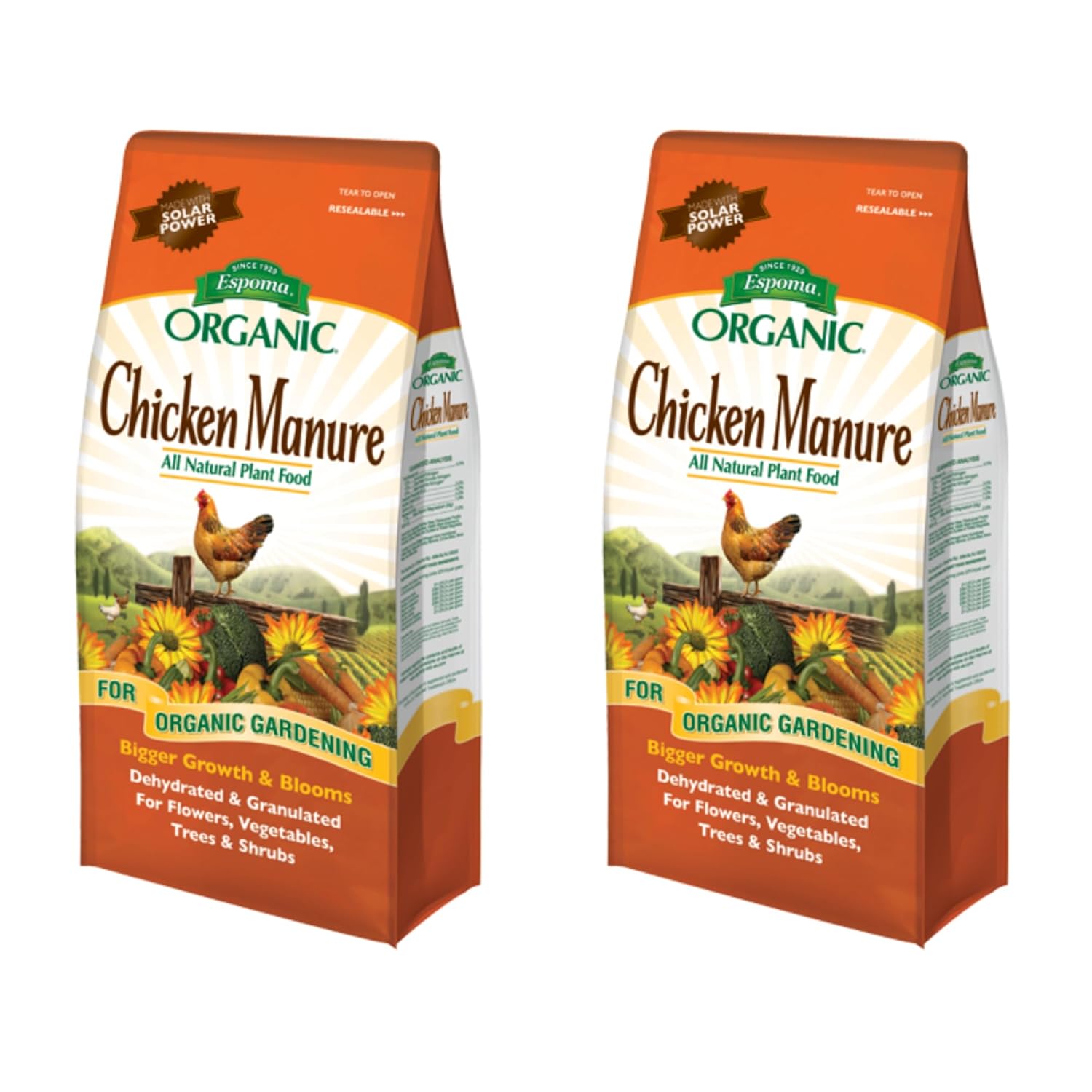
Espoma Organic Chicken Manure 25 lb. Bag (2 Pack)
| Item Form | Granules |
|---|---|
| Mixing Ratio | 5-3-2 |
| Specific Uses For Product | Food,Gardening,Organic |
| Target Species | Flowers, Vegetables, Trees, Shrubs |
Espoma Organic Chicken Manure is a ready-to-use, granulated organic fertilizer formulated for vegetable beds and other garden plants. It supplies a mild, slow-release 5-3-2 nutrient blend with added calcium and is heat treated and granulated so it spreads easily without lumping. Typical use is to broadcast or side-dress around the drip line of vegetables, flowers, shrubs, and young trees in spring and fall or monthly for actively fruiting vegetables. The product is registered for organic production and contains no added fillers or sludges, which makes it a straightforward choice for organic gardens. Practical benefits include ease of application, steady nutrient delivery that is gentle on plants, and an 8 percent calcium content that supports fruit set. Limitations are that the nutrient analysis is relatively low compared with synthetic alternatives so larger or nutrient-hungry beds may require more frequent applications or supplemental fertilizers, and being a manure product it benefits from thorough watering after application to avoid any localized salt build-up.
Best for: Gardeners who prioritize organic, proven inputs and want a simple, easy-to-apply fertilizer for vegetable beds and mixed garden plantings.
Less Ideal for: Large-scale growers or heavy-feeding crops that need high immediate nutrient levels should consider stronger or supplemental fertilizers.
- Organic, registered input suitable for certified organic vegetable gardens
- Granulated and heat treated for easy, even spreading
- Balanced slow-release 5-3-2 formula with added calcium
- No added sludges or fillers, composed of pure chicken manure
- Lower NPK values than many synthetic fertilizers, so larger beds may need more product or supplements
- Requires watering after application to integrate nutrients and avoid salt concentration
Verdict: A dependable, easy-to-apply organic chicken manure that delivers gentle, slow-release nutrients and calcium for vegetable gardens.
Choosing the Right Chicken Manure Fertilizer: Key Factors to Consider
Nutrient Balance and N-P-K Numbers
Knowing the nitrogen, phosphorus, and potassium content matters because chicken manure can range from mild to quite rich in nitrogen. High nitrogen is useful for leafy growth but can scorch seedlings if applied too concentrated. Look for N-P-K figures or supplier guidance so you can match the fertilizer to the crop stage and soil tests.
N-P-K also affects how much you should apply and whether you need to supplement with additional phosphorus or potassium. For long-term bed building, moderate N and detectable P and K are preferable to extreme nitrogen spikes that release quickly and leave soils unbalanced.
Composting Level and Pathogen Safety
Chicken manure should ideally be composted to reduce salts and pathogens. Finished composting lowers ammonia and reduces the risk of burning plants while diminishing pathogens that can be harmful in vegetable gardens. Products labeled as composted or heat-treated are generally safer for direct application.
If a product is raw or only partially composted, it may require on-site finishing or a waiting period before planting. Consider whether you want something safe for near-root applications or a material intended for pre-season bed building.
Salt Content and Maturity
Salt buildup can inhibit seed germination and damage sensitive plants. Mature composted chicken manure typically has lower soluble salts than fresh manure. If your soil test shows salt sensitivity or you grow seedlings and transplants, choose a low-salt, well-aged product.
Maturity also indicates stability. Stable manures break down predictably in the soil, improving structure instead of tying up nitrogen or causing odor and pest issues during decomposition.
Form and Application Method
Chicken manure fertilizer comes in several forms, including bagged compost, pellets, and blended blends. Bulk compost is economical for large beds but takes labor to spread. Pellets are easy to broadcast and measure for containers and small plots. Blends may include other soil amendments like lime or rock minerals to balance pH and nutrients.
Choose the form that fits how you garden. For beds and heavy feeding crops, bulk compost or blends work well. For container gardening and measured side-dressing, granules or pellets give more control.
Release Rate and Timing
Different products release nutrients at different speeds. Well-composted manures and blended organics tend to release nutrients slowly, supporting plants over weeks to months. Fresher materials and high-nitrogen products release faster and suit quick greening but may require careful timing to avoid burns.
Plan applications around crop needs: pre-plant incorporation of slow-release material for season-long support, or light side-dressing of faster-release products during active growth.
Effect on Soil Structure and Water Retention
Beyond nutrients, chicken manure contributes organic matter which improves soil structure, drainage, and water-holding capacity. Regular additions build crumb structure that benefits root growth and microbial life. Some products are blended with coir, composted wood, or peat alternatives to boost texture and moisture retention.
Consider how the product will change your soil over multiple seasons. A product that noticeably increases organic matter is valuable for sandy soils and compacted clay alike.
How to Use Chicken Manure Fertilizer Safely
Apply composted chicken manure before planting by mixing it into the top 6 to 8 inches of soil to avoid direct contact with tender roots. For container-grown vegetables or flowers, work a measured amount of pellets or compost into the potting mix rather than dumping raw material on the surface.
When side-dressing, place the material several inches away from stems and gently work it into the soil surface to minimize leaf contact. Water after applying to help move nutrients into the root zone. If using a faster-release product, reduce application rates for young seedlings and wait until plants are established.
- Avoid applying fresh manure directly to seedbeds.
- Wear gloves and a dust mask when handling dry products.
- Wash hands after working with manure-based amendments.
Timing Applications for Different Crops
Leafy greens and heavy feeders benefit from higher nitrogen earlier in the season, while fruiting crops need balanced nutrients and moderate nitrogen to encourage blossoms and fruit set. Apply a stable, composted product at bed preparation, then consider light side-dressing during active growth if needed.
Perennials and established shrubs gain more from incorporated organic matter than immediate nutrient push. For bulbs and root vegetables, err on the side of lower nitrogen at planting and use composted manure to build long-term fertility.
- Pre-plant incorporation: use slow-release composted manure.
- Seedlings and transplants: avoid high-nitrogen fresh manure.
- Mid-season: small side-dressings for heavy-feeding vegetables.
Adjusting Rates Based on Soil Tests
A soil test tells you what your garden already has and which nutrients are lacking. If tests show sufficient phosphorus or potassium, choose a chicken manure product with moderate N or blend it with other amendments to avoid excess of any one element. For very poor soils, heavier applications of well-composted material help rebuild fertility.
Use lower rates on soils with high salt or in containers where buildup is more likely. Repeat testing every one to three years to track changes after repeated manure applications.
- Match N-P-K to what the soil lacks rather than guessing.
- Reduce application frequency on already fertile soils.
- Consider alternating carbon-rich amendments to balance nitrogen.
Composting and On-Site Finishing Tips
If you buy a partially composted or raw product, finish composting on-site by building a hot pile with roughly equal parts carbon and nitrogen, turning periodically to reach and hold thermophilic temperatures. Finished compost should smell earthy and be crumbly rather than ammonia-like.
Finished compost can be applied directly to vegetable beds without a long waiting period. For gardeners who prefer to age materials further, incorporate them in the fall so they stabilize over winter before spring planting.
- Monitor temperature when composting to ensure pathogen reduction.
- Keep the pile moist but not saturated.
- Allow several months of curing for best results.
Environmental Considerations and Runoff Prevention
Avoid applying large amounts of manure before heavy rain to reduce nutrient runoff. Work amendments into the soil where plants can capture nutrients, and maintain vegetative buffers near waterways. Over-application can lead to nitrate leaching and water quality problems in nearby streams.
For sloped beds, use terraces or mulches to slow water flow and encourage infiltration. Pelleted or stabilized products reduce immediate runoff risk compared with raw, loose manures.
- Do not apply just before a forecasted storm.
- Incorporate manure to reduce surface runoff.
- Use cover crops or mulch to hold nutrients in place.
How We Chose the Best Chicken Manure Fertilizer
We focused on attributes that matter for gardens rather than marketing claims. Our selection filtered for products formulated or composted specifically for ornamental and vegetable beds, excluding raw or uncertified fresh manure sold for livestock bedding. We prioritized nutrient composition and consistency, looking for clear N-P-K numbers and stable organic matter content. Safety and handling were important, so we favored options with documented composting or pathogen-reduction processes and clear application guidance. Ease of application and versatility in garden contexts were considered, including suitability for raised beds, in-ground plots, and container gardens. Finally, we assessed material form and longevity, preferring products that provide steady nutrient release and measurable improvements to soil structure. Products that lacked usage guidance, had ambiguous sourcing, or were clearly intended only for heavy agricultural spreading were excluded.
FAQ
Is chicken manure fertilizer safe for vegetable gardens?
Often yes when it is fully composted or heat-treated so pathogens and excess ammonia are reduced. Composted products are safer for direct application in vegetable beds, while raw manure should be aged or composted before use to avoid food-safety and plant-burn risks.
How long should chicken manure compost cure before planting?
It usually takes several months of active composting plus a curing period for the material to stabilize. If the compost smells of ammonia or is very hot, allow more time. Finished compost is crumbly, earthy-smelling, and cooler to the touch before planting.
Can I use chicken manure fertilizer in containers?
Yes if you use a well-aged, low-salt product or pellets formulated for containers. Containers are more sensitive to salt and nutrient concentration, so use reduced rates and blend with quality potting mix to avoid root burn.
How often should I apply chicken manure to my garden beds?
Often one pre-season application of composted manure is enough for many beds, supplemented by light side-dressings during the growing season for heavy feeders. Frequency depends on the product's release rate, crop needs, and soil test results.
Will chicken manure raise soil pH?
It depends. Some chicken manure products are neutral to slightly alkaline, and blends may include lime or ash that affect pH. If pH adjustment is a concern, check product information and monitor soil pH after repeated applications.
Final Verdict
Choose chicken manure fertilizer based on how you garden and what your soil needs. Prioritize composted, stable materials if you plan to apply near roots or in vegetable beds. Match nutrient levels to crop stage and soil test results, and pick a form that fits your application method. By balancing release rate, safety, and organic-matter contributions, you can build healthier soil and support stronger, more productive plants.
