

Note: This article contains affiliate links. If you click on these links and make a purchase, I may earn a small commission at no extra cost to you. This helps support my research and content. Read my full affiliate disclosure here.
Picking the right coco coir matters when you run a hydroponic system because the root zone responds strongly to texture, salt levels, and moisture behavior. The wrong block or puck can cause poor aeration, uneven nutrient uptake, or pH swings that stress plants. This guide shortlists seven practical coco coir options suited for hydroponic use and explains the traits that actually affect performance in a real grow tent, greenhouse, or flood-and-drain setup. We evaluated these coco coir choices for fiber consistency, salt content, and how they handle wet-dry cycles so you can match a media to your reservoir, irrigation style, and crop. Read on for the decision factors we used and what to expect from different coir forms and preparations.
Top Picks at a Glance
| Best Overall The best all-around choice for most situations | CANNA Coco Brick 40L Expandable Plant Medium (8L dry) |  |
| Best Quality Built to a higher standard if you want something more solid | NUTRIFIELD Coco Mega Brick 5kg Compressed Coconut Coir Block (Expands to 55 L) |  |
| Best Value The sweet spot between price and what you get | Plantonix Coco Bliss Buffered Coco Coir Brick (10 lb) |  |
| Best Budget The cheapest option that still gets the job done reliably | COCF Coco Coir Brick — Low EC, pH‑Balanced Compressed Coconut Coir (1.4 lb) |  |
| Highest Rated A top-rated pick with lots of positive feedback | GREENSTONE Kiss 100% Coco Coir, 50 L Soilless Growing Media |  |
| Most Popular A crowd favorite that many people choose with confidence | Back to the Roots Organic Expanding Coco Coir Potting Soil Brick (10 lb) |  |
| Best Seller A high-volume bestseller chosen again and again | MagJo Naturals 100% Pure Coco Coir 11 lb Block (OMRI Listed) |  |
CANNA Coco Brick 40L Expandable Plant Medium (8L dry)

| Brand Name | CANNA |
|---|---|
| Number of Packs | 1 |
| Unit Count | 128 Ounce |
| Volume | 8 liters |
This CANNA Coco Brick is a compact, reusable block of natural coco coir that expands to 40 liters of growing medium after hydrating the 8 liter dry brick. It is typically used by growers who need a pH-neutral, well-draining substrate for hydroponics, pots, or seed starting. The brick is organic and delivers the airy texture coco coir is known for, which helps root aeration and moisture retention without waterlogging. Practical benefits include very efficient storage and transport while dry, straightforward rehydration to make a ready-to-use medium, and minimal dust if handled carefully. The product carries safety guidance to avoid skin or eye contact and to use gloves when mixing. Limitations are that it arrives compacted so you must add water and break it apart thoroughly to avoid lumps, and nutrient supplementation is required since coco provides little inherent fertility. This is best for growers who want a consistent, renewable coco medium for hydroponic or container setups and are comfortable preparing and feeding the substrate themselves.
Best for: Growers who want a reliable, pH-stable coco coir medium for hydroponic or container systems and value compact storage and consistent texture when prepared.
Less Ideal for: Gardeners who prefer ready-to-use, pre-fertilized potting mixes or those unwilling to mix and feed their own nutrient solution.
- Expands from a compact 8L dry brick to 40L usable medium for easy storage and transport
- pH-neutral, natural coco coir provides good aeration and water retention for roots
- Organic and reusable when managed correctly, suitable for hydroponic and container use
- Arrives compressed and requires thorough rehydration and manual breaking to avoid clumps
- Contains no nutrients so growers must add appropriate fertilizers for hydroponic use
Verdict: Choose this CANNA coco brick if you need a compact, high-quality coco coir medium that hydrates into a consistent, hydroponics-ready substrate.
NUTRIFIELD Coco Mega Brick 5kg Compressed Coconut Coir Block (Expands to 55 L)

| Unit weight | 5 kg |
|---|---|
| Expanded volume | 55 liters |
| Processing | Pre-buffered and triple-washed |
| Item type | Granules |
This NUTRIFIELD Coco Mega Brick is a performance-focused coco coir block designed for growers who need a consistent, ready-to-use substrate for hydroponics or large potting projects. The 5 kg compressed brick hydrates quickly and expands to roughly 55 liters of loose, friable coir that balances water retention with good aeration for roots. It is pre-buffered with calcium and triple-washed to lower electrical conductivity and stabilize pH, which reduces the need for extended rinsing before use and helps prevent salt-related nutrient issues. The product's horticultural-grade processing aims for uniform texture and low contaminants, useful when filling many pots or media trays. Because it is highly compressed, the brick saves storage and shipping space until you hydrate it. Limitations are typical of pure coir: it is an inert medium that requires added nutrients for hydroponic systems and may need occasional rewetting in hot, dry conditions compared with heavier soils.
Best for: Growers focused on performance and consistent results in hydroponics or large-scale potting will appreciate a ready-to-use, low-salt coir that reduces prep time and delivers uniform structure.
Less Ideal for: Casual gardeners who want an all-in-one potting mix with nutrients already included or users who prefer heavier, moisture-holding soils should consider alternatives.
- Expands from a compact 5 kg brick to about 55 liters of loose coir, saving storage space before hydration
- Pre-buffered with calcium and triple-washed to deliver low EC and more stable pH for quicker integration into hydroponic systems
- Horticultural-grade processing produces a consistent, friable texture that promotes root oxygenation and even water retention
- Large expansion ratio and uniform quality make it efficient for filling many pots or media trays for commercial or serious hobby growers
- Being an inert medium, it requires a complete nutrient program for hydroponic use
- May require occasional rewetting under hot, dry conditions compared with denser substrates
Verdict: Choose this coco coir brick if you need a high-volume, pre-buffered, low-EC growing medium that speeds setup for performance hydroponic grows.
Plantonix Coco Bliss Buffered Coco Coir Brick (10 lb)

| Unit Count | 160 Ounce |
|---|---|
| Item Type Name | Coco Coir Pith |
| Style Name | Coco Coir |
| Volume | 15 gallons |
Plantonix Coco Bliss is a 10 pound compressed coco coir brick that expands to roughly 15 gallons of loose, usable coir after soaking. It is pre-buffered and pre-rinsed to lower salts and stabilize pH so you can use it straight from the package for seedlings, potting mixes, drip systems, or grow bags without an extra cal-mag soak. The product is screened and aged to remove fiber and debris, and its high water retention and increased aeration make it useful for converting heavy soils into lighter mixes or as a primary medium in hydroponic blends. For hydroponic setups you can mix it with perlite for faster drainage or use it as a clean, renewable alternative to peat. The main compromises are the prep time to fully rehydrate a large brick and the need to boost drainage for succulent or very fast-draining hydro systems, since coir holds moisture well. For growers who value a ready-to-use, peat-free medium, this brick saves buffering steps and integrates easily into common hydroponic and container workflows.
Best for: Growers who want a ready-to-use, environmentally preferable growing medium that cuts out the buffering step and integrates quickly into container and hydroponic mixes.
Less Ideal for: People who need an instant, fully loose medium without any rehydration work or those running hydroponic systems that require very rapid drainage without adding amendments.
- Pre-buffered and pre-rinsed to reduce salts and stabilize pH for immediate use
- Expands to ~15 gallons providing a large volume from a compact brick
- High moisture retention while improving aeration compared with heavy soils
- Washed and screened to remove fiber, sand, and debris for a cleaner medium
- Requires soaking and hands-on breaking up to fully hydrate a large brick
- Holds moisture well so additional perlite or drainage amendments are needed for fast-draining hydro systems
Verdict: If you need a peat-free, pre-buffered coco coir that is ready for seedlings and hydro mixes, this brick delivers large volume and low-salt performance with minimal prep.
COCF Coco Coir Brick — Low EC, pH‑Balanced Compressed Coconut Coir (1.4 lb)

| Unit Count | 22.9 Ounce |
|---|---|
| Volume | 2 gallons |
| Brand Name | COCF |
This coco coir brick is a compact, budget‑friendly way to add a neutral, airy growing medium to your potting mixes or garden beds. The compressed 1.4 lb brick soaks up water and expands to about 2 gallons of light, fibrous coir in minutes, making it handy for seed starting, mixing with garden soil, or improving drainage for bulbs like tulips. Low electrical conductivity and near‑neutral pH mean it will not add salts or shift soil acidity, and the fibrous texture improves aeration and root development while holding moisture without waterlogging. It is easy to store and portion for small projects, and it is made from renewable coconut husk. Limitations are that coco coir provides little in the way of nutrients by itself, so you will still need to mix in compost or fertilizer for tulips to get strong blooms, and more substantial amendments may be needed for long‑term in‑ground beds.
Best for: Buyers on a tight budget who need an inexpensive, space‑saving substrate to amend potting mix or prepare small batches of bulb soil for tulips and other spring bulbs.
Less Ideal for: Gardeners who want a ready‑to‑plant, nutrient‑rich potting mix or who need large volumes of pre‑amended soil for extensive beds should look at blended soils or compost instead.
- Expands to ~2 gallons from a small compressed brick for easy storage and transport.
- Low EC and near‑neutral pH suitable for mixing into bulb planting mixes without raising salinity.
- Fibrous structure improves aeration and moisture retention, reducing risk of root rot.
- Made from renewable coconut husk, a biodegradable alternative to peat.
- Contains virtually no nutrients on its own so additional fertilizer or compost is required.
- Compressed brick format requires soaking and handling before use, which adds prep time.
Verdict: A low‑cost, low‑EC coco coir brick that expands into a lightweight, airy substrate ideal for amending soil when planting tulip bulbs.
GREENSTONE Kiss 100% Coco Coir, 50 L Soilless Growing Media

| Item Highlight | RHP certified | EC below 0.2 | Triple-washed, pH stabilized | Biodegradable | Hydroponic and organic compatible |
|---|---|
| Item Type Name | Coconut Coir |
| Volume | 1.77 cubic feet |
| Unit Count | 1 Count |
GREENSTONE Kiss Coco is a 50 L bag of 100% coco coir prepared for horticultural use, aimed at growers who need a reliable soilless medium for hydroponics or container culture. The coir is triple-washed and pH-stabilized with low electrical conductivity, which means it hydrates predictably and reduces the risk of salt stress when you begin feeding. Its fine pith holds water well while maintaining aeration around roots, so seedlings, clones, and mature plants can establish strong root systems. Typical use is simple: fill pots or grow bags, hydrate with a pH-balanced nutrient solution, transplant, and flush to maintain nutrient balance. Because it is RHP certified and compatible with both hydroponic and organic fertilizers, it integrates easily into structured feeding programs. The product is strictly a growing medium, so you will need to manage nutrients and supplemental minerals yourself and may want to blend it with additives for specific crops or long-term container mixes.
Best for: Growers who prioritize a consistent, low-salt base for hydroponic systems or container grows and want a ready-to-use, reliable medium that minimizes variability between batches.
Less Ideal for: Those looking for an all-in-one potting mix with built-in fertilizers or long-term slow-release amendments should consider pre-amended soils instead.
- Triple-washed and pH-stabilized for predictable hydration and lower salt content
- RHP certified with EC below 0.2, suitable for sensitive plants and controlled feeding
- Ultra fine pith balances strong water retention with good root-zone aeration
- Compatible with hydroponic and organic fertilizers for flexible growing systems
- Contains no nutrients or minerals so growers must supply a complete fertilizer program
Verdict: Buy this if you need a clean, RHP-certified coco coir base that gives predictable hydration and low-salt starting conditions for hydroponic growing.
Back to the Roots Organic Expanding Coco Coir Potting Soil Brick (10 lb)

| Item Highlight | 10 lb compressed coco coir brick; peat-free; OMRI Listed |
|---|---|
| Item Type Name | Coconut Coir |
| Volume | 2 cubic feet |
| Ingredients | Coconut Coir |
| Style Name | Expanding Potting Soil |
This compressed coco coir brick provides a lightweight, peat-free potting medium that expands when you add water to create loose, airy substrate for containers and seed flats. It is typically used by hydrating the 10 lb block to about 2 cubic feet of coir and then using it alone for potted plants, mixing it into garden soil to improve drainage and aeration, or blending with compost for starting seeds. Notable features include OMRI listing for organic use, a balanced pH suited to a wide range of plants, and compact storage before expansion which saves space. Practical benefits are improved root aeration and water retention compared with heavy garden loam, easier handling than bulky bags, and versatility across vegetables, herbs, and ornamentals. Important limitations are that coco coir is a soilless substrate and does not supply significant nutrients on its own so you will need to add fertilizer or compost for long-term potted herbs like rosemary, and the product requires time and a water source to expand before use.
Best for: Buyers who prioritize low-risk, easy-to-handle, organic potting media and want a versatile base for container herbs and seed starting without dealing with heavy bags.
Less Ideal for: Gardeners who want a ready-to-plant, nutrient-rich potting mix out of the box or those who prefer soil with built-in slow-release fertilizer.
- Peat-free OMRI listed organic coco coir suitable for organic growing
- Expands from a compact brick to about 2 cubic feet for easy storage and transport
- pH balanced and airy texture that improves drainage and root aeration
- Versatile use: can be used alone, for seed starting, or mixed into existing soil
- Provides little inherent fertility so supplemental feeding or compost is needed for nutrient-hungry plants
Verdict: A compact, peat-free coco coir brick that expands into an airy, pH-balanced base ideal for low-risk organic container gardening and seed starting when paired with fertilizer or compost.
MagJo Naturals 100% Pure Coco Coir 11 lb Block (OMRI Listed)
| Unit Count | 176 Fluid Ounces |
|---|---|
| Volume | 17 gallons |
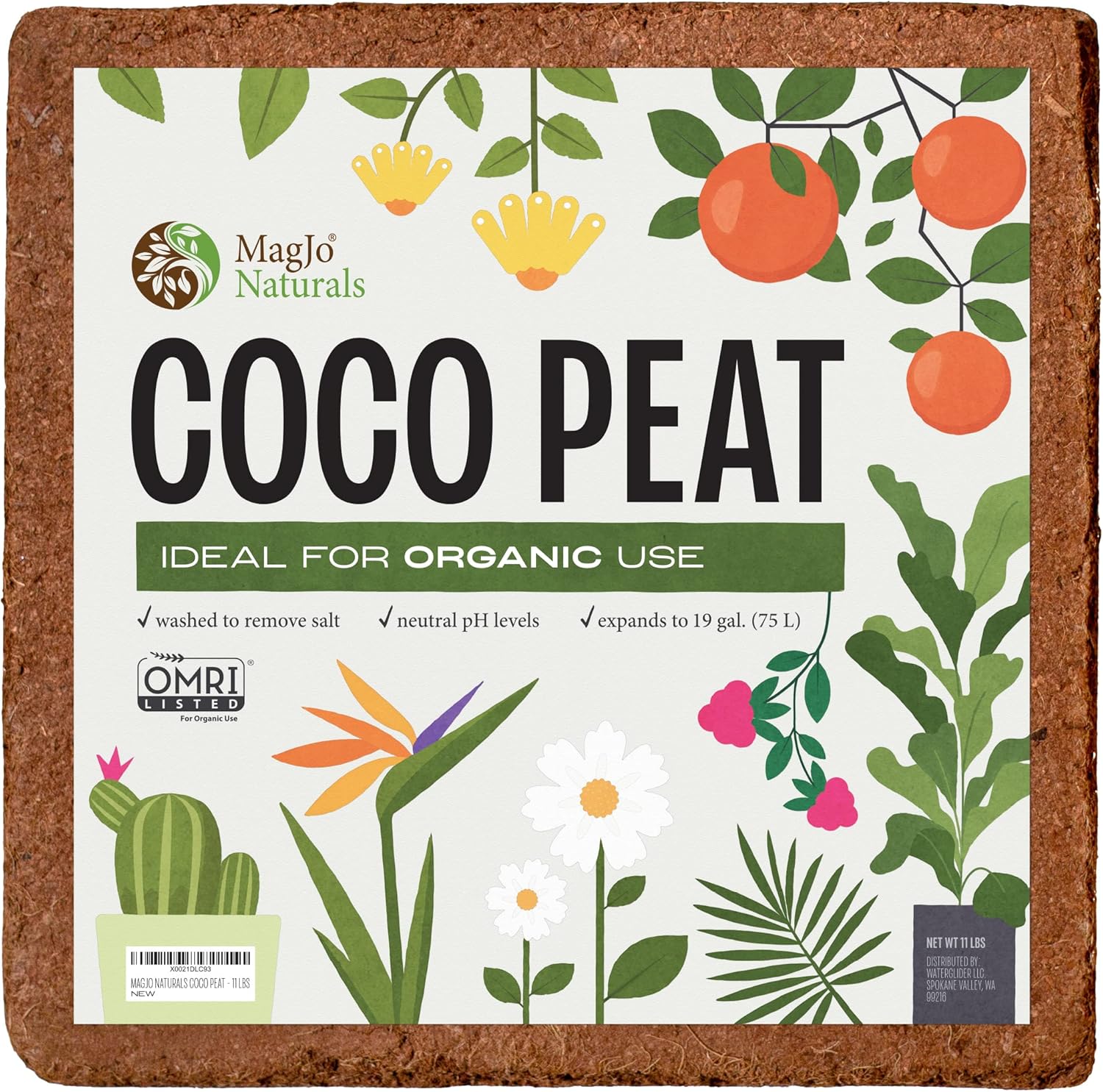
MagJo Naturals coco coir is a compressed 11 pound block that rehydrates into a loose, spongy growing medium suitable for potting mixes and hydroponic setups. It is OMRI listed for organic gardening and is described as washed to remove excess salts, which reduces the risk of sodium buildup when used for seed starting, container gardening, or media in ebb-and-flow and drip hydroponic systems. The block expands to give good aeration and water retention, helping roots access oxygen while holding moisture between waterings. Practical benefits include a renewable, peat-free alternative to peat moss and straightforward storage as a compact brick until you are ready to use it. Limitations are that you must fully rehydrate and fluff the block before use to avoid uneven moisture pockets, and it provides no nutrients on its own so fertilization is required for hydroponic or long-term container use.
Best for: Buyers who prioritize low-risk, reliable growing media for hydroponics or container gardening and want an organic, washed coco coir that is easy to store until needed.
Less Ideal for: Growers seeking a ready-to-use, nutrient-rich potting mix or those who prefer pre-mixed commercial hydroponic substrates with added nutrients.
- OMRI listed for organic gardening
- Washed to remove excess salts, safer for sensitive plants and hydroponic systems
- Expands into a light, airy medium that improves root oxygenation
- High water-holding capacity reduces watering frequency
- Compact compressed brick is easy to store and transport
- Requires full rehydration and manual fluffing before use
- Contains no nutrients and must be paired with appropriate fertilizers
Verdict: A compact, OMRI-listed washed coco coir block that gives risk-averse growers a dependable, peat-free base for hydroponic and container systems.
Choosing the Right Coco Coir for Hydroponics: Key Factors to Consider
Salt Content and Electrical Conductivity
Coco coir often contains residual salts from processing and marine-source coconut husks. In hydroponics, high soluble salts raise the media EC and can interfere with nutrient balance, especially for young plants and cuttings.
Look for coir with a low initial EC or that is marketed as pre-washed or buffered. If a product has higher EC, plan to rinse or buffer it before use and monitor solution EC closely. Consistent, low-salt coir reduces the time and water needed to stabilize nutrient concentrations and lowers the risk of osmotic stress.
Particle Size and Fiber Texture
The physical form of the coir-fine dust, pith, chips, or a graded mix-determines how quickly water drains and how much air remains around roots. Fine particles hold water tightly and can become oxygen-poor, while coarse chips improve aeration but drain faster.
Match particle texture to your hydroponic method. Dense mixes suit wick-style or low-frequency irrigation where you need moisture hold. Coarser grades fit flood-and-drain trays or systems that supply water frequently and benefit from better oxygen flow. Consistent particle size across a batch avoids pockets of poor drainage.
Water Retention Vs Aeration Balance
Successful hydroponic media find a balance between holding enough moisture for steady nutrient access and leaving air-filled pore space for healthy roots. Coco coir inherently retains water well, but the exact balance depends on grade and compression.
Consider how often your system irrigates and whether you can control flood timing. Higher retention coir reduces watering frequency but may require stronger aeration or more frequent floods to prevent compaction. Conversely, highly aerated coir needs more frequent nutrient delivery but can support vigorous root respiration.
pH Stability and Buffering
Coco coir tends to sit around neutral but can vary; it also has cation exchange properties that affect nutrient dynamics. A coir that holds pH within a predictable range simplifies nutrient management in hydroponics.
Buffered coir or products with manufacturer pH data shorten setup time because they resist wide swings when you first introduce nutrient solution. If using unbuffered coir, plan for an initial buffering step or close monitoring of pH during the first few irrigation cycles.
Preparation, Handling, and Cleanliness
How the coir arrives-compressed blocks, bricks, loose bags, or pre-fluffed-and how easy it is to hydrate matters for practical workflow. Compressed bricks save storage space but need thorough rehydration and possible rinsing. Pre-fluffed or bagged coir is ready faster but can be bulkier to store.
Also consider dust levels and cleanliness. Low-dust coir reduces clogging in pumps and emitters and is kinder to respiratory health during handling. Ease of rinsing and the amount of labor required to bring EC and pH to target values are real operational costs in a hydroponic setup.
Batch Consistency and Sourcing
Variation between production lots can cause unpredictable results when you scale up. Batch-to-batch consistency in particle distribution, EC, and moisture content ensures repeatable irrigation and nutrient schedules.
Prefer suppliers that specify testing or grading procedures. When consistency is unknown, purchase a smaller trial quantity to verify how it performs in your specific system before committing to large volumes.
Forms of Coco Coir and How They Fit Hydroponic Systems
Coco coir comes in several forms: compressed bricks and blocks that expand with water, loose chopped coir or chips, pre-fluffed bagged mix, and grow-pouches or slabs. Each form affects setup time, storage, and how the media behaves in different hydroponic styles.
Bricks are compact for storage and transport but require full rehydration and sometimes rinsing to lower EC. Loose or bagged coir is convenient for quick pot filling and propagation. Coir chips offer improved drainage and are often used where strong aeration is needed, such as in deep-water culture with frequent wetting cycles.
- Compressed bricks save space but need time and water to expand fully.
- Loose coir is fastest to use and typically cleaner to handle.
- Chips increase air space and reduce compaction in active systems.
Preparing Coco Coir for Hydroponic Use
A common preparation routine starts with full expansion using clean water, followed by repeated rinses or a buffering step with calcium and magnesium if the product has elevated EC. Take the time to check the media EC and pH after preparation so the coir enters the system near your target nutrient conditions.
For small-scale runs, a simple soak and drain may be enough. For larger or commercial setups, set a standard preparation protocol-consistent water volume, soak time, and rinse cycles-to ensure each batch performs the same.
- Soak until fully expanded, then test EC and pH.
- Rinse or buffer if initial EC is above your target.
- Record preparation steps so results are repeatable.
Managing Salt and Nutrient Uptake with Coco Coir
Salt and nutrient interactions are more pronounced in soilless media than in large soil volumes because the root zone is contained. High starting salts shift nutrient uptake and can cause marginal burn or reduced uptake of particular elements.
Use an EC meter and adjust nutrient concentrations during the initial cycles. If you see unexpectedly high EC readings from the media side, more thorough rinsing or switching to a low-EC batch may be necessary. Over time, consistent monitoring helps you avoid hidden salt buildup.
- Test media EC before planting and during early growth.
- Lower nutrient solution EC slightly during the first week after introducing new coir.
- Flush and refresh media between crops to avoid salt accumulation.
Compaction and Reuse Considerations
Coco coir can compress with repeated wet-dry cycles, reducing air-filled porosity and increasing the chance of root suffocation if not managed. Mechanical agitation, mixing with coarser material, or scheduled replacement can prevent compaction issues.
Reusing coir is common but requires sanitation and checks for residual salts, pathogens, and structural breakdown. When reusing, composting or solarization between cycles helps reduce pathogen load, and a fresh buffer rinse restores more predictable chemistry.
- Expect to amend or replace coir after several cropping cycles if structure degrades.
- Sanitize and test reused coir for EC and pH before replanting.
- Mixing in coarser media can restore aeration to compacted batches.
Practical Tips for Different Crop Types
Leafy greens and herbs often tolerate denser, higher-retention coir because they favor steady moisture without extreme root depth. Fruiting crops typically benefit from slightly coarser grades and more frequent irrigation to support higher oxygen demand and faster nutrient uptake.
For seedlings and cuttings, use finer, clean, low-salt coir or a propagation grade that holds moisture gently while allowing oxygen exchange. Adjust irrigation frequency and nutrient strength to match crop demands rather than expecting one coir grade to serve all crops equally.
- Use finer grades for propagation and early growth.
- Choose coarser mixes for vigorous, fruiting plants with higher oxygen needs.
- Adjust irrigation schedules to complement media retention characteristics.
How We Chose the Best Coco Coir for Hydroponics
We focused on factors that directly affect hydroponic root health and day-to-day system performance. Key evaluation criteria included fiber texture and grade because particle size controls drainage and air space; initial and residual soluble salt content since high salts impair nutrient uptake; buffering and pre-washability meaning how easily the coir reaches a stable EC and pH; water retention and air-filled porosity to balance moisture availability and oxygenation; and consistency of preparation-how uniform blocks, chips, or grow bags rehydrate and perform across multiple batches. We excluded products intended primarily for soil mixes, decorative mulches, or those with additives like perlite, peat, or slow-release fertilizers that change hydroponic nutrient balance. We also filtered out coir with inconsistent processing or unclear salt testing. The shortlist emphasizes materials that are clearly labeled for hydroponic or soilless use, with manufacturer specs or test data on EC and pH where available. These criteria align with the practical needs of growers using flood-and-drain, ebb-and-flow, drip, or DIY systems.
FAQ
Do I need to rinse coco coir before using it in hydroponics?
Often yes. Many coir products contain residual salts and dust, so rinsing or buffering reduces EC and removes fine particles. How thorough the rinse needs to be depends on initial EC readings and the product labeling.
Can coco coir be reused for multiple hydroponic crops?
It depends. Coir can be reused if it retains structure and tests low for salts and pathogens after sanitation. Reused coir often needs buffering and possibly mixing with fresh material to restore aeration.
What particle size of coco coir is best for ebb-and-flow systems?
A medium-coarse grade is usually best for ebb-and-flow because it balances water retention with good drainage and air-filled porosity during the dry portion of the cycle.
How does coco coir affect nutrient solution pH?
Coco coir can influence pH modestly due to its cation exchange capacity. Buffered coir tends to be more predictable, while unbuffered coir may require closer pH monitoring during the first few irrigation cycles.
Is coco coir compatible with all hydroponic crops?
Generally yes, but matching coir grade and irrigation frequency to the crop is important. Some crops with high oxygen demand need coarser mixes or supplemental aeration.
What common mistakes should I avoid when using coco coir in hydroponics?
Common issues include skipping initial rinsing, not testing EC and pH after preparation, and failing to manage compaction. Also avoid assuming one coir grade suits every crop without adjusting irrigation and nutrient schedules.
Final Verdict
Focus on the coir characteristics that most affect root-zone chemistry and structure: low and stable salt levels, a particle texture that matches your irrigation rhythm, and predictable water retention versus aeration. Prepare and test each batch before planting so your nutrient program starts from a known baseline. Prioritize consistency and manageable preparation steps over convenience alone, and adjust irrigation and crop choice to what the media actually provides. With those tradeoffs understood, you can select coco coir that supports steady growth and reliable harvests in hydroponic setups.
