

Note: This article contains affiliate links. If you click on these links and make a purchase, I may earn a small commission at no extra cost to you. This helps support my research and content. Read my full affiliate disclosure here.
Winter brings unique demands for outdoor watering and seasonal cleanup, so choosing a hose built for cold conditions matters. A hose that remains flexible when temperatures drop, resists kinks, and protects fittings can prevent bursts, leaks, and frustrating downtime. This guide shortlists the best cold weather garden hoses for gardeners who need reliable winter performance around vegetable beds, containers, and landscape irrigation. Each pick in this roundup was evaluated on real-use factors that matter in the yard, including low-temperature flexibility, kink resistance, and durable fittings. Read on to see which hoses performed best on those criteria and why they suit different winter tasks.
Top Picks at a Glance
| Best Overall The best all-around choice for most situations | SPECILITE 50 ft x 5/8 in Hot/Cold Garden Hose |  |
| Best Quality Built to a higher standard if you want something more solid | Continental Premium Cold Water Garden Hose, 5/8 in x 100 ft |  |
| Best Value The sweet spot between price and what you get | Guitrees 75 ft Heavy-Duty Rubber Garden Hose (3/4") |  |
| Best Budget The cheapest option that still gets the job done reliably | BLUBIRD AG-LITE Rubber Garden Hose (6 ft), High-Strength, Cold-Weather Rated |  |
| Highest Rated A top-rated pick with lots of positive feedback | WILAWELS Heavy-Duty 30 ft Rubber Garden Hose (5/8" I.D.) |  |
| Most Popular A crowd favorite that many people choose with confidence | Giraffe Tools 5/8" Heavy Duty Garden Hose, 100 ft |  |
| Best Seller A high-volume bestseller chosen again and again | Flexzilla Colors Garden Hose, 5/8 in. x 50 ft (Brown Mulch) |  |
SPECILITE 50 ft x 5/8 in Hot/Cold Garden Hose

| Material Type | Rubber |
|---|---|
| Unit Count | 50 Feet |
| Inside Diameter | 5/8’’ |
| Working Temperature | -50°F to 190°F |
| Maximum Pressure | 605 psi |
This SPECILITE 50 ft, 5/8‑inch garden hose is built for year‑round outdoor watering where temperatures swing widely. The hose combines blended rubber and polymer layers for flexibility and abrasion resistance, 100% solid brass 3/4‑inch fittings with a 360° rotating collar to reduce leaks, and a claimed working temperature range from -50°F to 190°F. In practice that means it stays pliable in deep winter and resists softening or melting on very hot days, so it is useful for routine garden watering, washing tasks, and draining hot water appliances. The hose’s working pressure (200 psi) and high burst rating (605 psi) support strong flow and reduce the chance of failure under pressure. It is heavier than lightweight expandable hoses and will take more storage space, but the weight reflects a thicker rubber construction that resists kinks and abrasion. If you need a dependable, all‑season hose that tolerates extreme temperatures and frequent outdoor use, this model delivers; if you prioritize ultra‑lightweight or compact storage, a different style may be preferable.
Best for: Gardeners who want a durable, year‑round hose that stays flexible in freezing weather and tolerates hot‑water tasks and heavy outdoor use.
Less Ideal for: Users who need an ultra‑light or highly compact hose for frequent carrying or tight storage spaces should consider lighter coil or expandable hoses instead.
- Wide temperature range (-50°F to 190°F) suitable for very cold and very hot conditions.
- Solid brass 3/4‑inch fittings with 360° rotating collar to reduce leaks and corrosion.
- High burst pressure (605 psi) and a 200 psi working pressure for reliable water flow.
- Rubber/polymer construction that resists kinking and surface abrasion.
- Heavier rubber construction requires more storage space and is less compact than lightweight expandables.
- No explicit warranty information provided in the product details.
Verdict: Choose this hose if you need a tough, all‑season garden hose that stays flexible in extreme cold and handles very hot water safely.
Continental Premium Cold Water Garden Hose, 5/8 in x 100 ft

| Material Type | Brass, Rubber |
|---|---|
| Maximum Pressure | 130 psi |
| Item Length | 100 feet |
This Continental Premium cold water hose is a straightforward, performance-focused choice for year-round outdoor watering where low-temperature flexibility matters. Made from heavy-gauge rubber it resists abrasion and corrosion better than many vinyl hoses and stays pliable down to -40 F, so it will not stiffen and kink in freezing conditions. Brass male and female fittings add durability at connection points and help prevent leaks under pressure. With a 5/8 inch inside diameter and 130 psi maximum pressure it delivers solid flow for lawn sprinkling, filling large containers, and power-washer feed lines. The hose is heavier than lightweight consumer options, which helps durability but makes handling and storage a bit more work. It is a no-frills, utilitarian product without built-in swivel connectors or storage features, so plan to use a reel or heavy-duty hanger. For cold-climate gardeners who prioritize reliability and longevity over low weight or accessory features this hose performs well.
Best for: Gardeners and outdoor homeowners who need a dependable hose that keeps working in freezing temperatures and prioritize durable materials and steady flow over light weight.
Less Ideal for: Casual users who prefer an ultralight or compact hose for easy handling and storage should consider lighter synthetic options with accessory fittings included.
- Designed for cold temperatures down to -40 F so it stays flexible in freezing weather
- Heavy-gauge rubber construction resists abrasion and corrosion for longer service life
- Brass fittings provide strong, leak-resistant connections
- 130 psi maximum pressure supports strong flow for demanding tasks
- Heavier weight makes it harder to coil and move compared with lightweight hoses
- No integrated swivel or quick-connect accessories included
Verdict: Choose this hose if you need a rugged, cold-weather-ready hose that stays flexible and reliable when temperatures drop.
Guitrees 75 ft Heavy-Duty Rubber Garden Hose (3/4")

| Material Type | Rubber |
|---|---|
| Unit Count | 75 Feet |
| Maximum Pressure | 1000 psi |
| Brand Name | Guitrees |
This Guitrees 75 ft rubber hose is designed for demanding outdoor work where durability and cold-weather performance matter. It handles high working pressures and a very high burst rating, uses five-layer braiding for reinforcement, and comes with solid brass 3/4" GHT fittings that make connecting to spigots and accessories secure. Typical use cases are year-round watering, tasks on construction sites, and irrigation where the hose must stay flexible in low temperatures. The rubber construction resists kinking and remains pliable in cold weather down to very low temperatures claimed by the brand, which reduces hookup and storage hassles in winter. Practical benefits include robust fittings, long reach from a single length, and a construction that tolerates heavy use. Important limitations are the hose weight and bulk when full and the single color and size option shown here; it is heavier than lightweight vinyl hoses and less convenient for frequent carrying or tight storage spaces.
Best for: Buyers who prioritize a durable, all-weather hose that stays flexible in cold conditions and can withstand heavy use around the yard or job site.
Less Ideal for: If you need an ultra-lightweight hose for frequent carrying, very compact storage, or decorative color choices, a lighter vinyl or expandable hose would be a better pick.
- High burst and working pressure ratings for demanding tasks
- Five-layer braided rubber construction improves durability and resists kinks
- Solid brass 3/4" GHT fittings provide secure, leak-resistant connections
- Rated for hot and cold water and designed to stay flexible in very low temperatures
- Heavier and bulkier than vinyl or lightweight hoses which makes handling and storage harder
- Only one length and color option listed which limits customization for small yards
Verdict: Choose this hose if you want a long, rugged rubber line that remains flexible in cold weather and stands up to heavy-duty watering and site work.
BLUBIRD AG-LITE Rubber Garden Hose (6 ft), High-Strength, Cold-Weather Rated

| Material Type | Brass, Polyester, Rubber |
|---|---|
| Maximum Pressure | 500 psi |
| Item Length | 72 inches |
| Nominal Wall Thickness | 0.0625 inches |
The BLUBIRD AG-LITE rubber hose is a compact, heavy-duty garden hose built for cold-weather performance and high pressure. It is made from 100% rubber with a polyester braid for strength and is rated to 500 psi, so it can handle demanding watering jobs and brief hot-water use. The hose is advertised with excellent cold flexibility, remaining pliable to very low temperatures and resisting kinks, abrasion, and ozone exposure, which makes it easy to maneuver in winter conditions. Its braided construction and brass-compatible fittings are practical for connecting to standard GHT outlets, and the included bend restrictor helps protect the ends from wear. The main limitations are length and intended use: this listing is for a short 6-foot section, so you will need multiple sections or a longer model for general garden coverage, and the weight and stiffness of a true rubber hose may be more than ultra-light vinyl options when coiling and storing. For cold-climate tasks where durability and pressure capacity matter, this hose delivers reliable performance in a compact package.
Best for: Buyers in cold climates who need a durable, kink-resistant hose for winter watering, heavy-duty outdoor tasks, or occasional hot-water use and prioritize longevity over ultra-lightweight portability.
Less Ideal for: Gardeners who need long single-run lengths for lawns or who prefer the lightest possible hose for frequent carrying and compact storage should consider other options.
- 100% rubber construction with polyester braid for high abrasion resistance and strength
- High maximum pressure rating (500 psi) suitable for demanding watering and some hot-water use
- Designed for extreme cold flexibility and ozone resistance to reduce cracking and kinks
- Reinforced fittings and included bend restrictor protect connection points
- Product listing is for a short 6-foot length which limits single-hose coverage
- True rubber hoses are heavier and bulkier to store compared with lightweight vinyl alternatives
Verdict: Choose this hose if you need a short, rugged rubber hose that stays flexible and reliable in very cold weather.
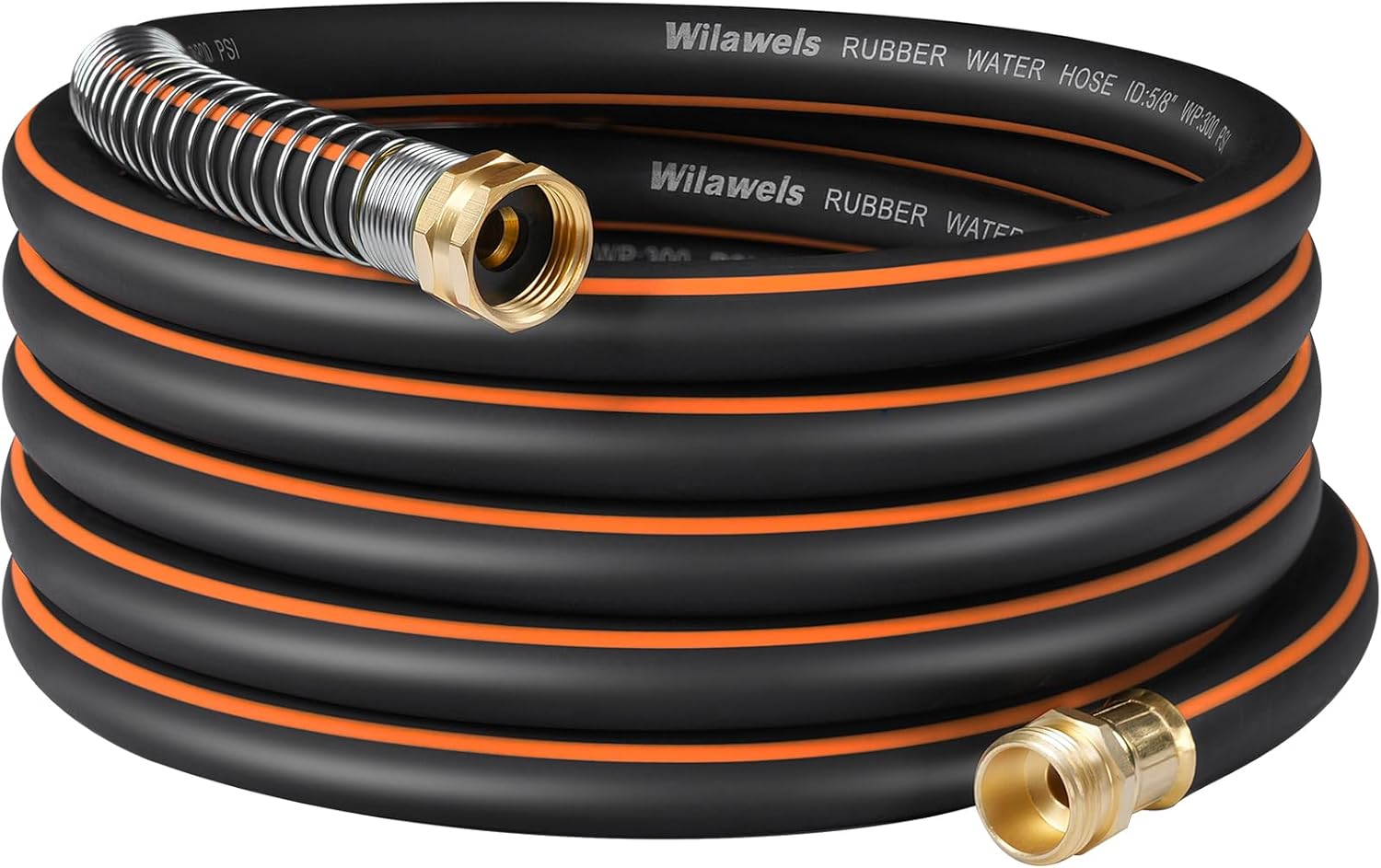
WILAWELS Heavy-Duty 30 ft Rubber Garden Hose (5/8" I.D.)
| Material Type | Rubber |
|---|---|
| Hose I.D. | 5/8 inch |
| Maximum Pressure | 1000 psi |
| Working Pressure | 300 PSI |
| Operating Temperature Range | -40°F to 176°F |
This WILAWELS 30 ft rubber hose is designed for durability and all-weather use, making it a practical choice when you need a reliable cold-weather hose. It has a 5/8-inch inner diameter, 5-layer braided rubber construction, and 3/4-inch brass connectors with a 360° rotating connector and built-in rubber sealing ring to reduce leaks and twisting at the faucet. A stainless steel protective ring at the inlet helps prevent stress and kinking where hoses usually fail. The hose is rated for a 300 PSI working pressure and 1000 PSI burst pressure and is specified to remain functional between -40°F and 176°F, so it should stay flexible in freezing conditions where cheaper hoses would stiffen or crack. Expect a heavier feel compared with polymer hoses, which helps with longevity but makes handling and coiling slightly more effort. It does not include a storage reel or nozzle, so plan to pair it with quality accessories for year-round use.
Best for: Buyers who prioritize a long-lasting, leak-minimizing hose that will remain flexible in freezing temperatures and who value durability over lightweight convenience.
Less Ideal for: People who need an ultra-lightweight, easy-to-store hose for frequent carrying or who want a complete set that includes reels or spray nozzles.
- Rubber construction with 5-layer braiding for strong puncture and wear resistance
- Rated to operate from -40°F to 176°F so it remains flexible in cold weather
- 360° swivel connector and rubber sealing ring reduce faucet twisting and leaks
- Stainless steel inlet ring protects against bending and kinking
- High burst pressure (1000 PSI) and 300 PSI working pressure for demanding uses
- Heavier and less lightweight than polymer or hybrid hoses, which makes handling and storage more effort
- No included storage accessories such as a reel or nozzle
Verdict: Choose this hose if you want a heavy-duty rubber line that stays flexible and resists damage in very cold weather.
Giraffe Tools 5/8" Heavy Duty Garden Hose, 100 ft

| Material Type | Polymer |
|---|---|
| Item Length | 100 feet |
| Nominal Wall Thickness | 3 millimeters |
| Maximum Pressure | 150 psi |
The Giraffe Tools 100 ft heavy duty garden hose is built as a hybrid polymer hose for everyday yard work and demanding watering tasks. It is typically used for watering lawns and garden beds, running sprinklers, or cleaning patios where a long reach and reliable flow are needed. Notable features include a reinforced middle layer to resist bulging, an abrasion- and UV-resistant outer layer for season-long durability, and threaded connections with built-in gaskets to reduce leaks. The hose is relatively lightweight for its length, coils and stores neatly on reels, and swivel handles at the cuff help prevent kinks when you unroll or move it around corners. Important limitations are that a 5/8-inch diameter provides moderate flow compared with larger commercial hoses and the polymer construction, while durable, will not match the puncture resistance or lifetime of heavy rubber industrial hoses. For typical residential heavy-duty use it balances flexibility, storage convenience, and sturdiness effectively.
Best for: Buyers who want a long, durable residential hose that resists kinks and leaks for regular heavy-duty yard tasks and who value social proof and risk mitigation when choosing a dependable product.
Less Ideal for: Commercial users needing maximum flow or extreme puncture resistance should consider larger-diameter or rubber industrial hoses instead.
- 100 ft length gives long reach for large yards and sprinkler setups
- Reinforced middle layer and reinforced ends reduce bulging and connection cracking
- Abrasion- and UV-resistant outer layer improves durability for four-season use
- Built-in gaskets and threaded connections minimize leaks and simplify hookups
- 5/8-inch diameter limits peak flow compared with larger commercial hoses
- Polymer construction is less puncture-resistant than heavy rubber industrial hoses
Verdict: A long, kink-resistant hybrid hose that balances durability and ease of use for heavy-duty residential watering tasks.
Flexzilla Colors Garden Hose, 5/8 in. x 50 ft (Brown Mulch)

| Material Type | Hybrid Polymer |
|---|---|
| Unit Count | 50 Feet |
| Maximum Pressure | 150 psi |
| Outside Diameter | 0.63 inches |
This Flexzilla Colors 5/8 in. x 50 ft hose is built around a flexible hybrid polymer that stays pliable in cold weather and resists kinking and memory so it coils and lays flat after use. Typical use is watering lawns, beds, or washing outdoor surfaces where a lightweight, easy-to-handle hose matters; the reinforced mid-layer and abrasion-resistant outer cover add durability for routine garden work. The anodized aircraft aluminum fittings and durable O-ring are designed to minimize leaks at the spigot, so you spend less time tightening connections. It handles up to 150 psi, which covers normal home watering tasks, and the earth-tone finish blends into landscaped areas. The trade-offs are that it is a 5/8-inch diameter and 50-foot length only, so gardeners needing heavier commercial flow, longer runs, or larger-diameter hoses should look elsewhere, and its lighter weight may feel less robust than heavy-duty rubber hoses for very rough use.
Best for: Buyers who prioritize a low-maintenance, reliable garden hose that stays flexible in cold weather and reduces leaking, especially for routine residential watering and outdoor cleaning.
Less Ideal for: People needing very high flow rates, much longer hose runs, or an extra-heavy-duty rubber hose for commercial or construction use should consider other options.
- Remains flexible in cold weather and resists kinking, making it easier to use year-round.
- Abrasion-resistant outer cover and reinforced mid-layer improve durability for everyday garden tasks.
- Anodized aircraft aluminum fittings with a durable O-ring provide reliable, low-leak spigot connections.
- Lightweight construction makes it easy to carry, maneuver, and coil for storage.
- Only available in a 5/8-inch diameter and 50-foot length in this listing, limiting flow and reach for larger jobs.
- Lighter construction can feel less heavy-duty for extremely rough or commercial use.
Verdict: Choose this hose if you want a lightweight, cold-weather friendly hose that resists kinks and delivers reliable, leak-resistant connections for everyday garden use.
Choosing the Right Cold Weather Garden Hose: Key Factors to Consider
Low-Temperature Flexibility
Hoses that remain pliable in cold weather are easier to unroll, route around beds, and attach to spigots without cracking. Flexibility depends on the hose material and wall construction; some formulations resist stiffening down to near-freezing or subfreezing temperatures while others become rigid and brittle.
A flexible hose reduces strain on fittings and lowers the chance of kinks forming when you move it. If you need to water occasionally in late fall or early spring, prioritize hoses with explicit low-temperature ratings or ones made from cold-resistant polymers.
Kink Resistance
Kinking interrupts flow and creates weak points that can split when exposed to ice. Kink-resistant designs use reinforcement layers, braided jackets, or thicker walls to keep a round profile under bending. For winter use, a hose that resists kinking when coiled on the ground or run around corners will last longer and maintain steady water delivery.
Consider how you store and deploy the hose. If you routinely pull a hose across uneven ground or wrap it around sharp corners, choose a kink-resistant option to avoid repeated stress and potential failures.
Fitting Durability and Seal Integrity
Metal or reinforced fittings that maintain a tight seal through freeze-thaw cycles matter for preventing leaks and breaks. Cheap or thin fittings can bend, crack, or lose sealing when exposed to thermal contraction. Look for fittings with corrosion-resistant platings and robust attachment to the hose body to reduce the chance of separation when ice forms near the coupling.
A reliable fitting also simplifies winter hookup to insulated spigots or heated enclosures. Where possible, prefer fittings that allow easy replacement or repair to extend service life.
Inner Liner Strength and Construction
The hose inner liner is the first defense against splitting when water freezes or when flow is suddenly restricted. Multi-layer liners, braided reinforcement, or thicker single liners make a hose less likely to burst under pressure changes or when partially frozen.
Hoses with clearly specified burst pressures and construction details give a better sense of cold-weather resilience. For intermittent winter use, a stronger liner reduces the risk of seasonal damage.
Weight, Handling, and Storage
Heavier hoses can be harder to coil and store, especially when they remain stiff from cold temperatures. Conversely, very light hoses may lack reinforcement needed for winter durability. Consider how you will roll, unroll, and store the hose between uses. A manageable weight and a design that stores compactly will reduce frustration and the temptation to leave a hose exposed to freezing conditions.
Storage solutions such as wall reels or insulated boxes can mitigate handling issues, but the hose itself should be easy to move and lay out when temperatures dip.
Compatibility with Winter Accessories
Think about how the hose will interface with spigot insulators, quick-connect systems, or inline heaters. Thread size and fitting shape affect compatibility with winter-proof attachments that can protect the faucet or maintain flow in cold spells.
Confirming standard thread sizes and sturdy fitting profiles will make it easier to add insulation or protective gear without compromising the hose seal during subzero conditions.
Why Cold Weather Hoses Behave Differently
Materials used in garden hoses respond to low temperatures in characteristic ways. Thermoplastic formulations can become brittle, rubber blends may retain flexibility longer, and reinforcement layers help maintain shape under bending. Understanding these behaviors helps explain why some hoses kink or split in winter while others keep working.
Thermal contraction can also affect fittings and seals. Even a hose that stays flexible can leak if a coupling contracts more than the hose body. That is why matching hose construction with durable fittings matters for dependable winter performance.
- Rubber or rubber-blend hoses usually perform better at low temperatures than cheap vinyl.
- Reinforced jackets help maintain a round cross-section and reduce pinhole failures.
- Cold ratings and manufacturer specifications provide useful guidance but test real-world handling too.
Proper Winter Storage and Handling
Storage technique is as important as hose choice. Drain hoses completely before storing and keep them indoors or in an insulated outdoor box to prevent water from freezing inside and damaging the liner. If you must leave a hose connected, use a heated spigot or place the coupling in a frost-free enclosure.
When deploying a hose in cold weather, unroll it fully and avoid tight coils that trap water. Gentle handling reduces stress on fittings and minimizes the chance of creating kinks that lead to breakage.
- Always drain and dry the hose before storing for long freezes.
- Use a reel or hanger to avoid ground contact and exposure.
- Check fittings and seals at the start of the season for cracks or corrosion.
Protecting Fittings and Spigots
Fittings are common failure points in cold conditions. Insulating the spigot and any exposed couplings reduces ice formation at the connection and helps maintain a tight seal. For exposed outdoor faucets, add a simple insulated cover or build a small enclosure to keep the immediate area above freezing when practical.
Consider using replaceable or upgradeable fittings so you can swap in more durable couplings if the originals show wear. Keeping threads clean and using a small amount of plumber-approved sealant tape when needed can also improve leak resistance.
- Insulate spigots and exposed couplings during freezing weather.
- Inspect and replace worn fittings before winter sets in.
- Avoid overtightening metal fittings, which can crack brittle hose ends.
Using Hoses for Winter Tasks
Cold-weather hoses are useful for a range of seasonal tasks, from winterizing containers to brief watering on mild winter days. For short, occasional runs to soak root zones or rinse salt from walkways, flexibility and kink resistance are most important. For longer-duration tasks or if you expect partial freezing, choose a hose with a stronger inner liner and robust fittings.
If you rely on hoses for livestock watering, greenhouse tasks, or winter irrigation, plan for frequent inspection. Ice formation can hide small leaks, so check connections and the hose body often when temperatures fluctuate.
- Use short runs for quick watering to minimize exposed water volume.
- Keep hoses elevated off cold surfaces when possible.
- Check for small leaks after thaw cycles to catch damage early.
When to Replace a Cold Weather Hose
Replace hoses that show cracks, bulging near fittings, or repeated leaks after thawing. Visible brittleness, especially along bends, indicates material breakdown from cold exposure or age. A hose that kinks easily or loses its round shape under light pressure is likely near end of life for winter use.
Routine replacement every few seasons may be the most reliable path if you use the hose through multiple freezes. Inspect hoses seasonally and retire any that cannot maintain pressure or sealing.
- Look for cracks, soft spots, or bead separation at fittings.
- If a hose fails repeatedly during freezes, replacement is safer than repair.
- Consider replacing fittings separately if the hose body still appears sound.
How We Chose the Best Cold Weather Garden Hose
We evaluated hoses based on attributes that directly affect winter garden performance. Primary evaluation criteria included low-temperature flexibility, which measures how pliable the hose remains near or below freezing; kink resistance, which affects flow and durability during frequent handling; and fitting durability, assessing the strength and sealing of couplings exposed to ice and thermal cycling. We also considered inner-liner construction and burst pressure ratings as indicators of resistance to splitting when water freezes, plus overall weight and handling for routine winter tasks. Our process filtered out garden hoses lacking clear specifications for cold-weather use or those with fittings that commonly fail under freeze-thaw conditions. We excluded hoses designed only for warm-season use, lightweight decorative hoses without cold ratings, and any product with unclear materials or poor customer reliability signals. The remaining selections were compared across the evaluation dimensions above to highlight options suited to different winter gardening setups.
FAQ
Can I leave a hose connected to an outdoor spigot in winter?
It often depends on local temperatures and whether the spigot is frost-free. Leaving a hose connected can trap water that freezes and damages both the hose and spigot. If you must leave it connected, insulate the spigot and keep the hose drained whenever possible.
How cold is too cold for a regular garden hose?
Regular hoses can become stiff and brittle near or below freezing, increasing the risk of cracking. Hoses without cold-weather ratings are best removed and drained before prolonged freezes. Cold-weather hoses specify lower temperature performance to reduce that risk.
Will a thicker hose prevent freezing inside the line?
A thicker wall and reinforced liner reduce the chance of splitting under pressure but do not prevent water from freezing. Reducing water volume in the hose, draining it, and insulating exposed sections are more effective ways to prevent internal ice damage.
Are rubber hoses better for winter than vinyl ones?
Rubber or rubber-blend hoses typically retain flexibility better in low temperatures compared with thin vinyl hoses. That said, construction and reinforcement matter too, so check cold-performance specifications rather than relying on material alone.
How should I store a hose between winter uses?
Drain the hose completely, coil it loosely, and store it in a dry, temperature-controlled area such as a garage or shed. If indoor storage is not possible, use an insulated outdoor box and keep the hose off frozen ground to reduce exposure.
Can I repair a hose that split after freezing?
Minor splits near the middle of a hose can sometimes be repaired with a coupling repair kit. However, splits near fittings or repeated failures often indicate more widespread damage and replacement is usually the safer long-term solution.
Final Verdict
Prioritize hoses that balance low-temperature flexibility with strong fittings and a reinforced inner liner for reliable winter performance. Expect tradeoffs between weight and reinforcement; heavier, well-constructed hoses usually resist kinks and bursts better but require easier storage solutions. Focus on how you will use and store the hose through freezes. Choose a hose rated for cold conditions, protect fittings, and inspect the line each season to reduce the chance of winter damage and to keep watering chores predictable.
