

Note: This article contains affiliate links. If you click on these links and make a purchase, I may earn a small commission at no extra cost to you. This helps support my research and content. Read my full affiliate disclosure here.
If you manage large properties, parks, or commercial landscapes, selecting the right commercial deer repellent makes the difference between repeated plant loss and stable, healthy beds. A product that provides broad coverage, long-lasting deterrence, and simple application reduces labor and keeps ornamentals, shrubs, and young trees safe across acres. This guide covers seven shortlisted commercial deer repellent options suited for expansive sites. We focus on measurable factors gardeners and landscape managers care about, including how long treatments last, how easy they are to apply on a large scale, and how the repellent interacts with different plantings. Use the evaluation notes to match a product to your site conditions and maintenance capacity.
Top Picks at a Glance
| Best Overall The best all-around choice for most situations | Deer Out 1 Gallon Concentrate Deer Repellent (Minty Fresh) |  |
| Best Quality Built to a higher standard if you want something more solid | Trico Pro Natural Deer Repellent Concentrate, 1 Gallon |  |
| Best Value The sweet spot between price and what you get | Bobbex Concentrated Deer Repellent (64 fl oz) |  |
| Best Budget The cheapest option that still gets the job done reliably | Deer Out Ready-to-Use Deer Repellent, 40 oz |  |
| Highest Rated A top-rated pick with lots of positive feedback | EPIC Deer Scram Professional Deer Repellent, 10 lb Bag |  |
| Most Popular A crowd favorite that many people choose with confidence | Liquid Fence Deer & Rabbit Repellent Ready-to-Use Spray, 1 Gallon |  |
| Best Seller A high-volume bestseller chosen again and again | Bonide Repels-All Animal Repellent Granules, 3 lb |  |
Deer Out 1 Gallon Concentrate Deer Repellent (Minty Fresh)

| Item model number | D00004 |
|---|---|
| Manufacturer | DEER OUT LLC |
| Date First Available | June 17, 2009 |
| ASIN | B002DQQ346 |
Deer Out 1 Gallon Concentrate is a mint-scented, ready-to-mix repellent that gardeners and landscapers apply to flowers, shrubs, vegetables and young trees to keep deer, rabbits and groundhogs from browsing. You dilute the concentrate per label directions and spray it on foliage; the formula includes natural sticky agents so the coating adheres and resists light rain. The product emphasizes an all-natural ingredient list and a pleasant scent to humans while remaining effective against cervids and small mammal pests. For performance-focused buyers, its key strengths are the long-lasting protection and suitability for year-round use, which reduce how often you need to reapply compared with water-soluble sprays. Important limitations are that it requires proper dilution and application for safety and effectiveness and that heavy downpours or irrigation may eventually reduce protection, requiring reapplication; it also does not physically exclude animals like fencing does. This concentrate is best used when you want a high-coverage, repeatable deterrent for ornamental beds, vegetable plots or perimeter plantings without permanent barriers.
Best for: Gardeners and property owners who prioritize reliable, long-lasting chemical deterrence over fencing and want a concentrated product to protect multiple plantings across a yard or small farm.
Less Ideal for: People seeking an immediate physical barrier, a zero-application solution, or those unwilling to mix and spray a concentrated product should consider fencing or pre-mixed alternatives.
- Concentrated gallon formula covers large areas after dilution
- Minty scent pleasant to people while deterring deer and similar animals
- Contains natural sticking agents that improve rain resistance
- All natural ingredients suitable for use around children and pets when used as directed
- Requires correct dilution and spraying equipment to apply effectively
- Not a physical barrier so determined animals may still reach plants under some conditions
Verdict: Choose Deer Out concentrate when you need a performance-focused, long-lasting, easy-to-cover deer deterrent for large gardens and landscape plantings.
Trico Pro Natural Deer Repellent Concentrate, 1 Gallon
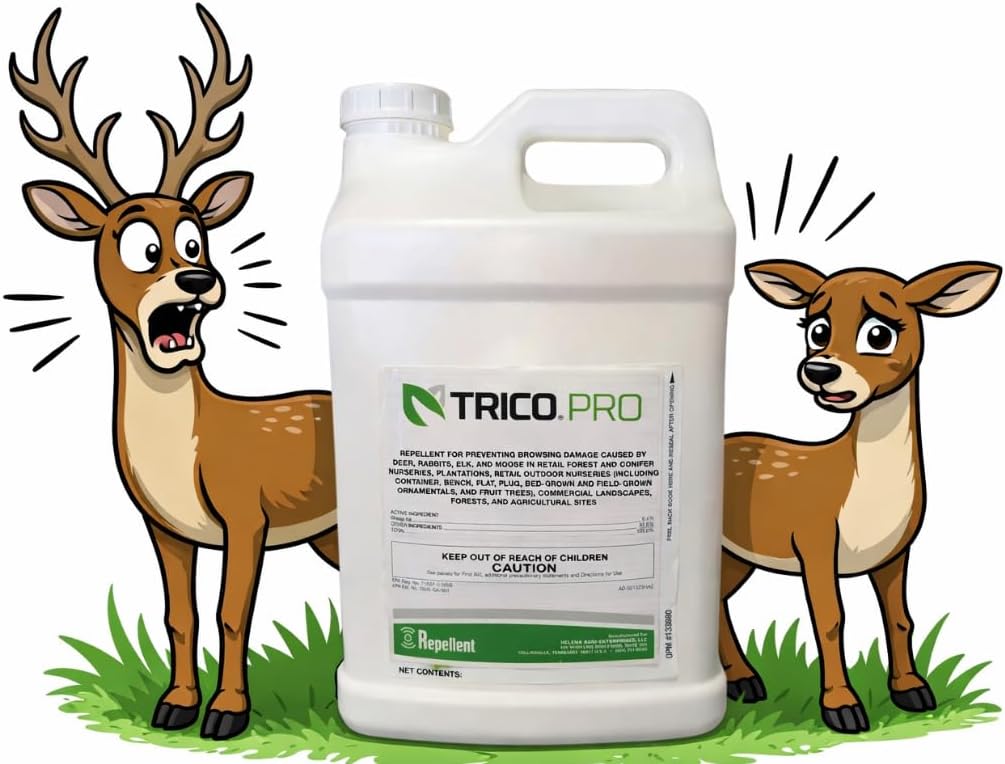
| Ingredient | Sheep Fat |
|---|---|
| Formulation | Concentrate |
| Labelled duration | Up to 6 months |
| Recommended dilution | 9:1 (≈12–16 fl oz per gallon) |
Trico Pro is a concentrated, sheep‑fat based liquid repellent designed to protect agricultural plantings and landscape ornamentals from deer, elk, moose and rabbits by targeting both smell and taste. It is typically diluted (recommended 9:1) and applied with a pump sprayer or mist blower to row crops, vineyards, orchards, turf, shrubs and seedlings. Key features include a weather‑resistant formula that the maker says lasts up to six months, a thick concentrate that produces a subtle odor to humans but is strongly repellent to browsing animals, and label rates for small‑scale and field use. For performance‑minded buyers this product is attractive because it covers large areas per application when diluted, reduces replanting need from browsing damage, and works across multiple species. Important limitations are that the concentrate is viscous and may require careful mixing and a sprayer that handles thicker fluids, and efficacy depends on correct application and initial coverage; results will vary by local deer pressure and environmental conditions.
Best for: Growers and serious property owners who need a commercial‑grade deterrent to protect crops or high‑value plantings and prioritize long duration between treatments.
Less Ideal for: Casual gardeners with small ornamental beds who prefer ready‑to‑use sprays or who lack appropriate spray equipment should consider simpler consumer products.
- Dual mode of action that repels by both scent and taste
- Long lasting, weather resistant formula rated up to six months
- Concentrated liquid covers large areas when diluted, lowering reapplication frequency
- Labelled for wide range of uses including crops, vineyards, orchards, ornamentals and turf
- Very thick concentrate that can clog or strain small sprayers if not properly diluted
- Effectiveness depends on thorough coverage and may vary with local wildlife pressure
Verdict: A concentrated, dual‑action repellent built for long‑lasting commercial protection of crops and high‑value plantings.
Bobbex Concentrated Deer Repellent (64 fl oz)

| Item Volume | 64 fluid ounces |
|---|---|
| Scent Name | Unscented |
| Item Form | Oil |
| Material Features | Natural |
Bobbex Concentrated Deer Repellent is a liquid deterrent that uses multiple smell and taste agents to discourage deer, elk, and moose from browsing garden plants. The product is sold as a concentrate that you dilute with water and apply to plant foliage with a pump or trigger sprayer. Notable features include a long-lasting formula that the manufacturer says resists washing off and an unscented, oil-based delivery that is described as harmless to people, pets, birds, and aquatic life when used as directed. In practice this makes Bobbex well suited for landscape beds, shrubs, and many types of ornamental and edible plants except for delicate edible leaves and soft berries. The concentrate format reduces repeat purchases for larger properties but requires careful mixing and even coverage to be effective. Users should expect to reapply after heavy rainfall beyond normal resistance claims and to avoid use on certain herbs and berries. For commercial or serious home use it offers a proven, widely used option that balances effectiveness with environmental safety.
Best for: Gardeners and commercial landscapers who prioritize a proven, long-lasting, environmentally friendly repellent and are willing to mix concentrate for broader coverage.
Less Ideal for: Casual gardeners who want a ready-to-use spray for small potted herbs or soft fruits, or buyers who prefer a no-mix, immediate-use product.
- Concentrated formula reduces frequency of repurchase for large gardens or commercial areas
- Natural ingredient blend designed to deter multiple herbivores including deer, elk, and moose
- Reported long-lasting performance that is more rain-resistant than many sprays
- Formulated to be environmentally compatible and safe for people, pets, birds, and aquatic life when used correctly
- Requires dilution and proper mixing which adds preparation time
- Not recommended for use on many edible leaves, herbs, or soft-skinned berries
- Effectiveness depends on thorough coverage and periodic reapplication after heavy rain
Verdict: A concentrated, research-backed repellent that delivers long-lasting protection for large lawns and commercial plantings while remaining environmentally friendly.
Deer Out Ready-to-Use Deer Repellent, 40 oz

| Item model number | D00001 |
|---|---|
| Manufacturer | DEER OUT LLC |
| Date First Available | June 17, 2009 |
Deer Out Ready-to-Use is a spray deer repellent intended for gardens, shrubs, vegetables and small landscape plantings. It is applied by misting both tops and undersides of leaves and allowed about an hour to absorb before watering or rain. The formula emphasizes natural oils with a minty scent that people find pleasant while being unappealing to deer, and the product claims rain resistance due to two natural stickers so it stays on foliage longer than simple rinsable sprays. Typical use is routine maintenance every 30 to 90 days, with more frequent reapplication during heavy browsing, rapid growth, or after heavy rain. Practical benefits include a non-toxic ingredient profile suited to yards with kids and pets and a ready-to-use spray bottle that removes mixing steps. Limitations are that it requires thorough coverage and periodic reapplication under heavy pressure or wash-off conditions and it should not be applied to plants with harvestable food commodities present, which restricts use on edible crops near harvest.
Best for: Buyers who want a straightforward, low-maintenance deer deterrent for ornamental beds and landscape plants and prefer natural, ready-to-use products that minimize setup and fuss.
Less Ideal for: Gardeners who need a long-lasting solution for high deer pressure on large acreages or who plan to apply to edible crops close to harvest should consider other approaches.
- Ready-to-use spray requires no mixing and is easy to apply
- Minty scent pleasant to people while deterring deer, elk and moose
- Rain-resistant formulation designed to stay on foliage longer
- Made from natural ingredients and marketed as safe around children and pets
- Needs thorough coverage and periodic reapplication under heavy animal pressure or after heavy rain
- Not suitable for application on plants that have harvestable food commodities present
Verdict: A convenient, natural ready-to-use spray that keeps deer away from ornamental plants with minimal effort.
EPIC Deer Scram Professional Deer Repellent, 10 lb Bag
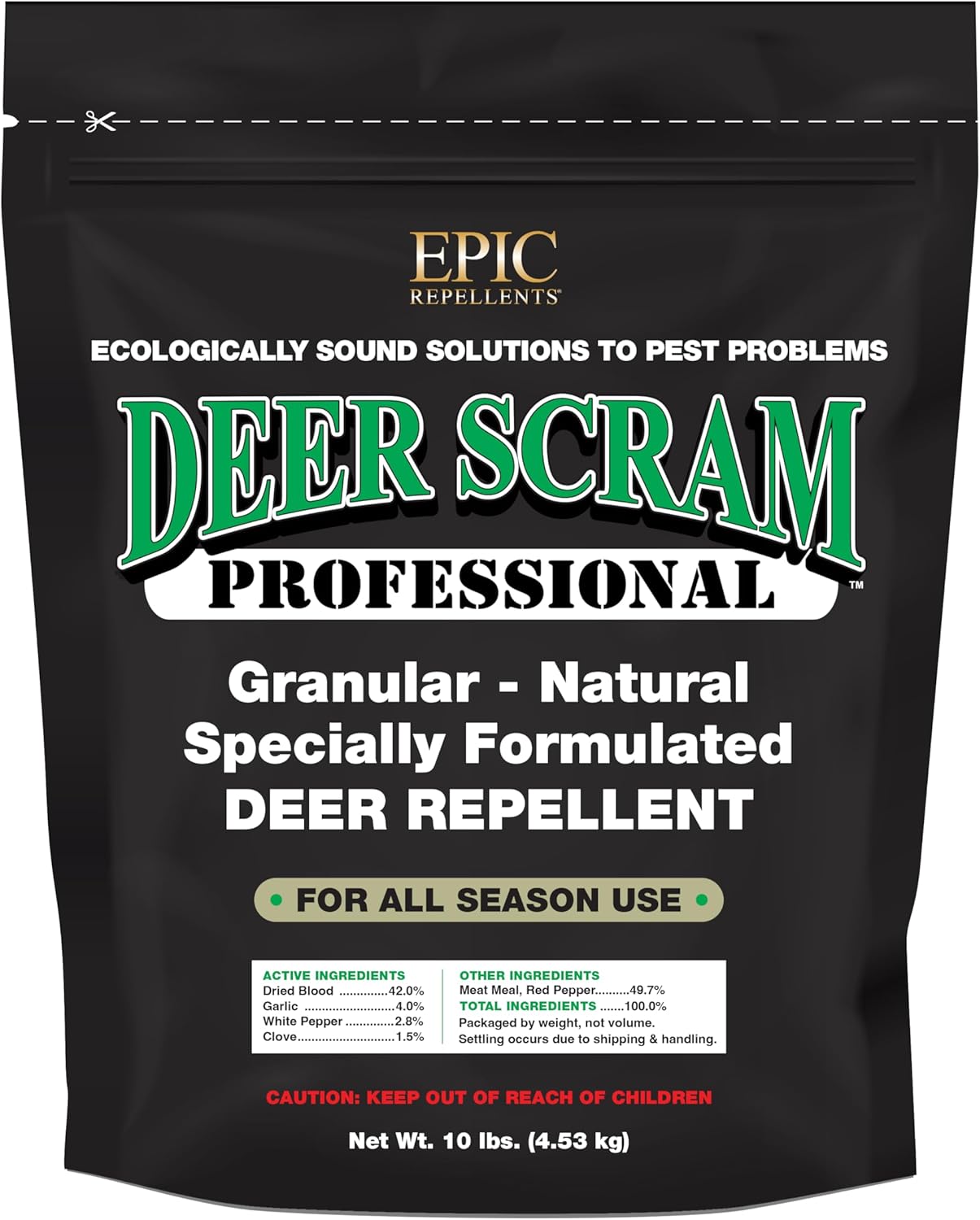
| Net weight | 10 lb |
|---|---|
| Coverage | 560 linear feet |
| Application interval | Every 30 days |
| Primary ingredients | Meat meal, bone meal, garlic, pepper |
Deer Scram Professional is a granular, all‑natural deer repellent intended for perimeter application around gardens and landscaped beds. The formula uses meat meal, bone meal, garlic, pepper and similar ingredients to mimic the scent of carrion, which deters deer from entering treated zones. Typical use is to sprinkle a 20‑inch wide band starting about 15 inches out from the landscape edge and reapply roughly every 30 days or sooner after very heavy rain. A 10 lb bag is advertised to cover about 560 linear feet, so it is practical for larger commercial or multiple small planting areas. The product is marketed as humane and non‑harmful to animals, and the granular form makes storage and targeted placement straightforward. Limitations include the need for regular reapplication in wet climates and that effectiveness depends on consistent perimeter coverage; it will not stop deer already inside a planted area and does not address other pests. Users should expect ongoing maintenance rather than a one‑time solution.
Best for: Property managers and landscapers who need a practical, humane perimeter repellent they can apply on a regular schedule to protect beds and borders.
Less Ideal for: Gardeners seeking a one‑time or maintenance‑free solution or those who need immediate removal of deer already present inside plantings.
- All‑natural ingredients formulated to deter deer without harming animals
- Granular form is easy to apply in a defined perimeter band
- Advertised coverage suitable for long linear borders, useful for larger areas
- Requires scheduled reapplication which helps maintain active protection
- Requires reapplication after heavy rain and roughly monthly maintenance
- Does not repel deer already inside treated areas or solve non-deer pest problems
Verdict: Choose this product when you want a humane, all‑natural granular repellent for routine perimeter protection on larger landscaped or commercial sites.
Liquid Fence Deer & Rabbit Repellent Ready-to-Use Spray, 1 Gallon

| Formulation | Ready-to-use liquid |
|---|---|
| Target pests | Deer and rabbits |
| Active ingredients | Putrescent whole egg solids, garlic, thyme oil |
| Application areas | Ornamental gardens, flowers, shrubs, trees, vines |
Liquid Fence Deer & Rabbit Ready-to-Use is a gallon spray formulated to keep deer and rabbits away by using a strong scent and taste deterrent rather than toxic ingredients. It is applied directly to vegetation—leaves, stems and buds—and is marketed as rain resistant so a single application during a dry period will provide protection for several weeks with monthly reapplication or more frequent sprays in heavy-feeding areas. The formula lists putrescent egg solids, garlic and thyme oil as active components and is intended to be harmless to plants and animals when used as directed. Practical benefits include easy spray application for landscape beds and established plantings and no need to rotate products seasonally. Limitations are the need to reapply after extended rain or heavy browsing pressure and the obvious scent that may be noticeable near treated areas, which some users may find unpleasant.
Best for: Gardeners who want a proven, scent-based deterrent to protect ornamental beds and established plantings and who value straightforward, ready-to-use solutions supported by many users.
Less Ideal for: People who need an invisible or scent-free solution or those seeking a one-time, permanent fix for heavy, constant browsing across large acreage.
- Ready-to-use gallon is simple to apply directly to plants without mixing
- Scent- and taste-based formula repels deer and rabbits before they feed
- Rain-resistant formula reduces frequency of reapplication in normal conditions
- Uses ingredients that are described as harmless to plants and animals when used as directed
- Has a strong odor from active ingredients that may be noticeable to people
- Requires regular reapplication (monthly or weekly under heavy pressure) to maintain protection
Verdict: A reliable, easy-to-apply scent-based spray that protects ornamental gardens from deer and rabbits with monthly maintenance.
Bonide Repels-All Animal Repellent Granules, 3 lb

| Net weight | 3 lb |
|---|---|
| Form | Granules |
| Claims | Biodegradable; People & pet safe when used as directed |
| Coverage duration | Up to 60 days (under normal conditions) |
Bonide Repels-All is a ready-to-use granular repellent formulated to keep deer, rabbits, squirrels, raccoons and many other pests away from planting areas. You spread the granules around beds, borders or other vulnerable spots and lightly water them in if no rain is expected; the manufacturer says the effect can last up to two months under normal conditions. The formula relies on scented and taste-irritant ingredients derived from fish meal, oils and minerals to trigger avoidance behavior rather than kill wildlife, and the product is described as biodegradable and safe for lawns and ornamentals when used as directed. For gardeners focused on protecting perennials, shrubs and newly planted areas it provides a low-effort barrier and can be re-applied more frequently after heavy rain or during rapid plant growth. Limitations are that effectiveness varies by species and local pressure of animals, and the granules require reapplication on a schedule for consistent protection and must not be applied directly to edible crops intended for human consumption.
Best for: Gardeners who want a low-effort, nonlethal way to protect ornamental plants from deer and small mammals and who prefer products that are described as safe for people and pets when used as directed.
Less Ideal for: Growers who need a guaranteed solution for heavy deer browsing or those wanting a repellent they can apply directly to fruits and vegetables should consider other targeted methods.
- Ready-to-use granular form is simple to apply around beds and borders
- Repels a broad list of animals including deer and rabbits using scent and taste deterrents
- Manufacturer states granules are biodegradable and safe for lawns and ornamental plants when used as directed
- Long-lasting effect up to 60 days under normal conditions with light watering after application
- Effectiveness varies with local animal pressure and weather and may require frequent reapplication after heavy rain
- Not labeled for direct use on edible crops intended for human consumption
Verdict: Choose these granules if you want a simple, nonlethal barrier that reduces deer and small-mammal damage to ornamental beds with infrequent reapplication.
Choosing the Right Commercial Deer Repellent: Key Factors to Consider
Duration and Reapplication Frequency
How long a treatment remains effective in the field drives labor and material planning. A longer-lasting formulation means fewer applications across the season, which is especially important on large properties where re-treating beds or fence lines is time-consuming.
Consider seasonal behavior of deer in your region because pressure can spike during certain months. Some products rely on scent molecules that dissipate with rain or sunlight, while others use taste or taste-conditioning that can offer longer deterrence. Expect to schedule inspections after heavy rain and factor in extra treatments during peak browse periods.
Coverage Area and Product Yield
Coverage per container or per gallon of concentrated product determines how much you need to buy and how often you must mix or refill sprayers. For commercial landscapes, products that treat more square footage per application reduce downtime and labor costs.
Also evaluate application rates at labeled dilutions. Some concentrates require low dilution to be effective, reducing overall cost per acre, while ready-to-use options trade convenience for lower yield. Match product yield to the size of beds, hedgerows, or open turf areas you need to protect.
Application Methods and Equipment Compatibility
Different formulations are designed for hand-spraying, backpack sprayers, hose-end applicators, or injection into irrigation systems. For large areas, compatibility with tractor-mounted or high-capacity sprayers can save significant time.
Check label instructions for nozzle types, recommended pressures, and whether agitation is required to keep certain suspensions mixed. Ease of application also includes how quickly treated areas dry and whether the product leaves residues that require extra cleanup on hardscapes.
Plant Safety and Phytotoxicity Risk
A repellent must not harm the plants it protects. Some active ingredients can cause leaf burn or discoloration under high heat or when applied to sensitive species. For commercial landscapes with mixed plantings, minimizing phytotoxicity risk is critical.
Read labels for temperature and light restrictions and for any plants listed as sensitive. Consider spot-testing on a small area before large-scale use, and factor in plant recovery time when planning application schedules near establishment or flowering periods.
Non-target Safety and Environmental Considerations
Commercial sites often have pets, service animals, wildlife, and beneficial insects present. Choose formulations that minimize risk to birds, pollinators, and aquatic systems. Some repellents are animal-safe but may be toxic to aquatic life if they wash into storm drains.
Assess buffer zone requirements for waterways and read guidance on use around food-bearing plants. Also consider odor strength and potential community impacts if the site is near public spaces.
Regulatory Compliance and Label Clarity
Commercial applicators must follow label instructions and local regulations. Clear labeling with dilution rates, application intervals, disposal instructions, and worker protection recommendations keeps operations compliant and safe.
Ensure the product provides instructions for commercial scale use, including permitted application methods and any required personal protective equipment. Products without explicit commercial instructions may not be suitable for institutional use.
How Repellents Work in a Landscape Context
Commercial deer repellents deter browsing through scent, taste, or conditioned avoidance. Scent-based products mask plant odors or create unpleasant smells that signal a potential threat to deer, while taste-based formulations teach deer to avoid treated foliage after an unpleasant mouthfeel. Conditioned repellents link a negative experience to the plants, reducing repeated visits over time.
- Scent repellents tend to work quickly but may need more frequent reapplication after rain.
- Taste-based products can be longer lasting but require deer to sample treated plants to be effective.
- Conditioning approaches can reduce pressure over weeks but work best when combined with other deterrents.
Site Preparation and Timing for Best Results
Apply repellents before deer browsing becomes heavy. Early-season treatments protect tender spring growth and can prevent deer from establishing a feeding pattern in a site. For new plantings, include repellent application in the installation plan to avoid early damage to young shrubs and perennials.
Stagger applications to coincide with vulnerable growth stages and high-risk months in your region. Inspect treated areas after rain or irrigation to determine whether spot reapplication is needed, and avoid applying on the hottest part of the day to reduce phytotoxicity risk.
- Treat borders and points of entry first, then work inward.
- Coordinate with maintenance staff to integrate repellent applications into routine landscape rounds.
Integrating Repellents with Landscape Design and Other Deterrents
Repellents are most effective when part of an integrated strategy. Combine chemical deterrents with physical barriers, strategic planting of less palatable species, and habitat modification to reduce attraction. For large properties, use repellents at perimeter lines, around high-value plantings, and near access points where deer enter the landscape.
Using a layered approach reduces reliance on any single method and spreads maintenance demands. For instance, placing deterrent-treated buffer strips around vulnerable beds can reduce browsing pressure on the core planting area.
- Alternate application types if local deer become habituated to a single scent profile.
- Use repellent-treated shrubs in entry zones to discourage repeated visits.
Practical Safety and Worker Procedures
Commercial application introduces operational health considerations. Provide staff with clear PPE guidance from the product label, and establish mixing and loading stations away from public areas. Transport concentrated products in secure containers and keep spill kits and neutralizers on hand.
Train staff to record application dates, rates, and weather conditions to track effectiveness. Documentation helps refine schedules and demonstrates compliance with site or municipal rules.
- Store concentrates in locked, labeled cabinets with secondary containment.
- Keep material safety data sheets accessible to all applicators.
Monitoring Effectiveness and Adjusting Strategy
Set up a monitoring routine with frequent inspections after initial application and after major weather events. Use photographic records and simple browse-scoring to quantify damage and determine whether a product choice or application interval needs adjustment.
If deer continue to browse, increase application frequency, switch modes of application, or rotate to a different active ingredient approach. Monitoring helps avoid unnecessary product use and identifies areas where additional physical exclusion is needed.
- Use fixed photo points to compare treated areas over time.
- Coordinate observations with seasonal deer movement patterns.
How We Chose the Best Commercial Deer Repellent
We prioritized repellents engineered for large properties and commercial settings, where coverage area and treatment longevity affect labor and cost more than in small gardens. Primary evaluation criteria included duration of effectiveness under rain and UV exposure, per-application coverage and product yield, modes of application suited to large areas, and safety for ornamental plants and non-target species. We also considered formulation types that reduce reapplication frequency and options compatible with irrigation systems or mechanized sprayers. Products were excluded if they were strictly marketed for home garden use or had no clear data on field longevity or large-area coverage. We filtered out products lacking documented safety guidance for common landscape species or those without clear dilution and application instructions for large sites. Final selections balance documented deterrent performance with practical application logistics and landscape safety. Evaluation criteria emphasized measurable, landscape-relevant attributes rather than anecdotal claims. We looked for clear directions for large-scale use and evidence of consistent repellent action in outdoor conditions.
FAQ
How often should I reapply repellent on large landscapes?
It depends on formulation and weather. Many commercial options last several weeks under dry conditions but need reapplication after heavy rain. Inspect high-value plantings weekly during peak browse seasons and after storms to decide on spot reapplication.
Can repellents harm ornamental plants or turf?
Some formulations can cause leaf burn or discoloration, especially when applied in full sun or high heat. Follow label restrictions, avoid applying at midday during hot weather, and test on a small area before full-scale application.
Are there repellents safe to use near pollinator plantings?
Some repellents are formulated to minimize risks to pollinators when used as directed, but any product that leaves residues on flowers can affect insects. Avoid spraying open blooms and follow buffer recommendations to protect pollinator activity.
Will deer become accustomed to a single repellent over time?
Habituation can occur, particularly with single-scent products. Rotating formulations or combining repellents with physical deterrents and habitat management reduces the chance that deer will ignore treatments.
Can I apply commercial repellent through irrigation systems?
Some concentrates are labeled for injection into irrigation or fertigation systems, but only if explicitly permitted on the label. Check compatibility with your irrigation components and observe dilution and timing instructions to avoid plant damage.
Final Verdict
For commercial and large-scale landscapes, prioritize repellents that deliver measurable coverage per application and reliable weather resistance to minimize labor. Balance application efficiency with plant safety so treatments protect ornamentals without causing damage. Incorporate repellents into a larger management plan that includes monitoring and physical deterrents to reduce dependence on chemical methods. Choosing the right product comes down to matching expected deer pressure, site size, and maintenance capability. Focus on duration, application compatibility with your equipment, and clear label instructions to keep landscapes protected and operations compliant.
