

Note: This article contains affiliate links. If you click on these links and make a purchase, I may earn a small commission at no extra cost to you. This helps support my research and content. Read my full affiliate disclosure here.
If you manage large lawns, sports fields, or commercial landscapes, a commercial garden spreader is one of the most time-saving tools you can add to your fleet. The right spreader keeps material distribution even across wide swaths, reduces overlap and missed strips, and cuts the labor needed for fertilizer, seed, or ice-melt applications. This guide covers our shortlisted top picks for heavy-use settings and explains the practical tradeoffs that matter in daily commercial work. We evaluated factors such as hopper size, main drive durability, calibration accuracy, and serviceability to help you match a spreader to the scale of your operations.
Top Picks at a Glance
| Best Overall The best all-around choice for most situations | EarthWay 2170 Commercial 100 lb Walk-Behind Broadcast Spreader |  |
| Best Quality Built to a higher standard if you want something more solid | CHAPIN 8400C Professional 100‑Pound Turf Broadcast Spreader |  |
| Best Value The sweet spot between price and what you get | John Deere 130 lb Push Broadcast Spreader |  |
| Best Budget The cheapest option that still gets the job done reliably | VEVOR 60 lb Push Broadcast Spreader with Pneumatic Wheels |  |
| Highest Rated A top-rated pick with lots of positive feedback | The Andersons Pacer Pro Walk-Behind Broadcast Spreader (80 lb Hopper) |  |
| Most Popular A crowd favorite that many people choose with confidence | EarthWay 2150 Commercial 50 lb Broadcast Fertilizer Spreader |  |
| Best Seller A high-volume bestseller chosen again and again | CHAPIN SaltPro 100 lb Contractor Salt Spreader (stainless parts) |  |
EarthWay 2170 Commercial 100 lb Walk-Behind Broadcast Spreader

| Capacity | 100 lb |
|---|---|
| Tire type | 13 inch pneumatic |
| Frame | Tube steel |
| Gearbox | Enclosed heavy-duty |
The EarthWay 2170 is a contractor-focused broadcast spreader designed to handle large jobs with a 100 pound hopper and a heavy-duty gearbox that keeps the agitator and metering consistent under load. It is used by pushing across turf or open areas while the pneumatic 13 inch tires and steel frame provide stable rolling over uneven ground. Notable features include side spread control for reducing waste along borders, a sturdy tube steel frame with enclosed gears for durability, and an adjustable handle for operator comfort. In practice the spread pattern is noticeably more even than economy models, which reduces respreading and striping. The reinforced controls and metal components mean less maintenance and fewer broken plastic parts in frequent use. The main compromises are size and weight that make it overbuilt for very small yards and the plastic hopper material which may be vulnerable to prolonged UV exposure without storage. For anyone maintaining large lawns, rental fleets, or commercial turf, this spreader emphasizes reliable, repeatable coverage and long-term durability.
Best for: Buyers who need a durable, professional-grade spreader for regular large-area lawn care, rental fleets, or contractor use and who prioritize consistent, even coverage over compact size.
Less Ideal for: Casual homeowners with small lawns or limited storage space should consider smaller, lighter spreaders that are easier to maneuver and store.
- 100 lb hopper capacity reduces refill frequency on large jobs
- Heavy-duty gearbox with enclosed gears for longer component life
- 13 inch pneumatic tires and steel frame provide stable movement over rough turf
- Side spread control helps reduce waste and improves edge accuracy
- Plastic hopper may degrade if left in sun long term
- Large and heavy for small residential yards
Verdict: Choose the EarthWay 2170 when you need a tough, professional spreader that delivers even, repeatable coverage on large lawns and job sites.
CHAPIN 8400C Professional 100‑Pound Turf Broadcast Spreader

| Load Capacity | 100 pounds |
|---|---|
| Wheel Type | Rubber |
| Number of Wheels | 2 |
| Material Type | Polyethylene, Stainless Steel |
The CHAPIN 8400C is a workhorse broadcast spreader aimed at serious homeowners and pros who need consistent coverage across lawns or larger properties. It pushes like a traditional walk‑behind spreader and uses a 100‑pound poly hopper on a stainless steel frame, an enclosed gearbox and cast agitator to keep material flowing without frequent clogging. The adjustable rotary gate and steel linkage let you control application pattern and rate for fertilizers, seed, and weed control products, while the 14‑inch pneumatic tires provide stability on uneven turf and moderate slopes. Practical touches include a rain cover, hopper grate to stop clumping, molded grips and a T‑handle for easier pushing. The unit requires assembly and is not recommended for salt, sand, or lime powders, so it is best for granular lawn products. Size and 38‑pound weight make it substantial to maneuver in tight beds, but that robustness is exactly what delivers steady, professional spread performance over larger areas.
Best for: Buyers who prioritize reliable, even application and durability for frequent use across lawns, acreage, or professional jobs where uptime and consistent coverage matter.
Less Ideal for: If you only need an occasional small‑yard spreader or must regularly apply salt, sand, or fine lime powders, a lighter-duty or specialty spreader would be a better fit.
- Large 100‑pound hopper reduces refill frequency for big yards
- Stainless steel frame and enclosed gearbox improve durability and reduce weather exposure
- Adjustable rotary gate and directional control for accurate application with different granular products
- 14‑inch pneumatic tires provide traction and stability on uneven terrain
- Included rain cover and hopper grate help prevent clumping in damp conditions
- Not recommended for salt, sand, lime or powderized materials
- Relatively heavy and sizeable which can make storage and maneuvering in tight spaces harder
Verdict: Choose the CHAPIN 8400C when you need a durable, high‑capacity broadcast spreader that delivers consistent professional‑grade coverage across larger lawns and properties.
John Deere 130 lb Push Broadcast Spreader

| Capacity | 130 lbs. |
|---|---|
| Approximate coverage | Up to 25,000 sq ft |
| Spread width | 10 – 12 ft |
| Wheels | 13" x 4" pneumatic tires |
This John Deere push broadcast spreader is built for larger lawns and frequent use. The 130 lb rust-proof poly hopper lets you cover roughly half an acre between refills, while the broadcast plate delivers a 10 to 12 ft spread that speeds application and reduces passes. Control is simple: a direct rod gate and adjustable flow stop let you dial output for seed, fertilizer, weed control products, or ice melt so you get more even coverage and less waste. Durability is focused on practical longevity rather than lightweight portability — heat-treated steel gears are enclosed to resist corrosive materials and large turf-tread pneumatic tires make it easy to push across uneven turf. Assembly is required and the unit is substantial to maneuver compared with compact hand spreaders, but that heft contributes to stability and capacity. For performance-focused gardeners with mid-size to large lawns, it reduces refill frequency and produces consistent spreading; casual users with very small yards may find it larger than necessary.
Best for: Gardeners and property owners who prioritize efficient, consistent coverage across mid-size to large lawns and want a durable spreader that reduces refill interruptions.
Less Ideal for: People with very small yards, limited storage space, or who need a lightweight, highly portable seed spreader.
- Large 130 lb poly hopper reduces refills for up to 25,000 sq ft of coverage
- Wide 10–12 ft broadcast spread speeds application and improves uniformity
- Direct rod control and adjustable flow stop for precise output with different materials
- Enclosed heat-treated steel gears and turf-tread pneumatic tires improve durability and maneuverability
- Substantial size and weight make it less convenient for very small yards or frequent transport
- Some assembly required before first use
Verdict: Choose this spreader if you need high-capacity, consistent broadcast coverage for mid-size to large lawns without frequent refilling.
VEVOR 60 lb Push Broadcast Spreader with Pneumatic Wheels

| Load capacity | 60LB |
|---|---|
| Wheels | 8-inch pneumatic |
| Frame | Powder-coated steel |
This VEVOR push broadcast spreader is built for straightforward, frequent lawn jobs where speed and coverage matter. It holds up to 60 pounds of seed or fertilizer in a plastic hopper mounted on a powder-coated steel frame and rolls on 8-inch pneumatic tires for easier movement across grass, gravel, and uneven ground. The unit offers multiple adjustable settings and a disc-style pellet controller to fine-tune spread width and flow, which helps achieve even coverage and reduces missed strips. Assembly is tool-free and quick, and the large hopper cuts down on how often you need to refill during a typical yard run. Practical buyers will appreciate the rugged frame and all-terrain wheels for year-round tasks from seeding to fertilizing. Limitations to note are that the spreader is a push model without motorized assistance, so it requires physical effort on larger properties, and the plastic hopper, while durable, is not as impact-resistant as metal for heavy-duty farm use.
Best for: Homeowners who want a reliable, no-frills spreader to speed up regular seeding and fertilizing on small to medium lawns while keeping setup and maintenance simple.
Less Ideal for: People who need a motorized or tow-behind spreader for large acreage or commercial operations should look at heavier duty or powered models.
- Large 60 lb hopper reduces refill frequency for medium-sized lawns
- Adjustable spread settings and disc pellet controller for precise coverage
- 8-inch pneumatic wheels ease movement over uneven terrain
- Powder-coated steel frame offers corrosion resistance for outdoor use
- Manual push design can be tiring on larger properties
- Plastic hopper is less impact-resistant than an all-steel construction
Verdict: Choose this spreader if you want a durable, large-capacity push unit that delivers controlled, even coverage for routine lawn seeding and fertilizing.
The Andersons Pacer Pro Walk-Behind Broadcast Spreader (80 lb Hopper)

| Hopper capacity | 80 lb |
|---|---|
| Tires | 12-inch pneumatic |
| Agitator | Spider agitator |
| Application control | Adjustable drop rate with 3-hole shut-off |
| Frame finish | Powder-coated frame |
The Andersons Pacer Pro is a heavy-duty broadcast spreader built to deliver consistent, reliable coverage for lawn care and winter tasks. It uses a spider agitator and dual material plates to keep fertilizer, seed, and salt flowing evenly, while the three-hole drop shut-off and adjustable drop rate let you dial in application without constant tweaks. The 80-pound hopper and included cover reduce refill frequency and protect materials from moisture, and the 12-inch knobby pneumatic tires give good traction and weight distribution across uneven terrain. The frame is powder-coated for corrosion resistance and the unit ships partially assembled, though you will need to finish setup and calibrate it before first use. If you expect pro-level consistency and year-round versatility, this spreader performs well, but it is a large, purpose-built tool better suited to medium to large lawns than tight, highly landscaped yards.
Best for: Buyers who prioritize dependable, pro-level spreading performance for medium to large lawns and need a durable, year-round tool for fertilizer, seed, and salt applications.
Less Ideal for: Not the best choice for owners of small, tightly planted yards or those who need a compact, lightweight spreader for occasional use.
- Large 80 lb hopper reduces refill frequency and includes a cover to protect materials
- Spider agitator and dual material plates promote consistent, even flow of fertilizer, seed, and salt
- Adjustable drop rate and three-hole shut-off allow precise application control
- 12-inch knobby pneumatic tires provide traction and smoother handling on uneven ground
- Arrives only partially assembled and requires calibration before first use
- Size and capacity make it less convenient for very small or highly detailed lawns
Verdict: Choose the Pacer Pro if you want a rugged, professional-grade spreader that delivers consistent, reliable applications across medium to large lawns.
EarthWay 2150 Commercial 50 lb Broadcast Fertilizer Spreader

| Brand | EarthWay |
|---|---|
| Model Number | 2150 |
| Hopper Capacity | 50 lb |
| Tire Type | 13 inch pneumatic |
| Gearbox | Fully enclosed |
The EarthWay 2150 is a professional-grade broadcast spreader designed to deliver an even application of fertilizer, seed, or ice melt across turf. It is typically used as a push spreader for lawns where accuracy and durability matter. Notable features include EarthWay’s patented 3-hole drop shut off system and side-spread control for an approximately 50/50 spread pattern, a clog-free removable grate, an enclosed gearbox that resists moisture, and large 13 inch pneumatic tires that roll smoothly over uneven turf. The rustproof poly hopper is impact resistant and easy to wash down, and stainless-steel linkage replaces sticky cables for reliable operation. In practice this means fewer missed spots, less product waste, and consistent results across multiple passes. The unit is engineered for longevity with powder-coated steel and a sealed gearbox, but its commercial construction makes it heavier and bulkier than lightweight consumer models and requires storage space. Assembly and calibration take a bit more time up front, but the payoff is precise, repeatable spreading season after season.
Best for: Buyers who prioritize application accuracy and long-term durability for frequent or professional lawn care and who are willing to trade portability for performance.
Less Ideal for: Casual or infrequent users with very small yards who prefer a lightweight, compact spreader that is easier to store and transport.
- Patented 3-hole drop system plus side-spread control for a consistent, even spread pattern
- Fully enclosed gearbox allows use in moist or damp conditions and reduces maintenance
- Large 13 inch pneumatic tires provide smooth movement over rough or uneven lawns
- Rustproof poly hopper with removable grate is clog resistant and easy to clean
- Commercial-grade weight and size make it less convenient to move and store than lightweight spreaders
- Requires initial assembly and calibration to achieve optimal accuracy
Verdict: Choose the EarthWay 2150 when you need a durable, precision spreader that delivers consistent, professional results across uneven lawns.
CHAPIN SaltPro 100 lb Contractor Salt Spreader (stainless parts)
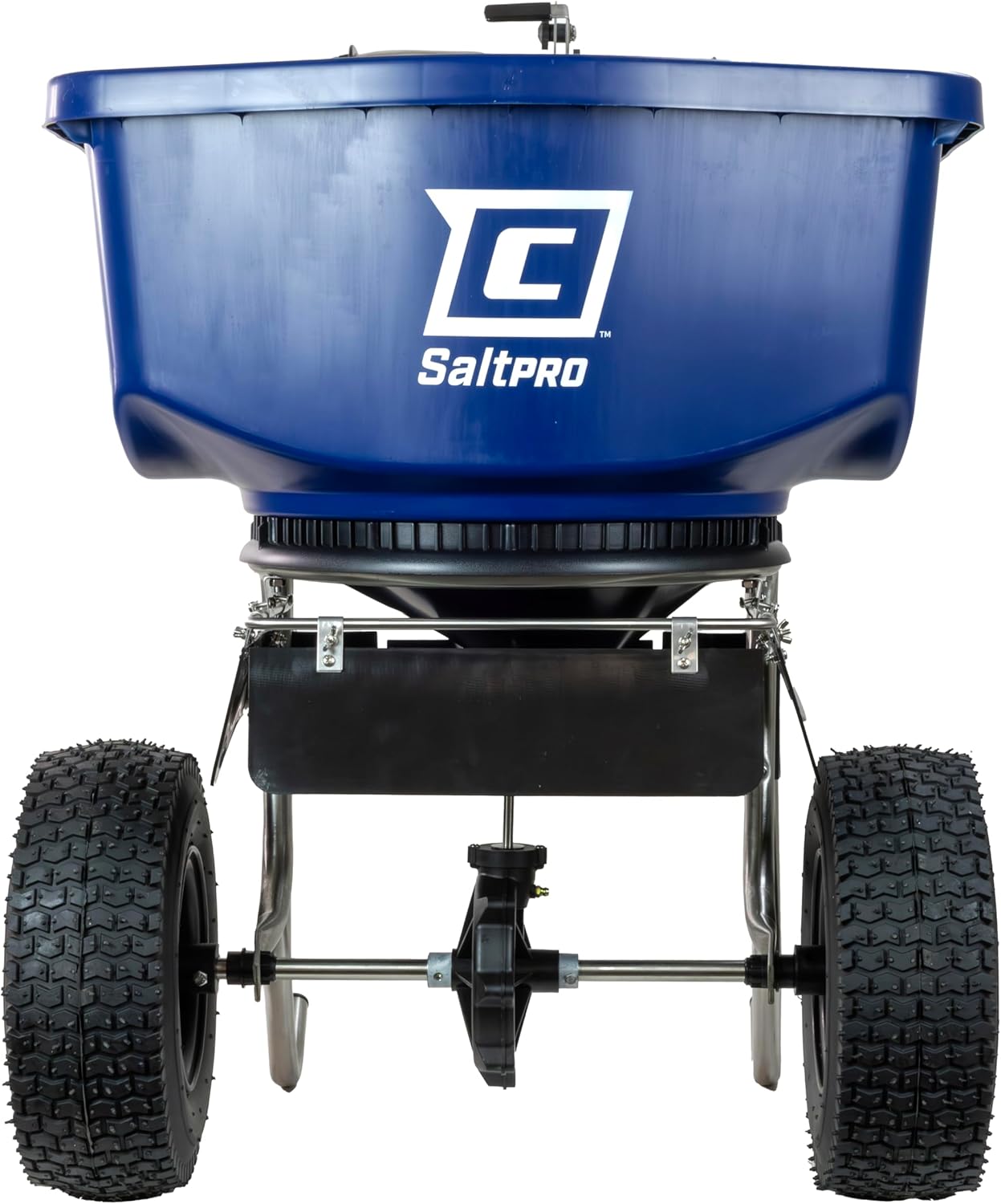
| Capacity | 100 lb hopper |
|---|---|
| Tire size | 12" pneumatic |
| Auger | Spiked auger |
| Hardware | Stainless steel |
The CHAPIN SaltPro 100 lb Contractor Spreader is a walk-behind broadcast spreader built for larger winter jobs where you need steady, reliable material delivery. It uses a 100 lb weather-resistant poly hopper and a spiked auger to break up clumps so pelletized or small ice-melt flows consistently through an adjustable gate and solid linkage. Side and rear baffles focus the pattern to reduce overspray and a T-handle sized for gloved use plus 12-inch pneumatic tires make it easier to push across uneven driveways and sidewalks. Stainless-steel hardware, enclosed gears with a grease fitting, and a rain cover add durability for frequent use. It is intended for salt and compatible ice melts rather than sand or lime blends, so it is best where melting agents are the chosen material. The unit is fairly large and built for regular commercial or heavy residential use, so it may be more than needed for small properties but will save time on larger areas and repeat jobs.
Best for: Buyers who need a dependable, heavy-use spreader for treating large driveways, commercial sidewalks, or multi-property winter maintenance and who prioritize reliability and low downtime.
Less Ideal for: Homeowners with only small yards or infrequent use who would prefer a lighter, simpler residential spreader or a handheld option.
- Large 100 lb poly hopper reduces refill frequency for big jobs
- Spiked auger and adjustable gate keep material flowing and let you control spread rate
- Stainless-steel hardware and enclosed, greased gears improve durability for frequent use
- 12" pneumatic tires and T-handle make it easier to maneuver over uneven ground
- Not recommended for sand, sand mixes, lime, or pelletized lime so material options are limited
- Relatively large and heavy which may be overkill for small lawns
Verdict: Choose this spreader when you need a durable, low-maintenance unit that handles large winter jobs reliably with stainless components.
Choosing the Right Commercial Garden Spreader: Key Factors to Consider
Hopper Capacity and Refill Frequency
Hopper capacity dictates how often you stop to refill, which directly affects productive coverage per hour. For commercial tasks you will often prefer larger hoppers so you can complete long runs without constant interruptions. A bigger hopper also reduces the number of times you need to mix or load product, which helps maintain consistent material moisture and prevents segregation during transport.
Consider how the spreader mounts to your towing vehicle and whether the larger hopper affects maneuverability in tight beds or service alleys. Very large hoppers can raise the center of gravity, so check that the frame and hitch arrangement remain stable when fully loaded.
Metering System and Calibration Precision
Accurate metering controls how much product is laid down per pass and ensures material is not wasted or under-applied. Commercial spreaders use adjustable gates, calibrated rate charts, or infinite-adjust controls. The clearer and more repeatable the calibration, the easier it is to train crews and maintain consistent application rates across different materials.
Look for systems that allow fine adjustments and clear markings. If you change materials frequently, a metering system that quickly resets without tool use saves time and reduces guesswork. Also consider if the metering mechanism resists clogging from damp materials.
Frame Construction and Drive Components
A commercial spreader will see more hours and heavier loads than a residential model, so the frame, axle, and drive components need to be robust. Steel frames with appropriate corrosion protection, welded joints, and reinforced mounting points resist fatigue in high-cycle use. Wheel drives, gearboxes, and chains must be sized for continuous operation and heavier loads.
Check for replaceable bushings and easily serviced bearings. Components that are modular and accessible cut repair time and extend service life. Consider the terrain you will tow across because rough surfaces increase stress on the frame and drives.
Material Compatibility and Flow Control
Commercial jobs use many granular and pelleted materials such as fertilizers, seeds, lime, and salts. Not every spreader distributes all materials evenly. Flow control shapes, agitator types, and gate geometry determine whether fine powders bridge, coarse granules flow freely, or moist mixes clog.
Assess whether the spreader offers adjustable agitators, vibration options, or interchangeable spread plates to handle different particle sizes. A machine that handles a wider range of materials reduces the need for dedicated equipment and increases operational flexibility.
Spread Pattern and Uniformity
Uniform application prevents thin strips, over-application, and visible streaking. Spread width, spinner design, and gate-to-spinner geometry determine pattern consistency. For commercial turf and landscape work, a consistent pattern reduces product waste and prevents turf damage from concentrated material.
Look for spreaders with adjustable deflectors or multiple spread settings so you can match pattern to job size. Consider how wind and vehicle speed interact with spread width; some machines maintain better uniformity at higher towing speeds.
Serviceability and Replacement Parts
Downtime costs money in commercial operations, so serviceability is a major purchasing factor. Machines that allow quick access to wear components, simple lubrication points, and common replacement parts save maintenance hours. A spreader with widely available universal components is easier to fix in the field.
Documentation, clear adjustment points, and tool-free access panels all reduce repair time. Confirm whether key parts like gears, chains, and agitators are standard sizes or proprietary items that could lengthen lead times for replacement.
Match Spreader Size to Job Scale
Estimate the average area you treat in a single outing and pick a spreader whose capacity and spread width let you complete typical jobs with minimal refills. For landscapers who do long contiguous runs, a higher-capacity hopper and wider spread setting reduce labor. For contractors working in tight urban lots, choose a model with a lower profile and a narrower footprint to avoid obstacles.
Also think about transport and storage. Larger commercial spreaders need larger transport vehicles and a secure storage area. If you frequently move between sites, confirm that the spreader fits your trailer or truck bed without risking damage.
- Estimate area per trip and compare to hopper volume
- Consider spread width versus towing speed for efficiency
- Check vehicle hitch and transport dimensions
Calibration Best Practices
Calibration is the routine that ensures your spread rates match label recommendations. Use a known container and weigh the amount distributed over a fixed distance, then adjust the gate until the measured rate matches the target. Keep a calibration log for each material, noting gate setting, vehicle speed, and recommended load conditions.
Train crews to recalibrate after changing materials or environmental conditions, because particle size and moisture content can alter flow rates. Simple, repeatable procedures reduce over-application and regulatory risk for commercial fertilization or ice management work.
- Weigh output over a set distance to confirm rates
- Record settings for each material and speed
- Recalibrate after material or moisture changes
Maintenance Routines for Continuous Use
Daily and weekly maintenance extends the life of a commercial spreader. After each use, remove leftover material or flush the hopper if appropriate to prevent corrosion or caking. Lubricate bearings and inspect gearbox oil levels at scheduled intervals. Replace worn agitator parts before they fail to avoid uneven flow during a job.
Plan for seasonal storage by thoroughly cleaning and protecting metal parts. Inspect tires, check for bent frames or mounting bolts, and tighten all fasteners. A small investment in routine care prevents larger repairs or unexpected failures mid-season.
- Empty and clean hopper after each use
- Lubricate moving parts and inspect drive components weekly
- Store dry and protected during off-season
Towing Vehicle and Mounting Options
Confirm compatibility between the spreader and your towing vehicle. Some commercial spreaders mount to utility vehicles, trucks, or trailers. Match hitch type, tongue weight, and electrical connections for spinner control or vibrator systems. Underpowered towing can reduce spread consistency and increase wear on both the spreader and vehicle.
Also consider mounting practicality on your fleet. Quick-attach hitches and modular platforms speed deployment and reduce labor between jobs. Evaluate whether the spreader requires additional brackets or reinforcement on your vehicle frame.
- Verify hitch type and tongue weight capacity
- Check electrical or hydraulic hookups if needed
- Consider quick-attach options for faster swaps
Handling Different Materials Safely
Commercial users handle fertilizers, seeds, salt, lime, and sometimes pest-control granules. Each material has handling recommendations for safety and equipment longevity. For corrosive materials such as salt, look for corrosion-resistant finishes or sacrificial coatings. For dusty fertilizers, take measures to reduce inhalation exposure during loading and cleaning.
Use appropriate personal protective equipment when loading and servicing spreaders. Follow local and label rules for spreading regulated materials and ensure spill containment steps are in place to protect soil and water near application sites.
- Use corrosion protection for salt and harsh materials
- Wear PPE when loading dusty or chemical materials
- Plan for spill containment and site protection
Upgrades That Improve Productivity
Several optional features can make a spreader more productive. Electric or hydraulic agitators reduce bridging without manual intervention. GPS-compatible controllers and variable-rate spreader attachments allow precise per-area application and reduce product waste. Spinner guards and deflectors let you shape the pattern for sensitive borders and beds.
Decide which upgrades provide measurable time savings or regulatory benefits for your operation. Some upgrades are worth retrofitting on an existing unit, while others are better selected when purchasing a new machine.
- Electric agitators reduce bridging and clogging
- Variable-rate controllers enable precise applications
- Deflectors and guards protect sensitive areas
How We Chose the Best Commercial Garden Spreader
We focused on features and build details that matter in high-use commercial settings. Key criteria included hopper capacity and flow control to minimize refilling on large jobs, and frame and axle construction that withstand frequent towing and rough surfaces. We evaluated rate control and calibration systems because consistent spread width and application rate determine product performance and material waste. Durability of moving parts, including gearboxes, agitators, and wheel drives, was weighed heavily to predict service intervals and repair needs. Ease of maintenance and availability of replaceable wear parts informed our selection to reduce downtime. We excluded products intended only for home or occasional use and models with clearly inadequate hopper volume or light-duty frames. The resulting list highlights spreaders that balance high-capacity handling, reliable metering, and straightforward upkeep for commercial landscapers and grounds crews.
FAQ
How often should a commercial spreader be calibrated?
Calibrate whenever you change material type, after significant weather changes that affect moisture, and at regular intervals during heavy use. Many operations calibrate daily for critical applications and keep a record of settings for each material.
Can one spreader handle fertilizers, seed, and salt?
Often a single commercial spreader can handle multiple granular materials, but effectiveness depends on hopper design, agitator type, and metering system. You may need different settings or optional agitators to prevent bridging or uneven flow with certain products.
What maintenance keeps a spreader reliable in commercial use?
Routine cleaning to remove residues, scheduled lubrication of bearings and drive components, inspection of gears and chains, and timely replacement of wear parts are the most important tasks. A short daily checklist and a documented maintenance schedule limit unexpected downtime.
Do spreader upgrades like electric agitators justify the cost?
Upgrades that reduce clogging and speed material flow often pay back through reduced labor and fewer stoppages, especially on frequent, high-volume jobs. Whether an upgrade is justified depends on job cadence and material types used most often.
How does towing speed affect spread pattern?
Towing speed influences spread width and uniformity. Higher speeds can increase throw distance but may also cause drift and uneven deposition. Calibrate rates and test spread patterns at the speeds you plan to operate to ensure consistent results.
What should I do to winterize a spreader?
Clean all residues from the hopper and spinner, lubricate moving parts, and protect exposed metal with a light coating of rust inhibitor. Store the spreader in a dry, covered area and lift or deflate tires if long-term storage is planned to prevent flat spots.
Final Verdict
For commercial landscaping and grounds work, prioritize hopper capacity, robust frame and drive components, and a metering system that provides repeatable calibration. These aspects directly affect how much area you can treat per hour, how often the machine requires service, and whether materials are distributed uniformly. Balance capacity with maneuverability and choose a spreader that matches your most common job types. Investing in easy maintenance and replaceable parts will reduce downtime and long-term costs, while the right metering and agitator setup will keep applications accurate across different materials.
