

Note: This article contains affiliate links. If you click on these links and make a purchase, I may earn a small commission at no extra cost to you. This helps support my research and content. Read my full affiliate disclosure here.
When pests threaten productive beds, landscape plantings, or building perimeters you need a commercial-grade insecticide that works reliably and fits the way you manage your site. The right product reduces pest pressure without disrupting beneficials or your maintenance schedule. This guide shortlists five top commercial insecticides that suit a range of outdoor and structural uses. We evaluated products for how long they protect treated surfaces, how they are applied across different settings, and how they fit into integrated pest management. Read on to see how each option performs against those criteria and which features matter most for your situation.
Top Picks at a Glance
| Best Overall The best all-around choice for most situations | Demon Max Insecticide 16 oz |  |
| Best Quality Built to a higher standard if you want something more solid | Quali-Pro Bifenthrin I/T 7.9F Insecticide, 1 Gallon |  |
| Best Value The sweet spot between price and what you get | Atticus Talak 7.9% Indoor/Outdoor Bifenthrin Insecticide Concentrate (1 gal) |  |
| Highest Rated A top-rated pick with lots of positive feedback | Control Solutions CSI D-FENSE SC Insecticide Concentrate (1 gal) |  |
| Best Seller A high-volume bestseller chosen again and again | Atticus Talak 7.9% Bifenthrin Indoor/Outdoor Insecticide Concentrate, 32 oz |  |
Demon Max Insecticide 16 oz
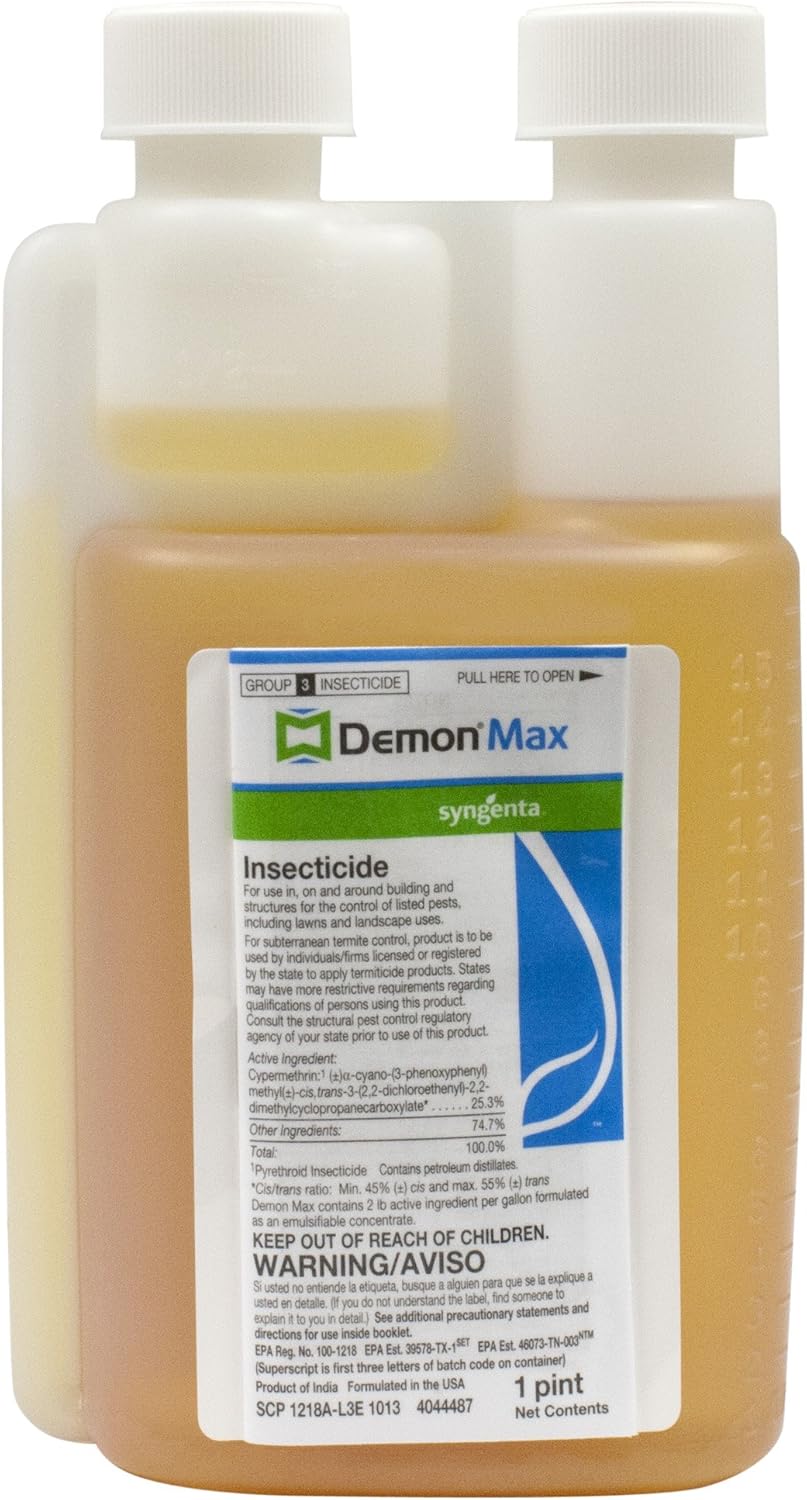
| Unit Count | 16 Ounce |
|---|---|
| Item Form | Liquid |
| Target Species | Insects |
| Active Ingredients | Cypermethrin |
Demon Max is a concentrated 16 ounce liquid insecticide designed for both quick knockdown and lasting residual control of more than 30 insect pests, making it suitable for spot, crack-and-crevice, and perimeter treatments. It is typically mixed in a hand-pump or compressed sprayer and applied around foundations, on lawns and vegetation, and in and around structures where pest activity is observed. The product lists cypermethrin as the active ingredient, which delivers fast contact mortality and residual protection when applied according to label directions. Practical benefits include flexible application options across multiple surfaces and economical coverage from a small concentrate. Important limitations are the need to measure and mix correctly for the treatment area and to follow safety precautions, including keeping it away from children and avoiding application on unintended plants or areas. This is a professional-strength, pesticide-focused option for users who want effective, long-lasting roach and general insect control when applied responsibly.
Best for: Buyers who prioritize strong, long-lasting pest control results and are comfortable mixing and applying a concentrated insecticide for targeted indoor and outdoor treatments.
Less Ideal for: Casual users seeking ready-to-use sprays or nonchemical options should consider simpler consumer products or mechanical controls instead.
- Fast knockdown and residual control against a wide range of insect pests
- Versatile use for crack-and-crevice, spot treatments, lawns, vegetation, and building perimeters
- Concentrated liquid formula that can be mixed to cover varied square footage
- Contains cypermethrin, a proven synthetic pyrethroid active ingredient
- Requires careful measuring and mixing for correct coverage and safety
- Labeled for professional-style applications and may need precautions for use near ornamentals and non-target areas
Verdict: Choose Demon Max when you need a concentrated, professional-strength liquid that delivers fast knockdown and lasting residual control of roaches and other insects.
Quali-Pro Bifenthrin I/T 7.9F Insecticide, 1 Gallon

| Item Form | Spray |
|---|---|
| Target Species | Termites, Carpenter Ants |
| Liquid Volume | 1 gallons |
| Active Ingredients | Bifenthrin |
This one-gallon Quali-Pro Bifenthrin I/T 7.9F is a flowable pyrethroid designed for preventive and residual control of a broad range of pests in lawns and landscaped areas. It is typically mixed and applied as a spray to turf, ornamental beds, foundations and around structures to suppress termites, carpenter ants, fleas, ticks, mites and similar pests. Key features include a long-lasting residual, compatibility with many turf and ornamental tank-mix partners, and a no-odor, non-irritating formulation that dries without visible residue. In practice it provides dependable knockdown and weeks of protection when applied at recommended rates, making it suited for routine perimeter treatments and spot-control of persistent infestations. Important limitations are that it is a concentrated professional-style product requiring careful dilution, protective equipment, and adherence to label directions for safe use around people, pets and desirable plants. It is not a ready-to-use consumer spray and should be used only where labeled.
Best for: Buyers who prioritize a reliable, long-lasting perimeter or spot-treatment solution for recurring or hard-to-control outdoor pests and who are comfortable following label directions and using concentrated products.
Less Ideal for: Casual users who want a simple ready-to-use spray for occasional bug bites or very small lawns should consider consumer-grade aerosols or hose-end products instead.
- Long-lasting residual control effective against termites, carpenter ants and other pests
- Compatible with herbicides, fungicides, insecticides and liquid fertilizers for tank mixes
- No-odor, non-irritating formula that dries with no visible residue
- Available in a one-gallon concentrated flowable for multiple applications
- Concentrated product requires dilution and protective equipment for safe handling
- Not intended as a ready-to-use consumer spray and may be overkill for very small yards
Verdict: Choose this product when you need a dependable, long-lasting concentrated insecticide for routine perimeter and spot treatments in lawns and ornamentals.
Atticus Talak 7.9% Indoor/Outdoor Bifenthrin Insecticide Concentrate (1 gal)

| Active Ingredients | Bifenthrin |
|---|---|
| Formulation | Suspension Concentrate |
| Unit Count | 128 Fluid Ounces |
| Specification Met | EPA |
Talak 7.9% is a water-based bifenthrin concentrate meant as a flexible indoor and outdoor insect control product. You dilute the concentrate with water and apply it as a spray for perimeter barrier treatments, to turf, to ornamentals, or to interior baseboards and other problem areas. The label lists control of more than 75 pests including mosquitoes and ticks, and the formula is designed to kill on contact and provide residual control for up to three months. Practical benefits include a clear, odor-free spray that dries without staining and a bottle that allows easier small pours for accurate mixing. Important limitations are that mixed solutions should be used the same day and it is not approved for fogger use, so it is best for targeted spray applications rather than broadcast fogging. As with any bifenthrin product, users should follow label directions closely and consider nonchemical options for integrated mosquito management.
Best for: Buyers who want a single, versatile insecticide to treat both perimeter and landscape mosquito problems and prefer a product that delivers residual control without odors or visible residue.
Less Ideal for: People seeking a ready-to-use fogging or misting solution or those who need an insecticide they can pre-mix and store for later use.
- Broad-spectrum control listing more than 75 indoor and outdoor pests including mosquitoes and ticks.
- Water-based formula that dries clear, leaves no residue, and is odor-free for use around living areas.
- Long residual effect with label claim of up to three months of control per application.
- Mixes with water for adjustable application rates across lawns, landscapes, and surfaces.
- Bottle design supports easier small pours to reduce mess when measuring concentrate.
- Mixed spray cannot be stored and must be used the same day.
- Not approved for use in foggers, limiting application methods to direct sprays.
Verdict: A versatile, long-lasting bifenthrin concentrate that provides broad-spectrum mosquito and perimeter control for users who want one product for indoor and outdoor applications.
Control Solutions CSI D-FENSE SC Insecticide Concentrate (1 gal)

| Item Form | Gel |
|---|---|
| Target Species | Insects |
| Liquid Volume | 128 fluid ounces |
The Control Solutions CSI D-FENSE SC is a one-gallon concentrate designed for commercial and residential turf and landscape insect control. Mixed and applied as a spray from the concentrate, it targets labeled insect species and is suitable for spot treatments, crack-and-crevice applications, and general turf use. The product is formulated as a gel suspension of micro-crystals, which helps deliver active ingredient in a stable concentrate that professionals can dilute to required application rates. Practical benefits include a high-volume liquid supply for treating large areas and compatibility with standard spray equipment for targeted or broadcast treatments. Important limitations are that it is a concentrate requiring proper dilution and application equipment, and users must follow label restrictions for where and how it may be applied; it is not ready-to-use out of the container. As a commercial-grade option it emphasizes consistent, repeatable control when handled by trained applicators who follow safety and mixing instructions.
Best for: Best for landscape managers, pest control professionals, and reliable-minded homeowners who prioritize consistent, professional-strength control for turf and landscaping and who are comfortable mixing and applying concentrates.
Less Ideal for: Not a good fit for casual gardeners or homeowners who want a ready-to-use spray or who are unwilling to handle concentrated pesticides or follow label mixing and safety procedures.
- Concentrated formula provides enough product to treat large turf and landscape areas.
- Gel suspension formulation can improve stability and handling compared with some liquid-only concentrates.
- Labeled for both commercial and residential turf and landscape use, offering professional-level control.
- Suitable for targeted applications such as cracks, crevices, and spot treatments when diluted and applied correctly.
- Requires dilution and appropriate spray equipment before use.
- Label restrictions and targeted insect list limit use to specified pests and situations.
Verdict: Choose this concentrated gel suspension if you need a professional, reliable insecticide for large-scale turf and landscape applications handled by trained applicators.
Atticus Talak 7.9% Bifenthrin Indoor/Outdoor Insecticide Concentrate, 32 oz

| Active Ingredient | Bifenthrin |
|---|---|
| Formulation | Suspension Concentrate |
| Liquid Volume | 32 fluid ounces |
| Length of Control | Up to three months |
| Target Species | Insects |
Talak 7.9% is a liquid concentrate for treating lawns, landscaping, outdoor living areas and indoor perimeter spots like baseboards and cabinets. You dilute the concentrate with water to create a spray for barrier treatments, spot applications or lawn mixes; label rates explain how much to mix per gallon depending on the use. The product uses bifenthrin, a proven broad-spectrum active ingredient, and the manufacturer states it controls over 75 species and can give residual control for as long as three months. Its water-based formula dries clear, leaves no odor or visible residue, and is not phytotoxic on plants when used per label. Practical benefits include flexible indoor and outdoor use, clear drying, and a bottle designed for easier pouring. Important limitations are that solutions should be mixed only for same-day use, it is not registered for sale in a few states, and it is not approved for fogger application, so professional-style misting methods are not appropriate.
Best for: Buyers who want a single, reliable product to protect yards, patios and building perimeters from a wide range of common pests and prefer conservative, label-driven application practices.
Less Ideal for: People seeking ready-to-use sprays or fogger-compatible products or those in states where this formulation is not registered should look at alternatives.
- Broad-spectrum control listed for 75+ indoor and outdoor pest species
- Water-based formula that dries clear and leaves no odor or residue
- Flexible label directions for lawns, landscapes, hardscapes and indoor perimeter treatments
- Long residual activity up to three months when applied at recommended rates
- Mixed spray solutions cannot be stored and must be used the same day
- Not approved for fogger application and not available for sale in some states
Verdict: A versatile, water-based bifenthrin concentrate that delivers long-lasting, broad-spectrum outdoor (and perimeter indoor) control when used according to the label.
Choosing the Right Commercial Insecticide: Key Factors to Consider
Residual Longevity and Environmental Persistence
How long an insecticide remains active on treated surfaces is central to planning treatments. Longer residual life reduces the frequency of reapplication but can increase exposure risk to non-target organisms and persistence in runoff. Consider the balance between season-long control needs and environmental stewardship.
Look at label guidance for expected residual duration under typical field or landscape conditions. Factors such as UV exposure, rainfall, and organic matter on leaves can shorten longevity. Choose products whose residual profile matches the interval you need between applications while following label limits on total seasonal use.
Labeled Application Methods and Site Uses
Commercial-use products vary widely in how they can be applied: foliar sprays, soil drenches, perimeter barrier treatments, crack-and-crevice structural work, or aerial and boom applications. The label must explicitly allow the method you plan to use. Using an application method not listed on the label is both unsafe and illegal.
Also check which sites are listed on the label. Some formulations are approved for greenhouse benches and container media, others for turf and landscape plantings, and some for structural pest management around buildings. Matching label use sites to your operations avoids wasted product and regulatory issues.
Target Pest Spectrum and Efficacy
Different active ingredients target different insect groups. A product effective against chewing pests may not control sucking pests or stored-product insects. Identify the primary pests you need to manage and select a product with documented activity against those species or the correct pest group on the label.
Consider whether you need quick knockdown for heavy infestations, longer-term control against reinfestation, or products that work as both contact and residual treatments. Also account for local resistance patterns and rotate modes of action when repeated applications are necessary.
Compatibility With Integrated Pest Management
Commercial insecticides are most effective when used as one component of integrated pest management. Evaluate how a product fits with cultural controls, biologicals, monitoring, and threshold-based decisions. Some materials are relatively benign to beneficial insects and can be used selectively to conserve natural enemies.
Plan applications to minimize harm to pollinators and predators by timing sprays for low activity periods, choosing targeted applications over broadcast treatments, or selecting chemistries with lower non-target toxicity. Products that allow lower-rate spot treatments can be better suited to IPM programs.
Formulation, Mixing, and Tank Stability
Formulation type affects how a product behaves in the field. Emulsifiable concentrates, wettable powders, water-dispersible granules, and microencapsulated formulations each have tradeoffs for spray quality, clogging risk in equipment, and environmental release. Check compatibility with your spray system and whether the formulation mixes readily with water.
Tank stability matters if you plan to mix multiple products. Some commercial insecticides can be tank-mixed with fertilizers, adjuvants, or other pesticides, while others will separate or lose efficacy. Read label instructions on allowed tank mixes and pre-mix procedures to ensure consistent dosing and safe handling.
Handling Requirements and Regulatory Labeling
Commercial-use insecticides carry specific handling, PPE, and re-entry interval instructions. These rules affect how soon workers can re-enter treated areas and what protective equipment is required during mixing and application. Consider labor availability and whether you can meet label-specified safety practices.
Also verify any record-keeping, site notification, or application buffer requirements listed on the label. Choosing a product with clearer, manageable safety instructions will reduce operational friction and help ensure compliance with workplace and environmental regulations.
Matching Application Method to Site Needs
Decide where treatments will occur and pick an application method that suits that environment. For landscape beds and container production, foliar sprays and soil drenches are common. For turf and large planting areas, boom or high-volume ground applications may be needed. Around buildings, spot or crack-and-crevice methods reduce non-target exposure.
Use equipment that delivers the intended deposit. Fine droplets improve coverage on foliage but increase drift risk. Coarse droplets reduce drift and stick to hard surfaces better. Equipment choice influences how well the active ingredient reaches hidden pest harborage sites.
- Choose backpack or boom sprayers for larger planted areas.
- Use hand-held or precision applicators for targeted structural work.
- Adjust droplet size and pressure to balance coverage and drift.
Reducing Non-Target Risk and Protecting Beneficials
Protect pollinators and beneficial predatory insects by avoiding broad broadcast sprays during bloom and by timing applications for dawn or dusk when pollinator activity is lowest. Use spot treatments where possible to limit the treatment footprint.
Consider physical barriers, trap cropping, and cultural controls alongside chemical control to keep beneficial populations intact. When a chemical is required, select a formulation and timing that minimizes harm to natural enemies to improve long-term pest suppression.
- Avoid spraying flowering plants during peak pollinator activity.
- Opt for targeted perimeter treatments rather than blanket applications when feasible.
Understanding Modes of Action and Resistance Management
Rotate products by mode of action to slow resistance development in pest populations. Check the action class on the label and avoid repeated use of the same class across the season when possible. Combining mechanistic understanding with field monitoring helps keep a product effective over multiple seasons.
Integrate nonchemical tactics to lower selection pressure. Regular scouting, sanitation, and removing pest habitat reduce reliance on insecticides and lower the chance that resistant populations will dominate.
- Document the mode of action used each application season.
- Use threshold-based decisions to avoid unnecessary sprays.
Application Timing and Weather Considerations
Timing applications for when pests are most vulnerable increases effectiveness and reduces wasted product. Early morning or late evening can improve uptake for some pests, while avoiding rain events prevents wash-off of newly applied material.
Pay attention to temperature extremes because some chemistries break down faster under high heat or intense sunlight. Check weather forecasts and label advisories before treating to maximize residual performance.
- Avoid applying before predicted heavy rain.
- Do not treat during windy conditions that increase drift.
Storage, Disposal, and Recordkeeping
Store commercial insecticides in original containers, in a secure, ventilated area away from heat and foodstuffs. Follow label instructions for safe disposal of leftover product and rinsate; triple-rinsing containers is commonly required for disposal or recycling.
Keep application records that note product used, rates, site, date, weather, and personnel. Good records help with resistance management, regulatory compliance, and diagnosing any follow-up issues after treatment.
- Label and securely lock storage areas.
- Maintain clear application logs for each treated site.
How We Chose the Best Commercial Insecticide
We focused on performance attributes that matter to professionals and serious gardeners using commercial insecticides in outdoor, greenhouse, and structural settings. Key evaluation criteria included residual longevity on treated surfaces, labeled application methods and site registrations, spectrum of insect control including key target pests, and compatibility with integrated pest management practices such as nonchemical tactics and beneficial-insect conservation. We also assessed formulation stability, ease of mixing and measuring for consistent dosing, and safety directions that affect handling and PPE requirements. Excluded items included consumer-only garden sprays that lack labeled commercial uses and products without clear, up-to-date label instructions for the intended site types. We prioritized products with documented efficacy against common outdoor and structural pests and with multiple labeled application options so users can match the product to boom, backpack, or targeted spot treatments. The scoring emphasized measurable, product-specific dimensions rather than brand reputation or marketing claims.
FAQ
Can I use a commercial insecticide in a home garden?
It depends on the product label. Some commercial formulations are labeled for landscape and greenhouse use and can be used in home gardens if the label lists that site. Always read and follow the label instructions for application rates, re-entry intervals, and PPE.
How often should I reapply a commercial insecticide?
Reapplication frequency depends on the product's residual longevity, the pest pressure, and environmental conditions like rain and sunlight. Follow the label interval and adjust based on monitoring; longer-residual materials require fewer applications but may have other tradeoffs.
Will a commercial insecticide kill beneficial insects?
Many insecticides can harm beneficials if applied broadly or during periods of high beneficial activity. Selecting targeted application methods, timing sprays to avoid pollinator activity, and using IPM-compatible chemistries can reduce non-target impacts.
Are tank mixes safe with commercial insecticides?
Some products are formulated to be tank-mix compatible, but others will separate or lose efficacy. Always check the label for approved tank-mix partners and conduct a jar test when mixing new combinations before full-scale application.
What PPE is typically required for commercial insecticide application?
PPE varies by formulation and concentration but commonly includes gloves resistant to the product chemistry, long-sleeved clothing, eye protection, and sometimes respirators for high-exposure mixing or enclosed-space treatments. Follow the label for exact requirements.
Final Verdict
Choosing the right commercial insecticide means balancing long-term control needs with environmental and safety considerations. Prioritize products whose residual life, labeled application methods, and target pest spectrum match your site and management routine. Fit any chemistries you use into an IPM program and maintain good records to support resistance management and regulatory compliance. Focus on practical tradeoffs: longer residuals reduce applications but can increase non-target risk, and broader-spectrum materials may require more careful timing. With clear priorities and label-driven use, you can select a commercial insecticide that delivers reliable pest control while supporting sustainable site management.
