

Note: This article contains affiliate links. If you click on these links and make a purchase, I may earn a small commission at no extra cost to you. This helps support my research and content. Read my full affiliate disclosure here.
Picking the right compost bin for garden use changes how quickly kitchen scraps and yard waste turn into usable compost and how much maintenance the system needs. In small yards, on patios, or next to raised beds, the wrong bin can mean slow decomposition, flies, or persistent smells. This guide covers seven shortlisted compost bins that suit typical garden situations, with attention to capacity, aeration, and ease of transfer so you can match a system to your space and workflow. Below we explain the practical tradeoffs and the criteria used to evaluate these top picks, then dive into details to help you choose.
Top Picks at a Glance
| Best Overall The best all-around choice for most situations | VIVOSUN Outdoor Dual-Chamber Tumbling Composter, 43 Gallon |  |
| Best Quality Built to a higher standard if you want something more solid | Algreen Soil Saver Classic 94‑Gallon Compost Bin |  |
| Best Value The sweet spot between price and what you get | Goplus 80-Gallon Outdoor Compost Bin with Top Lid and Bottom Exit Door |  |
| Best Budget The cheapest option that still gets the job done reliably | MyLifeUNIT 34‑Gallon Reusable Compost Bin Bags (2 Pack) |  |
| Highest Rated A top-rated pick with lots of positive feedback | Cozurra In-Ground Worm Compost Bin, 2-Pack (3.3 Gallon) |  |
| Most Popular A crowd favorite that many people choose with confidence | Miracle-Gro Dual Chamber Compost Tumbler (2 × 18.5 gal / 70 L) |  |
| Best Seller A high-volume bestseller chosen again and again | GEOBIN Expandable Backyard Compost Bin (Plastic) |  |
VIVOSUN Outdoor Dual-Chamber Tumbling Composter, 43 Gallon
| Capacity | 43 gallons |
|---|---|
| Material Type | galvanized steel and PP plastic |
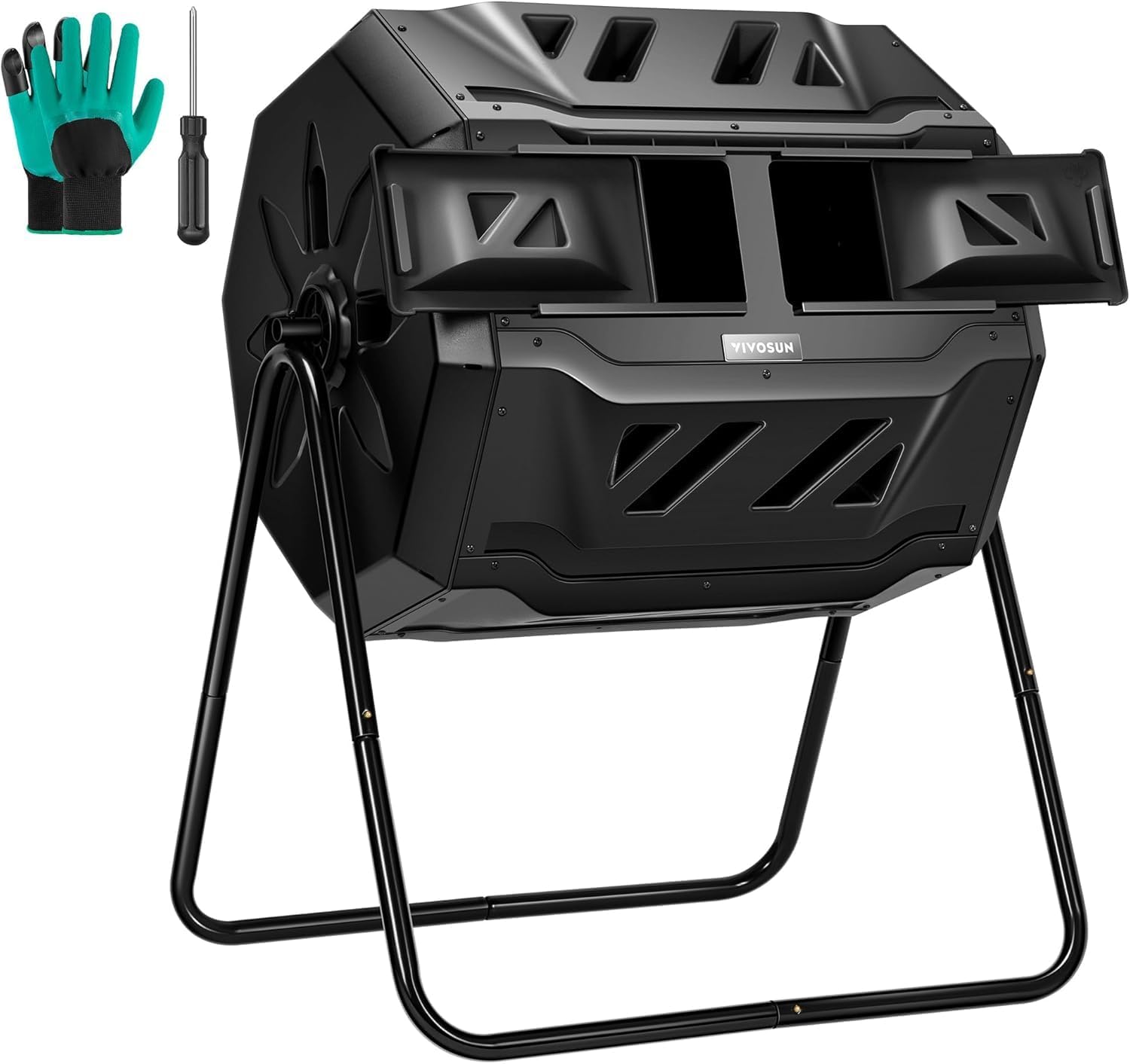
The VIVOSUN dual-chamber tumbling composter is built for gardeners who want a steady supply of finished compost without frequent manual mixing. You load kitchen scraps and yard clippings into one chamber while the other finishes; rotating the octagonal barrel with its deep fins breaks up clumps and accelerates aeration so material decomposes faster than in a static bin. The galvanized-steel frame and polypropylene body are corrosion-resistant for outdoor use, and vents around the drum promote oxygen flow to support aerobic breakdown. A pair of included waterproof gardening gloves and small digging claws are a useful extra for handling waste and loading the tumbler. The unit holds about 43 gallons, so it suits small to medium gardens but is not intended for large-scale yard waste. Assembly and turning require some physical effort, and like any enclosed tumbler it still needs a sensible balance of greens and browns and occasional monitoring of moisture and temperature for best results.
Best for: Gardeners who want a convenient, continuous source of finished compost and prefer a low-mess tumbling system that speeds breakdown without daily manual mixing.
Less Ideal for: People needing to process large volumes of yard waste or those who want a completely hands-off, passive composting method.
- Dual chambers let you load fresh waste while other material finishes, enabling continuous compost production
- 360-degree tumbling design with deep fins makes turning easier and improves aeration for faster decomposition
- Galvanized steel frame with PP plastic drum offers weather resistance for outdoor use
- Included waterproof gloves and digging claws simplify loading and handling compost
- 43-gallon capacity is best for small to medium gardens and may be too small for heavy yard waste
- Requires regular turning and monitoring of moisture and greens/browns balance to avoid slow decomposition
Verdict: Choose this dual-chamber tumbling composter if you want a compact, weather-resistant system that delivers a steady stream of finished compost with regular tumbling.
Algreen Soil Saver Classic 94‑Gallon Compost Bin

| Capacity | 94 gallons |
|---|---|
| Material Type | Plastic |
The Algreen Soil Saver Classic is a large-capacity stationary composter built for steady, performance-focused backyard composting. Its 94‑gallon bin holds plenty of kitchen scraps, leaves, and grass clippings so you can keep a continuous supply of material without frequent emptying. The solid-walled, heat-retaining plastic construction and slim ventilation slots support microbial breakdown and help keep temperatures up for faster decomposition, while the locking lid reduces pests and odors. Top loading is easy for adding new material and the two sliding bottom doors let you extract finished compost without digging through active layers. Made from recycled plastic, it is weather-resistant and intended for low-maintenance use. Limitations are that it is a stationary unit, so it requires a dedicated spot and is not suitable for frequent relocation, and it lacks active mixing or tumbling, which means faster results require manual turning or layering. For gardeners who want large-volume, reliable, low-fuss composting, this model delivers practical performance.
Best for: Gardeners who prioritize reliable, large-volume compost production and want a low-maintenance backyard system that keeps pests out and yields usable compost for beds and containers.
Less Ideal for: People with very small outdoor spaces or those who need a portable or actively mixing composter should consider smaller bins or a tumbler instead.
- Large 94‑gallon capacity supports continuous, high-volume backyard composting
- Solid, heat-retaining walls and ventilation slots encourage steady decomposition
- Locking lid and solid-walled design help deter pests and control odors
- Dual sliding bottom doors allow finished compost removal without disturbing new material
- Constructed from 100% recycled plastic for weather resistance and durability
- Stationary design requires a permanent spot and is not easy to move
- No built-in turning or tumbling mechanism, so manual aeration is needed for fastest results
Verdict: Buy this if you need a roomy, durable backyard composter that produces steady batches of finished compost with minimal fuss.
Goplus 80-Gallon Outdoor Compost Bin with Top Lid and Bottom Exit Door

| Capacity | 80 gallons |
|---|---|
| Material Type | Polypropylene (PP) |
This Goplus compost bin is a straightforward, no-frills outdoor composter built for gardeners who want to turn kitchen scraps and yard waste into usable soil without fuss. The 80-gallon capacity means you can add more material and go longer between emptying, while the top flip lid makes loading easy and the bottom exit door lets you pull finished compost without digging through the whole pile. Made from thick polypropylene rated BPA-free and UV-inhibited, the unit resists weathering and helps retain heat and moisture for steady decomposition. Twelve vents on each side improve air flow so aerobic breakdown is faster than in sealed containers, and the open-bottom grounding design lets leachate drain and worms access the pile naturally. Assembly requires no tools and is quick. Limitations are that the rigid rectangular panels are less insulated than heavy wooden or double-walled options, so in very cold climates decomposition will slow, and the plastic panels may warp over many seasons if exposed to extreme sun. For uncomplicated backyard composting where capacity and ease matter most, this model is a practical choice.
Best for: Gardeners who want a high-capacity, low-maintenance composter to process regular kitchen scraps and yard trimmings with minimal setup and handling.
Less Ideal for: Those who need a heavily insulated or insulated tumbling system for rapid winter composting or who prefer an attractive, built-in garden fixture.
- Large 80-gallon capacity reduces how often you need to empty or rotate material
- Top flip lid and bottom exit door make loading and harvesting finished compost simple
- 12 side vents promote airflow for faster aerobic decomposition
- BPA-free polypropylene construction is weather-resistant and helps retain heat and moisture
- Tool-free assembly lets you set it up in minutes
- Single-wall plastic panels offer less insulation than wood or double-walled designs, slowing composting in cold weather
- Plastic may eventually degrade or warp with prolonged high-UV exposure
Verdict: Choose this bin if you want a large, easy-to-use outdoor composter that lets you load from the top and harvest finished compost from the bottom with minimal assembly.
MyLifeUNIT 34‑Gallon Reusable Compost Bin Bags (2 Pack)

| Capacity | 34 gallons |
|---|---|
| Number of Items | 2 |
| Material Type | Polyethylene |
These MyLifeUNIT compost bags are lightweight, reusable containers intended to turn kitchen scraps and garden waste into compost in a compact, portable format. You use them like a small outdoor compost tumbler: add layered green and brown materials through the zippered top, monitor progress through the top opening, and release finished compost through the bottom self‑adhesive flap. Notable features include thickened PE material for water resistance and UV exposure, double webbing handles for moving filled bags, a zippered top to contain moisture and speed fermentation, and a bottom fertilizer gate to extract finished compost without emptying the whole bag. Practical benefits are easy storage when not in use, quick setup, and a simple option for gardeners who do not want a permanent bin. Limitations are that flexible bags can be less insulating and less pest‑resistant than rigid bins, capacity is modest at 34 gallons so frequent turning or multiple units are needed for larger waste volumes, and the bottom adhesive closure requires careful use to avoid soil contact with the strip.
Best for: Buyers who want an inexpensive, space‑saving way to compost kitchen scraps and small amounts of garden waste without installing a permanent bin.
Less Ideal for: People who need high‑volume composting, heavy insulation for cold climates, or strong pest control should consider a rigid tumbler or sealed hot compost system instead.
- Reusable, waterproof polyethylene resists tears and outdoor exposure
- Zippered top and bottom discharge flap let you add waste and remove finished compost without dumping
- Strong webbing handles make it portable when full
- Collapsible design stores flat when not in use
- Flexible bag design offers less insulation and pest protection than rigid compost bins
- 34 gallon capacity may be small for households with large amounts of yard waste
Verdict: A low‑cost, portable composting option for small gardens that makes turning kitchen and yard waste into usable compost simple and space efficient.
Cozurra In-Ground Worm Compost Bin, 2-Pack (3.3 Gallon)

| Capacity | 3.3 gallons |
|---|---|
| Material Type | Polypropylene (PP) |
| Number of Items | 2 |
The Cozurra 2-pack in-ground worm compost bins are compact plastic cylinders you bury in a raised bed or garden to feed kitchen scraps directly to composting worms. Each bin holds about 3.3 gallons and uses side ventilation holes plus a twist-lock lid to keep airflow while limiting pests and odors. The idea is simple: alternate the two units so one is collecting scraps while the other finishes breaking down material, giving a steady supply of castings for vegetables and flowers. The polypropylene construction should resist moisture and soil contact, and the removable lid and large opening make adding scraps straightforward. Because the system relies on worms and passive aeration, there is almost no turning or active management, which suits gardeners who want a reliable, low-effort way to enrich beds. Limitations are the small capacity and the need to bury the units, which means you must plan location and rotation in advance and may find them less useful for very large yards or heavy kitchen waste producers.
Best for: Gardeners who want a dependable, low-maintenance way to convert kitchen scraps into soil amendment directly where plants grow and prefer simple systems that do not need regular turning or monitoring.
Less Ideal for: People with very large households that generate heavy food waste or gardeners who need a portable or high-capacity composting solution should consider larger surface or tumbling composters.
- Two-bin system supports continuous composting by allowing rotation between active and curing bins
- Ventilated design with side holes and lid promotes airflow to reduce odors and anaerobic conditions
- Twist-lock lid and buried placement help deter pests and keep material contained
- Durable polypropylene construction suitable for contact with soil and outdoor conditions
- Small 3.3 gallon capacity per unit limits how much kitchen waste can be processed at once
- Requires digging and permanent placement in a bed which reduces flexibility for relocation
Verdict: A simple, reliable two-bin in-ground worm system for gardeners who want low-effort, continuous composting directly in beds.
Miracle-Gro Dual Chamber Compost Tumbler (2 × 18.5 gal / 70 L)

| Capacity | 37 gallons |
|---|---|
| Material Type | Alloy Steel |
| Number of Items | 1 |
The Miracle-Gro Dual Chamber Compost Tumbler is a user-friendly outdoor composter that makes batch-style composting simple for home gardeners. Its two 18.5 gallon chambers let you fill one side while the other cures, so you can maintain a near-constant supply of finished compost without manual turning. The barrel tumbles for easy aeration and the UV-protected, food-grade plastic body plus a galvanized steel base and side-locks aim to keep pests out and withstand seasonal use. In practice it is quick to load and unload through the sliding doors and the design helps speed decomposition to 4–6 weeks when the mix and moisture are right. Important limitations are the modest total capacity relative to large yard piles and the need to rotate every few days to keep the process active; very large households or heavy mulch users may need a larger unit. Assembly and placement on level ground matter for stable tumbling, and it is best for gardeners who want lower-maintenance, faster-turnaround compost without digging or frequent manual turning.
Best for: Gardeners who want a low-effort way to produce consistent batches of compost for vegetable beds or flower borders and appreciate product reliability backed by wide use.
Less Ideal for: People who generate large volumes of yard waste or need bulk compost quickly should choose a larger stationary bin or a multi-unit system instead.
- Dual-chamber design allows continuous composting by alternating filling and curing sides
- Tumbling mechanism provides easy aeration and reduces the need for manual turning
- UV-protected, food-grade plastic and galvanized steel base improve durability and pest resistance
- Sliding doors make loading and removing finished compost straightforward
- Total capacity (37 gallons) is limited for very large gardens or heavy yard waste
- Requires regular rotation and correct moisture balance to reach the advertised 4–6 week turnaround
Verdict: Choose this dual-chamber tumbler if you want an easy, reliable way to produce steady batches of finished compost with minimal manual turning.
GEOBIN Expandable Backyard Compost Bin (Plastic)

| Capacity | 216 gallons |
|---|---|
| Material Type | Plastic |
The GEOBIN is a cylindrical, expandable backyard composter built from plastic panels that snap together to form a roomy vessel for yard and kitchen waste. It assembles quickly with closure keys and can be collapsed and reassembled for moving or storage, which makes it practical for seasonal gardeners. The bin’s perforated design provides airflow to speed decomposition and helps avoid soggy, anaerobic pockets. With a quoted capacity around 216 gallons (expandable slightly), it holds a lot of material so you can batch leaves and kitchen scraps rather than turning the pile every few days. The lightweight panels keep the unit affordable and easy to handle, but plastic construction means it will not insulate like a heavy insulated tumbler and may degrade over many seasons in harsh sunlight. There is no built-in access door for finished compost, so you will need to pull apart the side to harvest material. For typical backyard composting where cost, easy setup, and ventilation matter most, this is a practical, low-fuss option.
Best for: Buyers who want a straightforward, low-maintenance backyard composter that is inexpensive, easy to set up, and holds large volumes for seasonal leaf and kitchen-waste composting.
Less Ideal for: Gardeners who need fast, high-heat composting or a built-in harvest door should consider insulated tumblers or bins with dedicated access instead.
- Large capacity suits batch composting of yard waste and kitchen scraps
- Expandable and easy to assemble or reconfigure with closure keys
- Perforated/plastic panels provide good ventilation to aid decomposition
- Lightweight panels are easy to move and store when empty
- No dedicated access door for scooping finished compost
- Plastic panels offer limited insulation and may wear faster in prolonged sun exposure
Verdict: A roomy, easy-to-assemble plastic composter that delivers good ventilation and simple, affordable backyard composting.
Choosing the Right Compost Bin for Garden: Key Factors to Consider
Capacity Relative to Garden Size
Capacity determines how much material you can store while it breaks down. A bin that is too small will force you to add partially decomposed material to the pile before it is ready, slowing the process and increasing the chance of odor. Conversely, an oversized bin can sit underused and take up valuable garden real estate.
Think about the volume of kitchen scraps, lawn clippings, and seasonal clean-up debris you produce. For small urban gardens or balconies, a compact tumbling or closed 50-100 liter unit will often be sufficient. For larger suburban gardens, aim for a bin that can hold several months of material so you can build heat and maintain steady decomposition without daily attention.
Aeration and Oxygen Flow
Composting is an aerobic process, so oxygen availability strongly affects decomposition speed and smell. Bins with built-in vents, adjustable openings, or designs that allow easy turning will promote aerobic breakdown and reduce anaerobic pockets that create bad odors and slow progress.
Look for systems with passive vents placed to encourage airflow through the pile, or for tumblers that make mechanical turning simple. Poorly ventilated closed bins may trap moisture and cause slimy, smelly material unless you are prepared to turn and monitor the pile frequently.
Access for Turning and Harvesting
How you access the material matters for both active and passive composting methods. A bin with a removable lid and a low-access hatch makes it easier to add bulky materials, check moisture, and harvest finished compost. Tumblers and rotating drums simplify turning but sometimes make small-scale additions awkward.
Consider how you plan to work: if you like to turn with a pitchfork, choose a bin with wide openings. If you prefer lower-effort systems, prioritize tumblers or multi-chamber designs that allow staged filling and harvesting without heavy lifting.
Durability and Weather Resilience
Outdoor compost bins face rain, sun, freezing temperatures, and pests. Materials that resist UV degradation and corrosion will last longer and maintain performance over seasons. Rigid plastics, powder-coated metal, and rot-resistant wood are common choices, each with tradeoffs in weight and maintenance.
Drainage and a secure lid keep pests out and prevent waterlogging. If you live in a very wet climate, ensure the design sheds excess rain or provides elevated bases. In cold regions, insulation or a larger thermal mass can help maintain decomposition during cooler months.
Pest Management and Site Placement
Keeping pests away is essential to avoid attracting rodents or flies. Solid lids, fine-mesh vents, and raising the bin off the ground are practical measures. Placement also influences pest risk: situate the bin away from property edges, on level ground, and not directly against wooden structures that might invite excavation.
Avoid placing bins where food scraps will be routinely added in plain sight of wildlife. Consider using a secure base or concrete pad in areas with high rodent activity and maintain good layering of carbon-rich materials to discourage odors that attract pests.
Maintenance Effort and Time Investment
Different systems demand different maintenance rhythms. Tumblers reduce turning effort but still require a schedule; stationary bins need manual turning and monitoring for moisture and temperature. Maintenance also includes occasional cleaning, checking vents, and managing leachate.
Be honest about how much time you will commit. Low-effort designs trade off some capacity or speed, while high-performance systems require more active management but produce finished compost faster. Match the bin to both your available time and your desired composting speed.
Choosing a Location in the Garden
Select a level, well-drained spot that is convenient for dropping kitchen scraps and garden waste but not so close to living areas that occasional odors are a nuisance. Aim for partial sun and partial shade to help maintain microbial activity without overheating the bin in summer.
If you expect to move heavy loads of finished compost, position the bin near beds where you will use it. Placing it on a solid base reduces contact with soil-dwelling pests and makes access easier.
- Avoid low spots that hold water
- Leave clearance around the bin for air circulation and access
- Consider proximity to a water source for occasional moisture adjustments
Types of Garden Compost Bins and How They Behave
There are several common designs that behave differently in a garden setting. Tumblers speed up turning and reduce contact with the ground, which can limit pest access and make harvesting straightforward. Enclosed stationary bins are simple and often hold more volume, but they may need manual turning with a pitchfork to prevent compaction.
Open wire or pallet-style enclosures are low-cost and breathable, but they require more attention to keep materials contained and to prevent scavenging by animals. Multi-chamber systems let you work in batches so one side can cure while you fill another, which works well for gardeners who want continuous output.
- Tumblers: low-lift turning, faster aeration
- Enclosed bins: higher capacity, may need tool turning
- Open bins: best airflow, more pest and containment attention
- Multi-chamber: continuous workflow, staged curing
Managing Moisture and the Carbon-to-Nitrogen Mix
Moisture balance and the right mix of greens and browns determine how efficiently a garden compost bin produces finished compost. Material should be damp like a wrung-out sponge; too wet leads to anaerobic conditions and odor, too dry slows microbial activity.
Add carbon-rich materials such as dry leaves, shredded paper, or straw to balance food scraps. Layering and occasional turning help distribute moisture and heat, producing a more uniform breakdown across the load.
- Aim for a 25-30:1 carbon-to-nitrogen ratio by volume when possible
- If smell develops, add dry brown materials and increase aeration
- Use a lid or cover to prevent excess rain from waterlogging the pile
Winter Composting Tips
Composting slows as temperatures drop, but it does not stop entirely. To keep a garden compost bin active through winter, add larger volumes before the cold season to give the mass thermal inertia, insulate with straw or a thick cover, and avoid frequent opening that releases heat.
If you need finished compost during winter, plan for stockpiling finished material before the cold sets in. For active composting in cold climates, smaller insulated bins or burying the bin in a sheltered spot can help retain heat.
- Reduce the frequency of turning to retain heat
- Add more bulky brown material to provide insulation
- Locate the bin in a sheltered area out of prevailing winds
Integrating Composting Into Garden Workflow
Think of the compost bin as part of your seasonal routine. Keep a small kitchen caddy or covered container near the preparation area to make regular transfers less of a chore. Matching the bin capacity to the cadence of your garden tasks prevents overflow and keeps composting efficient.
Use finished compost to top-dress beds, amend soil before planting, or make compost tea for potted plants. Planning how and when you will use the output helps size the system and manage harvest timing.
- Keep a hand tool and moisture meter nearby for quick checks
- Plan to harvest and apply compost at the start or end of the growing season
- Consider a two-bin workflow for continuous supply
How We Chose the Best Compost Bin for Garden
We focused on features that matter for real garden composting rather than marketing claims. Key evaluation criteria included usable capacity and footprint, because garden spaces range from balcony planters to suburban yards; aeration and aeration control, since oxygen flow drives decomposition speed and odor control; access and material removal, which affect how easily finished compost is recovered and applied; durability and weather resistance to ensure a bin lasts through seasons; and maintenance effort, including how often turning or moisture adjustments are required. We excluded specialized industrial units, DIY pile-only methods, and systems intended solely for indoor or vermicomposting because they do not meet the average outdoor gardener's needs. We also filtered out units that lacked clear instructions for setup or had obvious drainage and pest-entry issues. The selected bins balance capacity, airflow management, durability, and user effort so gardeners can choose a system that fits their space and composting routine.
FAQ
How big should a compost bin be for a small garden?
For small gardens, a compact bin between about 50 and 200 liters typically balances capacity and space. Choose the larger end of that range if you generate a lot of yard waste or want faster heat-driven decomposition.
Can I compost meat and dairy in a garden compost bin?
Meat and dairy often attract pests and can create strong odors in outdoor garden bins. It is usually better to avoid them unless you have a well-sealed, high-heat system specifically designed to handle such materials.
How often should I turn my compost bin?
Turning frequency depends on the system and your goals. Tumblers may be turned every few days for faster results, while stationary bins often need turning every 1 to 3 weeks. Less frequent turning is acceptable if you maintain good aeration and moisture balance.
Will a compost bin create a smell in my garden?
Properly balanced and aerated compost typically smells earthy rather than unpleasant. Persistent foul odors usually indicate excess moisture or too much green material and can be remedied by adding dry browns and increasing airflow.
Do compost bins attract rodents and how can I prevent that?
Bins can attract rodents if food scraps are exposed or lids are unsecured. Prevent problems with tight-fitting lids, fine-mesh vents, burying food scraps slightly under brown material, and placing the bin on a solid or raised base.
Final Verdict
Match the compost bin to the size of your garden, the volume of material you produce, and how much time you want to spend managing the process. Prioritize adequate aeration and easy access if you want faster results, or choose lower-effort designs if convenience is more important than speed. By weighing capacity, airflow, durability, and maintenance effort, you can select a garden compost bin that fits your workflow and delivers usable compost on a schedule that suits your beds and containers.
