

Note: This article contains affiliate links. If you click on these links and make a purchase, I may earn a small commission at no extra cost to you. This helps support my research and content. Read my full affiliate disclosure here.
Brewing compost tea can boost plant health, feed soil microbes, and give young transplants a stronger start. You want compost that releases soluble nutrients readily, is mature enough to avoid phytotoxicity, and is low in weed seeds or pathogens. This guide shortlists six top composts suited for compost tea and explains the practical reasons gardeners pick one over another. We evaluated each option for factors that matter in real gardens: nutrient extractability, contamination risk, and how the material behaves during brewing. Read on to understand the differences and how to choose the right compost for your brewing needs.
Top Picks at a Glance
| Best Quality Built to a higher standard if you want something more solid | Blue Ribbon Organics OMRI-Certified Organic Compost (Bag) |  |
| Best Value The sweet spot between price and what you get | HiThrive Worm Castings Liquid Concentrate, 1 Gallon |  |
| Best Budget The cheapest option that still gets the job done reliably | Xtreme Gardening Xtreme Tea Brews Compost Tea Kit, 2-Pack |  |
| Highest Rated A top-rated pick with lots of positive feedback | Brut Organic Worm Castings, 5 lb |  |
| Most Popular A crowd favorite that many people choose with confidence | Wiggle Worm Pure Worm Castings Organic Fertilizer, 30 lb |  |
| Best Seller A high-volume bestseller chosen again and again | Mighty Plant Instant Compost Tea (5 oz) |  |
Blue Ribbon Organics OMRI-Certified Organic Compost (Bag)

| Brand | Blue Ribbon Organics |
|---|---|
| Included Components | Compost |
| Item Type Name | Organic Compost |
| Volume | 7.48 gallons |
Blue Ribbon Organics OMRI-Certified Compost is a bagged, fully processed organic compost designed to be worked into beds, used as a topdressing on lawns, or applied as a mulch around trees and shrubs. It is made from recycled food and yard residuals, monitored for maturity and contaminants, and certified for organic use so you can add it directly to vegetable, flower, and landscape plantings. Typical applications include incorporating 3–4 inches into new beds, adding a light 1/4–1 inch replenishment to established beds, or topdressing lawns at 1/4–1/2 inch in fall. The product claims improved aeration, increased water retention, pH buffering, and a boost of key nutrients such as nitrogen, phosphorus, and potassium. Because it is a natural material, moisture variation can affect bag weight and handling, and a single bag covers a modest area, so larger projects will require multiple bags or bulk compost. For gardeners focused on measurable soil improvement and organic certification, this compost delivers an easy, safe way to rebuild soil health without synthetic inputs.
Best for: Gardeners who prioritize measurable soil improvement and organic certification and want a ready-made compost to reliably boost planting beds, lawns, and established landscapes.
Less Ideal for: Large-scale landscapers or gardeners needing to amend many beds quickly should consider bulk compost options rather than repeated bag purchases.
- OMRI certified and meets US Composting Council standards so it is suitable for organic vegetable and flower gardens
- Processed and tested for maturity, pathogens, and weed seed to reduce risk of introducing problems
- Versatile use: can be tilled into new beds, used as a topdressing for lawns, or applied as mulch around trees and shrubs
- Contains a balanced mix of organic nutrients and improves soil aeration and water retention
- Bag size/volume is modest so several bags are needed for large beds or multiple trees
- Moisture variation in a natural product can make individual bag weights inconsistent
Verdict: Choose this bagged OMRI-certified compost when you want a tested, organic-ready product that reliably improves soil structure and supports performance-oriented gardening.
HiThrive Worm Castings Liquid Concentrate, 1 Gallon

| Item Form | Liquid |
|---|---|
| Liquid Volume | 1 gallons |
| Mixing Ratio | 1 tablespoon per gallon of water |
| Coverage | All indoor and outdoor plants |
| Specific Uses For Product | Plant Growth |
HiThrive Worm Castings is a ready‑to‑mix liquid worm casting concentrate intended for use as a soil amendment and compost tea base. You mix one tablespoon per gallon of water and apply with regular waterings or as a foliar/soil drench to boost soil fertility and microbial activity. The product’s main benefit is dilution economy: the 1 gallon bottle claims to make up to 256 gallons of usable tea, so a small container covers a lot of ground in vegetable beds, container gardens, and houseplants. It is 100 percent organic and formulated for use across all plant types and growth stages, which makes it simple to slot into existing feeding routines. Practical caveats are that it is a liquid concentrate rather than a dry amendment, so storage and handling require care and protective gear, and you must follow the dilution directions to avoid overapplication. The formula is versatile and easy to use for gardeners who want a concentrated, organic source of worm‑casting benefits without brewing and straining solid castings.
Best for: Gardeners who value efficient, no‑fuss organic inputs and want a concentrated worm‑casting source to stretch across beds, containers, and houseplants without brewing raw castings.
Less Ideal for: People who prefer solid amendments to mix directly into soil or those who need precise, labeled nutrient breakdowns for professional nutrient management.
- High concentration yields long usable volume from a single bottle (advertised up to 256 gallons)
- 100% organic worm castings concentrate suitable for all indoor and outdoor plants
- Easy to mix with a simple 1 tablespoon per gallon ratio for routine watering or tea applications
- Useful as both soil drench and foliar feed to improve soil fertility and plant vigor
- Liquid concentrate requires careful storage and handling and may need gloves and eye protection
- No nutrient analysis provided on the listing to quantify specific N‑P‑K or micronutrient levels
Verdict: A highly concentrated, easy‑to‑mix organic worm casting concentrate for gardeners who want to produce large amounts of compost tea with minimal effort.
Xtreme Gardening Xtreme Tea Brews Compost Tea Kit, 2-Pack

| Item Form | Powder |
|---|---|
| Specific Uses For Product | Vegetable Gardens, Fruit Trees, Herbs, Houseplants, Flowers |
| Coverage | Full |
| Liquid Volume | 10 gallons |
Xtreme Gardening Xtreme Tea Brews is a two-part powdered compost tea system that simplifies brewing a biologically active tea for vegetable gardens, herbs, fruit trees, houseplants, and flowers. Each pouch is formulated to supply organic compost material and microbe food so you can steep a tea that boosts beneficial soil biology and helps make nutrients more plant-available. In practice you mix the powder with water and brew according to the instructions, then apply weekly to the root zone or use as a foliar feed depending on plant needs. Notable features include the paired ingredients that stay stable until use and a coverage claim that one kit brews multiple gallons of finished tea, making it economical for small-scale gardeners. Limitations are that the package gives general application guidance rather than precise doses and that heavy users will need multiple kits for larger beds. This product is best when you want a straightforward, ready-to-brew compost tea without crafting your own recipe from scratch.
Best for: Gardeners on a budget who want an easy, ready-made compost tea solution to boost soil biology across vegetables, herbs, and container plants.
Less Ideal for: Large-scale growers or those who prefer fully custom compost tea recipes and precise dosing control should consider bulk amendments or professional blends.
- Two-part powder keeps ingredients stable until brewing for consistent results
- Formulated to increase beneficial microbes and improve nutrient availability
- Suitable for a wide range of plants and growing media including hydroponics and soil
- Compact, lightweight packaging brews multiple gallons, useful for small gardens
- No specific application rates listed on the package which requires judgment for dosing
- Small unit size means frequent repurchase for larger beds or frequent applications
Verdict: An affordable, pre-formulated compost tea kit that makes brewing beneficial microbial tea quick and simple for small to medium home gardens.
Brut Organic Worm Castings, 5 lb

| Item Form | Granules |
|---|---|
| Specific Uses For Product | Gardening,Organic |
| Target Species | All plants |
| Mixing Ratio | 1:5 |
Brut Organic Worm Castings function as a concentrated, natural soil amendment you mix into potting mixes or top-dress garden beds and raised beds. Typical use is mixing at the recommended 1:5 ratio for new indoor plants, sprinkling a cup around established houseplants, or working into outdoor planting holes and beds according to the brand directions. The product is OMRI/CDFA listed and produced in controlled conditions, which supports consistent nutrient content and beneficial microbial life that help roots establish, improve soil structure, and increase moisture retention without burning plants. Practical benefits for raised garden beds include improved aeration, slow-release nutrients, and a boost in microbial activity that supports long-term fertility. Limitations are that it is not a complete NPK fertilizer for immediate heavy feeding needs and larger beds require significant quantities to hit the suggested per-square-foot rates, so frequent applications or bulk purchases may be needed for big projects.
Best for: Gardeners who prioritize dependable, organic soil improvement for raised beds and container gardens and prefer predictable, low-risk amendments that support long-term soil health.
Less Ideal for: Those needing immediate, high-NPK feeding for heavy-feeding crops or gardeners who want to amend very large beds without buying supplemental bulk material.
- Certified organic and produced indoors for consistent purity
- Rich in beneficial microbes that improve soil structure and plant vigor
- Easy-to-use granular form suitable for mixing or top-dressing
- Not a standalone high-NPK fertilizer for rapid nutrient correction
- Five-pound bag may be small for large raised beds and repeated seasonal use
Verdict: Use this OMRI/CDFA-listed worm castings product to reliably build long-term fertility and microbial health in raised beds and containers.
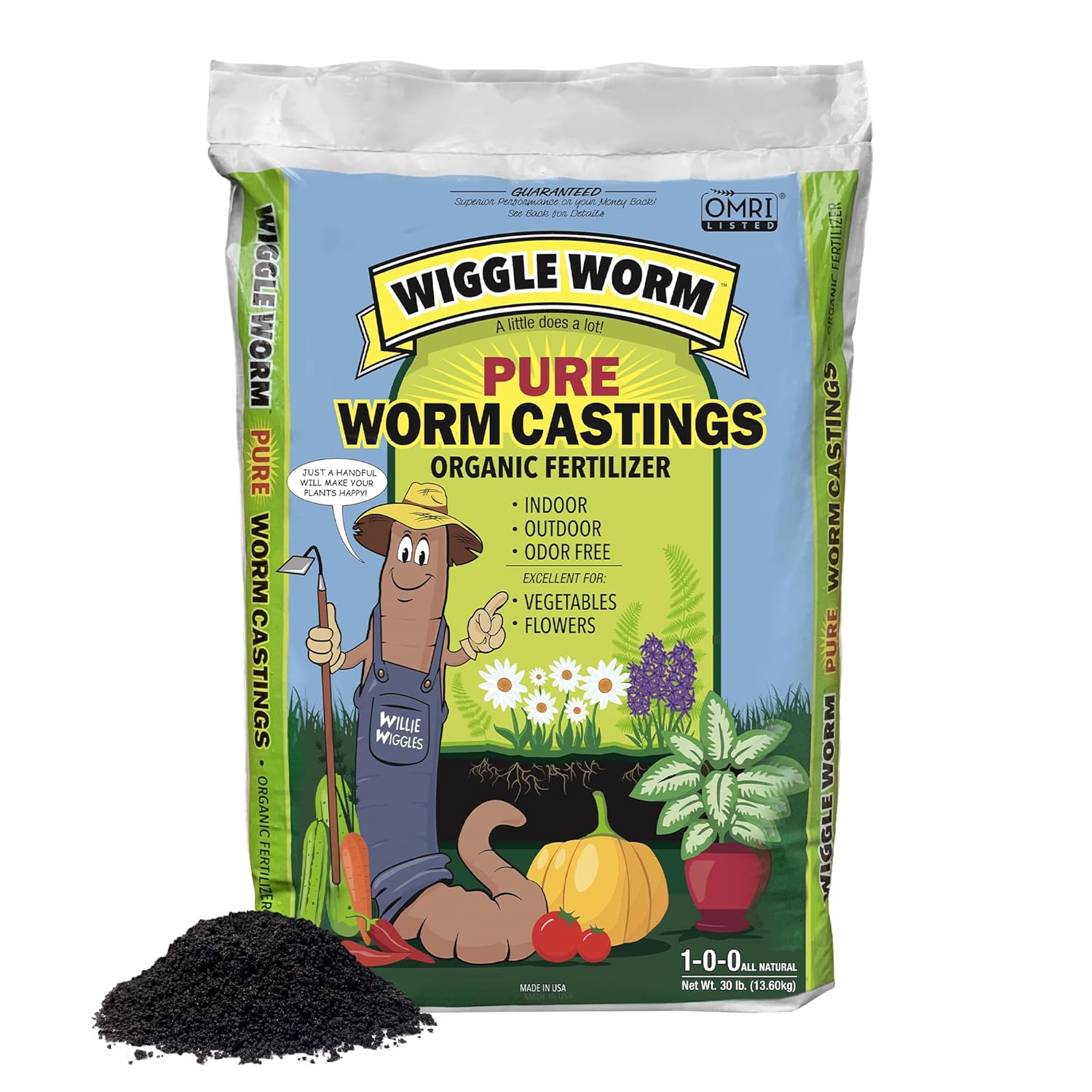
Wiggle Worm Pure Worm Castings Organic Fertilizer, 30 lb
| Item Form | Granules |
|---|---|
| Specific Uses For Product | Soil Conditioning |
| Application Method | Apply to soil |
| Unit Count | 480 Ounce |
Wiggle Worm Pure Worm Castings are a ready-to-use organic soil amendment made from concentrated earthworm castings. Gardeners typically mix a portion into potting mixes, top-dress established plants, work it into transplant holes, or brew it as a nutrient tea; the product page includes specific dosing for vegetables, containers, lawns, and roses. The castings are odorless, non-burning, and OMRI listed for organic use, so they supply water-soluble nutrients plus microbes that improve aeration, water retention, and root development without synthetic chemicals. Practical benefits include easy application, safe use on seedlings and mature plants, and versatility across raised beds, container gardens, and lawns. The main limitation is that this is a concentrated soil builder rather than an all-in-one fertilizer with NPK labels, so users seeking precise, fast-acting nutrient ratios may need to supplement for specific deficiencies; also a 30 lb bag is bulky to handle for small-space gardeners. For gardeners focused on long-term soil health and organic production, it functions as a low-risk, effective amendment.
Best for: Gardeners who prioritize building long-term soil health and want a safe, organic amendment for vegetables, ornamentals, and containers; buyers who value proven, low-risk inputs backed by strong user feedback.
Less Ideal for: Gardeners who need targeted, rapid nutrient correction based on precise NPK values or those who only want a lightweight product for very small balconies or indoor micro-gardens.
- OMRI listed organic and made from 100% worm castings
- Provides beneficial microbes that improve soil structure and water retention
- Odorless and non-burning so safe for seedlings and established plants
- Versatile dosing for containers, raised beds, lawns, and making worm casting tea
- No standard NPK nutrient label so not a precise standalone fertilizer for targeted feeding
- Large 30 lb bag can be heavy and awkward for gardeners with limited storage or mobility
Verdict: Choose this product when you want a proven, OMRI-listed worm casting that builds soil biology and improves plant health across beds and containers.
Mighty Plant Instant Compost Tea (5 oz)

| Item Form | Powder |
|---|---|
| Application Method | root drench or foliar spray |
| Coverage | Medium |
| Target Species | All plants |
| Mixing Ratio | 1:64 (Indoor), 1:32 (Outdoor) |
Mighty Plant Instant Compost Tea is a 100% water‑soluble powder that turns into a ready‑to‑use compost tea without brewing. You dissolve the measured powder in unchlorinated water (1 tsp/gal for indoor, 2 tsp/gal for outdoor) and apply it as a root drench or foliar spray; a single 5 oz pack makes up to 50 gallons. The formula emphasizes biological stimulation, supplying amino acids plus kelp and yeast extracts to feed soil and root zone microbes and support growth and flowering. For routine gardening it simplifies the variable process of brewed teas by delivering a consistent mix each time and it is stated to be safe for hydroponics and irrigation systems. Limitations are that the product description focuses on biological benefits rather than a guaranteed nutrient analysis, so users wanting precise N‑P‑K numbers or lab‑verified microbial counts may find the information incomplete. Also it requires unchlorinated water and correct dilution for best results which adds a small step compared with standard liquid fertilizers.
Best for: Gardeners who prefer low‑risk, repeatable products that reliably support soil biology without managing a messy brewed compost tea; good for routine feeding of container, garden bed, and hydroponic plants.
Less Ideal for: Users who need precise, lab‑verified nutrient analysis or those who want to formulate their own compost brews from raw materials.
- Ready to use without brewing, saving time and reducing variability
- Water‑soluble powder that yields up to 50 gallons from a 5 oz packet
- Suitable for root drench or foliar spray and compatible with hydroponic systems
- Contains amino acids plus kelp and yeast extracts to support beneficial biology
- No detailed N‑P‑K breakdown or certified microbial counts provided
- Requires unchlorinated water and correct dilution to achieve intended results
Verdict: Choose this product if you want a predictable, easy‑to‑use compost tea concentrate that boosts root and soil biology without brewing.
Choosing the Right Compost for Compost Tea: Key Factors to Consider
Feedstock Composition
The materials used to make compost determine what ends up in your tea. Compost made from a balanced mix of green nitrogen sources and brown carbon materials tends to offer both soluble nutrients and a steady carbon supply that supports microbial activity. Compost dominated by woody chips will release fewer soluble nutrients and may require longer brewing or finer grinding. If the compost contains manure, verify it was well thermally processed to reduce pathogen risk.
Feedstock also affects unwanted residues. Compost containing persistent plant toxins, treated wood, or invasive weed roots can introduce compounds or viable weed material into your tea. Choose composts with clearly labeled feedstocks when possible.
Maturity and Stability
Mature, stable compost has finished active decomposition and is less likely to produce phytotoxic compounds when brewed. Immature compost can release ammonia or organic acids that burn plant roots and stunt seedlings. Look for composts that show fine, crumbly texture, earthlike smell, and uniform dark color as signs of maturity.
Stability matters because it also influences the microbial community available for extraction. Stable composts tend to harbor a balanced microbial population rather than the large, rapidly changing communities found in fresh piles.
Nutrient Profile and Solubility
Not all nutrients in compost are equally extractable in water. Soluble nitrogen forms, some phosphorus, and micronutrients dissolve more readily and are most useful in short brews. Composts high in available nitrogen and with a moderate C:N ratio generally produce stronger nutrient teas. However, very high total nutrient levels do not guarantee high extractability; particle size and degree of humification affect what actually leaches into the water.
If you want a nutrient-forward tea, prioritize compost with a known analysis or composts made from vegetable scraps and manure (if properly processed). For a microbe-focused tea, choose composts rich in diverse organic inputs rather than strictly high-nitrogen sources.
Microbial Community Potential
Compost tea relies on extracting beneficial microbes to inoculate soil and foliage. Compost with a diverse microbial community – including bacteria, actinomycetes, and fungi – offers broader functional benefits. Diversity is encouraged by varied feedstocks, aerobic processing, and avoidance of chemical contaminants that suppress microbes.
Keep in mind that extraction method, aeration, and brewing time influence which microbes dominate the final tea. A compost that supports a balanced community in the pile is a better starting point for a biologically active brew.
Particle Size and Filtration
Particle size affects how quickly and cleanly compounds and microbes pass into the tea. Finely screened compost will leach faster and is easier to strain, leading to clearer teas and fewer clogged pumps. Larger chunks take longer to extract and make filtration more cumbersome.
For gardeners using small aerators or watering cans, a compost that strains easily through cheesecloth or a fine mesh will save time and reduce the risk of equipment blockage. Consider whether you will screen or grind the compost before brewing.
Contamination and Weed Seed Risk
Compost intended for tea should have low risk of carrying weed seeds, persistent herbicide residues, or human pathogens. Compost produced at adequate temperatures for sufficient durations will inactivate most seeds and pathogens. However, some persistent herbicide residues can survive composting and pass into the tea, causing unexplained plant damage.
When possible, choose composts with certification or clear processing information. Avoid compost from unknown municipal or industrial sources that might include prohibited inputs.
Types of Compost That Work Well For Brewing
Different compost styles behave differently in the brew. Leaf-based composts produce gentle, microbe-rich teas good for topdressing and seedling care. Manure-enriched composts tend to yield nutrient-rich brews but must be fully stabilized to avoid phytotoxicity. Vermicompost is prized for very active microbial communities and often produces lively teas even in short brews.
- Leaf and yard composts: Typically lower nutrient concentration but high in fungal life.
- Manure-amended composts: Higher soluble nutrients when properly composted.
- Vermicompost: High microbial activity and often clearer, biologically active teas.
Practical Brewing Tips for Gardeners
Use a clean container and consider an aeration source for longer brews to favor beneficial aerobic microbes. Short, non-aerated steeping produces a different profile dominated by what dissolves quickly; it can be useful for fast nutrient boosts but may not build biological diversity.
Strain the tea through multiple layers of fine mesh or a tight-weave cloth to remove fine particles that clog sprayers and to reduce phytotoxic solids. Start with a weak brew the first time you use a new compost to observe plant response before increasing concentration.
- Aerated brews: Better for promoting beneficial bacteria and avoiding anaerobic odors.
- Non-aerated brews: Simpler but can favor anaerobes if left too long.
- Filtration: Use fine mesh and allow settling to clarify the tea before application.
Storage, Shelf Life, and Handling
Store compost in a dry, ventilated area to preserve its microbial life and prevent anaerobic pockets. Once brewed, compost tea is perishable; apply within 6 to 24 hours for best living microbe counts and to avoid souring. If you must hold tea longer, maintain aeration and keep it cool to slow microbial shifts.
For compost itself, avoid cross-contamination between batches and keep bagged compost off bare ground to reduce rewetting and weed introduction.
- Brewed tea: Use quickly, ideally within a day.
- Unbrewed compost: Keep dry and labeled with feedstock when possible.
Using Compost Tea in Different Garden Situations
For seedlings and transplants, use weak, frequent teas that emphasize microbial support rather than heavy nutrient doses. In vegetable beds, alternate compost tea with other soil-building practices like mulching and green manures to sustain long-term fertility. For ornamentals, foliar applications can help microbial diversity on leaves but avoid spraying in hot sun or when plants are stressed.
Adjust brew strength and frequency to match plant stage and soil fertility; overuse of nutrient-heavy teas can imbalance soil microbes and nutrient dynamics.
- Seedlings: Dilute tea and apply sparingly to avoid root burn.
- Vegetable beds: Use as part of a broader fertility plan.
- Ornamentals: Apply as foliar feed in cool, calm conditions.
How We Chose the Best Compost for Compost Tea
We focused on traits that directly affect the safety and effectiveness of compost when brewed into tea. Our selection filters prioritized maturity and stability because undercomposted material can release phytotoxins and ammonia that harm plants. We also screened for feedstock composition, favoring mixes with balanced green and brown materials and minimal weeds or persistent contaminants. We evaluated nutrient extractability, looking for materials that release soluble nitrogen, phosphorus, and potassium into water without leaving excessive insoluble residue. Microbial diversity potential was another criterion, since diverse microbial populations help create a biologically active tea. Particle size and porosity were considered because they affect how quickly compounds leach out and how well aeration systems circulate through the tea. Practical handling mattered too: bulk versus bagged formats, odor during brewing, and how easily the compost strains were filtered after steeping. We excluded any composts known to include biosolids, uncomposted manure, or unprocessed green waste that can increase pathogen risk. Products that failed basic stability and contamination screens were not considered.
FAQ
How long should I brew compost tea for best results?
Brew time depends on your goals. Short steeps of a few hours extract soluble nutrients quickly. Aerated brews run 12 to 24 hours to favor beneficial airborne bacteria. Longer non-aerated brews can become anaerobic and risk unpleasant compounds.
Can I use any compost to make compost tea?
Many composts work, but choose mature, stable material with known feedstocks. Avoid uncomposted manure, unprocessed municipal waste, or materials with suspected herbicide residues. Certainty about processing reduces contamination risk.
Should I aerate my compost tea?
Aeration helps maintain oxygen-loving beneficial microbes and prevents anaerobic souring. For microbial inoculation goals, aerated brews are usually preferable. Short, non-aerated steeps can still supply nutrients but are less reliable for broad microbial diversity.
Will compost tea introduce weed seeds to my garden?
Well-made, hot compost generally destroys most weed seeds. If compost has not reached adequate temperatures or contains persistent seeds, some may survive. Straining the tea removes solids but not microscopic seeds, so starting with properly processed compost is key.
How do I avoid phytotoxicity when applying compost tea?
Use mature compost and start with dilute brews to test plant response. Ensure compost has a pleasant earthy smell and no strong ammonia odor. Apply in cool parts of the day and avoid watering stressed plants with undiluted or very fresh brews.
Final Verdict
Choose compost for compost tea by prioritizing maturity, low contamination risk, and a feedstock mix that matches your brewing goals. If you want microbe-rich teas, favor diverse, well-aerated composts or vermicompost. If nutrients are the priority, select stable composts with higher available nitrogen but confirm they are fully cured. Balance the tradeoffs between nutrient extractability and microbial diversity, and adjust brew method and strength to fit plant stage and application method. Following these priorities will help you brew safer, more effective compost teas for your garden.
