

Note: This article contains affiliate links. If you click on these links and make a purchase, I may earn a small commission at no extra cost to you. This helps support my research and content. Read my full affiliate disclosure here.
Picking the right compost for garden soil changes how beds hold water, how roots explore, and how well plants access nutrients. Whether you tend a vegetable patch, ornamental borders, or container gardens, the compost you add affects drainage, microbial activity, and how often you need to amend again. This guide covers the top shortlisted composts suited for garden soil, with practical notes on nutrient balance, particle texture, and contamination risks. We evaluate each option by factors gardeners actually experience in the yard and greenhouse, so you can match a compost to your soil and planting plans.
Top Picks at a Glance
| Best Overall The best all-around choice for most situations | Wiggle Worm Pure Worm Castings Organic Fertilizer, 30 lb |  |
| Best Quality Built to a higher standard if you want something more solid | Blue Ribbon Organics OMRI-Certified Organic Compost (Bag) |  |
| Best Value The sweet spot between price and what you get | R&M Organics Cow Manure Compost Soil Amendment (10 lb) |  |
| Best Budget The cheapest option that still gets the job done reliably | True Organic Worm Castings — Natural Granular Soil Amendment (64 oz) |  |
| Highest Rated A top-rated pick with lots of positive feedback | Coast of Maine Cobscook Blend In-Ground Garden Soil, 1 cu ft |  |
| Most Popular A crowd favorite that many people choose with confidence | Brut Organic Worm Castings, 5 lb |  |
| Best Seller A high-volume bestseller chosen again and again | Back to the Roots Organic All-Purpose Compost Mix, 25.7 qt |  |
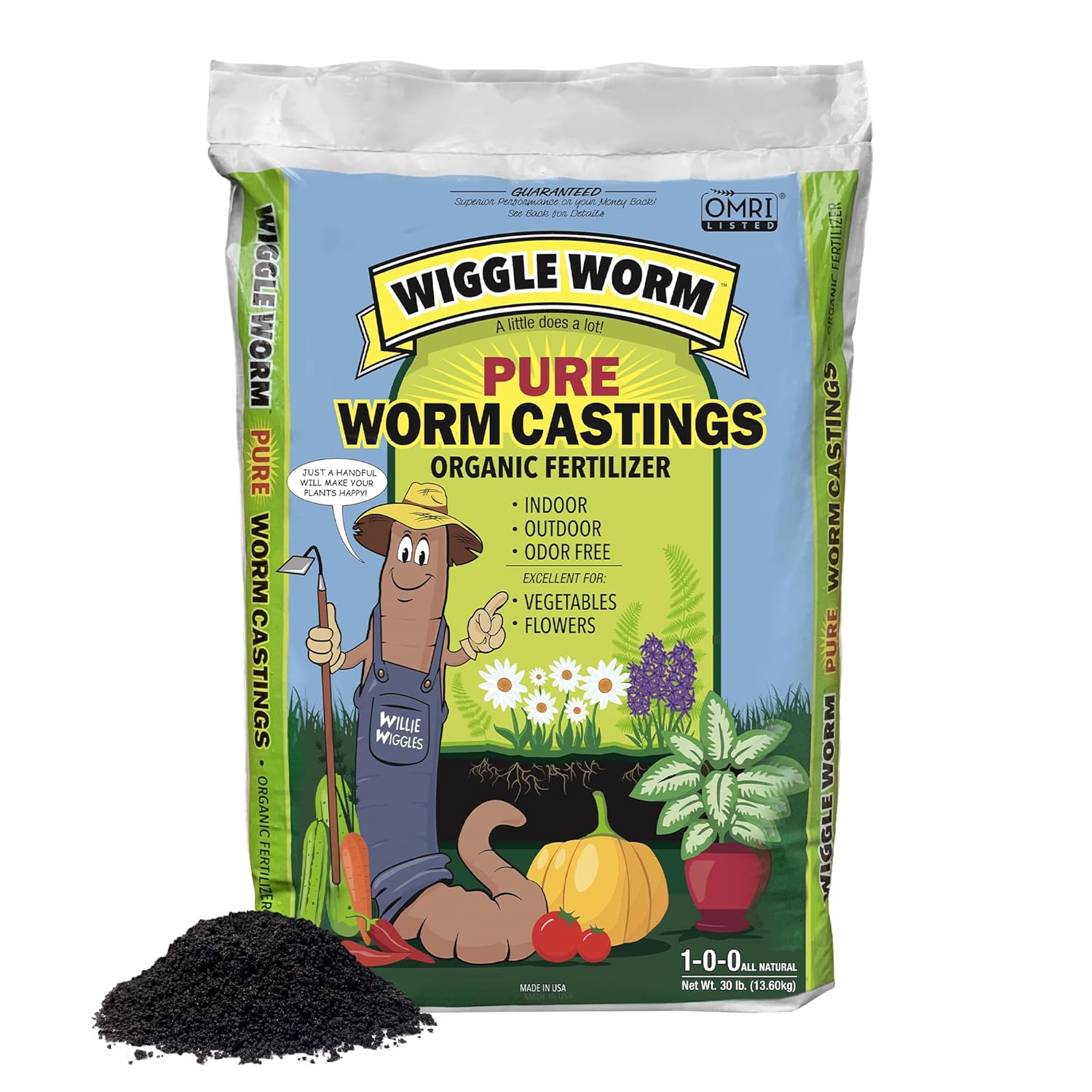
Wiggle Worm Pure Worm Castings Organic Fertilizer, 30 lb
| Item Form | Granules |
|---|---|
| Specific Uses For Product | Soil Conditioning |
| Application Method | Apply to soil |
| Unit Count | 480 Ounce |
Wiggle Worm Pure Worm Castings are a ready-to-use organic soil amendment made from concentrated earthworm castings. Gardeners typically mix a portion into potting mixes, top-dress established plants, work it into transplant holes, or brew it as a nutrient tea; the product page includes specific dosing for vegetables, containers, lawns, and roses. The castings are odorless, non-burning, and OMRI listed for organic use, so they supply water-soluble nutrients plus microbes that improve aeration, water retention, and root development without synthetic chemicals. Practical benefits include easy application, safe use on seedlings and mature plants, and versatility across raised beds, container gardens, and lawns. The main limitation is that this is a concentrated soil builder rather than an all-in-one fertilizer with NPK labels, so users seeking precise, fast-acting nutrient ratios may need to supplement for specific deficiencies; also a 30 lb bag is bulky to handle for small-space gardeners. For gardeners focused on long-term soil health and organic production, it functions as a low-risk, effective amendment.
Best for: Gardeners who prioritize building long-term soil health and want a safe, organic amendment for vegetables, ornamentals, and containers; buyers who value proven, low-risk inputs backed by strong user feedback.
Less Ideal for: Gardeners who need targeted, rapid nutrient correction based on precise NPK values or those who only want a lightweight product for very small balconies or indoor micro-gardens.
- OMRI listed organic and made from 100% worm castings
- Provides beneficial microbes that improve soil structure and water retention
- Odorless and non-burning so safe for seedlings and established plants
- Versatile dosing for containers, raised beds, lawns, and making worm casting tea
- No standard NPK nutrient label so not a precise standalone fertilizer for targeted feeding
- Large 30 lb bag can be heavy and awkward for gardeners with limited storage or mobility
Verdict: Choose this product when you want a proven, OMRI-listed worm casting that builds soil biology and improves plant health across beds and containers.
Blue Ribbon Organics OMRI-Certified Organic Compost (Bag)

| Brand | Blue Ribbon Organics |
|---|---|
| Included Components | Compost |
| Item Type Name | Organic Compost |
| Volume | 7.48 gallons |
Blue Ribbon Organics OMRI-Certified Compost is a bagged, fully processed organic compost designed to be worked into beds, used as a topdressing on lawns, or applied as a mulch around trees and shrubs. It is made from recycled food and yard residuals, monitored for maturity and contaminants, and certified for organic use so you can add it directly to vegetable, flower, and landscape plantings. Typical applications include incorporating 3–4 inches into new beds, adding a light 1/4–1 inch replenishment to established beds, or topdressing lawns at 1/4–1/2 inch in fall. The product claims improved aeration, increased water retention, pH buffering, and a boost of key nutrients such as nitrogen, phosphorus, and potassium. Because it is a natural material, moisture variation can affect bag weight and handling, and a single bag covers a modest area, so larger projects will require multiple bags or bulk compost. For gardeners focused on measurable soil improvement and organic certification, this compost delivers an easy, safe way to rebuild soil health without synthetic inputs.
Best for: Gardeners who prioritize measurable soil improvement and organic certification and want a ready-made compost to reliably boost planting beds, lawns, and established landscapes.
Less Ideal for: Large-scale landscapers or gardeners needing to amend many beds quickly should consider bulk compost options rather than repeated bag purchases.
- OMRI certified and meets US Composting Council standards so it is suitable for organic vegetable and flower gardens
- Processed and tested for maturity, pathogens, and weed seed to reduce risk of introducing problems
- Versatile use: can be tilled into new beds, used as a topdressing for lawns, or applied as mulch around trees and shrubs
- Contains a balanced mix of organic nutrients and improves soil aeration and water retention
- Bag size/volume is modest so several bags are needed for large beds or multiple trees
- Moisture variation in a natural product can make individual bag weights inconsistent
Verdict: Choose this bagged OMRI-certified compost when you want a tested, organic-ready product that reliably improves soil structure and supports performance-oriented gardening.
R&M Organics Cow Manure Compost Soil Amendment (10 lb)

| Item Form | Solid |
|---|---|
| Specific Uses For Product | Organic |
| Application Method | Apply a thin layer around plants or mix into soil |
| Coverage | All-purpose |
| Target Species | fruits, vegetables, flowers, lawns, trees |
This 10 lb bag of R&M Organics compost is a straightforward, all-purpose soil amendment aimed at improving soil health in garden beds, containers, and raised beds. Made from cured cow manure and fully composted, it is low-odor and easy to work with — apply a thin quarter-inch layer around established plants or mix into planting soil at the recommended 5:1 ratio for new beds. The compost enhances moisture retention, aeration, and organic matter, which helps roots establish and reduces watering frequency. Its small bag size and modest weight make it convenient for small to medium projects and for gardeners who prefer incremental soil improvements. Because the product is pure compost rather than a balanced fertilizer, it is best used as a long-term soil builder rather than a quick nutrient fix; you may still need targeted fertilizers for heavy-feeding vegetables or to correct specific nutrient deficiencies. The simplicity and low odor make it a practical choice for backyard growers who want a reliable organic amendment without handling fresh manure or bulk deliveries.
Best for: Gardeners who prefer incremental, low-effort soil improvement for beds and containers and who prioritize organic, low-odor amendments for everyday maintenance.
Less Ideal for: Large-scale gardeners or landscapers who need bulk amendments or immediate corrective fertilizers for specific nutrient deficiencies should look for bulk compost or formulated plant foods.
- Fully composted cow manure reduces pathogens and minimizes odor compared with raw manure
- Improves soil structure and moisture retention for beds, containers, and raised beds
- Small 10 lb bag is easy to carry, store, and apply for small to medium gardens
- Versatile all-purpose amendment suitable for fruits, vegetables, flowers, lawns, and trees
- Not a formulated fertilizer so it may not supply immediately available nutrients for heavy feeders
- Bag size is small for larger beds or bulk soil rebuilding projects
Verdict: A convenient, low-odor organic compost that steadily improves soil structure and moisture retention for small to medium garden beds.
True Organic Worm Castings — Natural Granular Soil Amendment (64 oz)

| Item Form | Granules |
|---|---|
| Specific Uses For Product | Agriculture, Gardening, Root Development, Seed Development |
| Application Method | Mix into soil, use for seeding and transplants |
| Unit Count | 64 Ounce |
| Target Species | Plants |
True Organic Worm Castings are a straightforward, all‑natural soil amendment intended to improve garden soil health and support plant growth. Applied by mixing into potting mixes, garden beds, or around transplants and seedings, the granules increase microbial activity, improve aeration and water retention, and supply 1% total nitrogen with 0.95% slow‑release nitrogen for steady feeding. For home vegetable beds and flower borders this product is easy to use and low mess compared with liquid amendments. Because it is purely worm castings there are no synthetic additives and it supports long‑term soil biology rather than quick green‑up. The limitations are that the nutrient content is low compared with bagged fertilizers, so expect modest immediate feeding and plan to use it alongside a balanced fertilizer for heavy‑feeding crops. The 64 ounce unit is convenient for spot applications, container mixes, and small beds but will not replace bulk compost for larger garden renovations.
Best for: Gardeners who prioritize improving soil biology and want an easy, natural amendment for containers, raised beds, and small vegetable plots on a modest budget.
Less Ideal for: Growers who need a high‑N or complete fertilizer for large areas or heavy‑feeding crops should choose a concentrated fertilizer or bulk compost instead.
- 100% natural worm castings that boost beneficial soil microbes
- Improves soil structure, aeration, and water retention for healthier roots
- Contains slow‑release nitrogen to provide steady, low‑risk feeding
- Granular form is easy to mix into potting mix, transplants, and seed rows
- Low nutrient concentration so not a standalone fertilizer for heavy feeders
- 64 oz size is better suited to small gardens and containers rather than large beds
Verdict: A compact, all‑natural worm castings product that reliably improves soil health and supports steady plant growth, ideal for containers and small garden beds.
Coast of Maine Cobscook Blend In-Ground Garden Soil, 1 cu ft

| Unit Count | 1 Count |
|---|---|
| Included Components | SOIL |
| Item Type Name | Plant Food |
| Brand Name | Coast of Maine |
Coast of Maine Cobscook Blend is an OMRI-listed, organic in-ground soil mix designed to revitalize existing garden beds. It combines compost, sphagnum peat moss, and aged bark plus ocean-derived amendments so it helps improve drainage, moisture retention, and aeration when worked into sandy or compacted soils. Typical use is mixing several inches into the topsoil when planting new beds or top-dressing established areas to rebuild fertility and microbial life. Notable features are its organic ingredients and focus on supporting beneficial soil organisms rather than supplying quick-release synthetic nutrients. Practical benefits include better root development, improved texture in heavy soils, and a safer formula for families and pets. Limitations are the small bag size for large projects and the absence of guaranteed NPK numbers for feeding heavy feeders, so you may need additional amendments or repeat applications for nutrient-hungry crops. It is best used as a soil conditioner and long-term soil-building component rather than an all-in-one fertilizer for a single season’s maximum yield.
Best for: Gardeners who prioritize consistent, long-term soil health and prefer organic, sustainable amendments for in-ground beds. Good for people reconditioning compacted, sandy, or depleted garden beds who value reliability over one-off quick fixes.
Less Ideal for: Those needing a single-season high-nitrogen boost for heavy-feeding annuals or anyone wanting a large-volume, ready-to-use soil supply without frequent bag handling.
- OMRI-listed organic formulation suitable for in-ground vegetable and flower beds
- Blend of compost, peat moss, and aged bark improves structure, drainage, and moisture retention
- Includes ocean-sourced amendments that support soil microbes and biodiversity
- Safe for families and pets due to organic ingredients
- Sold in 1 cu ft bags which makes covering large beds labor intensive
- No detailed NPK or guaranteed nutrient analysis provided
Verdict: Choose this blend if you want a trusted organic soil conditioner that rebuilds garden beds and supports long-term plant health.
Brut Organic Worm Castings, 5 lb

| Item Form | Granules |
|---|---|
| Specific Uses For Product | Gardening,Organic |
| Target Species | All plants |
| Mixing Ratio | 1:5 |
Brut Organic Worm Castings function as a concentrated, natural soil amendment you mix into potting mixes or top-dress garden beds and raised beds. Typical use is mixing at the recommended 1:5 ratio for new indoor plants, sprinkling a cup around established houseplants, or working into outdoor planting holes and beds according to the brand directions. The product is OMRI/CDFA listed and produced in controlled conditions, which supports consistent nutrient content and beneficial microbial life that help roots establish, improve soil structure, and increase moisture retention without burning plants. Practical benefits for raised garden beds include improved aeration, slow-release nutrients, and a boost in microbial activity that supports long-term fertility. Limitations are that it is not a complete NPK fertilizer for immediate heavy feeding needs and larger beds require significant quantities to hit the suggested per-square-foot rates, so frequent applications or bulk purchases may be needed for big projects.
Best for: Gardeners who prioritize dependable, organic soil improvement for raised beds and container gardens and prefer predictable, low-risk amendments that support long-term soil health.
Less Ideal for: Those needing immediate, high-NPK feeding for heavy-feeding crops or gardeners who want to amend very large beds without buying supplemental bulk material.
- Certified organic and produced indoors for consistent purity
- Rich in beneficial microbes that improve soil structure and plant vigor
- Easy-to-use granular form suitable for mixing or top-dressing
- Not a standalone high-NPK fertilizer for rapid nutrient correction
- Five-pound bag may be small for large raised beds and repeated seasonal use
Verdict: Use this OMRI/CDFA-listed worm castings product to reliably build long-term fertility and microbial health in raised beds and containers.
Back to the Roots Organic All-Purpose Compost Mix, 25.7 qt

| Item Highlight | Organic compost soil amendment for raised beds, gardens and plants; peat-free blend with yucca and gypsum; 25.7 quart bag |
|---|---|
| Unit Count | 822.4 Ounce |
| Item Type Name | garden soil |
| Brand Name | Back to the Roots |
| Style Name | Compost |
This Back to the Roots compost is a ready-to-use organic soil amendment designed to enrich raised beds and containers for vegetables, herbs, fruits, and flowers. It mixes easily into existing bed soil or can be used as part of a potting blend to boost nutrient content and improve moisture behavior. Notable features include a peat-free base made from upcycled plant matter and wood fines, dolomitic limestone for pH adjustment, gypsum to aid water absorption, and yucca extract for better moisture control. In practical use it helps promote healthier root growth and can reduce watering frequency thanks to improved moisture retention and absorption. The bag size covers small to medium raised beds when incorporated as an amendment but may require multiple bags for larger projects. This product is focused on organic, sustainable inputs rather than synthetic fertilizers, so gardeners seeking an all-in-one high-NPK concentrate may need to supplement with targeted fertilizers as plants mature.
Best for: Gardeners who prioritize sustainable, organic amendments and want an easy-to-use compost to blend into raised beds and containers to improve soil health and moisture behavior.
Less Ideal for: Gardeners who need a single high-NPK soil or who are filling large commercial-scale beds from scratch without willingness to buy multiple bags.
- 100% organic and peat-free base made from upcycled plant matter
- Includes dolomitic limestone and gypsum to help balance pH and improve water uptake
- Yucca extract helps with moisture control to reduce over- or under-watering
- Formulated for raised beds, containers, and in-ground use across edible and ornamental plants
- Bag volume is modest for larger raised beds so multiple bags may be needed
- Not formulated as a high-concentration fertilizer so additional feeding can be necessary for heavy-feeding crops
Verdict: A sustainably made, peat-free compost mix that quickly improves raised-bed and container soil health and moisture control.
Choosing the Right Compost for Garden Soil: Key Factors to Consider
Nutrient Balance And Release Pattern
Compost varies in the amounts and ratios of nitrogen, phosphorus, and potassium. A balanced nutrient profile supports steady plant growth without forcing excessive leafy growth or causing deficiencies. Slow-release organic nutrients in stable compost feed soil life and plants over weeks to months rather than spiking availability briefly.
Consider how soon you need nutrients and what your crops demand. Heavy feeders benefit from compost with higher nitrogen and available phosphorus, while established ornamentals may only need modest nutrient additions. Also remember that compost is a supplement to a fertility plan, not a precise fertilizer alternative.
Maturity, Stability, And Carbon:Nitrogen Ratio
Immature compost can compete with plants for nitrogen while it finishes decomposing in soil. Mature compost is crumbly, earthlike, and has an earthy smell rather than ammonia. Stability also affects how long the benefits persist and whether the material will continue to heat up after application.
Check for indicators of maturity such as uniform dark color, absence of recognizable raw feedstock, and a stable pH. A reasonable carbon:nitrogen ratio helps predict whether the compost will immobilize nitrogen temporarily; lower ratios usually release nitrogen faster, while very high ratios may slow release.
Texture, Particle Size, And Soil Integration
Particle size influences how quickly compost integrates with garden soil and how it affects drainage. Finer, well-crumbled compost mixes smoothly into loosened topsoil and improves aggregation, while coarser chunks are better when you want long-term aeration in heavy clay.
Think about your method of incorporation. For top-dressing or mulching, a blend with varied particle sizes can be ideal. For mixing into seedbeds or potting blends, a finer texture ensures consistent contact with roots and reduces air pockets.
Weed Seeds, Pathogen Risk, And Feedstock Cleanliness
Compost made from mixed or untested feedstocks can carry viable weed seeds or, worse, plant pathogens. Properly hot-composted materials greatly reduce these risks. For vegetable gardens and young transplants, low-risk compost is especially important to avoid introducing problems that are hard to eradicate later.
Ask about feedstock origins and composting process when possible. Materials sourced from municipal green waste, certified yard trimmings, or well-managed farm residues typically pose lower contamination risk than unknown mixes.
Moisture Retention Versus Drainage Balance
Adding compost shifts your soil's water dynamics. In sandy soil, compost increases water-holding capacity and nutrient retention. In heavy clay, moderate amounts of compost improve structure and drainage, but excessive organic matter can create sticky conditions if not balanced.
Match compost quantity and texture to existing soil. Lighter, fibrous composts bolster water-holding in dry sites, while well-crumbled, mineral-rich composts help break up compacted clay. Layer thickness and incorporation depth both influence the final moisture behavior.
Ease Of Handling And Application
Gardeners need compost that is practical to move, spread, and incorporate. Heavy, overly wet compost is hard to handle and can compact beds, while extremely dry, dusty compost spreads unevenly and may blow away. Bagged, screened composts are easier for containers and small gardens, while bulk loads suit larger beds but require equipment or extra labor.
Consider odor during handling if you work close to living spaces, and choose a consistency that fits your tools and mixing methods. Compost that clumps or contains large sticks may require pre-screening before use in fine seedbeds.
How Much Compost To Add And When
Quantity and timing depend on soil type and planting plans. For established beds, top-dressing with a 1/2- to 1-inch layer of mature compost once or twice a year improves structure without overwhelming soil biology. When establishing new beds, incorporate 2 to 3 inches of compost into the top 6 to 8 inches of soil to start with a balanced planting medium.
- Vegetable beds benefit from fall incorporation so winter processes stabilize organic matter.
- Use lighter applications around young seedlings to avoid excess nutrient or salt contact.
- Container mixes usually need 20 to 30 percent compost by volume for good fertility and water retention.
Mixing Compost Into Different Soil Types
Sandy soil needs compost to increase water and nutrient retention; adding 2 to 3 inches worked into the topsoil helps reduce irrigation frequency. Clay soils gain porosity and drainage when compost is mixed thoroughly, but avoid adding so much that the soil becomes overly dark and dense in wet seasons.
- For clay, mix compost as deep as possible and avoid leaving a thick uncompacted layer on top that could repel water.
- For raised beds, blend compost with native soil and some mineral grit for long-term structure stability.
Using Compost In Containers And Small Beds
Containers and small raised beds need a compost that is fine-textured and weed-free. Coarse chunks can cause uneven moisture retention and air gaps. Choose screened, mature composts for potting blends, and retain a higher proportion of compost in mixes for short-season vegetables that benefit from readily available nutrients.
- Sterile or well-stabilized compost reduces transplant shock in seedlings.
- Combine compost with a lightweight mineral component for better drainage in deep pots.
Compost And Soil Biology: Building Long-Term Health
Beyond nutrients and texture, compost feeds microbial life that drives nutrient cycling and soil structure. Regular applications build populations of beneficial fungi and bacteria, which improve root access to locked-up minerals and help suppress some soil-borne diseases. Look for composts that are fully decomposed and earthy smelling, as these are most active in supporting soil biology.
- Avoid over-application; too much fresh organic matter can create imbalances while communities adjust.
- Rotate organic inputs seasonally to supply a range of carbon sources for diverse soil microbes.
How We Chose the Best Compost for Garden Soil
We focused on selection criteria that matter to gardeners using compost specifically for garden soil. First, nutrient profile and stability: compost should supply a balanced, plant-available mix of nitrogen, phosphorus, and potassium while being mature enough to avoid tying up nitrogen. Second, texture and particle size: crumbly, well-aggregated compost integrates into topsoil and improves water infiltration without creating a dense layer. Third, contamination risk and weed seed content: compost made from clean feedstocks and properly heated reduces weed and pathogen problems. Fourth, odor and handling: low-odor, easy-to-spread materials are more practical for raised beds, containers, and close-to-house gardening. Fifth, moisture retention versus drainage balance: compost should boost water-holding capacity without creating soggy conditions for shallow-rooted crops. Products were excluded if their feedstock was unclear, if there was consistent evidence of persistent weed seeds or contaminants, or if maturity and stability data were missing. The included composts scored well across these real-world dimensions gardeners rely on when improving garden soil.
FAQ
How soon after adding compost can I plant?
It depends on maturity. With fully matured compost you can plant immediately; it is stable and will not rob nitrogen. If the compost smells strongly of ammonia or still has recognizable raw material, wait until it stabilizes or compost it further before planting.
Will compost raise soil pH or acidity?
Most finished composts are near neutral pH and have a modest buffering effect. Large volumes of certain feedstocks can shift pH slightly, so test your soil if your plants are pH-sensitive and adjust amendments accordingly.
Can I use compost as a mulch around seedlings?
Light applications of finely screened compost can be used as a mulch around established seedlings. Avoid placing a heavy layer directly against stems and use a thinner top-dress for very young plants to prevent damp, cool conditions that can harm tender roots.
How do I avoid introducing weed seeds with compost?
Choose compost that was hot-composted or certified weed-free when possible, and prefer screened materials for seedbeds. If you suspect viable seeds, solarize small batches or screen the compost before using it for seed-starting or sensitive beds.
Is all compost safe for edible gardens?
Not always. Compost from unknown or mixed municipal wastes can contain contaminants. For edible gardens, use compost from garden waste, food-scrap programs with documented processes, or well-managed farm residues that confirm safe feedstocks and adequate composting temperatures.
How long do compost benefits last in garden soil?
Benefits are cumulative. A single application improves structure and nutrient availability for one to several seasons, depending on soil type and plant uptake. Regular, modest annual additions are more effective for long-term soil improvement than one large, infrequent application.
Final Verdict
Choose compost for garden soil by prioritizing maturity, appropriate texture, and low contamination risk. Match particle size and nutrient release to your soil type and the crops you grow, and adjust application rate so you improve structure without creating soggy or nitrogen-starved conditions. The right compost is an investment in soil biology and long-term fertility. Focus on stable, screened materials for seedbeds and containers, and consider coarser blends for long-term soil building in heavy soils. With those tradeoffs in mind, you can pick a compost that fits your garden workflow and improves plant health over seasons.
