

Note: This article contains affiliate links. If you click on these links and make a purchase, I may earn a small commission at no extra cost to you. This helps support my research and content. Read my full affiliate disclosure here.
Choosing the right compost for growing grass changes how quickly new seed establishes and how resilient existing turf becomes. The wrong blend can hold too much moisture, burn young seedlings, or fail to supply the slow-release nutrients grass needs. This guide shortlists the top compost options for growing grass, explaining how they behave in a lawn, what soil problems they solve, and which lawns benefit most from each type. We evaluate mixes based on nutrient balance, texture and particle size, and suitability for seed or sod. Read on to find a compost that improves seed germination, builds soil structure, and supports denser, healthier turf.
Top Picks at a Glance
| Best Overall The best all-around choice for most situations | Garden Magic Michigan Peat Compost & Manure Blend, 40 lb |  |
| Best Quality Built to a higher standard if you want something more solid | Blue Ribbon Organics OMRI-Certified Organic Compost (Bag) |  |
| Best Value The sweet spot between price and what you get | True Organic Worm Castings Natural Fertilizer, 64 oz |  |
| Best Budget The cheapest option that still gets the job done reliably | Gantessa Stone Premium Organic Compost, 2 lb |  |
| Highest Rated A top-rated pick with lots of positive feedback | Earth Science Premium Earthworm Castings, 3 lb |  |
| Best Seller A high-volume bestseller chosen again and again | Charlie's Compost Concentrated Organic Plant Fertilizer (10 lb) |  |
Garden Magic Michigan Peat Compost & Manure Blend, 40 lb

| Unit Count | 640 Ounce |
|---|---|
| Included Components | Michigan Peat – 5240 – 40lb |
| Item Type Name | Manure |
| Manufacturer | Michigan Peat |
This 40 lb Garden Magic Michigan Peat Compost & Manure Blend is a pre-mixed, odor-reduced soil amendment intended to boost nutrients and organic matter in raised beds and containers. It combines reed sedge peat with composted animal manure so you can work it into existing bed soil or use it to refresh potting mixes without additional processing. The bag is easy to scoop and spread around planting holes, top-dress beds, or mix into the top few inches of soil for vegetables, flowers, and lawns. Notable features are the organic compost content, manure-derived nutrients, and the claim of being odor-free, which makes handling more pleasant than raw manure. Because it is a blend rather than a complete potting soil, expect it to act as an amendment that improves texture and fertility rather than a standalone, soilless potting mix. If you need large volumes for deep beds you will likely need multiple bags, but for small raised beds and container refreshes this provides a straightforward, no-mix option to add organic matter and feed plants.
Best for: Ideal for gardeners updating small raised beds or refreshing container soil who prioritize value and a simple, ready-to-use organic amendment.
Less Ideal for: Not the best choice for growers who need a full premium potting mix formulated for seed starting or for large-scale bed builds where bulk soil or compost deliveries are more economical.
- Ready-to-use blend that can be applied directly to raised beds and containers
- Contains composted animal manure for added nutrients to support plant growth
- Odor-reduced reed sedge peat makes handling more pleasant than raw manures
- 40 lb bag provides a manageable amount for small beds and planter refreshes
- Sold as a soil amendment rather than a complete soilless potting mix
- One 40 lb bag covers a limited volume so larger projects require multiple bags
Verdict: A convenient, budget-friendly organic amendment that quickly boosts fertility and structure in small raised beds and containers.
Blue Ribbon Organics OMRI-Certified Organic Compost (Bag)

| Brand | Blue Ribbon Organics |
|---|---|
| Included Components | Compost |
| Item Type Name | Organic Compost |
| Volume | 7.48 gallons |
Blue Ribbon Organics OMRI-Certified Compost is a bagged, fully processed organic compost designed to be worked into beds, used as a topdressing on lawns, or applied as a mulch around trees and shrubs. It is made from recycled food and yard residuals, monitored for maturity and contaminants, and certified for organic use so you can add it directly to vegetable, flower, and landscape plantings. Typical applications include incorporating 3–4 inches into new beds, adding a light 1/4–1 inch replenishment to established beds, or topdressing lawns at 1/4–1/2 inch in fall. The product claims improved aeration, increased water retention, pH buffering, and a boost of key nutrients such as nitrogen, phosphorus, and potassium. Because it is a natural material, moisture variation can affect bag weight and handling, and a single bag covers a modest area, so larger projects will require multiple bags or bulk compost. For gardeners focused on measurable soil improvement and organic certification, this compost delivers an easy, safe way to rebuild soil health without synthetic inputs.
Best for: Gardeners who prioritize measurable soil improvement and organic certification and want a ready-made compost to reliably boost planting beds, lawns, and established landscapes.
Less Ideal for: Large-scale landscapers or gardeners needing to amend many beds quickly should consider bulk compost options rather than repeated bag purchases.
- OMRI certified and meets US Composting Council standards so it is suitable for organic vegetable and flower gardens
- Processed and tested for maturity, pathogens, and weed seed to reduce risk of introducing problems
- Versatile use: can be tilled into new beds, used as a topdressing for lawns, or applied as mulch around trees and shrubs
- Contains a balanced mix of organic nutrients and improves soil aeration and water retention
- Bag size/volume is modest so several bags are needed for large beds or multiple trees
- Moisture variation in a natural product can make individual bag weights inconsistent
Verdict: Choose this bagged OMRI-certified compost when you want a tested, organic-ready product that reliably improves soil structure and supports performance-oriented gardening.
True Organic Worm Castings Natural Fertilizer, 64 oz

| Item Form | Granules |
|---|---|
| Specific Uses For Product | Agriculture, Gardening, Root Development, Seed Development |
| Application Method | Mix into soil, use for seeding and transplants |
| Unit Count | 64 Ounce |
This 64-ounce bag of True Organic Worm Castings is a straightforward, no-frills soil amendment for gardeners who want to improve soil biology and water retention without synthetic inputs. It is used by mixing granules into topsoil, incorporating at seeding time, or adding to transplant holes to encourage root development and steady nutrient availability. The product lists 1% total nitrogen with 0.95% slow-release nitrogen, so it provides a gentle, long-lasting nutrient bump rather than a quick feed, and the castings also bring beneficial microbes that improve nutrient availability over time. Practical benefits include better soil structure and aeration, improved moisture retention for new grass seed, and a safe organic profile that suits vegetable beds, flower borders, and lawn renovation. Limitations are the low nutrient numbers if you need immediate, high-N feeding and the single bag size which may require multiple purchases for large lawn projects. For overseeding or small to medium lawn patches it works well, but large turf projects will need larger volumes or supplemental fertilizer.
Best for: Gardeners who prioritize practical, low-risk soil improvement and want a natural amendment to improve seed germination and root health during overseeding or small patch repairs.
Less Ideal for: Those tackling large lawn installations or needing an immediate high-nitrogen starter should choose bulk compost or a dedicated high-N fertilizer instead.
- All-natural worm castings that boost beneficial soil microbes
- Improves soil structure, aeration, and water retention for better root establishment
- Contains slow-release nitrogen for steady, long-term nutrient supply
- Versatile application for mixing into soil, seeding, and transplants
- Low total nitrogen content so it will not replace a high-N starter fertilizer
- Single 64 oz bag may be insufficient for large lawn renovations
Verdict: Use these worm castings to improve soil biology and moisture retention for better grass seed establishment and healthier roots in small to medium lawn repairs.
Gantessa Stone Premium Organic Compost, 2 lb

| Item Form | Solid |
|---|---|
| Application Method | Soil Amendment, Top Dressing, Compost Tea |
| Coverage | Medium |
| Target Species | flowers, vegetables, herbs, and more |
| Unit Count | 32 Ounce |
This 2 lb bag of Gantessa Stone premium organic compost is a screened, manure-based amendment meant to boost soil structure and moisture retention in small vegetable garden beds or containers. Typical uses are mixing into potting mixes at the recommended 1:2 ratio, top-dressing established beds, or brewing compost tea. The product emphasizes improved porosity and water holding capacity and supplies a range of organic nutrients and beneficial microbes rather than concentrated NPK values. Because it is screened and sold in a compact unit, it is handy for hobby gardeners, balcony growers, and patch repairs where hauling large bags is impractical. Limitations are the small unit size and lack of guaranteed nutrient analysis, so it is best used to build organic matter rather than as a primary fertilizer for heavy-feeding crops. For larger beds you will need multiple bags or a bulk compost source, but for spot applications and seedling mixes this is a convenient, low-effort option.
Best for: Gardeners working on small vegetable beds, containers, or seedlings who want an easy-to-use organic amendment without hauling bulk compost.
Less Ideal for: Large-scale vegetable gardeners or those who need a measured fertilizer program for heavy-feeding crops should choose bulk compost or a product with a guaranteed nutrient analysis.
- Screened organic compost improves soil structure and water retention
- Suitable for multiple application methods: soil amendment, top dressing, or compost tea
- Compact 2 lb bag is convenient for container gardeners and small repairs
- Small 2 lb unit requires buying multiple bags for larger vegetable beds
- No detailed NPK or guaranteed nutrient analysis provided
Verdict: A handy screened organic compost for small vegetable gardens and containers when you want to quickly add organic matter without buying bulk.
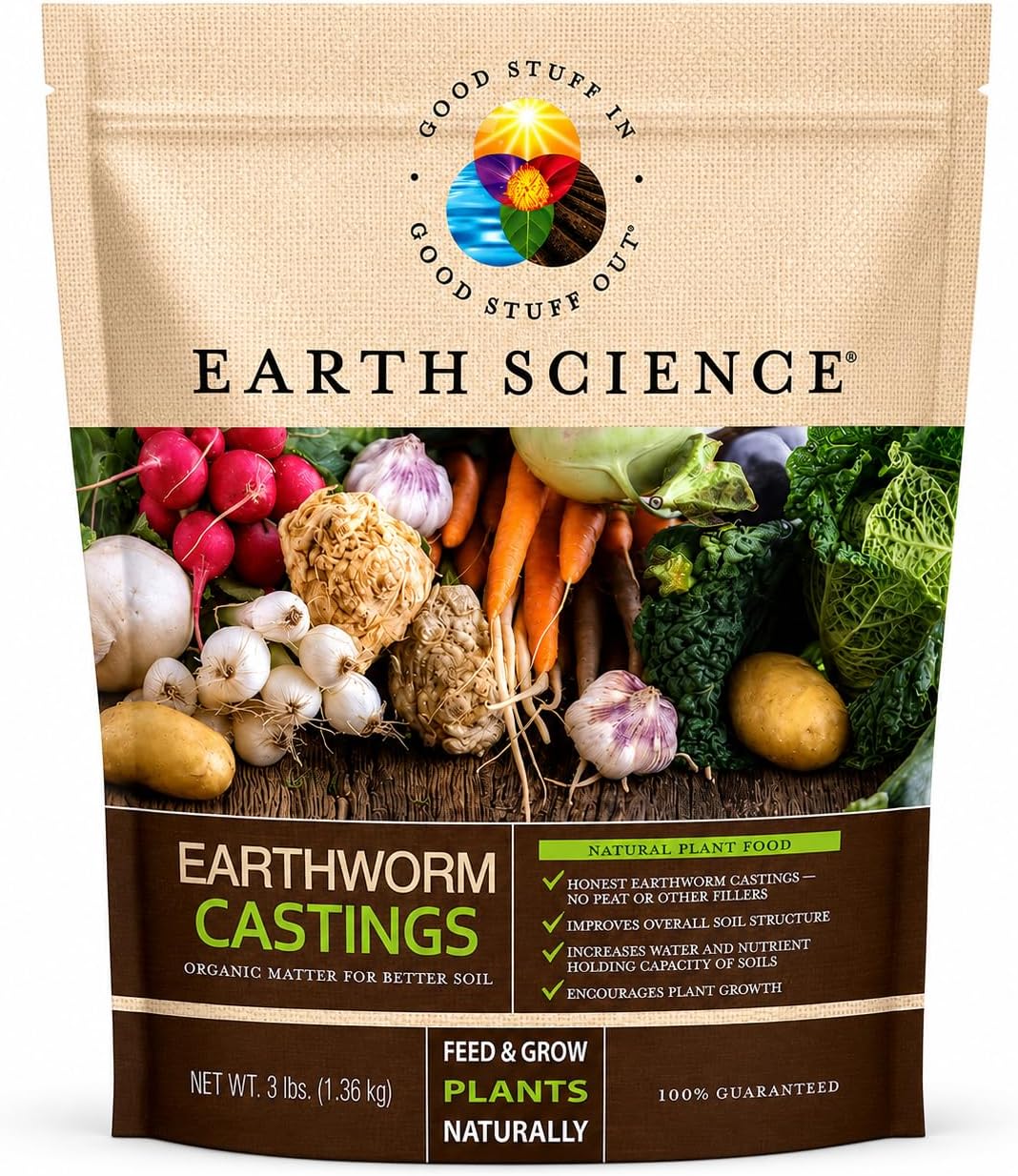
Earth Science Premium Earthworm Castings, 3 lb
| Item Form | Granules |
|---|---|
| Specific Uses For Product | Organic,Plant Food,Plant Growth |
| Coverage | Medium |
| Target Species | gardens, flower beds, fruits, trees, shrubs |
| Mixing Ratio | 1:4 |
Earth Science Premium Earthworm Castings are a pure vermicompost product intended to enrich garden and potting soils. Gardeners typically use it as a top dressing, mixed into potting mixes at about 1:4 castings to soil, or incorporated into garden beds at 1/4 to 1/2 inch and watered in; it can also be brewed as compost tea. The castings add organic matter that helps soil retain moisture, supports beneficial microbes, and can reduce compaction by improving aggregation. Practical benefits include a straightforward application for vegetables, flower beds, trees, and shrubs and the flexibility to use in pots, compost piles, or on lawns. The product is free of fillers and presented as a slow-release, natural fertilizer rather than a quick synthetic boost, so expect gradual improvements over weeks to months rather than immediate greening. Because this is a small, concentrated pouch, frequent reapplication during the growing season is recommended for larger beds or heavy-feeding crops.
Best for: Gardeners who prioritize dependable, natural soil improvement for organic vegetable beds and potted edibles and prefer steady, biology-driven results over quick chemical fixes.
Less Ideal for: Growers who need rapid, high-N fertilizer responses for a single fast-growing crop or who require large-volume amendments for extensive beds without frequent reapplication.
- 100% vermicompost with no peat or fillers
- Versatile uses: top dressing, potting mix amendment, compost tea, and compost layering
- Improves soil structure and water retention while feeding beneficial microbes
- Slow-acting nutrient release not suited for immediate greening or fast corrective feeding
Verdict: Use this pure earthworm castings product when you want a reliable, natural soil conditioner that builds long-term fertility for an organic vegetable garden.
Charlie's Compost Concentrated Organic Plant Fertilizer (10 lb)

| Net weight | 10 pounds |
|---|---|
| Manufacturer | Charlie's Compost |
| Ingredients | Vegetarian chicken manure, biochar, organic grasses, crop residue |
| Certification | OMRI listed organic |
Charlie’s Compost is a concentrated, OMRI-listed organic compost intended to boost soil biology and nutrient content for vegetables, ornamentals and container plants. You apply it by working small amounts into garden soil or mixing with potting media to add organic matter, microorganisms and slow-release nutrients rather than relying on synthetic fertilizers. Notable features include a vegetarian, antibiotic-free chicken manure base, added biochar and crop-residue organics, and organic certification that makes it suitable for organic vegetable production. In practice a little goes a long way, so it is useful for improving tired beds, prepping new vegetable rows, or topdressing containers; the concentrated nature reduces the volume you need to handle compared with loose compost. Limitations are that this is a bagged, concentrated product so it will not replace large volumes of finished compost for major soil building and may require additional application or mixing for even distribution in large beds.
Best for: Gardeners who prioritize organic, low-risk inputs and want a ready-to-use concentrated amendment to improve vegetable beds or containers without synthetic chemicals.
Less Ideal for: Those needing large quantities of finished compost to rebuild soil structure across many beds or landscapers who prefer bulk, loose compost for large-scale projects.
- OMRI-listed organic formulation safe for certified organic vegetable production
- Concentrated formula delivers nutrients and microbes with smaller application volumes
- Contains biochar and diverse organic inputs to improve soil structure and biology
- Suitable for both in-ground beds and containers when mixed appropriately
- Not a bulk finished compost so larger soil-building projects will still need more volume
- Bagged form requires mixing or spreading to avoid uneven application
Verdict: Choose this concentrated, OMRI-listed compost when you want an organic, low-volume soil amendment to boost biology and nutrients in veggie beds and containers.
Choosing the Right Compost for Growing Grass: Key Factors to Consider
Nutrient Balance and Carbon-to-Nitrogen Ratio
Compost supplies the slow-release nutrients that help grass seedlings grow and established turf recover after wear. A balanced C:N ratio prevents nitrogen immobilization, which can temporarily starve young grass if the compost is too high in carbon. For lawns, mixes that lean slightly toward available nitrogen are often best at establishment because grass is a heavy nitrogen feeder.
Also consider how quickly nutrients become plant-available. Well-aged, mature compost releases nutrients steadily rather than in a single flush. That reduces burn risk and supports root development over the first critical weeks after seeding or sodding.
Texture, Particle Size, and Seed Contact
Texture determines how well seed contacts soil and how easily roots penetrate. Fine, screened compost gives good seed-to-soil contact and helps small grass seeds germinate quickly, while coarser compost improves drainage and creates durable structure in compacted lawns. Many gardeners mix screened compost with a small proportion of coarser material to balance contact and aeration.
Particle size also affects spreading accuracy and incorporation. Very coarse chunks make an uneven seedbed and can leave air gaps that dry out seedlings. Choose a texture that matches whether you are topdressing, overseeding, or building a new lawn.
Moisture Retention Versus Drainage
Compost moderates moisture at the soil surface, which helps germination and reduces the need for constant light watering. However, compost that holds too much water can suffocate roots or prolong disease-friendly conditions. For clay soils, compost that increases porosity helps prevent puddling; for sandy soils, compost that improves water-holding capacity reduces drought stress.
Think about your local climate and irrigation ability. In hot, dry regions a mix that retains more moisture is helpful. In cool or poorly drained sites, prioritize compost that improves drainage and does not become waterlogged.
Weed Seed Content and Compost Maturity
Immature compost or poorly heated piles can contain viable weed seeds and pathogens that undermine lawn establishment. Mature, thermophilic-processed compost is less likely to introduce weeds and typically has a more stable nutrient profile. Inspect product descriptions or lab results for assurance of maturity.
Using compost with low weed seed content reduces early competition with grass seedlings and cuts down on follow-up weeding. If you plan to overseed an existing lawn, choose a clean, screened compost to avoid spreading unwanted plants.
pH and Soluble Salts
Soil pH affects nutrient availability for grass. Compost can buffer pH and usually moves the soil toward neutral, but some feedstocks create slightly acidic or alkaline end products. Test soil pH before large applications and select compost that complements your turf species' preferences.
High soluble salt levels can damage seedlings and hinder germination, especially in container-grown starter mixes or composts made from certain manures. Look for low-salt analyses for seeding projects in sensitive areas.
Application Rate and Incorporation Method
How you use compost matters as much as which compost you choose. Thin topdressing layers improve surface condition and seed contact without smothering new grass. For new lawns, incorporating a modest depth of compost into the top few inches of soil improves structure and root zone fertility. Over-application can create an unstable seedbed and encourage shallow rooting.
Consider the effort required to spread and work compost into the soil. Screened, uniform materials are easier to rake and level, while chunkier materials may need additional processing for even results.
Choosing Compost for Overseeding Versus New Lawns
Overseeding existing turf and establishing a new lawn require different compost behaviors. For overseeding, you want a fine, screened compost that enhances seed-to-soil contact and settles into gaps between blades without burying seed deeply. A light topdressing can protect seed and improve germination without altering lawn grade.
When building a new lawn, incorporate compost into the top several inches of soil to create a fertile seedbed. A slightly coarser mix that still includes a screened fraction will balance drainage and nutrient availability while giving grass roots room to expand.
- Overseeding: prioritize fine texture and low weed seed content
- New lawns: aim for mixes that improve structure and root depth
- Topdressing: apply thin, even layers for consistent germination
How Compost Affects Different Soil Types
Compost helps both heavy clay and light sandy soils but in different ways. In clay, compost increases porosity, reduces compaction, and helps roots access oxygen. In sand, compost improves water retention and nutrient-holding capacity so that turf remains greener between waterings.
Match the compost to your soil's biggest limitation. For compacted yards, use materials with coarser particles to maintain air space. For free-draining sand, favor compost with higher organic matter to hold moisture and nutrients.
- Clay soils benefit from structure-building, coarser fractions
- Sandy soils benefit from higher organic matter and finer particles
- Moderately amended loam often needs only light topdressing
Timing, Weather, and Establishment Practices
Sow seed when temperatures favor germination for your grass species and when you can maintain consistent moisture. Apply compost shortly before or at the time of seeding so the seed has fresh contact with the amended surface.
Avoid applying compost right before heavy rain that could wash seed away, and do not seed during prolonged drought unless you can irrigate. For cool-season grasses, early fall is often the best window; for warm-season grasses, late spring to early summer is usually preferable.
- Apply compost and seed in a window where watering is manageable
- Lightly rake or roll after spreading to ensure good seed contact
- Keep new turf consistently moist until roots establish
Testing and Amending Compost Before Use
When possible, review lab or analysis data that reports nutrient levels, pH, and soluble salts. A simple soil test of the target lawn area helps you decide whether the compost will correct deficiencies or push levels outside the ideal range for your grass species.
If compost is slightly acidic or alkaline relative to your soil needs, you can balance it with lime or sulfur over time rather than trying to correct large pH shifts at once. For high-salt composts, blend with low-salt topsoil or use sparingly where seedlings will be most vulnerable.
- Compare compost analysis to existing soil test results
- Blend incompatible composts with neutral topsoil to dilute salts
- Choose compost maturity over untested homemade piles for seeding
Practical Spreading and Incorporation Tips
Use a broadcast spreader for even coverage of screened compost when topdressing. For small areas or spot repairs, a rake and wheelbarrow work well. When incorporating compost into new lawns, use a rototiller or broadfork to mix it into the top 3 to 4 inches of soil.
After spreading seed and compost, press the seed gently into the soil with a lawn roller or by tamping to secure contact. Avoid burying seed too deeply under heavy compost layers; a thin, even application supports germination while improving the root zone.
- Broadcast for even topdressing, rake for spot repairs
- Incorporate compost into top 3 to 4 inches for new lawns
- Light rolling improves contact without compacting
How We Chose the Best Compost for Growing Grass
We prioritized traits that directly affect turf establishment and long-term lawn health. Key evaluation criteria were nutrient balance and C:N ratio to ensure steady nitrogen release without burning seedlings; texture and particle size because coarse material creates air space while fine material helps seed-to-soil contact; moisture retention and drainage to balance germination needs with root oxygenation; and weed seed content and maturity to avoid introducing competition. We also assessed salt levels and pH suitability for common turfgrasses, plus source and processing methods to gauge consistency. Products were excluded if they were immature compost, contained obvious contaminants, or had high weed seed loads. Editorial decisions focused on mixes that demonstrably improve seed germination, support root growth, and integrate cleanly with existing lawn soil.
FAQ
Can I use any garden compost to seed grass?
Often garden compost varies in maturity and weed seed content. Use mature, screened compost with low weed seed levels for seeding. Immature or untested piles can inhibit germination or introduce weeds.
How thick should a compost topdressing be for overseeding?
A thin layer, typically 1/8 to 1/4 inch, is usually enough to improve seed contact and moisture without smothering grass. Thicker layers can delay emergence and create uneven grade.
Will compost replace the need for fertilizer on a new lawn?
Compost supplies slow-release nutrients but often does not meet all early-season nitrogen needs for heavy-feeding turf. It reduces fertilizer frequency and improves soil biology, but follow soil test recommendations for any supplemental feeding.
Is compost good for improving compacted lawn soil?
Yes. Regular incorporation of compost increases porosity and reduces compaction over time. For severe compaction, combine compost with mechanical aeration or deeper topsoil amendments.
When is the best time to apply compost for lawn establishment?
Timing depends on grass type. Cool-season grasses benefit from early fall applications, while warm-season grasses respond best to late spring or early summer. Apply when you can water consistently through germination.
Final Verdict
Prioritize compost that matches how you plan to use it: fine, screened mixes for overseeding and germination, and slightly coarser, mature compost for soil rebuilding and new lawns. Balance nutrient release and particle size to support root development without creating drainage problems or weed introductions. Focus on compost maturity, low weed seed content, and appropriate salt and pH levels, and apply at rates that improve the seedbed without smothering seed. With those tradeoffs managed, you can select a compost that consistently produces thicker, greener turf.
