

Note: This article contains affiliate links. If you click on these links and make a purchase, I may earn a small commission at no extra cost to you. This helps support my research and content. Read my full affiliate disclosure here.
Laying turf is a short-window job where soil preparation makes the difference between an instant-looking lawn and one that struggles to knit in. Using the right compost for laying turf evens out surface texture, corrects minor nutrient imbalances, and creates a welcoming rooting medium so newly laid grass gets established quickly. In this guide we shortlist five compost options suited to turf installation and evaluate them on the traits that matter to gardeners and landscapers. Expect clear notes on texture, nutrient profile, and how each compost behaves during the first three months after laying.
Top Picks at a Glance
| Best Overall The best all-around choice for most situations | Coast of Maine Bumper Crop Organic Soil Builder, 1 Cubic Foot |  |
| Best Quality Built to a higher standard if you want something more solid | Espoma Organic Land and Sea Gourmet Compost with Lobster & Crab Meal, 1 cu ft |  |
| Best Value The sweet spot between price and what you get | Plantonix Compost Bliss — 100% Natural Compost (8 qts) |  |
| Highest Rated A top-rated pick with lots of positive feedback | Wiggle Worm Pure Worm Castings Organic Fertilizer, 30 lb |  |
| Most Popular A crowd favorite that many people choose with confidence | R&M Organics Cow Manure Compost Soil Amendment (10 lb) |  |
Coast of Maine Bumper Crop Organic Soil Builder, 1 Cubic Foot

| Volume | 1 cubic feet |
|---|
Coast of Maine Bumper Crop is an organic soil builder intended to amend garden soil before planting turf or beds. It combines lobster and crab shell meal with compost, sphagnum peat moss and aged bark and includes endo and ecto mycorrhizal fungi to support root health and nutrient uptake. In practice you work it into the topsoil to improve texture, drainage and moisture retention and to introduce beneficial microbes that help new grass roots establish. The formula is especially useful for breaking up heavy or compacted soils and for giving a biological kick to new turf areas where better root development matters. Because the product is an amendment rather than a complete topsoil, you will still need to blend it at appropriate rates with existing soil; it is sold in 1 cubic foot bags so multiple bags are needed for larger lawns. Wear a mask and gloves when handling dry bags as with any compost-based product.
Best for: Gardeners who want an organic, biologically active amendment to improve soil before laying turf and prioritize healthier root development and soil structure.
Less Ideal for: People needing bulk topsoil or a finished soil surface for immediate sod laying without mixing; landscapers who require large volumes delivered may prefer bulk amendments.
- Organic blend with lobster and crab shell meal that supplies slow-release nutrients
- Includes endo and ecto mycorrhizal fungi to support root establishment
- Improves soil texture and moisture retention, helpful for breaking up clay or compacted soils
- Made from composted ingredients and produced in the United States
- Sold in 1 cubic foot bags which means many bags are required to treat a whole lawn
- Not a ready-to-lay topsoil so it needs to be mixed into existing soil at recommended rates
Verdict: A small-bag organic soil builder that adds nutrients and mycorrhizae to improve soil structure and root establishment before laying turf.
Espoma Organic Land and Sea Gourmet Compost with Lobster & Crab Meal, 1 cu ft

| Item Form | Granules |
|---|---|
| Specific Uses For Product | Soil Conditioning, Plant Growth, Seed Development, Root Development |
| Included Components | Lobster and crab meal |
| Ingredients | Aged forest products, sphagnum peat moss, humus, limestone, lobster meal & crab meal |
Espoma Organic Land and Sea is a premium, ready-to-use compost intended for amending garden beds, planters, and transplant holes. The mix combines aged forest products, sphagnum peat moss, humus, limestone for pH adjustment, and lobster and crab meal to deliver organic nutrients and slow-release nitrogen. It also includes a mycorrhizae blend to help root establishment and nutrient uptake. In practice this product is mixed into native soil when planting or used to refresh container mixes, and it noticeably improves moisture retention and soil texture while adding a food source for vegetables, flowers, trees, and shrubs. Because it is a finished compost you do not need to wait for further decomposition before planting. Limitations are typical of peat-containing mixes: it is somewhat bulky to handle and not a concentrated fertilizer for rapid greening, so heavy feeders may still need supplemental feedings during the season. Overall it is a convenient, performance-focused soil amendment for gardeners who want an organic, biologically active boost at planting time.
Best for: Gardeners who prioritize reliable, organic soil improvement at planting time and want a biologically active amendment that supports root development and steady plant performance.
Less Ideal for: Buyers seeking an instant, high-nitrogen fertilizer or those who strictly avoid peat-based products should consider alternatives.
- Finished, ready-to-use compost suitable for immediate planting
- Contains lobster and crab meal for slow-release organic nutrients
- Includes endo and ecto mycorrhizae to support root growth and nutrient uptake
- Improves soil texture and moisture retention for containers and beds
- Contains peat moss which some gardeners avoid for sustainability reasons
- Not formulated as a high-concentration fertilizer for rapid greening
Verdict: A ready-to-use organic compost that boosts soil biology and root performance at planting for gardeners focused on steady, long-term results.
Plantonix Compost Bliss — 100% Natural Compost (8 qts)

| Brand | plantonix |
|---|---|
| Unit Count | 160 Ounce |
| Volume | 8 quarts |
| Style Name | 100% Natural Compost |
Plantonix Compost Bliss is a ready-to-use, 100% natural compost designed to be mixed into garden soil, potting mixes, or used when starting seed and laying grass seed. It arrives fully cured so you can open the bag and blend it immediately with topsoil or seed-starting mixes to improve aeration and water retention while adding organic nutrients. Practical benefits include easier soil crumbling, better moisture holding for young grass roots, and a way to avoid synthetic fertilizers since the product is OMRI-listed and made from plant-based materials. For lawn repair or overseeding, a light incorporation with topsoil can help seed-to-soil contact and give seedlings a nutrient-rich environment without burning tender roots. The main limitation is bag size and volume: at 8 quarts this is convenient for small patches, pots, or starter mixes but you will need multiple bags for larger lawn projects. Also there are no added controlled-release nutrients, so for longer-term fertility planning you may still need scheduled feeding.
Best for: Gardeners who prefer low-risk, natural amendments for seed starting and small lawn repairs and who value an immediately usable compost they can mix into soil without extra steps.
Less Ideal for: Large-scale lawn projects or homeowners who need a one-step granular fertilizer with specified N-P-K values for season-long feeding.
- Fully composted and ready to use with no curing or preparation required
- Made from 100% plant-based materials for a natural, OMRI-friendly amendment
- Improves soil structure and moisture retention useful for seed germination
- Suitable for both containers and small garden or lawn repair projects
- Small 8 quart volume means multiple bags are required for larger lawn areas
- No added slow-release or specific fertilizer ratios for long-term feeding
Verdict: A ready-to-use, plant-based compost that gives seed and small lawn patches a natural nutrient and moisture boost with minimal risk.
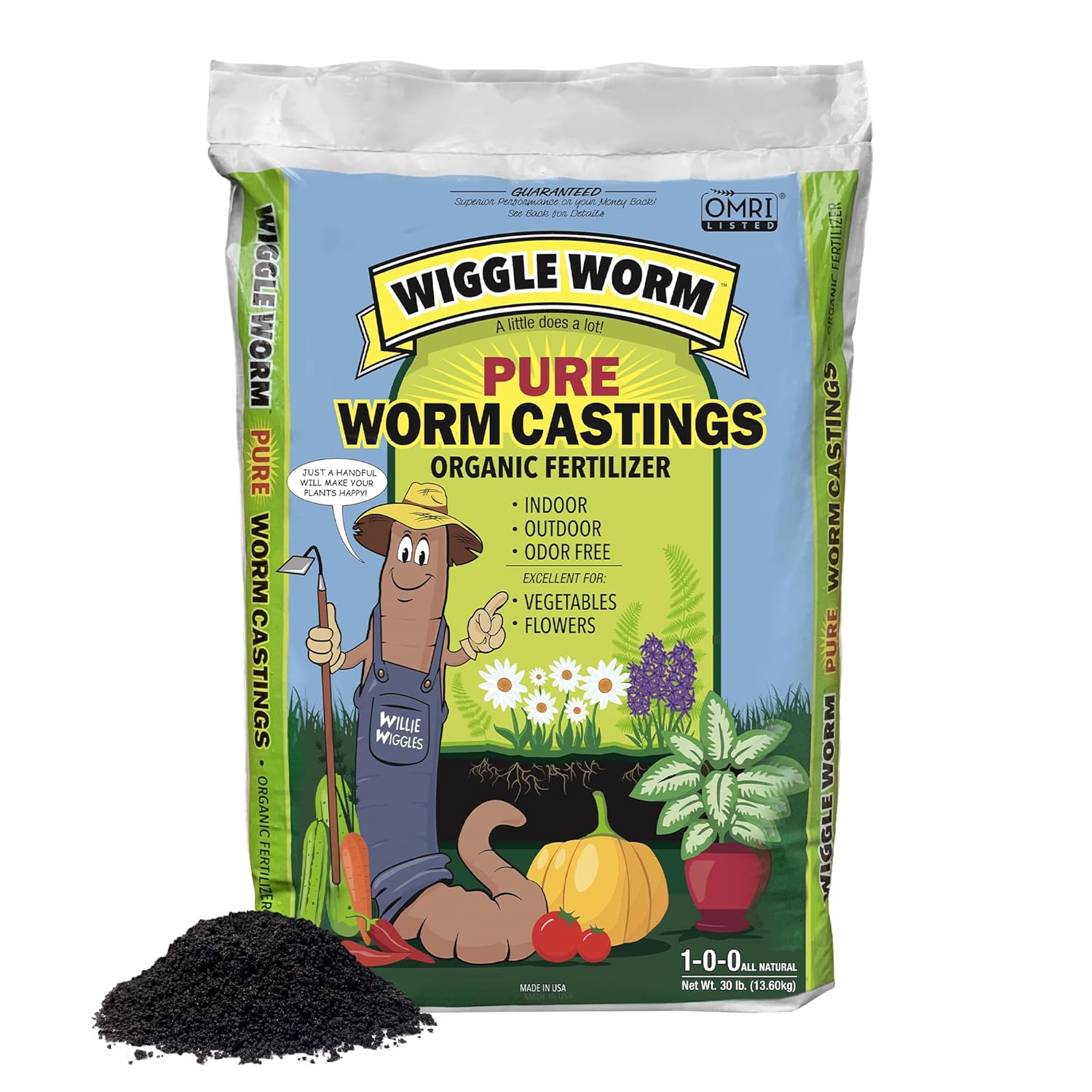
Wiggle Worm Pure Worm Castings Organic Fertilizer, 30 lb
| Item Form | Granules |
|---|---|
| Specific Uses For Product | Soil Conditioning |
| Application Method | Apply to soil |
| Unit Count | 480 Ounce |
Wiggle Worm Pure Worm Castings are a ready-to-use organic soil amendment made from concentrated earthworm castings. Gardeners typically mix a portion into potting mixes, top-dress established plants, work it into transplant holes, or brew it as a nutrient tea; the product page includes specific dosing for vegetables, containers, lawns, and roses. The castings are odorless, non-burning, and OMRI listed for organic use, so they supply water-soluble nutrients plus microbes that improve aeration, water retention, and root development without synthetic chemicals. Practical benefits include easy application, safe use on seedlings and mature plants, and versatility across raised beds, container gardens, and lawns. The main limitation is that this is a concentrated soil builder rather than an all-in-one fertilizer with NPK labels, so users seeking precise, fast-acting nutrient ratios may need to supplement for specific deficiencies; also a 30 lb bag is bulky to handle for small-space gardeners. For gardeners focused on long-term soil health and organic production, it functions as a low-risk, effective amendment.
Best for: Gardeners who prioritize building long-term soil health and want a safe, organic amendment for vegetables, ornamentals, and containers; buyers who value proven, low-risk inputs backed by strong user feedback.
Less Ideal for: Gardeners who need targeted, rapid nutrient correction based on precise NPK values or those who only want a lightweight product for very small balconies or indoor micro-gardens.
- OMRI listed organic and made from 100% worm castings
- Provides beneficial microbes that improve soil structure and water retention
- Odorless and non-burning so safe for seedlings and established plants
- Versatile dosing for containers, raised beds, lawns, and making worm casting tea
- No standard NPK nutrient label so not a precise standalone fertilizer for targeted feeding
- Large 30 lb bag can be heavy and awkward for gardeners with limited storage or mobility
Verdict: Choose this product when you want a proven, OMRI-listed worm casting that builds soil biology and improves plant health across beds and containers.
R&M Organics Cow Manure Compost Soil Amendment (10 lb)

| Item Form | Solid |
|---|---|
| Specific Uses For Product | Organic |
| Application Method | Apply a thin layer around plants or mix into soil |
| Coverage | All-purpose |
| Target Species | fruits, vegetables, flowers, lawns, trees |
This 10 lb bag of R&M Organics compost is a straightforward, all-purpose soil amendment aimed at improving soil health in garden beds, containers, and raised beds. Made from cured cow manure and fully composted, it is low-odor and easy to work with — apply a thin quarter-inch layer around established plants or mix into planting soil at the recommended 5:1 ratio for new beds. The compost enhances moisture retention, aeration, and organic matter, which helps roots establish and reduces watering frequency. Its small bag size and modest weight make it convenient for small to medium projects and for gardeners who prefer incremental soil improvements. Because the product is pure compost rather than a balanced fertilizer, it is best used as a long-term soil builder rather than a quick nutrient fix; you may still need targeted fertilizers for heavy-feeding vegetables or to correct specific nutrient deficiencies. The simplicity and low odor make it a practical choice for backyard growers who want a reliable organic amendment without handling fresh manure or bulk deliveries.
Best for: Gardeners who prefer incremental, low-effort soil improvement for beds and containers and who prioritize organic, low-odor amendments for everyday maintenance.
Less Ideal for: Large-scale gardeners or landscapers who need bulk amendments or immediate corrective fertilizers for specific nutrient deficiencies should look for bulk compost or formulated plant foods.
- Fully composted cow manure reduces pathogens and minimizes odor compared with raw manure
- Improves soil structure and moisture retention for beds, containers, and raised beds
- Small 10 lb bag is easy to carry, store, and apply for small to medium gardens
- Versatile all-purpose amendment suitable for fruits, vegetables, flowers, lawns, and trees
- Not a formulated fertilizer so it may not supply immediately available nutrients for heavy feeders
- Bag size is small for larger beds or bulk soil rebuilding projects
Verdict: A convenient, low-odor organic compost that steadily improves soil structure and moisture retention for small to medium garden beds.
Choosing the Right Compost for Laying Turf: Key Factors to Consider
Texture and Particle Size
Texture governs how well the compost forms a stable, even bed for turf. A fine, crumbly texture helps achieve close contact between turf roots and underlying soil, which is vital for rapid rooting. Very coarse chunks of undecomposed material create air pockets and uneven settlement that show up as dips and bumps after the turf has settled.
Particle size also affects how the surface responds to raking and rolling. Compost that is too dusty compacts and limits oxygen; compost that is too fibrous resists compaction but can leave visible fibers on the lawn surface. Aim for a balanced crumb that tolerates light rolling without crushing and still allows roots to penetrate easily.
Nutrient Balance and Starter Feed
New turf benefits from a modest, controlled supply of nitrogen, phosphorus, and potassium to support quick root growth without excessive top growth. Compost can supply trace nutrients and some slow-release nitrogen, but its exact nutrient profile varies widely depending on source materials and composting method.
Excess available nitrogen in compost can lead to flushes of leaf growth at the expense of root development and increase mowing needs in the first few weeks. Conversely, compost with almost no plant-available nutrients will delay green-up until roots access the underlying soil or supplemental feed is applied. Look for composts with clear nutrient guidance and moderate starter levels appropriate for initial turf establishment.
Drainage and Water Retention
Successful turf establishment requires both good surface drainage to avoid waterlogging and enough water retention to sustain roots between irrigations. Compost influences both properties: coarse, open compost improves drainage but may dry quickly, while high-organic, fine compost holds moisture but can remain overly wet on heavy soils.
Consider your existing soil type. On clay soils, compost that enhances structure and increases porosity is ideal. On free-draining sandy soils, choose compost that adds water-holding capacity. The right balance reduces disease risk and makes irrigation more forgiving during the critical rooting window.
Maturity and Stability
Only fully matured, stable compost should be used beneath new turf. Immature compost continues to decompose after installation, which causes shrinkage, uneven settling, and temporary nitrogen immobilization that can starve grass roots. Signs of immaturity include heat, a strong ammonia smell, and visible woody chips that are still breaking down.
Mature compost will have an earthy smell, uniform color, and no recent temperature spike. Using stable compost minimizes post-installation movement and helps maintain even turf contact with the soil for reliable root establishment.
Salt Content and Contaminants
High soluble salt levels or residues from herbicide-treated green waste can severely impair turf rooting and early growth. New turf is particularly sensitive to salt stress, which reduces water uptake and can cause browning or patchy establishment.
Compost sourced from municipal or mixed green waste should come with testing or assurances about low salt and the absence of persistent herbicide residues. When in doubt, choose compost that has documented testing for soluble salts and known feedstock origins to reduce the risk of establishment problems.
Application Thickness and Mix Ratio
How much compost you apply and whether you incorporate it into the topsoil changes outcomes. A thin top dressing can improve surface texture and add organic matter without creating a separate layer that might impede rooting. Mixing compost into the top 75 to 100 millimeters of soil helps roots access improved structure and nutrients more quickly.
Thicker uncompacted layers can act as a separate horizon that maintains different moisture and temperature regimes from the underlying soil, potentially hindering root penetration. Consider your turf type and soil test results when deciding depth and mix ratios.
Preparing the Soil Before Laying Turf
Start by removing weeds, stones, and debris so the compost and turf sit flat against the existing soil. Lightly fork or rototill the top layer to loosen compacted areas, taking care not to create a fine dustpan of soil that compacts when rolled.
If your topsoil is thin or poor, blend compost into the top 75 to 100 millimeters rather than just spreading a deep layer on top. This encourages roots to grow into the existing soil and reduces the chance of a separate loose horizon forming under the turf.
- Level and grade for surface runoff before adding compost.
- Remove perennial weeds and treat persistent roots by physical removal.
- Firm lightly with a roller to create contact, but avoid overcompaction.
How to Apply Compost for Turf
Spread compost in an even layer and rake to a uniform finish. For most installations, a 10 to 25 millimeter top dressing or a 75 to 100 millimeter incorporated layer is appropriate depending on soil quality and turf type.
After spreading, lightly water the area to settle the compost and remove large air pockets. Avoid heavy watering that can wash fines into low spots.
- Use a lawn rake to create a smooth, even surface.
- Work compost into the soil surface for better long-term rooting.
- Keep the finished surface slightly firm to the touch before laying turf.
Irrigation and Early Care After Laying
Newly laid turf requires frequent, shallow watering initially to keep the upper root zone moist. Compost helps retain moisture, but you should still monitor for dry patches and adjust irrigation accordingly.
As roots establish, transition to deeper, less frequent watering to encourage deeper rooting. Avoid overwatering early on, which can cause slumping and reduce oxygen at the root zone.
- Water daily or twice daily in hot, dry weather until turf roots in.
- Reduce frequency and increase duration after three to four weeks to promote deeper roots.
- Avoid heavy foot traffic until the lawn is firmly rooted.
Working with Different Soil Types
Clay soils benefit from compost that improves structure and increases porosity so roots can penetrate more easily. Mixing compost into the topsoil helps prevent waterlogging near the surface.
Sandy soils need compost that offers some moisture retention without making the profile too rich in fines. On very free-draining sites, thicker incorporation helps retain the moisture new turf needs between irrigations.
- For clay: emphasize porosity-enhancing compost with coarser particles.
- For sand: choose compost with better water-holding organic matter.
- Adjust incorporation depth depending on how poor the existing topsoil is.
Testing and Verifying Compost Quality
Ask for composition details or lab analyses where available. Key parameters include soluble salt level, pH, particulate distribution, and maturity indicators. These metrics directly relate to how the compost will behave once the turf is laid.
If lab results are not available, inspect the compost physically for a fine, earthy smell, absence of strong ammonia odor, and lack of visible undecomposed woody material. When uncertain, perform a small test patch to observe settlement and plant response before treating a large area.
- Check for a neutral to slightly acidic pH suitable for most turf grasses.
- Look for consistent color and texture across the batch.
- Do a short trial if using an unfamiliar source.
How We Chose the Best Compost for Laying Turf
We focused on factors that directly affect turf establishment and short-term lawn health. Key evaluation criteria included particle texture and consistency, because a consistent crumbly mix prevents uneven seating and promotes root penetration; nutrient balance and starter nitrogen, since too little delays green-up and too much risks scorch; drainage and water retention, as turf needs both quick surface drainage and moisture-holding capacity below; salt and contaminant levels, because excess salts or herbicide residues can prevent rooting; and organic stability and maturity, since under‑composted material shrinks and creates voids after turf is laid. Products were excluded if they were primarily potting mixes, contained high levels of uncomposted woody material, or were designed only for long-term soil building rather than immediate turf establishment. We also filtered out blends lacking clear composition details. The resulting picks passed practical checks for workable texture, detectable but controlled nutrients appropriate for new turf, and predictable moisture behavior in typical garden soils.
FAQ
Can I use garden compost for laying turf?
Often yes, if the garden compost is fully matured, free of persistent weed seeds and weed roots, and has a suitable texture. Avoid compost with visible, undecomposed woody material or a strong ammonia smell, as those indicate immaturity. If in doubt, use a test patch to check how turf roots respond.
How thick should a compost layer be under new turf?
A light top dressing of 10 to 25 millimeters can improve surface contact, while incorporating 75 to 100 millimeters into the topsoil is common when topsoil quality is poor. Avoid creating a very thick loose layer that can form a separate horizon and impede deep rooting.
Will compost increase the need for watering after laying turf?
That depends on the compost type and your soil. Compost with good water retention can reduce how often you need to irrigate, but fine, dense compost on heavy soils can hold water and create soggy conditions if irrigation is excessive. Monitor moisture and adjust irrigation frequency as roots establish.
How soon will turf root into compost-amended soil?
Turf typically begins to root within two to three weeks under favorable moisture and temperature conditions, with more substantial rooting by four to six weeks. Using properly prepared compost speeds early root penetration by improving contact and adding friable structure.
Are there composts to avoid when preparing for turf?
Avoid uncomposted green waste, materials with high salt content, and any composts with a history of herbicide contamination. Also be cautious with very high nitrogen, fresh manures that can burn young roots or stimulate excessive top growth at the expense of rooting.
Final Verdict
When laying turf, prioritize compost that provides a stable, crumbly texture, moderate starter nutrients, and appropriate moisture handling for your soil. The best choice balances drainage and water retention, is fully matured, and shows low salt and contaminant levels. Make application depth and incorporation decisions based on existing soil condition to avoid creating a separate unstable layer. With those tradeoffs understood, you can pick a compost that helps new turf establish firmly and quickly.
