

Note: This article contains affiliate links. If you click on these links and make a purchase, I may earn a small commission at no extra cost to you. This helps support my research and content. Read my full affiliate disclosure here.
Picking the right compost for perennials matters because these plants rely on steady, long-term soil conditions rather than quick boosts. The wrong mix can hold too much moisture, lock up nutrients, or break down too fast and create short-lived results. This guide focuses on composts formulated for perennial beds and containers so you can improve drainage, supply slow-release nutrients, and build structure over seasons. Below are our top shortlisted composts chosen for perennial planting. We explain what made each option stand out and walk through the practical factors you should weigh when adding compost to existing perennial beds or when planting new clumps and drifts.
Top Picks at a Glance
| Best Overall The best all-around choice for most situations | Coast of Maine Cobscook Blend In-Ground Garden Soil (2 cu ft) |  |
| Best Quality Built to a higher standard if you want something more solid | Espoma Organic Land and Sea Gourmet Compost with Lobster & Crab Meal, 1 cu ft |  |
| Best Value The sweet spot between price and what you get | Back to the Roots Organic All-Purpose Compost Mix, 25.7 qt |  |
| Best Budget The cheapest option that still gets the job done reliably | Gantessa Stone Premium Organic Compost, 2 lb |  |
| Highest Rated A top-rated pick with lots of positive feedback | Wiggle Worm Pure Worm Castings Organic Fertilizer, 30 lb |  |
| Most Popular A crowd favorite that many people choose with confidence | Brut Organic Worm Castings, 5 lb |  |
| Best Seller A high-volume bestseller chosen again and again | Coast of Maine Quoddy Blend Lobster Compost, 1 cu ft |  |
Coast of Maine Cobscook Blend In-Ground Garden Soil (2 cu ft)

| Brand | Coast of Maine |
|---|---|
| Volume | 2 cubic feet |
| Main ingredients | Sphagnum peat moss, aged bark, salmon and blueberry compost |
| Made in | United States |
Coast of Maine Cobscook Blend is an organic in-ground soil designed to enrich existing garden beds and support perennials, annuals and lawn repair. Gardeners typically mix it into native soil when planting shrubs, trees or perennials, or use it as a top-dressing on established beds to boost nutrient content and water retention. The formula lists sphagnum peat moss, aged bark and salmon/blueberry compost, ingredients that improve aeration while adding organic matter and beneficial microbes. In practice this means better root establishment for new plantings and improved moisture balance in heavier or sandy soils. Because it is a base soil rather than a complete potting mix, it is best applied to the ground rather than containers and may be combined with native soil rather than used alone. Expect gradual soil improvement over seasons rather than instant fertilizer-style results. Overall it is a practical organic choice for gardeners who want a multi-use, sustainably sourced soil amendment for in-ground perennial beds.
Best for: Gardeners who want an organic, multi-use soil amendment to improve in-ground perennial and flower beds and who value sustainable, natural ingredients.
Less Ideal for: People looking for a ready-to-use container potting mix or an instant high-nitrogen fertilizer should choose a product formulated specifically for those needs.
- Organic blend of peat moss, aged bark and compost supports microbial activity
- Improves water retention and aeration for better root establishment
- Versatile for mixing into native soil or top-dressing established in-ground beds
- Made in the USA from recycled organic inputs that promote sustainability
- Formulated for in-ground use so it is not ideal as a standalone potting mix for containers
Verdict: A sustainably made organic in-ground soil blend that reliably improves structure and moisture retention for perennial beds and lawn repair.
Espoma Organic Land and Sea Gourmet Compost with Lobster & Crab Meal, 1 cu ft

| Item Form | Granules |
|---|---|
| Specific Uses For Product | Soil Conditioning, Plant Growth, Seed Development, Root Development |
| Included Components | Lobster and crab meal |
| Ingredients | Aged forest products, sphagnum peat moss, humus, limestone, lobster meal & crab meal |
Espoma Organic Land and Sea is a premium, ready-to-use compost intended for amending garden beds, planters, and transplant holes. The mix combines aged forest products, sphagnum peat moss, humus, limestone for pH adjustment, and lobster and crab meal to deliver organic nutrients and slow-release nitrogen. It also includes a mycorrhizae blend to help root establishment and nutrient uptake. In practice this product is mixed into native soil when planting or used to refresh container mixes, and it noticeably improves moisture retention and soil texture while adding a food source for vegetables, flowers, trees, and shrubs. Because it is a finished compost you do not need to wait for further decomposition before planting. Limitations are typical of peat-containing mixes: it is somewhat bulky to handle and not a concentrated fertilizer for rapid greening, so heavy feeders may still need supplemental feedings during the season. Overall it is a convenient, performance-focused soil amendment for gardeners who want an organic, biologically active boost at planting time.
Best for: Gardeners who prioritize reliable, organic soil improvement at planting time and want a biologically active amendment that supports root development and steady plant performance.
Less Ideal for: Buyers seeking an instant, high-nitrogen fertilizer or those who strictly avoid peat-based products should consider alternatives.
- Finished, ready-to-use compost suitable for immediate planting
- Contains lobster and crab meal for slow-release organic nutrients
- Includes endo and ecto mycorrhizae to support root growth and nutrient uptake
- Improves soil texture and moisture retention for containers and beds
- Contains peat moss which some gardeners avoid for sustainability reasons
- Not formulated as a high-concentration fertilizer for rapid greening
Verdict: A ready-to-use organic compost that boosts soil biology and root performance at planting for gardeners focused on steady, long-term results.
Back to the Roots Organic All-Purpose Compost Mix, 25.7 qt

| Item Highlight | Organic compost soil amendment for raised beds, gardens and plants; peat-free blend with yucca and gypsum; 25.7 quart bag |
|---|---|
| Unit Count | 822.4 Ounce |
| Item Type Name | garden soil |
| Brand Name | Back to the Roots |
| Style Name | Compost |
This Back to the Roots compost is a ready-to-use organic soil amendment designed to enrich raised beds and containers for vegetables, herbs, fruits, and flowers. It mixes easily into existing bed soil or can be used as part of a potting blend to boost nutrient content and improve moisture behavior. Notable features include a peat-free base made from upcycled plant matter and wood fines, dolomitic limestone for pH adjustment, gypsum to aid water absorption, and yucca extract for better moisture control. In practical use it helps promote healthier root growth and can reduce watering frequency thanks to improved moisture retention and absorption. The bag size covers small to medium raised beds when incorporated as an amendment but may require multiple bags for larger projects. This product is focused on organic, sustainable inputs rather than synthetic fertilizers, so gardeners seeking an all-in-one high-NPK concentrate may need to supplement with targeted fertilizers as plants mature.
Best for: Gardeners who prioritize sustainable, organic amendments and want an easy-to-use compost to blend into raised beds and containers to improve soil health and moisture behavior.
Less Ideal for: Gardeners who need a single high-NPK soil or who are filling large commercial-scale beds from scratch without willingness to buy multiple bags.
- 100% organic and peat-free base made from upcycled plant matter
- Includes dolomitic limestone and gypsum to help balance pH and improve water uptake
- Yucca extract helps with moisture control to reduce over- or under-watering
- Formulated for raised beds, containers, and in-ground use across edible and ornamental plants
- Bag volume is modest for larger raised beds so multiple bags may be needed
- Not formulated as a high-concentration fertilizer so additional feeding can be necessary for heavy-feeding crops
Verdict: A sustainably made, peat-free compost mix that quickly improves raised-bed and container soil health and moisture control.
Gantessa Stone Premium Organic Compost, 2 lb

| Item Form | Solid |
|---|---|
| Application Method | Soil Amendment, Top Dressing, Compost Tea |
| Coverage | Medium |
| Target Species | flowers, vegetables, herbs, and more |
| Unit Count | 32 Ounce |
This 2 lb bag of Gantessa Stone premium organic compost is a screened, manure-based amendment meant to boost soil structure and moisture retention in small vegetable garden beds or containers. Typical uses are mixing into potting mixes at the recommended 1:2 ratio, top-dressing established beds, or brewing compost tea. The product emphasizes improved porosity and water holding capacity and supplies a range of organic nutrients and beneficial microbes rather than concentrated NPK values. Because it is screened and sold in a compact unit, it is handy for hobby gardeners, balcony growers, and patch repairs where hauling large bags is impractical. Limitations are the small unit size and lack of guaranteed nutrient analysis, so it is best used to build organic matter rather than as a primary fertilizer for heavy-feeding crops. For larger beds you will need multiple bags or a bulk compost source, but for spot applications and seedling mixes this is a convenient, low-effort option.
Best for: Gardeners working on small vegetable beds, containers, or seedlings who want an easy-to-use organic amendment without hauling bulk compost.
Less Ideal for: Large-scale vegetable gardeners or those who need a measured fertilizer program for heavy-feeding crops should choose bulk compost or a product with a guaranteed nutrient analysis.
- Screened organic compost improves soil structure and water retention
- Suitable for multiple application methods: soil amendment, top dressing, or compost tea
- Compact 2 lb bag is convenient for container gardeners and small repairs
- Small 2 lb unit requires buying multiple bags for larger vegetable beds
- No detailed NPK or guaranteed nutrient analysis provided
Verdict: A handy screened organic compost for small vegetable gardens and containers when you want to quickly add organic matter without buying bulk.
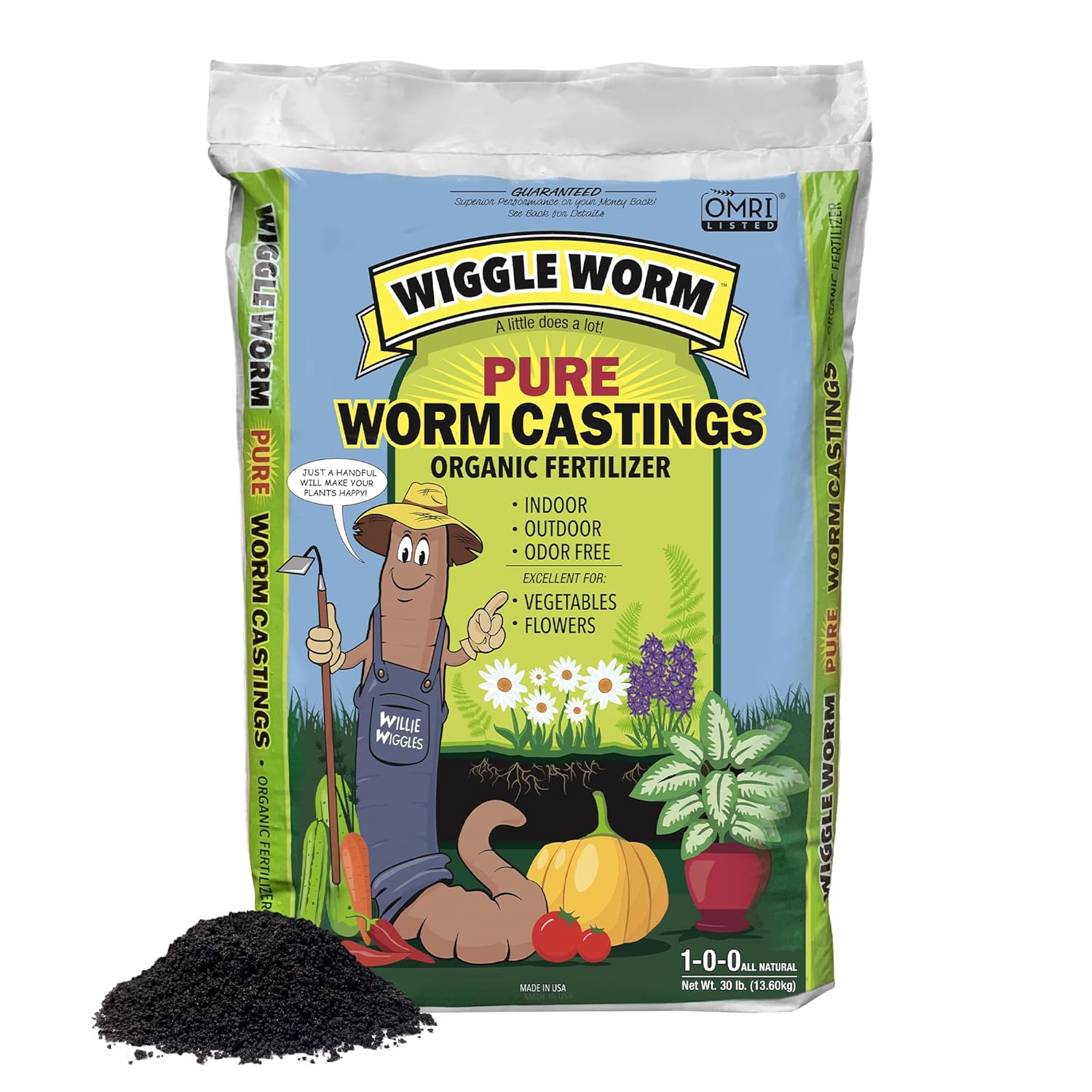
Wiggle Worm Pure Worm Castings Organic Fertilizer, 30 lb
| Item Form | Granules |
|---|---|
| Specific Uses For Product | Soil Conditioning |
| Application Method | Apply to soil |
| Unit Count | 480 Ounce |
Wiggle Worm Pure Worm Castings are a ready-to-use organic soil amendment made from concentrated earthworm castings. Gardeners typically mix a portion into potting mixes, top-dress established plants, work it into transplant holes, or brew it as a nutrient tea; the product page includes specific dosing for vegetables, containers, lawns, and roses. The castings are odorless, non-burning, and OMRI listed for organic use, so they supply water-soluble nutrients plus microbes that improve aeration, water retention, and root development without synthetic chemicals. Practical benefits include easy application, safe use on seedlings and mature plants, and versatility across raised beds, container gardens, and lawns. The main limitation is that this is a concentrated soil builder rather than an all-in-one fertilizer with NPK labels, so users seeking precise, fast-acting nutrient ratios may need to supplement for specific deficiencies; also a 30 lb bag is bulky to handle for small-space gardeners. For gardeners focused on long-term soil health and organic production, it functions as a low-risk, effective amendment.
Best for: Gardeners who prioritize building long-term soil health and want a safe, organic amendment for vegetables, ornamentals, and containers; buyers who value proven, low-risk inputs backed by strong user feedback.
Less Ideal for: Gardeners who need targeted, rapid nutrient correction based on precise NPK values or those who only want a lightweight product for very small balconies or indoor micro-gardens.
- OMRI listed organic and made from 100% worm castings
- Provides beneficial microbes that improve soil structure and water retention
- Odorless and non-burning so safe for seedlings and established plants
- Versatile dosing for containers, raised beds, lawns, and making worm casting tea
- No standard NPK nutrient label so not a precise standalone fertilizer for targeted feeding
- Large 30 lb bag can be heavy and awkward for gardeners with limited storage or mobility
Verdict: Choose this product when you want a proven, OMRI-listed worm casting that builds soil biology and improves plant health across beds and containers.
Brut Organic Worm Castings, 5 lb

| Item Form | Granules |
|---|---|
| Specific Uses For Product | Gardening,Organic |
| Target Species | All plants |
| Mixing Ratio | 1:5 |
Brut Organic Worm Castings function as a concentrated, natural soil amendment you mix into potting mixes or top-dress garden beds and raised beds. Typical use is mixing at the recommended 1:5 ratio for new indoor plants, sprinkling a cup around established houseplants, or working into outdoor planting holes and beds according to the brand directions. The product is OMRI/CDFA listed and produced in controlled conditions, which supports consistent nutrient content and beneficial microbial life that help roots establish, improve soil structure, and increase moisture retention without burning plants. Practical benefits for raised garden beds include improved aeration, slow-release nutrients, and a boost in microbial activity that supports long-term fertility. Limitations are that it is not a complete NPK fertilizer for immediate heavy feeding needs and larger beds require significant quantities to hit the suggested per-square-foot rates, so frequent applications or bulk purchases may be needed for big projects.
Best for: Gardeners who prioritize dependable, organic soil improvement for raised beds and container gardens and prefer predictable, low-risk amendments that support long-term soil health.
Less Ideal for: Those needing immediate, high-NPK feeding for heavy-feeding crops or gardeners who want to amend very large beds without buying supplemental bulk material.
- Certified organic and produced indoors for consistent purity
- Rich in beneficial microbes that improve soil structure and plant vigor
- Easy-to-use granular form suitable for mixing or top-dressing
- Not a standalone high-NPK fertilizer for rapid nutrient correction
- Five-pound bag may be small for large raised beds and repeated seasonal use
Verdict: Use this OMRI/CDFA-listed worm castings product to reliably build long-term fertility and microbial health in raised beds and containers.
Coast of Maine Quoddy Blend Lobster Compost, 1 cu ft

| Unit Count | 1 Count |
|---|---|
| Volume | 1 cubic feet |
| Item Weight | 24 pounds |
| OMRI Listed | Yes |
Coast of Maine Quoddy Blend is a ready-to-use, OMRI-listed compost made from a mix of composted manure, peat moss, aged bark and lobster and crab shell meal to boost soil nutrients and microbial life. In practice you spread or mix it into beds and around perennial roots to improve structure, drainage and moisture retention while supplying phosphorus, calcium and nitrogen from seafood-derived amendments. The product’s balanced density makes it useful for raised beds, borders and in-ground perennial plantings where steady nutrient release and improved texture matter. Notable features include the OMRI listing for organic use and a formula specifically aimed at building living soil rather than providing quick-release synthetic fertilizer. Limitations are practical: the bag is one cubic foot so covering large areas requires multiple bags, and the shell-based content can trigger allergies in sensitive households so handle carefully. Expect gradual soil improvement over the season rather than instant greening from soluble fertilizers.
Best for: Gardners focused on building long-term soil health for perennial beds who prefer organic, sustainably sourced amendments and gradual, steady nutrient release.
Less Ideal for: Gardeners who need a high-volume, fast-acting synthetic fertilizer or who must cover large areas quickly should consider bulk compost or blended fertilizers instead.
- OMRI-listed for organic gardening and suitable for perennials
- Contains shell meal and composted manures that add phosphorus, calcium and nitrogen
- Improves soil structure, moisture retention and drainage when mixed into beds
- Balanced density works well in raised beds, borders, and in-ground plantings
- Small 1 cu ft bag means multiple bags are needed for larger garden areas
- May contain allergens from shellfish so requires careful handling
Verdict: Choose this OMRI-listed seafood compost when you want an organic, nutrient-rich amendment to improve soil structure and feed perennials over the growing season.
Choosing the Right Compost for Perennials: Key Factors to Consider
Nutrient Balance and Release Pattern
Perennials benefit from a steady supply of nitrogen, phosphorus, and potassium rather than a single flush. Look for compost described with a balanced nutrient profile or known inputs that supply sustained release. A moderate carbon-to-nitrogen ratio helps microbes break down organic matter at a pace that feeds plants across the growing season.
A compost that releases nutrients too quickly can stimulate leafy growth at the expense of root strength, while one that is too inert may not support establishment. Match the compost's release pattern to the life stage of your perennials: newly planted divisions need a gentler boost, while mature clumps may tolerate richer feeds.
Texture, Particle Size, and Drainage
Good texture prevents waterlogging around perennial roots while retaining enough moisture between irrigations. Coarse particles and a mix that includes broken-down woody material or leaf litter improve aeration and structural stability. Finer, very decomposed compost can pack down and reduce oxygen around roots, especially in heavy soils.
Consider how the compost will mix with your existing soil. In clay, favor coarser, more open compost to increase porosity. In sandy sites, a higher proportion of finer, moisture-holding compost helps retain water. Particle size also affects how quickly the compost integrates and how often you will need to refresh application.
Organic Matter Content and Stability
High organic matter is valuable because it builds soil structure and feeds soil life, but stability matters more than simple percentage. Stable humus-like material resists rapid decomposition and contributes lasting structure, whereas very fresh, unstable compost will break down and require frequent replenishment.
Stable organic matter also reduces nutrient leaching and supports a diverse soil community. For perennial borders you want compost that contributes to long-term soil improvement rather than providing only a short-term nutrient surge.
Weed Seed and Pathogen Screening
Compost quality varies in terms of heat treatment and screening. Compost containing viable weed seeds or plant pathogens can introduce problems that become persistent in perennial beds. Choose composts that specify weed-seed-free production or have undergone adequate thermophilic processing.
For high-value perennial plantings and propagation beds, err on the side of screened, well-matured compost. In lower-risk ornamental drifts you may accept less-stringent screening if you plan to use mulch or hand-weed regularly.
pH and Mineral Compatibility
Most perennials prefer near-neutral to slightly acidic soils, but specific species vary. Compost influences soil pH depending on source materials and mineral content. A compost that is strongly alkaline or acidic can shift soil chemistry over time and affect nutrient availability.
Test your soil first and choose a compost whose pH is compatible, or adjust your regimen with complementary amendments. Matching compost pH to plant needs reduces the chance of nutrient lockup and makes long-term maintenance simpler.
Salt Content and Source Materials
Some composts, especially those derived from manures or biosolids, can have elevated soluble salt levels that stress sensitive perennial roots. Source materials also influence nutrient composition, odor, and potential contaminants.
If you are planting salt-sensitive species or container perennials, select composts with documented low salt or that list mellow feedstocks like leaf mold, yard waste, and well-aged garden organics. For established beds with tolerant species, higher-salt compost can be acceptable if used sparingly and incorporated well.
When to Apply Compost to Perennial Beds
Apply compost in late winter to early spring before new growth begins so nutrients are available as roots wake up. For established perennials, a thin topdressing of compost every year or every other year supplies slow-release nutrients without disturbing root systems.
For newly planted perennials, blend a modest amount of compost into the backfill to improve initial root contact, but avoid replacing too much native soil with straight compost. Overloading can create a moisture and nutrient contrast that limits root exploration.
- Topdress 1 to 2 inches of compost around established plants, keeping material away from crowns.
- In planting holes, mix compost at no more than 25% of total backfill volume for best root encouragement.
- Refresh compost layer in spring or after heavy winter breakdown rather than frequent light applications.
Compost for Containers and Planters with Perennials
Containers behave differently than in-ground beds; they dry and warm faster, and salt buildup is more common. Use a compost blend formulated for container use or incorporate a smaller proportion of compost into a well-draining potting mix.
Choose mixes with coarse components and added aeration such as bark or perlite to prevent compaction. For long-lived container perennials, plan on replacing part of the container mix every two to three years to maintain structure.
- Use compost sparingly in containers: around 10 to 25 percent of the total mix by volume.
- Topdress containers each spring with a thin layer of compost to refresh nutrients without disturbing roots.
How Compost Affects Soil Biology in Perennial Plantings
Compost feeds soil microbes and supports beneficial fungi that help perennial roots access nutrients and water. Stable, biologically active compost encourages gradual nutrient cycling and improved soil aggregation, which is especially valuable in perennial beds that are meant to persist for years.
Too much fresh, high-nitrogen compost can temporarily increase microbial competition for nitrogen, leading to short-term nutrient locking. Choosing well-matured compost reduces this risk and promotes a balanced soil food web that favors perennial health.
- Look for compost labeled as fully matured or stable for minimal nitrogen immobilization.
- Encourage mycorrhizal development by avoiding excessive, high-salt amendments and by maintaining diverse organic inputs.
Using Compost with Mulch and Fertilizer Regimens
Compost complements mulches by improving the soil beneath and supplying nutrients that mulch breakdown can release later. Use compost as a foundation layer under organic mulches to combine the benefits of moisture retention and steady feeding.
If you use additional fertilizers, consider the compost's nutrient contribution to avoid overfeeding. Slow-release or organic fertilizers pair best with compost because they align with the gradual nutrient dynamics perennials prefer.
- Apply compost before laying a 2 to 3 inch organic mulch layer for the best long-term soil improvement.
- Adjust supplemental fertilizer rates based on observed plant vigor rather than fixed schedules.
Testing and Monitoring Soil After Compost Applications
Regular soil testing helps you track the long-term effects of compost on pH, nutrient levels, and organic matter. Test every two to three years in perennial beds so you can adjust future compost choices or amend with lime or sulfur as needed.
Visual monitoring is also useful: look for improved root depth, reduced wilting, and steadier growth as signs the compost is working. If you notice poor drainage or excessive lushness, reassess particle size or application rate.
- Collect samples from the root zone for accurate testing results.
- Compare compost application areas to untreated patches to see practical differences in structure and plant performance.
How We Chose the Best Compost for Perennials
We selected composts that suit perennial plants by filtering for mixes that deliver steady nutrition, stable structure, and good drainage over multiple seasons. Our editorial process prioritized measurable properties that matter in the perennial garden: nutrient profile and C:N balance, particle size and texture, organic matter percent and stability, pH range, and weed or pathogen screening. We also considered moisture retention relative to drainage to avoid compaction around roots and the composts ability to integrate with existing soil without causing nutrient imbalances. Excluded from this list were specialty mixes aimed primarily at annuals, seed starting, or fast-release lawn topdressing because they do not match the long-term feeding and structural goals of perennial beds. We looked for products with clear feed profiles and straightforward ingredient lists so gardeners can anticipate how the compost will behave over months and years. The resulting shortlist reflects options that support root development, encourage beneficial soil life, and reduce the need for frequent reapplication.
FAQ
How much compost should I add to established perennial beds?
A thin topdressing of 1 to 2 inches once a year or every other year is usually enough for established beds. This supplies steady organic matter without smothering crowns or causing excessive nutrient flushes.
Can I use fresh manure-based compost around perennials?
Fresh manure-based compost can be high in soluble salts and nitrogen and may be too strong for delicate perennials. Use well-aged, fully composted manure at low rates and avoid placing it against plant crowns.
Will compost change soil pH for my perennials?
Compost has a moderating effect on soil pH, but significant changes depend on the compost's source materials. Test your soil if you are managing species with strict pH needs and select composts that match your target range.
Is compost the same as garden soil or topsoil for perennial planting?
No. Compost is decomposed organic matter rich in nutrients and biology, while garden soil or topsoil contains mineral particles and native structure. For planting, mix compost with native soil rather than substituting it entirely to preserve proper soil texture.
How often should I reapply compost in perennial containers?
Topdressing containers with a thin layer of compost each spring and replacing part of the container mix every two to three years keeps long-lived container perennials healthy. Containers lose structure faster than in-ground beds.
Final Verdict
Prioritize composts that improve structure and provide steady nutrition rather than quick-release fertility for perennial plantings. Focus on texture and stability to avoid compaction and frequent reapplication, and match pH and salt levels to the plants you grow. By weighing nutrient release, particle size, and maturation you can choose a compost that builds long-term soil health and reduces maintenance for your perennial borders. Aim for modest, regular applications and monitor soil tests to refine your approach over seasons.
