

Note: This article contains affiliate links. If you click on these links and make a purchase, I may earn a small commission at no extra cost to you. This helps support my research and content. Read my full affiliate disclosure here.
Starting seeds in the right growing medium changes how quickly seedlings emerge and how well they survive the first critical weeks. Compost for seed starting should be light, free of pathogens, and low in salts and heavy nutrients that can scorch tender roots. In this guide we shortlist the top composts gardeners will consider when setting up flats, cells, or pots for transplantable seedlings. Each option was evaluated for texture, nutrient balance, and cleanliness to help you pick a mix that supports vigorous, healthy starts. Read on for the practical criteria we used and clear guidance for different seed-starting situations.
Top Picks at a Glance
| Best Overall The best all-around choice for most situations | Espoma Organic Seed Starter Premium Potting Mix, 16 qt |  |
| Best Quality Built to a higher standard if you want something more solid | Vermont Compost Company Fort Vee Organic Potting Mix, 20 Quart |  |
| Best Value The sweet spot between price and what you get | Burpee Organic Coconut Coir Seed Starting Mix (Coir Brick, expands to 8 qt) |  |
| Best Budget The cheapest option that still gets the job done reliably | SunGro Horticulture Organic Seedling Mix (8 Quart) |  |
| Highest Rated A top-rated pick with lots of positive feedback | Coast of Maine Sprout Island Blend Seed Starter, 8 qt (4-pack) |  |
| Most Popular A crowd favorite that many people choose with confidence | Miracle-Gro Indoor Potting Mix for Seed Starting, 8 qt. (2-Pack) |  |
| Best Seller A high-volume bestseller chosen again and again | Back to the Roots Organic Seed Starting Mix — Expanding 12 Quart Block |  |
Espoma Organic Seed Starter Premium Potting Mix, 16 qt

| Brand Name | Espoma |
|---|---|
| Volume | 16 quarts |
| Unit Count | 598.4 Ounce |
| Model Number | SS16 |
Espoma Organic Seed Starter is a peat-based, lightweight potting mix designed specifically for germinating seeds and rooting cuttings. The blend of sphagnum peat moss and perlite gives good aeration and drainage while the formula includes yucca extract to improve wetting and lime to balance pH. It also contains Myco-tone mycorrhizae to help early root establishment and improve nutrient access during the seedling stage. Typical use is filling trays, cells, or small pots for seeds and softwood cuttings; its fine texture and moisture retention reduce damping-off risk when used with proper sanitation and watering. Because it contains no synthetic fertilizers, it is appropriate for organic growing but you will need to begin light feeding once true leaves form or when transplanting. The bag size covers routine home-seed-starting needs, and the product is straightforward to handle and mix for small-scale propagation projects.
Best for: Gardeners focused on reliable seed germination and strong early root development who want an organic, ready-to-use mix for trays and small pots.
Less Ideal for: Growers wanting a peat-free or pre-fertilized seed mix or those starting very large volumes commercially should consider alternatives tailored to those needs.
- Formulated for seedlings with peat and perlite for balanced aeration and moisture retention
- Includes Myco-tone mycorrhizae to support early root development
- Organic ingredients with no synthetic fertilizers, suitable for organic growing
- Contains yucca extract to improve wetting and lime to help stabilize pH
- No starter nutrients included so plants need feeding after true leaves appear
- Peat-based mix is not the most sustainable choice for gardeners preferring peat-free media
Verdict: Choose this organic seed starter when you want a ready-to-use mix that promotes rapid root development and reliable germination for home seedlings and cuttings.
Vermont Compost Company Fort Vee Organic Potting Mix, 20 Quart

| Brand | Vermont Compost Company |
|---|---|
| Volume | 20 quarts |
| Style Name | Garden,Peat Moss,Potting,Potting Soil Mix,Soil Mix,Vermiculite |
| Model Number | Fort Vee 45 Qt |
Fort Vee is a professional-style, compost-based potting mix designed for seed starting and potting up transplants. It holds shape well for soil blocks and repeat waterings, so it is practical for growers who use trays, plugs, and small pots. The formula lists composted manure and plant materials plus peat moss, vermiculite, coir, and mineral inputs such as granite, basalt, bone meal, blood meal, kelp meal, and gypsum, which together deliver sustained nutrition for heavy-feeding seedlings and young vegetables. That nutrient density reduces the need for early fertilizer applications and supports vigorous root and shoot development prior to garden transplanting. The texture is described as stable yet workable, making it easier to handle when forming blocks or filling small cells. Limitations are that it is a concentrated, nutrient-rich mix intended for early-stage use rather than long-term container media and it requires careful handling to avoid inhaling dust and to follow basic safety guidance.
Best for: Gardeners and small-scale growers who prioritize vigorous, nutrient-rich starts for vegetable and herb transplants and who use soil blocks, trays, or plug flats.
Less Ideal for: People looking for an all-season container potting soil for mature plants or those who prefer a low-nutrient, bare-minimum seed-starter.
- Compost-based formula with organic amendments provides sustained nutrition for seedlings and transplants
- Holds shape reliably for soil blocks and repeat watering, useful for seed-starting workflows
- Includes vermiculite and coir for good moisture retention and aeration in small cells
- Formulated with minerals and meals (bone, blood, kelp, gypsum) to support heavy-feeding crops
- Designed primarily as a seed-starting/potting mix rather than a long-term container soil
- May produce dust and should be handled with care to avoid inhalation
Verdict: Choose Fort Vee when you need a nutrient-dense, compost-based mix that reliably forms soil blocks and gives seedlings a strong, vigorous start.
Burpee Organic Coconut Coir Seed Starting Mix (Coir Brick, expands to 8 qt)

| Brand Name | Burpee |
|---|---|
| Item Highlight | OMRI Listed coconut coir expands with water to 16 qts of growing mix; ideal for seed starting and seedlings. |
| Included Components | Coir |
| Ingredients | Coconut Coir |
Burpee’s compressed coconut coir brick is a simple, space-saving seed starting medium: add water and the brick expands into about 8 quarts of loose coir suitable for sowing seeds and potting seedlings. It is OMRI listed and made from recycled coconut husks, so it holds moisture well while maintaining good aeration around roots, which helps germination and early root development for vegetables, herbs, and flowers. The dehydrated brick is easy to store and transport compared with bulky bagged mixes, and it mixes readily with compost or a small amount of fertilizer when you need extra nutrients. Because it is essentially pure coir, you should plan to add starter nutrients or blend with organic potting mix for longer-term growth since it contains no built-in fertilizer. Some gardeners may find it slower to rehydrate if not broken apart first, and the product is a single concentrated brick so you must expand a full unit even when you need less volume. For someone optimizing space and wanting a reliable, low-mess seed-start medium, this is a practical choice.
Best for: Gardeners who value compact storage and a reliable, sterile medium for starting vegetable and herb seeds and who plan to amend or feed seedlings after germination.
Less Ideal for: Those who want an all-in-one potting mix with built-in fertilizer or growers who need small precise single-use portions without expanding a whole brick.
- OMRI listed organic coir made from recycled coconut husks
- Expands with water to about 8 quarts per brick for compact storage
- Good moisture retention with improved aeration for seed germination
- Mixes easily with compost or potting soil to tailor nutrient levels
- Contains no nutrients so you must add starter fertilizer for sustained growth
- Sold as a concentrated brick so you may over-expand when only a small amount is needed
Verdict: A compact, organic coir brick that gives practical gardeners an easy-to-store, moisture-retentive seed starting medium they can amend as needed.
SunGro Horticulture Organic Seedling Mix (8 Quart)

| Brand Name | SUN GRO |
|---|---|
| Style Name | Peat Moss |
| Volume | 8 quarts |
SunGro Horticulture Seedling Mix is a fine-textured, peat-based starting mix formulated to germinate seeds in flats, pots, and plug trays. It contains sphagnum peat moss, perlite for lightness and drainage, and an organic wetting agent to promote even water absorption, which helps maintain consistent moisture for small seeds. The mix also includes a silicon-enriched additive called RESiLIENCE intended to support stronger seedlings and reduce wilting during establishment. Typical use is filling trays or small pots, keeping the medium evenly moist but not waterlogged, then transplanting seedlings once roots are established. Practical benefits include predictable moisture retention, a clean fine texture that allows delicate roots to develop, and OMRI listing for organic onion transplants and other edible starts. Limitations are its small 8 quart volume for larger onion seed programs and that peat-based mixes dry out faster than heavier soils, so frequent monitoring is required; it also provides limited long-term nutrients so potting up into a richer mix or fertilizing before transplant is necessary.
Best for: Gardeners who want an organic, predictable seed starting medium for small to medium onion seed batches and who prioritize reliable germination over bulk volume.
Less Ideal for: Commercial growers or anyone starting very large quantities of onion seedlings should choose larger-volume or more nutrient-dense starting media.
- Fine, light texture suitable for delicate seed germination
- Organic wetting agent promotes uniform water absorption
- OMRI listed so safe for organic edible starts
- Contains perlite for improved drainage and root aeration
- Small 8 quart bag may not be cost-effective for starting large onion batches
- Peat-based mix has low long-term nutrient content and needs fertilizing before transplant
Verdict: A reliable OMRI-listed seed starting mix that delivers even moisture and a fine texture ideal for producing healthy onion seedlings in small home gardens.
Coast of Maine Sprout Island Blend Seed Starter, 8 qt (4-pack)

| Brand Name | Coast of Maine |
|---|---|
| Number of Packs | 4 |
| Unit Count | 32 Count |
| Volume | 8 quarts |
| Guaranteed Analysis | 0.35 – 0.10 – 0.05 |
Coast of Maine Sprout Island Blend is a ready-to-use seed starting mix designed specifically for germinating seeds and rooting cuttings. It combines sphagnum peat moss, well-aged compost, aged bark, perlite and biological amendments such as kelp meal, lobster and crab shell meal, worm castings and mycorrhizae to create a porous, moisture-retentive medium with a light organic nutrient charge. You use it straight from the bag in cell packs, trays or flats; the perlite and bark help keep the mix airy while peat and compost hold water so tiny roots find both moisture and oxygen. The added kelp and castings support early growth without heavy synthetic fertilizer, and the mycorrhizae can help young roots establish. Because it is compost-based rather than a purely inert mix, expect some variation in texture between bags and a mild odor typical of organic materials. Safety guidance notes to avoid skin and eye contact and to handle with gloves. This four-pack format suits repeat sowing through a season or multiple small batches.
Best for: Buyers who prioritize a dependable, ready-made seed starting medium that encourages quick, healthy germination and want consistent results across multiple sowings.
Less Ideal for: Growers seeking a peat-free or fully inert sterile medium for delicate seedlings or those who prefer to blend their own custom mixes from raw ingredients.
- Formulated specifically for seeds and cuttings with a balance of moisture retention and aeration
- Includes biological amendments (kelp, worm castings, mycorrhizae) to support early root development
- Ready-to-use in trays, cell packs, or flats with no mixing required
- Sold as a multi-pack so you can sow several batches or seasons without repurchasing
- Contains peat moss which may compress over time and offers limited long-term sustainability benefits
Verdict: A reliable, biologically enriched seed starter that delivers consistent moisture, aeration, and gentle nutrients for dependable germination.
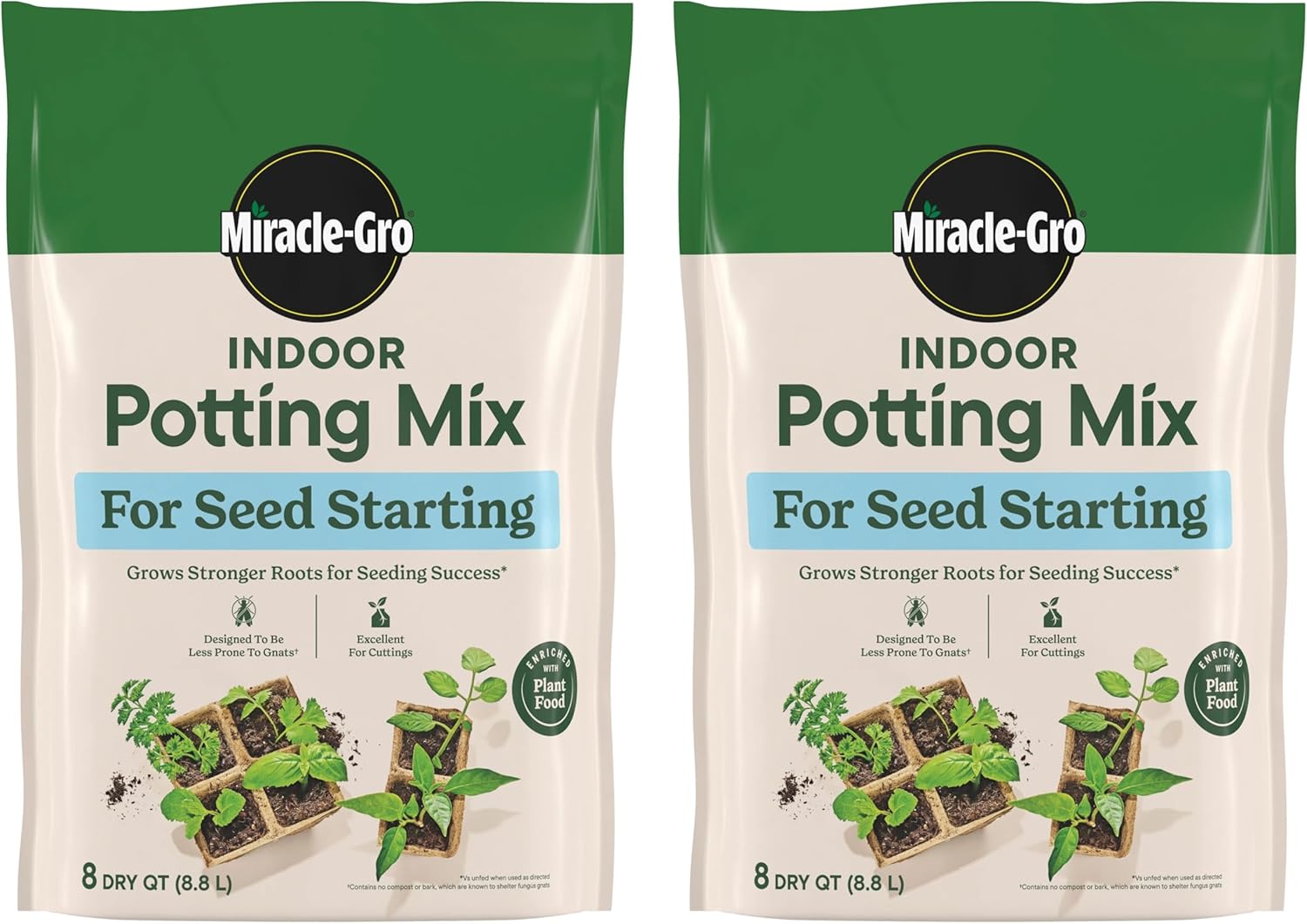
Miracle-Gro Indoor Potting Mix for Seed Starting, 8 qt. (2-Pack)
| Brand Name | Miracle-Gro |
|---|---|
| Item Type Name | Potting Mix |
| Number of Packs | 2 |
| Volume | 8 quarts |
This two-pack of Miracle-Gro Indoor Potting Mix is designed specifically for starting seeds and rooting cuttings indoors. The blend is lightweight and pre-enriched with plant food so seedlings get a nutrient boost during early root development, and the manufacturer says it yields stronger roots compared with unfed mixes when used as directed. It is intended for vegetables, flowers, and herbs and works well in cell trays and small containers; one 8 qt. bag will fill roughly three 72-cell trays. Notably, the formula omits compost and bark, which helps lower the chance of fungus gnat infestations in damp seed-starting setups. Use it by filling trays or pots, keeping the mix evenly moist, and shielding newly sown seeds from direct sun until germination. Important limitations are standard for enriched mixes: it contains fertilizer (so handle carefully) and it is a seed-starting medium rather than an all-purpose potting soil for mature plants, so you will likely transplant seedlings into a different mix or amend soil later.
Best for: Buyers who want a low-effort, indoor seed-starting medium that supports faster root development and reduces common pest risks while following proven seed-starting practices.
Less Ideal for: Gardeners who need a permanent potting soil for mature container plants or who prefer fully organic, compost-rich mixes should consider alternatives.
- Lightweight, ready-to-use formula tailored for seed germination and cuttings
- Pre-enriched with plant food to support early root and seedling growth
- Excludes compost and bark to reduce habitat for fungus gnats
- Comes as a two-pack so you have enough mix for multiple trays
- Contains fertilizer which requires careful handling and storage
- Intended for seed starting so not formulated as long-term potting soil for mature plants
Verdict: A practical, low-risk seed-starting mix that boosts early root growth and reduces fungus gnat risk, making it a reliable choice for indoor vegetable seedlings.
Back to the Roots Organic Seed Starting Mix — Expanding 12 Quart Block

| Volume | 12 quarts |
|---|---|
| Item Type Name | Seed Starting Mix |
| Unit Count | 384 Fluid Ounces |
| OMRI Listed | Yes |
| Peat Free | Yes |
This compressed seed starting mix is a coir-based block that expands to 12 quarts of loose, ready-to-use seedling soil after adding water. It is designed for starting seeds, potting up seedlings, and amending small pots for herbs, vegetables, and flowers. Notable features include an OMRI-listed organic formulation, balanced pH and low electrical conductivity to support nutrient uptake, and compact storage compared with bulky soil bags. In practice the block is easy to hydrate and fluffs up quickly, producing a light, airy medium with good water retention and aeration for root development. The convenience of a single expanding block and beginner-friendly handling makes it a reliable choice for cautious gardeners who want predictable results without mixing multiple ingredients. Limitations are that it is a single-purpose starter mix rather than an all-in-one fertilized potting soil and larger projects will need multiple blocks, so plan quantities ahead.
Best for: Practical gardeners who want a reliable, easy-to-use organic starter medium for small-scale seed trays, pots, and indoor seedlings and who prioritize predictable, low-fuss results.
Less Ideal for: Gardeners needing a ready-to-use, fertilized all-purpose potting soil for large container gardens or immediate long-term container plantings should consider an enriched potting mix instead.
- Expands to 12 quarts from a compact compressed block for easy storage and transport
- OMRI-listed organic and peat-free formulation suitable for organic growing
- Neutral pH and low electrical conductivity support seedling nutrient uptake
- Light, fluffy texture promotes good aeration and root development
- Simple to hydrate and use, friendly for beginners and low-effort setups
- Sold as a bare starting mix without added fertilizer for later stages
- Single block size requires purchasing multiple units for larger seed batches
Verdict: A compact, OMRI-listed organic seed starter that reliably expands into a light, neutral-pH medium for predictable, beginner-friendly seed starting.
Choosing the Right Compost for Seed Starting: Key Factors to Consider
Texture and Particle Size
Fine, uniform texture matters because tiny seeds need close contact with the medium to absorb moisture and send out the embryo root. A medium that is too coarse leaves air gaps that prevent reliable germination, while a medium that is too dense can compact and suffocate emerging roots. Look for composts with a mix of fine particles and a light component such as screened compost or finely milled coir so seeds sit snugly without being buried.
Particle size also affects how the medium wets and dries. Smaller particles retain water more evenly but can become gluey if they lack structure. A balanced particle profile encourages even moisture at the seed level while allowing excess water to drain away.
Pathogen Cleanliness and Sterility
Seedlings are highly vulnerable to fungal pathogens like Pythium and Botrytis in their first weeks. Compost for seed starting should be pasteurized, sterilized, or produced under hygienic conditions to minimize those risks. Products labeled specifically for seed starting or pasteurized greenhouse mixes usually have lower pathogen loads than garden compost or unprocessed leaf mold.
Cleanliness is not an absolute guarantee, so avoid introducing contaminated tools or overwatering, which can negate the benefit of a clean mix. When possible, visually inspect the compost for mold, large debris, or an unpleasant sour odor that suggests active decomposition.
Nutrient Level and Starter Fertility
Seedlings need minimal nutrients at first because their cotyledons provide the earliest food. Compost for seed starting should offer a low to moderate, slow-release nutrient profile that supports the seedling after the cotyledons fade but does not cause rapid, weak growth or fertilizer burn. A light reserve of nitrogen and trace elements helps seedlings transition before you begin a gentle feeding schedule.
Avoid heavily fortified composts or mixes labeled for finished potting where high nutrient concentrations are intended for mature plants. Those can produce leggy, stressed seedlings or damage tender root tips.
Moisture Management
The ideal seed-starting compost holds enough moisture to keep seeds hydrated while allowing excess to drain. Too much free water invites damping-off pathogens and rots the seed, while too little leads to uneven germination and failed flats. Good seed-starting composts strike a balance with moisture-retentive components such as peat or coir paired with drainage components like perlite or fine grit.
Consider how the compost behaves in a typical tray under a humidity dome or plastic cover; the mix should not remain waterlogged but should stay evenly damp for several days between checks.
pH and Salt Content
pH influences nutrient availability to tiny roots. Most seeds prefer a slightly acidic to neutral range, roughly 5.5 to 6.8. Compost for seed starting should be tested or manufactured to fall in that window, or at least be neutral enough to avoid locking up essential elements. Similarly, salt content matters because young roots are sensitive to soluble salts that can draw moisture from delicate tissue.
Composts made from finished manures or high-strength amendments can have elevated salts. For reliable starts, choose a medium with low electrical conductivity or one specified for seedlings to prevent germination issues and early stress.
Ease of Use and Consistency
Gardeners appreciate a compost that handles predictably when filling trays, sowing tiny seeds, and transplanting. A consistent bag-to-bag texture saves time and reduces frustration. Avoid mixes with large, variable chunks that require extra screening, or that compact differently when tamped or watered.
Good seed-starting compost should level smoothly in cells, accept surface-sown seeds without burying them too deep, and hold together enough to allow gentle lifting at transplant time without falling apart entirely.
When to Use Dedicated Seed-Starting Compost
Use a seed-starting compost whenever you are germinating small-seeded vegetables, annuals, or herbs indoors or in a greenhouse. Dedicated mixes reduce the chance of damping-off and give uniform moisture contact that improves germination percentages for fine seeds like petunia, lettuce, and snapdragon.
- Indoor sowing under lights or on a sunny windowsill
- Starting many seeds in flats for later transplanting
- Sowing heat-sensitive or slow-germinating varieties that need stable moisture control
Preparing Flats and Trays
Fill trays lightly and level the surface so seeds make consistent contact. Pre-moisten the compost until it holds together when squeezed but does not drip. If the compost is very loose, firm gently with a flat board to create an even seedbed without compacting the lower layers.
- Avoid overpacking; leave small air spaces for root aeration
- Label trays before sowing to keep different varieties organized
- Use clean tools and trays to maintain the medium's pathogen cleanliness
Watering and Humidity Management
Start with a fine mister or bottom-watering to avoid displacing tiny seeds. Bottom-watering encourages roots to grow downward and prevents surface crusting. Cover trays with a clear dome or plastic wrap until cotyledons appear to maintain humidity, but remove covers as soon as true leaves form to reduce disease risk.
- Check moisture daily; surface should be evenly damp, not soggy
- Open covers briefly each day to exchange air and reduce condensation build-up
- Switch to a gentler watering method as seedlings develop stronger roots
Transitioning Seedlings to Potting Mix
When seedlings have their first true leaves and a healthy root system, move them into a richer potting mix or larger cells. Handle seedlings by the leaves rather than the stem to avoid damage. Gradually reduce humidity and increase light intensity to harden off seedlings before transplanting outdoors.
- Use a lightweight potting mix with more organic matter and controlled nutrients for the next stage
- Gradually acclimate seedlings to lower humidity and stronger light over 5 to 10 days
- Water carefully after transplanting to settle the new medium around roots
How We Chose the Best Compost for Seed Starting
We focused on characteristics that actually matter in a seed-starting environment. Key evaluation criteria included texture and porosity to ensure good drainage and fine seed-to-soil contact; pathogen cleanliness and pasteurization to reduce damping-off and seed rot; nutrient balance so seedlings get a gentle supply without fertilizer burn; and moisture retention to keep tiny roots hydrated without waterlogging. We also considered ease of use for hobby gardeners, including how well a compost compacts in flats and how it accepts seeds and light coverings. Exclusions: mixes designed primarily for established plants, heavy garden composts with large particulate matter, and products marketed as finished potting soils with high fertilizer charge were excluded. The final shortlist emphasizes composts and seed-starting blends that deliver consistent germination, low disease risk, and predictable handling in trays and small containers.
FAQ
Can I use garden compost for seed starting?
Often garden compost is too coarse and may contain pathogens or weed seeds. It can be used if well-screened and pasteurized, but dedicated seed-starting composts are a safer, more consistent choice for reliable germination.
How wet should compost be when sowing seeds?
The medium should be evenly damp, like a wrung-out sponge. Too wet invites disease and too dry prevents germination. Pre-moisten before filling trays and check daily, adjusting with a fine mister or bottom-watering.
Do I need to fertilize seedlings started in seed compost?
Usually not immediately. Most seed-starting composts provide a modest nutrient reserve. Begin light feeding after the first true leaves appear, using a diluted balanced fertilizer to support steady growth.
Is sterilized compost necessary to prevent damping-off?
Sterilized or pasteurized compost reduces pathogen risk but good cultural practices are also essential. Avoid overwatering, provide good air circulation, and use clean trays to minimize damping-off even when using clean mixes.
Can I reuse seed-starting compost after growing seedlings?
Reusing compost is possible but not recommended without treatment because it may contain pathogens and depleted nutrients. If you reuse it, consider sterilizing and blending with fresh material and adding slow-release nutrients.
Final Verdict
Choose a seed-starting compost that balances fine texture, cleanliness, and gentle nutrition. Prioritize pathogen-reduced mixes with good porosity and moisture control for consistent germination and strong early root development. Tradeoffs include moisture retention versus drainage and low nutrients versus the need for an early feed; match the mix to your sowing method and seed type. With the right compost and basic hygiene, you can improve germination rates and grow sturdier seedlings ready for transplanting.
