

Note: This article contains affiliate links. If you click on these links and make a purchase, I may earn a small commission at no extra cost to you. This helps support my research and content. Read my full affiliate disclosure here.
If you garden in a small yard, patio, or raised bed, the right compost can transform restricted soil into a productive, healthy growing area. You want material that builds structure, holds moisture without becoming waterlogged, and supplies nutrients at a pace your plants can use. This guide shortlists seven top compost options that work well in confined growing spaces and explains the practical tradeoffs gardeners face when choosing between bagged, bulk, and home-processed mixes. We evaluate texture, nutrient content, and ease of handling to help you pick the most useful compost for your small garden.
Top Picks at a Glance
| Best Overall The best all-around choice for most situations | Wiggle Worm Pure Worm Castings Organic Fertilizer, 15 lb |  |
| Best Quality Built to a higher standard if you want something more solid | Back to the Roots Organic All-Purpose Compost Mix, 25.7 qt |  |
| Best Value The sweet spot between price and what you get | Black Kow Composted Cow Manure Fertilizer, 8 qt |  |
| Best Budget The cheapest option that still gets the job done reliably | Life Cycle Organics 100% Organic Worm Castings, 20 oz |  |
| Highest Rated A top-rated pick with lots of positive feedback | Earth Science Premium Earthworm Castings, 3 lb |  |
| Most Popular A crowd favorite that many people choose with confidence | Brut Organic Worm Castings, 5 lb |  |
| Best Seller A high-volume bestseller chosen again and again | Wiggle Worm Pure Worm Castings Organic Fertilizer, 30 lb |  |
Wiggle Worm Pure Worm Castings Organic Fertilizer, 15 lb

| Item Form | Pure earthworm castings |
|---|---|
| Specific Uses For Product | Soil Conditioning |
| Unit Count | 240 Ounce |
| OMRI Listed | Yes |
Wiggle Worm Pure Worm Castings is a straightforward organic soil amendment that supplies water-soluble nutrients and a boost of beneficial microbes to garden beds, containers, and lawns. It is used by mixing a portion into potting mixes, adding a thin top dressing to established plants, working into planting holes for transplants, or brewing into a quick casting tea for fast uptake. Notable features include its pure castings formulation with screening to remove debris and worm eggs and an OMRI listing that makes it suitable for organic gardens. Practical benefits are improved soil aeration and water retention, enhanced root development, and slow-release nutrition that reduces the need for frequent feeding. The product is non-burning and odorless, so it is safe for use around seedlings and mature plants. Limitations are that a single 15 lb bag covers a modest area so larger lawns or multiple raised beds will require multiple bags, and because it is an amendment rather than a complete fertilizer you may still need to supplement specific nutrients depending on soil test results.
Best for: Gardeners seeking an all-purpose organic soil builder to improve soil health and root development across flower beds, vegetables, and containers who prefer low-risk, easy-to-use amendments.
Less Ideal for: People who need large-scale bulk fertilizer for extensive lawns or those looking for a single product to meet precise N-P-K requirements without soil testing.
- 100% pure worm castings that add beneficial microbes and plant-ready nutrients
- OMRI listed for organic use and safe around seedlings due to non-burning formula
- Versatile application methods: top dressing, soil mix-in, planting hole amendment, or tea
- Improves soil aeration and water retention to support stronger root growth
- 15 lb bag provides only modest coverage for larger gardens or lawns
- Not a complete fertilizer so specific nutrient gaps may still require testing and supplementation
Verdict: A safe, OMRI-listed organic soil amendment that reliably improves soil structure and root health for gardeners who want an easy, low-risk way to boost plant vigor.
Back to the Roots Organic All-Purpose Compost Mix, 25.7 qt

| Item Highlight | Organic compost soil amendment for raised beds, gardens and plants; peat-free blend with yucca and gypsum; 25.7 quart bag |
|---|---|
| Unit Count | 822.4 Ounce |
| Item Type Name | garden soil |
| Brand Name | Back to the Roots |
| Style Name | Compost |
This Back to the Roots compost is a ready-to-use organic soil amendment designed to enrich raised beds and containers for vegetables, herbs, fruits, and flowers. It mixes easily into existing bed soil or can be used as part of a potting blend to boost nutrient content and improve moisture behavior. Notable features include a peat-free base made from upcycled plant matter and wood fines, dolomitic limestone for pH adjustment, gypsum to aid water absorption, and yucca extract for better moisture control. In practical use it helps promote healthier root growth and can reduce watering frequency thanks to improved moisture retention and absorption. The bag size covers small to medium raised beds when incorporated as an amendment but may require multiple bags for larger projects. This product is focused on organic, sustainable inputs rather than synthetic fertilizers, so gardeners seeking an all-in-one high-NPK concentrate may need to supplement with targeted fertilizers as plants mature.
Best for: Gardeners who prioritize sustainable, organic amendments and want an easy-to-use compost to blend into raised beds and containers to improve soil health and moisture behavior.
Less Ideal for: Gardeners who need a single high-NPK soil or who are filling large commercial-scale beds from scratch without willingness to buy multiple bags.
- 100% organic and peat-free base made from upcycled plant matter
- Includes dolomitic limestone and gypsum to help balance pH and improve water uptake
- Yucca extract helps with moisture control to reduce over- or under-watering
- Formulated for raised beds, containers, and in-ground use across edible and ornamental plants
- Bag volume is modest for larger raised beds so multiple bags may be needed
- Not formulated as a high-concentration fertilizer so additional feeding can be necessary for heavy-feeding crops
Verdict: A sustainably made, peat-free compost mix that quickly improves raised-bed and container soil health and moisture control.
Black Kow Composted Cow Manure Fertilizer, 8 qt

| Item Form | Granules |
|---|---|
| Unit Count | 256 Fluid Ounces |
| Included Components | Cow Manure |
| Mixing Ratio | 1:1 |
Black Kow composted cow manure is a ready-to-use organic soil amendment formulated to improve moisture retention, aeration, and nutrient availability in planting areas. Gardeners typically mix it into raised bed soil before planting or use it as a top dressing and it can also be brewed into compost tea using the 1:1 mixing ratio supplied. The product is granular and contains beneficial microbes that help convert nitrogen into plant-available forms, so it feeds slowly without burning young roots. Practical benefits for raised vegetable beds include better water-holding in sandy mixes and improved crumb structure in heavier soils, which helps root development and reduces nutrient leaching. Important limitations are that nutrient content is not given as an N-P-K analysis and dosing is less precise than bagged balanced fertilizers, so heavy feeders may still need supplemental fertilizers. The safety notes mean you should handle with gloves and a mask and avoid direct contact with edible harvests immediately after fresh application.
Best for: Home gardeners building or refreshing raised vegetable beds who want an affordable, organic soil conditioner to improve texture, water retention, and microbial activity.
Less Ideal for: Gardeners who need a precise, high-analysis fertilizer program for heavy-feeding crops or who prefer fully screened, potting-grade composts for container vegetables.
- Organic composted manure improves soil structure and moisture retention
- Contains beneficial microbes that help make nutrients available to plants
- Versatile use as soil amendment, top dressing, or compost tea ingredient
- Granular form is easy to mix into raised bed mixes and garden soil
- No detailed N-P-K nutrient breakdown provided for precise feeding
- May require supplementary fertilizer for heavy-feeding vegetables
Verdict: A budget-friendly organic soil amendment that improves structure and moisture retention in raised vegetable beds while supplying slow-release nutrients.
Life Cycle Organics 100% Organic Worm Castings, 20 oz

| Unit Count | 20 Ounce |
|---|---|
| Brand Name | Life Cycle Organics |
| OMRI listed | Yes |
| pH | Neutral pH-7 balance |
Life Cycle Organics 20 oz worm castings are a small, resealable pouch of concentrated organic worm manure designed to boost root development and soil health. Use it mixed into potting mix for seed starting or repotting, or sprinkle as a top dressing around established plants, then water and mulch. The product is OMRI listed for organic use, described as neutral pH and non-toxic, so it can be used safely around children, pets, and indoor plants. Practical benefits include easier seedling establishment, improved nutrient availability for vegetables and flowers, and the ability to reapply without risk of burning plants. Because the pouch is modest in size the bag is best for container gardeners, hobby growers, or as a test quantity before committing to larger volumes; gardeners with bigger beds or farms will need larger bags for economical coverage. The instructions are simple and the resealable packaging keeps contents dry, but expect multiple purchases if you apply frequently over a season or across many plants.
Best for: Great for budget-minded container gardeners, balcony growers, or beginners who want an affordable, organic boost for seedlings, potted plants, and small vegetable plots.
Less Ideal for: Not a good fit for large vegetable beds, orchards, or anyone needing to amend many square feet at once without buying larger bulk volumes.
- OMRI listed and 100% organic suitable for certified organic growing
- Neutral pH and non-toxic formula safe for indoor use and around pets
- Resealable pouch that is convenient for small-scale or container applications
- Small 20 oz size limits coverage for larger gardens so frequent repurchasing may be needed
- No nutrient analysis or guaranteed N-P-K ratios provided on product details
Verdict: A compact, OMRI-listed organic worm casting pouch that gives a safe, easy nutrient boost for container gardeners and small plots.
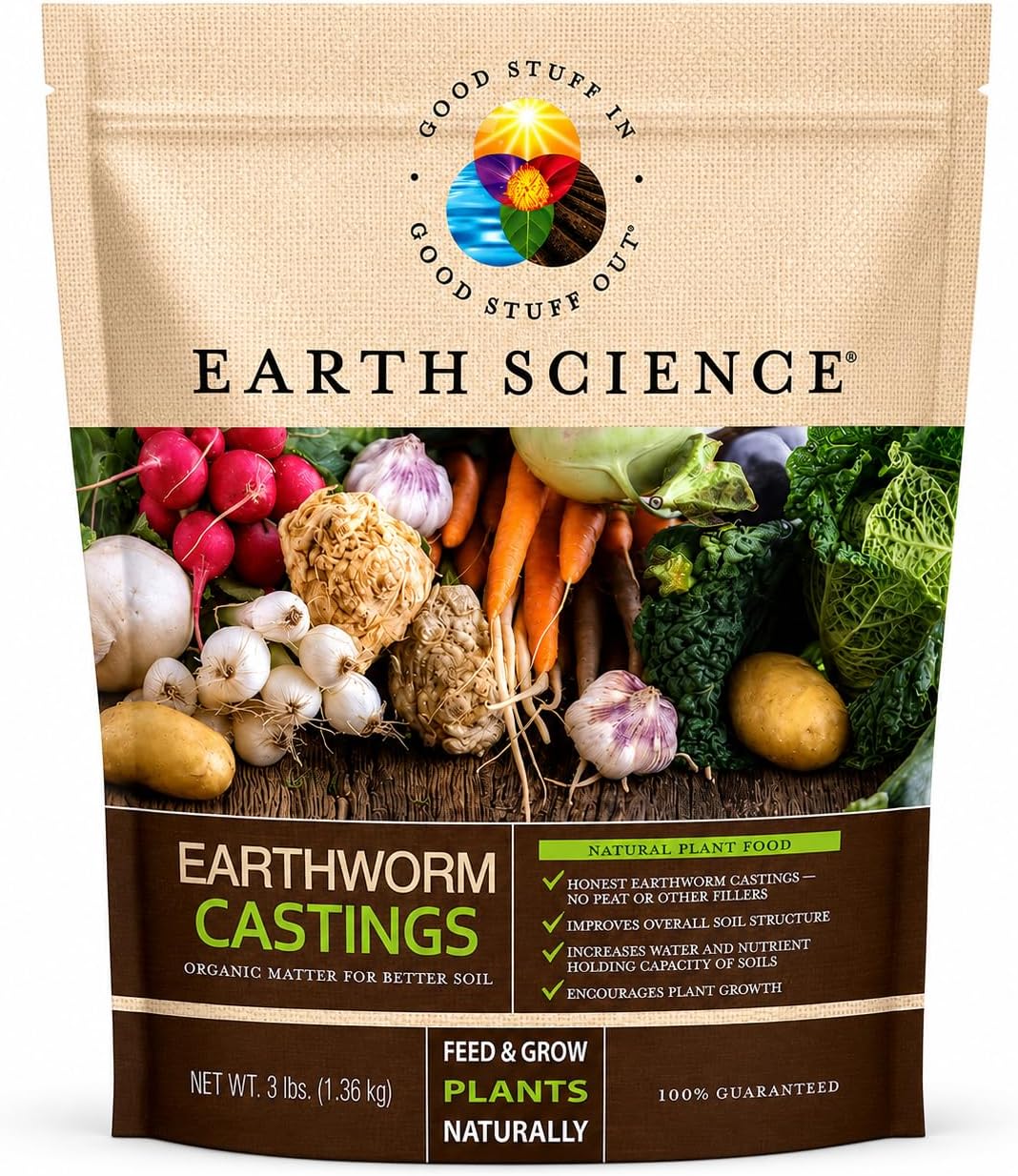
Earth Science Premium Earthworm Castings, 3 lb
| Item Form | Granules |
|---|---|
| Specific Uses For Product | Organic,Plant Food,Plant Growth |
| Coverage | Medium |
| Target Species | gardens, flower beds, fruits, trees, shrubs |
| Mixing Ratio | 1:4 |
Earth Science Premium Earthworm Castings are a pure vermicompost product intended to enrich garden and potting soils. Gardeners typically use it as a top dressing, mixed into potting mixes at about 1:4 castings to soil, or incorporated into garden beds at 1/4 to 1/2 inch and watered in; it can also be brewed as compost tea. The castings add organic matter that helps soil retain moisture, supports beneficial microbes, and can reduce compaction by improving aggregation. Practical benefits include a straightforward application for vegetables, flower beds, trees, and shrubs and the flexibility to use in pots, compost piles, or on lawns. The product is free of fillers and presented as a slow-release, natural fertilizer rather than a quick synthetic boost, so expect gradual improvements over weeks to months rather than immediate greening. Because this is a small, concentrated pouch, frequent reapplication during the growing season is recommended for larger beds or heavy-feeding crops.
Best for: Gardeners who prioritize dependable, natural soil improvement for organic vegetable beds and potted edibles and prefer steady, biology-driven results over quick chemical fixes.
Less Ideal for: Growers who need rapid, high-N fertilizer responses for a single fast-growing crop or who require large-volume amendments for extensive beds without frequent reapplication.
- 100% vermicompost with no peat or fillers
- Versatile uses: top dressing, potting mix amendment, compost tea, and compost layering
- Improves soil structure and water retention while feeding beneficial microbes
- Slow-acting nutrient release not suited for immediate greening or fast corrective feeding
Verdict: Use this pure earthworm castings product when you want a reliable, natural soil conditioner that builds long-term fertility for an organic vegetable garden.
Brut Organic Worm Castings, 5 lb

| Item Form | Granules |
|---|---|
| Specific Uses For Product | Gardening,Organic |
| Target Species | All plants |
| Mixing Ratio | 1:5 |
Brut Organic Worm Castings function as a concentrated, natural soil amendment you mix into potting mixes or top-dress garden beds and raised beds. Typical use is mixing at the recommended 1:5 ratio for new indoor plants, sprinkling a cup around established houseplants, or working into outdoor planting holes and beds according to the brand directions. The product is OMRI/CDFA listed and produced in controlled conditions, which supports consistent nutrient content and beneficial microbial life that help roots establish, improve soil structure, and increase moisture retention without burning plants. Practical benefits for raised garden beds include improved aeration, slow-release nutrients, and a boost in microbial activity that supports long-term fertility. Limitations are that it is not a complete NPK fertilizer for immediate heavy feeding needs and larger beds require significant quantities to hit the suggested per-square-foot rates, so frequent applications or bulk purchases may be needed for big projects.
Best for: Gardeners who prioritize dependable, organic soil improvement for raised beds and container gardens and prefer predictable, low-risk amendments that support long-term soil health.
Less Ideal for: Those needing immediate, high-NPK feeding for heavy-feeding crops or gardeners who want to amend very large beds without buying supplemental bulk material.
- Certified organic and produced indoors for consistent purity
- Rich in beneficial microbes that improve soil structure and plant vigor
- Easy-to-use granular form suitable for mixing or top-dressing
- Not a standalone high-NPK fertilizer for rapid nutrient correction
- Five-pound bag may be small for large raised beds and repeated seasonal use
Verdict: Use this OMRI/CDFA-listed worm castings product to reliably build long-term fertility and microbial health in raised beds and containers.
Wiggle Worm Pure Worm Castings Organic Fertilizer, 30 lb

| Item Form | Granules |
|---|---|
| Specific Uses For Product | Soil Conditioning |
| Application Method | Apply to soil |
| Unit Count | 480 Ounce |
Wiggle Worm Pure Worm Castings are a ready-to-use organic soil amendment made from concentrated earthworm castings. Gardeners typically mix a portion into potting mixes, top-dress established plants, work it into transplant holes, or brew it as a nutrient tea; the product page includes specific dosing for vegetables, containers, lawns, and roses. The castings are odorless, non-burning, and OMRI listed for organic use, so they supply water-soluble nutrients plus microbes that improve aeration, water retention, and root development without synthetic chemicals. Practical benefits include easy application, safe use on seedlings and mature plants, and versatility across raised beds, container gardens, and lawns. The main limitation is that this is a concentrated soil builder rather than an all-in-one fertilizer with NPK labels, so users seeking precise, fast-acting nutrient ratios may need to supplement for specific deficiencies; also a 30 lb bag is bulky to handle for small-space gardeners. For gardeners focused on long-term soil health and organic production, it functions as a low-risk, effective amendment.
Best for: Gardeners who prioritize building long-term soil health and want a safe, organic amendment for vegetables, ornamentals, and containers; buyers who value proven, low-risk inputs backed by strong user feedback.
Less Ideal for: Gardeners who need targeted, rapid nutrient correction based on precise NPK values or those who only want a lightweight product for very small balconies or indoor micro-gardens.
- OMRI listed organic and made from 100% worm castings
- Provides beneficial microbes that improve soil structure and water retention
- Odorless and non-burning so safe for seedlings and established plants
- Versatile dosing for containers, raised beds, lawns, and making worm casting tea
- No standard NPK nutrient label so not a precise standalone fertilizer for targeted feeding
- Large 30 lb bag can be heavy and awkward for gardeners with limited storage or mobility
Verdict: Choose this product when you want a proven, OMRI-listed worm casting that builds soil biology and improves plant health across beds and containers.
Choosing the Right Compost for Small Gardens: Key Factors to Consider
Nutrient Balance and Release Rate
Compost for small gardens should provide a usable mix of nitrogen, phosphorus, and potassium plus micronutrients without overwhelming young plants. A balanced nutrient profile reduces the need for frequent supplemental feeding in tight spaces where overapplication is easy.
Release rate matters because slow-release compost keeps containers and small beds fed over weeks, while fresher, less-mature material can temporarily tie up nitrogen as microbes continue breaking down carbon. For small gardens, choose compost that is mature enough to avoid major nutrient lockup but still active enough to support steady plant growth.
Texture and Moisture Management
Physical texture determines how compost behaves in raised beds and pots. Fine, crumbly compost mixes evenly into small volumes and improves water retention without creating dense, poorly drained pockets. Coarser, chunky material can create air pockets but may be harder to blend uniformly into small containers.
Moisture retention is crucial in small gardens because limited soil volume dries out quickly. Compost that holds moisture but still drains prevents both frequent watering and root rot. Consider how the compost will mix with your existing medium and how it alters watering frequency.
Bulk Density and Ease of Storage
Gardeners with limited outdoor space need composts that are easy to store and handle in small quantities. Low bulk density materials can be lightweight to move but take up more space; compressed or bagged options save footprint but may require airing before use.
Look for compost sold in smaller bags or that compresses well for long-term storage. Also consider whether you can store it under cover to keep it dry and free from pests, and whether the packaging allows you to remove only what you need without exposing the rest to the elements.
Maturity and Contamination Risk
Mature, stable compost is less likely to contain viable weed seeds, pathogens, or persistent contaminants such as plastics and treated wood residues. Immature compost or poorly processed feedstocks can introduce problems into small beds where there is little soil to buffer contaminants.
For small gardens, contamination has an outsized effect because there is less soil to dilute unwanted ingredients. Check for signs of proper processing such as a pleasant earthy smell, uniform dark color, and absence of recognizable food scraps or woody chunks when possible.
Suitability for Containers and Raised Beds
Compost that works well in open beds is not always ideal for containers. Container mixes need good drainage and a stable structure to prevent compaction. Compost designed or tested for container use often includes coarser components such as aged bark or perlite to maintain porosity.
In raised beds, compost can be mixed more liberally, but you still want a blend that supports root development without excessive settling. Consider how the product integrates with potting mix or existing bed soil and whether it will require additional amendments to support particular crops.
Source Transparency and Feedstock
Knowing what went into the compost helps you predict nutrient content and contamination risk. Composts made from yard trimmings, vegetable waste, and certified green waste are usually reliable for vegetable and flower beds. Manure-based or biosolid-amended composts can have higher nutrient levels but require careful use in small gardens to avoid salt buildup.
For small-space gardeners, prefer products that list feedstocks and processing methods. Transparency reduces surprises and helps you choose a compost that fits edible versus ornamental planting without introducing regulatory or safety concerns.
How to Use Compost in a Small Garden
Apply compost thoughtfully to avoid over-enrichment of limited soil. For raised beds, work a couple of inches of compost into the top 6 to 8 inches when preparing a new bed or refresh with a light topdress each season. In containers, blend compost with potting mix at low ratios, typically no more than 20 to 30 percent by volume, to maintain drainage and aeration.
Pay attention to watering after adding compost. Because compost changes moisture retention, you may need to adjust irrigation frequency. When mixing into small beds, distribute compost evenly to prevent nutrient hotspots that can stress plants.
- Topdress shallowly around established plants rather than piling it against stems.
- Mix compost into the root zone when transplanting rather than in small isolated pockets.
- Use a lightweight hand tool or small fork to integrate compost in tight spaces.
Storing and Handling Small Quantities
Store compost in sealed bags or covered bins to keep it dry and prevent pests. If you buy in bulk, transfer portions into smaller containers so you can access what you need without exposing the entire supply to weather.
When moving compost in small gardens, use wheeled bins, buckets, or a foldable tarp to make transport easier and keep pathways clean. Scoop only the amount you need to reduce compaction of the remaining pile.
- Label opened bags with the date and intended use.
- Keep compost off bare soil if it is wet to prevent nutrient runoff and pest attraction.
Adjusting Your Watering and Feeding Schedule
Adding compost alters both water holding and nutrient dynamics. Expect containers to retain more moisture, which can reduce watering frequency, while raised beds with mixed-in compost may require slightly more frequent irrigation early on as plant roots expand into the amended soil.
Because compost supplies a slow-release nutrient source, scale back concentrated liquid feeds initially. Monitor plant vigor and leaf color, and supplement with targeted fertilizers only if signs of deficiency appear.
- Check soil moisture by finger testing rather than on a fixed schedule.
- Reduce nitrogen-heavy fertilization immediately after incorporating large amounts of fresh compost.
Making Your Own Small-Batch Compost
If you want a steady supply without storage issues, small-batch home composting is a viable option. Use a compact tumbler, worm bin, or a covered backyard bin to process kitchen scraps and yard waste. Small-batch systems allow you to compost gradually so you have usable material without large piles.
Keep the carbon-to-nitrogen balance in mind by alternating kitchen greens with dry browns. For tight spaces, vermicomposting with worms produces rich, fine-textured castings that are especially useful for containers.
- Chop materials into small pieces to speed breakdown.
- Monitor moisture and aeration to avoid odors and slow decomposition.
Common Mistakes Small Gardeners Make With Compost
A frequent error is using too much compost in containers, which can cause poor drainage and nutrient imbalances. Another mistake is adding immature compost that continues decomposing in the soil, temporarily reducing nitrogen availability to plants.
Storing large exposed piles near small garden beds can attract pests and create hygiene issues. Finally, assuming all composts are interchangeable leads to uneven results; different feedstocks and processing methods change how compost behaves.
- Avoid adding thick layers against plant stems.
- Do not substitute heavy, manure-rich compost for lightweight blends in sensitive container-grown crops.
How We Chose the Best Compost for Small Gardens
We prioritized characteristics that matter in limited-space gardening where storage, ease of application, and predictable results are essential. Selection began with composts and mixes formulated or commonly used for small beds, containers, and raised planters. Key evaluation criteria were nutrient profile and maturity, physical texture and moisture retention, bulk density and ease of storage, and contamination risk including weed seeds or persistent materials. We also considered sourcing practicality such as availability in manageable package sizes or suitability for small-scale home composting. We excluded large-scale agricultural composts and products intended exclusively for landscape-level topdressing because their handling and application rates do not suit tight garden plots. We also left out untested or poorly documented blends lacking clear feedstock or maturity information. The final picks reflect materials that balance workable texture, reliable nutrient release, low contamination risk, and straightforward handling for gardeners with limited space and storage.
FAQ
How much compost should I add to a raised bed in a small garden?
A good rule is to work in about 1 to 2 inches of compost into the top 6 to 8 inches of soil when building or refreshing a raised bed. Lighter topdressings of about a half inch can be applied annually to maintain organic matter without disrupting existing plant roots.
Is bagged compost as good as home compost for containers?
Bagged compost can be excellent because it is often screened and mature, reducing contamination risk. Home compost can be superior in nutrient content if properly processed, but it requires careful curing and screening before use in containers to avoid pests and uneven texture.
Can I use compost every season in a small garden?
Yes, but adjust the amount. Light annual topdressings or modest incorporation each season maintain organic matter without overwhelming the soil. Excessive yearly additions can raise nutrient levels or alter soil structure in ways that harm some crops.
Will compost reduce how often I need to water containers?
Compost improves moisture retention, so containers amended with the right proportion often need less frequent watering. The effect depends on the compost's texture and the mix ratio; highly fine composts can retain more water than coarse blends.
How can I tell if compost is mature enough to use?
Mature compost is dark, crumbly, and has an earthy smell rather than a strong ammonia or rotten odor. It should not contain obvious food scraps or large woody pieces. If in doubt, let it cure longer or screen out large chunks before using in small gardens.
Final Verdict
For small gardens, prioritize composts that combine workable texture, stable nutrient release, and low contamination risk. Focus on products or home-processed batches that are mature, easy to store in small quantities, and suited to containers or shallow beds. Tradeoffs are inevitable: richer, manure-heavy composts offer nutrients but may require careful use in tight spaces, while finer, screened composts are easier to mix and store. Choose the option that matches how you garden, and adjust application rates so your small plots gain structure and fertility without drainage or salt issues.
