

Note: This article contains affiliate links. If you click on these links and make a purchase, I may earn a small commission at no extra cost to you. This helps support my research and content. Read my full affiliate disclosure here.
Picking the right compost for trees changes how water, air, and nutrients move through the root zone. Whether you are planting a sapling or giving an established specimen a seasonal boost, the right mix supports deeper roots, reduces transplant stress, and improves drought resilience. This guide looks at seven shortlisted composts chosen for tree planting and maintenance uses. We focus on the traits that affect tree performance in real landscapes: nutrient balance, particle size and texture, organic matter stability, and weed or contaminant control. Read on for practical notes on how each compost type behaves in the soil and which qualities matter most for your trees.
Top Picks at a Glance
| Best Overall The best all-around choice for most situations | Espoma Organic Land and Sea Gourmet Compost (1 cu ft) |  |
| Best Quality Built to a higher standard if you want something more solid | Blue Ribbon Organics OMRI Certified Organic Compost, 7.9 Gallon Bag |  |
| Best Value The sweet spot between price and what you get | Back to the Roots Organic All-Purpose Compost Mix, 25.7 qt |  |
| Best Budget The cheapest option that still gets the job done reliably | Gantessa Stone Premium Organic Screened Compost, 2 lb |  |
| Highest Rated A top-rated pick with lots of positive feedback | Wiggle Worm 100% Pure Worm Castings Organic Fertilizer, 30 lb |  |
| Most Popular A crowd favorite that many people choose with confidence | Brut Organic Worm Castings for Plants, 5 lb |  |
| Best Seller A high-volume bestseller chosen again and again | Garden Magic Michigan Peat Outdoor Compost & Manure Blend, 40 lb |  |
Espoma Organic Land and Sea Gourmet Compost (1 cu ft)

| Item Form | Granules |
|---|---|
| Specific Uses For Product | Soil Conditioning, Plant Growth, Seed Development, Root Development |
| Ingredients | Aged forest products, sphagnum peat moss, humus, limestone, lobster meal, crab meal |
| Unit Count | 1 Count |
Espoma Organic Land and Sea is a granular compost intended for use when planting or transplanting trees, shrubs, vegetables and flowers. It mixes into native soil or container media to add organic matter, nutrients and a proprietary myco-tone blend of endo and ecto mycorrhizae that can help root establishment. The formula lists aged forest products, peat moss, humus, limestone for pH adjustment and lobster and crab meal as natural nutrient sources, so it acts as both a soil conditioner and an organic nutrient boost. Typical use is to work it into planting holes, amend potting mixes for larger containers, or top-dress root zones before backfilling. Practical benefits include improved soil texture and biological activity without synthetic fertilizers, and straightforward application instructions for planting and transplanting. Limitations are that the product is a general-purpose compost rather than a tree-specific slow-release fertilizer, and its granular form and peat content mean it will not immediately supply high soluble nitrogen for rapid green-up.
Best for: Gardeners who want a dependable, organic soil amendment to improve planting sites and support root establishment for newly planted trees and shrubs.
Less Ideal for: Those seeking a specific slow-release, high-N fertilizer for rapid canopy growth or gardeners who prefer peat-free or sterile synthetic-free mixes.
- Contains lobster and crab meal for natural nutrient input
- Includes endo and ecto mycorrhizae to support root development
- Improves soil structure and organic matter when mixed into planting sites
- Suitable for both in-ground planting and large containers
- Not formulated as a concentrated, long-term tree fertilizer with guaranteed nutrient analysis
- Contains peat moss which may be a concern for gardeners avoiding peat
Verdict: A versatile organic compost that improves soil biology and root establishment, making it a solid choice for planting and transplanting trees.
Blue Ribbon Organics OMRI Certified Organic Compost, 7.9 Gallon Bag

| Included Components | Compost |
|---|---|
| Item Type Name | Organic Compost |
| Volume | 7.48 gallons |
| OMRI | Certified |
Blue Ribbon Organics OMRI Certified Compost is a finished, monitored compost designed to regenerate soil and support vigorous plant growth. Typically used as a soil amendment, topdressing, or mulch, the product is applied at a few inches when establishing beds or as a thinner topdressing for maintenance. Notable features include OMRI certification for organic use, testing for maturity and contaminants, and a nutrient profile that supplies nitrogen, phosphorus, potassium, calcium, and magnesium derived from recycled food and yard residuals. For tree care it improves aeration around roots, increases water holding capacity in the root zone, buffers pH, and adds organic matter that supports long-term soil biology. Practical benefits are easier planting and faster establishment of seedlings and young trees, better drought resilience for established trees, and a reduced need for synthetic fertilizers. Limitations are the bagged volume and variable moisture content, which means multiple bags or bulk delivery may be needed for large trees or multiple specimen plantings and weight can vary between shipments.
Best for: Gardeners focused on plant performance who want a certified, lab-tested compost to improve soil health around trees and accelerate establishment without synthetic inputs.
Less Ideal for: Buyers planning to amend many large trees or extensive landscapes who need bulk quantities or on-site delivery options.
- OMRI certified for organic production and safe around vegetables, flowers, trees, and shrubs
- Formulated from recycled food and yard residuals and tested for maturity and contaminants
- Improves soil aeration and water retention which helps tree root establishment and drought resilience
- Provides a broad nutrient mix including nitrogen, phosphorus, potassium, calcium, and magnesium
- Bag volume is small for larger trees so several bags or bulk compost are needed for big projects
- Moisture and therefore weight can vary between batches which affects handling and coverage estimates
Verdict: Choose this OMRI-certified compost when you want a tested, organic soil builder that reliably improves root-zone aeration and moisture retention for healthier trees.
Back to the Roots Organic All-Purpose Compost Mix, 25.7 qt

| Item Highlight | Organic compost soil amendment for raised beds, gardens and plants; peat-free blend with yucca and gypsum; 25.7 quart bag |
|---|---|
| Unit Count | 822.4 Ounce |
| Item Type Name | garden soil |
| Brand Name | Back to the Roots |
This Back to the Roots compost is a ready-to-use, peat-free soil amendment designed to boost productivity in raised beds, vegetable patches, and containers. It combines upcycled plant matter and wood fines with dolomitic limestone, gypsum, and yucca extract so the mix adjusts pH, improves water absorption, and helps retain moisture without becoming waterlogged. Typical use is top-dressing tree root zones in spring or mixing into planting holes or the top few inches of bed soil to enrich organic content and microbial activity. The product is convenient in prebagged form and avoids peat, which is appealing for sustainable gardeners. Limitations are that it is an all-purpose blend rather than a tree-specific compost, so heavy feeders or soil tests might still require targeted amendments, and a single 25.7 quart bag provides modest coverage around larger trees. For small fruit trees, saplings, and orchard beds it will add structure and nutrients; for mature large trees you will need significantly more volume or bulk amendments.
Best for: Gardeners who prioritize sustainable, ready-to-use soil amendments and want an easy organic boost for young trees, fruiting trees in beds, and mixed vegetable/tree plots.
Less Ideal for: Owners of large established shade or canopy trees who need bulk amounts or custom nutrient blends based on soil test results.
- 100% organic and peat-free base made from upcycled plant matter
- Includes dolomitic limestone and gypsum for pH adjustment and improved water absorption
- Yucca extract aids moisture control to reduce watering frequency
- Pre-mixed and ready to use for top-dressing, potting, or mixing into beds
- All-purpose formula not tailored specifically to tree care or heavy-feeding species
Verdict: A practical, peat-free organic compost mix that gives small trees and raised beds an immediate, sustainable nutrient and moisture-control boost.
Gantessa Stone Premium Organic Screened Compost, 2 lb

| Item Form | Solid |
|---|---|
| Application Method | Soil Amendment, Top Dressing, Compost Tea |
| Coverage | Medium |
| Target Species | flowers, vegetables, herbs, and more |
| Mixing Ratio | 1:2 |
This screened organic compost is a lightweight, ready-to-use soil amendment for improving structure and moisture retention around trees and other plantings. It is presented in a 32-ounce package and is described for use as a top dressing, soil amendment, or to make compost tea, with a recommended mixing ratio of 1:2. In practice the screened texture makes it easy to work into topsoil or mix into potting blends without large chunks, and its organic manure content can supply a modest boost of nitrogen, phosphorus and potassium plus beneficial microorganisms. For tree care you can apply it as a thin top dressing to the root zone or blend it into planting backfill for young trees to improve aeration and water holding. Limitations are the small unit size and variable nutrient strength typical of general composts, so larger trees or landscape beds will require multiple bags or a bulk product to cover adequately. The product is most useful for spot treatments, container trees, or supplementing existing mulch rather than large-scale soil renovation.
Best for: Gardeners caring for single trees, container trees, or small planting spots who want an affordable, ready-to-use organic compost to improve soil structure and moisture retention.
Less Ideal for: Property owners needing to amend large tree root zones or renovate extensive planting beds who should look for bulk compost or larger bags.
- Screened texture makes it easy to spread and mix into soil
- Suitable for multiple application methods: top dressing, soil amendment, or compost tea
- Helps improve soil structure and moisture retention for root zones
- Contains organic manure and microorganisms that support nutrient cycling
- Small 32-ounce unit is not practical for treating large trees or landscape areas
- Nutrient levels are not specified and can vary compared with formulated fertilizers
Verdict: A convenient small-bag organic compost that is ideal for spot-treating trees and container plantings to improve soil structure and moisture retention.
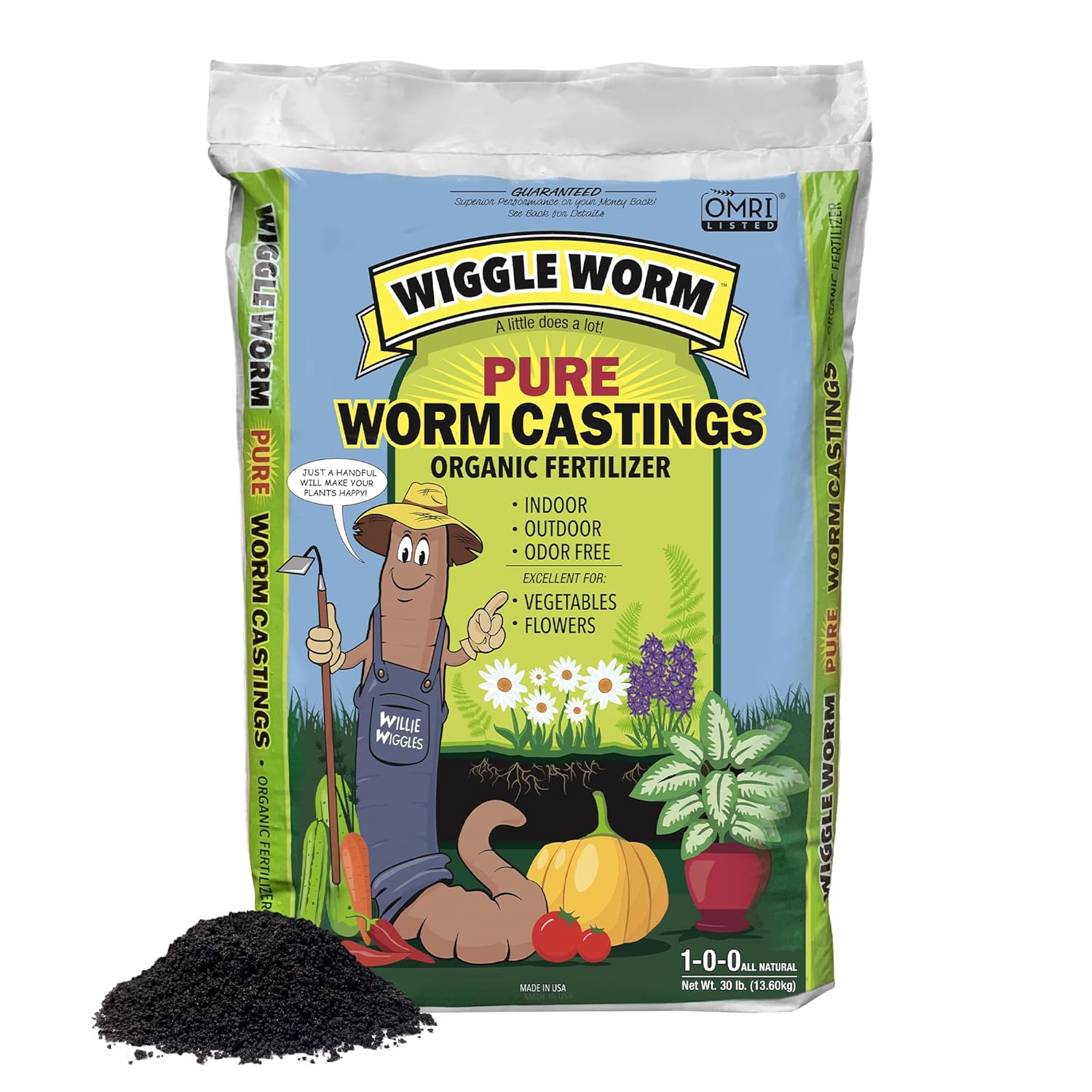
Wiggle Worm 100% Pure Worm Castings Organic Fertilizer, 30 lb
| Item Form | Granules |
|---|---|
| Specific Uses For Product | Soil Conditioning |
| Application Method | Apply to soil |
| Unit Count | 480 Ounce |
Wiggle Worm Pure Worm Castings is a straightforward, no-frills soil amendment made entirely from earthworm castings and intended to boost soil biology and nutrient availability around trees. Use it by working a modest amount into planting holes for new trees, top-dressing established root zones, or mixing into transplant backfill; the product sheet gives specific dosing for new and established plants and for lawns. Notable features are that it is 100% worm castings, OMRI listed for organic use, and described as odorless and non-burning so it can be applied directly around roots without scorching. Practically, it improves aeration, water retention, and microbial activity, which helps tree roots establish and access nutrients over weeks to months. The product is simple to use but is a single-ingredient amendment rather than a balanced NPK fertilizer, so for quick green-up or specific nutrient corrections you may still need supplemental fertilizer. Large bags are convenient for whole-yard or multiple-tree applications but will require dry storage to keep them usable season to season.
Best for: Buyers who prioritize dependable, organic soil-building products for long-term tree health and want a low-risk amendment they can apply directly to roots or planting holes.
Less Ideal for: Gardeners who need fast foliage response or precise nutrient ratios for heavy-feeding trees should consider a complementary balanced fertilizer.
- OMRI listed organic pure worm castings suitable for certified organic gardens
- Non-burning, plant-ready nutrient forms safe for use around roots
- Improves soil structure, water retention, and microbial activity for better root health
- Detailed usage guidance for planting holes, top-dressing, and making worm-casting tea
- Single-ingredient amendment so it does not replace balanced fertilizers for immediate high-nitrogen needs
- Requires dry storage to maintain product quality over time
Verdict: Choose Wiggle Worm Pure Worm Castings when you want a reliable, OMRI-listed organic soil builder that quietly improves root health and soil biology for trees.
Brut Organic Worm Castings for Plants, 5 lb

| Item Form | Granules |
|---|---|
| Specific Uses For Product | Gardening,Organic |
| Target Species | All plants |
| Mixing Ratio | 1:5 |
Brut Organic Worm Castings are a concentrated organic soil amendment made from earthworm castings intended to improve soil fertility, structure, and microbial life. Typically used as a soil amendment or top dressing, the product is mixed into potting medium at a 1:5 ratio for new indoor plants, sprinkled around established plants, or worked into garden soil and tree planting holes as directed. Notable features include a granular form that is easy to apply, certified organic ingredients, and a high microbial and nutrient density that supports root health and boosts plant vigor without burning. Practical benefits for trees include improved aeration, water retention, and steady nutrient release when incorporated into planting holes or spread around root zones. Limitations are that significant coverage recommendations (pounds per area) mean larger trees or established landscapes require multiple bags and repeated applications per year for visible effect, and users should follow safety advice like wearing gloves when handling. The product works best as a regular organic boost rather than a one-time fix for poor or compacted soils.
Best for: Gardeners who prioritize organic, microbe-rich soil amendments and want a reliable, low-risk product to supplement tree planting holes or to top-dress around established trees.
Less Ideal for: People needing an inexpensive bulk fertilizer for large acreage or those who require a fast-acting chemical fix for acute nutrient deficiencies should consider different options.
- Certified organic and OMRI/CDFA listed for use in organic gardens
- High microbial content and nutrient density that improve soil biology
- Granular form is easy to mix into soil or use as a top dressing
- Clear usage guidance for indoor plants, garden beds, lawns, and tree planting
- Coverage recommendations mean you may need many bags to treat large trees or landscape areas
- Not a quick corrective for severely compacted or nutrient-depleted soils without additional amendments or cultivation
Verdict: Choose these worm castings if you want a certified organic, microbe-rich soil amendment to steadily improve tree root health and long-term soil fertility.
Garden Magic Michigan Peat Outdoor Compost & Manure Blend, 40 lb

| Unit Count | 640 Ounce |
|---|---|
| Number of Packs | 1 |
| Item Type Name | Manure |
| Manufacturer | Michigan Peat |
This 40 lb Garden Magic Michigan Peat blend is a pre-mixed compost and manure product intended to enrich garden soil quickly without on-site mixing. It combines odor-free reed sedge peat with composted animal manure to add organic matter and nutrients; gardeners typically work it into planting holes, mix it with existing topsoil, or top-dress around trees and shrubs. The product is convenient for small jobs because it comes ready to use and each bag covers about 0.75 cubic feet, so you can precisely apply a measured amount around individual trees. Notable features are the odor-controlled formula and the focus on balanced nutrient content rather than raw manure, which reduces immediate smell and handling concerns. Limitations are the bag size and coverage for larger trees or landscape-scale projects and the lack of detailed nutrient analysis on the label, so heavy feeders or large-root zones may require multiple bags or supplemental fertilizer. For cautious gardeners who want a straightforward organic soil amendment, this provides an easy, low-hassle option.
Best for: Home gardeners who prefer a low-risk, ready-made organic soil amendment for improving soil structure and feeding young to medium-sized trees and surrounding beds.
Less Ideal for: Large properties, mass tree plantings, or professional landscapers who need detailed nutrient analysis and higher-volume supply for big root zones.
- Ready-to-use mixture that requires no on-site composting or blending
- Odor-reduced reed sedge peat and composted manure make handling more pleasant
- Suitable for top-dressing, planting holes, and container mixes
- 40 lb bag provides a manageable quantity for small-tree or yard projects
- Limited coverage per bag for larger trees or multiple plantings
- No detailed N-P-K or nutrient breakdown provided on product details
Verdict: A convenient, odor-reduced organic compost and manure blend that lets cautious gardeners quickly improve soil around trees without mixing or handling raw materials.
Choosing the Right Compost for Trees: Key Factors to Consider
Nutrient Balance and Release Pattern
Trees need a balanced supply of macro- and micronutrients without large spikes of available nitrogen that drive foliage at the cost of root development. Compost for trees should supply modest available nitrogen with a higher proportion of slow-release organic nitrogen and a steady reserve of phosphorus and potassium. Overly rich, fresh compost can cause excessive top growth and increase pest or disease susceptibility, while too-weak compost delivers little benefit. Consider how the compost will interact with your soil test results and whether supplemental granular fertilizer is still needed for specific deficiencies.
Particle Size, Texture, and Drainage
The physical structure of compost affects aeration, water movement, and root penetration. Coarser, flakier compost improves porosity in heavy clay soils and prevents compaction in container mixes. Finer, humified compost works well as a surface mulch or for amending sandy soils where water retention is desirable. For tree root zones, a balance is ideal: enough coarse material to allow air exchange plus fine humus to retain moisture and nutrients. Texture also influences how compost mixes with existing soil when backfilling a planting hole or topdressing around an established trunk.
Maturity, Stability, and Curing
Fully cured compost is biologically stable and safe to apply near roots. Immature or 'hot' compost can deplete oxygen, generate heat, and release ammonia or organic acids that damage young roots. Stable compost shows an earthy smell, a crumbly texture, and no visible steam or active heating. Using immature material risks transplant failure and poor root development. Always check for signs of maturity and, when in doubt, let the compost age or incorporate it into the soil at lower rates rather than placing fresh compost directly against roots.
Salt Content and Contaminant Risk
Excess salts and physical contaminants harm tree roots, especially in containers or newly planted saplings. Compost sourced from municipal biosolids, certain food wastes, or construction scraps can have higher salt levels or unwanted debris. Elevated soluble salts reduce water uptake and can cause leaf scorch or slowed growth. Contaminants such as plastic, glass, or persistent herbicide residues also create long-term issues. Look for composts with low electrical conductivity readings where provided and clear feedstock labeling to minimize these risks.
Support for Soil Biology and Mycorrhizae
Active soil biology enhances nutrient cycling and root health for trees. Compost that contains a diversity of organic materials and has undergone aerobic decomposition supports beneficial microbes and fungal partners. Mycorrhizal fungi improve root access to water and immobile nutrients, and compost can create a hospitable environment for these organisms. However, excessively hot or chemically sterilized compost may suppress biological activity. Choose compost that encourages microbial life rather than eliminating it, and combine it with practices that protect mycorrhizae, such as minimal soil disturbance and avoiding high-phosphate fertilizers.
Feedstock Transparency and Local Suitability
Knowing what went into a compost helps you anticipate its behavior in your landscape. Leaf-rich or wood-based composts tend to be slower to release nutrients but build structure, while food-waste composts often provide quicker mineralization. Local feedstocks also mean lower transport impacts and better suitability to regional soil types. Transparent labeling reduces the chance of surprises like persistent weed seeds or prohibited materials. When choosing compost for trees, prefer sources that list primary inputs and provide basic testing information such as pH and salt levels.
How to Use Compost When Planting New Trees
When planting, avoid replacing all the native soil with compost. Mix a moderate proportion of compost into backfill to improve structure and nutrient content while keeping enough original soil so roots encounter familiar conditions. A common approach is blending one part compost with two to three parts native soil for the planting backfill, which enhances rooting without creating a dense compost pocket that can inhibit root breakout.
Loosely backfill and firm lightly to remove large air pockets, then water thoroughly to settle the soil. For the first year, apply a thin layer of compost as a topdressing rather than piling it against the trunk. This encourages roots to explore outward and reduces the risk of collar rot or rodent damage.
- Mix compost with native soil rather than replacing it entirely
- Keep compost away from direct trunk contact
- Water well after planting to settle mix and remove air gaps
Topdressing Established Trees
For established trees, topdressing with compost refreshes surface organic matter, improves soil structure, and feeds roots in the upper soil layer where most fine roots live. Spread a 1 to 3 inch layer of finished compost over the root zone, extending to or beyond the drip line, and avoid piling the material against the trunk flare.
Topdressing is a low-disturbance way to increase biological activity and slowly release nutrients through wetting and microbial action during the growing season.
- Apply compost in a donut shape out to the drip line
- Keep layer thin to prevent oxygen depletion
- Reapply annually or every few years depending on soil tests
Compost for Container-Grown Trees
Container trees need mixes that balance moisture retention and drainage. Use compost as a component rather than the majority of potting mix to prevent waterlogging. Coarser compost or a compost-amended bark blend helps maintain aeration while supplying nutrients.
Watch for soluble salts and choose well-cured composts for containers, since roots in pots are more sensitive to salt buildup and fluctuating moisture. Regular flushing and re-potting schedules also help avoid salt accumulation.
- Limit compost to part of the potting mix
- Prefer coarser, well-cured compost for containers
- Monitor for salt buildup with occasional leaching
Signs a Compost Is Not Suitable for Trees
Watch for strong ammonia or sour smells, excessive heating, visible contaminants, or a slimy texture. These are indicators of immature or contaminated material that can harm roots. Also be cautious with composts that list unknown or mixed industrial feedstocks.
If a compost causes leaf browning, stunted growth, or poor water uptake after application, stop using it and test the soil for salts, pH shifts, or nutrient imbalances. Return to stable, well-documented compost sources if problems persist.
- Ammonia or sour odor means immaturity
- Visible debris suggests poor processing or contamination
- Poor plant response warrants soil testing for salts and pH
Adjusting Compost Use by Soil Type
In heavy clay soils, use coarser compost to improve drainage and porosity without increasing water retention to the point of suffocating roots. For sandy soils, prioritize composts with higher fine humus content to boost water and nutrient retention. Neutral or near-neutral pH composts work broadly, but if you have an acidic or alkaline soil issue, choose compost that helps move pH toward the desired range based on testing.
Tailoring the compost texture and application rate to your soil type ensures the amendment complements, rather than conflicts with, existing conditions.
- Coarser composts benefit clay soils
- Finer humus-rich composts improve sandy soils
- Match compost pH tendencies to soil test results
How We Chose the Best Compost for Trees
We selected composts that suit tree planting and long-term tree care by applying garden-focused filters and measurable criteria. First, we prioritized nutrient balance relevant to woody plants, looking for moderate available nitrogen combined with steady-release phosphorus and potassium to avoid excessive shoot flush at the expense of roots. Second, texture and particle size were assessed because coarse, well-structured compost improves aeration around roots while very fine, compacted compost can impede drainage. Third, stability and maturity mattered: we excluded poorly cured or hot composts that can burn roots, favoring stable, biologically active material that continues to feed soil life without high ammonia or heat. Fourth, contaminant screening removed sources with persistent weed seeds, excessive salts, or visible plastic and construction debris. Finally, we considered sourcing and feedstock transparency so gardeners can understand what is actually in the bag. Excluded items include raw manures, uncomposed yard debris, and ambiguous blends with unknown origins. These filters map directly to the scoring criteria used to evaluate each compost option.
FAQ
Can I use compost directly in the planting hole for a tree?
You can incorporate compost into planting backfill, but avoid replacing all native soil with pure compost. Mix compost with native soil at a conservative ratio to preserve proper texture and encourage roots to establish in surrounding soil.
How much compost should I apply around an established tree?
A light topdressing of 1 to 3 inches over the root zone is usually effective. Thicker layers can reduce oxygen flow and create anaerobic conditions, so keep applications moderate and spread compost out toward the drip line.
When is compost unsafe for tree use?
Compost that smells strongly of ammonia, is still hot, contains visible contaminants, or comes from unclear feedstocks should be avoided. Immature or contaminated compost can damage roots and introduce salts or persistent residues.
Will compost replace the need for fertilizer on trees?
Compost contributes nutrients and supports soil biology, but it may not supply all nutrients in the amounts or ratios a specific tree needs. Use soil tests to determine if targeted fertilizer is necessary in addition to regular compost applications.
How often should I reapply compost to mature trees?
Reapplication every one to three years is common, depending on soil condition and tree vigor. Check soil organic matter, nutrient levels, and root health to decide timing rather than following a fixed calendar.
Final Verdict
Choose compost for trees by prioritizing maturity, appropriate texture, and transparent feedstock information. Match particle size to your soil type and aim for steady-release nutrients that support root growth over rapid top growth. Limit direct placement of fresh compost against trunks and favor light, regular topdressings or blended backfill at planting. Focusing on these tradeoffs will help you pick a compost that improves soil structure, supports biological activity, and reduces the risk of stress to your trees.
