

Note: This article contains affiliate links. If you click on these links and make a purchase, I may earn a small commission at no extra cost to you. This helps support my research and content. Read my full affiliate disclosure here.
Tomato plants are highly productive but vulnerable to blights, bacterial spots, and leaf diseases that can quickly reduce yield. Choosing the right copper fungicide for tomatoes matters because application timing, coverage, and resistance management determine whether sprays preserve healthy foliage and fruit. This guide shortlists seven well-suited copper fungicides for tomatoes across backyard, container, and greenhouse situations. We evaluate ease of use, disease control coverage, and the risk of leaf burn so you can pick a formula and schedule that matches your growing conditions. Read on for practical notes on when and how to apply and what tradeoffs to expect.
Top Picks at a Glance
| Best Overall The best all-around choice for most situations | Bonide Captain Jack's Liquid Copper Fungicide Ready-to-Use, 32 oz |  |
| Best Quality Built to a higher standard if you want something more solid | Monterey Liqui-Cop Copper Fungicide Concentrate, 1 Gallon |  |
| Best Value The sweet spot between price and what you get | Neudorff Copper Fungicide Ready-to-Use Spray, 16 fl oz |  |
| Best Budget The cheapest option that still gets the job done reliably | Bonide Copper Fungicide Ready-to-Use Spray or Dust, 16 oz |  |
| Highest Rated A top-rated pick with lots of positive feedback | Monterey Copper Fungicide Garden Spray, 16 oz |  |
| Most Popular A crowd favorite that many people choose with confidence | Bonide Captain Jack Copper Fungicide 16 oz Concentrate |  |
| Best Seller A high-volume bestseller chosen again and again | Southern Ag Liquid Copper Fungicide, 32 oz |  |
Bonide Captain Jack's Liquid Copper Fungicide Ready-to-Use, 32 oz

| Item Form | Spray |
|---|---|
| Unit Count | 32 Ounce |
| Active Ingredients | copper |
Bonide Captain Jack’s Liquid Copper Fungicide is a trigger-spray, ready-to-use copper treatment designed to control common fungal diseases such as black spot, powdery mildew, blight and peach leaf curl. It is applied by shaking and thoroughly spraying tops and undersides of leaves every 7 to 10 days or as needed, and the label allows application up to the day of harvest on listed edible plants. The product’s copper active ingredient makes it broadly effective against many foliar diseases and the convenient spray bottle removes the need to mix concentrates. Practical benefits include organic approval for many uses and clear directions for repeat treatments, which helps with consistent disease management. Important limitations are that it is a contact-style copper spray rather than a systemic cure, so thorough coverage and repeated applications are required for control, and care must be taken to follow label directions to avoid phytotoxicity on sensitive varieties.
Best for: Gardeners who prioritize established, proven solutions and want an organic-approved spray that controls common foliar diseases on roses and other plants with minimal setup.
Less Ideal for: Growers looking for a systemic fungicide or a single-application cure for long-term prevention should consider alternatives with systemic activity.
- Ready-to-use trigger spray for easy application without measuring or mixing
- Approved for organic gardening and label allows use up to day of harvest on listed edibles
- Effective copper active ingredient against a wide range of foliar fungal diseases including black spot
- Clear instructions for treatment interval make follow-up applications straightforward
- Contact-action copper requires thorough coverage and repeat sprays rather than a one-time systemic fix
- Potential for phytotoxicity on some sensitive plants if label directions are not followed
Verdict: A ready-to-use, organic-approved copper spray that provides reliable contact control of black spot and other foliar diseases when applied thoroughly and on schedule.
Monterey Liqui-Cop Copper Fungicide Concentrate, 1 Gallon

| Item Form | Liquid |
|---|---|
| Target Species | Fungus |
Monterey Liqui-Cop is a concentrated liquid copper fungicide designed primarily as a preventative spray for common fungal problems such as leaf spot, blight, anthracnose and botrytis. You mix the concentrate with water and apply it with a pump or backpack sprayer to thoroughly coat foliage and fruit; the gel-like formulation dries to a rain-fast film so treatments stay on after light rain. It is suitable across fruit trees, nut crops, vegetables and ornamentals, making it a practical choice for gardeners who want one product for whole-garden disease protection. Notable features include broad-spectrum fungus targeting and instructions aimed at home use. Important limitations are that copper products prevent infection rather than cure existing systemic disease and require full coverage to be effective, and users must follow safety precautions such as wearing gloves and eye protection when mixing and applying. For tomato growers focused on reliable preventive disease control, Liqui-Cop provides durable coverage but should be used as part of an integrated program rather than a standalone cure.
Best for: Gardeners who prioritize reliable, preventative disease protection for tomato beds and want a single, durable copper treatment they can apply across multiple crops.
Less Ideal for: People looking for a curative product for active systemic infections or those unwilling to follow safety and mixing instructions should consider other options.
- Broad-spectrum copper formula that targets common fungal pathogens affecting tomatoes and other plants
- Gel-like formulation dries rain-fast for longer residual protection after application
- Concentrate form lets you mix larger volumes for treating whole-garden plantings
- Suitable for use on vegetables, fruit trees and ornamentals for flexible garden-wide control
- Preventative only and will not cure established systemic infections
- Requires thorough coverage and correct mixing rates for effectiveness
- Safety precautions needed when handling concentrate, including protective clothing
Verdict: Choose Liqui-Cop when you need a rain-fast, broad-spectrum copper fungicide to prevent fungal disease across tomato plants and the rest of your garden.
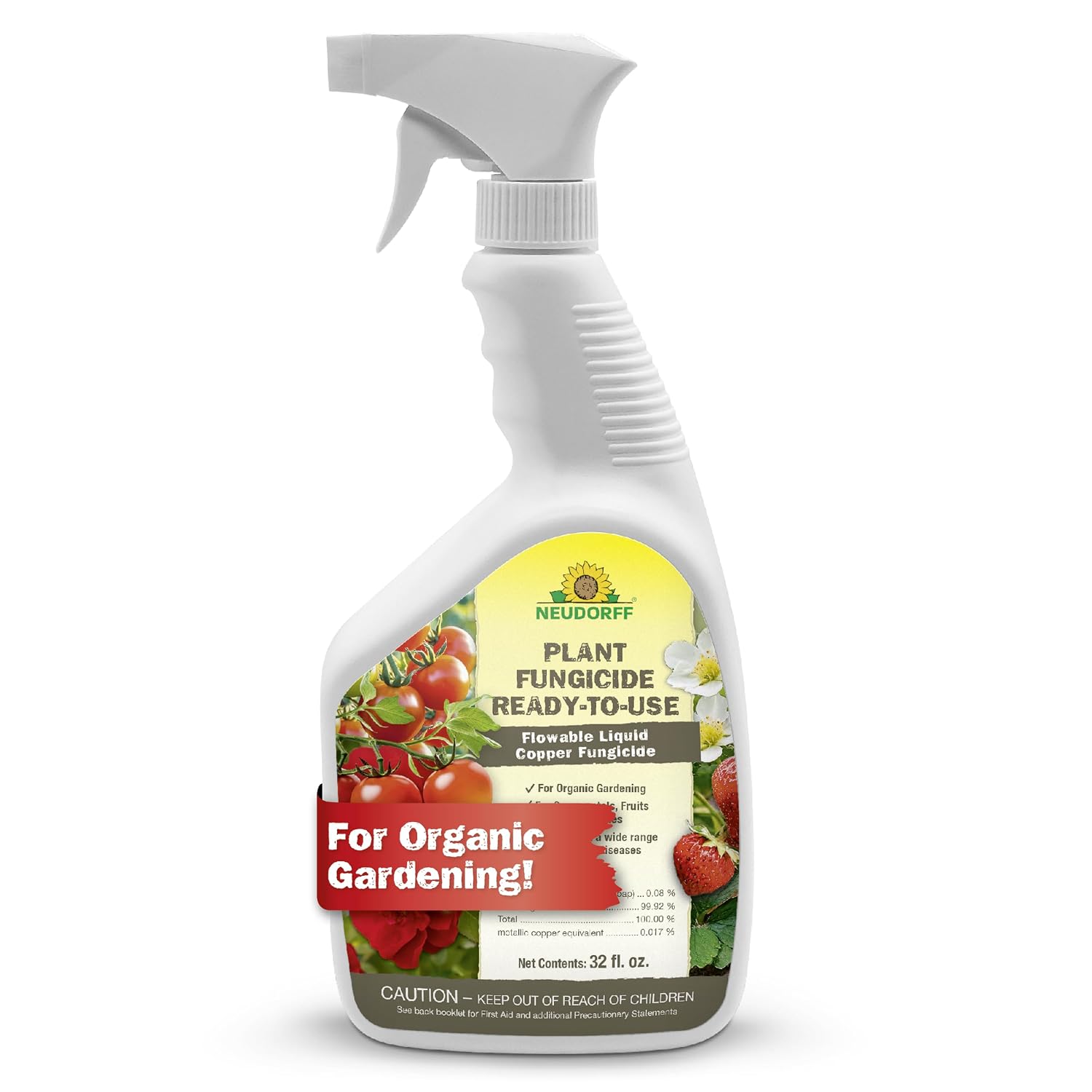
Neudorff Copper Fungicide Ready-to-Use Spray, 16 fl oz
| Item Form | Spray |
|---|---|
| Target Species | Insects, Mites, Gnats |
| Liquid Volume | 16 fluid ounces |
This Neudorff copper fungicide is a ready-to-use spray designed to protect tomatoes and other edibles from fungal diseases such as early and late blight, powdery mildew, rusts, and leaf and fruit spots. You spray foliage and fruit starting before disease appears or at first signs, and reapply every 7 to 10 days or after heavy rain. The product uses a low-concentration copper formulation that decomposes to soluble copper and fatty acids, which the brand says are compatible with organic gardening and safe to use up to the day of harvest. Practical benefits include simple application with no mixing, suitability for use on a wide range of plants including tomatoes, roses and houseplants, and clear reapplication guidance. Important limitations are the need for repeat applications during wet weather and the usual constraints of copper products, which can build up in soil with long-term heavy use and may require careful timing to avoid phytotoxicity on sensitive varieties. The spray format is convenient for small plots but may be slower to cover larger beds compared with pump sprayers or concentrate formulations.
Best for: Tomato growers who want a simple, organic-compatible spray they can apply quickly by hand and who prioritize ease of use and reliable control during a rainy season.
Less Ideal for: Large-scale growers or those who need to treat many plants quickly should consider concentrate or mechanized sprayer options instead.
- Ready-to-use spray requires no measuring or mixing
- Specifically labeled for common tomato diseases including early and late blight
- Suitable for use up to day of harvest, making it practical for edible crops
- Works on a wide range of plants including vegetables, fruit trees, ornamentals and houseplants
- Requires regular reapplication every 7 to 10 days and after rain for continued protection
- Copper-based products can accumulate in soil with frequent long-term use
Verdict: A user-friendly ready-to-use copper spray that makes protecting tomatoes from common blights easy for small-scale and home gardeners.
Bonide Copper Fungicide Ready-to-Use Spray or Dust, 16 oz

| Item Form | Spray |
|---|---|
| Target Species | Plants |
| Special Features | organic |
| Unit Count | 16 Ounce |
Bonide Copper Fungicide is a ready-to-use copper spray or dust formulated to prevent and control common fungal diseases such as powdery mildew, early blight, black spot, rust, and peach leaf curl on tomatoes and other garden plants. It can be applied directly as a dust or mixed with water for use in a hose-end or tank sprayer, which makes it convenient whether you need spot treatments or broader coverage. The active copper ingredient is a traditional, broadly effective option approved for organic gardening and can be applied up to the day of harvest on listed crops. Practical benefits include ease of use, versatility across many plant types, and suitability for organic production. Limitations are typical for copper products: it provides preventive and early-treatment control rather than curing advanced infections, and repeated use can lead to copper buildup in soil if not managed. Users should follow label rates and safety guidance to avoid phytotoxicity on sensitive plants.
Best for: Home gardeners growing tomatoes who want a straightforward, organic-approved fungicide that is easy to apply for regular preventive care and early disease control.
Less Ideal for: Gardeners needing an immediate curative treatment for advanced fungal outbreaks or those managing large-acreage commercial operations should consider stronger professional formulations or integrated programs.
- Ready-to-use formula that can be applied as a dust or mixed into a spray for flexible application
- Active copper ingredient accepted for organic gardening and usable up to day of harvest on listed crops
- Controls a broad range of common fungal diseases affecting tomatoes and other vegetables
- Works with common sprayers and hose-end applicators for easy backyard use
- Not a corrective cure for severe, established infections and works best as prevention or early treatment
- Repeated long-term use can contribute to copper accumulation in soil if not rotated with other controls
Verdict: A convenient, organic-approved copper option for tomato growers who need an easy preventive and early-treatment fungicide for home gardens.
Monterey Copper Fungicide Garden Spray, 16 oz

| Item Form | Liquid |
|---|---|
| Target Species | Fungus |
| Unit Count | 16 Fluid Ounces |
Monterey Copper Fungicide is a liquid concentrate designed for preventative control of common fungal diseases on fruits, vegetables, citrus, nuts, and ornamentals. Gardeners mix it with water and apply as a foliar spray or soil drench to protect foliage and fruit surfaces before infections take hold. The product emphasizes ease of use for home gardeners with clear directions and safety guidance and can be applied with a pump sprayer. Because it is a preventative copper formulation, it helps reduce incidence of leaf spots, blights, and other fungal issues on susceptible crops such as tomatoes, but it will not cure active systemic infections. Users should follow protective clothing and mixing instructions and avoid overapplication to limit phytotoxicity on sensitive varieties. The 16-ounce concentrate is convenient for treating multiple plants across a small to medium vegetable patch, and Monterey’s instructions make it straightforward for reliable season-long preventative care when used on the tomato plants most vulnerable to early blight and septoria leaf spot.
Best for: Home gardeners seeking a dependable preventative fungicide to protect tomato plants and other garden edibles throughout the season, and who prioritize consistent disease prevention over quick cures.
Less Ideal for: Growers who need a curative solution for active systemic infections or those unwilling to follow safety and mixing instructions should consider other options.
- Prevents a broad range of fungal diseases on edible and ornamental plants
- Versatile application as foliar spray or soil drench
- Concentrated 16 fl oz formula treats multiple plants
- Designed with clear instructions for home gardener use
- Formulation is preventative only and will not cure established systemic infections
- Requires careful handling and protective clothing to avoid skin or eye exposure
Verdict: A reliable preventative copper fungicide for tomato growers who want straightforward, season-long disease protection for their vegetable beds.
Bonide Captain Jack Copper Fungicide 16 oz Concentrate

| Unit Count | 16 Ounce |
|---|---|
| Item Form | Liquid |
| Target Species | Fungus |
| Active Ingredients | Copper Octanoate (Copper Soap) |
Bonide Captain Jack Copper Fungicide is a liquid concentrate designed to prevent and treat a broad range of fungal diseases on vegetables, fruits, ornamentals, and turf. Mixed with water per label directions, it is sprayed onto plant surfaces, including tops and undersides of leaves, and can be applied up to the day of harvest, which makes it practical for food crops like tomatoes. The active ingredient copper octanoate provides contact protection against powdery mildew, blight, black spot, rust, peach leaf curl and similar diseases. Application is straightforward and repeatable every 7 to 10 days as needed, and the product is cleared for use in organic gardening. Limitations to consider are that copper is a contact fungicide so it does not systemically move through the plant and works best as a preventative or early-treatment tool rather than curing severe systemic infections. Users should follow safety directions and avoid overuse to reduce copper buildup in soil.
Best for: Gardeners looking for a performance-focused, organic-approved fungicide to include in a preventative disease program for tomatoes and other edibles.
Less Ideal for: Growers seeking a systemic treatment for already advanced internal infections or those who prefer non-copper chemistries to avoid soil accumulation.
- Approved for organic gardening and can be used up to the day of harvest
- Controls a wide range of common diseases affecting tomatoes such as blight and powdery mildew
- Concentrated liquid formula mixes with water for spray application
- Repeatable 7–10 day application schedule makes preventative programs easy to maintain
- Acts as a contact fungicide and does not move systemically within the plant
- Repeated use can contribute to copper accumulation in soil if not managed
Verdict: Use this organic-approved copper concentrate when you want an effective, easy-to-apply preventative spray to protect tomatoes from common fungal diseases.
Southern Ag Liquid Copper Fungicide, 32 oz

| Item Form | Liquid |
|---|---|
| Target Species | Fungus |
| Special Features | organic |
| Liquid Volume | 32 fluid ounces |
Southern Ag Liquid Copper Fungicide is a ready-to-mix copper fungicide sold in a 32 ounce bottle for treating fungal and some bacterial diseases on ornamentals and fruit trees. It is applied as a foliar spray, typically diluted according to label directions and used with a pump or hose-end sprayer to cover trunks and foliage for preventative and curative treatments. The formulation is labeled organic and noted to control common problems like leaf spots, blights and moss or algae on surfaces. Practical benefits include broad-spectrum disease control and a liquid form that meters easily into sprayers for larger trees. Limitations are that copper products can build up in soil with frequent use and must be applied carefully to avoid phytotoxicity on sensitive varieties; always follow timing and dilution instructions. The bottle size suits homeowners and small orchards who need multiple applications without frequent reordering.
Best for: Home orchardists and gardeners looking for a straightforward, organic-acceptable fungicide to protect fruit trees with scheduled foliar sprays who prioritize reliable disease control and ease of application.
Less Ideal for: Growers who need a systemic product for internal disease control or those managing very large commercial orchards that require bulk industrial formulations and tailored application programs.
- Broad-spectrum activity against fungal and some bacterial diseases common on fruit trees
- Liquid concentrate mixes for use with pump or hose-end sprayers for easier coverage
- Labeled as organic, which fits organic or low-chemical treatment plans
- 32 ounce bottle provides multiple applications for backyard orchards
- Repeated applications can lead to copper accumulation in soil if not managed
- Risk of leaf burn on sensitive plants if applied at improper dilution or in hot conditions
Verdict: A practical, organic-acceptable copper concentrate that makes preventive and curative foliar treatments for backyard fruit trees simple and effective.
Choosing the Right Copper Fungicide for Tomatoes: Key Factors to Consider
Disease Spectrum and Label Claims
Different copper formulations vary in which pathogens they suppress. For tomatoes you want explicit label claims against common problems such as early blight, late blight, bacterial spot, and septoria leaf spot. A product with a broader spectrum reduces the need to alternate chemistries as often and simplifies scheduling during high-pressure seasons. Read the label to confirm listed diseases rather than assuming general garden use covers tomatoes.
Labels also spell out whether the product is intended for foliar spray, seed or soil treatment, or post-harvest use. For in-season foliar protection, confirm the label includes directions for tomatoes and appropriate application intervals.
Phytotoxicity and Temperature Sensitivity
Copper can burn tender tomato foliage if applied at high rates, under high temperatures, or when plants are under stress. Pay attention to recommended concentrations and avoid spraying in hot, sunny midafternoons. Many labels advise not to apply when temperatures exceed a threshold or when plants are water stressed to reduce leaf scorch.
Some formulations are engineered to lower burn risk through finer particle size or stabilizers, but no product is completely risk-free. Start with lower label rates on young plants and test-spray a small area when trying a new formulation.
Formulation Type and Mixing Practicalities
Copper fungicides come as wettable powders, liquid concentrates, flowables, or micronized formulations. Each handles differently in the sprayer: powders can clog screens, concentrates often mix cleanly, and micronized products can provide better coverage but may require agitation. Consider how easy a product is to measure, dissolve, and maintain in suspension during the job.
If you use a backpack or hand-pump sprayer, a product that requires minimal pre-mixing and leaves less residue in the tank reduces cleanup time. Check label instructions for recommended nozzle types and tank-mix partners to avoid separation or settling during application.
Rainfastness and Residual Protection
Copper deposits work primarily as a protective barrier on leaf surfaces, so how long they stay effective after rain is important. Labels include guidance on reapplication intervals following rain and on how soon after an application the spray will be rainfast. Longer residual protection reduces spray frequency during wet periods, but frequency also depends on disease pressure and tomato growth stage.
Consider local weather patterns. In climates with frequent rain, plan for shorter reapplication intervals and prefer formulations with good adhesion and documented rain tolerance.
Integrated Pest Management Compatibility
Copper fungicides are often used within an integrated pest management program that includes cultural controls, resistant varieties, and proper sanitation. Think about how a fungicide fits into that plan. Some copper products are permitted in organic systems while others are not, and tank-mix compatibility with biologicals or selective fungicides matters if you alternate modes of action to delay resistance.
Read labels for preharvest intervals and minimum days to harvest, and confirm whether tank mixes are allowed with biological disease suppressants you may already use.
Application Frequency and Harvest Intervals
Tomato growers must balance disease control with harvest timing. Labels specify maximum number of applications per season and required days between the last spray and harvest. These restrictions influence how you schedule sprays during fruit set and ripening.
If you grow many successive plantings, cumulative seasonal limits matter. Choose a product whose application window and harvest interval match your production rhythm so you can protect fruit without risking residues at picking.
When to Start Copper Sprays
Begin treatments at first signs of disease or when weather conditions favor infection. For early blight and bacterial spots, initiating protective sprays at the onset of frequent warm, wet weather gives the best chance to limit outbreaks before they spread.
During periods of persistent leaf wetness, shorten intervals between sprays according to label guidance. For established infections, use copper as part of a rotation with other compatible materials rather than as the only control measure.
- Start at seedling transplant or at first true leaves if your area has known disease pressure
- Follow label intervals strictly during prolonged wet periods
- Avoid application on stressed or wilting plants to reduce burn risk
Application Technique and Coverage Tips
Good coverage is essential because copper acts on contact. Direct spray to both upper and lower leaf surfaces and avoid relying on light misting. Use nozzle types that produce a fine, even spray without heavy runoff.
Maintain sprayer agitation and monitor for settling. Calibrate application rate to deliver the label-specified amount per area rather than guessing by dilution.
- Target underside of leaves where spores often land
- Clean sprayer tanks between different chemistries to prevent incompatibilities
- Use protective gear and follow label safety instructions
Managing Leaf Scorch and Plant Stress
To minimize scorch, avoid spraying in full sun or when daytime temperatures are high. Morning applications after dew dries but before midday heat are often safest. If you notice marginal browning after applications, reduce concentration or frequency and reassess environmental timing.
Irrigation timing matters. Do not apply to drought-stressed plants; instead water adequately a day or two before spraying to reduce sensitivity.
- Test-spray a few plants when trying a new product
- Lower tank concentration on young seedlings where label allows
- Avoid multiple consecutive sprays at maximum label rates
Using Copper in Organic and IPM Gardens
Some copper formulations are permitted in organic systems but organic approval varies by jurisdiction and product. When using copper within an organic program, prioritize cultural practices first: sanitation, crop rotation, and resistant varieties.
Copper remains useful as a backup protective spray in IPM programs, but integrate it carefully to avoid overreliance. Alternate with non-copper options and use precise timing based on disease scouting rather than calendar sprays.
- Check organic program lists for allowed forms
- Limit cumulative seasonal copper where recommended to reduce soil accumulation
- Combine with good sanitation to reduce inoculum between crops
Storage, Safety, and Environmental Notes
Store copper products in original containers, tightly sealed, and away from children and pets. Keep them dry and out of direct sunlight and avoid freezing conditions if the label warns against it.
Copper can accumulate in soil with repeated heavy use, so follow label limits and rotate chemistries when possible to reduce environmental buildup. Dispose of leftover mix and rinsate according to local regulations and label directions.
- Wear gloves, eye protection, and long sleeves during mixing and application
- Keep products out of water courses and avoid drift to sensitive plants
- Rinse sprayers in a controlled area and manage rinsate per label
How We Chose the Best Copper Fungicide for Tomatoes
We focused on products that are appropriate for tomato production across common home and small-scale settings, including open garden beds, raised beds, containers, and greenhouses. Selection prioritized formulations with documented activity against common tomato pathogens such as early blight, late blight, and bacterial spot, while favoring labels that include specific tomato use and clear application instructions. We evaluated ease of mixing and application, label guidance on rates and residency, and the spectrum of organisms controlled. Resistance management guidance and compatibility with organic or integrated programs were considered. Safety and phytotoxicity risk under different temperature and leaf-wetness conditions were factored in. We excluded products whose labels do not list tomatoes or that are restricted to commercial-only use. Final picks balance broad disease coverage, predictable phytotoxicity profiles, and practical application steps gardeners can follow.
FAQ
How often should I apply copper fungicide to tomatoes?
Frequency depends on disease pressure and the product label. Typical intervals range from 7 to 14 days during wet periods. Shorten intervals when conditions favor infection and follow label maximum seasonal uses.
Will copper sprays harm ripe fruit or affect flavor?
Labels specify preharvest intervals that must be followed. When applied according to label directions and observing days-to-harvest, copper residues are managed and flavor impacts are unlikely. Avoid spraying directly on ripening fruit when possible.
Can I tank-mix copper with biological controls or fertilizers?
Tank-mix compatibility varies. Some biologicals and fertilizers may be sensitive to copper. Check both product labels for compatibility notes and perform a small jar test before mixing in the spray tank.
Is copper safe to use in containers and small raised beds?
Copper can be used in containers and raised beds if the label allows tomato use in those settings. Be mindful of potential soil accumulation in confined media and follow application limits to avoid buildup.
Does copper control both fungal and bacterial tomato diseases?
Copper has activity against certain fungal and bacterial pathogens, including bacterial spot and some blights. Effectiveness varies by formulation and disease, so choose products with label claims for the specific pathogens you face.
How can I reduce the risk of leaf burn when using copper?
Reduce burn risk by avoiding high temperatures and plant stress during application, using recommended concentrations, testing on a small area first, and choosing formulations with lower phytotoxicity when available.
Final Verdict
When selecting a copper fungicide for tomatoes, prioritize products with clear label claims for the diseases you face and follow concentration and timing guidance to minimize leaf scorch. Balance coverage and rainfastness against the need for compatibility with your IPM or organic program. Use precise application technique and observe harvest intervals. By matching product formulation to your climate and production style and rotating strategies when needed, you can protect foliage and fruit while limiting environmental buildup and plant stress.
