

Note: This article contains affiliate links. If you click on these links and make a purchase, I may earn a small commission at no extra cost to you. This helps support my research and content. Read my full affiliate disclosure here.
If you are dealing with dense layers of dead grass and organic buildup, choosing the right dethatching garden rake changes how much work you do and how healthy the lawn comes back. The right tool lifts and clears thatch without gouging soil or stressing grass crowns. This guide shortlists seven top performing dethatching rakes and explains the practical differences that matter when you are working a backyard, small lawn, or tight urban yard. We evaluated each rake for how aggressively it removes layer build-up, how comfortable and durable it is for repeated passes, and how easy it is to maneuver and maintain. Read on to understand the tradeoffs so you can pick the best rake for the size of your lawn and the severity of thatch buildup.
Top Picks at a Glance
| Best Overall The best all-around choice for most situations | Walensee Heavy Duty Dual‑Sided Bow Rake, 63" Stainless Steel Handle, 17‑Tine Metal Head |  |
| Best Quality Built to a higher standard if you want something more solid | Bully Tools 24-Tine Thatching Rake with Fiberglass Handle |  |
| Best Value The sweet spot between price and what you get | CKLT 62.5-Inch Thatch Rake with 18 Tempered Spring Steel Tines |  |
| Best Budget The cheapest option that still gets the job done reliably | cogardenshower 2-in-1 Thatch Rake with 21 Carbon Steel Tines and Adjustable Handle |  |
| Highest Rated A top-rated pick with lots of positive feedback | THE GROUNDSKEEPER II Garden Rake, 21-inch Head with Fiberglass Handle |  |
| Most Popular A crowd favorite that many people choose with confidence | Walensee 15-Inch Thatch Rake with 19-Tine Dual-Sided Head and Adjustable Handle |  |
| Best Seller A high-volume bestseller chosen again and again | YEELOR 17" Thatch Rake with Adjustable 66" Stainless Steel Handle |  |
Walensee Heavy Duty Dual‑Sided Bow Rake, 63" Stainless Steel Handle, 17‑Tine Metal Head

| Head Material | Metal |
|---|---|
| Handle Material | Stainless Steel |
| Grip Material | Stainless Steel |
| Rake Type | Garden Rake |
This Walensee dual‑sided bow rake is built for homeowners who need one robust tool for dethatching, soil loosening, and light leveling. One side of the head has reinforced, heat‑treated manganese steel tines for pulling thatch and breaking up compacted soil while the opposite side provides a flatter profile for spreading mulch, gravel, or topsoil. The 17‑inch head covers ground quickly and the 63‑inch stainless steel handle reduces bending during extended use. Construction details such as triple‑welded joints and double‑locking screws aim to keep the head secure under heavy use. In practical terms the rake works well across typical yard tasks — clearing thatch from lawns, prepping beds for planting, and evening out material after wheelbarrow work. It is heavier and stiffer than lightweight leaf rakes, which helps with tougher soil but makes it less nimble for very fine raking or delicate plants. Expect a durable, no‑nonsense garden tool that consolidates several functions into one implement.
Best for: Buyers who want one sturdy, multiuse rake for regular lawn and garden maintenance and value durability and coverage over featherlight maneuverability.
Less Ideal for: If you need an ultra‑light rake for fine surface work, frequent trimming around plants, or a collapsible tool for compact storage, this heavier bow rake is not the best choice.
- Dual‑sided head handles dethatching and leveling without swapping tools
- Heat‑treated manganese steel head and triple‑welded construction for durability
- 17 steel tines and 17‑inch head cover more ground per pass
- 63‑inch stainless steel handle reduces bending for more comfortable extended use
- Heavier, stiffer build is less suited to delicate finishing or lightweight leaf raking
- Adjustable multi‑section pole may add slight flex compared with a single‑piece handle
Verdict: A heavy‑duty, dual‑sided bow rake that combines effective dethatching and reliable leveling in one durable tool.
Bully Tools 24-Tine Thatching Rake with Fiberglass Handle
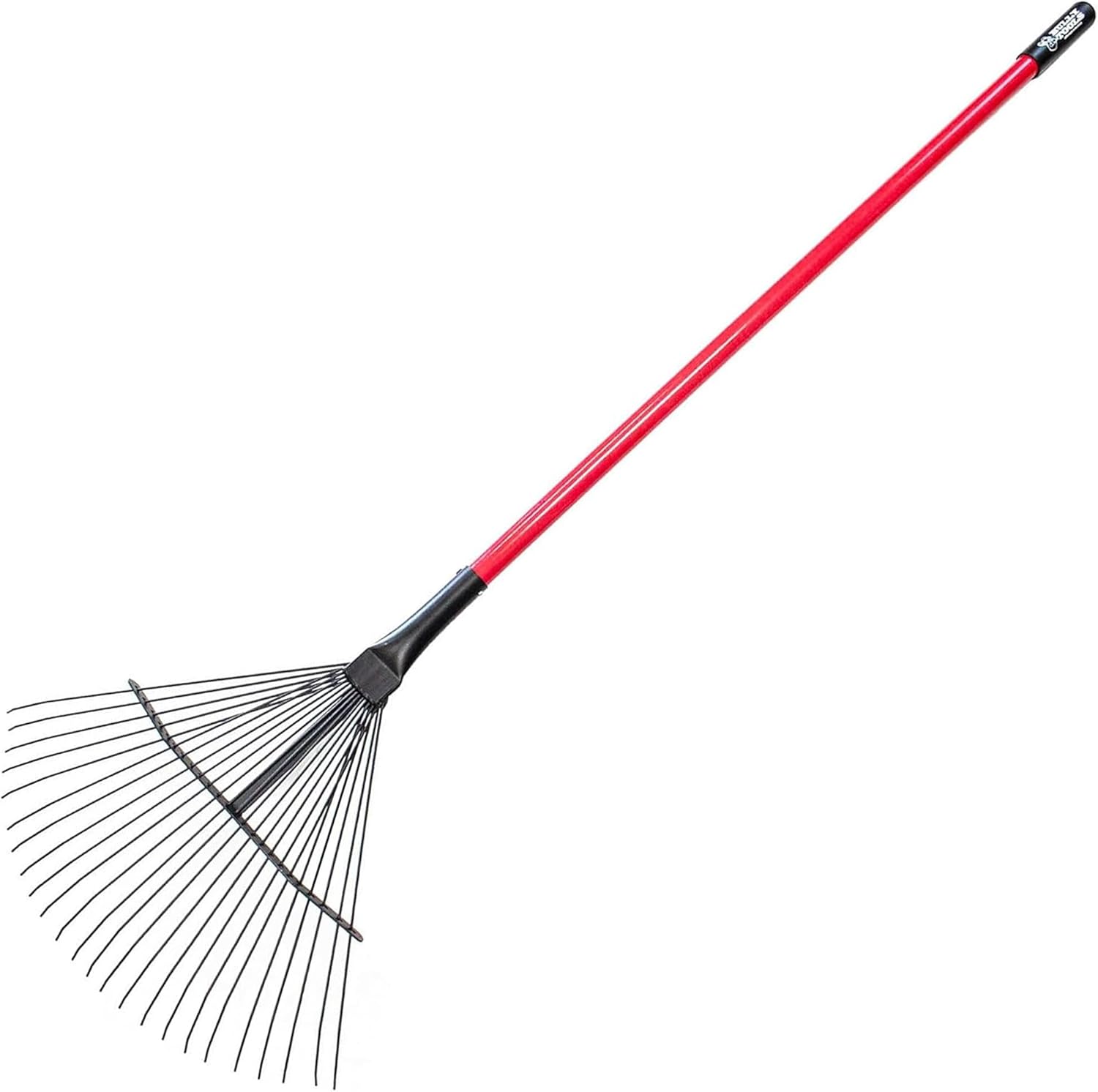
| Head Size | 24 tines |
|---|---|
| Handle Material | Fiberglass |
| Head Material | Alloy Steel |
This Bully Tools thatching rake is built for heavy-duty dethatching and seasonal yard cleanup. The 24 tempered steel tines are designed to comb through turf and pull up thatch and debris without uprooting grass, and the wide head covers more ground for faster work. An overwelded head-to-handle connection and powder-coated finish improve durability and rust resistance for repeated use, while the triple-wall fiberglass handle resists splintering and reduces flex under load. The wooden grip and rubberized end help reduce hand fatigue during longer sessions. Assembly is minimal and straightforward. Limitations include a fixed long-handle design that may be too long for very short users or tight beds, and the metal tines are firm so the rake requires careful use around delicate plants. For someone focused on performance and durability, this rake delivers reliable dethatching power and a build that holds up to frequent, strenuous use.
Best for: Buyers who prioritize a durable, performance-focused tool for routine dethatching and large-area yard cleanup and want a rake that stands up to heavy, frequent use.
Less Ideal for: Gardners who need a compact or adjustable tool for small beds, tight corners, or very gentle work should consider lighter or smaller alternatives.
- 24 tempered steel tines designed to pull thatch and debris without tearing grass
- Overwelded head-to-handle connection for increased durability under heavy use
- Triple-wall fiberglass handle resists splintering and reduces flex
- Powder-coated finish on head improves rust resistance for year-round use
- Long fixed handle may be awkward for shorter users or tight spaces
- Rigid steel tines require careful use around delicate plants and edges
Verdict: A heavy-duty, performance-oriented thatching rake built to remove stubborn thatch and withstand frequent, strenuous use.
CKLT 62.5-Inch Thatch Rake with 18 Tempered Spring Steel Tines

| Head Size | 15 inches |
|---|---|
| Handle Material | Stainless Steel |
| Item Weight | 1.87 kg |
| Rake Type | Lawn Rake |
This CKLT dethatching rake is built for real lawn work: 18 sharp tempered spring steel tines and a dual-sided 15-inch head let you both lift deep thatch and clear surface debris. Use the short side to loosen soil, remove leaves and shallow thatch, then flip to the long side for deeper passes that pull up matted dead grass without digging into healthy turf. The telescoping stainless steel handle extends to three lengths so you can work upright and reduce back strain, and the rubber grip improves comfort during longer sessions. Construction details like 304 stainless screws and a reinforced metal frame reduce rust and connection wobble, so the tool stays useful season after season. Expect effective dethatching on common warm-season lawns and good versatility for spring and fall cleanup, but the metal head and sharp tines make it a manual, somewhat strenuous tool on very large areas compared with powered dethatchers.
Best for: Buyers who want a durable, no-frills manual dethatcher to maintain small to medium lawns and who prioritize tool longevity and efficient thatch removal over powered equipment.
Less Ideal for: People with very large properties or limited physical ability should consider a powered dethatcher or hiring a service instead.
- 18 tempered spring steel tines resist bending and pull up deep thatch effectively
- Dual-sided 15-inch head for both surface raking and deeper dethatching
- Adjustable stainless steel handle with rubber grip reduces bending and improves comfort
- 304 stainless steel screws and solid metal frame resist rust and maintain stability
- Manual operation can be tiring on large lawns compared with motorized dethatchers
- Sharp metal tines can snag delicate turf if used with excessive force
Verdict: A tough, adjustable manual dethatching rake that delivers reliable deep-thatch removal and long-term corrosion resistance for hands-on lawn care.
cogardenshower 2-in-1 Thatch Rake with 21 Carbon Steel Tines and Adjustable Handle

| Head width | 13 inches |
|---|---|
| Tines | 21 carbon steel tines |
| Handle material | Stainless Steel |
| Adjustable handle | Sectional, adjustable length |
This dethatching rake is a budget-friendly manual tool built to pull up thatch, moss, and dead grass and to prep turf for overseeding. The 13-inch head has 21 sharp carbon steel tines spaced to grab dense thatch, and the dual-sided design lets you flip to an 11-tine side for lighter raking and leaf cleanup. The reinforced stainless steel handle and head connection are designed to resist bending during heavy pulls, and the sectional adjustable handle helps you work more upright to reduce back strain. In practice it works well on small to medium yards where mechanical dethatchers are unnecessary or too costly. Expect efficient thatch removal in modest passes, but it requires physical effort and is slower than powered options on large lawns. The coated metal finish improves rust resistance but regular cleaning and storage will extend life. For homeowners who want a straightforward, all-in-one manual dethatcher without specialty attachments, this is a practical choice.
Best for: Homeowners who want an inexpensive, reliable manual tool to revive small to medium lawns and prepare turf for overseeding without buying powered equipment.
Less Ideal for: People with large acreage, limited physical mobility, or those who need fast, contractor-scale dethatching should consider powered or professional options instead.
- 21 sharp carbon steel tines pull up thick thatch and moss effectively
- Dual-sided head lets you switch between deep dethatching and lighter raking without changing tools
- Reinforced stainless steel handle and head connection resist bending during heavy use
- Sectional adjustable handle reduces bending and improves comfort for different users
- Coated metal construction helps resist rust for season-to-season use
- Manual operation is physically demanding and slower than powered dethatchers on large lawns
- Head width is modest so larger yards require many passes
Verdict: A simple, durable 2-in-1 manual dethatching rake that gives budget-minded homeowners effective thatch and moss removal without the cost of powered equipment.
THE GROUNDSKEEPER II Garden Rake, 21-inch Head with Fiberglass Handle

| Head Material | Alloy Steel |
|---|---|
| Handle Material | Fiberglass |
| Head Size | 21 inches |
| Number of tines | 28 |
| Made in the USA | Yes |
The Groundskeeper II is a purpose-built yard rake that uses angled, spring-loaded hardened steel tines and a lightweight fiberglass handle to make dethatching and debris cleanup easier. In use it digs into thatch and lifts leaves, pine needles, and small sticks without requiring you to press down, so you can work standing up and finish tasks faster. The 21-inch head with 28 stiff tines is effective for dethatching lawns and for moving heavier materials like mulch or gravel, and the design lets green stems pass through without damage. Its co-polymer head, replaceable torsion springs, and fiberglass construction prioritize durability for frequent use, while the self-cleaning flip-and-pull action speeds repeated passes. Important limitations are its stiff tines, which can be aggressive in very soft turf or near delicate plants, and the fixed long handle may feel long for users who prefer shorter tools. Some assembly is required but the head includes a hang hole for storage.
Best for: This is for homeowners or landscapers who prioritize a reliable, long-lasting rake for regular dethatching and heavy yard cleanup and who value tools built to withstand repeated professional use.
Less Ideal for: Gardeners who need a very gentle, flexible leaf rake for delicate flower beds or newly established lawns should consider a softer-tined rake instead.
- Angled, hardened steel tines that dig in for effective dethatching
- Very lightweight fiberglass handle and head for reduced user fatigue
- Durable construction with replaceable springs designed for frequent use
- Self-cleaning flip-and-pull action that speeds cleanup passes
- Stiff tines can be too aggressive on very soft or newly seeded turf
Verdict: Buy this rake if you want a durable, professional-grade tool that makes dethatching and heavier yard cleanup faster and less tiring.
Walensee 15-Inch Thatch Rake with 19-Tine Dual-Sided Head and Adjustable Handle

| Rake Type | Thatch Rake |
|---|---|
| Item Highlight | Dual-sided 19-tine head; 40, 55 and 70 in. handle lengths |
| Handle Material | Stainless Steel |
| Head Material | Stainless Steel |
This Walensee thatch rake is a straightforward manual dethatcher built for routine lawn maintenance. The 15-inch, dual-sided 19-tine head lets you flip between a tined side that lifts dead grass and a more aggressive side for loosening the top of the soil, so you can use it for light dethatching, leaf and debris cleanup, and surface cultivation. The hardened manganese steel head with a powder coat should resist rust and stand up to repeated use. The sectional stainless steel handle detaches and adjusts to roughly 40, 55, or 70 inches, which reduces bending and makes it easier to store or transport. A cushioned non-slip grip improves control during longer sessions. Because it is manual, this rake requires physical effort and works best on moderate thatch layers rather than heavy, compacted mats that need mechanical dethatching. Assembly uses twist-lock sections, so check connections before extended use. For buyers who value proven construction and clear product details, this rake offers a practical, low-tech solution for seasonal thatch control.
Best for: Buyers who want a reliable, low-tech tool for seasonal dethatching and surface cleanup and who prefer clear product details and simple construction backed by solid materials.
Less Ideal for: Homeowners with very large lawns or severe, compacted thatch who need a powered dethatcher or professional service should look elsewhere.
- Dual-sided 19-tine head lets you switch between lifting dead grass and loosening surface soil
- Hardened manganese steel head with powder coat for improved rust and wear resistance
- Adjustable, detachable stainless steel handle (40, 55, 70 in.) reduces bending and eases storage
- Cushioned non-slip grip improves comfort and control during use
- Manual operation can be tiring on large lawns or with heavy compacted thatch
- Twist-lock handle sections require periodic rechecking to ensure connections stay tight
Verdict: A durable, easy-to-use manual dethatcher that delivers practical seasonal thatch removal for small to medium lawns.
YEELOR 17" Thatch Rake with Adjustable 66" Stainless Steel Handle

| Head Material | Polycarbonate (PC) |
|---|---|
| Handle Material | Stainless Steel |
| Head Width | 17 Inch |
| Number of Tines | 21 pairs |
| Item Weight | 2.5 pounds |
This YEELOR thatch rake is built for straightforward lawn dethatching and debris cleanup. The 17‑inch polycarbonate head carries 21 pairs of spring steel hook tines that grip and pull out thatch, pine needles and dead grass without heavy downward force, so you can work with less back strain. The segmented stainless steel handle extends to 66 inches for better reach and leverage and detaches for compact storage. Dual‑screw head connections and spring steel tines improve stability and wear resistance compared with single‑screw designs, and the lightweight 2.5 lb construction keeps it easy to maneuver across a medium‑sized yard. Expect efficient removal on thatch and surface debris, though the hooked fine tines are intended for dethatching and light debris rather than moving large volumes of wet leaves or heavy branches. Assembly is simple—tighten the screws and lock the handle segments—and the materials are UV and wear resistant for outdoor use. For cautious buyers who prioritize durable construction and ease of use, this rake is a practical, low‑risk choice for routine lawn maintenance.
Best for: Buyers who want a reliable, easy‑to‑use dethatching tool for regular lawn care and prioritize durable construction and low physical strain during use.
Less Ideal for: People who need a multi‑purpose yard tool for bulk leaf removal or handling heavy woody debris should consider a dedicated leaf rake or blower instead.
- Semi‑circular hook spring steel tines designed to extract thatch effectively with minimal downward pressure
- Adjustable stainless steel handle that extends for reach and disassembles for compact storage
- Dual‑screw reinforced head connection for greater stability and reduced wobble
- Lightweight construction (about 2.5 lb) makes the tool easy to maneuver during extended use
- Not designed for moving large, heavy or very wet debris where a leaf rake or blower would be faster
Verdict: A simple, durable dethatching rake that reduces back strain and delivers reliable, low‑risk performance for routine lawn thatch removal.
Choosing the Right Dethatching Garden Rake: Key Factors to Consider
Tine Design and Spacing
Tine material, thickness, and how far apart the tines are determine how much thatch you lift with each pass. Stiffer, thicker tines penetrate and pry away compacted layers without bending out of shape, while the spacing controls whether the rake removes only the dead surface layer or digs into healthy crowns.
Too-aggressive spacing or very rigid tines can scar turf, so you want a design that balances penetration with forgiveness. Consider how the tine tips are finished: blunted or slightly rounded ends reduce tearing of live grass, while sharper tips are better at breaking up dense mats. For homeowners, a middle-ground tine spacing and medium-stiff steel often provide effective dethatching without excessive turf damage.
Handle Length and Grip Comfort
Handle length affects leverage and back strain. A longer handle lets you work more upright and cover more ground per stroke, but an overly long or heavy handle can become unwieldy in tight areas. Look for handles sized to your height and the typical posture you use while gardening.
Grip shape and material matter for repeated use. Cushioned, non-slip grips reduce hand fatigue and prevent slipping when your hands are wet. Some handles have slight bends or ergonomic profiles that keep wrists in a neutral position and reduce strain during long dethatching sessions. Also consider whether the handle is replaceable or offers modular attachments for multi-season use.
Tool Balance and Head Width
Head width governs coverage rate and control. A wider head removes more thatch per pass, which is efficient on medium to large lawns. Narrower heads give better control along edges, around gardens, and in tighter turf areas.
Balance between the head and handle affects maneuverability. A well-balanced rake will feel responsive and follow your hand movements without requiring excessive effort to keep tines engaged. If you often work on uneven ground or steep slopes, prioritize a design with good balance and a head size that matches the terrain.
Construction Materials and Corrosion Resistance
Because dethatching involves dirt, moisture, and repetitive impact, durable materials are essential. Steel tines and a solid head plate resist bending, while powder-coated or galvanized finishes help limit rust after exposure to wet grass and soil.
Handles made from hardwood, fiberglass, or reinforced aluminum each have tradeoffs in weight, shock absorption, and lifetime. Hardwood can be comfortable and repairable but needs treatment to resist rot. Fiberglass and aluminum are often lighter and more weatherproof but can transmit more vibration to hands. Check how components are joined; welded or bolted heads with solid collars usually outlast press-fit designs.
Maintenance and Storage Practicalities
How easy a rake is to clean, sharpen, or service affects whether it stays useful season after season. Tines that resist clogging and a head design that sheds debris make cleanup faster. If tines bend or break, being able to replace them or tighten hardware is a big plus.
Storage considerations include whether the rake can hang on a wall, has a compact profile, or comes with removable heads. Tools that accept replacement handles or modular heads extend working life and reduce long-term cost. Think about winter storage and whether the materials will withstand freeze-thaw cycles in your region.
Aggressiveness Versus Turf Safety
Some rakes are built to be aggressive, suited to heavy thatch in neglected lawns, while others are gentler and intended for routine seasonal maintenance. Aggressive tools remove more material but raise the risk of pulling crowns or creating bare patches if used incorrectly.
Match the rake aggressiveness to the condition of your lawn and your comfort with follow-up care. After heavy dethatching, grass may need overseeding and extra watering to recover. For light thatch build-up, choose a milder tine profile to avoid unnecessary turf stress.
When to Dethatch Your Lawn
Thatch builds gradually from clippings, stems, and roots, and it becomes a problem when the layer exceeds about half an inch. Signs that you need to dethatch include spongy turf, poor water infiltration, and an increase in disease or weed pressure. Timing matters: spring or early fall are common windows when grass is actively growing and can recover quickly after a dethatching pass.
If you are unsure, test by removing a small plug of sod and measuring the thatch layer. For light buildup, a single pass with a gentler rake may suffice. For heavy mats, plan multiple light passes spaced several weeks apart so the lawn can recover between treatments.
- Check soil moisture; slightly moist ground improves tine penetration but avoid working in saturated conditions.
- Combine dethatching with aeration if the soil is compacted to improve recovery and root access to water.
- Plan follow-up lawn care such as topdressing or overseeding for heavily raked areas to speed recovery.
Techniques for Effective Hand Dethatching
Use controlled, even strokes and avoid dragging so hard that you pull large chunks of turf. Work in rows across the lawn and overlap each pass slightly to ensure consistent coverage. Adjust the rake angle and your body position to keep tines engaged without forcing them through crowns.
For heavy thatch, perform several lighter passes rather than one deep, aggressive pass. Rake in different directions on successive passes to lift more material. Afterward, collect loosened debris promptly to prevent it from smothering the grass during recovery.
- Start with a shallow pass and increase aggressiveness only if the thatch does not loosen.
- Work a small test area first to see how the turf responds before treating the whole lawn.
- Wear gloves and eye protection; thatch and debris can be sharp and may eject during vigorous raking.
Adapting Rake Choice to Lawn Size and Access
For small urban yards or narrow strips, a narrower dethatching head gives better control and easier maneuvering around obstacles. Medium to larger lawns benefit from wider heads that reduce time spent raking by covering more ground per pass.
If you frequently work in raised beds, around trees, or close to borders, consider carrying a secondary, compact dethatching tool for those tight spots. Balance travel time and storage convenience when selecting head width and handle length.
- Measure gate and storage space to ensure the rake will fit through and stow cleanly.
- Choose a detachable head if you need a compact profile for transporting in a small car or storing in a tight shed.
Caring for Your Rake After Use
Clean the head and tines after each session to remove damp thatch and soil that can accelerate corrosion. Use a stiff brush and a quick rinse, then dry thoroughly before storing. Tighten any bolts and check the handle collar regularly to prevent wobble.
Sharpen or replace bent tines as needed to maintain performance. Treat wooden handles with oil or sealant annually to prevent splitting, and inspect fiberglass handles for cracks and aluminum for dents.
- Hang the rake to keep tines straight and to save floor space.
- Store in a dry, ventilated area away from direct ground contact to reduce rot and corrosion.
Complementary Lawn Care Practices
Dethatching is one part of a seasonal lawn program. If your soil is compacted, pair dethatching with aeration so water and roots can penetrate more easily. Follow dethatching with overseeding or topdressing where the turf looks thin to speed recovery.
Adjust fertilization and watering after dethatching to support new tillering and root growth. Avoid heavy fertilizer immediately after an aggressive pass; give grass a short recovery window and then apply balanced nutrition according to your lawn type.
- Consider soil testing to tailor fertilization after major lawn work.
- Use lightweight topdressing to fill low spots and improve seed-to-soil contact when overseeding.
How We Chose the Best Dethatching Garden Rake
Our selection process prioritized tools that are purpose-built for dethatching and that demonstrate durable design and real-world usability. We started by filtering for rakes specifically labeled for dethatching or that use stiff, spaced tines intended to lift turf residue, excluding general-purpose leaf rakes and flimsy garden forks that are not engineered to pull thick thatch. Key evaluation criteria included tine design and spacing, which determine how effectively a rake lifts and removes thatch without pulling live grass; handle length, shape, and grip comfort to reduce back strain during long passes; construction materials and hardware quality that affect longevity in outdoor, damp conditions; ease of cleaning and maintenance so the tool stays effective season after season; and overall balance and head width that influence coverage rate and control on different lawn sizes. We also considered how simple adjustments or replacement parts are to source, and whether the tool is practical for storage. We excluded tools that were primarily light leaf rakes, specialized power dethatchers, or designs unsuitable for typical homeowner use. The resulting list focuses on durable, manual dethatching rakes suitable for small to medium lawns and for gardeners who prefer hand tools for spot dethatching or seasonal cleanup.
FAQ
How often should I dethatch my lawn?
Frequency depends on grass type and growth rate. Many lawns only need dethatching every few years. Lawns with heavy traffic or persistent thatch may need annual attention. Inspect the thatch layer and perform treatment when it exceeds roughly half an inch.
Can I dethatch when the soil is wet?
Working on saturated soil can damage grass roots and compact soil further. Slightly moist conditions improve tine penetration, but avoid heavy rain or very soft ground. If the soil is too wet, wait until it dries to a workable firmness.
Will dethatching damage my grass permanently?
If done appropriately, dethatching encourages healthier turf by removing barriers to water and air. Aggressive or improperly timed dethatching can create bare patches, so use lighter passes and follow up with overseeding and proper care on sensitive lawns.
Is a manual dethatching rake as effective as power tools?
Manual rakes are very effective for spot treatments, small lawns, and lighter thatch layers and give more control near edges. Power dethatchers remove material faster on large areas but are more aggressive and can require more recovery care. The best choice depends on lawn size and thatch severity.
How do I dispose of removed thatch?
Collect loosened material and compost it if it is free of disease and weed seed. For heavy volumes, spread thinly in a garden bed as mulch or place in yard waste recycling. Avoid leaving thick piles on the lawn where they can smother grass.
Final Verdict
Choose a dethatching garden rake that matches how much thatch you typically face and the size of the areas you maintain. Prioritize tine design and spacing for effective removal, handle ergonomics for comfortable use, and durable materials for long-term reliability. Expect tradeoffs between aggression and turf safety: more aggressive tines remove more material but require careful technique and post-care. Work in light passes, clean and store the tool properly, and plan follow-up aeration, overseeding, or topdressing if you remove heavy thatch. With the right rake and sensible technique, you can restore air and water flow in the lawn while limiting recovery time and turf stress.
