

Note: This article contains affiliate links. If you click on these links and make a purchase, I may earn a small commission at no extra cost to you. This helps support my research and content. Read my full affiliate disclosure here.
If you share your yard with dogs, selecting the right weed killer matters for both pest control and pet safety. A dog friendly weed killer reduces the risk of accidental poisoning, contact irritation, and soil residues that pets might ingest when sniffing or digging. In practical garden terms, you want something that controls common broadleaf weeds and crabgrass without forcing you to keep pets off treated areas for days. This guide covers six top-rated, pet-conscious weed-control options chosen for lawns, garden edges, and patios. We evaluated each option on safety-related measures and real-world effectiveness so you can pick the best fit for your yard and routine. Read on to see the key criteria we used and how different approaches work in practice.
Top Picks at a Glance
| Best Overall The best all-around choice for most situations | Spruce Weed & Grass Killer Power Wand Kit with 64 oz Refill |  |
| Best Quality Built to a higher standard if you want something more solid | Natural Armor Weed & Grass Killer, 1 Gallon (128 oz) |  |
| Best Value The sweet spot between price and what you get | Earth's Ally Weed & Grass Killer Spray, 32 fl oz |  |
| Best Budget The cheapest option that still gets the job done reliably | Pulverize Weed & Grass Killer, Ready-to-Use 1 Gallon (Messinas) |  |
| Highest Rated A top-rated pick with lots of positive feedback | Ortho GroundClear Weed & Grass Killer with Comfort Wand, 1 gal. |  |
| Most Popular A crowd favorite that many people choose with confidence | Just For Pets Pet Safe Weed Killer, 1 Gallon Ready-to-Use |  |
Spruce Weed & Grass Killer Power Wand Kit with 64 oz Refill

| Unit Count | 64 Fluid Ounces |
|---|---|
| Coverage | 1 bottle treats up to 400 weeds |
| Item Form | Multiple |
| Liquid Volume | 64 fluid ounces |
This kit combines a 64 oz ready-to-use herbicide with a battery-powered Power Wand for fast, targeted spot treatments. The formula is non-mixing and designed to work on contact, dehydrating leaves so you can see darkening or wilting within an hour and complete die-off by about 24 hours when used as directed. The wand is reusable and comes with two AA batteries so you can spray cracks, edges, mulch beds, driveways, and walkways without pouring or measuring. Practical benefits include ease of use, rainproofing within 10 minutes, and a formula advertised as safe around people, pets, and bees when directions are followed. Limitations are that it is non-selective so it must be applied carefully to avoid desirable plants and grass, it is intended for spot treatment rather than broadcast lawn application, and best results require spraying in dry, warm conditions above 60°F with no immediate rain forecast.
Best for: Buyers who want a fast, easy-to-use spot weed killer for driveways, cracks, mulch beds, and edges and who prioritize quick visible results and minimal setup.
Less Ideal for: Those needing large-area lawn herbicide or selective weed control within turf should look for products made for broadcast lawn treatments or selective formulas.
- Ready-to-use 64 oz refill eliminates measuring or mixing
- Visible results in about one hour and full effect around 24 hours
- Includes battery-powered reusable wand for precision spot treatments
- Rainproof within 10 minutes so light showers are less likely to wash it off
- Formulated for use around people, pets, and bees when directions are followed
- Non-selective formula can damage desirable plants if oversprayed
- Designed for spot treatments not for broadcasting over large lawns
- Performance depends on spraying in recommended weather conditions
Verdict: A convenient, no-mix spot-treatment kit that delivers fast visible weed kill with a reusable powered wand for precise, low-fuss applications.
Natural Armor Weed & Grass Killer, 1 Gallon (128 oz)

| Unit Count | 128 Fluid Ounces |
|---|---|
| Item Form | Spray |
| Active Ingredients | Vinegar |
| Coverage | Hardscapes, beds, driveways, foundations and similar areas |
Natural Armor Weed & Grass Killer is a concentrated, vinegar-based herbicide supplied in a one-gallon ready-to-use bottle with a sprayer connection. It is intended for spot-treating unwanted vegetation around driveways, patios, mulch beds, gravel, foundations and other hardscape areas where you do not want plant growth. The product uses high-strength vinegar as the active ingredient so you get fast visible wilting often within an hour and broader dieback over the following days. Practical benefits include easy application with no mixing, a formula marketed as all-natural and glyphosate-free, and coverage recommendations that list many common outdoor use areas. Limitations are that it is non-selective so it will damage desirable plants on contact and may require repeat applications for persistent perennial weeds because vinegar-based products typically burn foliage but do not always kill deep roots. Also follow safety directions to keep children and pets away during use and avoid application around vegetation you want to keep.
Best for: Gardeners who want a non-glyphosate, easy-to-use herbicide for spot-treating driveways, patios and other areas where no vegetation is desired and who prioritize natural active ingredients over systemic control.
Less Ideal for: Homeowners who need selective weed control near ornamental plants or who require a systemic herbicide that reliably kills deep-rooted perennials across large turf areas.
- Ready-to-use formula requires no mixing and connects to a sprayer for straightforward application
- Vinegar-based, glyphosate-free formulation for buyers seeking non-synthetic active ingredients
- Fast-acting foliage burn with visible results often within an hour
- Large one-gallon volume reduces the need for frequent repurchase for larger yards
- Non-selective action will harm any plants it contacts rather than targeting weeds only
- May need multiple treatments to control deeply rooted perennial weeds
Verdict: A large ready-to-use, vinegar-based herbicide for buyers who want a fast, non-glyphosate option to spot-treat weeds on hardscapes and unwanted areas.
Earth's Ally Weed & Grass Killer Spray, 32 fl oz
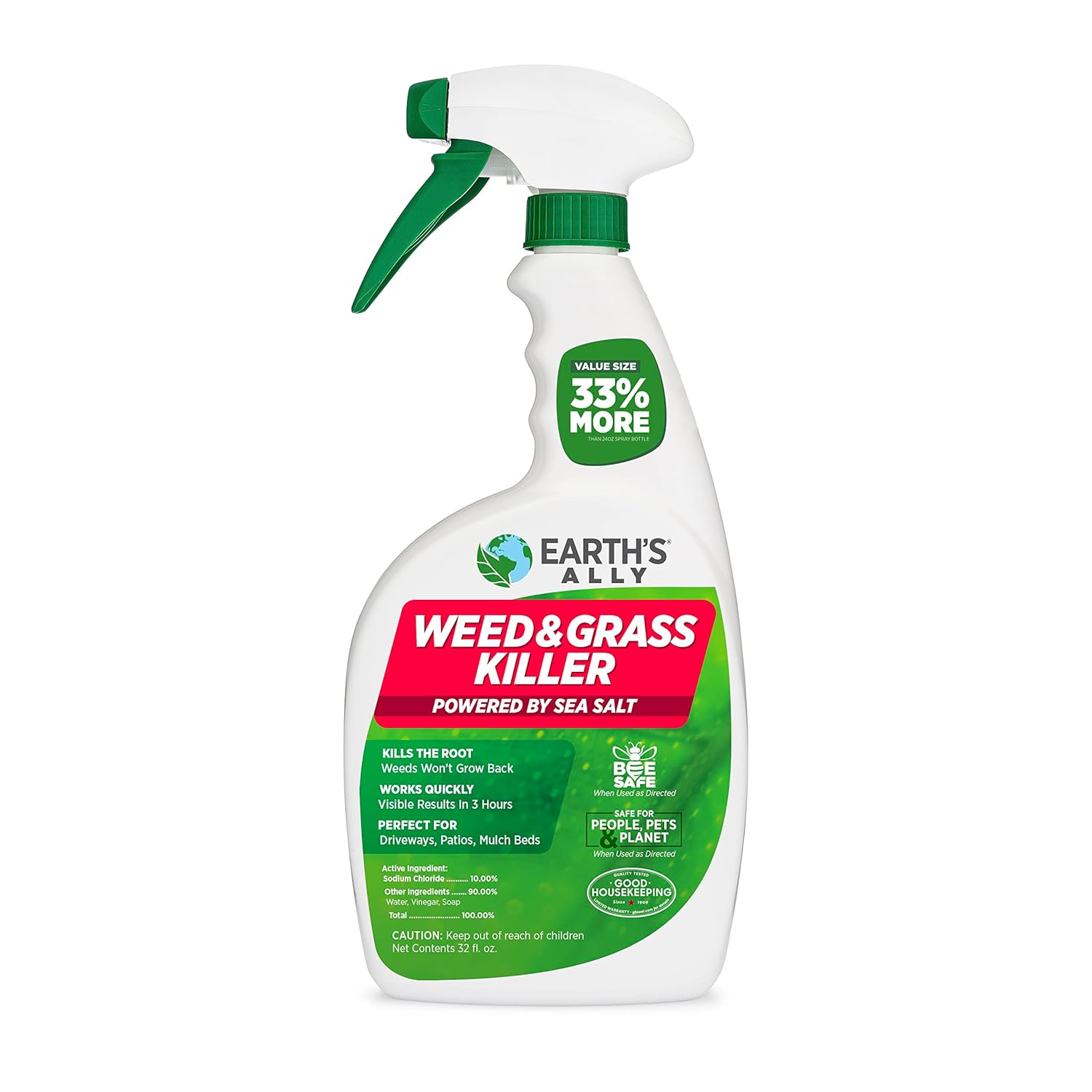
| Unit Count | 32 Fluid Ounces |
|---|---|
| Active Ingredient | Sodium Chloride (10.00%) |
| Item Form | Spray |
| OMRI Listed | Yes |
| Safe for Bees | Yes |
Earth's Ally Weed & Grass Killer is a ready-to-use spray that relies on sea salt, vinegar, and soap to kill common broadleaf and grassy weeds on contact and to the root when applied generously. It is typically used on hardscape and high-traffic areas such as patios, driveways and sidewalks; for larger beds the brand recommends mixing in a pump or backpack sprayer. Notable features include an OMRI-listed formulation, pet- and pollinator-safe testing when used as directed, and visible wilting often within a few hours. Practical benefits are straightforward: no mixing of toxic concentrates, safer handling around people and pets, and an easy spray application that requires saturating leaves and base to reach roots. Important limitations are that it is non-selective so it will damage desirable plants if oversprayed, it requires repeat saturating applications compared with synthetic herbicides, and results depend on dry, sunny conditions for best effect rather than working in wet or overcast weather.
Best for: Buyers who prioritize a safer, low-toxicity option for spot-treating weeds on patios, driveways, sidewalks and other high-traffic hardscape areas and who prefer convenience over industrial-strength persistence.
Less Ideal for: Gardeners who need a selective lawn herbicide or long-term residual control across large turf areas should consider products formulated for those specific uses.
- Ready-to-use spray requires no measuring or harsh concentrate handling
- Sea-salt based formula avoids glyphosate and other synthetic herbicides
- Shown to produce visible wilting within hours when applied on a sunny, dry day
- OMRI-listed and independently tested for pollinator and pet safety
- Non-selective formula will harm any plant it contacts so careful application is required
- Less persistent than some synthetic herbicides so repeated or saturated applications may be necessary
Verdict: Choose this product if you want an easy, ready-to-use weed killer that avoids harsh synthetics and is designed for safe spot treatment on hard surfaces.
Pulverize Weed & Grass Killer, Ready-to-Use 1 Gallon (Messinas)

| Unit Count | 128 Fluid Ounces |
|---|---|
| Item Form | Spray |
| Liquid Volume | 1 gallons |
| Active Ingredients | Maleic hydrazide |
| Coverage | Up to 250 sq.ft. (Gallon Ready to Use) |
This ready-to-use Pulverize Weed & Grass Killer is designed for homeowners who need a fast, no-mix solution for weeds on patios, driveways, and garden edges. You spray directly onto foliage and the formula begins drying weeds within hours, making it useful for spot treatments and clearing hardscape cracks. The product is non-selective so it will kill any plant it contacts, and the label highlights control of common annual weeds, moss, algae, and lichens. The formula is described as made from naturally derived ingredients and approved for organic gardening, which reduces concerns about heavy synthetic chemicals and makes it easier to use around family areas once treated surfaces have dried. Important trade-offs are that it will damage desirable plants if oversprayed and that repeat applications every 2 to 3 weeks are recommended for new growth; rain within a few hours can require reapplication. For small to medium problem areas this gallon size gives broad coverage without mixing, but users should follow safety directions to avoid skin or eye contact.
Best for: Homeowners who need an affordable, easy-to-use herbicide for spot-treating driveways, patios, and edges and who prioritize friendlier, naturally derived ingredients around pets.
Less Ideal for: Gardeners wanting a selective lawn-safe product to preserve turf or those who need a systemic, long-term single-application control for deep perennial roots.
- Ready-to-use spray requires no measuring or mixing
- Fast-acting formula shows visible weed dieback within hours
- Naturally derived active ingredient intended for pet- and family-friendlier use once dry
- Effective on a broad range of annual weeds plus moss, algae, and lichens
- Non-selective formula will kill desirable plants if contacted
- May require repeat applications every 2–3 weeks for new growth
Verdict: A convenient, pet-friendlier ready-to-use herbicide for quickly clearing weeds and hardscape growth without mixing.
Ortho GroundClear Weed & Grass Killer with Comfort Wand, 1 gal.

| Item Form | Spray |
|---|---|
| Coverage | 5120 square feet |
| Unit Count | 128 Fluid Ounces |
| Active Ingredients | Ammonium Nonanoate |
Ortho GroundClear is a one-gallon ready-to-use weed and grass spray designed for spot and surface treatment on driveways, walkways, patios, and landscape beds. The formula absorbs on contact and shows visible browning in about 15 minutes, becoming rainproof roughly two hours after drying, which helps when weather is unpredictable. The included Comfort Wand makes it easy to aim at weeds growing between gravel and pavers without soaking surrounding surfaces. It is OMRI Listed, so it can fit into some organic-minded maintenance routines. Coverage is large for a single container, and the product lists ammonium nonanoate as the active ingredient, which works by contact so small or actively growing weeds are best treated. Because it is a contact herbicide, perennial or well-established weeds may need repeat applications or mechanical removal for full control, and care is required to avoid spray drift onto desirable plants. Follow safety directions and keep pets and children away until treated areas are dry.
Best for: Homeowners who want a practical, hands-on solution to remove weeds from gravel driveways and hardscapes and who prioritize quick, targeted results with minimal setup.
Less Ideal for: People seeking a long-term systemic control for deep-rooted perennial weeds or a total lawn herbicide should consider systemic products or integrated mechanical removal instead.
- Fast visible results on contact, often browning in about 15 minutes.
- Comfort Wand enables precise targeting in gravel joints and along edges.
- Becomes rainproof in approximately 2 hours, reducing loss from unexpected rain.
- OMRI Listed, compatible with some organic production standards.
- Contact-only action means deeper or perennial roots may require multiple applications.
- Spray can damage nearby desired plants if not applied carefully.
Verdict: A fast, ready-to-use contact spray with a comfort wand that makes quick, precise weed control on gravel driveways simple and practical.
Just For Pets Pet Safe Weed Killer, 1 Gallon Ready-to-Use

| Unit Count | 128 Fluid Ounces |
|---|---|
| Item Form | Liquid |
| Active Ingredients | Vinegar |
This one-gallon ready-to-use weed killer is a vinegar-based, non-glyphosate formula packaged with a pump sprayer for straightforward spot treatment of unwanted weeds and grass. You simply shake, pressurize the sprayer, and coat target plants; visible wilting can appear within hours and clearer results are typical by 24 hours. The product is presented as pet- and family-friendly when used according to directions and is suitable for hardscape areas, rock beds, driveways, patios and fence lines where you want non-selective contact control. Practical benefits include no mixing or measuring, fast action on common weeds like dandelions and crabgrass, and a formulation that avoids glyphosate. Important limitations are that it is non-selective so it will harm desirable plants on contact, it requires thorough coverage to be effective, and contact herbicides sometimes need repeat applications for deep-rooted perennials. Also follow drying and safety guidance before allowing pets or children back into treated areas.
Best for: Homeowners who prioritize low-toxicity, easy-to-use weed control around hardscapes and landscape beds and want a quick, no-mix solution that avoids glyphosate.
Less Ideal for: Gardeners seeking a selective herbicide for lawns or those needing a systemic solution for tough perennial roots should consider other products or integrated removal methods.
- Ready-to-use pump sprayer requires no mixing or measuring
- Vinegar-based formula with no glyphosate for a more natural active ingredient
- Fast visible results often within 24 hours on annual weeds and grasses
- Versatile for use on driveways, sidewalks, patios, rock beds and fence lines
- Non-selective contact action can damage desirable plants if oversprayed
- May require repeat treatments for deep-rooted or persistent perennial weeds
Verdict: A fast, ready-to-use vinegar weed killer for homeowners who want a non-glyphosate, easy contact solution for weeds on hardscape and beds.
Choosing the Right Dog Friendly Weed Killer: Key Factors to Consider
Safety Profile
A product's safety profile determines how soon pets can return to treated areas and the level of supervision required. Look for clear label guidance on pet reentry intervals and whether the active ingredients are low-toxicity to mammals. Also note whether the formulation leaves residues on foliage or in soil where a dog might sniff, roll, or ingest them.
Consider whether you need an immediate-return option for high-traffic yards or can tolerate short exclusion periods. Safety extends beyond the active ingredient to include surfactants, solvents, and adjuvants that can cause skin or eye irritation. If you have puppies or dogs that eat vegetation, prioritize products with minimal oral toxicity and low residual activity in topsoil.
Speed of Visible Control
How quickly you see weeds wilt matters for timing outdoor activities and assessing effectiveness. Fast-acting contact solutions show browning within days but may need repeat treatments for regrowth, while slower systemic options can take one to three weeks to fully kill deep-rooted weeds.
In yards with pets, a quicker visible result can reduce the chance of dogs digging at stressed plants, but fast-acting contact killers sometimes require repeat applications and can disturb turf if misapplied. Balance the desire for quick results with the potential need for reapplication and the product's compatibility with surrounding plants.
Weed Spectrum
Different weed killers target different kinds of weeds. Some are broadleaf-selective, sparing most turfgrass while removing dandelions and clovers. Others are nonselective and will damage grass and ornamental plants on contact. Knowing the common weeds in your yard and whether you need spot treatment or blanket control will help you choose a product with the right spectrum.
If your lawn has a mix of broadleaf weeds and grassy invasives, pick a product or approach that covers both or plan a combination strategy. For patios and driveways where you want to remove anything growing in cracks, a nonselective option may be appropriate provided it fits your pet-safety requirements.
Residue Persistence
Residue persistence affects how long treated soil or surfaces remain risky for pets. Some active ingredients bind tightly to soil and break down quickly, while others persist and retain biological activity for weeks. Persistence influences how soon you can let dogs back into treated beds and whether you should cover or water areas after application.
Also consider surface type: hardscapes and mulch may retain residues differently than turf. For high-use play areas, choose products with shorter persistence or plan treatments during times when you can keep pets away until residues dissipate.
Ease of Application
Practical application factors determine whether you will follow label directions accurately. Ready-to-use sprays and granular options can be simpler for small yards; concentrates require measuring and mixing but are more economical for large areas. Also evaluate whether the application method allows precise spot treatment to limit pet exposure.
Think about required protective equipment, the need for calibration of sprayers, and cleanup procedures. An easy-to-apply product reduces the chance of over-application, drift, or accidental exposure to pets and desirable plants.
Approaches That Reduce Pet Exposure
There are several strategies that lower pet exposure beyond choosing a labeled pet-conscious product. Spot treatment limits the treated area to the weed itself, reducing overall chemical footprint. Physical removal combined with barrier methods like landscape fabric or mulch can also cut down on the need for repeated chemical use.
Timing and placement matter. Treat weeds when dogs are least likely to be in the yard and keep them out until spray droplets have dried. For granular products, sweep excess from patios and allow any surface residue to settle or be watered in according to label instructions.
- Use targeted spot spraying for isolated weeds.
- Combine manual pulling with seasonal preventive steps.
- Restrict pet access until treated surfaces are dry or settled.
Natural and Mechanical Alternatives
Nonchemical options can be effective in pet areas. Repeated hand-pulling, shallow digging to remove taproots, and using a flame weeder on hardscapes are all alternatives that eliminate chemical exposure risks. Solarization-covering soil with clear plastic in hot months-can reduce weed seed banks in beds away from pets.
Keep in mind that mechanical methods may be labor intensive and are not always practical for dense infestations. Combining a gentle, low-residue product with mechanical control often gives a balanced result.
- Hand-pulling is selective and safe but time-consuming.
- Thermal weeding suits cracks and paths but requires caution.
- Solarization is seasonal and best for prep work in beds.
Timing Treatments for Lawn Health and Pet Safety
Treat at times when plants are actively growing for best uptake, usually in warm weather, but also when you can keep pets off treated areas for the labeled return interval. Early morning or late afternoon applications reduce drift and allow droplets to dry before midday activity. Avoid treating before rain unless label instructions permit watering in.
Plan follow-up checks. Fast-acting contact treatments often require a second pass to catch regrowth, while systemic options need patience for full translocation. Mark treated zones so you and family members remember restricted areas until it is safe.
- Apply during active weed growth for better efficacy.
- Avoid treatments when rain or wind could spread products.
- Mark treated areas to manage pet access.
Managing Treated Soil and Mulches
Soil type and organic matter influence how chemicals bind and break down. High-organic soils may hold residues differently from sandy soils. When treating beds where dogs dig, consider watering in some products as instructed to move residues below the surface or choose a formulation with low persistence.
Mulch can trap residues on its surface; if dogs frequent mulched beds, delay their return until labels indicate it is safe. For edible beds or areas where pets consume plants, avoid any treatments not explicitly labeled safe for such use.
- Follow label guidance about watering in or covering soil.
- Delay pet access to mulched beds until safe intervals have passed.
- Prefer low-persistence options for areas where dogs dig.
When to Call a Professional
If your yard has large, persistent infestations, sensitive ornamental beds, or pets with special health concerns, a licensed professional can advise on integrated strategies that minimize pet risk. Professionals can also help with precise application to reduce off-target damage and environmental exposure.
However, many homeowners can manage common weed issues with spot treatments, manual control, and preventive lawn care. Use professional services when infestations are extensive, when you need specialized equipment, or when label directions for safe use are unclear.
- Seek professional help for large-scale or complex infestations.
- Use professionals to implement targeted, low-drift applications.
- Reserve lab-level chemical options for situations that truly require them.
How We Chose the Best Dog Friendly Weed Killer
We focused on products and approaches that limit pet risk while still delivering reliable weed control in typical home lawns, garden beds, and hardscape edges. Evaluation prioritized concrete, garden-relevant dimensions: safety profile including labeled pet restrictions and residue behavior, speed and consistency of visible weed control, spectrum of weeds controlled (broadleaf and grassy weeds), and application practicality for home gardeners. We screened out treatments with long reentry times for pets, known high-toxicity active ingredients, or those requiring specialized equipment beyond a homeowner sprayer. We also excluded options that only work on a very narrow set of species. The final shortlist favored solutions with clear safety instructions, predictable action in mixed-surface yards, and manageable cleanup and storage needs. Lab-level toxicity data was not used; instead we relied on labeled safety claims, typical environmental persistence, and how the product behaves in common garden scenarios. The scoring emphasized measurable garden outcomes gardeners can observe and control: how soon weeds wilt, whether the treatment harms nearby desirable plants, how long residues persist in soil or on turf, and how easy the product is to apply correctly.
FAQ
Are pet-safe weed killers completely harmless to dogs?
Pet-safe or dog friendly weed killers reduce risk but are not universally harmless. Labels often require pets be kept off treated areas until dry or for a short reentry time. Always follow label instructions and supervise pets until residues have dissipated according to the product guidance.
How long should I keep my dog off a treated lawn?
Reentry intervals vary by product and formulation. Many low-residue, pet-focused treatments allow return once spray droplets are dry, while others recommend waiting several hours or longer. Check the product label for the specific timeframe and any additional precautions for ingestion or contact.
Can I use natural acids or vinegar around pets?
Acidic solutions like horticultural vinegar can kill green tissue on contact but may cause irritation if pets contact treated areas or lap up residues. They are often nonselective and can damage desirable plants. Use them cautiously and keep pets away until treated surfaces have dried and been rinsed if the label advises.
Is spot treatment safer than broadcast spraying when pets are present?
Spot treatment limits the area of exposure and is generally safer in pet areas because less product is applied overall. It also reduces the chance of drift onto play areas or edible gardens. For widespread infestations, balance spot treatments with other control methods to avoid repeated applications.
Do granular weed control products present a higher risk to dogs?
Granular products vary. Those designed to be incorporated into soil or that dissolve quickly may have lower surface exposure risk than granules that remain on hardscapes. Dogs that eat granules directly are at risk, so keep pets away during and immediately after application and store granules securely.
How can I minimize residue where my dog likes to dig?
Avoid treating favored digging spots if possible. If treatment is needed, choose low-persistence formulations, water in as the label directs to move residues deeper, and wait the recommended interval before allowing unsupervised access. Adding a physical barrier or replacing the top layer of soil are alternatives for frequent diggers.
Final Verdict
Prioritize safety profile and residue persistence when choosing a dog friendly weed killer, and match the product spectrum and speed of action to the specific weeds in your yard. For pet-heavy yards, favor targeted applications, low-residue formulations, or nonchemical methods to keep exposure minimal. Balance quick control with the need to protect pets and desirable plants, and follow label directions closely to decide when dogs can safely return to treated areas.
