

Note: This article contains affiliate links. If you click on these links and make a purchase, I may earn a small commission at no extra cost to you. This helps support my research and content. Read my full affiliate disclosure here.
When you want exact seed, fertilizer, or granular treatment placement, a Drop Spreader gives far more control than broadcast-style units. For small to medium lawns, patio strips, and patch repair work, the right drop-style spreader reduces waste and prevents product drift into flower beds or pavement. This guide shortlists six top Drop Spreaders and explains the practical tradeoffs that matter in the garden. We evaluate accuracy, build durability, hopper capacity, and gait-friendly handling so you can pick a model that fits your yard and routine. Read on for the criteria we used and what to look for before you buy.
Top Picks at a Glance
| Best Overall The best all-around choice for most situations | Gelacie Lawn Drop Spreader with 4 Wheels and Adjustable Rate |  |
| Best Quality Built to a higher standard if you want something more solid | Buyers Products SaltDogg WB400 Walk-Behind Drop Spreader, 2.5 cu ft Poly Hopper |  |
| Best Value The sweet spot between price and what you get | Spyker Walk-Behind Side-by-Side Drop Spreader, 120 lb Capacity |  |
| Best Budget The cheapest option that still gets the job done reliably | Yard Commander 60 lb Walk-Behind Drop Spreader |  |
| Highest Rated A top-rated pick with lots of positive feedback | At Home 75 lb Drop Spreader |  |
| Most Popular A crowd favorite that many people choose with confidence | Agri-Fab 45-0288 175 lb Tow-Behind Drop Spreader, 42" Spread |  |
Gelacie Lawn Drop Spreader with 4 Wheels and Adjustable Rate
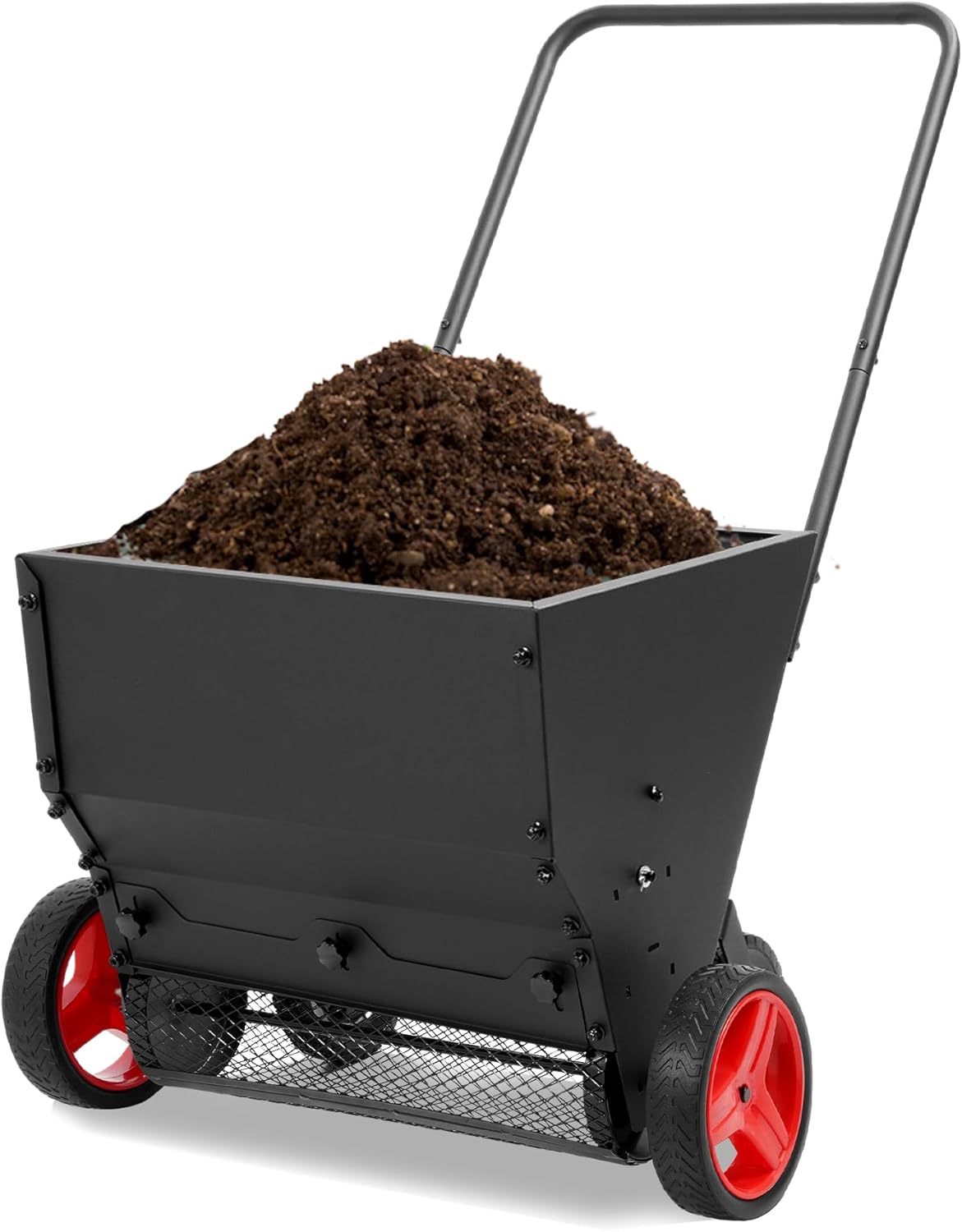
| Manufacturer | JMTAAT |
|---|---|
| Item model number | CB-4057 |
| Item Weight | 67.8 pounds |
| Product Dimensions | 23.39 x 21.37 x 46 inches |
This Gelacie drop spreader is a walk-behind, four-wheel unit intended for evenly applying granular materials such as fertilizer, grass seed, or compost across medium to large lawns. Its ground-driven drum links to the wheels via a gear chain so the spreading rate follows your walking pace, and an internal blade stirring mechanism helps prevent bridging and keeps material flowing. A flow control port under the hopper lets you fine-tune output to match particle size and application rate, and the rear fixed wheels allow you to lift the drum to stop spreading without unloading the cart. Built from steel, plastic, and rubber with a powder-coat finish, the frame is designed for outdoor use and a longer service life. Expect to assemble the unit from included hardware and consult the manual for setup. Important limitations are its heavy weight which makes handling and storage more demanding and the basic user controls compared with higher-end commercial spreaders, so precise calibration will take some trial runs on new lawns.
Best for: Homeowners who want a reliable, no-frills drop spreader for regular lawn maintenance and value even application across medium to large yards.
Less Ideal for: People who need a lightweight, easily storable spreader for small yards or users who require precision commercial-grade controls and calibration features.
- Ground-driven drum provides consistent application tied to walking speed
- Internal blade stirring reduces clogging and improves material flow
- Adjustable flow control port for tuning spread rate to different materials
- Sturdy mixed-material construction with powder-coat finish for outdoor durability
- Heavier design makes assembly, maneuvering, and storage more effortful
- Controls and calibration are basic compared with premium or commercial spreaders
Verdict: Choose this spreader if you want a durable, ground-driven drop spreader that delivers steady, clog-resistant distribution for routine lawn care.
Buyers Products SaltDogg WB400 Walk-Behind Drop Spreader, 2.5 cu ft Poly Hopper

| Hopper capacity | 2.5 cu ft (200 lb) |
|---|---|
| Path width | 44 in |
| Frame material | Stainless steel |
| Tire type | 13 in pneumatic |
The SaltDogg WB400 is a purpose-built walk-behind drop spreader for contractors, property managers, and homeowners who need accurate, high-capacity de-icing coverage. Its low-to-the-ground drop design places material directly on the surface instead of flinging it, which makes it well suited for sidewalks and landscaped areas where overspray would be a problem. The 2.5 cubic foot poly hopper holds up to 200 lb of bagged salt or ice melt while the stainless steel frame, agitator, and discharge trough resist corrosion for season-after-season use. A solid linkage lever gives straightforward discharge adjustment and the included hopper screen and nylon bushings reduce jamming from clumped material. Large 13-inch pneumatic tires keep the unit stable over uneven walkways and the wide 44-inch spread covers a full path in one pass, saving time on long runs. It arrives mostly assembled and includes a rain cover to keep material dry. Be aware this is a specialized, heavy unit intended for regular outdoor use and may be overbuilt for very small properties or occasional, light-duty needs.
Best for: Buyers who prioritize reliable, precise de-icing performance and durability for frequent or commercial-style winter maintenance on sidewalks, driveways, and walkways.
Less Ideal for: Casual users with very small properties or those who need a lightweight, compact spreader for occasional spot treatment should consider simpler handheld or broadcast models.
- Drop-spread design delivers precise placement near vegetation and hardscape
- 2.5 cu ft poly hopper holds up to 200 lb of bagged salt or ice melt
- Stainless steel frame, agitator, and trough resist corrosion for longer service life
- Hopper screen and nylon bushings help prevent jams and break up clumps
- 13 in pneumatic tires and 44 in coverage provide stability and single-pass width for sidewalks
- Heavy and substantial unit that may be harder to maneuver or store in tight spaces
- Designed specifically for bagged salt/ice melt so not optimized for very fine granular fertilizers or specialty materials
Verdict: Choose the SaltDogg WB400 when you need a durable, low‑to‑the‑ground drop spreader that delivers precise, single‑pass coverage for serious winter de-icing tasks.
Spyker Walk-Behind Side-by-Side Drop Spreader, 120 lb Capacity
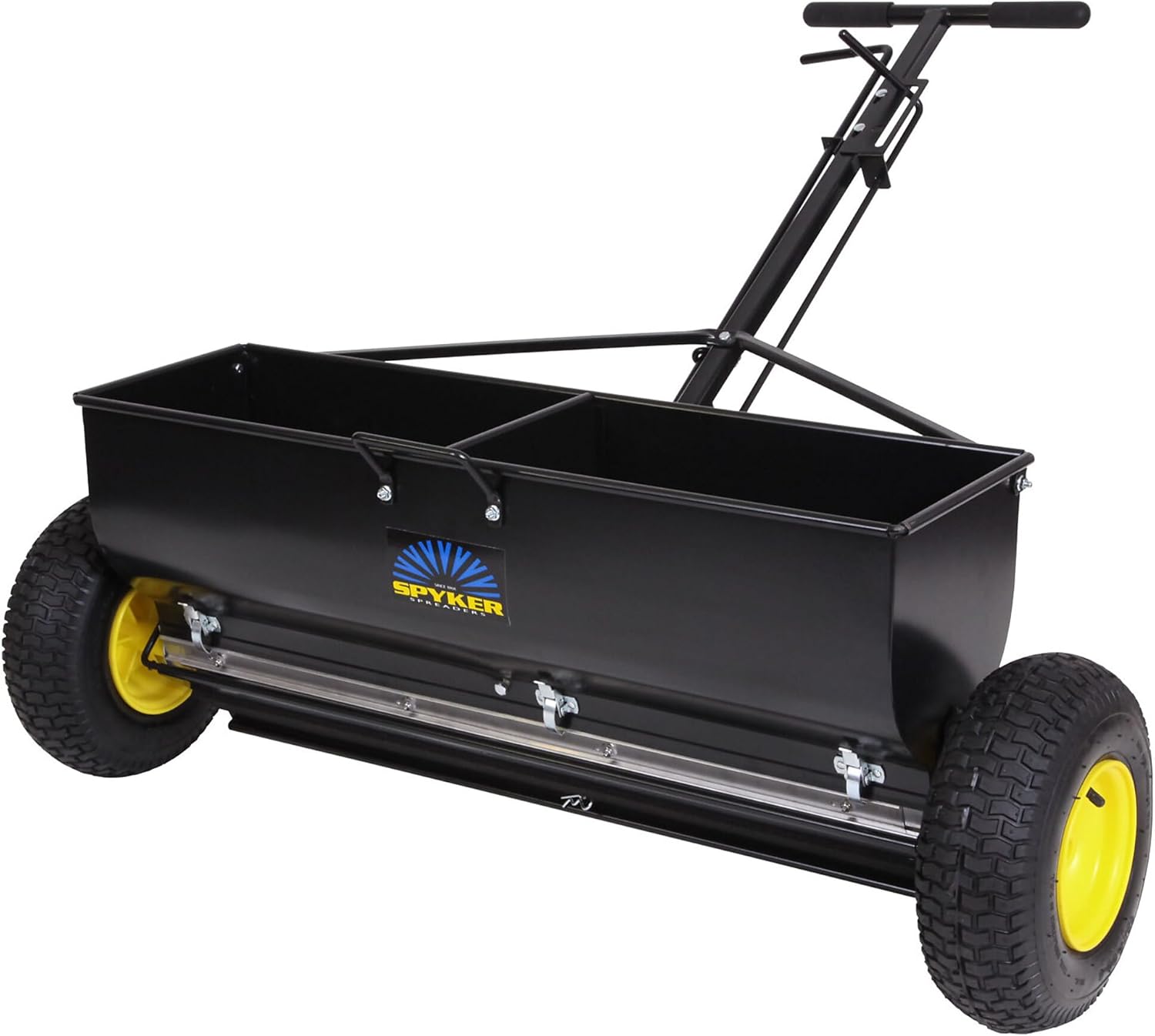
| Hopper capacity | 120 lb. |
|---|---|
| Spread width | 18" or 36" |
| Power source | Hand powered |
| Material | Alloy Steel |
The Spyker side-by-side drop spreader is built for accurate, repeatable coverage when you need spot-on placement of seed, fertilizer, or salt. Its dual hopper lets you run an 18 inch or full 36 inch drop pattern so you can aim materials into planting strips or cover wider runs without overspray. The Spyker Dial and Accuway calibration system help set consistent opening sizes while the fully enclosed metal gears and zerk fittings improve durability under frequent use. Large pneumatic tires smooth operation across turf and reduce rutting when the hopper is loaded. Typical use is hand-pushing across lawns, beds, sidewalks, and driveways where precise placement matters more than broadcast coverage. The unit is heavy and built from alloy steel with a powder-coated frame, so it feels solid but is less convenient to lift into a truck. Setup and calibration take a little time up front to get exact rates, and the spreader is best suited to users who value control over maximum speed of coverage.
Best for: Gardeners and groundskeepers who prioritize precise placement and repeatable calibration for seeding, fertilizing, or ice-melt tasks and who accept a sturdy, workhorse tool over lightweight convenience.
Less Ideal for: Users who need to cover very large acreages quickly or who prefer lightweight, easily portable equipment for occasional residential use.
- Dual side-by-side hopper supports precise 18" or 36" drop widths for targeted application
- Accuway Spyker Dial provides accurate calibration for consistent material rates
- Fully enclosed metal gears with grease fittings improve long-term durability
- Large pneumatic tires reduce turf impact and ease pushing over uneven ground
- Heavy steel construction makes it bulky to lift or move when empty
- Manual hand-powered operation is slower than motorized alternatives
Verdict: Choose this Spyker drop spreader when you need rugged build and precise, adjustable drop placement for professional-quality seeding and deicing.
Yard Commander 60 lb Walk-Behind Drop Spreader

| Capacity | 60-Pound |
|---|---|
| Coverage | Up to 15,000 SQFT |
| Spread pattern | 22-inch |
| Tire size | 12-inch never-flat tires |
| Frame finish | Powder-coated steel |
The Yard Commander 60 lb walk-behind drop spreader is a straightforward tool for applying fertilizer, seed, or granular treatments across yards up to about 15,000 sq ft. Its composite hopper resists corrosion and is easy to rinse after use, while the factory-attached adjustment lever and cable simplify initial setup and let you open and close the hopper gate reliably. The unit rides on 12-inch never-flat tires and sits on a powder-coated steel frame that improves stability and resists rust in regular outdoor use. The drop-style design and adjustable flow control handle make it easier to place materials precisely along beds, walkways, and lawn edges compared with broadcast spreaders, and the quoted 22-inch spread pattern gives predictable coverage for planning passes. Limitations to expect are the need to walk the entire area for larger properties and the lower capacity relative to tow-behind or broadcast models, so you will refill more often on bigger jobs. Assembly is required but the most important control comes preinstalled to reduce hassle.
Best for: Buyers who want a low-cost, no-frills walk-behind spreader for routine lawn maintenance on small to medium yards and who prioritize reliable materials handling over high-capacity or towable attachments.
Less Ideal for: Not the best choice for users who need to cover large acreage quickly or who prefer a broadcast or tow-behind spreader that minimizes refills and walking.
- Corrosion-resistant composite hopper that is easy to clean after use
- Adjustable flow control with factory-adjusted cable for simple, accurate spreading
- 12-inch never-flat tires provide traction and eliminate flat tire downtime
- Powder-coated steel frame adds durability and resistance to rust
- Designed coverage up to 15,000 sq ft with a consistent 22-inch spread pattern
- 60 lb capacity means more frequent refills on larger properties
- Drop spreader design covers a narrower swath than broadcast models, increasing pass count
Verdict: A practical, budget-friendly drop spreader that gives precise, corrosion-resistant performance for small to medium lawns.
At Home 75 lb Drop Spreader
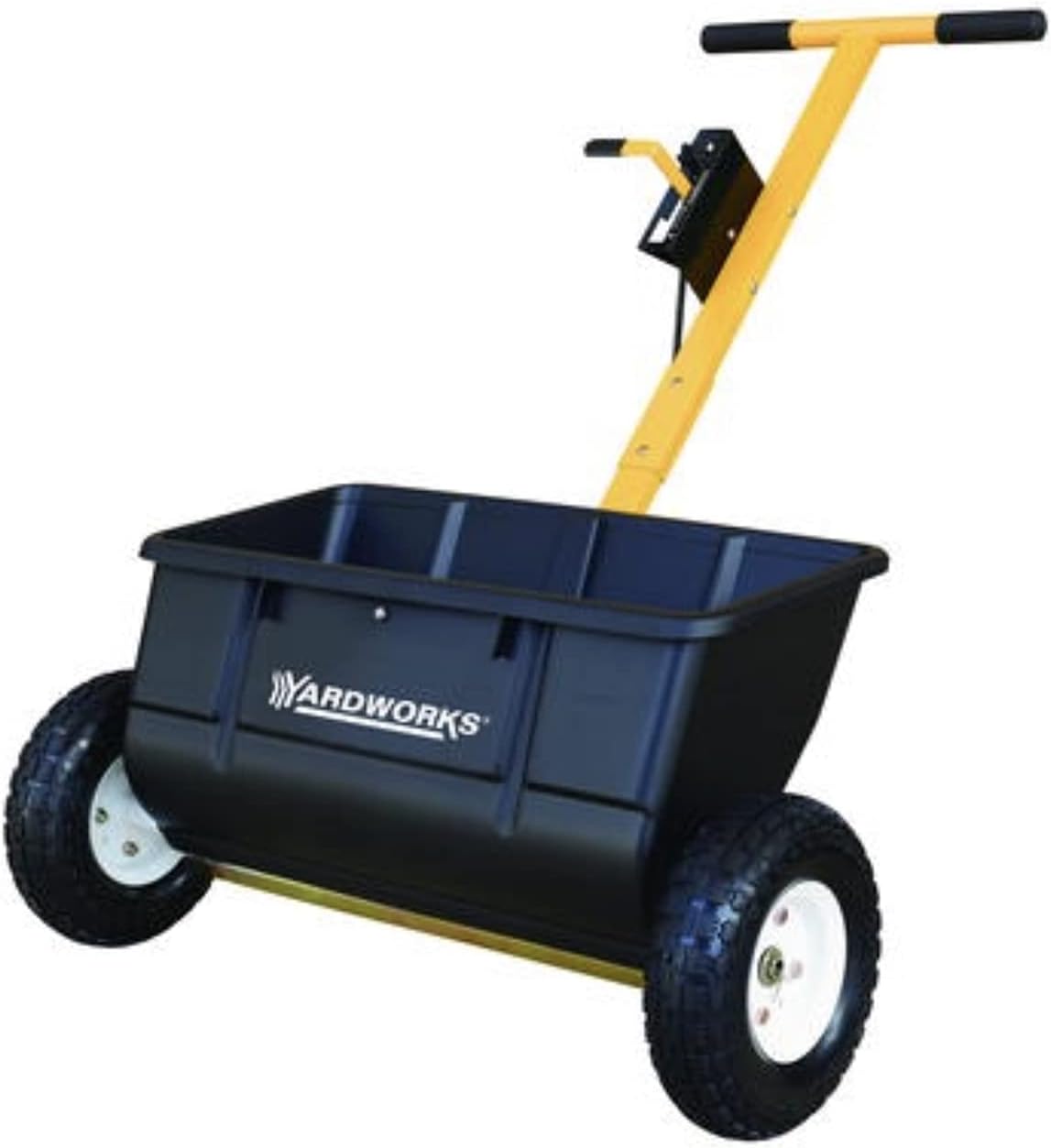
| Maximum Weight Capacity | 75 lb |
|---|---|
| Wheel Diameter | 10 inch |
| Tray Material | Poly |
| Handle Material | Steel |
The At Home 75 lb Drop Spreader is a straightforward, reliability-minded tool for homeowners who need consistent, even application of seed and granular lawn products. It is manually operated with a 75 lb tray and a steel flow control that the product describes as maintenance-free, which helps deliver predictable application rates. Ten-inch never-flat rubber tires and galvanized steel agitators reduce downtime by resisting flats and breaking up lumps so material feeds smoothly. Foam-padded handles improve comfort during extended use and the unit requires some assembly but otherwise is ready for seasonal tasks. Because it is a drop-style spreader, it places material directly beneath the cart for precise strips rather than wide broadcast patterns, making it better for overseeding, fertilizer bands, and targeted treatment. The trade-offs are that it is not motorized, so large commercial acreages will take longer, and the manual controls require walking at a consistent pace to maintain accuracy. For homeowners focused on steady, repeatable results, this spreader is a practical, low-maintenance choice.
Best for: Homeowners who prioritize consistent, low-maintenance lawn application and want precise placement for seed or fertilizer on medium to large yards.
Less Ideal for: Commercial landscapers or users with multiple acres to cover who need faster, motorized, or tow-behind spreaders for higher productivity.
- 75 lb hopper capacity for covering large residential lawns in fewer refills
- Never-flat 10-inch rubber wheels reduce interruptions from flats
- Galvanized steel agitators help prevent clogging by breaking up lumps
- Steel flow control claimed to be maintenance-free for consistent dispensing
- Foam-padded handles improve comfort during extended use
- Manual operation slows work on very large properties compared with tow-behind or powered spreaders
- Drop pattern is narrow so it is less efficient for broadcasting over very wide areas
Verdict: Buy this spreader if you want a dependable, low-maintenance manual drop spreader that delivers precise, repeatable placement for home lawns.
Agri-Fab 45-0288 175 lb Tow-Behind Drop Spreader, 42" Spread

| Capacity | 175 pounds |
|---|---|
| Spread width | 42" controlled spread width |
| Coverage | Approximately 40,000 sq ft |
| Wheels | 12" x 3.5" pneumatic tires |
| Construction | Poly hopper with galvanized steel agitator |
The Agri-Fab 45-0288 is a tow-behind drop spreader made to cover roughly one acre per fill and simplify large-lawn maintenance. It is typically hitched to a lawn or garden tractor and used for spreading seed, fertilizer, ice melt, or salt across lawns and driveways; the on/off control is accessible from the tractor seat for convenient operation. Notable features include a rustproof poly hopper with a 175 lb (17 gallon) capacity that reduces refill interruptions, a 42 inch controlled spread width for precise placement, and 12" pneumatic tires that help with smooth towing over uneven turf. Construction uses galvanized steel components for the agitator and an alloy frame to stand up to regular outdoor use. Expect straightforward assembly and durable year-round performance, though this model requires a tractor or tow vehicle and is sized for larger properties rather than small yards. It does not include integrated spiking or powered agitation, so very heavy or damp materials may need checking for flow consistency.
Best for: Buyers who manage medium to large lawns and prioritize reliable, proven equipment that reduces time spent refilling and gives consistent, precise drop spreading when towed behind a tractor.
Less Ideal for: Homeowners with small yards, those who need a push spreader, or anyone wanting built-in spiking or powered agitation should consider other options.
- Large 175 lb (17 gallon) hopper reduces frequency of refills for acre-sized jobs
- 42 inch controlled spread width delivers more precise material placement
- Rustproof poly hopper and galvanized components resist corrosion for longer life
- On/off control accessible from the tractor seat makes operation convenient while towing
- Requires a tow vehicle such as a garden tractor, so not suitable for walk-behind use
- No powered agitation or spiker attachment included which can limit flow with damp or clumping materials
Verdict: Choose this Agri-Fab tow-behind drop spreader when you need a durable, high-capacity unit that delivers precise, acre-sized coverage with minimal refills.
Choosing the Right Drop Spreader: Key Factors to Consider
Spread Accuracy and Metering
Precise metering is the primary reason gardeners choose a Drop Spreader. A well-designed drop gate and clear calibration markings let you apply seed or granular fertilizer at the rate specified on the product label. In practice this reduces waste, prevents overfeeding turf, and avoids accidental damage to nearby plants.
Consider how well the spreader maintains a consistent output at common walking speeds. Look for adjustable gate settings with tactile detents and calibration charts that match standard product granularities. If a model provides a way to test a measured scoop or conduct a short trial run, that makes real-world calibration much easier.
Hopper Capacity and Refill Frequency
Hopper size determines how often you stop to reload during a job. For small lawns and patch repairs, a compact hopper keeps the unit lightweight and easier to maneuver. For larger small-to-medium lawns, a bigger hopper reduces trips back to the bag but adds weight and can affect handling.
Think about the typical area you need to treat and the granule density of the materials you use. Heavy, coarse fertilizers weigh more and will make a full hopper feel substantially heavier. Also factor in whether you prefer fewer refills at the expense of carrying extra weight, or a lighter unit you can move more nimbly around obstacles.
Build Materials and Corrosion Resistance
Spreaders are exposed to abrasive and corrosive materials. Hoppers made from UV-stabilized plastic resist cracking and rust-free frames or powder-coated steel increase service life. Stainless or zinc-plated fasteners and sealed gears help prevent early failure in damp storage conditions.
Inspect how easily the hopper and gate can be rinsed and whether there are nooks that trap moisture and fertilizer dust. Replaceable wear parts and an accessible gear train extend usable life and simplify repairs if an abrasive material abrades components.
Wheel and Gear Performance
Wheel diameter, tread pattern, and gearing determine how smoothly the metering runs as you walk. Larger wheels roll over rough turf more smoothly and maintain consistent gear engagement, which supports even distribution. Fine-tooth gearing can give better low-speed control but may clog more easily with grit.
Check for sealed bearings or bushings that resist grit, and for a gear drive that offers a positive feel without jerkiness. Smooth, predictable operation reduces the chance of streaks or uneven application, especially when turning or moving at walking pace across a varied surface.
Calibration, Controls, and User Comfort
Controls should be intuitive and reachable while walking. A lever or dial that adjusts the gate without stopping improves accuracy and saves time. Comfortable handle height, grip shape, and the ability to adjust for operator height reduce fatigue on larger jobs.
Consider whether the model allows you to quickly close the gate to preserve unused product when crossing driveways or flower beds. A secure gate latch and positive open/close action prevent accidental spillage and make multi-tasking in the yard easier.
Maintenance and Serviceability
A spreader that is easy to clean and service will last longer and perform reliably. Removable hoppers, accessible gear covers, and standard fasteners allow routine maintenance and part replacement without specialized tools.
Evaluate how simple it is to flush out old fertilizer, inspect the gate for wear, and replace wheels or linkages. Models with documented spare parts availability or modular components reduce downtime and expense over the tool's lifetime.
When a Drop Spreader Is the Right Tool
Drop spreaders excel when you need targeted placement along edges, in small patches, or under trees where overspray would harm plants or create waste. Because they release material directly below the wheels, they avoid the lateral scatter common with broadcast units.
Use drop-style spreaders for overseeding high-traffic strips, treating narrow lawn strips beside sidewalks, or placing starter seed in repair patches. They are less useful when you need wide-area, rapid coverage across very large properties because their lane width is narrow and throughput is lower.
- Best for precise strip work and patch repairs
- Reduces drift onto beds, pavement, and gravel
- Slower coverage rate but far more control
Calibrating Your Drop Spreader for Common Materials
Start with the manufacturer's chart if available, then perform a small test run over a measured distance to verify output. Use a known area and weigh or measure the material applied to match label recommendations. Adjust the gate incrementally and repeat until the measured application matches the recommended rate.
Remember that granular size and shape affect flow. Pelleted fertilizers, coarse seed mixes, and rock-like ice melt products will behave differently through the gate. If you change materials, re-check calibration rather than assuming previous settings still apply.
- Test on a measured strip to confirm settings
- Recalibrate when changing material type or moisture conditions
- Measure output by area, not by eye
Storing and Protecting a Drop Spreader
Rinse out residual product after use to prevent corrosive buildup and blockages. Let the hopper dry fully before storing to avoid trapped moisture that accelerates rust or clumping. Store the unit in a dry, sheltered location away from direct sunlight to protect plastic components from UV degradation.
If possible, raise the spreader off the ground to prevent wheel dampness and keep moving parts free from pests. Light lubrication of exposed linkages and occasional inspection of fasteners will keep the mechanism working smoothly season after season.
- Empty and rinse hopper after each use
- Store in a dry, sheltered place
- Inspect and lubricate moving parts periodically
Using a Drop Spreader in Narrow or Ornamental Areas
When working near flower beds or ornamental plantings, walk slowly and keep the gate closed during transitions to avoid accidental deposits. Use the spreader to place seed or fertilizer in a controlled band and follow with light raking only if recommended for the specific seed type.
For very tight spots where the spreader does not fit, consider using hand-held applicators for the final touches. However, a drop spreader can still serve well for the majority of the job by staying a few inches away from delicate borders.
- Close gate when crossing hard surfaces
- Use hand tools for the tightest spots
- Walk at consistent pace for even bands
Common Mistakes and How to Avoid Them
A frequent mistake is relying solely on visual judgment for spread uniformity. Always measure and test on a small area to confirm settings. Another common error is overfilling the hopper, which makes the unit harder to control and can change the effective metering because of increased pressure on the gate.
Also avoid storing granular products in a damp hopper. Clumping changes flow characteristics and can lead to streaks. Finally, do not ignore wheel or gear play; loose components create inconsistent gate actuation and uneven application.
- Test settings rather than guessing
- Avoid overfilling the hopper
- Keep the hopper dry and components tight
How We Chose the Best Drop Spreader
We shortlisted Drop Spreaders that consistently deliver accurate, repeatable placement for seed and granular lawn treatments. The main evaluation criteria were spread accuracy and calibration ease, because precise metering is the core benefit of drop-style units. Build durability and hopper materials were assessed to predict how the tool stands up to wet storage, abrasives, and repeated use. Capacity and portability were considered to match typical small to medium lawn sizes without excessive refills. Control and handling-measured by wheel quality, gearing smoothness, and operator comfort-were included to reflect real-world use over walks and around landscape features. We also checked ease of cleaning and maintenance, since grit and fertilizer can clog mechanisms or corrode components. We excluded broadcast-only spreaders and units designed solely for commercial, high-acreage turf care because they are not optimized for the precise placement needs of home lawns and tight planting areas. Products with unclear calibration markings or without replaceable wear parts were deprioritized. The result is a focused list of drop-style spreaders that balance meter precision, durable construction, and appropriate capacity for typical residential gardening tasks.
FAQ
Can I use a Drop Spreader for both seed and fertilizer?
Yes. Drop spreaders work for seed and many granular fertilizers because they meter material directly under the hopper. You should recalibrate when switching materials and confirm that the granule size flows well through the gate.
How wide is the coverage strip from a typical Drop Spreader?
Coverage width is usually narrow, often a few inches to a foot per pass depending on the model. Expect multiple parallel passes for a full lawn. The narrow strip is why drop spreaders are preferred for precision rather than rapid, broad coverage.
Will a Drop Spreader cause seed to clump or fail to germinate?
Clumping is usually due to damp seed or a dirty hopper rather than the spreader itself. Rinse and dry the hopper, and use seed mixes appropriate for drop application. Light incorporation or surface contact may be needed depending on seed type.
How often should I calibrate my Drop Spreader?
Calibrate at the start of each season and whenever you change product types or notice uneven application. Regular calibration checks after a few passes help catch changes due to wear or debris in the gate.
Is wheel size important for lawn surface types?
Yes. Larger wheels roll more smoothly over uneven turf and reduce gear slip, improving consistency. Small wheels can work on smooth surfaces but may create uneven metering on rough or thatchy lawns.
Final Verdict
For small and medium lawns where precision matters, prioritize a Drop Spreader with reliable metering, clear calibration, and robust materials. Decide between larger hoppers for fewer refills and lighter units for easier handling based on the size of your treatment area. Regular calibration, careful storage, and routine maintenance will deliver consistent results season after season. Focus on spread accuracy, smooth gearing, and corrosion-resistant construction when choosing. Those tradeoffs will ensure the tool performs precisely where you need it and lasts through repeated seasonal use.
