

Note: This article contains affiliate links. If you click on these links and make a purchase, I may earn a small commission at no extra cost to you. This helps support my research and content. Read my full affiliate disclosure here.
When drywood termites invade structural lumber, trim, or outdoor furniture, you need treatments that reach colonies inside wood and leave a persistent barrier against reinfestation. The right drywood termite killer matters because treatments vary by how they penetrate wood, how long they keep working, and how easy they are to apply safely in and around a home. This guide shortlists six top-performing options and focuses on practical factors gardeners and homeowners care about, including application method, residual protection, and suitability for interior versus exterior wood. Below you will find concise product summaries followed by decision-making guidance so you can pick the best treatment for your situation.
Top Picks at a Glance
| Best Quality Built to a higher standard if you want something more solid | BASF Termidor Foam 20 oz Termiticide/Insecticide |  |
| Best Value The sweet spot between price and what you get | Nisus Tim-BOR Professional Borate Powder, 1.5 lb |  |
| Best Budget The cheapest option that still gets the job done reliably | Spectracide Terminate Termite Killing Foam, 16 oz |  |
| Highest Rated A top-rated pick with lots of positive feedback | Nisus Tim-Bor Professional Insecticide/Fungicide Powder, 25 lb |  |
| Most Popular A crowd favorite that many people choose with confidence | TERRO Carpenter Ant, Termite & Carpenter Bee Killer Aerosol Spray, 16 oz (6 Count) |  |
| Best Seller A high-volume bestseller chosen again and again | Nisus Bora-Care Borate Termiticide and Wood Treatment, 1 Gallon |  |
BASF Termidor Foam 20 oz Termiticide/Insecticide

| Item Form | Spray |
|---|---|
| Target Species | Insects, Termite, Ant, Wood Boring Bugs |
| Special Features | Fast-Acting, Long-Lasting, Non-Staining |
| Liquid Volume | 20 fluid ounces |
| Specification Met | EPA |
Termidor Foam is a professional-strength, ready-to-use aerosol that expands into a dry foam to reach voids, galleries, and other hard-to-access harborages where termites and wood-destroying insects hide. You apply it directly from the can to suspected infestation sites on structural and non-structural elements such as wall voids, damaged wood, decks, poles, and tree cavities. The formulation contains fipronil and expands at roughly 30:1, so a small amount of product produces a large volume of foam that clings and stays intact longer than typical wet sprays. Because it is non-repellent, insects do not avoid treated areas and can transfer the active ingredient through the colony, which speeds control compared with baiting in many situations. Practical benefits include precise, localized treatment without whole-house fumigation and good persistence in sheltered cavities. Important limitations are that this is a spot treatment product rather than a full perimeter soil application and it requires careful adherence to label instructions and safety precautions when used indoors or near people and pets.
Best for: Buyers who prioritize fast, professional-level elimination of localized termite and wood-boring insect problems and need a product that delivers deep penetration into voids without whole-structure fumigation.
Less Ideal for: Homeowners seeking a one-step solution for complete perimeter protection or those unwilling to follow pesticide label and safety requirements should consider alternative integrated strategies or professional application.
- Ready-to-use aerosol foam that requires no mixing for fast spot treatments
- Expands about 30:1 to penetrate deep into voids, galleries, and nests
- Non-repellent fipronil formula allows transfer within the colony for broader control
- Dry foam has thicker cell walls and remains intact longer than liquid sprays
- Intended for targeted spot treatments, not as a substitute for full perimeter soil treatments
Verdict: Choose Termidor Foam when you need a professional-grade, ready-to-use foam that penetrates deep voids for fast, colony-level control of termites and wood-destroying insects.
Nisus Tim-BOR Professional Borate Powder, 1.5 lb

| Unit Count | 24 Ounce |
|---|---|
| Item Form | Powder |
| Target Species | Fungus |
| Liquid Volume | 1.5 liters |
| Specification Met | EPA |
Tim-BOR Professional is a versatile borate powder intended to protect and remediate wood against drywood termites, carpenter ants, wood decay fungi, and wood-boring beetles. It dissolves in water for spray or foam applications but can also be applied as a dust to reach cracks, voids, and exposed wood. The formulation is nonstaining and noncorrosive so it preserves the look of bare wood and will not damage fasteners. Practical benefits include multiple application options, long-lasting protection when applied correctly, and an EPA-recognized active ingredient derived from borate mineral. It is especially useful on untreated or new-construction wood where a 15% solution can create a durable preservative barrier. Important limitations are that it must be kept dry to remain effective, should not be used over painted or sealed surfaces, and requires correct mixing and application to hit hidden infestation sites. Users should follow label directions for safety and placement to avoid unnecessary exposure and to get reliable protection.
Best for: Buyers who prioritize durable, cost-effective wood protection and want a product they can apply themselves to prevent or treat wood-infesting pests in new construction or exposed untreated wood.
Less Ideal for: People wanting a ready-to-use spray for finished, painted, or sealed surfaces or those who prefer nonchemical pest control methods.
- Multiple application methods: dust, liquid, foam, or mist to reach exposed and hidden wood surfaces
- Effective against a broad set of wood pests and wood decay fungi
- Nonstaining and noncorrosive so it preserves wood appearance and fasteners
- EPA-recognized borate formulation with long-lasting protection when kept dry
- Must remain dry to be effective and cannot be used over painted or sealed surfaces
- Requires proper mixing and targeted application to treat infestations inside voids and cracks
Verdict: Choose Tim-BOR Professional when you need a proven, versatile borate treatment to prevent or remediate wood-destroying insects and decay in untreated or new-construction wood.
Spectracide Terminate Termite Killing Foam, 16 oz

| Unit Count | 16 Ounce |
|---|---|
| Item Form | Spray |
| Target Species | Insects |
| Liquid Volume | 16 fluid ounces |
Spectracide Terminate is a foaming aerosol formulated for targeted spot treatment of termites and carpenter bees. The foam expands to fill voids, cracks, and damaged wood channels, and the included extension tube helps direct the spray into hard-to-reach areas. It kills on contact and is intended for localized, above-ground infestations rather than whole-structure protection. The product is non-staining once applied and dries to allow people and pets to contact surfaces after drying, but label directions should be followed closely because it contains petroleum distillates and active insecticides. Typical use cases are treating visible tunnels, voids, and small infested spots around foundations, crawl spaces, window frames, or wooden trim. It is easy to apply for homeowners who want a fast, inexpensive way to knock down exposed pests, but it is not a substitute for professional treatment for active or widespread infestations. Read the label for safe use and reapplication guidance.
Best for: Homeowners on a budget who need a straightforward, do-it-yourself spot treatment for visible termite or carpenter bee activity and want a quick knockdown for small problem areas.
Less Ideal for: Property owners dealing with widespread, concealed, or active infestations that need comprehensive colony-level control should choose professional services or perimeter treatments instead.
- Foaming formula expands into voids and cracks for targeted contact kill
- Extension tube allows precise application into hard-to-reach areas
- Non-staining finish after drying so treated surfaces remain cosmetically acceptable
- Suitable for both indoor and outdoor spot treatments
- Intended only for localized, above-ground control and not a replacement for professional whole-structure treatments
- Contains petroleum distillates and insecticide actives that require careful handling and adherence to label instructions
Verdict: An affordable, easy-to-use foaming spray for DIY spot treatment of visible termite and carpenter bee activity.
Nisus Tim-Bor Professional Insecticide/Fungicide Powder, 25 lb

| Brand | Nisus |
|---|---|
| Unit Count | 400 Ounce |
| Included Components | 1 25 pound tub of Nisus Tim-Bor |
| Item Form | Powder |
| Target Species | Insects |
Tim-Bor Professional is a concentrated disodium octaborate tetrahydrate powder that protects bare wood and treats active infestations when mixed as a liquid or applied as a dust. It is typically mixed with hot water to make a 10–15% solution for brushing or spraying decks, fences, sheds, steps, and other exterior wood; the powder can also be dusted directly into drywood termite galleries where it can kill termites in about a week. The product’s core strength is long-term, nonvolatile protection: borate penetrates the wood and provides both fungicidal and insecticidal action without leaving a surface film. Practical benefits include suitability for preventative treatment of new construction and targeted remediation of infestations, and the large 25 pound tub supports multiple projects. Important limitations are that treated wood must be protected from heavy rain because borates are water soluble, and it requires careful measuring and mixing for liquid applications rather than a ready-to-use spray.
Best for: Homeowners or contractors who prioritize dependable, long-lasting wood protection and want a single treatment that addresses both decay fungi and wood-infesting insects for decks, fences, and outbuildings.
Less Ideal for: Users who need a quick, ready-to-use spray or who cannot protect treated wood from weather exposure should consider alternative, nonwater-soluble options.
- Provides both insecticidal and fungicidal protection in a single product
- Can be used as a dust for direct termite galleries or mixed into a 10–15% liquid for surface treatment
- Penetrates and preserves wood for long-lasting protection when kept dry
- Large 25 pound tub is suitable for treating multiple structures or large projects
- Water soluble so performance is reduced on exterior wood exposed to heavy, repeated rain
- Requires measuring and mixing to prepare solutions rather than being ready to use
Verdict: Choose Tim-Bor when you need proven, long-lasting borate wood protection and insect control for preventative or remedial treatments on exterior wood that can be kept dry.
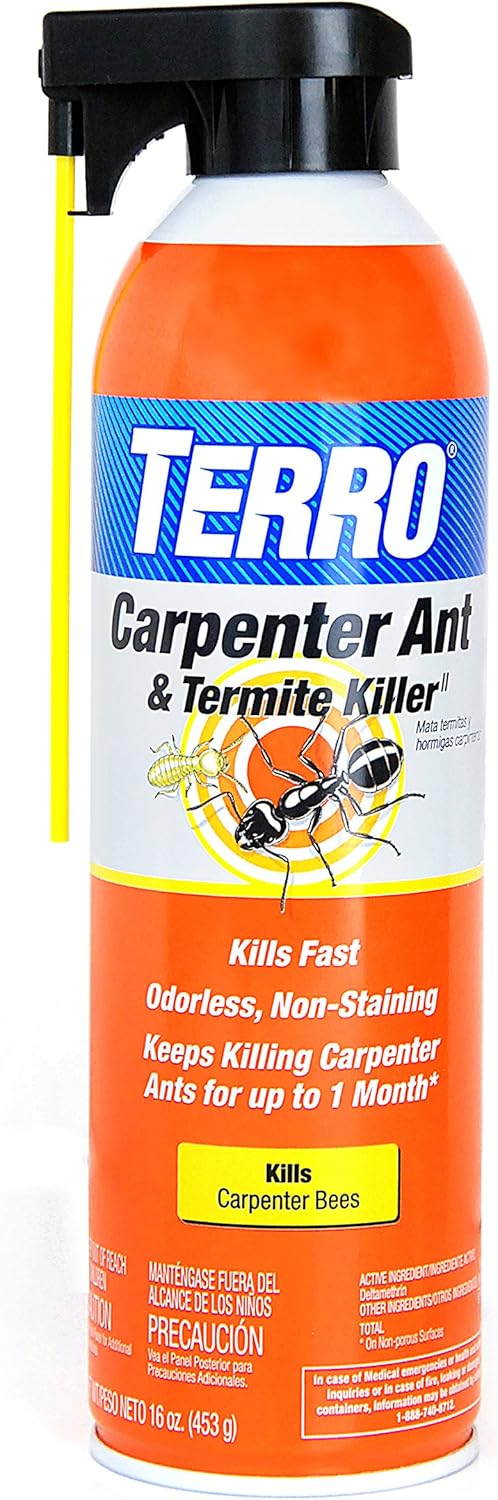
TERRO Carpenter Ant, Termite & Carpenter Bee Killer Aerosol Spray, 16 oz (6 Count)
| Item Form | Spray |
|---|---|
| Target Species | Carpenter ants, Carpenter bees, Termites, Wood wasps, Beetles& Borers |
| Liquid Volume | 16 fluid ounces |
| Unit Count | 6 Count |
This TERRO aerosol is designed to kill carpenter ants, carpenter bees, termites, wood wasps, beetles and borers with a fast-acting contact formula and residual control. It is used by spraying directly into cracks, crevices, wall voids and onto infested wood or around entry points; the two-way nozzle lets you switch between a broad spray for surfaces and a narrow jet for precision treatment. The formula is described as non-staining and odorless, so it can be applied indoors or outdoors without obvious residue or smell. Practical benefits include the convenience of a ready-to-use can, flexible spraying patterns for targeted spot treatments, and a month of residual activity that helps reduce short-term reinfestation. Important limitations are that aerosols are best for localized or early problems and the product is not recommended as the sole solution for active termite infestations, which may require professional inspection and treatment for full colony control.
Best for: Homeowners who want a convenient, store-bought spray to treat isolated wood-infesting pests and to spot-treat entry points or visible infestations with minimal preparation.
Less Ideal for: People facing a widespread or established termite problem, multi-structure infestations, or those who prefer long-term integrated pest management without aerosol use.
- Ready-to-use aerosol requires no mixing or special equipment
- Two-way nozzle for both wide coverage and precise crack-and-crevice application
- Label claims fast contact kill plus up to one month residual control
- Non-staining, low-odor formula suitable for indoor and outdoor spot treatments
- Aerosol cans are intended for localized treatments and may not eliminate large or hidden infestations
- Not recommended as a standalone solution for active termite colonies
Verdict: A convenient, ready-to-use aerosol for quickly treating and reducing visible wood-infesting pests around the home.
Nisus Bora-Care Borate Termiticide and Wood Treatment, 1 Gallon

| Unit Count | 128 Fluid Ounces |
|---|---|
| Item Form | Spray |
| Target Species | Insects |
| Active Ingredients | disodium octoborate tetrahydrate |
Bora-Care is a professional-grade borate concentrate designed to treat exposed wood and provide long-term protection against termites, wood-boring beetles, carpenter ants, and decay fungi. You dilute the concentrate and apply it directly to wood surfaces or to a two-foot treatment band around framing members; once absorbed the active ingredient becomes part of the wood and remains effective for the life of the structure. The product is commonly used during new construction at the dried-in phase and for spot treatments on existing homes where soil treatments are undesirable. Its main strengths are deep penetration and long residual protection without the need to apply chemicals to surrounding soil, which is useful for sensitive sites like lakeside properties. Important trade-offs are that it requires proper dilution and application technique to be effective and it only protects treated wood rather than creating a treated soil barrier, so it is not a complete replacement for other integrated pest management measures in every situation.
Best for: Homeowners who prioritize long-term, low-environmental-impact protection for structural wood and who want a preventative or corrective treatment they can apply during construction or for targeted repairs.
Less Ideal for: Buyers seeking a simple ready-to-use surface spray or a product that treats soil around a structure should consider other options that create a soil barrier or offer easier application.
- Penetrates and bonds with wood fibers for long-lasting residual protection
- Targets a broad range of wood-destroying pests including termites and wood-boring beetles
- Concentrated 1-gallon formula covers a large area when mixed correctly
- Does not require soil injection, reducing chemical exposure to surrounding ground and water
- Requires correct dilution and application technique to be effective
- Protects only treated wood and does not create a treated soil barrier
Verdict: Use Bora-Care when you want a long-lasting borate treatment that penetrates wood for lifetime protection against termites and wood-destroying insects.
Choosing the Right Drywood Termite Killer: Key Factors to Consider
Mode of Action and Wood Penetration
How a treatment reaches termites inside dry wood determines its effectiveness. Some formulations rely on liquid solvents that soak into wood grain, while others use dusts that get carried back to galleries on the insects themselves. Products that penetrate deeply are better for treating larger colonies inside beams or thick trim. Transferable actives that termites spread through contact or grooming increase the chance of colony-level control.
Consider the thickness of the wood you need to treat and whether the product's application method will actually reach the galleries. Surface sprays may only affect insects near the surface, whereas injected or fumigant-based approaches can access deeper galleries when used according to label directions.
Residual Life and Re-treatment Interval
Residual protection determines how long treated wood remains hostile to reinfesting termites. A product with a longer residual reduces the frequency of follow-up treatments and gives ongoing protection for vulnerable structures such as exposed decking or fascia. Residual life often depends on the active ingredient's persistence in wood and whether it is prone to degradation from sunlight, moisture, or abrasion.
When planning treatment, factor in the expected longevity of protection versus the typical exposure conditions. Exterior wood exposed to rain and sun may require more frequent maintenance treatments or a different product than interior structural members.
Application Method and Equipment Needs
Different drywood termite killers require different application approaches: ready-to-use sprays, concentrated liquids to dilute, dusts, or injection systems. Some methods need basic hand tools like injector syringes or caulking guns, while others work with a standard garden sprayer. Choose a product compatible with tools you already own or can comfortably use. Ease of application also affects safety because complicated setups increase the chance of application errors.
Also consider how discreet you need the treatment to be. Injection or localized dusting targets specific galleries and is less disruptive to finishes than broad-surface sprays. If you have limited space or are treating interior trim, a precise applicator is often preferable.
Surface and Finish Compatibility
Some termiticides can stain, soften, or otherwise affect paints, stains, and delicate wood finishes. If you plan to treat visible trim, furniture, or finished surfaces, check whether the product is intended for use on finished wood or whether it requires masking and post-treatment refinishing. Wood compatibility also includes whether the chemical alters the wood's appearance or impedes future staining or painting.
For historic or decorative woodwork, prioritize products labeled safe for finished surfaces or plan to test on a small hidden area first. For rough-cut lumber in outbuildings, surface compatibility may be less critical than penetration and residual life.
Safety, Label Instructions, and Environmental Considerations
Termite treatments range in toxicity and required precautions. Look for clear label instructions about personal protective equipment, ventilation for indoor use, and post-application re-entry intervals. Safety guidance also covers disposal of leftover product and contaminated applicators. Consider how treatments affect non-target organisms, especially if applied near pollinator habitat or vegetable and herb gardens.
If you need a solution safe for close proximity to people and pets, prioritize products with lower acute toxicity and explicit indoor-use instructions. For outdoor-only applications, confirm runoff and waterway precautions to prevent harm to aquatic life.
Regulatory Labeling and Use Restrictions
Legal and effective termite control depends on following labeled uses. Some effective products are restricted to licensed professionals or limited to certain substrates. Confirm that the product is labeled for drywood termite species and the type of wood you intend to treat. Label restrictions also define allowable application techniques, maximum treated area per unit, and whether retreatment intervals are mandated.
Ignoring label restrictions can result in ineffective control or regulatory violations. When in doubt, consult the label or a professional to ensure the chosen approach is authorized for your situation.
When to Treat Versus When to Monitor
Spotting live termites, active droppings, or fresh damage are clear signs that treatment is warranted. However, not every small sign requires immediate widespread application. Monitoring can be a sensible first step in low-activity situations because seasonal activity varies and subterranean incursions differ from established drywood colonies.
Set up a monitoring plan when evidence is limited: mark affected areas, remove clutter that hides damage, and check for new droppings periodically. If activity increases or gallery damage progresses, escalate to targeted treatment using a product suitable for wood penetration and colony elimination.
- Use monitoring to establish whether damage is active or historical.
- Prioritize treatment for load-bearing or frequently used structures.
- Retreat or widen treatment area when new activity appears after monitoring.
Nonchemical and Preventive Measures
Physical and maintenance steps reduce the risk of drywood termite establishment. Keep wood off the ground, maintain good ventilation in crawlspaces and attics to reduce moisture, and seal gaps where wood meets masonry or eaves. Removing infested material is an option for isolated pieces of furniture or trim.
For prevention on new wood, use naturally resistant species or pressure-treated lumber in vulnerable outdoor locations. Regular inspections and good wood management often reduce the need for repeated chemical treatments.
- Repair water leaks and eliminate wood-to-soil contact.
- Store firewood away from structures and inspect before bringing it indoors.
- Consider routine inspections of attics, eaves, and decking for early signs.
Application Tips for Interior Woodwork
When treating interior trim, baseboards, or furniture, choose a method that minimizes finish damage and indoor exposure. Injection or localized dusting into galleries allows you to target the colony while leaving surrounding finishes intact. Work in a well-ventilated area and follow label re-entry times.
Protect floors and nearby furnishings during surface spray applications by masking and containing overspray. Always use the recommended personal protective equipment and avoid applying treatments where they could contact food preparation surfaces or edible plants.
- Test sprays and solvents in an inconspicuous spot before treating visible surfaces.
- Use syringes or injectors for precise gallery treatments.
- Ventilate treated rooms according to label guidance before reoccupying.
Treating Exterior Wood and Decking
Exterior applications must account for weather exposure and abrasion. Surface sprays can protect exposed surfaces but may wash off faster in wet conditions. For long-term protection on decking or fascia, look for products with proven persistence in outdoor conditions or consider combining a penetrant treatment with a water-resistant finish after the correct drying interval.
Ensure that runoff does not enter garden beds or water features. Time applications for dry weather and follow label directions regarding irrigation avoidance after treatment.
- Apply during dry weather for better penetration and reduced runoff.
- Avoid treating blooming plants or areas where pollinators forage.
- Reapply at intervals recommended for outdoor exposure when needed.
When to Call a Professional
Large infestations, structural damage, or situations requiring fumigation or tenting are best handled by licensed professionals. Professionals can perform inspections, confirm species, and use specialized tools or formulation types that may be restricted to certified applicators.
If your inspection uncovers extensive gallery networks in major structural members, or if you are uncertain about safety or label restrictions, a professional assessment can provide a safe and thorough treatment plan.
- Seek professional help for heavy infestations or structural concerns.
- Professionals can advise on long-term prevention strategies and warranties.
- Licensed applicators can access restricted-use products when appropriate.
How We Chose the Best Drywood Termite Killer
We prioritized products that offer modes of action effective against termites that live inside dry wood and materials commonly found in yards, outbuildings, and home interiors. Evaluation criteria focused on proven penetration or transfer mechanisms, measurable residual protection, and options compatible with typical homeowner application methods such as injection, surface spray, or localized dust. Safety in occupied spaces and clear label directions were essential filters because termite treatments must be used according to label to protect people, pets, and beneficial insects. We also weighed product versatility across common wooden substrates including siding, decking, furniture, and framing, plus ease of cleanup and compatibility with finishes. Excluded from consideration were general-purpose insect sprays not labeled for structural drywood termite control, fumigants requiring licensed applicators only, and experimental formulations lacking clear application guidance. The short list reflects products that meet regulatory labeling for drywood termite use, provide clear application options for homeowners or pros, and balance efficacy with user-focused features like applicator compatibility and re-treatment intervals.
FAQ
How long before treated wood is safe to touch or reenter indoors?
Re-entry times vary by product and formulation. Many sprays and dusts allow reentry once treated surfaces are dry and ventilation guidelines are met, while some concentrated treatments specify a wait period. Always follow the product label for exact re-entry intervals and safety steps.
Can I use a surface spray to eliminate a deep drywood colony?
Surface sprays may kill exposed termites but often fail to reach deep galleries. For established colonies inside thick wood, injection, dusting into galleries, or treatments designed for penetration are usually more effective. Assess gallery depth before relying solely on a surface application.
Are there low-toxicity options safe near children and pets?
Options with lower acute toxicity and clear indoor-use labeling exist, but safety still depends on correct application and adherence to label directions. If household exposure is a concern, choose products labeled for indoor use with minimal precautions and follow protective measures during and after application.
How often should I retreat treated exterior wood?
Retreatment intervals depend on the product's residual life and environmental exposure. Exterior wood exposed to rain and sun typically needs more frequent inspections and possibly earlier retreatment than interior wood. Follow label recommendations and inspect annually for new activity.
Will treating one infested board protect adjacent boards?
Treating one board can reduce local termite activity, but neighboring boards may still harbor colonies. Transferable actives and good penetration improve the chance of broader control, but monitoring adjacent wood and treating as needed is prudent to prevent spread.
Final Verdict
Prioritize treatments that match the infestation scale and the wood you need to protect. For isolated galleries and finished interior wood, precision methods like injection or dusting preserve finishes and limit exposure. For exterior or heavily infested members, choose a penetrating treatment with proven residual life and follow re-treatment guidance. Balance penetration, residual protection, and safety when selecting a drywood termite killer. Testing small areas and monitoring after treatment helps confirm success and indicates whether follow-up action is needed.
