

Note: This article contains affiliate links. If you click on these links and make a purchase, I may earn a small commission at no extra cost to you. This helps support my research and content. Read my full affiliate disclosure here.
Choosing the right early spring weed and feed matters because the window between dormancy ending and active growth is short and delicate. The wrong formulation can stress grass, leave clumps, or fail to stop fast-spreading broadleaf weeds. This guide focuses on Early Spring Weed and Feed products suited to that transitional moment in lawns and turf. We shortlisted six leading options and evaluated them on turf safety, weed control speed, fertilizer balance, and ease of application. Read on to understand the tradeoffs so you can pick a product that protects young blades while delivering effective early-season weed control.
Top Picks at a Glance
| Best Overall The best all-around choice for most situations | Scotts Turf Builder Halts Crabgrass Preventer with Lawn Food (covers 5,000 sq. ft.) |  |
| Best Quality Built to a higher standard if you want something more solid | The Andersons Barricade 18-0-4 Granular Fertilizer with Pre-Emergent (18 lb, 5,000 sq ft) |  |
| Best Value The sweet spot between price and what you get | BioAdvanced 5-in-1 Weed and Feed Granules (9.6 lb) |  |
| Best Budget The cheapest option that still gets the job done reliably | Spectracide Weed & Feed 20-0-0 Ready-to-Spray, 32 oz |  |
| Highest Rated A top-rated pick with lots of positive feedback | AgChimp 18-0-9 Pre-Emergent Herbicide & Precision Lawn Fertilizer, 15 lb |  |
| Best Seller A high-volume bestseller chosen again and again | Scotts Turf Builder Weed & Feed5 Granular Lawn Fertilizer (33.95 lb) |  |
Scotts Turf Builder Halts Crabgrass Preventer with Lawn Food (covers 5,000 sq. ft.)

| Item Form | Granule |
|---|---|
| Coverage | 5000 square feet |
| Unit Count | 213.6 Ounce |
| Fertilizer analysis | 30-0-4 |
Scotts Turf Builder Halts combines a pre-emergent crabgrass preventer with a granular lawn fertilizer to protect and feed an established lawn through the spring. You apply it once in early spring to a dry lawn before regular hot weather, using a broadcast or drop spreader and then water the lawn lightly within 2 to 3 days so the active ingredient forms a barrier in the soil. The product covers 5,000 sq. ft. per bag and is formulated to prevent several grassy and broadleaf weeds while the 30-0-4 fertilizer helps grass green up quickly and build deeper roots. Practical benefits include season-long prevention of new crabgrass and simultaneous feeding, which reduces extra steps in spring lawn care. Limitations are that it will not kill mature crabgrass or existing weeds and it is not suitable for certain turf types like dichondra or bentgrass. Also, correct spreader settings and post-application watering are important for reliable performance, so casual or inexperienced applicators should follow directions closely.
Best for: Homeowners who prioritize reliable, season-long prevention and want a simple spring treatment that both blocks new crabgrass and feeds the lawn.
Less Ideal for: People needing a post-emergent weed killer for existing crabgrass or those managing dichondra or bentgrass turf should choose a different product.
- Pre-emergent formula prevents crabgrass and several other grassy weeds when applied correctly
- Includes fertilizer (30-0-4) for fast green-up and stronger root development
- Single-application coverage for 5,000 sq. ft. reduces repeat treatments in spring
- Granular form works with common broadcast and drop spreaders for even application
- Does not control established or mature crabgrass or existing weeds
- Not safe for use on dichondra and bentgrass lawns
Verdict: Choose this product if you want a dependable one-time early-spring treatment that prevents new crabgrass while feeding and strengthening your lawn.
The Andersons Barricade 18-0-4 Granular Fertilizer with Pre-Emergent (18 lb, 5,000 sq ft)

| Item Form | Granule |
|---|---|
| Coverage | 5,000 sq ft |
| Active Ingredients | Prodiamine |
| Unit Count | 288 Ounce |
The Andersons Barricade is a combined pre-emergent weed controller and fertilizer intended for preventive lawn care over roughly 5,000 square feet. You apply it in early spring or fall to establish a chemical barrier that stops weed seeds such as crabgrass, poa annua, and goosegrass from germinating, while the 18-0-4 formulation supplies nitrogen and potassium to promote thicker turf. The product uses a dispersible granule technology so particles dissolve quickly with watering and move into the soil where prodiamine works most effectively. Practical users will appreciate that it is designed specifically for prevention rather than post-emergent weed removal, so it should be part of a seasonal maintenance plan rather than a quick fix for existing infestations. Directions limit application timing to early spring and fall, and it will not kill established weeds, so expect to combine this with spot treatments or mechanical removal if you already have visible weeds. Overall it simplifies routine turf care by pairing nutrition and preventive weed control in one product for landscape-scale yards.
Best for: Homeowners who plan seasonal lawn maintenance and want to prevent weed emergence while supplying nitrogen to encourage thicker turf; good for those who schedule spring and fall treatments into their yard care routine.
Less Ideal for: People needing an immediate solution for visible or mature weed problems or those who require year-round weed control without seasonal applications.
- Combines pre-emergent herbicide and fertilizer so one application both feeds turf and prevents seeded weeds
- Covers up to 5,000 sq ft per bag, suitable for medium to large lawns
- Dispersible granule (DG) technology dissolves quickly and moves active ingredient into the soil after watering
- Targets a broad range of common grassy and broadleaf weeds including crabgrass and poa annua
- Does not control or remove existing weeds because it is a preventive product
- Application is season-limited to early spring and fall for best efficacy
Verdict: A convenient single-bag solution for preventive lawn care that pairs prodiamine weed prevention with 18-0-4 feeding to keep lawns thicker and reduce new weed pressure.
BioAdvanced 5-in-1 Weed and Feed Granules (9.6 lb)

| Item Form | Granule |
|---|---|
| Coverage | 4000 square_feet |
| Active Ingredients | Dicamba, Quinclorac |
BioAdvanced 5-in-1 Weed and Feed is a granular lawn treatment that combines multiple herbicides with fertilizer so you can kill existing weeds and feed turf in a single application. You apply it with a broadcast or drop spreader to an established, dry lawn, then water in and avoid mowing for at least a day. The formula targets over 200 broadleaf weeds and large crabgrass and creates a soil barrier that helps prevent new listed weeds for up to six months while feeding and greening the lawn for about three months. Practical features include granular form for easy even coverage and instructions for follow-up watering and safety precautions. Important limitations are usual for combined herbicide-fertilizers: it is intended for established turf rather than newly seeded lawns, and precautions are needed around children, pets, and windy applications. It is not labeled for sale in all states and requires following label directions closely for best results.
Best for: Homeowners who want a low-effort, maintenance-friendly product to reduce separate purchases and applications and keep an established lawn greener while controlling common weeds.
Less Ideal for: People establishing a new lawn from seed, managing sensitive ornamentals near turf, or those who prefer non-chemical weed control methods.
- Combines weed control and fertilizer in one application for convenience
- Controls both broadleaf weeds and large crabgrass and helps prevent new weeds for up to six months
- Granular formula spreads evenly with a broadcast or drop spreader for uniform coverage
- Feeds and greens turf for up to three months after application
- Not suitable for newly seeded or delicate lawns where herbicides can inhibit germination
- Requires careful handling and exclusion of children and pets until treated areas are dry
Verdict: Use this product when you want one granular application to both kill common and crabgrass weeds and feed an established lawn for months of reduced maintenance.
Spectracide Weed & Feed 20-0-0 Ready-to-Spray, 32 oz

| Unit Count | 32 Fluid Ounces |
|---|---|
| Item Form | Spray |
| Coverage | 7500 square_feet |
| Active Ingredients | Nitrogen |
Spectracide Weed & Feed 20-0-0 is a hose-end spray that combines a broadleaf weedkiller with a high-nitrogen feed to treat lawns without mixing. You attach the QuickFlip sprayer to a garden hose, spray when weeds are actively growing, and the formula targets dandelion, chickweed, clover, plantain and similar weeds while delivering nitrogen to green up turf. The ready-to-spray design makes application fast for mid-season spot or whole-lawn treatments, and the stated coverage (up to 7,500 sq ft) suits small to medium yards. Important practical points: use on actively growing lawns, water 1–2 days before applying, and avoid application in extreme heat or before rain. Safety precautions are needed because the product can irritate skin and eyes and must be kept away from children and pets. This product is best for straightforward seasonal weed control and fertilization in established lawns rather than for new seedings or sensitive sites where reseeding is planned soon.
Best for: Buyers who want a quick, no-mix solution to reduce visible broadleaf weeds while boosting lawn greenness on an established lawn and who prefer an easy hose-end application.
Less Ideal for: Gardeners planning to seed or sod soon, or those with small specialty lawns that require low-nitrogen or organic treatments should consider other options.
- Ready-to-spray hose-end applicator simplifies application with no measuring or mixing
- High nitrogen formulation feeds lawn while treating broadleaf weeds
- Wide stated coverage that can treat up to 7,500 sq ft
- Targets common broadleaf weeds like dandelion, clover, chickweed and plantain
- Contains ingredients that can irritate skin and eyes so protective gear is required
- Not suitable for newly seeded, sodded, or reseeded areas for at least six months
Verdict: A fast, no-mix hose-end weed-and-feed that kills common broadleaf weeds while giving a strong nitrogen boost to established lawns.
AgChimp 18-0-9 Pre-Emergent Herbicide & Precision Lawn Fertilizer, 15 lb

| Item Form | Granules |
|---|---|
| Active Ingredient | Prodiamine |
| NPK | 18-0-9 |
| Slow-Release Nitrogen | 30% Polymer-coated |
| Coverage | Up to 5,000 sq ft |
This AgChimp 18-0-9 granular formula mixes pre-emergent weed protection and controlled-release fertilization in a single broadcast application. It is applied with a spreader in early spring or fall and watered in to form a soil surface barrier that prevents annual weeds such as crabgrass and chickweed from germinating while the polymer-coated nitrogen supplies steady feeding. Notable features include 0.29% prodiamine for pre-emergent control, 30% slow-release nitrogen for long-lasting nutrition, potassium for stress resistance, and 2% iron to deepen green color. The combination simplifies lawn maintenance by reducing the need for separate herbicide and fertilizer steps and covers roughly 5,000 square feet per 15 lb bag. Practical limitations are that it targets prevention rather than post-emergent weed removal, so established weeds will need separate treatment, and proper timing and irrigation are required for the pre-emergent to form an effective barrier. For those who prioritize consistent, season-long results, this product offers a dependable, low-hassle preventative approach.
Best for: Homeowners and property managers who want a reliable, low-fuss preventive program and prefer one product to both reduce weeds and deliver steady seasonal nutrition.
Less Ideal for: Those needing fast post-emergent weed removal or who require a product formulated specifically for spot treatment or established broadleaf weeds.
- Combines pre-emergent herbicide and fertilizer in one granular application
- 30% slow-release nitrogen provides steady feeding and avoids growth spikes
- 0.29% prodiamine forms a barrier that prevents common annual weeds from germinating
- Includes potassium and iron to improve turf stress tolerance and color
- Covers up to 5,000 sq ft from a single 15 lb bag
- Does not control established weeds since it is a preventive pre-emergent
- Requires correct timing and watering-in to be effective
Verdict: Buy this if you want a dependable, single-step granular product that prevents annual weeds while delivering steady, long-lasting lawn nutrition.
Scotts Turf Builder Weed & Feed5 Granular Lawn Fertilizer (33.95 lb)
| Item Form | Granule |
|---|---|
| Coverage | 12000 square feet |
| Active Ingredients | 2.4‑D and Dicamba |
| Unit Count | 1 Count |
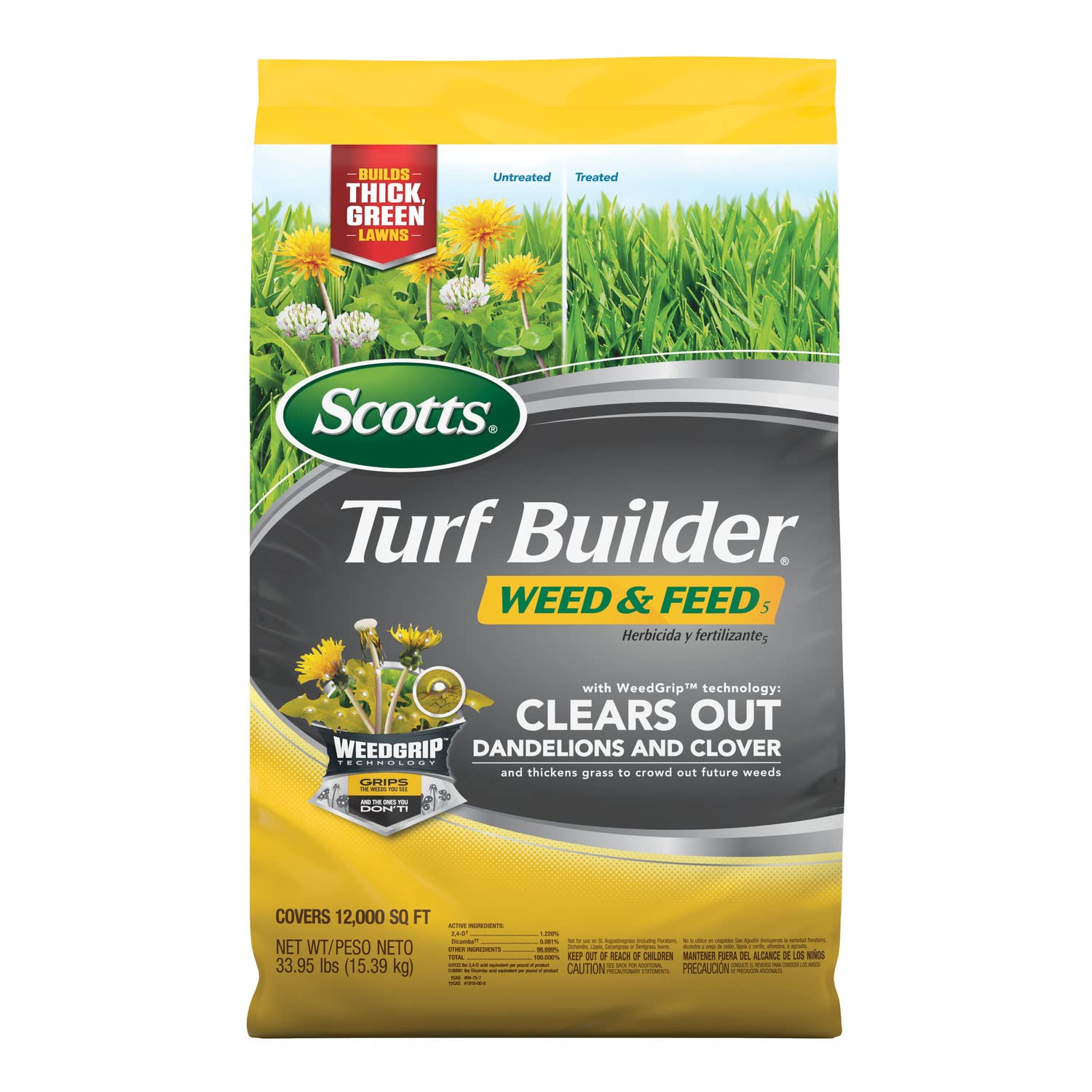
Scotts Turf Builder Weed & Feed5 is a combined granular weed killer and lawn fertilizer intended for use when broadleaf weeds are actively growing and daytime temperatures are between 60°F and 90°F. You apply it to a wet lawn with a broadcast, drop, or hand spreader (Scotts publishes spreader settings) and then avoid watering for 24 hours to let granules stick to weed leaves. The formula uses WeedGrip technology and active ingredients 2,4‑D and dicamba to target common lawn weeds such as clover and dandelion while the fertilizer portion delivers nitrogen and potassium to thicken turf. A single 33.95 lb. bag is sized to cover about 12,000 square feet, making it convenient for medium to large yards. Important limits: do not use on St. Augustine, bentgrass, dichondra, carpetgrass, or lippia and do not apply if rain is expected within 24 hours; the product can also require keeping people and pets off treated turf until dust settles. For homeowners seeking a combined weed control plus feeding step, this simplifies late‑spring applications, but those with excluded grass types or who need precise spot treatments should consider alternatives.
Best for: Homeowners with warm‑season Bahia and other listed grass types who want a single late‑spring application to control broadleaf weeds while feeding the lawn and prefer products with established brand usage guidance.
Less Ideal for: Anyone growing St. Augustine, bentgrass, dichondra, carpetgrass, or lippia or gardeners who need spot treatments, organic options, or year‑round fertilization plans.
- Kills a wide range of listed broadleaf lawn weeds including clover and dandelion using WeedGrip technology
- Feeds lawn while treating weeds so it both reduces weeds and promotes thicker turf
- Large 33.95 lb. bag covers up to 12,000 sq ft, suitable for medium to large lawns
- Published application guidance and spreader settings make it straightforward to apply evenly
- Not safe for use on several turf types including St. Augustine and bentgrass
- Requires dry window after application and restriction on people and pets until dust settles
- Contains synthetic herbicides that require careful handling and label compliance
Verdict: A convenient, proven weed‑and‑feed option for Bahia and other compatible lawns that combines broadleaf weed control with feeding in one late‑spring application.
Choosing the Right Early Spring Weed and Feed: Key Factors to Consider
Turf Safety and Grass Type
Different grasses respond very differently to early-season weed-and-feed products. Cool-season grasses such as fescue and bluegrass and warm-season grasses such as bermuda and zoysia have distinct tolerance windows. Applying a product outside its labeled timing or on the wrong grass type increases the risk of leaf burn, slowed recovery, or uneven coloration.
Look for formulations and label guidance that explicitly list your grass species and recommended timing. If you manage a mixed lawn or overseeded turf, choose a product with a proven safety margin or delay application until grass is actively growing and less vulnerable.
Herbicide Spectrum and Target Weeds
Early spring weed issues are often driven by broadleaf weeds that emerge as temperatures rise. Different active ingredients target different weed families, so you should match the herbicide spectrum to the weeds you actually see. Some products control common targets like dandelion, clover, and plantain, while others add control for chickweed, henbit, or ground ivy.
Consider whether you need pre-emergent control for grassy annuals in addition to post-emergent broadleaf control. A product that focuses narrowly on a few species may be fine for light weed pressure, but heavier or diverse infestations call for broader-spectrum actives or a planned follow-up application.
Nutrient Composition and Growth Goals
Weed-and-feed products combine herbicides with fertilizer blends that influence early-season growth. Look at the nitrogen form and release pattern. Fast-release nitrogen gives a quick green-up but can stress newly emerging grass if applied too early or at high rates. Slow- or controlled-release nitrogen supports steady recovery without sudden surge that can require extra mowing.
Also consider secondary nutrients and any added iron. If your lawn needs a color boost and you expect slow spring growth, a modest iron supplement can deepen green color without excessive top growth. Match the blend to whether you want quick visual results or gradual, sustainable turf development.
Application Timing and Weather Considerations
Timing is critical with early spring treatments. Most labels recommend applying when grass is just beginning active growth and soil temperatures are consistently above a threshold. Applying during frost, heavy rain, or drought increases risk of poor uptake or turf damage.
Plan applications for a calm, dry day with several hours without rain to allow granules to settle and herbicides to activate. If rain is forecast within 24 hours, delay application to avoid wash-off. Also factor in mowing: apply after the first light mow and allow several days before a heavy cut to let herbicide and fertilizer work into the plant.
Coverage Rates and Spreader Compatibility
Accurate coverage prevents over-application in high-traffic areas and under-application where weeds persist. Check label coverage rates and whether the granule size or formulation is compatible with common broadcast or drop spreaders. A mismatched spreader setting leads to uneven results and possible turf injury.
Test your spreader on a small area to confirm settings before treating the whole lawn. Consider products that provide clear spreader settings and multiple coverage options so you can calibrate for small yards, large lawns, or irregular shapes without guesswork.
Environmental and Dormant Season Impacts
Early spring treatments can affect nearby plants, water run-off, and beneficial insects if not used carefully. Read label precautions about trimming irrigation schedules before and after application, and avoid treating on slopes or near water bodies unless the product is labeled for those conditions.
If you have pollinator gardens or vegetable beds adjacent to turf, maintain buffer zones and follow any recommended reentry intervals. Choosing a product with lower off-target movement reduces risk to non-lawn plants and local waterways.
When to Apply Early Spring Treatments
Apply once grass has begun active growth but before weeds have fully established. For many regions that means the first few weeks after soil temperatures hover above a common threshold and after the danger of hard frosts has passed. Watch turf behavior more than the calendar: new shoots, a slight uptick in color, and steady morning soil warmth are good signals.
Avoid application during heavy rain forecasts or drought stress. A light rainfall after application can help activate granules, but heavy wash-off will reduce efficacy and increase environmental risk. If you are unsure, wait a few days for steadier conditions rather than risking a poorly timed application.
- Apply after an initial light mowing, not immediately after a heavy cut.
- Do not apply before an expected hard freeze or immediate heavy rain.
- Use soil temperature readings or local extension guidance for timing cues.
Safe Practices for Mixed or Overseeded Lawns
Overseeded lawns and mixes of cool- and warm-season grasses need extra caution. Herbicide labels may advise waiting until new seed has been mowed several times or is well established. In many cases, delaying weed-and-feed for several mowings protects tender seedlings.
If you must address weeds early on a recently overseeded lawn, consider spot-treating weeds with a targeted method or using a fertilizer-only application until seedlings are robust enough for combined herbicide treatments.
- Wait two to three mowings after overseeding before whole-lawn herbicide treatments.
- Calibrate application rates lower for uneven stands to reduce risk of localized burn.
Post-Application Care and Expectations
After applying an early spring weed and feed, expect visible weed control on most broadleaf targets within one to three weeks. Some tough perennial weeds may require a follow-up treatment or mechanical removal after initial suppression. Fertilizer effects on color and growth usually appear more quickly with soluble nitrogen blends and more gradually with slow-release blends.
Continue regular cultural care: proper mowing height, adequate irrigation, and targeted aeration all help the lawn take advantage of the nutrient boost and to outcompete remaining weeds.
- Delay heavy mowing for several days to let herbicide move into weeds.
- Do not overwater immediately after application; light irrigation may help granule activation if label allows.
Managing Expectations for Persistent Weeds
Some weeds are naturally resistant to certain early-season herbicides and may only be suppressed rather than eliminated. For species that produce deep taproots or extensive rhizomes, plan for integrated control including manual removal, repeated seasonal treatments, and improved turf vigor to reduce reinfestation.
Document the species you see so you can choose complementary control strategies later in the season. Persistent weed problems often reveal underlying cultural issues such as compaction, shade, or poor soil fertility that need correcting for lasting improvement.
- Identify recurring species to plan targeted follow-ups.
- Pair chemical control with cultural fixes for long-term suppression.
How We Chose the Best Early Spring Weed and Feed
We focused on items formulated specifically for the early spring window and judged them by concrete, garden-relevant measures. Key evaluation criteria included turf safety on cool-season and warm-season grasses, the spectrum and speed of broadleaf weed control, nitrogen and nutrient balance for starter growth, application flexibility and spreader compatibility, and residual activity versus reapplication needs. We looked for evidence of balanced nutrient ratios that encourage tillering without burning emerging shoots, and for herbicide actives that target common spring broadleaf weeds without harming desirable grasses. Products intended solely for late-spring or summer applications were excluded, as were formulations labeled only for spot treatment rather than whole-lawn broadcast use. Packaging clarity, application rate guidance, and compatibility with common spreaders were also factors because they affect real-world success in home lawns and small properties.
FAQ
Will an early spring weed and feed harm newly germinated grass seed?
It often depends on the product and the seed age. Many labels recommend waiting until new grass has been mowed two to three times before applying combined herbicide-fertilizer formulations. If seed is very new, use a fertilizer-only product or delay treatment to avoid stunting seedlings.
How long after application will I see weeds die back?
Most broadleaf weeds show visible decline within one to three weeks, though contact timing varies by species and weather. Cool, cloudy conditions can slow uptake, while warm, active growth speeds results. Tough perennials may take longer or need repeat treatment.
Can I apply early spring products before the first mow?
Applying after an initial light mow is usually better. Mowing removes old growth and allows granules to reach soil and young shoots more effectively. If you apply before mowing, wait a few days after treatment before cutting to avoid removing treated leaf tissue prematurely.
Is a single early spring application enough for the season?
A single early spring treatment helps with early broadleaf control and a nutrient boost, but it may not cover every weed or last the whole season. Some lawns benefit from a planned late-spring or summer follow-up depending on weed pressure and turf needs.
How should I handle nearby flower beds or vegetable gardens?
Maintain a buffer zone and avoid applying granules directly where runoff could reach planting beds. Many labels recommend keeping a clear distance from edible gardens and ornamental beds until the product has settled and any irrigation is managed to prevent drift.
Final Verdict
Early spring weed-and-feed products can jump-start turf recovery and reduce early broadleaf pressure when you match timing, grass type, and formulation to your lawn's needs. Prioritize turf safety and application accuracy over aggressive nutrient doses to avoid stressing young shoots. Balance the desire for quick green-up with the long-term goal of a denser, healthier lawn. Use the evaluation criteria above to choose a product that fits your grass type, weed spectrum, and management style so you get predictable early-season results.
