

Note: This article contains affiliate links. If you click on these links and make a purchase, I may earn a small commission at no extra cost to you. This helps support my research and content. Read my full affiliate disclosure here.
If you care about a uniform stripe and a clean finish across about one acre, the mower you pick affects how long mowing takes and how often you stop to recharge or swap batteries. Electric mowers designed for this size of property can deliver quieter operation, lower maintenance, and consistent cutting when you match runtime and cutting width to your yard. This guide walks through our top shortlisted options for an electric lawn mower for 1 acre and the practical reasons each type makes sense for different gardens. We evaluate run time, recharge options, cutting width, deck durability, and handling to help you choose the right setup for your lawn. Read on to see which features matter most for mowing an acre efficiently and comfortably.
Top Picks at a Glance
| Best Quality Built to a higher standard if you want something more solid | LYMOW One Plus Robot Lawn Mower with RTK+VSLAM Navigation and Tracked Drive |  |
| Best Budget The cheapest option that still gets the job done reliably | Husqvarna Automower 550 Robotic Lawn Mower (Commercial, 1.25 Acre) |  |
| Highest Rated A top-rated pick with lots of positive feedback | LOPKIN L2500 Robot Lawn Mower with NetRTK, AI Vision and Wi‑Fi HaLow |  |
| Most Popular A crowd favorite that many people choose with confidence | Mammotion LUBA 2 AWD 5000HX Robot Lawn Mower with Cleaning Stand |  |
| Best Seller A high-volume bestseller chosen again and again | roborock RockMow X130H Robot Lawn Mower with 4WD and Quad-Vision Navigation |  |
LYMOW One Plus Robot Lawn Mower with RTK+VSLAM Navigation and Tracked Drive

| Cutting width | 16 inches |
|---|---|
| Minimum Adjustable Cutting Height | 1.2 inches |
| Maximum Adjustable Cutting Height | 4 inches |
| Power Source | Battery Powered |
The LYMOW One Plus is a purpose-built robotic mower for large, hilly properties that combines high-precision RTK positioning with VSLAM visual mapping and a tracked drive system to handle very steep terrain. Setup is wire-free via smartphone and you define virtual boundaries and no-go zones in the app; once configured it runs autonomously, auto-recharges, and resumes tasks. Notable hardware includes a 16-inch dual-rotary blade deck with adjustable heights from 1.2 to 4 inches, a high-capacity LiFePO4 battery that supports multiple daily cycles, and a heavy-duty track drive that claims 45° slope capability and good obstacle-crossing. The onboard AI vision and ultrasonic sensors provide real-time obstacle detection, while the cyclone airflow and dual blades aim for even cuts and mulching of clippings. Trade-offs are its size and complexity: this is a premium, robust machine intended for large or challenging lawns rather than small plots, and initial mapping plus occasional maintenance of blades and tracks will be required to keep performance consistent.
Best for: Buyers who need a capable, low-supervision mower for large properties with steep slopes and complex boundaries and who value precise mapping and hands-off operation.
Less Ideal for: Those with small, simple lawns or buyers seeking a minimal-maintenance, budget entry-level robotic mower should consider simpler wheeled models instead.
- Tracked drive and reinforced motor enable climbing and stable operation on slopes up to 45°
- RTK plus VSLAM navigation provides precise, wire-free mapping and consistent coverage
- Large-capacity LiFePO4 battery supports multiple cycles per day for wide area coverage
- 16-inch dual rotary blades with airflow lift and mulching reduce missed cuts and return fine clippings to the lawn
- Designed for large, complex lawns so it may be oversized for small yards
- Higher mechanical complexity means more maintenance on tracks and blades than a basic wheeled mower
Verdict: If you need a robust, wire-free robot that can reliably mow steep, uneven lawns with high precision, the LYMOW One Plus is built for that job.
Husqvarna Automower 550 Robotic Lawn Mower (Commercial, 1.25 Acre)

| Power Source | Electric |
|---|---|
| Operation Mode | Automatic |
| Covers | 1.25 acres |
| Maximum Adjustable Cutting Height | 3.5 inches |
| Minimum Adjustable Cutting Height | 2 inches |
The Husqvarna Automower 550 is a heavy-duty robotic mower built for large or divided properties up to roughly 1.25 acres. It uses triple guide wires, five remote start points, and GPS-assisted navigation to find and evenly mow complex lawns while large coarse-tread wheels handle slopes up to 45%. Primary use is autonomous scheduled mowing managed through Husqvarna Fleet Services and the Automower Connect app, with remote start, geofencing and theft tracking for peace of mind. Practical benefits include reduced labor, consistent cut heights between 2 and 3.5 inches, and flexible charging-station placement that simplifies installation on commercial sites. Smart home integration with major voice assistants and fleet controls make it straightforward to coordinate multiple machines or monitor status remotely. Important limitations are that this is a commercial product intended for larger properties and fleet management workflows, so it may be more complex to set up and maintain than consumer models and carries capabilities that exceed simple residential needs.
Best for: Buyers who need a robust, mostly hands-off mower for a large or divided 1-acre-plus lawn and who prioritize reliable coverage and remote fleet-style management.
Less Ideal for: Homeowners with small yards under 0.5 acres or buyers who want a simple plug-and-play consumer robot without fleet features or professional setup.
- Designed for properties up to 1.25 acres so it covers larger lawns without constant intervention
- Triple guide wires and five start points reduce search time on divided or complex sites
- GPS navigation plus geofencing and theft tracking provide reliable location awareness and security
- Large coarse-tread wheels offer traction on slopes up to 45% for hilly terrain
- Commercial-grade features and fleet management add setup complexity compared with consumer models
- Higher operational and maintenance demands typical of professional equipment
Verdict: Choose the Automower 550 when you need a professional, remotely managed robotic mower that reliably covers large or divided lawns up to about 1.25 acres.
LOPKIN L2500 Robot Lawn Mower with NetRTK, AI Vision and Wi‑Fi HaLow

| Power Source | Battery Powered |
|---|---|
| Battery Average Life | 4 hours |
| Maximum Adjustable Cutting Height | 3 inches |
| Minimum Adjustable Cutting Height | 1.2 inches |
| Operation Mode | Automatic |
The LOPKIN L2500 is a wire‑free robotic mower built for large, complex yards that combines NetRTK, GNSS/INS fusion and AI vision to map and mow without a boundary wire. Typical use is app driven: initial mapping takes minutes, then you set schedules, multi‑zone plans and no‑go areas from your phone while the mower handles routine cuts automatically. Notable features include Wi‑Fi HaLow for extended, stable connectivity across large properties, AI vision that recognizes and avoids common obstacles, and a 10Ah battery providing up to four hours of runtime with a 5A fast charger. Practical benefits are precise navigation around trees and structures, multi‑zone management for separate lawn areas, and IP66 protection so it can pause for rain and continue night mowing when appropriate. Limitations to weigh are its relatively narrow cutting width compared with ride‑on options and the need for the dedicated router for HaLow range; very steep or highly debris‑strewn sites may still require occasional human intervention. Installation and daily operation are geared to owners who want mostly hands‑off mowing with strong connectivity across large properties.
Best for: Owners of large, complicated yards who prioritize dependable, hands‑off mowing and precise navigation across multiple zones and signal‑challenging areas.
Less Ideal for: People who need very wide swath cutting for fastest possible full‑acre mowing or who prefer a simple plug‑and‑play device without installing a dedicated long‑range router.
- RTK + GNSS/INS fusion and AI vision enable high‑precision, wire‑free navigation in complex yards
- Wi‑Fi HaLow router provides long‑range, stable connectivity for large properties
- App-based multi‑zone mapping and scheduling for separate lawns and customized plans
- Up to four hours runtime per charge with a 5A fast charger for relatively long continuous operation
- IP66 rating and rain sensor for reliable outdoor operation in wet conditions
- Cutting width is modest, so full‑acre jobs may take longer than larger commercial mowers
- Requires the dedicated HaLow router to realize maximum connectivity range
Verdict: If you need reliable, wire‑free automated mowing across a large, complex yard with strong long‑range connectivity and smart obstacle avoidance, the LOPKIN L2500 is designed for that job.
Mammotion LUBA 2 AWD 5000HX Robot Lawn Mower with Cleaning Stand

| Cutting width | 15.7 inches |
|---|---|
| Operation Mode | Automatic |
| Number of Positions | 7 |
| Power Source | Battery Powered |
| Battery Capacity | 12 Ah |
The Mammotion LUBA 2 AWD 5000HX is built for demanding yards: its four-wheel 165 W drive and all-wheel traction let it tackle steep slopes and uneven terrain while the dual-blade disk and 15.7-inch cutting width deliver efficient, clean cuts. It uses UltraSense AI vision plus RTK positioning to map lawns precisely, mow close to edges, and avoid more than 200 object types without a physical boundary wire. You can manage up to 50 zones, set planned patterns, and control the mower remotely via 4G/Wi‑Fi/Bluetooth and the Mammotion app; it also offers GPS tracking and anti-theft safeguards. Charge time and area-per-charge figures indicate this is sized for roughly 1.25 acres per the spec sheet, and automatic return-and-resume behavior keeps large multi-zone jobs moving. Expect a setup and learning curve for mapping complex properties and reliance on app connectivity for advanced features, plus periodic maintenance on blades and sensors like any robotic mower. For performance-focused owners this mower prioritizes terrain capability, precise routing, and autonomy over the simplicity of basic consumer models.
Best for: Buyers who prioritize robust off-road performance and precise autonomous control for large, varied lawns and steep terrain and who are comfortable using app-driven features to optimize mowing patterns.
Less Ideal for: Small, flat lawns where a simpler, lower-cost robotic mower or push mower would be more practical or for buyers who want a fully plug-and-play device with minimal setup.
- True all-wheel-drive and 165 W motors provide strong traction for steep slopes and rough terrain
- UltraSense AI Vision with RTK navigation enables precise mapping, edge cutting, and obstacle recognition
- Supports management of up to 50 mowing zones and multiple mowing patterns for complex properties
- Connectivity via 4G, Wi‑Fi, and Bluetooth plus app control allows remote monitoring and customized schedules
- GPS tracking and anti-theft features help protect investment on larger properties
- Requires app connectivity and initial mapping that can be complex for intricate landscapes
- Plastic bodywork may need careful handling in very rough environments
Verdict: Choose the LUBA 2 AWD 5000HX when you need a heavy-duty, terrain-capable robotic mower that delivers precise AI-guided mowing and full multi-zone control for challenging large lawns.
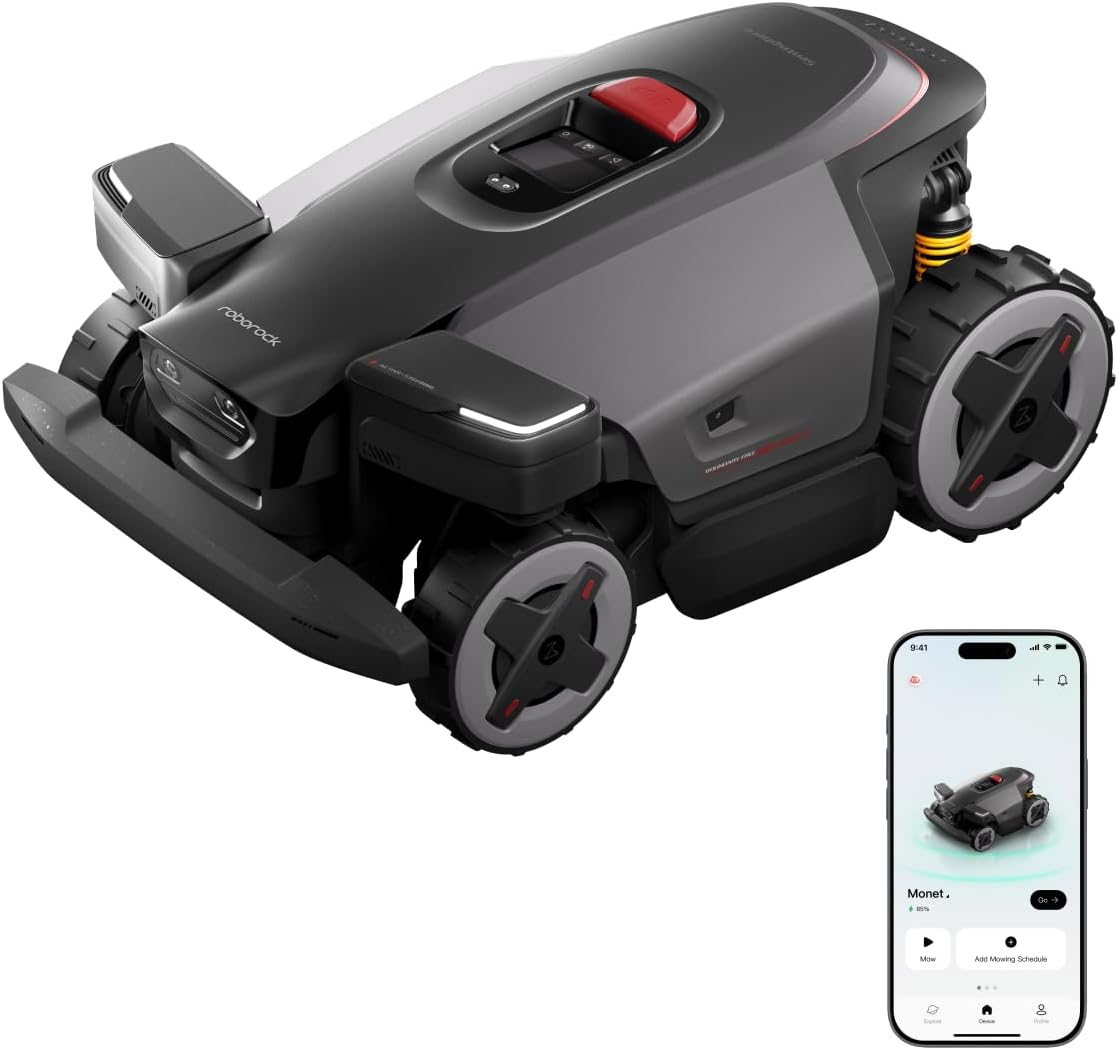
roborock RockMow X130H Robot Lawn Mower with 4WD and Quad-Vision Navigation
| Power Source | Battery Powered |
|---|---|
| Cutting width | 9.5 inches |
| Maximum Adjustable Cutting Height | 3.5 inches |
| Battery Average Life | 140 minutes |
The roborock RockMow X130H is a high-capability robot mower built to handle steep, uneven, and complex lawns without a buried perimeter wire. It uses Full-Band RTK plus a quad-camera AI vision system for precise positioning and dual mapping modes so you can either auto-map open areas or manually trace boundaries from the app. The pro-grade four-wheel drive, active steering, and dynamic suspension let it climb slopes up to 80% and roll over obstacles up to about 3.1 inches while keeping a floating cutting deck for consistent surface-following. Practical benefits include a relatively wide 9.5-inch cut to reduce runtime, multi-zone scheduling and a real-time app dashboard, plus anti-theft features and 4G connectivity. Important limitations are its weight and size for handling and storage, and the advanced navigation and connectivity mean a learning curve during setup and when customizing complex zones. For homeowners with steep or irregular yards who want largely hands-off mowing, this mower brings robust, reliable performance.
Best for: Homeowners with steep, irregular, or obstacle-filled lawns who want a durable, hands-off mower that prioritizes precise navigation and traction over simplicity.
Less Ideal for: Small, flat lawns or buyers who want a very lightweight, simple plug-and-play robot mower with minimal setup and fewer connectivity features.
- Four-wheel drive, active steering, and dynamic suspension that handle slopes up to 80% and 3.1-inch obstacles
- Full-Band RTK plus quad-camera AI vision for accurate positioning under trees and near fences
- Wire-free dual mapping options with app control and multi-zone scheduling for flexible setup
- 9.5-inch cutting width and floating deck for efficient, even mowing across contours
- Built-in anti-theft features including PIN lock, alarm, and GPS tracking
- Heavy and bulky compared with smaller robotic mowers, making manual transport and storage more cumbersome
- Advanced navigation and connectivity increase setup complexity and may require time to fine-tune for complex yards
Verdict: Choose the RockMow X130H if you need a wire-free, high-traction robot mower that can reliably conquer steep, uneven lawns with precise navigation.
Choosing the Right Electric Lawn Mower for 1 Acre: Key Factors to Consider
Battery Runtime and Recharge Options
How long a mower runs per charge directly determines whether you can finish an acre in one session or need to pause for recharging. Runtime varies with grass height, blade speed, and whether the mower is mulching or bagging. Look for manufacturers who publish runtime under realistic loads and check whether batteries are user-replaceable to allow swapping in a fresh pack mid-job.
Also consider recharge options. Fast chargers reduce downtime between sessions, while compatibility with larger-capacity batteries or multi-battery systems gives flexibility. For larger yards, assess whether the machine supports a second battery or if an extra spare battery is necessary to maintain continuous mowing without long waits.
Cutting Width and Mowing Efficiency
Cutting width affects how many passes you need to cover an acre. Wider decks reduce overlap and total runtime, but wider machines can be harder to maneuver through tight corners, gates, or around landscaping. Choose a width that balances efficiency with the layout of your yard.
Also factor in how the deck design handles clippings. Some decks channel clippings smoothly for even discharge or mulching; others can clog when grass is tall or wet. A mower that keeps clippings moving reduces clog-related slowdowns and preserves cutting speed across the entire lawn.
Deck Material and Build Quality
Deck construction determines long-term durability and how well the mower resists dings, corrosion, and warping. Steel or reinforced stamped decks stand up better to regular use on an acre, especially if you encounter hidden debris or slightly rough ground. Lighter composite decks save weight and can resist rust, but they may not tolerate repeated impacts as well.
Inspect the quality of mounting points, reinforcement ribs, and the design of blade spindles. A robust deck reduces the need for repairs and keeps blade alignment true for a cleaner cut across many seasons.
Handling, Maneuverability, and Operator Comfort
Comfortable and predictable handling matters when you are pushing or walking behind a mower for an hour or more. Wheel size and tread impact traction on slopes and moist ground. Adjustable handle height, vibration damping, and intuitive control placements reduce fatigue and let you focus on an even cut.
Consider whether self-propel features, variable speed controls, or all-wheel drive options are useful for your terrain. A mower that climbs small inclines easily and responds well around obstacles will finish a one-acre job faster and with fewer stops.
Cut Quality and Height Adjustment
The mower's blade system and height adjustment mechanism define the final look of the lawn. A blade that remains balanced and sharp delivers even clipping length; a reliable multi-point height adjuster lets you fine-tune the cut for seasonal needs. Easy, tool-free height changes are practical when you alternate between close mowing and raising the deck for stressed grass.
Also think about whether the mower delivers consistent cut quality when battery power declines. Some machines maintain blade speed longer into the discharge cycle, producing a steadier finish across an entire battery charge.
Maintenance Accessibility and Serviceability
Electric mowers generally require less routine maintenance than gas models, but accessibility still matters. Look for mowers with easy-to-remove decks for blade sharpening or cleaning, straightforward battery access, and clear instructions for blade replacement. Simple routine tasks cut down on downtime and keep performance strong.
Consider availability of common replacement parts like blades, belts, and batteries. Designs that allow DIY maintenance without specialized tools help keep operating costs lower and reduce the need for professional servicing.
Matching Mower Setup to Yard Layout
An acre can take many shapes. A mostly open rectangular lawn favors a wider deck and longer runtime so you can mow long swaths quickly. Conversely, yards with tight beds, trees, and garden features need a narrower or more maneuverable machine so you can navigate without excessive trimming afterward.
Consider gates, storage access, and trailer or shed dimensions when choosing deck width. Measure the narrowest passage you need to move the mower through and make sure the chosen machine fits comfortably with any battery or handle attachments in place.
- Wider decks reduce passes but require more turning room.
- Smaller decks increase maneuverability around landscaping.
- Check storage clearance with battery installed.
Battery Care and Seasonal Storage
Proper battery care keeps performance high season after season. Store lithium packs in a cool, dry place and avoid leaving them fully discharged for long periods. Charge batteries halfway to 60 percent for long-term storage and top them up every few months if convenient.
During heavy-use months, rotate batteries to keep available charge capacity even. Clean battery contacts and inspect packs for damage periodically. Following the manufacturer's basic care steps will prolong usable runtime and reduce unexpected failures when the mowing season arrives.
- Store batteries away from direct sunlight and freezing temperatures.
- Rotate battery use to avoid deep discharge on a single pack.
- Keep contacts clean and dry to ensure reliable power transfer.
Mulching Versus Bagging for an Acre
Mulching cuts clippings finely and returns nutrients to the soil, which can reduce the need for additional fertilizer over time. For one acre, mulching reduces the volume of clippings you need to manage, but it requires a mower with good blade speed and deck airflow to prevent clumping.
Bagging collects clippings for composting or to keep a tidy lawn appearance. Bagging every pass across an acre increases the time you spend emptying collection bags or changing systems. Consider a mower with a high-capacity collection option or the ability to quickly switch between mulching and bagging modes.
- Mulching saves time hauling clippings but needs good deck airflow.
- Bagging keeps the lawn tidy but adds emptying time.
- Consider a hybrid approach: mulch most passes, bag when grass is long.
Safe Operation on Slopes and Uneven Ground
Slope capability matters for safety and cut quality. Check the mower's recommended maximum slope and use extra caution on steeper sections. Self-propel models or machines with larger rear wheels typically handle modest grades more safely and with less strain on the operator.
When ground is uneven, slower ground speed and slightly higher cutting settings reduce scalp marks and prevent blade strikes. Walk the route before mowing to remove branches or hidden hazards that could damage the deck or blades.
- Confirm the mower's maximum slope rating for your yard.
- Use larger wheels or self-propel features for hilly areas.
- Raise cutting height slightly on uneven sections to avoid scalping.
Noise, Neighbors, and Local Regulations
One advantage of electric mowers is lower noise output compared with gas engines. If you have close neighbors or local quiet-hour rules, choose a unit known for quieter operation so you can mow earlier or later without complaints.
Also review local regulations or homeowners association rules regarding electric equipment and battery storage. While electric mowers reduce emissions at the point of use, some areas have rules on battery disposal or noise that are worth confirming before purchase.
- Electric mowers are generally quieter and may allow more flexible mowing times.
- Check local rules on tool noise and battery storage or disposal.
- Quieter mowing helps maintain neighborhood relations.
How We Chose the Best Electric Lawn Mower for 1 Acre
We prioritized real-world mowing needs for roughly one-acre lawns and selected machines that balance battery runtime, cutting width, and durable deck construction. Editorial filters focused on tested battery capacity and realistic runtime figures, deck width and material, cutting-height range and adjustment ease, and handling characteristics that reduce operator fatigue on varied terrain. We also considered available charging options and whether a mower supports multiple battery swaps or quick top-up charging. Products were excluded if they were clearly optimized only for small urban yards or for large acreage beyond one acre where commercial features dominate. We excluded gas-only models, hybrid designs that require constant engine servicing, and units with insufficient documentation about battery performance under load. The final shortlist emphasizes practical mowing speed, consistent cut quality, and straightforward maintenance chores that matter most to homeowners working a one-acre property.
FAQ
How much battery runtime do I need to mow one acre?
It often depends on deck width and grass conditions, but expect to need enough runtime to cover the full area at your typical walking speed. Wider decks and efficient motors reduce runtime. For many yards, a single large-capacity battery or two mid-capacity batteries will cover an acre under normal conditions.
Is a wider cutting deck always better for an acre?
Not always. Wider decks cut more area per pass but can be harder to maneuver around landscape features and through gates. Choose a width that balances fewer passes with the actual layout and access points of your yard.
Can I finish an acre on a single battery charge?
Sometimes you can, depending on battery capacity, deck width, grass height, and terrain. Tall or wet grass and steep slopes shorten runtime. If one charge falls short, consider a second battery or a faster charger to avoid long interruptions.
Do electric mowers need less maintenance than gas mowers?
Generally yes. Electric mowers eliminate oil changes and spark plug service, but they still require blade sharpening, deck cleaning, and battery care. Easy access to blades and clear maintenance instructions make upkeep straightforward.
Are electric mowers safe to use on slopes?
Many electric mowers handle modest slopes safely, especially self-propel or larger-wheel models. However, steep grades may exceed a mower's recommended limits. Always follow the manufacturer's slope guidance and use extra caution on wet or loose surfaces.
Final Verdict
For mowing roughly one acre, prioritize battery runtime and cutting width first, then balance deck durability and maneuverability against the layout of your yard. If your lawn is open and regularly maintained, a wider deck and a single long-lasting battery can finish the job efficiently. For yards with obstacles, favor maneuverability and easy battery swapping to keep downtime low. Weighing these tradeoffs will help you pick an electric mower that suits how you mow, the shape of your property, and how much maintenance you want to manage. Focus on runtime, deck construction, and handling to make a confident choice for an acre-sized lawn.
