

Note: This article contains affiliate links. If you click on these links and make a purchase, I may earn a small commission at no extra cost to you. This helps support my research and content. Read my full affiliate disclosure here.
If you need an electric pressure washer for commercial use, the stakes are different than buying one for home chores. Commercial settings demand machines that can run for hours, handle tougher soils, and survive frequent transport and storage. Choosing the right unit affects how fast you finish jobs, the kinds of surfaces you can treat, and how much maintenance the machine requires. This guide covers the top shortlisted electric commercial pressure washers and explains the practical criteria that matter on the job site, including pressure output, pump type, and serviceability. Read on to understand how these factors influence daily productivity and long-term ownership before you examine individual models.
Top Picks at a Glance
| Best Overall The best all-around choice for most situations | Tecoloy Commercial Electric Pressure Washer GJ01 with Triplex Pump and 47 ft Hose |  |
| Best Quality Built to a higher standard if you want something more solid | CANPUMP CF 2530 EH Wall-Mount Pressure Washer with Remote Total Stop System |  |
| Best Value The sweet spot between price and what you get | Greenworks 3000 PSI Brushless Electric Pressure Washer |  |
| Most Popular A crowd favorite that many people choose with confidence | Westinghouse WPX3000e Electric Pressure Washer |  |
| Best Seller A high-volume bestseller chosen again and again | Westinghouse WPX3400e Electric Pressure Washer (3400 PSI, Brushless Motor) |  |
Tecoloy Commercial Electric Pressure Washer GJ01 with Triplex Pump and 47 ft Hose

| Power Source | ac |
|---|---|
| Maximum Flow Rate | 4 gpm |
| Maximum Pressure | 1450 psi |
| Hose Length | 47 feet |
The Tecoloy GJ01 is built as a commercial electric pressure washer intended for demanding cleaning around vehicles, driveways, patios, and light industrial use. It pairs a permanent magnet motor with variable frequency control and a horizontal triplex pump to deliver up to 1450 psi and 4 gpm (manufacturer lists 2200PSI/3.2GPM in marketing), plus a long 47 foot hose and a 1 L detergent tank for flexible cleaning without frequent moves. Typical use includes washing cars, RVs, concrete, siding, and equipment where continuous operation and durability matter. Notable features are the quiet 65 dB operation, LED control panel with real-time monitoring, soft-start and wide voltage compatibility, and a self-priming intake so you can draw water from a container. Practical benefits include reduced noise for neighborhood use, professional-grade pump components rated for extended hours, and a full nozzle kit and foam cannon for versatile cleaning. Limitations are that specifications vary between sections of the listing (pressure and flow figures are inconsistent) and the unit is a heavier, wall-mount style that requires a fixed installation point rather than being as portable as small wheeled consumer models.
Best for: For buyers who need a durable, low-noise electric machine for frequent commercial or heavy residential cleaning and who prioritize continuous operation and professional pump longevity.
Less Ideal for: Not a great choice for someone who needs a highly portable, lightweight wheeled pressure washer for occasional spot jobs or frequent transport between sites.
- Commercial triplex pump and ceramic plungers designed for long service life
- Permanent magnet motor with variable frequency control for improved energy efficiency
- Long 47 ft hose and included nozzle/foam accessories for versatile reach and cleaning options
- Quiet 65 dB operation and LED control panel for monitoring during extended use
- Listing shows inconsistent pressure and flow numbers across sections which can confuse exact performance expectations
- Wall-mount/heavier design reduces portability compared with compact wheeled pressure washers
Verdict: Choose the Tecoloy GJ01 if you want a quieter, commercial-style electric pressure washer built for extended professional use and versatile cleaning accessories.
CANPUMP CF 2530 EH Wall-Mount Pressure Washer with Remote Total Stop System
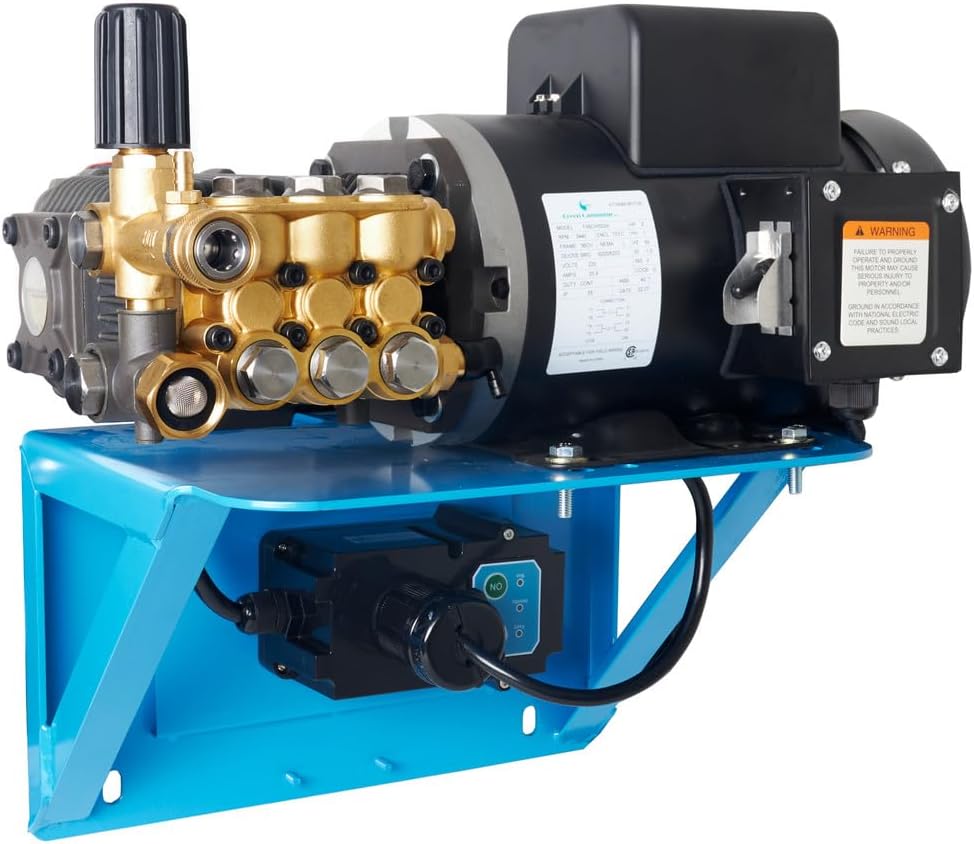
| Power Source | Electric |
|---|---|
| Maximum Flow Rate | 3.1 gpm |
| Maximum Pressure | 2500 psi |
The CANPUMP CF 2530 EH is a wall-mounted electric pressure washer built for heavy-duty chores where sustained power and serviceability matter. It pairs a 5 hp solid-shaft motor with a triplex plunger pump to deliver up to about 2,500 psi and roughly 2.9–3.1 gpm depending on configuration, making it capable of removing grease, grime, and set-in dirt from vehicles, shop floors, and exterior surfaces. The unit is intended to be used permanently mounted to a wall with a garden-hose inlet and quick-connect outlet, and it supports a detachable pressure regulator, nozzle kit, and foam or turbo accessories for task-specific cleaning. The remote-control Total Stop System shuts the pump down when the trigger gun is released to save energy and reduce wear. Notable practical strengths are the commercial-grade pump components and fully serviceable design that simplify maintenance. Important limitations are the 230 V, 22 A electrical requirement and the need for proper mounting and plumbing, so it is better suited to a workshop or garage with appropriate electrical capacity rather than casual backyard use.
Best for: Buyers who need a permanent, high-performance cleaning station for a garage, shop, or commercial workspace and prioritize power, uptime, and serviceability.
Less Ideal for: Casual homeowners who need a portable, plug-and-play cleaner for occasional light-duty tasks or those without a compatible 230 V circuit or mounting location.
- Commercial-grade triplex plunger pump and robust motor designed for sustained heavy-duty cleaning
- Remote Total Stop System reduces idle run time and extends pump life
- Serviceable design with readily available spare parts and a detachable unloader valve for easier maintenance
- Quick-connect outlet and multiple nozzle options allow fast setup and versatile spray patterns
- Requires 230 V/22 A single-phase circuit which may need a dedicated breaker and professional installation
- Wall-mount installation and hose/manifold routing add setup complexity compared with portable units
Verdict: Choose this unit if you want a wall-mounted, commercial-grade electric pressure washer that delivers sustained high power and is built to be serviced and upgraded for demanding cleaning work.
Greenworks 3000 PSI Brushless Electric Pressure Washer

| Power Source | ac |
|---|---|
| Maximum Flow Rate | 2 gpm |
| Maximum Pressure | 3000 psi |
| Tank Volume | 1 gallons |
The Greenworks 3000 PSI brushless electric pressure washer is built for homeowners who need strong, reliable cleaning power without gas maintenance. It pairs a 14 Amp TruBrushless motor with JetFlow technology to deliver up to 3000 PSI and 2.0 GPM, which is capable of stripping grime from driveways, patios, siding and large outdoor surfaces. The unit is corded for continuous runtime and includes a 25 foot kink-resistant high-pressure hose, metal spray gun, five quick-connect nozzles (including turbo and soap) and a built-in detergent tank for faster degreasing. The steel-frame build, oversized wheels and multiple grip points make it easier to move around a property, while the 35 foot power cord increases reach from a standard outlet. Expect quieter operation than gas models and low maintenance from the electric brushless motor. Important limitations are that it is a corded unit so you need access to outlets or an extension solution and the maximum 2.0 GPM flow rate is balanced toward pressure rather than highest water volume for very large commercial jobs.
Best for: Homeowners who want a powerful, low-maintenance electric pressure washer to deep-clean driveways, patios and siding without dealing with gas engines, and who value portability and versatile spray options.
Less Ideal for: Contractors or users who need cordless freedom or very high continuous water flow for large commercial sites should consider professional gas or higher-GPM units instead.
- High peak cleaning power: up to 3000 PSI with a 2.0 GPM flow suitable for deep driveway and concrete cleaning
- Brushless motor with JetFlow tech for consistent power and lower maintenance
- Includes five quick-connect nozzles plus built-in detergent tank for flexible cleaning and faster stain removal
- Portable steel-frame design with oversized wheels and long power/hose reach for easy maneuvering
- Corded design requires access to a grounded outlet or extension for larger properties
- 2.0 GPM flow favors pressure over maximum water throughput for very large commercial jobs
Verdict: A high-pressure, low-maintenance electric washer that balances strong cleaning power and portability for homeowners tackling driveway and exterior grime.
Westinghouse WPX3000e Electric Pressure Washer

| Power Source | ac |
|---|---|
| Maximum Flow Rate | 1.76 gpm |
| Maximum Pressure | 3000 psi |
| Tank Volume | 0.45 gallons |
| Hose Length | 25 feet |
The Westinghouse WPX3000e is a performance-oriented electric pressure washer aimed at homeowners who need strong cleaning power without gas engine maintenance. It produces up to 3000 max PSI (rated 2600 PSI) and a maximum flow of 1.76 GPM, and includes a .45 gallon onboard soap tank plus five quick-connect nozzles for tasks from delicate rinsing to heavy-duty blasting. The unit uses a heavy-duty AC motor and a maintenance-free axial pump with an auto-stop feature, which makes it suitable for frequent driveway, deck, fence, and vehicle cleaning sessions. A 25-foot abrasion-resistant hose, 35-foot GFCI cord, and 10-inch never-flat wheels improve reach and mobility around a yard. For foam cannon use it pairs well with M22-compatible accessories and the integrated soap tank simplifies applying detergent before switching to a foam cannon for thicker suds. Expect a relatively heavy, cart-style machine that trades compactness for sturdiness and power, and note that electrical supply and extension limitations will constrain remote or off-grid jobs compared with gas models.
Best for: Buyers who prioritize cleaning power and reliable, low-maintenance operation for frequent residential jobs and want a unit that works well with foam cannons and detergent-assisted cleaning.
Less Ideal for: Users who need a lightweight, ultra-portable unit for occasional spot cleaning or those who need gas-powered mobility for remote job sites.
- High peak pressure up to 3000 PSI and rated 2600 PSI for tough cleaning
- Maximum flow rate 1.76 GPM supports faster rinsing and thicker foam generation
- Built-in 0.45 gallon soap tank and 5 quick-connect nozzles for detergent work
- Maintenance-free axial pump and heavy-duty AC motor reduce upkeep
- 25 ft hose and 10" never-flat wheels offer good reach and maneuverability
- Requires AC power so not suitable for remote jobs without electricity
- Relatively heavy and bulky compared with compact electric units
Verdict: A powerful, low-maintenance electric washer that pairs well with foam cannons for heavy-duty residential cleaning.
Westinghouse WPX3400e Electric Pressure Washer (3400 PSI, Brushless Motor)

| Power Source | ac |
|---|---|
| Maximum Flow Rate | 2 gpm |
| Maximum Pressure | 3400 psi |
| Hose Length | 25 feet |
| Tank Volume | 0.45 gallons |
The Westinghouse WPX3400e is an electric pressure washer built to handle demanding home projects like decks, driveways, siding and fences without the noise and maintenance of a gas unit. It delivers up to 3400 max PSI with a brushless AC motor and an axial cam pump that runs with an auto‑stop feature, and it includes a 0.45 gallon onboard soap tank plus five quick‑connect nozzle tips for flat fan, turbo, and soap applications. The 25 foot abrasion‑resistant hose, 10 inch never‑flat wheels and a long GFCI cord make it easy to move around a two‑story house and reach elevated work areas with an extension wand or compatible accessories. Practical benefits include good cleaning power for stubborn grime, lower upkeep compared with gas washers, and built‑in detergent delivery for siding and decks. Important limitations are that electric power restricts runtime to available outlets and extension reach, and the rated water flow drops from max PSI to a lower continuous flow for sustained cleaning, so very large jobs may take longer than with a commercial gas model.
Best for: Homeowners who want a powerful, low‑maintenance electric washer for thorough cleaning of siding, decks, driveways and periodic second‑story jobs and who value ease of use over commercial gas performance.
Less Ideal for: Users who need long continuous runtime, remote jobsite operation without power, or the fastest cleaning on very large paved areas should consider a gas or higher‑flow commercial unit instead.
- High peak pressure (3400 max PSI) suitable for heavy residential tasks
- Brushless AC motor and maintenance‑free axial cam pump for longer life
- Onboard 0.45 gallon soap tank and five quick‑connect nozzles for versatile cleaning
- Long hose and 35 ft GFCI power cord plus never‑flat wheels for easier mobility
- Requires an electrical outlet which limits placement and continuous runtime
- Lower rated flow (3000 PSI at 1.1 GPM) for sustained cleaning compared with peak spec
Verdict: A strong, low‑maintenance electric pressure washer that balances high cleaning power and user convenience for most two‑story home cleaning jobs.
Choosing the Right Electric Pressure Washer for Commercial Use: Key Factors to Consider
Pressure Output and Flow Rate
Pressure and flow determine what surfaces you can clean and how quickly you complete work. Higher pressure helps remove stubborn residues from concrete, heavy equipment, and vehicles, while higher flow rates rinse away loosened soil faster.
In commercial work you should consider both peak PSI and sustained working PSI under load. A unit with high peak pressure but weak continuous flow will struggle to rinse efficiently. Think about the types of jobs you run daily and choose a combination of pressure and flow that matches typical soils and surface area per job.
Pump Construction and Warranty
The pump is the most stressed component in regular commercial use. Pumps that use triplex ceramic plungers, brass manifolds, or other commercial-grade materials typically hold up better than low-cost wobble or axial pumps.
Check the pump warranty and whether the manufacturer offers replaceable rebuild kits and spare seals. A pump that is serviceable in the field reduces downtime and long-term ownership costs compared with sealed, non-repairable units.
Duty Cycle and Cooling System
Commercial jobs often require long run periods. Duty cycle ratings and motor cooling determine how long a machine can run without overheating or tripping thermal protection.
Look for models with active cooling designs, thermal cutouts, or clear continuous-duty specifications. Overheating shortens component life and increases interruptions, so cooling features matter both for productivity and longevity.
Electrical Safety and Cord Management
Electric commercial washers must handle higher current safely and often operate in wet environments. Ground-fault protection, heavy-duty cords, and secure strain relief reduce the risk of electrical faults.
Also consider how the cord and hose are stored and routed during transport and use. Good cord management reduces wear, prevents trip hazards, and simplifies setup on job sites where time is money.
Mobility and Frame Durability
You will likely move the machine across job sites, into trucks, and around tight spaces. A stout frame, heavy-duty wheels, and secure handle design make daily handling easier and reduce the chance of accidental damage.
Consider whether the frame protects components like pumps and controls during transport, and whether wheels are rated for rough surfaces. Stability during operation is also important so the unit does not tip or shift while you work.
Maintenance Access and Replacement Parts
Regular maintenance keeps a commercial unit working reliably. Easy access to oil fill ports, filters, and pump components shortens service time.
Investigate the availability of common replacement parts such as unloader valves, seals, inlet filters, and hose fittings. A machine with widely available parts and clear service documentation will save time and money over many service cycles.
Common Commercial Applications and Matching Specs
Different commercial tasks need different pressure washer characteristics. For example, vehicle fleets, food service exteriors, and heavy equipment cleaning place different demands on pressure and flow. Vehicles often benefit from moderate pressure with higher flow to rinse gently but quickly, while concrete and industrial equipment require higher pressure and durable pump construction.
- Fleet washing: prioritize moderate PSI with high GPM for quick rinsing.
- Concrete and masonry: choose higher PSI and a pump built for abrasive contaminants.
- Equipment degreasing: look for consistent sustained pressure and chemical injector compatibility.
Running and Storing an Electric Commercial Washer Safely
Safe operation extends equipment life and protects staff. Set up a grounded supply circuit that matches the machine rating and use proper extension cables when necessary. Avoid running units on undersized circuits or through makeshift connections.
- Keep cords elevated and away from water spray.
- Park the unit on level ground and use wheel chocks if needed during operation.
- Drain any water from the pump and hoses before freezing conditions to prevent damage.
Hose, Nozzle, and Accessory Choices That Increase Productivity
The right hose length and nozzle selection can make jobs faster and reduce fatigue. Longer hoses increase reach but add pressure loss, so balance length with required working pressure. Quick-change nozzle systems speed transitions between tasks.
- Use a high-pressure hose rated above machine output.
- Choose nozzles that match cleaning tasks: wider fan tips for rinsing, narrow tips for stubborn soils.
- Consider a low-pressure chemical injector for detergent-based cleaning when needed.
Electrical Supply and Site Prep Considerations
Commercial sites may have variable power availability. Confirm the available supply type and capacity before selecting a unit. In some cases you will need dedicated circuits or to plan work to avoid overloading shared electrical panels.
- Verify cord length and gauge requirements for each site.
- Plan for safe routing to avoid water exposure and mechanical damage.
- Confirm building power limits if you operate in leased or shared facilities.
Routine Maintenance Checklist for Commercial Units
A short maintenance routine keeps a commercial pressure washer reliable. Include checks for pump oil level, inlet filters, hose condition, and electrical cord integrity before each use. Follow manufacturer intervals for oil changes and pump service.
- Visual inspection of hoses and fittings before every shift.
- Pump oil change based on duty hours rather than calendar time.
- Keep a small kit of common spare parts on the truck for quick repairs.
How We Chose the Best Electric Pressure Washer for Commercial Use
Our shortlist focuses on machines that perform reliably in commercial settings rather than occasional residential use. We prioritized measurable, service-oriented criteria that reflect real-world needs: continuous duty cycle capability, peak and sustained pressure ratings, pump construction and warranty, motor cooling and electrical safety features, and ease of maintenance including replacement parts availability. We excluded light-duty models designed only for garage or patio tasks and any consumer-grade units with short duty cycles or non-serviceable pumps. Units were evaluated on documented specifications, manufacturer pump type data, customer reports about durability, and serviceability information such as spare-parts access. Final selections favored equipment with robust duty ratings, clear maintenance paths, and safety features appropriate for frequent professional use.
FAQ
Can electric pressure washers handle full-day commercial workloads?
Often they can, if the unit is specified for continuous duty and has adequate cooling and a commercial-grade pump. Check the duty cycle rating and cooling features for units intended for frequent, long runs.
What electrical supply do these commercial units usually require?
It depends on motor size. Small commercial electric washers may run on standard 120V circuits, while more powerful units need 240V single-phase or dedicated higher-capacity circuits. Confirm the machine amperage and site supply before purchasing.
How important is pump rebuildability for a commercial machine?
Very important. Rebuildable pumps allow quick repairs and lower downtime. Units with replaceable seals and available rebuild kits are easier to maintain in the field than sealed, non-serviceable pumps.
Are electric commercial washers suitable for grease and oil removal?
They can be effective, particularly when combined with proper detergents and hot-water capability if needed. For heavy oil, pairing high-pressure rinse with appropriate degreasers and hot-water machines often yields better results.
How do I prevent freezing damage during winter storage?
Drain water from the pump, hoses, and inlet lines before storing in freezing temperatures. Use pump antifreeze procedures recommended by the manufacturer if extended cold storage is expected.
Final Verdict
For commercial use, prioritize a combination of sustained pressure and flow, a durable and serviceable pump, and electrical and cooling systems built for long duty cycles. Mobility and frame protection matter for frequent transport and on-site handling, while easy access to replacement parts reduces downtime. Weigh the tradeoffs between highest possible pressure and portability, and favor units with clear service documentation and commercial-grade components when uptime matters. Choosing a machine that matches your common jobs and maintenance capacity will deliver the best balance of productivity and long-term cost control.
