

Note: This article contains affiliate links. If you click on these links and make a purchase, I may earn a small commission at no extra cost to you. This helps support my research and content. Read my full affiliate disclosure here.
A driveway overrun with moss and deep-rooted weeds is more than an eyesore; it can crack paving, clog drainage, and create slippery surfaces. Choosing an extra strong weed killer for driveways matters because treatments face hot sun, porous jointing, and shallow soil that lets roots hide in crevices. You want a product that kills actively growing foliage fast, moves into roots to reduce regrowth, and does not damage concrete, block paving, or adjacent plants. This guide covers the top shortlisted extra strong weed killers for driveways and explains how we evaluated them for speed of action, residual control, and surface compatibility. Read on to compare practical tradeoffs and pick the option that fits your driveway type and maintenance plan.
Top Picks at a Glance
| Best Overall The best all-around choice for most situations | Roundup Dual Action 365 Weed & Grass Killer Plus 12 Month Preventer, 1 gal. |  |
| Best Quality Built to a higher standard if you want something more solid | Roundup QuickPro Herbicide Powder (108.8 oz) |  |
| Best Value The sweet spot between price and what you get | Compare-N-Save 75324 Herbicide, 1-gallon (glyphosate concentrate) |  |
| Best Budget The cheapest option that still gets the job done reliably | Spectracide One-Shot Weed & Grass Killer 1 Gal (AccuShot Sprayer Refill) |  |
| Highest Rated A top-rated pick with lots of positive feedback | RM43 Total Vegetation Control 43% Glyphosate Plus Weed Preventer, 2.5-Gallon |  |
| Most Popular A crowd favorite that many people choose with confidence | Spectracide Weed & Grass Killer with AccuShot Power Sprayer, 1.33 Gal |  |
| Best Seller A high-volume bestseller chosen again and again | Roundup Weed & Grass Killer4 Refill, 1.25 gal |  |
Roundup Dual Action 365 Weed & Grass Killer Plus 12 Month Preventer, 1 gal.

| Unit Count | 128 Fluid Ounces |
|---|---|
| Item Form | Spray |
| Coverage | 300 square feet |
| Active Ingredients | Triclopyr; Fluazifop-P-Butyl; Imazapic; Diquat Dibromide |
This one-gallon Roundup Dual Action 365 combines fast-acting contact herbicides with a longer-lasting residual to both kill visible weeds and prevent new growth for up to a year when applied correctly. It is intended for non-lawn areas such as cracks in driveways, sidewalks, patios, gravel and under decks. The Comfort Wand one-touch continuous spray makes treating a contiguous area less fatiguing and helps deliver an even application. Visible wilting can appear within hours and treated areas become rainproof in roughly 30 minutes. The label stresses spraying the entire target area, not just individual plants, because the preventer works by creating an invisible soil barrier. Practical limits include use only on non-lawn surfaces and adherence to label rates and reapplication intervals; it is not suitable for spot-spraying near desirable plants or for use on turf you want to keep. If you need a fast, long-lasting solution for clearing and keeping paved and gravel areas weed-free, this product streamlines both tasks in a single application.
Best for: Buyers who want a straightforward, long-lasting solution to clear and keep paved, gravel, and other non-lawn areas weed-free with minimal repeated effort.
Less Ideal for: Gardeners who need selective control inside lawns, around flower beds, or who prefer an organic or nonchemical approach should consider other products or methods.
- Kills existing broadleaf and grassy weeds and many tough species.
- Provides up to 12 months of prevention when the entire area is treated.
- Comfort Wand with one-touch continuous spray reduces hand fatigue and promotes even coverage.
- Fast visible results in hours and becomes rainproof in about 30 minutes.
- Formulated only for non-lawn areas so it will damage desirable turf and plants if misapplied.
- Requires treating the entire area to establish the preventive barrier rather than only spot-treating visible weeds.
Verdict: If you need a single product that quickly kills weeds and then prevents new growth for up to a year in non-lawn areas, this is a convenient, long-lasting option.
Roundup QuickPro Herbicide Powder (108.8 oz)

| Item Form | Powder |
|---|---|
| Coverage | Non-selective broad spectrum coverage |
| Active Ingredients | Glyphosate; Diquat |
| Unit Count | 108.8 Ounce |
| Liquid Volume | 1 gallons |
Roundup QuickPro is a concentrated powder herbicide designed to be mixed with water and applied through standard sprayers for rapid control of unwanted vegetation. It combines glyphosate for systemic, lasting control with diquat for quicker leaf uptake, so you can see visible browning in as little as 24 hours and the spray becomes rainfast in about an hour. Typical use is mixing 1.5 ounces per gallon of water, treating driveways, fence lines, and other areas where nonselective weed kill is acceptable while protecting desirable plants from drift. The powder format yields a lot of product in one unit and is convenient for users who prefer to mix exact doses when treating larger areas. Important limitations include the nonselective nature of the formula, which means careful application and shielding of desirable plants are required, and the product contains glyphosate, which some buyers may want to avoid. Follow label safety directions to protect people, pets, and non‑target plants.
Best for: Buyers who prioritize a reliable, fast‑acting solution for removing unwanted grass and weeds from nonplanting areas and who value predictable, professional‑style results.
Less Ideal for: Gardeners wanting selective lawn treatments, organic-only approaches, or those who need to treat areas near sensitive plants or pollinator habitat should consider alternatives.
- Fast visible control due to combined glyphosate and diquat action
- Concentrated powder mixes to treat large areas with controlled dosing
- Rainfast in about one hour so treatments hold up through brief showers
- Works systemically for control of many annual and perennial weeds
- Nonselective formula can damage desirable plants if not carefully applied
- Contains glyphosate which some gardeners may prefer to avoid
Verdict: Choose Roundup QuickPro when you need a dependable, fast‑acting nonselective herbicide that delivers visible control quickly and holds up through light rain.
Compare-N-Save 75324 Herbicide, 1-gallon (glyphosate concentrate)

| Active Ingredients | glyphosate |
|---|---|
| Liquid Volume | 1 gallons |
| Item Form | Spray |
| Coverage | 25000 square_feet |
This one-gallon Compare-N-Save concentrate uses glyphosate to kill a wide range of annual and perennial weeds and grasses by foliar uptake down to the roots. It is mixed with water to create ready-to-use spray: the label recommends about 1.5 ounces per gallon for general use and up to 2.5 ounces per gallon for tougher perennials, with the full gallon making multiple gallons of spray for larger areas. Typical uses include clearing driveways, walkways, fence lines, garden preparation, lawn renovation, and stump or brush treatment. Notable features are fast visible results in 2 to 4 days, rainproofing within about two hours, and broad area coverage when diluted (manufacturer states it can cover thousands of square feet at recommended rates). Important limitations are that glyphosate will kill any green plant it contacts so careful targeting and protective gear are required, it has no residual pre-emergent activity, and label directions must be followed for safe use around edible gardens. For commercial lawn work, its concentration and economy make it effective but it demands disciplined application to avoid off-target damage.
Best for: Commercial landscapers or property managers who need an economical, fast-acting nonselective herbicide for clearing large areas and preparing sites for renovation while following safety protocols.
Less Ideal for: Home gardeners seeking a selective lawn-safe product or people who need a long-lasting pre-emergent should consider alternatives.
- Concentrated formula stretches to many gallons of ready-to-use spray for large-area work.
- Fast visible control with results often in 2 to 4 days and rainproofing in about two hours.
- Broad-spectrum activity against annual and perennial weeds and grasses, including root kill.
- Simple dilution instructions let crews mix strength for general or tougher targets.
- Nonselective glyphosate will damage or kill desirable plants if drift occurs.
- No residual activity so repeat treatments or follow-up prevention are required for long-term control.
Verdict: A cost-effective, concentrated glyphosate concentrate that delivers fast, large-area weed and grass control when used with proper precautions.
Spectracide One-Shot Weed & Grass Killer 1 Gal (AccuShot Sprayer Refill)

| Unit Count | 128 Fluid Ounces |
|---|---|
| Item Form | Spray |
| Coverage | up to 6,400 square feet |
This one-gallon Spectracide One-Shot refill supplies a fast-acting herbicide for clearing weeds and grass from driveways, walkways, and patios. It is formulated to kill foliage and roots with visible wilting the same day and to prevent regrowth for up to five months when applied during warm weather. The bottle is intended to work with the AccuShot sprayer cap so you get a continuous spray, extendable wand for accuracy, and a two-finger trigger to reduce hand fatigue. It is rain safe within an hour and allows people and pets back into treated areas once the spray dries. Practical benefits include large coverage per bottle and precise application on hardscapes so nearby desirable plants are easier to avoid. Important limitations are that it must not be used on lawns, shrubs, or desirable plants and performs best above 60 degrees Fahrenheit, so timing and care are needed to avoid damage to adjacent vegetation.
Best for: Homeowners who need an affordable, high-coverage solution to clear weeds and grass from driveways and other hard surfaces and who prefer a refill that pairs with a targeted sprayer for accurate application.
Less Ideal for: Gardeners who need a selective product for use on lawns, beds, or around ornamental plants or those who require an all-weather solution that works reliably in cool conditions.
- Kills weeds and grass down to the root with visible results the same day
- Prevents regrowth for up to five months when applied correctly
- Large one-gallon refill covers up to 6,400 square feet
- Works with AccuShot sprayer for precise, continuous spraying and reduced hand fatigue
- Rain safe within one hour and allows re-entry once dry
- Not safe for desirable plants, lawns, shrubs, or trees and requires careful aiming
- Performance is temperature dependent and best above 60 degrees Fahrenheit
- Requires the AccuShot sprayer cap for intended application functionality
Verdict: A cost-effective one-gallon refill that provides fast, long-lasting weed and grass control on driveways and other hardscapes when used with the AccuShot sprayer.
RM43 Total Vegetation Control 43% Glyphosate Plus Weed Preventer, 2.5-Gallon
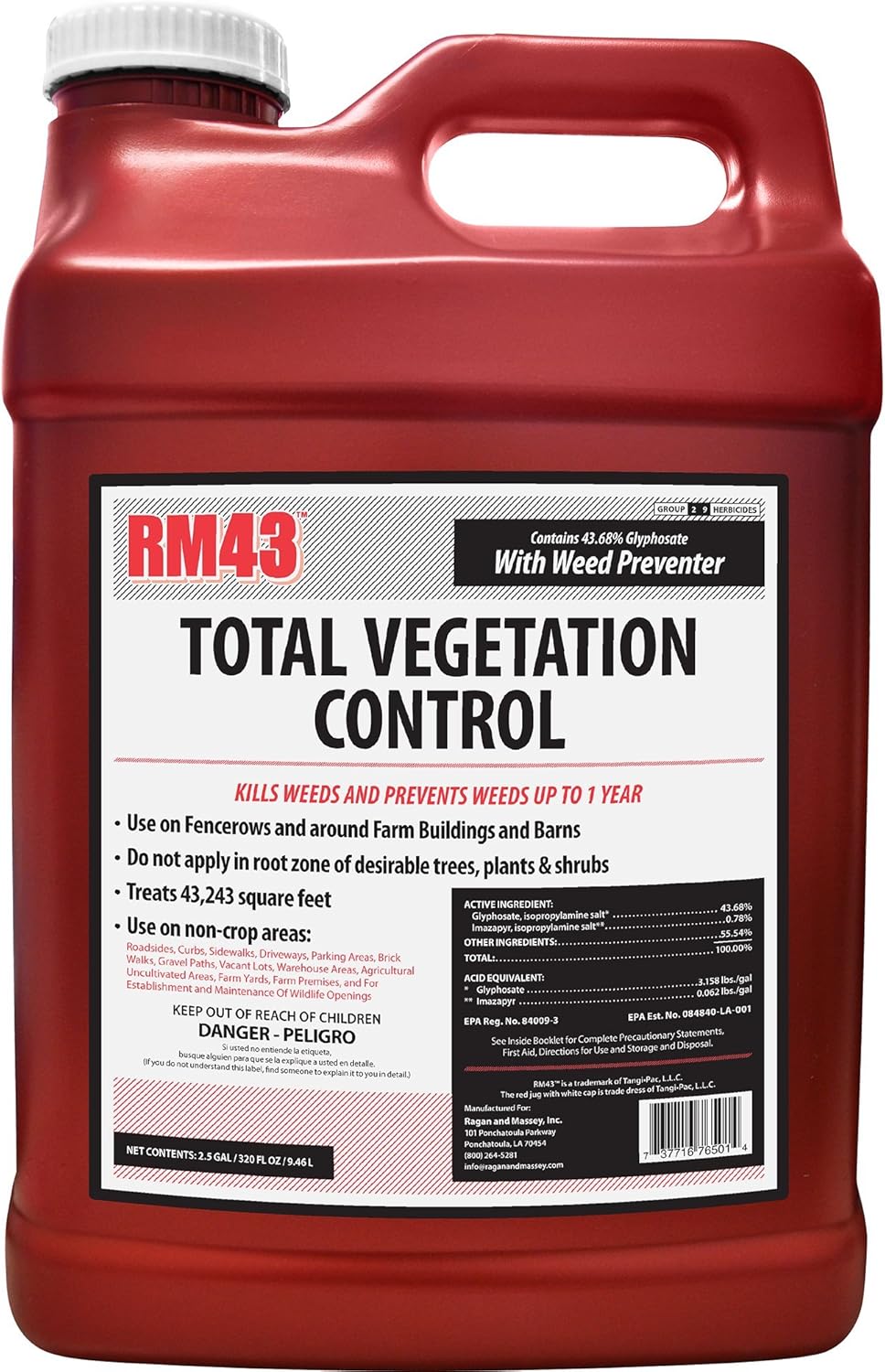
| Unit Count | 320 Fluid Ounces |
|---|---|
| Liquid Volume | 320 fluid ounces |
| Coverage | 243 243 square feet |
| Active Ingredients | Glyphosate isopropylamine salt, Imazapyr isopropylamine salt |
RM43 Total Vegetation Control is a concentrated 2.5‑gallon herbicide intended for killing existing growth and preventing regrowth for up to a year on areas where no vegetation is desired. You mix it into spray solution and apply to hardscape edges, gravel driveways, fence rows, and around buildings as either spot treatments or blanket applications on bare ground. The formula pairs glyphosate and imazapyr with a surfactant so it kills grasses, broadleaf weeds, vines, brush and some woody growth and becomes rainfast in about two hours. Practical benefits for driveway use include long residual control that reduces repeat spraying and a large coverage rate that treats many square feet from one container. Important limitations are that it is for non‑crop areas only and will damage desirable plants if sprayed over roots or drift occurs, and the active ingredient blend makes it persistent so care is required where you may later want vegetation to return. Follow label directions for mixing, application timing and safety precautions when using near soil that will be planted later.
Best for: Gardeners, property owners, and maintenance crews who prioritize strong, long‑lasting weed eradication on gravel driveways and other non‑crop hardscape areas and want to minimize repeat applications.
Less Ideal for: Homeowners planning to replant treated areas soon or those needing selective weed control near desirable plants should choose a less persistent or more targeted product.
- Combination of glyphosate and imazapyr for both knockdown and long residual control
- Concentrated 2.5‑gallon container covers large areas without frequent refills
- Rainfast in about two hours so light rain soon after application is less likely to reduce effectiveness
- Suitable for total vegetation control on gravel driveways, fence rows and other non‑crop areas
- Persistent active ingredients that can prevent desirable vegetation from reestablishing for an extended period
- Not safe for use where desirable plant roots may be exposed or where drift could contact nearby plants
Verdict: Choose RM43 when you need a single, heavy‑duty application that delivers broad spectrum kill and up to a year of weed prevention on gravel driveways and other non‑crop surfaces.
Spectracide Weed & Grass Killer with AccuShot Power Sprayer, 1.33 Gal

| Unit Count | 170 Fluid Ounces |
|---|---|
| Item Form | Spray |
| Coverage | 1 gallon |
| Active Ingredients | Diquat Dibromide 0.12%, Fluazifop-p-butyl 0.06%, Dicamba 0.04% |
Spectracide Weed & Grass Killer pairs a concentrated non-selective formula with a battery-powered AccuShot sprayer to clear weeds from driveway cracks, patios and around foundations. The product is used by aiming and spraying foliage until leaves are covered; the active ingredients move through the leaf to the root and can show visible die-back in as little as three hours. The AccuShot wand is extendable and provides continuous spray without manual pumping, which improves accuracy for narrow cracks and reduces hand fatigue during larger jobs. It is rainproof within 15 minutes, so treated areas are protected quickly. Practical benefits include fast results that let you replant or resume use of the area within a day and a reusable sprayer for follow-up applications. Important limitations are that the herbicide is non-selective so it will kill any plant it contacts, it requires careful handling and PPE to avoid skin or eye exposure, and the sprayer runs on four AA batteries that must be replaced periodically. Follow label directions to avoid runoff into water.
Best for: Buyers who want a fast, no-nonsense solution for weeds growing in driveways and hard surfaces and who prioritize tools with clear user feedback and proven results.
Less Ideal for: Gardeners who need a selective lawn-safe treatment, people unwilling to follow pesticide safety precautions, or those treating areas adjacent to water features.
- AccuShot battery-powered wand gives continuous spray for accurate application in tight cracks
- Formula moves through foliage to kill weeds down to the root with visible results in about three hours
- Rainproof after 15 minutes so treatments are not easily washed away by brief showers
- Covers approximately 300 square feet per gallon, suitable for multiple crack-treatment sessions
- Non-selective herbicide will damage any desirable plants it contacts
- Sprayer requires four AA batteries and occasional replacement to maintain function
- Product is toxic to aquatic life and must not be used near water or allowed to run off
Verdict: A fast-acting, easy-to-aim non-selective herbicide with a battery-powered wand that is well suited to reliably clear weeds from driveway cracks and other hard surfaces.
Roundup Weed & Grass Killer4 Refill, 1.25 gal

| Unit Count | 160 Fluid Ounces |
|---|---|
| Coverage | 375 square feet |
| Item Form | Spray |
| Active Ingredients | Triclopyr, Fluazifop P-Butyl, Diquat Dibromide |
This 1.25 gallon Roundup Weed & Grass Killer4 refill is designed to be poured into an empty spray container to treat weeds and grassy weeds around beds, walkways, driveways, foundations, and other hardscape edges. It contains multiple active ingredients that attack broadleaf weeds and grasses to the root and promises visible wilting within hours and rainproofing in as fast as 30 minutes, which makes it convenient when weather windows are short. The refill covers about 375 square feet and is intended for use in and around established plantings when applied carefully to avoid drift onto desirable plants. Practical benefits include fast action, the ability to replant some areas within a specified wait period, and compatibility with the brand’s comfort wand refills so you avoid frequent repurchasing of small bottles. Important limitations are that it is a nonselective herbicide so it will damage desirable plants if misapplied and treated areas should be kept clear of people and pets until spray dries; follow label directions closely for safe use and replanting intervals.
Best for: Buyers who prioritize reliable, fast-acting weed control for routine maintenance of beds, edges, and hardscape areas and who follow label directions to minimize risk.
Less Ideal for: Gardeners who need selective control inside densely planted flower beds or who prefer organic or nonchemical weed management methods.
- Kills a broad range of weeds and grasses to the root, including dandelion and crabgrass
- Fast visible results in hours and becomes rainproof in about 30 minutes
- Large 1.25 gal refill reduces need for frequent repurchases and covers roughly 375 sq ft
- Formulated to refill compatible spray wand for easy application around beds and hardscapes
- Nonselective formula that will harm desirable plants if it drifts or is oversprayed
- Requires careful handling and adherence to label safety and replanting intervals
Verdict: Choose this refill if you want a fast, proven, large-format herbicide that quickly kills tough weeds and grasses and refills a compatible spray wand for area-wide maintenance.
Choosing the Right Extra Strong Weed Killer for Driveways: Key Factors to Consider
Kill Speed and Visible Results
How quickly a product browns and collapses foliage matters when you need immediate improvement on a driveway. Fast-acting contact ingredients show visible results in a few days, which is useful for high-traffic areas where appearance and safety are priorities.
However, rapid top-kill does not always mean the root system is controlled. Consider whether the formulation combines quick contact action with systemic uptake so the plant cannot reshoot from crowns or deep roots. For persistent species such as bindweed or dock that grow in cracks and deeper pockets, systemic activity reduces repeat treatments and labor.
Systemic Activity and Root Uptake
Systemic formulations move from leaves into root and crown tissues, which is essential for perennial weeds with stored energy reserves. Products that translocate effectively lower the chance of resprouting and can reduce the number of follow-up applications.
Timing matters for systemic uptake. Treat when plants are actively growing and not drought-stressed so translocation is maximized. For driveways, weeds often heat up in summer and may be stressed, so plan treatments in spring or autumn for best root uptake unless a product specifically targets tough dormant roots.
Surface Compatibility and Stain Risk
Driveways are built from a range of materials that react differently to chemicals and water. Some formulations can discolor porous concrete, etch natural stone, or leave residues in block paving joints. Check whether a product is labeled safe for your surface type and follow rinsing guidance for accidental overspray.
Avoid leaving concentrated droplets on decorative stonework or painted surfaces. Lightly sealing or testing an inconspicuous area first can prevent permanent marks. Surface compatibility also shapes drainage choices; runoff from driveways can carry residues into soil beds, so choose products with lower mobility if sensitive planting borders are nearby.
Residual Control and Reapplication Frequency
Residual action describes how long a product suppresses new growth after application. For some driveway situations, a short residual that kills germinating seedlings is helpful to keep joints clear through a season. For other sites, long residuals reduce how often you must treat but may impact nearby planting and soil life.
Consider how often you are willing to re-treat and how the chosen chemistry affects surrounding landscape plants. If you prefer a mechanical cleanup schedule, select a product with minimal residual activity to avoid harming desirable plants when you sweep or pressure-wash the driveway later.
Application Method and Ease of Use
How you apply the product influences coverage, safety, and time spent. Ready-to-use sprayers are convenient for small cracks and spot treatments, while concentrate formulations that fit a garden sprayer are more economical for larger driveways. Pressure-sprayer compatibility, nozzle choice, and tank-mixing instructions change how evenly the product deposits in joints.
Also factor in drift control features and wind-window guidance to prevent spray reaching adjacent lawns or garden beds. Ease of rinsing equipment and clear label instructions reduce the chance of accidental over-application or operator exposure.
Environmental and Neighbourhood Considerations
Driveways often sit next to planted borders, public footpaths, or drains. Choose products with clear guidance on runoff, buffer zones, and pet safety to reduce environmental impact. Some active ingredients bind quickly while others remain mobile; understanding the chemistry helps you plan application timing and avoid contamination of nearby soil or water courses.
Consider local regulations, community rules, and the presence of pollinators or pets when scheduling treatments. Non-chemical alternatives such as hot-water or steam systems are outside this roundup, but looking at integrated approaches can minimize overall chemical use while keeping driveway surfaces clear.
When to Treat Driveway Weeds
Timing treatment for driveway weeds depends on plant growth stage and local climate. Treat when weeds are actively growing so systemic actives move into roots. In temperate regions this is usually spring or early autumn for the best translocation; midsummer treatments can still work but may need follow-up if plants are drought-stressed.
Also plan around traffic and weather. Choose a calm, dry day with no forecast rain for at least 24 hours to allow the product to dry and reduce wash-off. If your driveway is used frequently, schedule treatments when you can restrict parking for the recommended contact period to avoid disturbing wet spray.
- Treat actively growing foliage rather than dormant patches
- Avoid windy or rainy windows to minimize drift and runoff
- Restrict access until the surface has dried when label requires
Application Tips for Cracks and Joints
Weeds in joints and cracks need direct contact with the product and good coverage of crown tissue. For small gaps, apply with a targeted nozzle or brush-on applicator to concentrate product where the plant is located and reduce waste. For broad infestation, a low-pressure fan nozzle provides even coverage.
Removing surface debris and giving plants a light trim before treatment improves contact with live tissue and reduces shielding. For stubborn roots in deeper pockets, repeat spot treatments spaced as recommended on the label rather than increasing dose at once.
- Brush or blow out loose debris before spraying
- Use spot application tools for precision in tight joints
- Trim tall weeds so spray contacts fresh growth
Safe Practices Around Plants and Pets
Protect adjacent planting by creating buffer zones and covering desirable plants if drift is likely. Water the soil around sensitive shrubs before treatment to reduce uptake of any accidental spray. Follow label guidance for re-entry intervals where people or pets may walk.
Store and mix concentrates away from children and animals, and rinse equipment in an area where rinse water will not enter garden beds or drains. If pets cross treated surfaces, keep them off until the surface is fully dry and any recommended re-entry interval has passed.
- Establish buffer areas to protect borders
- Rinse mixing equipment in impermeable areas away from soil
- Keep pets off treated areas until dry
Combining Chemical and Mechanical Control
A combined approach often yields the best long-term results. Use mechanical methods such as scraping, wire brushing, or steam for thick mats and moss, then follow with a targeted herbicide for roots that remain. Mechanical removal reduces plant mass and lets herbicides contact fresh tissue more effectively.
For heavy infestations, plan a maintenance calendar that alternates mechanical clearing with selective chemical spot treatments. This reduces total chemical use while keeping joints and paving looking tidy and functional.
- Remove surface growth before applying systemic treatments
- Schedule seasonal mechanical clean-ups to reduce herbicide reliance
- Use chemicals for regrowth and root-kill after mechanical measures
Dealing with Tough Perennials and Deep Roots
Perennials with deep roots require patience. Expect some species to need two or more correctly timed treatments for reliable control. Apply systemic products when plants are storing energy in roots and follow label intervals for repeat applications rather than increasing single-dose strength.
For particularly stubborn plants, combine targeted foliar sprays with spot applications directly into larger crowns using an applicator designed for concentrated treatments. Avoid dragging clumps across clean paving as this spreads roots and seed.
- Plan multiple treatments for perennial species
- Apply when plants are actively transporting sugars to roots
- Use concentrated spot application into crowns when allowed
How We Chose the Best Extra Strong Weed Killer for Driveways
We shortlisted products that are explicitly formulated for heavy weed pressure and for use on hard surfaces such as concrete, block paving, and tarmac. Selection focused on measurable, gardener-relevant performance: contact kill speed, systemic activity to reach roots, residual control to limit frequent re-treating, and surface safety to avoid staining or etching. We also considered application versatility, including suitability for hand-spraying, pressure sprayers, or spot treatment, and whether the formulation reduced drift or runoff risk. Excluded from consideration were products intended only for lawns or for broad landscape use where surface safety was not specified, plus any treatments requiring specialist licensing. We prioritized products with clear directions for driveway use, realistic re-entry and rain-window guidance, and formulations that balance strength with responsible urban garden use. The listed evaluation criteria reflect these priorities and guided the picks.
FAQ
Can I use extra-strong weed killer on all driveway surfaces?
It depends. Some formulations are labeled safe for concrete and tarmac but may discolor or etch natural stone or painted surfaces. Always check surface compatibility on the label and test a small inconspicuous area first.
How soon will I see results after spraying driveway weeds?
Visible browning often appears within days for contact ingredients, while full plant collapse and root dieback can take one to three weeks depending on species and weather. Systemic uptake is faster on actively growing plants.
Is it safe to use near flower beds or lawns?
Often it is safe if you observe buffer zones and avoid drift, but some actives can move in runoff or soil. Protect nearby planting by covering or wetting soil to reduce unintended uptake and follow label buffer recommendations.
How often will I need to re-treat a driveway?
Reapplication frequency depends on the product residual and the weed species. Annual or seasonal touch-ups are common for seedling control, while persistent perennials may need targeted follow-up visits within weeks or months.
Can I pressure-wash after treatment?
You can pressure-wash to remove dead plant material once the herbicide has had time to act and any recommended re-entry interval has passed. Washing too soon can reduce effectiveness and may spread viable root fragments if not fully killed.
Final Verdict
Choose an extra strong driveway weed killer by balancing immediate visual results with root-system control and surface safety. Prioritize products that combine fast contact action with systemic uptake if you need fewer follow-ups, and pick formulations labeled for your driveway material to avoid staining or etching. Plan treatments for active growth periods, use precise application methods in joints and cracks, and combine mechanical clearance for heavy mats. That approach reduces repeat work and keeps your driveway functional and tidy with the least impact on nearby planting.
