

Note: This article contains affiliate links. If you click on these links and make a purchase, I may earn a small commission at no extra cost to you. This helps support my research and content. Read my full affiliate disclosure here.
Picking the right fall fertilizer for Kentucky bluegrass matters more than a midseason treatment. In the cooler months the right nutrient balance supports root growth, carbohydrate storage, and a faster spring green-up. You want a product that matches your lawn size, spreader type, and maintenance goals while delivering the right ratio of nitrogen, potassium, and slow-release options. This guide covers six top fall fertilizers shortlisted for Kentucky bluegrass lawns in typical cool-season turf management. We explain the criteria used to select them and walk through the practical factors that affect results, from timing and application to soil needs and spreader compatibility.
Top Picks at a Glance
| Best Overall The best all-around choice for most situations | The Andersons Fall Lawn Food 24-0-14 Fertilizer (5,000 sq ft) |  |
| Best Quality Built to a higher standard if you want something more solid | GreenView Fairway Formula Fall Lawn Fertilizer, 22.5 lb |  |
| Best Value The sweet spot between price and what you get | GreenView Fall Lawn Food 48 lb Bag (22-0-10) — Fall Lawn Fertilizer |  |
| Best Budget The cheapest option that still gets the job done reliably | Milorganite Slow-Release Organic Fertilizer, 5 lb |  |
| Highest Rated A top-rated pick with lots of positive feedback | Milorganite 6-4-0 Slow-Release Fertilizer, 32 lb (with Feeding Tips Brochure) |  |
| Most Popular A crowd favorite that many people choose with confidence | Scotts Turf Builder WinterGuard Fall Lawn Food, 10 lb. |  |
The Andersons Fall Lawn Food 24-0-14 Fertilizer (5,000 sq ft)

| N-P-K | 24-0-14 |
|---|---|
| Item Form | Granules |
| Specific Uses For Product | Lawn |
| Coverage | lawns and turf grasses |
The Andersons Fall Lawn Food 24-0-14 is formulated for late-season lawn care to help turf recover from summer stress and build hardiness for winter. You apply it to dry foliage and then water in; the mix of quick-, intermediate-, and slow-release nitrogen gives an initial green-up followed by weeks of steady feeding. Potash in the blend helps thicken cell walls for more vigorous, resilient grass and added iron reduces yellowing for deeper color. The granular form spreads well with a broadcast or drop spreader and is labeled safe for all turf types, making it straightforward to include as the fourth application in a seasonal lawn program. Important practical notes are the safety instructions for handling and the recommendation to avoid collecting clippings for at least one mowing after application to prevent particle pick-up. If you need a balanced fall fertilizer focused on color, recovery, and winter prep, this product provides proven ingredients in a ready-to-use format but requires proper spreading and watering to perform as promised.
Best for: Homeowners who want a straightforward, seasonal fall treatment to green up, thicken, and harden lawns before winter and who follow a multi-application lawn program.
Less Ideal for: Gardeners seeking a phosphorus-rich starter or those who prefer liquid or organic-only fertilizers should consider alternative products.
- Three types of nitrogen for immediate and extended feeding
- Includes potash to strengthen grass cell walls and improve hardiness
- Contains iron to reduce yellowing and promote deep green color
- Granular formula suitable for use with standard lawn spreaders and labeled for all turf types
- No phosphorus included which limits benefits for root stimulation
- Requires watering after application and temporary restriction on collecting clippings
Verdict: A practical, ready-to-apply fall fertilizer that greens, strengthens, and helps winterize lawns with a mix of fast and slow-release nutrients.
GreenView Fairway Formula Fall Lawn Fertilizer, 22.5 lb

| Item Form | Granules |
|---|---|
| Application Method | broadcast spreader |
| Coverage | 7,500 sq. ft. |
| Specific Uses For Product | Plant Growth, Root Development, Seed Development, Soil Conditioning |
GreenView Fairway Formula Fall Lawn Fertilizer is a granular winterizer designed for homeowners preparing turf for winter and aiming for a healthier spring lawn. It is applied with a broadcast or drop spreader and supplies a mix of immediate and slow-release nitrogen so lawns green evenly without a surge of top growth while encouraging deeper root development. A single 22.5 lb bag covers about 7,500 square feet and the manufacturer claims feeding for up to 12 weeks, which makes scheduling a single late-season application simple. The formula contains 59% slow-release nitrogen and no phosphate to reduce runoff concerns. Practical benefits include easier application with standard spreaders, steady feeding that reduces mowing shock, and help repairing summer stress before dormancy. Limitations are that it is focused on nitrogen and root development only, so it will not address phosphorus or micronutrient deficiencies, and safety guidance means you should not hand spread and must store unused product securely.
Best for: Homeowners who want a straightforward late-season lawn treatment that focuses on root strengthening and steady greening with a single, easy spreader application.
Less Ideal for: Gardeners managing soils with known phosphorus or micronutrient deficiencies or those needing an all-in-one nutrient program should consider targeted soil tests and alternative blends.
- High proportion of slow-release nitrogen provides steady feeding for up to 12 weeks
- Formulated to promote deep root development and repair summer stress before winter
- Covers approximately 7,500 sq. ft. per bag for single-application convenience
- Designed for easy application with a broadcast or drop spreader
- No phosphate in the formulation to help reduce runoff concerns
- Does not supply phosphorus or specific micronutrients that some soils may need
- Not intended for hand spreading and requires safe storage away from children
Verdict: A reliable fall winterizer that delivers steady, slow-release nitrogen to strengthen roots and simplify late-season lawn care.
GreenView Fall Lawn Food 48 lb Bag (22-0-10) — Fall Lawn Fertilizer

| NPK | 22-0-10 |
|---|---|
| Application method | broadcast or drop spreader |
| Coverage | 15,000 sq. ft. |
| Item form | Granules |
GreenView Fall Lawn Food is a granular, fall-applied fertilizer formulated to encourage root growth, improve winter hardiness, and promote earlier spring green-up. It is used with a broadcast or drop spreader at the recommended rate to cover large lawns and can be lightly raked into the topsoil after application; the MESA controlled-release nitrogen provides steady feeding for up to eight weeks so you avoid surge growth while replenishing nutrients lost during summer. The product is intended for seeded or established lawns that are still actively growing in fall and its zero-phosphate emphasis helps limit runoff concerns in sensitive areas. Practical benefits include broad coverage from a single 48 pound bag, predictable slow-release nutrition, and guidance for combining with seeding for fall establishment. Limitations are that it must be applied before hard freezes to be effective for new seedings and it contains phosphorus so local restrictions may apply in areas that limit phosphorous use on turf.
Best for: Homeowners who prioritize practical, season-specific lawn care and want a single, predictable application to restore summer losses and build root strength before winter.
Less Ideal for: Those with very small lawns who prefer smaller packaging or gardeners in jurisdictions that ban phosphorus on non-agricultural turf should consider alternatives.
- MESA controlled-release nitrogen feeds lawns steadily for up to eight weeks
- Formulated to encourage deeper root growth and improve winter hardiness
- Large 48 lb bag covers roughly 15,000 sq. ft., reducing trips to buy more
- Applied with broadcast or drop spreader for even distribution
- Contains phosphorus which may be restricted by local regulations
- Must be applied early enough in fall for seeded areas to establish before freezes
Verdict: Choose this if you want a fall-focused, slow-release fertilizer that builds stronger roots and provides steady feeding across large lawns.
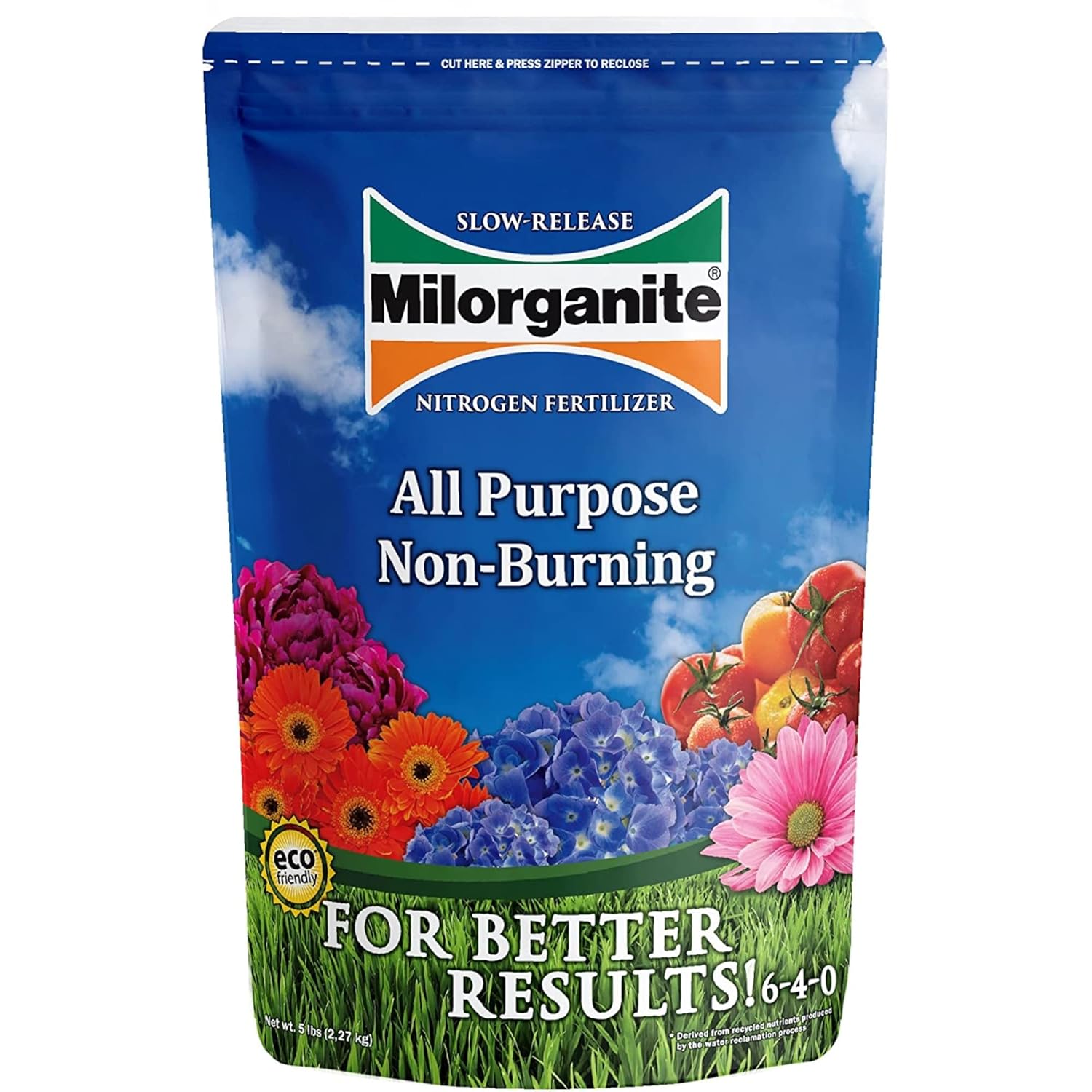
Milorganite Slow-Release Organic Fertilizer, 5 lb
| Item Form | Granules |
|---|---|
| Specific Uses For Product | Lawns, Flowers and Gardens |
| Coverage | 390 Square Feet |
| Ingredients | Nitrogen |
Milorganite is a granular, slow-release organic fertilizer formulated to feed lawns and garden plants for about 8 to 10 weeks per application. It is typically broadcast by hand or with a spreader and does not require immediate watering in, making it easy to fit into routine maintenance. Notable features include a low-salt formula that greatly reduces the risk of burning turf, organically complex iron that greens grass without staining hard surfaces, and about 85% organic matter that helps improve soil structure over time. The product covers roughly 390 square feet from a 5 pound bag and is positioned as safe for use on lawns, shrubs, flowers, trees, and edible gardens. Limitations are that nutrient release is gradual, so it is not a quick fix for severe nitrogen deficiency, and the bag has an earthy odor at first that some pets may find attractive until it dissipates or is watered in. For someone managing Empire Zoysia, use on the recommended schedule and expect steady, low-risk green-up rather than instant color change.
Best for: Gardeners who prioritize steady, low-risk nutrient delivery and soil health and who prefer a hands-off feeding schedule for fine-textured lawns like Empire Zoysia.
Less Ideal for: Homeowners wanting rapid color correction or fast-acting synthetic nitrogen boosts should choose a quick-release fertilizer instead.
- Slow-release nitrogen feeds lawns for 8–10 weeks reducing application frequency
- Low salt formulation minimizes risk of burning sensitive turf like Zoysia
- Provides organically complex iron that greens grass without staining concrete
- High organic matter improves soil structure and water retention over time
- Slow-release action means it will not correct severe yellowing immediately
- Initial earthy odor that may attract some pets until it is watered in or dissipates
Verdict: Choose Milorganite for Empire Zoysia when you want a safe, slow-release organic feed that greens turf steadily without burning or staining.
Milorganite 6-4-0 Slow-Release Fertilizer, 32 lb (with Feeding Tips Brochure)

| Item Form | Pelletized |
|---|---|
| Application Method | Broadcast, Rotary or Manual |
| Coverage | 2,500 Square Feet |
| Specific Uses For Product | Lawns, Flowers and Gardens, Education |
Milorganite 6-4-0 is an organic, pelletized slow-release fertilizer intended for routine lawn and garden feeding. It is typically broadcast with a rotary or manual spreader and provides nitrogen slowly over 8 to 10 weeks, which reduces the need for frequent applications and lowers burn risk. The product contains organically complex iron for greening without the strong staining associated with iron salts and is low in soluble salts, so it performs well in warm or drier conditions. The 32 lb bag covers roughly 2,500 square feet and comes with a printed feeding and spreader tips brochure to simplify seasonal timing and application rates. Because it is made from heat-dried microbes, it also adds organic matter to improve soil structure in heavy clay or sandy soils. Limitations are that nutrient release is gradual so it is not suited to quick color fixes or rapid turf recovery, and users seeking tightly controlled N-P-K ratios or fast-acting synthetic performance may prefer a different product.
Best for: Buyers who want a low-maintenance, environmentally minded fertilizer that steadily feeds established lawns and mixed garden beds with minimal risk of burn and fewer repeat applications.
Less Ideal for: If you need rapid turf recovery, immediate color correction, or precise synthetic nutrient control for athletic fields or newly sodded lawns, choose a fast-release or specialty fertilizer instead.
- Slow-release nitrogen feeds lawns and plants for 8–10 weeks, reducing application frequency
- Low-salt formulation minimizes fertilizer burn and streaking in hot or dry conditions
- Organically complex iron promotes deep greening without heavy staining of concrete
- Pelletized form works with broadcast, rotary, or manual spreaders for easy application
- Adds organic matter that can improve drainage and soil structure in clay or sandy soils
- Not fast-acting, so it will not deliver an immediate green-up after application
- Contains biosolids which some buyers may prefer to avoid for personal or local reasons
Verdict: Pick this if you want a reliable, low-salt slow-release fertilizer that feeds lawns and gardens for weeks with minimal maintenance.
Scotts Turf Builder WinterGuard Fall Lawn Food, 10 lb.

| Item Form | Granules |
|---|---|
| Specific Uses For Product | Lawn Fertilizer |
| Application Method | spread |
| Coverage | 4000 |
| Target Species | lawn grasses |
Scotts Turf Builder WinterGuard is a granular fall lawn food designed to build strong, deep roots and help turf recover from summer heat, drought, and regular wear. It is applied with a broadcast or drop spreader over a lawn in autumn and can be used on any grass type. The bag covers about 4,000 sq. ft., and the package directions include recommended spreader settings and note that watering-in is optional for fast results. In practice this product provides a straightforward, DIY-friendly way to add nutrients before winter; the granules are easy to spread and work with standard spreaders. Notable features are its all-grass compatibility and clear application guidance. Limitations are that it is a single-season bag sized for small to medium yards and it does not include weed or insect control functions found in some other Scotts formulas, so you may need additional products if those issues are a concern. For homeowners wanting a simple autumn boost to root strength, this is an effective, no-frills option.
Best for: Homeowners who want a simple, reliable fall fertilizer to strengthen roots and help lawns recover from summer stress without complicated application steps.
Less Ideal for: People managing large lawns who need wide-coverage bulk fertilizer or those who want combined weed or insect control in the same product.
- Formulated specifically for fall to build deep, winter-ready roots
- Works on all grass types so it fits mixed lawns
- Clear application instructions and spreader settings for easy DIY use
- Covers 4,000 sq. ft. from a single 10 lb. bag for small to medium yards
- No built-in weed or insect control so additional products may be needed
- Single 10 lb. bag may be small for larger properties
Verdict: Choose this bag if you want an easy-to-apply fall fertilizer that strengthens roots and helps your lawn recover before winter.
Choosing the Right Fall Fertilizer for Kentucky Bluegrass: Key Factors to Consider
Nitrogen Source and Release Rate
Fall fertilizer decisions hinge on what type of nitrogen is in the bag and how quickly it releases. For Kentucky bluegrass, a program leaning toward slow-release or stabilized nitrogen helps feed roots and crown tissues without forcing lush top growth that is vulnerable to cold damage. A fertilizer with a blend of quick and slow sources will give an initial nutrient boost while maintaining steady uptake during cooler soil conditions.
Knowing the release characteristics also determines timing. Fast-release nitrogen is useful earlier in the fall when temperatures still permit active leaf uptake, while water-soluble sources lose effectiveness as soils cool. Match the product's release pattern to your local first-frost expectations to maximize benefit.
Potassium Level and Stress Tolerance
Potassium is the nutrient most associated with winter hardiness and stress resistance in turf. Adequate potassium improves carbohydrate storage and cell function, which helps Kentucky bluegrass survive freeze-thaw cycles and spring heaving. When evaluating fall fertilizers, look for elevated potassium numbers relative to summer maintenance feeds.
Higher potassium can also influence drought and disease resistance, making it a worthwhile trade-off in the fall when the plant is reallocating resources. The absolute number you need depends on your soil test results, but products targeting fall strength typically emphasize this nutrient.
Application Timing and Local Climate
Timing a fall fertilizer application properly is as important as the product choice. In most cool-season regions, the ideal window starts when daily high temperatures reliably fall below about 70°F and continues until just before dormancy. Applying too early may produce excessive top growth that is susceptible to disease, while applying too late may not allow enough root uptake.
Local microclimates, elevation, and last frost dates should guide your schedule. Also factor in predicted rainfall or irrigation so granules can dissolve and begin moving into the root zone without washing away.
Spreader Type and Calibration
Even the best fall fertilizer will perform poorly if it is spread unevenly. Granule size and uniformity affect how materials behave through broadcast and drop spreaders. Some products list spreader settings for common models; others only provide coverage rates and require a calibration step.
Calibrating your spreader ensures correct application rate across varying bag sizes and lawn geometries. For irregular yards, smaller bag sizes or hand-held applicators may reduce overlap or misses. Consider the ease of calibration and whether the product provides clear guidance.
Soil Test Results and Nutrient Balance
A soil test gives the facts needed to match fertilizer choice to actual deficiencies. Fall fertilizers can vary in secondary and micronutrient content, including magnesium, iron, and sulfur, which affect color and long-term turf health. If your soil already has adequate potassium or phosphorus, choose a product that addresses nitrogen timing and does not add excess of nutrients already in surplus.
Avoid routine overapplication. Using a product that aligns with soil test recommendations prevents nutrient runoff and keeps the turf's nutrient balance healthy entering winter.
Coverage Options and Lawn Size
Bag sizes, coverage claims, and ease of handling influence cost-effectiveness and convenience. Wide-coverage bags are efficient for large, simple lawns but can be heavy and hard to store. Small bags reduce waste for small yards and make spot treatments easier.
Consider how many applications you will need per season and whether you prefer one autumn application or a two-step approach. Coverage also ties back to spreader compatibility because some products are intended for broadcast spreaders while others work better with drop spreaders or hand application.
When to Apply Fall Fertilizer in Cool-Season Lawns
For Kentucky bluegrass, aim to apply fall fertilizer during the period of active root growth but declining shoot growth. That window typically starts when daytime highs drop into the 60s to low 70s and continues until late fall dormancy. Monitor local forecasts and lawn response rather than fixed calendar dates.
If you use a two-application strategy, the first application occurs in early fall to restore carbohydrates and recover from summer stress, and the second, lighter application is in late fall to reinforce roots and provide potassium before dormancy. Single-application approaches can also work if timed correctly and matched to a product with an appropriate release profile.
- Early fall application: better for recovery from summer stress
- Late fall application: focuses on winter hardiness and carbohydrate storage
- Avoid fertilizing during very wet or frozen soil conditions
Using Soil Tests to Guide Your Fall Plan
A soil test tells you which nutrients are lacking and whether pH adjustments are needed. For Kentucky bluegrass, potassium and magnesium levels are common fall concerns. If the test shows sufficient potassium, prioritize slow-release nitrogen instead of a high-K product.
In addition to N-P-K numbers, note recommendations for lime or sulfur. Correcting pH issues in the fall gives amendments time to affect nutrient availability before spring growth.
- Test every 2 to 3 years for established lawns
- Match product choice to the nutrient gaps shown by the test
- Consider micro-nutrients only when tests or symptoms indicate deficiencies
Spreader Tips and Calibration Tricks
A calibrated spreader prevents streaks and doubles. Use a measured test strip on a driveway to verify the output for a given setting and adjust accordingly. Many fertilizer bags list a coverage rate per pound; use that to calculate the correct setting for your spreader.
For odd-shaped lawns, break the area into smaller zones and overlap slightly to avoid thin patches. Clean the spreader after use to prevent corrosion from fertilizer residues and store it dry.
- Calibrate with a catch-pan or by measuring weight applied over a known area
- Overlap slightly on turns to avoid missed strips
- Use hand application for small or sensitive areas
Environmental Best Practices for Fall Feeding
Avoid applying fertilizer immediately before heavy rain to reduce runoff risk. Sweep stray granules off hard surfaces and back onto turf. Choosing a product with lower water-soluble nitrogen can reduce leaching potential in areas with sandy soils or slopes.
Follow local regulations and recommended application rates to protect waterways. Buffer zones near streams and driveways are often necessary to prevent nutrients from reaching surface water.
- Do not apply on frozen ground
- Store bags in a dry, secure place to prevent contamination
- Follow municipal guidelines for nutrient management
Combining Fertilizer with Overseeding and Aeration
Fall is a common time for aeration and overseeding, which changes fertilizer needs. If you aerate, plan fertilizer timing to coincide with seed establishment and root recovery. Lighter, starter-focused feeds work better when overseeding, while higher potassium emphasis is better after overseeding has had time to establish.
When overseeding Kentucky bluegrass, choose a fertilizer strategy that supports seedlings without encouraging excessive weed competition. Use seed-friendly rates and avoid products with high salt index near newly sown areas.
- Apply starter-appropriate fertilizer when seeding
- Delay heavier potassium-focused feeds until seedlings are established
- Coordinate aeration timing to maximize root-soil contact
How We Chose the Best Fall Fertilizer for Kentucky Bluegrass
We prioritized products formulated specifically to support cool-season turf recovery and overwintering, focusing on nutrient profiles and release characteristics that favor root development over leafy growth. Key evaluation dimensions included nitrogen source and release rate, potassium content for stress tolerance, and the presence of secondary nutrients that correct common turf deficiencies. Application practicality was another filter: we considered ease of spreading with common broadcast and drop spreaders, granule uniformity to reduce streaking, and available bag sizes for different lawn areas. Safety and turf health factors such as salt index and burn risk were assessed to avoid products that can stress roots when used at recommended fall rates. We also checked labeling clarity and recommended application windows for cool climates to ensure gardeners can match timing to local frost and dormancy patterns. Products were excluded if their formulas were clearly aimed at fast leaf green-up rather than root and crown strengthening, or if they lacked clear spreader calibration guidance. The resulting picks balance nutrient science with real-world lawn care practicality.
FAQ
How late in the season can I apply fall fertilizer to Kentucky bluegrass?
You can apply fertilizer until the turf enters full dormancy and the soil starts to freeze. Usually this means a late fall window after daytime highs consistently fall and before prolonged freezes. Timing depends on local climate and specific seasonal trends.
Will a high-potassium fertilizer prevent winterkill?
Higher potassium improves winter hardiness by boosting carbohydrate storage and cell function, but it is not a guaranteed prevention for winterkill. Winter survival also depends on snow cover, freeze-thaw cycles, soil drainage, and overall turf health.
Should I use a liquid or granular fall fertilizer?
Granular slow-release fertilizers are common for fall because they provide steady nutrients and are easy to apply with spreaders. Liquids can be used for targeted feeding but often lack long-term release unless designed as controlled-release products. Choice depends on application equipment and desired release profile.
Can I apply fall fertilizer after overseeding?
Yes, but use a seed-friendly rate and formula suitable for new seedlings. Heavy, high-salt products can harm delicate grass seedlings. Many gardeners apply a starter feed at seeding and follow with a potassium-focused application once seedlings have established.
How does soil type affect fall fertilizer choice?
Sandy soils are more prone to leaching, so slow-release nitrogen with moderate potassium is preferable. Clay soils hold nutrients longer but may show compaction symptoms; combine feeding with aeration when possible. Soil tests guide specific adjustments for both types.
Do I still need a spring fertilizer if I apply a fall treatment?
Often a well-timed fall application reduces the need for heavy spring feeding, but many lawns benefit from a light spring tune-up to support rapid green-up. The need depends on fall application timing, product release characteristics, and lawn vigor coming out of dormancy.
Final Verdict
Prioritize a fall fertilizer that supports root development and winter hardiness for Kentucky bluegrass, with a nutrient profile emphasizing slow-release nitrogen and adequate potassium. Match timing to your local seasonal conditions, use soil test data to fill actual nutrient gaps, and ensure your spreader is properly calibrated. Balancing application practicality with the right nutrient mix reduces risk and improves spring recovery. Focus on release rates, potassium levels, and turf safety when choosing, and plan applications around aeration or overseeding for the best long-term results.
