

Note: This article contains affiliate links. If you click on these links and make a purchase, I may earn a small commission at no extra cost to you. This helps support my research and content. Read my full affiliate disclosure here.
Getting the timing and product right for fall weed control makes a big difference in next spring's lawn health. Applied when weeds are actively transporting nutrients to roots, a proper fall weed killer reduces winter survivors and cuts the seed and root reserve that fuels spring outbreaks. This guide covers five top-rated fall weed killers for lawns chosen for strong control of common broadleaf weeds, minimal stress to cool- and warm-season turf, and application practicalities gardeners face. We explain the key criteria used to shortlist options and what to watch for during fall applications so you can pick the approach that fits your lawn size, turf type, and maintenance style.
Top Picks at a Glance
| Best Overall The best all-around choice for most situations | BioAdvanced Season-Long Weed Control for Lawns, Ready-to-Spray (29 oz) |  |
| Best Value The sweet spot between price and what you get | Spectracide Large Plot Weed Stop for Lawns Concentrate, 1 Gal |  |
| Best Budget The cheapest option that still gets the job done reliably | Spectracide Weed Stop for Lawns Concentrate, 40 oz |  |
| Highest Rated A top-rated pick with lots of positive feedback | Scotts Turf Builder WinterGuard Fall Weed & Feed, 11.43 lb |  |
| Most Popular A crowd favorite that many people choose with confidence | Scotts Turf Builder Weed & Feed (42.87 lb) |  |
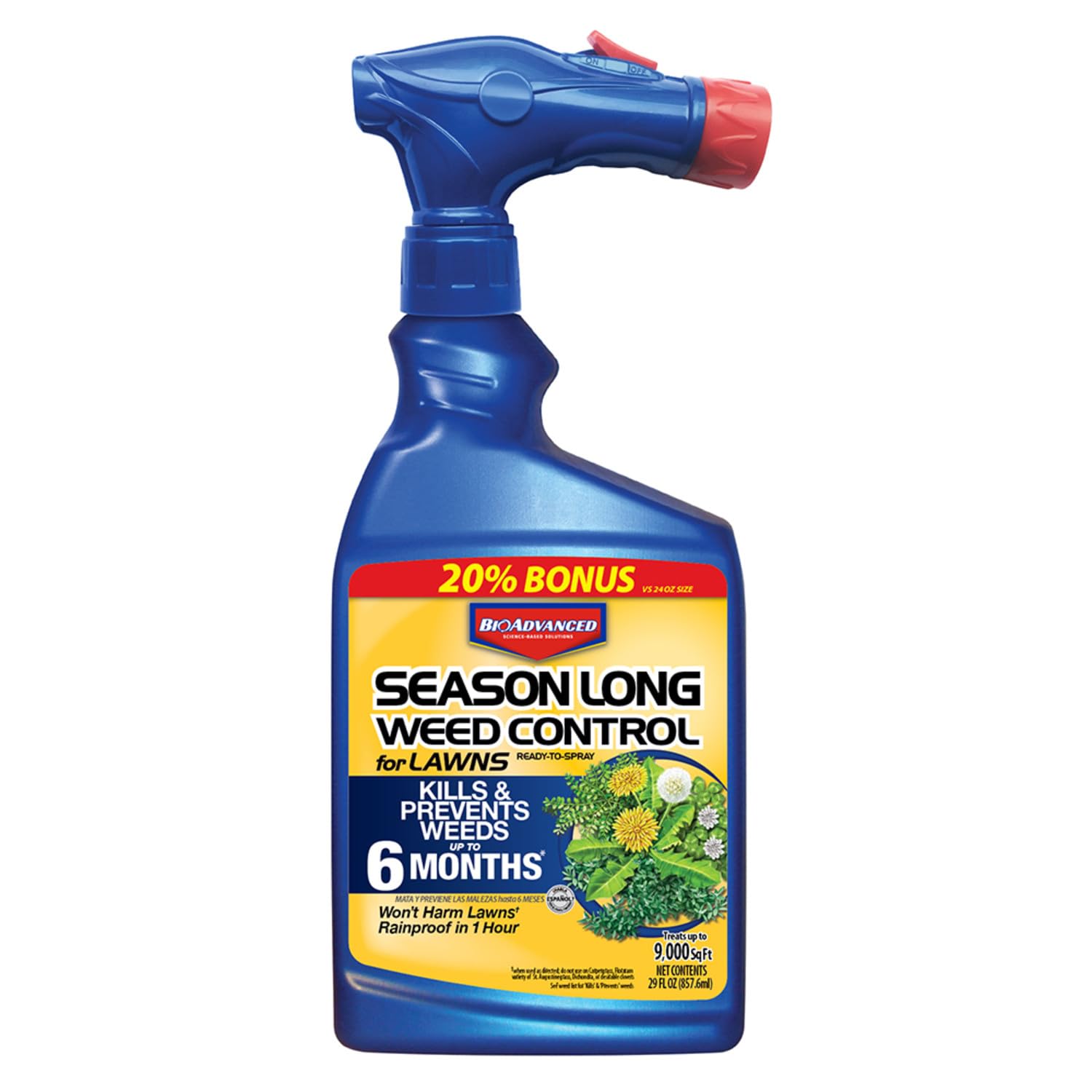
BioAdvanced Season-Long Weed Control for Lawns, Ready-to-Spray (29 oz)
| Unit Count | 29 Fluid Ounces |
|---|---|
| Item Form | Oil |
| Coverage | 9000 square feet |
| Active Ingredients | 2,4-D dimethylamine Salt |
This ready-to-spray BioAdvanced formula combines post-emergent control with pre-emergent protection to kill listed broadleaf weeds and block new ones for up to six months. You apply it to established lawns between 50 and 90°F; the bottle covers up to 9,000 sq ft and becomes rainproof in about an hour, so light showers shortly after application are less likely to reduce effectiveness. The product lists common targets such as dandelion, clover, and dollarweed and uses active ingredients including 2,4-D dimethylamine salt and isoxaben. Practical benefits include the convenience of a pre-mixed sprayer for quick treatment and seasonal flexibility from spring through fall. Limitations to note are the regional restriction on sales in New York and the need to follow specific dilution rates for northern versus southern turf in some instructions, which can affect treated area calculations. As with all herbicides, avoid contact with skin and eyes and keep children and pets off treated areas until safe per label directions.
Best for: Homeowners who want a straightforward, seasonal treatment to both eliminate visible broadleaf weeds and reduce future emergence with minimal mixing or repeated applications.
Less Ideal for: Those seeking an organic or non-chemical weed control method or people who need a product labeled for use in New York should look for alternatives.
- 2-in-1 formula kills existing broadleaf weeds and prevents listed weeds for up to six months
- Ready-to-spray bottle simplifies application for large lawns without measuring or mixing
- Rainproof in one hour, reducing loss of effectiveness from short-term rain
- Covers up to 9,000 square feet, suitable for mid to large lawns
- Not approved for sale in New York which limits availability in that state
- Contains strong active ingredients requiring careful handling and following label safety instructions
Verdict: A convenient ready-to-spray formula that removes common broadleaf weeds and provides up to six months of prevention for homeowners who want low-effort seasonal control.
Spectracide Large Plot Weed Stop for Lawns Concentrate, 1 Gal

| Unit Count | 128 Fluid Ounces |
|---|---|
| Item Form | Liquid |
| Coverage | 32000 square feet |
Spectracide Large Plot Weed Stop is a concentrate lawn herbicide you mix with water and apply with a sprayer to control broadleaf weeds across large areas. It targets more than 200 listed weeds, including common offenders like dandelion, chickweed and clover, and is formulated to kill weeds down to the root for visible results in hours. The bottle links to hose-end or tank sprayers and includes settings for concentrate or ready-to-spray use, which makes covering up to tens of thousands of square feet practical for homeowners with large yards. It is rainproof within hours and is labeled for both northern and southern grass types when applied at recommended rates. Important limitations are the temperature window for safe application and safety precautions for people, pets and water features; do not apply when air temperatures exceed 85°F and keep off treated areas until dry. For persistent or isolated tough weeds you may need targeted repeat spot treatments.
Best for: Homeowners who need an effective, large‑area solution for common broadleaf weeds and prefer a concentrated product they can mix and spray themselves.
Less Ideal for: Small-plot gardeners who prefer spot-only, non-chemical methods or anyone who cannot follow temperature and safety application restrictions.
- Concentrate treats large areas—label lists coverage up to 32,000 sq ft for northern grasses
- Kills over 200 listed broadleaf weeds and works down to the root for longer control
- Rainproof within hours so light rain soon after application is less likely to wash it away
- Works with common sprayers and has a built-in hose connector for easier mixing and application
- Must not be applied when air temperatures exceed 85°F to avoid turf damage
- Contains chemicals that require safety precautions and keeping people and pets off treated areas until dry
Verdict: Choose this concentrated sprayer-ready formula if you need a practical, large‑area herbicide that kills common broadleaf weeds down to the root while preserving lawn when used as directed.
Spectracide Weed Stop for Lawns Concentrate, 40 oz

| Unit Count | 40 Fluid Ounces |
|---|---|
| Coverage | 20000 square_feet |
| Item Form | Liquid |
Spectracide Weed Stop for Lawns Concentrate is a liquid herbicide you mix with water and apply with a garden sprayer to spot-treat or blanket-spray lawns. It targets more than 200 listed broadleaf weeds, including dandelion, chickweed and clover, and works by contact to kill down to the root with visible results in hours. The bottle treats up to 20,000 sq ft when mixed at recommended rates, is rainproof after six hours, and is intended for use in spring when weeds are actively growing or in fall to reduce next season’s problems. Practical features include a concentrated formula for fewer refill purchases and clear label directions for mowing, mixing and timing. Limitations are that you need a separate sprayer, careful mixing to avoid turf damage, and some very tough weeds may require a repeat spot treatment after a few weeks. For spring use follow label temperature guidance and safety precautions to avoid skin or eye contact.
Best for: Homeowners who want an economical, garden-sprayer solution to clear broadleaf weeds from established lawns in spring and prefer a concentrated product that covers large areas.
Less Ideal for: People without any sprayer equipment or those looking for an all-in-one ready-to-use product for small lawns and patios.
- Concentrated formula treats up to 20,000 sq ft, reducing how often you buy replacement product
- Kills over 200 listed broadleaf weeds and works down to the root for durable control
- Rainproof in about six hours so light rain shortly after application is less likely to reduce effectiveness
- Visible results within hours when applied during the recommended temperature window
- Requires a separate garden sprayer and correct mixing, adding equipment and setup time
- May need repeat spot treatments on very persistent weeds
Verdict: A concentrated, rainproof herbicide that gives fast, broadleaf weed control across large lawns when mixed and applied with a sprayer.
Scotts Turf Builder WinterGuard Fall Weed & Feed, 11.43 lb

| Item Form | Granule |
|---|---|
| Coverage | 4000 square feet |
Scotts Turf Builder WinterGuard is a fall granular weed-and-feed formulated to kill common broadleaf weeds such as clover and dandelion while feeding cool- and warm-season grasses. It is applied with a broadcast or drop spreader to a moist lawn on a calm day when temperatures are between 60°F and 90°F. Notable features include WeedGrip Technology to improve granule adhesion to weed leaves, instructions tuned for Scotts spreaders, and coverage sized for about 4,000 square feet per 11.43 lb bag. In practice it simplifies a seasonal task by combining weed control and fertilization in one application, which helps build root strength and recover summer stress heading into winter. Important limitations are that it is labeled for specific grass types only and must not be used on St. Augustinegrass, bentgrass, or several groundcover species, and you must avoid watering for 24 hours after application for best effect. For homeowners who want a dependable, single-step fall treatment for typical lawn weeds, this performs as advertised; those with unsupported grass types or very large lawns will need a different product or multiple bags.
Best for: Homeowners who prioritize a reliable, low-effort fall solution to eliminate clover and other broadleaf weeds while feeding their lawn for winter hardiness.
Less Ideal for: Properties planted with unsupported turf species or buyers who need coverage for very large lawns without buying multiple bags.
- Kills over 50 listed lawn weeds including clover and dandelion
- Combined fertilizer and weed control saves an extra application
- WeedGrip Technology helps granules stick to moist weed leaves for better uptake
- Clear application guidance for use with Scotts spreaders and recommended timing
- Labeled for specific grass types only and should not be used on St. Augustinegrass, bentgrass, or certain groundcovers
Verdict: Choose this product if you want a dependable one-step fall treatment that both kills clover and feeds your lawn to build stronger roots for spring.
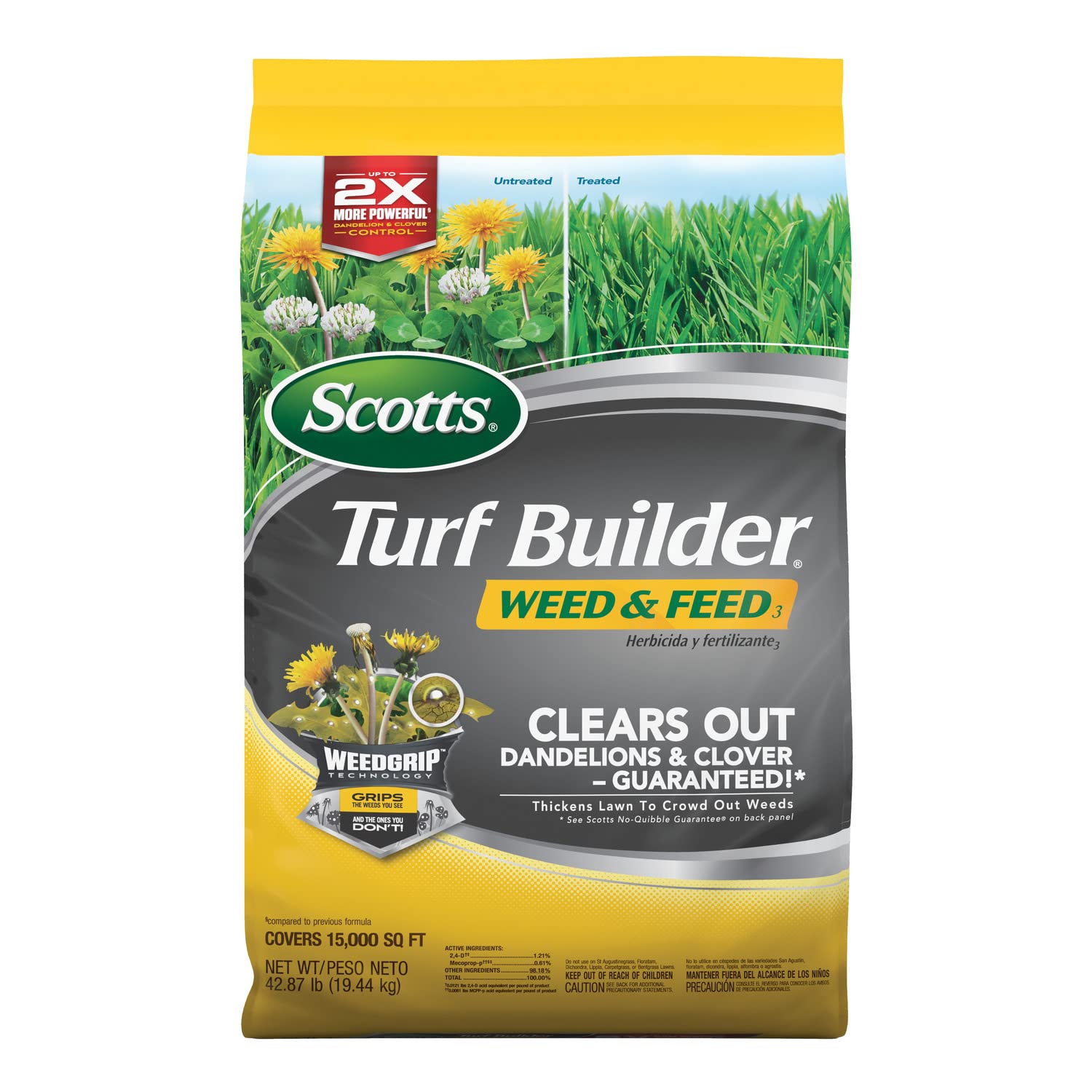
Scotts Turf Builder Weed & Feed (42.87 lb)
| Item Form | Granule |
|---|---|
| Coverage | 15000 square_feet |
| Active Ingredients | 24-D Mecoprop-p |
Scotts Turf Builder Weed & Feed is a granular lawn treatment that kills broadleaf weeds while feeding grass to encourage thicker turf. It is applied with a spreader when weeds are actively growing and temperatures are between 60°F and 90°F; the label recommends applying to a wet lawn so granules stick to weed leaves and waiting 24 hours before watering. The formula uses WeedGrip technology and lists active ingredients including 2,4-D and Mecoprop-p, and the 42.87 lb bag covers about 15,000 square feet. In practice this product is straightforward to broadcast across medium to large lawns and gives visible reduction of common weeds like dandelions and clover while supplying nutrients to help crowd out future weeds. Important limitations are application timing and grass restrictions: do not use on St. Augustinegrass, bentgrass, carpetgrass, dichondra, or lippia, and do not apply if rain is expected within 24 hours. Also keep people and pets off treated turf until dust settles. For homeowners who follow label directions, it is an efficient one-step option for late spring weed control and feeding.
Best for: Homeowners who want a single product to both reduce common broadleaf weeds and feed a cool- or warm-season lawn and who prefer a proven brand with clear label instructions and wide user adoption.
Less Ideal for: People with lawns made of excluded grass types or those needing immediate spot treatment for individual weeds should consider alternatives designed for those specific situations.
- Combines selective broadleaf weed control and fertilizer in one application
- Large bag covers up to 15,000 sq. ft., suitable for medium to large lawns
- WeedGrip technology helps granules adhere to weed leaves for better control
- Granular form is compatible with common broadcast or drop spreaders
- Not safe for several grass types including St. Augustine and bentgrass
- Requires specific temperature and moisture conditions for best results
Verdict: A convenient, proven one-step weed-and-feed for homeowners who want broadleaf weed control plus lawn feeding across large yards.
Choosing the Right Fall Weed Killer for Lawns: Key Factors to Consider
Active Ingredient and Target Weeds
Knowing the active ingredient tells you which weeds a product will control and how it works. Some act on broadleaf weeds only, while others add components that target grassy weeds or provide systemic root-killing action. In fall, systemic herbicides that translocate to roots tend to reduce perennial weed survival because weeds are moving sugars to roots for winter.
Match the active ingredient to the common weeds in your lawn. If your yard has deep-rooted perennials, favor systemic chemistries listed for root control. For winter annuals, products with good young-weed contact and some residual uptake perform better during cooler fall periods.
Turf Species and Label Safety
Labels specify which turfgrass species are safe and which are at risk. Cool-season grasses and warm-season grasses can respond differently to the same active ingredient, and some products are labeled only for certain lawns. Applying a product not labeled for your turf raises the chance of discoloration, thinning, or long-term damage.
Read the label for application rates, temperature windows, and any restrictions on seeding after treatment. If you plan overseeding or winter ryegrass, choose a product that allows reseeding on the schedule you intend to follow to avoid preventing turf establishment.
Timing and Weather Conditions
Effective fall control depends heavily on timing. Treat when weeds are actively growing but before hard frosts set in so herbicide translocation is maximized. Soil moisture matters: slightly moist soil helps uptake, while drought-stressed or waterlogged plants absorb poorly.
Avoid application before heavy rain or immediately after an extended dry period. Check daytime temperatures; many formulas perform best within a moderate temperature range. Proper timing reduces the need for repeat applications and improves long-term suppression.
Application Method and Coverage
How you apply affects both efficacy and risk to desirable turf and nearby plants. Broadcast sprayers cover larger lawns quickly but must be calibrated for correct rate and even coverage. Handheld pump sprayers suit smaller areas and spot treatments but require careful mixing and agitation.
Consider drift risk around flower beds, vegetable gardens, and ornamentals. Use low-drift nozzles and avoid spraying on windy days. For spot control, apply directly to the weed foliage to limit unnecessary turf exposure.
Persistence and Follow-up Needs
Persistence refers to how long a product remains active in the soil or on weed tissues. Some residual activity helps prevent new seedlings from establishing, while long persistence can interfere with overseeding or affect nearby desirable plants.
Plan follow-up mowing, watering, and any necessary retreatments based on the product's residual window. If overseeding is planned, choose a product with a label that allows reseeding within your intended timeline or schedule treatments well ahead of seeding.
Environmental and Safety Considerations
Consider runoff, proximity to water, and pollinator exposure when selecting a fall weed control approach. Some active ingredients require buffers from streams, ponds, and storm drains and have label restrictions to protect aquatic life.
Use protective equipment, follow mixing instructions, and dispose of rinsate responsibly. If pets or children use the lawn, check re-entry intervals and any post-application precautions to keep the household safe while treatments take effect.
When To Treat In Fall
Aim to spray when daytime temperatures consistently allow weed growth and before the first hard freeze. For many regions this means mid-to-late fall, when weeds are still green and transporting carbohydrates to roots. Treating too late reduces herbicide movement and lowers control of perennial species.
- Target weeds while actively growing, not dormant or frost-damaged.
- Avoid application on very hot or very cold days; moderate daytime warmth improves uptake.
- Plan treatments several weeks before overseeding or sod installation to comply with label reseeding windows.
Spot Treatments Versus Broadcast Applications
Choose spot treatment for isolated weed patches to limit chemical use and reduce turf stress. Broadcast applications suit lawns with widespread infestations or where prevention of new seedlings is a priority. The method affects product choice because some formulations are designed for precise spot use while others include surfactants and carriers optimized for broadcast sprayers.
- Calibrate broadcast equipment to deliver the labeled rate per 1,000 square feet.
- For spot-spraying, mix smaller batches and label the container to avoid misapplication.
- Use shields or low-drift nozzles when spraying near desirable plants to prevent drift damage.
Preparing the Lawn Before Application
Mow a few days before treatment so weeds have sufficient leaf area for herbicide contact, but do not remove more than one-third of the turf height at once. Irrigate lightly if the lawn is drought-stressed to revive weed growth for better uptake, but do not water immediately before spraying. Remove debris and control thatch where it prevents herbicide from reaching foliage.
- Wait at least 24 hours after watering before applying in most cases unless label indicates otherwise.
- Collect and remove large clumps of leaves or thatch that can intercept spray.
- Mark treated areas to avoid double application during retreatment windows.
Protecting Landscapes and Non-target Plants
Prevent drift and runoff to protect shrubs, garden beds, and water features. Use nozzles that produce coarser droplets to reduce drift and apply during calm periods. Avoid walking wet spray onto mulch or into flower beds where sensitive plants could be exposed.
- Keep children and pets off treated areas for the time specified on the label.
- Rinse equipment on a gravel or cement surface away from storm drains and gardens.
- Store products in a locked area and follow disposal instructions for any leftover mix.
Managing Expectations and Follow-up Care
Expect visible weed decline to take days or weeks depending on the weed species and conditions. Perennial weeds may need a second treatment in the following season for full control. Monitor treated areas and note which species show poor response to adjust future plans. Follow-up cultural practices such as overseeding thin patches, adjusting fertilizer timing, and improving drainage will help the lawn recover and outcompete future weed pressure.
- Record application dates, rates, and weather conditions for future reference.
- Avoid heavy nitrogen fertilization immediately after treatment unless label allows it.
- Plan a turf health program that includes proper mowing, irrigation, and soil testing to reduce reliance on herbicides over time.
How We Chose the Best Fall Weed Killer for Lawns
Our selection focused on products and formulas that deliver reliable fall control of common lawn weeds while minimizing harm to turf and the surrounding landscape. We prioritized options with clear efficacy on perennial broadleaf weeds that are active in autumn growth stages, and we evaluated turf safety across cool- and warm-season grasses under typical homeowner application rates. Key evaluation criteria included active ingredient effectiveness against perennial and winter annual broadleaf weeds, labeled turf species and safety instructions, required re-entry and watering restrictions, and ease of mixing and application for homeowners. We also considered persistence and residual effects so the product suppresses regrowth without causing carryover damage to overseeding or new sod. We excluded spot treatments intended only for hardscapes, products formulated solely for grass suppression, and products with unclear labeling for residential turf. The resulting shortlist balances proven weed control, turf safety, and practical application details a homeowner needs for successful fall treatments.
FAQ
Can I apply fall weed killer right after mowing?
Usually you should mow a few days before treatment so weeds have leaf area for herbicide uptake. Applying immediately after a very close mow can reduce effectiveness because there is less foliage to absorb the product. Follow label guidance for best timing.
Will fall weed control harm my grass?
Some products can stress turf if used outside labeled species or rates. Choosing a product labeled for your turf species and following application and temperature instructions minimizes the risk. Cooler-season grasses and warm-season grasses can react differently, so check the label carefully.
How long after treatment should I keep pets and children off the lawn?
Re-entry intervals vary by product and formulation. Many residential lawn treatments allow normal use once the spray has dried, but some require longer waiting periods. Check the product label for specific re-entry and contact precautions.
Can I overseed after applying a fall herbicide?
It depends on the product. Some herbicides require a waiting period before seeding to avoid injury to new grass, while others are compatible with overseeding on a specific timeline. Read the label for reseeding windows and plan treatments accordingly.
Is spot-spraying as effective as broadcasting on large lawns?
Spot-spraying is effective for isolated patches and reduces chemical use, but it is labor intensive on large lawns and risks missing scattered seedlings. Broadcast applications provide uniform coverage for widespread infestations and can include residual control to prevent new weeds.
Do I need to worry about runoff into nearby water features?
Yes. Avoid applying before heavy rain and maintain buffers from ponds, streams, and storm drains per label directions. Some active ingredients have specific aquatic protection measures to reduce harm to fish and other aquatic life.
Final Verdict
Choose a fall weed control approach that matches the weeds you need to manage, your turf species, and your timing goals. Prioritize active ingredients and labeled turf safety first, then select the application method that limits drift and fits your lawn size. Accept that tradeoffs exist between persistence and reseeding flexibility. With correct timing, careful application, and routine follow-up cultural care, a targeted fall treatment will reduce overwintering weed pressure and set up a healthier lawn for spring green-up.
