

Note: This article contains affiliate links. If you click on these links and make a purchase, I may earn a small commission at no extra cost to you. This helps support my research and content. Read my full affiliate disclosure here.
Picking the right feeding plan matters for Adenium because these succulent trees need a mix of concentrated nutrients and careful timing to reward you with swollen trunks and vivid blooms. With the wrong fertilizer or schedule you can get leggy growth, weak branching, or reduced flowering. This guide covers seven top fertilizer options shortlisted for Adenium, explaining nutrient ratios, application methods, and how each choice behaves in pots or the ground. We evaluate mixes, feeding frequency, and how easy each product is to use so you can match a fertilizer to your growing style. Read on to see which feeding approach fits your Adenium goals.
Top Picks at a Glance
| Best Overall The best all-around choice for most situations | GrowThrive Desert Rose Liquid Fertilizer (10 fl oz) |  |
| Best Quality Built to a higher standard if you want something more solid | Gardenera 3-1-2 Liquid Fertilizer Concentrate for Desert Rose (8 oz) |  |
| Best Value The sweet spot between price and what you get | TPS NUTRIENTS Desert Rose Fertilizer Spray, 16 oz |  |
| Best Budget The cheapest option that still gets the job done reliably | TPS Nutrients Desert Rose Liquid Fertilizer, 8 oz |  |
| Highest Rated A top-rated pick with lots of positive feedback | GARDENWISE Liquid Kelp Concentrate for Desert Rose (16 oz) |  |
| Most Popular A crowd favorite that many people choose with confidence | Farmer's Secret Desert Rose Liquid Plant Food (8 oz) |  |
| Best Seller A high-volume bestseller chosen again and again | kisanmart Adenium Flower Booster Fertilizer (Powder) |  |
GrowThrive Desert Rose Liquid Fertilizer (10 fl oz)

| Item Form | Liquid |
|---|---|
| Specific Uses For Product | Plant Growth, Root Development, Seed Development, Soil Conditioning |
| Application Method | Watering |
| Target Species | Desert Rose |
| Liquid Volume | 300 ml |
This GrowThrive Desert Rose liquid fertilizer is a concentrated probiotic plant food designed specifically for flowering desert rose (Adenium). It is supplied as a 300 ml bottle and used either as a foliar spray or for root watering; foliar applications call for a 1:100 dilution and root drenches use a 1:400 dilution with recommended frequency of one to two times per week. The formula emphasizes beneficial microbes and organic components to improve soil biology, increase nutrient availability, and support stronger roots and more abundant blooms. Practical benefits include easy mixing, a clear application plan for both leaves and root zone, and a gentle nutrient profile intended to reduce risk of seedling burn or over-fertilization. Limitations to note are small bottle size relative to repeat applications on multiple plants and that directions advise avoiding foliar use during bloom, which requires timing care for peak flowering. Expect the product to perform best as a regular maintenance feed for potted or small-collection desert rose plants rather than large-scale garden use.
Best for: Growers who prioritize consistent, biologically based feeding for potted desert rose and want a reliable, easy-to-follow product to maintain bloom quality and root health.
Less Ideal for: People managing large outdoor beds or many plants who need bulk fertilizer or those who prefer synthetic NPK-only feeds for rapid vegetative push.
- Formulated specifically for desert rose with bloom-focused nutrients and beneficial microbes
- Clear, dual application methods (foliar spray and root watering) with stated dilution ratios
- Claims to reduce risk of seedling burn and over-fertilization through a gentle formula
- Contains active microbes and organic enzymes to improve soil biology and nutrient uptake
- Small 10 fl oz bottle may require frequent repurchasing for growers with several plants
- Foliar use is not recommended during bloom which limits application timing for peak flowering
Verdict: A targeted probiotic liquid feed that makes it easy to maintain healthy roots and better blooms on potted desert rose plants.
Gardenera 3-1-2 Liquid Fertilizer Concentrate for Desert Rose (8 oz)

| Item Form | Liquid |
|---|---|
| Application Method | Mix with water |
| Target Species | Desert Rose |
| Mixing Ratio | 1 teaspoon per gallon |
This 8 oz Gardenera 3-1-2 concentrate is built for routine root-zone feeding of indoor desert roses and other similar succulents. You mix one teaspoon per gallon of water and apply it in place of a regular watering, so a single bottle covers many feedings for a shelf of plants. The nitrogen-forward 3-1-2 NPK supports steady green growth while phosphorus and potassium help flowering and root health, and plant-specific labels simplify use across collections. Practical benefits include quick measuring, gentle dilution that minimizes foliar burn when used at label rates, and focused root delivery via the watering can. Limitations are that it is a small 8 oz bottle so heavy users will need replacements more often, and it is not labeled as organic on this specific formula despite marketing language suggesting natural ingredients. It is designed for regular watering schedules rather than foliar sprays, so growers wanting a spray-on foliage treatment or a higher phosphorus bloom booster may prefer a complementary product.
Best for: Gardeners focused on measurable performance who feed Adenium regularly and prefer a simple, root-directed concentrate that fits into a watering routine.
Less Ideal for: People who primarily want foliar sprays or a high-phosphorus bloom booster or who need a very large-volume supply for many plants.
- Concentrated formula stretches a small bottle into many feedings with 1 teaspoon per gallon dosing.
- 3-1-2 NPK ratio supports leafy growth with balanced support for flowering and roots.
- Root-zone application via watering can delivers nutrients directly to the potting mix.
- Plant-specific labeling helps match the formula to succulents and other indoor plant families.
- 8 fl oz volume limits total coverage for larger collections.
- Designed for watering-can feeding only and not intended as a foliar spray option.
Verdict: A compact, easy-to-dose 3-1-2 concentrate that delivers focused root nutrition to Adenium growers who prioritize steady growth and repeatable feeding.
TPS NUTRIENTS Desert Rose Fertilizer Spray, 16 oz

| Item Form | Liquid |
|---|---|
| Specific Uses For Product | Flower Development |
| Application Method | Spray |
| Unit Count | 16 Fluid Ounces |
This ready-to-use spray delivers a balanced foliar feed aimed at encouraging bloom production and healthier foliage on desert rose and similar potted flowering plants. You apply it as a fine mist to leaf surfaces and undersides, with recommended frequencies higher in spring and summer and reduced in fall and winter, which makes it easy to incorporate into a regular care routine. Notable features include a liquid form for quick uptake, kelp plus nitrate and phosphate ingredients that support flower development, and directions tailored to indoor and outdoor container-grown adeniums. Practical benefits are faster nutrient delivery than soil-only feeds, simple dosing with no mixing, and suitability for small collections or individual specimen plants. Limits are its low stated coverage, so one bottle is meant for spot or small-scale use rather than treating many plants, and the product is a foliar supplement rather than a full soil fertilizer so root-feeding needs may still require separate products. Follow safety guidance to avoid skin or eye contact.
Best for: Buyers who want a straightforward, low-effort way to boost flowering on one to a few potted adeniums or other container flowering plants and who prefer foliar feeding as part of regular maintenance.
Less Ideal for: Gardeners managing large collections, beds, or commercial production where bulk coverage and soil feeding are primary needs.
- Ready-to-use spray simplifies routine feeding with no mixing required
- Formulation includes kelp and key nitrates and phosphates to support bloom development
- Directions provide season-specific application frequency for practical scheduling
- Suitable for indoor and outdoor potted adenium and succulent collections
- Low coverage makes it impractical for large gardens or many plants
- Designed as a foliar supplement and may not replace a comprehensive soil fertilizer program
Verdict: A convenient ready-to-use foliar spray that makes it easy to boost blooms and maintain vigor on a few potted desert rose plants.
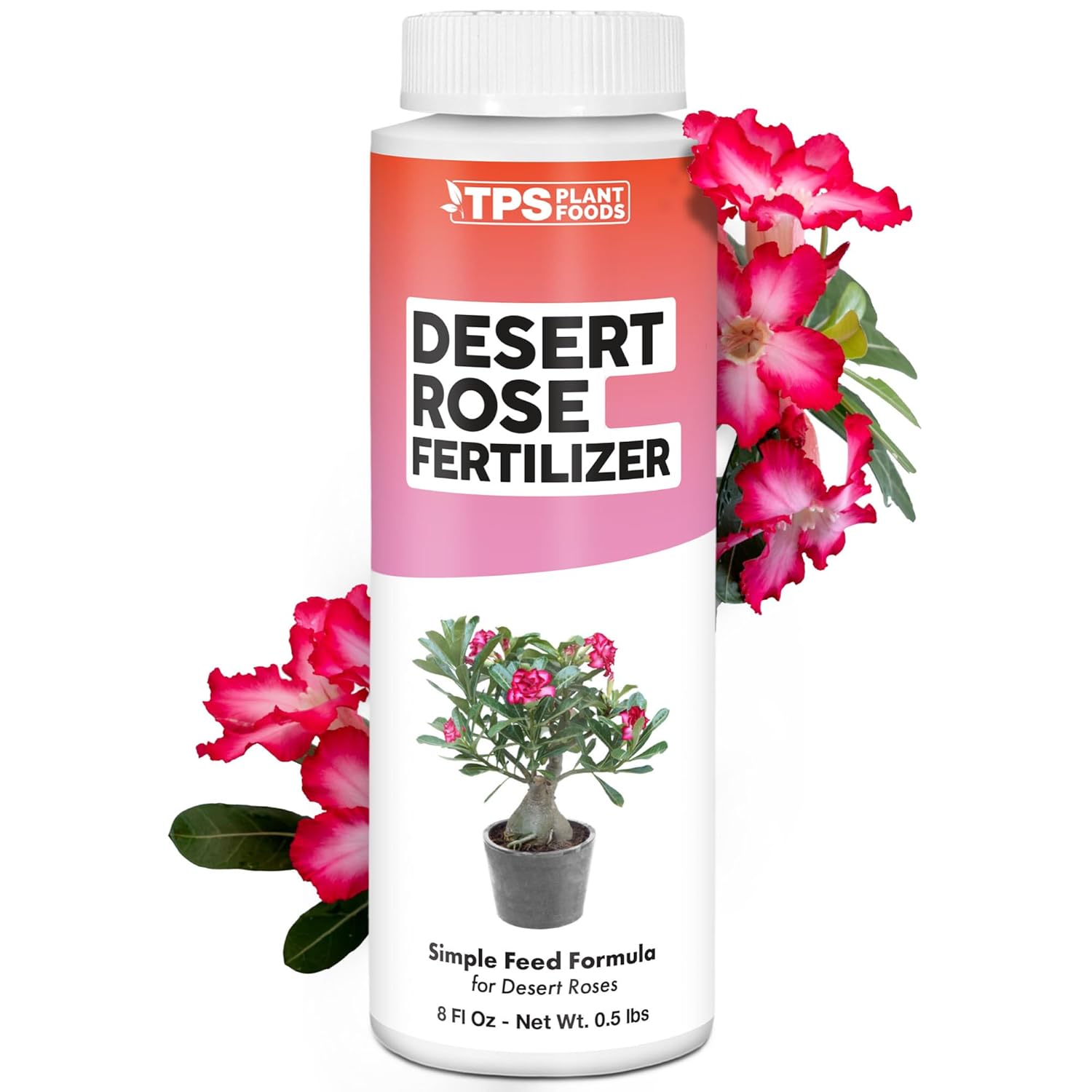
TPS Nutrients Desert Rose Liquid Fertilizer, 8 oz
| Item Form | Liquid |
|---|---|
| Coverage | Desert rose plants |
| Target Species | Desert Rose |
| Mixing Ratio | 1 tablespoon per gallon of water |
| Unit Count | 8 fluid ounces |
This 8 oz liquid formula is designed specifically for desert rose (Adenium) plants and is used by diluting 1 tablespoon per gallon of water and applying during the growing season. The low nitrogen, bloom-focused mix with added kelp and micronutrients supports vivid flowering while promoting compact, sturdy caudex development, which is important for healthy adeniums. Its liquid form makes it easy to mix and deliver to potted specimens or plants on a patio, and the modest unit size is convenient for small collections or trial use. Because it targets desert rose coverage, you get a tailored nutrient balance rather than a generic houseplant feed. The main limitations are the small 8 oz volume, which means frequent repurchase for larger collections, and the product is specialized so it may not replace an all-purpose succulent or fertilizer program for other species. For gardeners wanting a straightforward bloom booster for Adeniums, this product is a practical, easy-to-use option.
Best for: Budget-minded adenium growers with a small collection who want an easy-to-use, bloom-focused fertilizer tailored to desert rose care.
Less Ideal for: Gardeners with large collections, mixed-species succulent beds, or those seeking a multi-purpose fertilizer for many plant types.
- Formulated specifically for desert rose to encourage blooms and caudex strength
- Liquid concentrate mixes at 1 tablespoon per gallon for simple, controlled feeding
- Includes kelp and micronutrients to support overall plant vigor
- Gentle low-nitrogen formula reduces risk of excessive vegetative growth
- Small 8 oz bottle can be costly to maintain for multiple plants
- Made for desert rose only so it is not a versatile all-plant fertilizer
Verdict: A compact, easy-to-use liquid fertilizer that delivers bloom-focused nutrition specifically for Adenium growers with a small collection.
GARDENWISE Liquid Kelp Concentrate for Desert Rose (16 oz)

| Item Form | Liquid |
|---|---|
| Specific Uses For Product | Organic Liquid Kelp Concentrate for Desert Rose (Adenium obesum) |
| Application Method | foliar spray and root feed |
| Liquid Volume | 16 fluid ounces |
| Mixing Ratio | 1 tsp per 12 oz water (regular) or 1/2 tsp per 12 oz (foliar) |
GARDENWISE Liquid Kelp Concentrate is an organic seaweed fertilizer made for Desert Rose (Adenium obesum) that you dilute and apply every 7 to 10 days as a foliar spray or root feed. It supplies low levels of N, P and K plus trace elements and natural growth compounds from laminaria seaweed, which helps strengthen roots, improve recovery after pruning or transplanting, and encourage more vivid blooms and greener foliage. The bottle includes clear mixing directions (1 tsp per 12 oz for regular feeding, 1/2 tsp per 12 oz for foliar use) and is gentle enough to avoid burn when used as directed. Because it is a concentrate, a small bottle covers multiple applications and is easy to add to a watering routine for performance-focused growers. Limitations are that it is not a balanced high-NPK fertilizer so it is best used as a supplemental tonic rather than a sole feeding for heavy feeding schedules or to correct specific nutrient deficiencies.
Best for: Growers who prioritize plant performance and resilience and want a gentle organic tonic to boost blooms, aid recovery after pruning or transplanting, and strengthen root systems in Desert Rose.
Less Ideal for: Gardeners seeking a single product to fully supply macro nutrient needs or to correct specific nutrient deficiencies should choose a targeted balanced fertilizer instead.
- Formulated specifically for Adenium obesum with instructions for foliar and root application
- Contains laminaria seaweed and trace minerals to support root strength, recovery, and flowering
- Clear mixing ratios and a concentrate format that stretches multiple applications
- Gentle organic formula that minimizes risk of leaf burn when used as directed
- Very low NPK values mean it is a supplement rather than a complete fertilizer for heavy feeders
Verdict: A concentrated, gentle kelp tonic made to boost blooms and root resilience in Desert Rose rather than replace a complete fertilizer.
Farmer's Secret Desert Rose Liquid Plant Food (8 oz)

| Item Form | Liquid |
|---|---|
| Application Method | Dilute into watering routine |
| Target Species | Adenium obesum |
| Mixing Ratio | 3:11:8 |
This 8 oz bottle of Farmer's Secret Desert Rose liquid plant food is a highly concentrated feed designed specifically for Adenium obesum (desert rose). You dilute small measured amounts into your regular watering schedule — the brand recommends half a teaspoon for young plants and one teaspoon for mature specimens — which makes the bottle last through many applications. The 3:11:8 NPK ratio and liquid form help deliver nutrients quickly to support flowering and thicker trunk development, and the product is presented as lab-formulated by agronomists. Practical benefits include easy dosing, compatibility with weekly or every-other-watering feeds, and concentrated formulation that reduces storage and handling compared with bulk granular fertilizers. Limitations are that the formula is tailored to desert rose specifically so it may not be optimal for unrelated houseplants, and precise measuring is needed because of the concentration; there is limited guidance beyond the basic mixing ratio and target species.
Best for: Buyers who want a targeted, lab-formulated feed for desert roses and prefer a concentrated liquid they can add to their regular watering schedule to encourage blooms and sturdier trunks.
Less Ideal for: Gardeners seeking a general-purpose fertilizer for mixed collections or those who prefer slow-release granular products should consider broader-spectrum alternatives.
- Formulated specifically for Adenium obesum to promote flowering and trunk growth
- Liquid concentrate delivers nutrients quickly and is easy to mix into watering routine
- Very concentrated so a small bottle covers many feedings
- Clear dosing guidance for young versus mature plants
- Focused formulation may not suit a wide range of other plant species
- Requires careful measuring because of high concentration
Verdict: A compact, professional-strength liquid feed for growers who want a concentrated, easy-to-use fertilizer tuned specifically to desert rose performance.
kisanmart Adenium Flower Booster Fertilizer (Powder)

| Item Form | Powder |
|---|---|
| Specific Uses For Product | Plant Growth, Root Development, Seed Development, Soil Conditioning |
| Application Method | Granular |
| Target Species | Adenium |
| Ingredients | Organic Compost |
This kisanmart Adenium Flower Booster is a granular powder fertilizer designed specifically for desert rose (Adenium) plants. It is applied by sprinkling a small measured amount near the root zone and watering in, and the manufacturer recommends weekly applications; the formulation is described as containing NPK, micronutrients and organic compost to encourage bigger, more colorful blooms and stronger roots. In practice this product is straightforward to use on potted Adenium and garden specimens where frequent feeding is acceptable. The simple granular form and organic compost base make it easy to store and handle without special mixing. Limitations to expect are modest documentation on exact nutrient analysis and small packaged unit sizes shown, so heavy feeders or large collections may need multiple buys, and results depend on following the recommended weekly schedule. For conservative gardeners this booster offers a focused, easy routine to enhance flowering when used consistently.
Best for: A cautious gardener who wants a simple, plant-specific feed for Adenium and is willing to follow a regular weekly routine for reliable bloom improvements.
Less Ideal for: Growers who prefer precise, lab-analyzed fertilizer formulations or who need large-volume fertilizer for many plants should consider other bulk or fully labeled options.
- Formulated specifically for Adenium so recommendations target desert rose needs
- Granular powder is easy to apply directly at the root zone
- Contains organic compost plus NPK and micronutrients for balanced nutrition
- Promotes stronger roots and more abundant, colorful blooms when used regularly
- Product listing lacks a detailed NPK breakdown and full ingredient percentages
- Small unit weight means frequent repurchasing for larger collections
Verdict: If you want an easy, Adenium-focused fertilizer to boost blooms and root health with a simple weekly routine, this product is a practical choice.
Choosing the Right Fertilizer for Adenium: Key Factors to Consider
Nutrient Ratio and Form
Adenium perform best with a nutrient profile that encourages flowering without excessive leafy growth. A moderate to slightly higher phosphorus level can stimulate blooms, while too much nitrogen causes lanky stems. The nutrient form matters as well. Water-soluble fertilizers allow quick correction and are easy to use in small pots, whereas slow-release granules provide steady feeding over weeks and reduce the risk of overfertilizing. Liquid feeds let you adjust dose frequently during active growth, but concentrated solids are useful for long-term maintenance.
When assessing labels, consider both the NPK numbers and whether nutrients are immediately available or in a controlled-release matrix. The right combination will produce compact, woody stems and consistent flowering rather than lush green growth at the expense of blooms.
Salt Load and Concentration
Because Adenium are succulent and often grown in fast-draining mixes, they are sensitive to soluble salt buildup. High-salt fertilizers or repeated overfeeding can burn roots and lead to stunted growth. Look for formulas with a low salt index or those that explicitly recommend low-concentration feeding schedules. Using a mild feed at more frequent intervals usually beats a single heavy application.
Also factor in irrigation and drainage. If you water often or use fertilizer concentrates, flush the potting mix periodically to prevent accumulation. Choosing a fertilizer that dissolves cleanly and allows accurate, low-rate dosing reduces risk to root health and keeps plants vigorous.
Application Method and Convenience
How you prefer to feed will shape your choice. Gardeners who want minimal maintenance often favor slow-release granules or time-release tablets that can deliver nutrients for months. Those who enjoy hands-on care may prefer water-soluble powders or concentrated liquids for fortnightly or weekly feedings. Foliar sprays can be useful for quick micronutrient correction but are not a substitute for root feeding.
Consider pot size and access when choosing a form. Small pots need very accurate, small doses; granular feeds can be hard to measure at that scale. Conversely, large containers and outdoor specimens tolerate broader dosing and benefit from longer-lasting granules.
Micronutrients and Additives
Beyond NPK, micronutrients like iron, manganese, zinc, and boron can prevent subtle deficiencies that reduce bloom quality and trunk development. Calcium and magnesium support structural strength in stems, while chelated forms of micronutrients improve uptake in a range of soil pH levels. Some fertilizers include bloom-promoting trace elements or organic acids that enhance nutrient availability.
If your potting mix is tightly buffered or you use rainwater, pick a formula that supplies a balanced micronutrient package. For gardeners dealing with frequent leaf yellowing or poor flowering, a fertilizer with targeted trace elements can make a noticeable difference.
pH Interaction and Potting Mix
The effectiveness of nutrients depends on root-zone pH. Adenium thrive in slightly acidic to neutral mixes. If the fertilizer alters pH significantly or contains unbalanced salts, nutrient availability can change and deficiencies may appear. Some feeds are labeled as pH-neutral or include chelated micronutrients to reduce pH sensitivity.
Match your fertilizer to the potting medium you use. Fast-draining, mineral-rich mixes behave differently than organic-rich media, so choose a product that maintains balanced availability in your typical mix. Periodic pH checks help you know whether you need to adjust feed type or supplement with foliar trace elements.
Feeding Schedule and Growth Phase
Adenium have distinct active growth and dormancy phases where nutrient needs change. During active spring and summer growth you can feed more regularly with a bloom-oriented formula, while in dormancy you should reduce feeding frequency and concentration. A fertilizer that allows flexible scheduling-either by offering dilute liquid feed recommendations or removable slow-release granules-lets you match nutrition to plant phenology.
Consider how the product fits your climate and indoor/outdoor cycle. If you move plants indoors for winter, reduce feeding accordingly. The best fertilizers for Adenium provide clear guidance for staging doses through the growth cycle.
Feeding Frequency for Potted Adenium
Potted Adenium need more precise, lower-dose feedings than ground-planted specimens. For most container setups, a mild liquid feed every two weeks during active growth is effective, with a flush of plain water every few months to prevent salt buildup.
If you prefer a low-maintenance approach, a single application of a controlled-release granule at potting time can carry a plant through a season, but monitor growth and flower set and supplement with a light liquid feed if blooms lag.
- Use lower-than-label strength for small pots
- Flush pots periodically to avoid salt accumulation
- Reduce or stop feeding during winter dormancy
Adjusting Feed for Blooming Vs Trunk Thickening
Different nutrient goals require different approaches. To favor trunk thickening and woody growth, choose a balanced formula with adequate calcium and moderate nitrogen. To push flowering, increase the relative phosphorus in short cycles while keeping overall concentration low.
Rotate or alternate feeds if you need both outcomes over a season: a general maintenance feed early in spring, then a bloom-focused feed leading up to flowering, followed by a maintenance or root-strengthening feed afterward.
- Maintenance feeds keep stems compact
- Bloom-targeted feeds for short pre-flowering periods
- Supplement with calcium or magnesium if stems feel weak
Using Foliar Sprays and Soil Drenches
Foliar sprays are useful for quick correction of micronutrient deficiencies and can give a short-term boost to flower color and vigor. They should be used as a supplement to root feeding and applied in the morning or late afternoon to avoid leaf burn.
Soil drenches and root-feeding provide the bulk of nutrition and are the preferred method for sustained growth. Ensure good drainage and avoid letting pots sit in fertilizer-rich runoff, which concentrates salts at the root zone.
- Apply foliar sprays for targeted micronutrient corrections
- Avoid foliar feeds in hot, sunny conditions
- Prioritize root feeding for longer-term nutrient supply
Signs of Overfeeding and Underfeeding
Watch for leaf burn, brown tips, and slowed growth as signs of overfeeding. Overly rapid, soft growth that lacks flowers can indicate too much nitrogen. If you suspect overfertilization, flush the potting mix thoroughly and reduce subsequent doses.
Pale leaves, poor bloom set, and slow trunk development often point to underfeeding or a missing micronutrient. A modest increase in frequency or a corrective foliar spray can restore vigor, but adjust carefully to avoid swinging to the opposite problem.
- Flush if you see salt buildup or leaf scorch
- Increase feeding gradually when correcting deficiencies
- Record your feed schedule to track plant response
Preparing Fertilizer for Different Growing Seasons
Match fertilizer strength and frequency to seasonal growth. In active months, use the recommended feed rate or a slightly diluted solution for frequent application. During cooler or dormant periods, halve the frequency and concentration to prevent root stress.
For plants moved between indoor and outdoor environments, give a transition period with conservative feeding while the root system readjusts to lighting and temperature changes.
- Increase feeding as growth resumes in spring
- Cut back during fall and winter dormancy
- Use transition feeding when relocating plants
How We Chose the Best Fertilizer for Adenium
We chose fertilizers based on criteria that matter to gardeners growing Adenium in containers and small gardens. First, nutrient ratio and form were essential. Adenium respond differently to high-phosphorus bloom boosters, balanced NPK, and formulations with controlled-release properties, so we favored options that supply the right amounts for flowering without forcing excessive vegetative growth. Second, salt index and concentration were evaluated because Adenium are salt-sensitive succulents; products that allow accurate, low-rate dosing ranked better. Third, application method and convenience mattered: soluble fertilizers, slow-release granules, and foliar options affect how often you feed and how uniform uptake is. Fourth, additives such as micronutrients, calcium, and chelators were considered since they influence trunk thickening and overall vigor. We filtered out products intended solely for large-scale agriculture, lawn feeds, or formulations with ambiguous nutrient analysis. Our selection favors garden- and container-friendly fertilizers that permit conservative dosing and clear instructions. The final list reflects those practical priorities: nutrient balance, salt safety, application flexibility, and supplemental elements that support bloom and trunk development.
FAQ
How often should I feed my Adenium during active growth?
Often every one to two weeks with a dilute liquid fertilizer is effective for potted Adenium during active growth. Adjust frequency downward for slow-release products and always observe plant response.
Can I use a standard houseplant fertilizer on Adenium?
It depends. Standard houseplant feeds can work if you dilute them and avoid high-nitrogen formulas. Choose a balanced or bloom-leaning ratio and use low concentrations to prevent soft, leggy growth.
What are the signs my Adenium needs different nutrients?
Pale or yellowing leaves, poor flower production, and weak stem thickening indicate nutrient imbalance or deficiency. Micronutrient shortages often show as interveinal chlorosis or stunted new growth.
Should I stop fertilizing Adenium in winter?
Usually you should reduce or stop feeding during winter when growth slows. Continue minimal feeding only if the plant shows active new growth indoors, and use lower concentrations to avoid root stress.
Is it better to use slow-release or liquid fertilizer for Adenium?
Both have advantages. Slow-release reduces maintenance and steady feeding, while liquids allow precise control and quick correction. Many growers use a combination: slow-release for baseline nutrition and liquids for targeted boosts.
How do I avoid salt buildup when feeding Adenium?
Flush the potting mix with plain water periodically, use low-concentration feeds, and avoid feeding every time you water. Choosing fertilizers with lower soluble salt content and following conservative dosing reduces buildup.
Final Verdict
Choose a fertilizer that matches how you grow Adenium and the goals you care about. Prioritize a nutrient profile that supports flowering without excessive nitrogen, keep soluble salt load low, and pick a form that fits your feeding routine. Be ready to adjust concentration and timing through the seasons and to use foliar corrections for micronutrient issues. The right feeding approach balances trunk strength and bloom production while minimizing salt stress. Focus on nutrient ratio fit, safe dosing, and application convenience to get healthier plants and more reliable flowering.
