

Note: This article contains affiliate links. If you click on these links and make a purchase, I may earn a small commission at no extra cost to you. This helps support my research and content. Read my full affiliate disclosure here.
Getting the right fertilizer for desert rose plants makes a noticeable difference in flowering, stem vigor, and overall resilience in hot, dry conditions. Desert rose are succulent-adapted shrubs that respond well to targeted feeding timed with growth and bloom cycles. In this guide we shortlist seven top options suited for desert rose care across patio, container, and landscape situations. We evaluated each option for nutrient profile, application method, and how it fits typical desert rose cultural needs like infrequent watering and fast drainage. The following picks reflect those priorities and will help you choose a feeding routine that encourages bloom without promoting excessive soft growth.
Top Picks at a Glance
| Best Overall The best all-around choice for most situations | GARDENERA Organic Liquid Kelp Fertilizer Concentrate for Desert Rose (32 oz) |  |
| Best Quality Built to a higher standard if you want something more solid | Gardenera 3-1-2 Liquid Fertilizer Concentrate for Desert Rose (8 oz) |  |
| Best Value The sweet spot between price and what you get | GARDENWISE Liquid Kelp Concentrate for Desert Rose (16 oz) |  |
| Best Budget The cheapest option that still gets the job done reliably | TPS Nutrients Desert Rose Liquid Fertilizer, 8 oz |  |
| Highest Rated A top-rated pick with lots of positive feedback | GrowThrive Desert Rose Liquid Fertilizer (10 fl oz) |  |
| Most Popular A crowd favorite that many people choose with confidence | Farmer's Secret Desert Rose Liquid Plant Food (8 oz) |  |
| Best Seller A high-volume bestseller chosen again and again | Gardenera Plant Superfood Spray for Desert Rose, 8 oz |  |
GARDENERA Organic Liquid Kelp Fertilizer Concentrate for Desert Rose (32 oz)

| Item Form | Liquid |
|---|---|
| Specific Uses For Product | Desert Rose (Adenium) plants, Indoor & Outdoor use |
| Liquid Volume | 32 fluid ounces |
| Mixing Ratio | 1:5625 |
This concentrated liquid kelp from Gardenera is a seaweed-based supplement made for Desert Rose (Adenium) growers who want to boost blooms and overall plant vigor. It is a cold-harvested Ascophyllum nodosum concentrate supplied as a 32 oz bottle that dilutes to a large volume of solution, and it can be applied as a foliar spray or soil drench every 2 to 4 weeks during the growing season. In practice the product supplies natural growth hormones, micronutrients, and trace elements that encourage bud set, richer foliage color, stronger roots, and thicker caudex formation—traits collectors look for in Adenium and hybrids. The mix ratio and directions make it straightforward to use at hobby scale, and the formula is described as non-toxic and suitable for both potted and in-ground plants. Important limitations are that it is a supplemental kelp feed rather than a complete NPK fertilizer, so it works best when used alongside a balanced feeding program, and overapplication can stress roots so attention to dilution is necessary.
Best for: For growers who want a targeted organic supplement to improve flowering, foliage health, and caudex development in Desert Rose plants and who already use or will pair it with a baseline fertilizer routine.
Less Ideal for: Not the best choice for gardeners seeking a one-step, complete macronutrient fertilizer or for those who prefer granular slow-release feeds for low-maintenance care.
- Formulated specifically for Desert Rose plants to encourage blooms and caudex thickening.
- Concentrated 32 oz bottle mixes to many gallons, making it economical for regular use.
- Made from Ascophyllum nodosum seaweed, providing natural hormones, micronutrients, and trace elements.
- Safe for foliar spray or soil drench and labeled for indoor and outdoor use.
- Not a complete NPK fertilizer so it should be paired with a balanced feed for macronutrient needs.
- Requires careful dilution to avoid root stress or overapplication.
Verdict: A concentrated organic kelp boost designed to enhance blooms, root strength, and caudex thickening in Desert Rose when used as part of a balanced feeding plan.
Gardenera 3-1-2 Liquid Fertilizer Concentrate for Desert Rose (8 oz)

| Item Form | Liquid |
|---|---|
| Application Method | Mix with water |
| Target Species | Desert Rose |
| Mixing Ratio | 1 teaspoon per gallon |
This 8 oz Gardenera 3-1-2 concentrate is built for routine root-zone feeding of indoor desert roses and other similar succulents. You mix one teaspoon per gallon of water and apply it in place of a regular watering, so a single bottle covers many feedings for a shelf of plants. The nitrogen-forward 3-1-2 NPK supports steady green growth while phosphorus and potassium help flowering and root health, and plant-specific labels simplify use across collections. Practical benefits include quick measuring, gentle dilution that minimizes foliar burn when used at label rates, and focused root delivery via the watering can. Limitations are that it is a small 8 oz bottle so heavy users will need replacements more often, and it is not labeled as organic on this specific formula despite marketing language suggesting natural ingredients. It is designed for regular watering schedules rather than foliar sprays, so growers wanting a spray-on foliage treatment or a higher phosphorus bloom booster may prefer a complementary product.
Best for: Gardeners focused on measurable performance who feed Adenium regularly and prefer a simple, root-directed concentrate that fits into a watering routine.
Less Ideal for: People who primarily want foliar sprays or a high-phosphorus bloom booster or who need a very large-volume supply for many plants.
- Concentrated formula stretches a small bottle into many feedings with 1 teaspoon per gallon dosing.
- 3-1-2 NPK ratio supports leafy growth with balanced support for flowering and roots.
- Root-zone application via watering can delivers nutrients directly to the potting mix.
- Plant-specific labeling helps match the formula to succulents and other indoor plant families.
- 8 fl oz volume limits total coverage for larger collections.
- Designed for watering-can feeding only and not intended as a foliar spray option.
Verdict: A compact, easy-to-dose 3-1-2 concentrate that delivers focused root nutrition to Adenium growers who prioritize steady growth and repeatable feeding.
GARDENWISE Liquid Kelp Concentrate for Desert Rose (16 oz)

| Item Form | Liquid |
|---|---|
| Specific Uses For Product | Organic Liquid Kelp Concentrate for Desert Rose (Adenium obesum) |
| Application Method | foliar spray and root feed |
| Liquid Volume | 16 fluid ounces |
| Mixing Ratio | 1 tsp per 12 oz water (regular) or 1/2 tsp per 12 oz (foliar) |
GARDENWISE Liquid Kelp Concentrate is an organic seaweed fertilizer made for Desert Rose (Adenium obesum) that you dilute and apply every 7 to 10 days as a foliar spray or root feed. It supplies low levels of N, P and K plus trace elements and natural growth compounds from laminaria seaweed, which helps strengthen roots, improve recovery after pruning or transplanting, and encourage more vivid blooms and greener foliage. The bottle includes clear mixing directions (1 tsp per 12 oz for regular feeding, 1/2 tsp per 12 oz for foliar use) and is gentle enough to avoid burn when used as directed. Because it is a concentrate, a small bottle covers multiple applications and is easy to add to a watering routine for performance-focused growers. Limitations are that it is not a balanced high-NPK fertilizer so it is best used as a supplemental tonic rather than a sole feeding for heavy feeding schedules or to correct specific nutrient deficiencies.
Best for: Growers who prioritize plant performance and resilience and want a gentle organic tonic to boost blooms, aid recovery after pruning or transplanting, and strengthen root systems in Desert Rose.
Less Ideal for: Gardeners seeking a single product to fully supply macro nutrient needs or to correct specific nutrient deficiencies should choose a targeted balanced fertilizer instead.
- Formulated specifically for Adenium obesum with instructions for foliar and root application
- Contains laminaria seaweed and trace minerals to support root strength, recovery, and flowering
- Clear mixing ratios and a concentrate format that stretches multiple applications
- Gentle organic formula that minimizes risk of leaf burn when used as directed
- Very low NPK values mean it is a supplement rather than a complete fertilizer for heavy feeders
Verdict: A concentrated, gentle kelp tonic made to boost blooms and root resilience in Desert Rose rather than replace a complete fertilizer.
TPS Nutrients Desert Rose Liquid Fertilizer, 8 oz
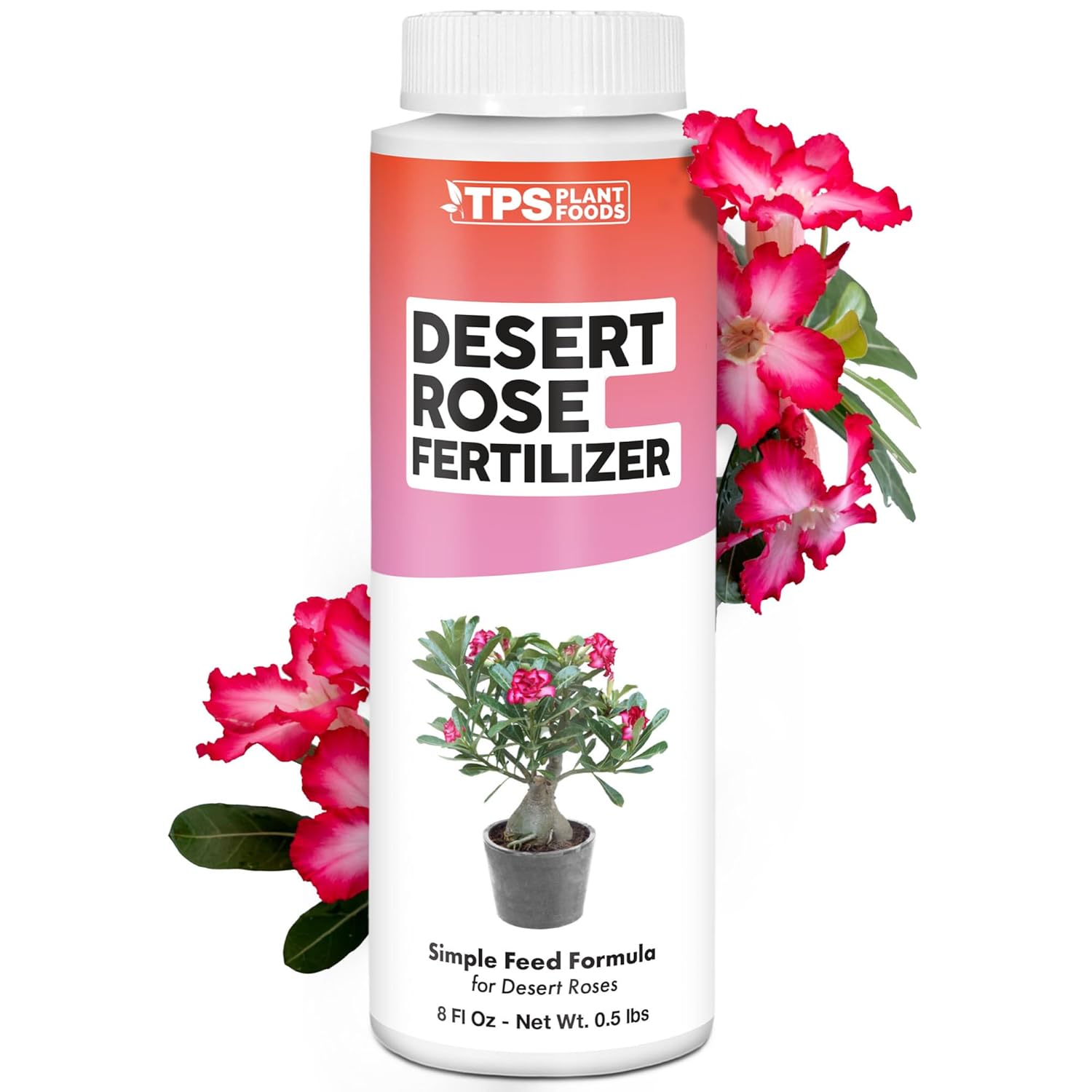
| Item Form | Liquid |
|---|---|
| Coverage | Desert rose plants |
| Target Species | Desert Rose |
| Mixing Ratio | 1 tablespoon per gallon of water |
| Unit Count | 8 fluid ounces |
This 8 oz liquid formula is designed specifically for desert rose (Adenium) plants and is used by diluting 1 tablespoon per gallon of water and applying during the growing season. The low nitrogen, bloom-focused mix with added kelp and micronutrients supports vivid flowering while promoting compact, sturdy caudex development, which is important for healthy adeniums. Its liquid form makes it easy to mix and deliver to potted specimens or plants on a patio, and the modest unit size is convenient for small collections or trial use. Because it targets desert rose coverage, you get a tailored nutrient balance rather than a generic houseplant feed. The main limitations are the small 8 oz volume, which means frequent repurchase for larger collections, and the product is specialized so it may not replace an all-purpose succulent or fertilizer program for other species. For gardeners wanting a straightforward bloom booster for Adeniums, this product is a practical, easy-to-use option.
Best for: Budget-minded adenium growers with a small collection who want an easy-to-use, bloom-focused fertilizer tailored to desert rose care.
Less Ideal for: Gardeners with large collections, mixed-species succulent beds, or those seeking a multi-purpose fertilizer for many plant types.
- Formulated specifically for desert rose to encourage blooms and caudex strength
- Liquid concentrate mixes at 1 tablespoon per gallon for simple, controlled feeding
- Includes kelp and micronutrients to support overall plant vigor
- Gentle low-nitrogen formula reduces risk of excessive vegetative growth
- Small 8 oz bottle can be costly to maintain for multiple plants
- Made for desert rose only so it is not a versatile all-plant fertilizer
Verdict: A compact, easy-to-use liquid fertilizer that delivers bloom-focused nutrition specifically for Adenium growers with a small collection.
GrowThrive Desert Rose Liquid Fertilizer (10 fl oz)

| Item Form | Liquid |
|---|---|
| Specific Uses For Product | Plant Growth, Root Development, Seed Development, Soil Conditioning |
| Application Method | Watering |
| Target Species | Desert Rose |
| Liquid Volume | 300 ml |
This GrowThrive Desert Rose liquid fertilizer is a concentrated probiotic plant food designed specifically for flowering desert rose (Adenium). It is supplied as a 300 ml bottle and used either as a foliar spray or for root watering; foliar applications call for a 1:100 dilution and root drenches use a 1:400 dilution with recommended frequency of one to two times per week. The formula emphasizes beneficial microbes and organic components to improve soil biology, increase nutrient availability, and support stronger roots and more abundant blooms. Practical benefits include easy mixing, a clear application plan for both leaves and root zone, and a gentle nutrient profile intended to reduce risk of seedling burn or over-fertilization. Limitations to note are small bottle size relative to repeat applications on multiple plants and that directions advise avoiding foliar use during bloom, which requires timing care for peak flowering. Expect the product to perform best as a regular maintenance feed for potted or small-collection desert rose plants rather than large-scale garden use.
Best for: Growers who prioritize consistent, biologically based feeding for potted desert rose and want a reliable, easy-to-follow product to maintain bloom quality and root health.
Less Ideal for: People managing large outdoor beds or many plants who need bulk fertilizer or those who prefer synthetic NPK-only feeds for rapid vegetative push.
- Formulated specifically for desert rose with bloom-focused nutrients and beneficial microbes
- Clear, dual application methods (foliar spray and root watering) with stated dilution ratios
- Claims to reduce risk of seedling burn and over-fertilization through a gentle formula
- Contains active microbes and organic enzymes to improve soil biology and nutrient uptake
- Small 10 fl oz bottle may require frequent repurchasing for growers with several plants
- Foliar use is not recommended during bloom which limits application timing for peak flowering
Verdict: A targeted probiotic liquid feed that makes it easy to maintain healthy roots and better blooms on potted desert rose plants.
Farmer's Secret Desert Rose Liquid Plant Food (8 oz)

| Item Form | Liquid |
|---|---|
| Application Method | Dilute into watering routine |
| Target Species | Adenium obesum |
| Mixing Ratio | 3:11:8 |
This 8 oz bottle of Farmer's Secret Desert Rose liquid plant food is a highly concentrated feed designed specifically for Adenium obesum (desert rose). You dilute small measured amounts into your regular watering schedule — the brand recommends half a teaspoon for young plants and one teaspoon for mature specimens — which makes the bottle last through many applications. The 3:11:8 NPK ratio and liquid form help deliver nutrients quickly to support flowering and thicker trunk development, and the product is presented as lab-formulated by agronomists. Practical benefits include easy dosing, compatibility with weekly or every-other-watering feeds, and concentrated formulation that reduces storage and handling compared with bulk granular fertilizers. Limitations are that the formula is tailored to desert rose specifically so it may not be optimal for unrelated houseplants, and precise measuring is needed because of the concentration; there is limited guidance beyond the basic mixing ratio and target species.
Best for: Buyers who want a targeted, lab-formulated feed for desert roses and prefer a concentrated liquid they can add to their regular watering schedule to encourage blooms and sturdier trunks.
Less Ideal for: Gardeners seeking a general-purpose fertilizer for mixed collections or those who prefer slow-release granular products should consider broader-spectrum alternatives.
- Formulated specifically for Adenium obesum to promote flowering and trunk growth
- Liquid concentrate delivers nutrients quickly and is easy to mix into watering routine
- Very concentrated so a small bottle covers many feedings
- Clear dosing guidance for young versus mature plants
- Focused formulation may not suit a wide range of other plant species
- Requires careful measuring because of high concentration
Verdict: A compact, professional-strength liquid feed for growers who want a concentrated, easy-to-use fertilizer tuned specifically to desert rose performance.
Gardenera Plant Superfood Spray for Desert Rose, 8 oz

| Item Form | Liquid |
|---|---|
| Application Method | Spray |
| Coverage | Full |
| Target Species | desert rose plants |
| Mixing Ratio | 1:0 |
Gardenera Plant Superfood Spray is a ready-to-use liquid fertilizer designed specifically for desert rose plants and applied as a foliar spray. You mist the leaves and stems weekly, then water after sunset to improve uptake; the label highlights vitamin B1 to support root development and reduce transplant shock, plus iron, manganese, zinc, and glucose for an immediate energy boost. In practice the spray is convenient for potted or container specimens and for quick nutrient top-ups between feedings because it does not require mixing. The focused formula can help strengthen young or recently repotted plants and improve foliage vibrancy without complicated schedules. Limitations to note are the small 8 ounce volume, which means frequent repurchase for collections, and that the product is specific to desert rose so it may not replace a broader balanced fertilizer program for other garden needs.
Best for: Someone who prefers a simple, low-risk feeding routine for one or a few desert rose plants and wants an easy foliar supplement to support root recovery and foliage health.
Less Ideal for: Growers managing large collections, mixed-species beds, or those who need a complete balanced fertilizer for long-term nutrient planning should consider broader formulations.
- Ready-to-use liquid spray makes weekly foliar feeding simple and fast
- Contains vitamin B1 to help root development and reduce transplant shock
- Includes micronutrients iron, manganese, and zinc for healthier foliage
- Glucose provides an immediate energy boost to stressed or recovering plants
- Small 8 ounce bottle may be insufficient for multiple or large plants
- Formulated specifically for desert rose so not a general-purpose garden fertilizer
Verdict: A convenient, desert-rose–focused foliar spray that makes weekly feeding and transplant recovery straightforward for cautious plant owners.
Choosing the Right Fertilizer for Desert Rose Plants: Key Factors to Consider
Nutrient Ratio and Bloom Support
Desert rose plants respond best to fertilizer ratios that encourage flowering without pushing soft, leggy growth. A bloom-focused balance will often have a modestly higher middle or potassium value relative to nitrogen, depending on the formulation. Nitrogen supports leaf and stem growth, but excessive nitrogen can reduce bloom count and encourage weak tissue that is vulnerable in bright, hot conditions.
Consider seasonal adjustments: light feeding during winter dormancy and increased bloom-oriented feeding during active growth and flowering. Knowing the N-P-K numbers helps you time applications so nutrients support buds and flower development rather than vegetative growth.
Salt Levels and Root Safety
Desert rose have succulent stems and a root system that can be sensitive to high soluble salts, especially in containers where salts accumulate. Fertilizers with a lower salt index or those labeled safe for succulents and cacti reduce the risk of root burn and leaf tip scorch.
If you use water-soluble feeds, monitor conductivity and flush pots periodically. Slow-release or organic-based fertilizers often release nutrients more gently, lowering acute salt stress while still delivering steady nutrition over time.
Application Method and Frequency
Choose a fertilizer whose application cadence matches how you manage plants. Water-soluble fertilizers give quick results and are useful during bloom flushes but require more frequent dosing. Slow-release granules or coated pellets suit gardeners who prefer set-and-forget feeding, especially for outdoor landscape specimens.
Application frequency matters for watering schedules. If you water infrequently, a slow-release product reduces the chance of dose spikes. For frequent light watering, dilute liquid feeds can be integrated into regular irrigation without abrupt nutrient surges.
Formulation Type and Garden Setting
Fertilizers come as granular, water-soluble, liquid concentrate, and slow-release coated forms. Each has pros and cons for desert rose. Granular amendments are easy to broadcast into landscape beds but can concentrate in the root zone of containers. Liquid feeds are precise and fast-acting but require more attention. Slow-release options are convenient for long-term containers and landscape plantings.
Match the formulation to your setting: containers benefit from controlled-release or dilute liquids; in-ground specimens tolerate periodic granular applications more readily.
Compatibility With Soil and Potting Mix
Desert rose need sharply draining mixes. Fertilizer interactions with the media affect nutrient availability and water retention. High-organic amendments can increase water-holding capacity, which may not suit plants in hot, dry sites. Conversely, mineral-based or soluble formulas release predictably in well-draining mixes.
Before committing to a feeding regimen, consider a soil test or assess the mix components. That helps you avoid feeding into a media that already holds excess moisture or salts and allows you to adjust rates for containers versus landscape soil.
Trace Elements and Micronutrients
While N-P-K drives most growth responses, micronutrients like iron, magnesium, and manganese can affect leaf color and overall plant vigor. Desert rose can show subtle deficiency signs when micronutrients are lacking, such as interveinal chlorosis or slowed new growth.
Look for fertilizers that include or allow supplementation of key trace elements. Liquid chelates or foliar feeds can quickly correct deficiencies, while complete granular mixes may provide slow correction over time. Consider your water chemistry and pH, since those factors influence micronutrient availability.
When to Feed Desert Rose
Timing feeding to the plant's growth cycle gives the best results. Start light feeding in early spring as new shoots emerge, increase bloom-focused feeding during the main flowering period, and taper off as temperatures cool or plants enter dormancy.
Avoid heavy fertilization during extreme heat when plants may be stressed and less able to use nutrients. If you keep desert rose indoors in bright rooms, maintain a lighter, consistent schedule because potted specimens have limited nutrient reserves.
- Begin with low-dose feeds as new growth starts
- Increase frequency or switch to bloom formulas during flowering
- Reduce or stop feeding during dormancy or extreme heat
Feeding Containers Versus In-Ground Plants
Container-grown desert rose need a more controlled feeding approach because salts build up faster in confined media. Use dilute liquid feeds or slow-release granules designed for containers and flush pots periodically to prevent salt accumulation.
In-ground plants tolerate broader application methods and occasional granular top-dressings. Still, choose products that release nutrients steadily rather than in large pulses, particularly where irrigation is infrequent.
- Containers: prefer slow-release or dilute water-soluble feeds
- In-ground: granular top-dress or periodic liquid feedings
- Flush containers occasionally to manage salt levels
Adjusting Feed for Watering Practices
Your irrigation routine should inform fertilizer choice. If you water deeply and infrequently, a product that releases nutrients more gradually reduces the risk of spikes. For regular light watering, soluble fertilizers can be applied at lower concentrations more frequently.
Match fertilizer frequency and concentration to prevent overfertilization. Monitor foliage and root health and adjust rates when you see signs of excess salts or unwanted soft growth.
- Deep, infrequent watering pairs well with slow-release formulas
- Frequent light watering works with dilute liquid feeds
- Watch for leaf tip burn or soft growth as signs to cut back
Correcting Common Nutrient Issues
Yellowing leaves, weak new growth, and poor bloom set point to nutrient imbalances but can also signal watering or pH problems. A balanced bloom-oriented feed often corrects mild deficiencies, while targeted micronutrient applications fix specific shortages.
If you suspect iron or magnesium deficiency, use chelated forms or foliar sprays for a quicker response. Always rule out cultural causes like poor drainage before increasing feeding rates.
- Use balanced bloom feeds for general deficiency symptoms
- Apply chelated micronutrients for specific trace element shortages
- Check drainage and watering before raising fertilizer rates
Safety and Handling for Gardeners
Follow label instructions for dosage and frequency to avoid root damage. Wear gloves when handling concentrated fertilizers and store products in a cool, dry place away from children and pets.
When applying to containers, mix thoroughly and avoid piling granules near stems. Rinse measuring tools after use and dispose of unused diluted solution according to local guidelines.
- Wear gloves and follow label safety directions
- Avoid direct contact of granules with plant stems
- Store products securely and clean tools after use
How We Chose the Best Fertilizer for Desert Rose Plants
We selected fertilizers that match the specific cultural needs of desert rose plants and are appropriate for common growing situations such as containers, dry gardens, and indoor bright locations. Criteria emphasized nutrient balance for flowering, salt levels that suit drought-adapted succulents, and formulations that work with well-draining soils. Key evaluation filters included nutrient ratio and form, application frequency and ease, salt index and suitability for sensitive roots, and how the product interacts with common potting mixes and landscape soils. We excluded broad-spectrum garden fertilizers intended for heavy-feeding vegetables and any products unsuitable for succulents or that build excess soluble salts under low-water regimes. We also looked at application versatility, including granular, water-soluble, and slow-release forms, since growers use different schedules and container sizes. Practical handling and instructions were part of the editorial judgment because clear directions reduce risk of overfeeding. Finally, we favored products with transparent nutrient analysis so gardeners can match feeding to seasonal growth stages.
FAQ
How often should I fertilize a desert rose in a container?
Usually feed lightly every two to four weeks with a dilute liquid fertilizer during the growing season, or apply a single dose of slow-release granules that last several months. Frequency depends on pot size, media, and watering habits.
Can I use succulent or cactus fertilizer for desert rose plants?
Often succulent-formulated fertilizers are suitable because they tend to have lower salt indices and gentle release patterns. Check nutrient ratios to ensure the product supports flowering rather than only vegetative growth.
Will too much fertilizer cause problems for desert rose?
Yes. Excessive feeding can produce soft, weak growth, reduce flowering, and increase salt buildup in the root zone, which leads to leaf burn and root stress. Follow recommended rates and flush containers occasionally to prevent accumulation.
Is slow-release or liquid fertilizer better for bloom production?
Both can work. Slow-release gives steady nutrition with less maintenance, while liquid feeds offer quick correction and precise control during peak blooming. Choose based on how closely you want to manage feeding and your watering routine.
Do I need to adjust fertilizer for winter dormancy?
Yes. Reduce or stop feeding when growth slows in cooler months. Desert rose benefit from a rest period with minimal supplemental nutrients until active spring growth resumes.
Final Verdict
Choose a fertilizer that fits your growing situation and feeding preference. Prioritize a nutrient balance that encourages blooms while avoiding high salt loads that can stress roots in containers and hot sites. Match formulation and application frequency to your watering habits and potting mix to get consistent results. Focus on predictable nutrient delivery and clear instructions. By weighing bloom support, salt safety, and application style, you can select a feeding approach that maintains healthy stems, strong roots, and regular flowering for desert rose plants.
